
Wireless Multimedia System Cellular Concepts Wireless Multimedia Network
![Reading w [Katzela 96]Katzela, and M. Nahgshineh, ”Channel assignment schemes for cellular mobile telecommunication](https://slidetodoc.com/presentation_image_h/25f85e2cd5b960152e65b97950b956da/image-16.jpg "Reading w [Katzela 96]Katzela, and M. Nahgshineh, ”Channel assignment schemes for cellular mobile telecommunication")
- Slides: 86
無線網路多媒體系統 Wireless Multimedia System Cellular Concepts 吳曉光博士 Wireless & Multimedia Network Laboratory
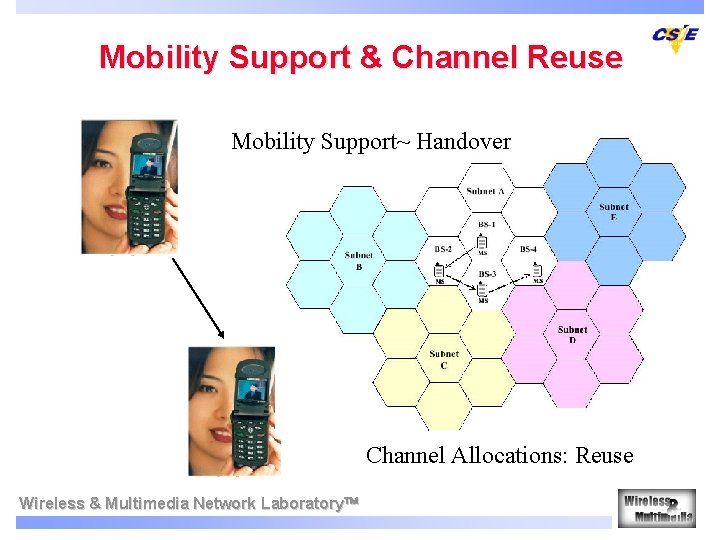
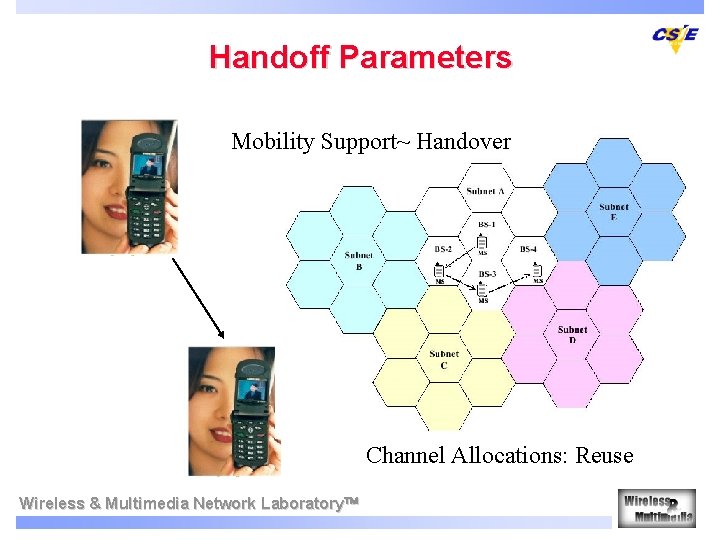
Mobility Support & Channel Reuse Mobility Support~ Handover Channel Allocations: Reuse Wireless & Multimedia Network Laboratory
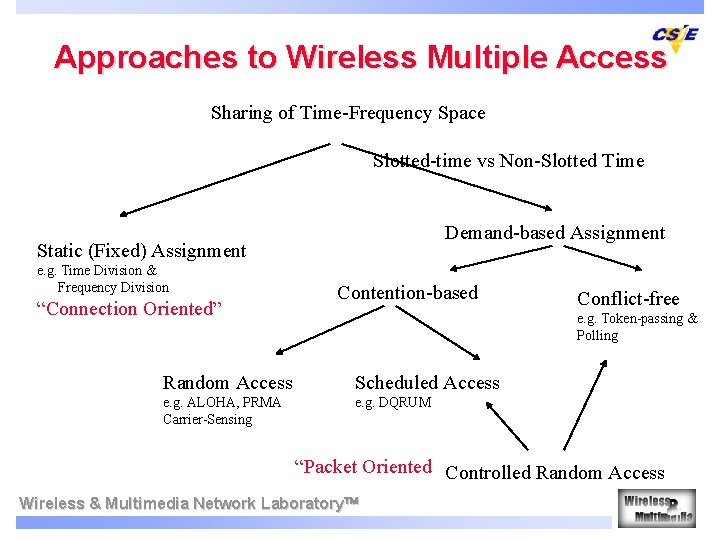
Approaches to Wireless Multiple Access Sharing of Time-Frequency Space Slotted-time vs Non-Slotted Time Demand-based Assignment Static (Fixed) Assignment e. g. Time Division & Frequency Division “Connection Oriented” Contention-based Conflict-free e. g. Token-passing & Polling Random Access Scheduled Access e. g. ALOHA, PRMA Carrier-Sensing e. g. DQRUM “Packet Oriented Controlled Random Access Wireless & Multimedia Network Laboratory
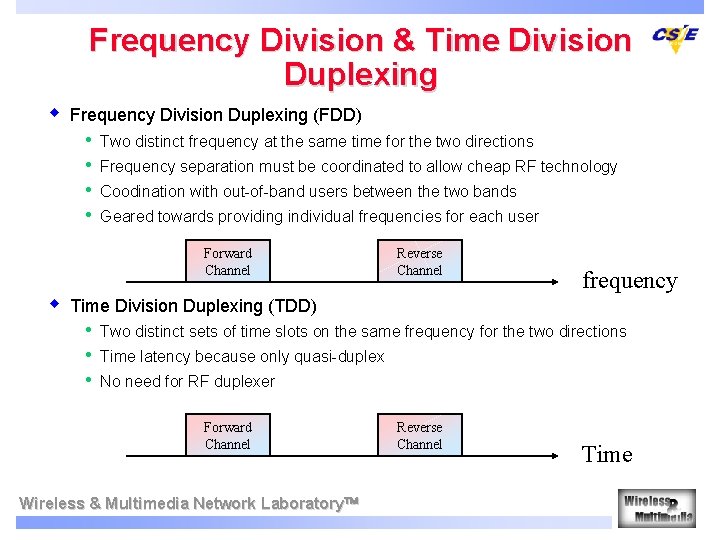
Frequency Division & Time Division Duplexing w Frequency Division Duplexing (FDD) • • Two distinct frequency at the same time for the two directions Frequency separation must be coordinated to allow cheap RF technology Coodination with out-of-band users between the two bands Geared towards providing individual frequencies for each user Forward Channel w Reverse Channel frequency Time Division Duplexing (TDD) • • • Two distinct sets of time slots on the same frequency for the two directions Time latency because only quasi-duplex No need for RF duplexer Forward Channel Wireless & Multimedia Network Laboratory Reverse Channel Time
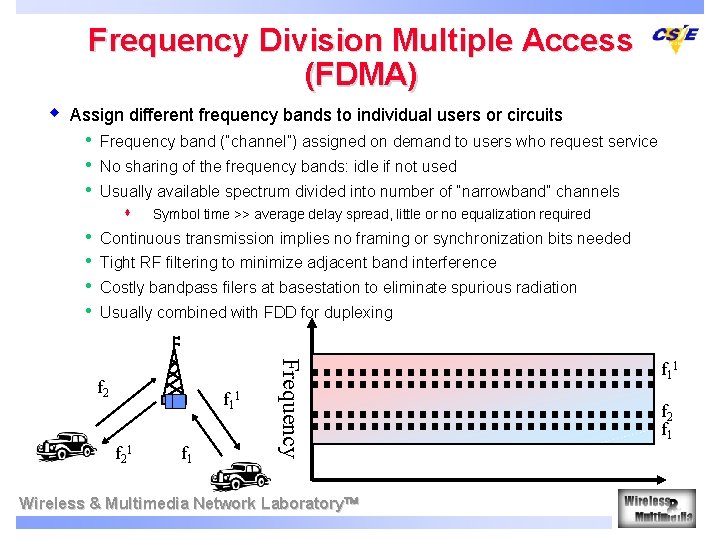
Frequency Division Multiple Access (FDMA) w Assign different frequency bands to individual users or circuits • • • Frequency band (“channel”) assigned on demand to users who request service No sharing of the frequency bands: idle if not used Usually available spectrum divided into number of “narrowband” channels s • • Symbol time >> average delay spread, little or no equalization required Continuous transmission implies no framing or synchronization bits needed Tight RF filtering to minimize adjacent band interference Costly bandpass filers at basestation to eliminate spurious radiation Usually combined with FDD for duplexing f 1 1 f 2 1 f 1 Frequency f 2 Wireless & Multimedia Network Laboratory f 1 1 f 2 f 1
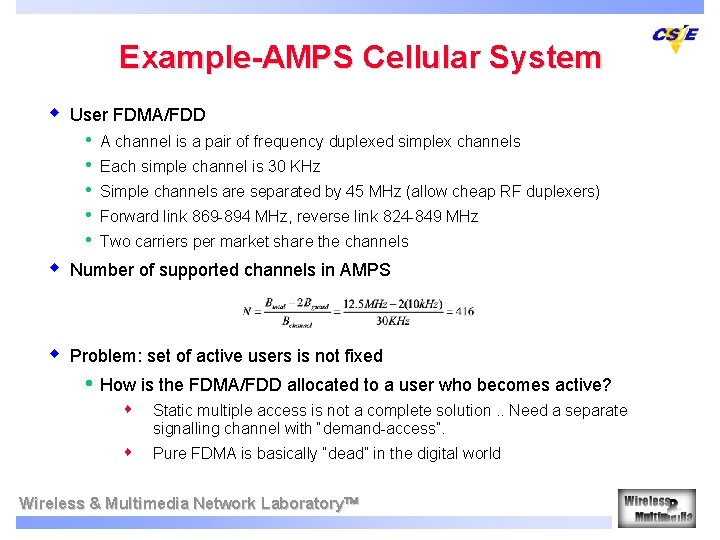
Example-AMPS Cellular System w User FDMA/FDD • • • A channel is a pair of frequency duplexed simplex channels Each simple channel is 30 KHz Simple channels are separated by 45 MHz (allow cheap RF duplexers) Forward link 869 -894 MHz, reverse link 824 -849 MHz Two carriers per market share the channels w Number of supported channels in AMPS w Problem: set of active users is not fixed • How is the FDMA/FDD allocated to a user who becomes active? s Static multiple access is not a complete solution. . Need a separate signalling channel with “demand-access”. s Pure FDMA is basically “dead” in the digital world Wireless & Multimedia Network Laboratory
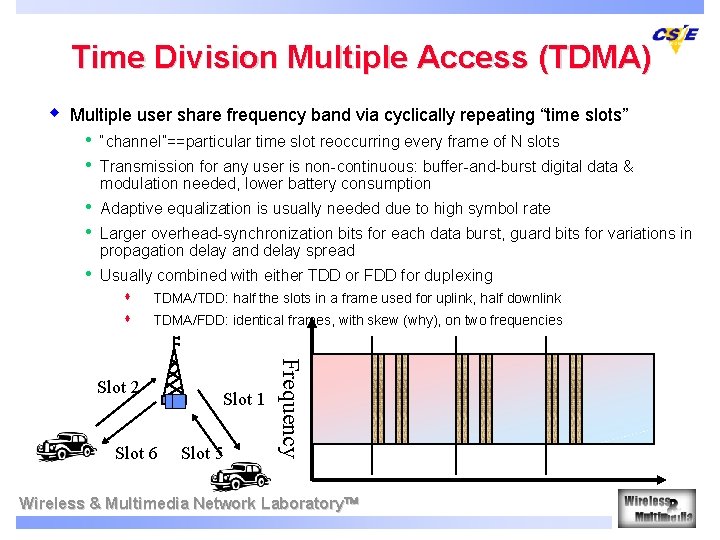
Time Division Multiple Access (TDMA) w Multiple user share frequency band via cyclically repeating “time slots” • • “channel”==particular time slot reoccurring every frame of N slots • • Adaptive equalization is usually needed due to high symbol rate • Usually combined with either TDD or FDD for duplexing Transmission for any user is non-continuous: buffer-and-burst digital data & modulation needed, lower battery consumption Larger overhead-synchronization bits for each data burst, guard bits for variations in propagation delay and delay spread s s TDMA/TDD: half the slots in a frame used for uplink, half downlink TDMA/FDD: identical frames, with skew (why), on two frequencies Slot 6 Slot 1 Slot 5 Frequency Slot 2 Wireless & Multimedia Network Laboratory
Wireless & Multimedia Network Laboratory
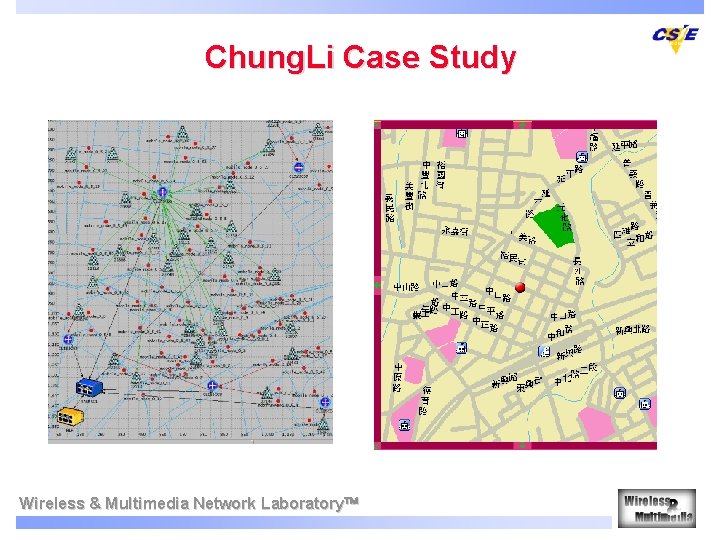
Chung. Li Case Study Wireless & Multimedia Network Laboratory
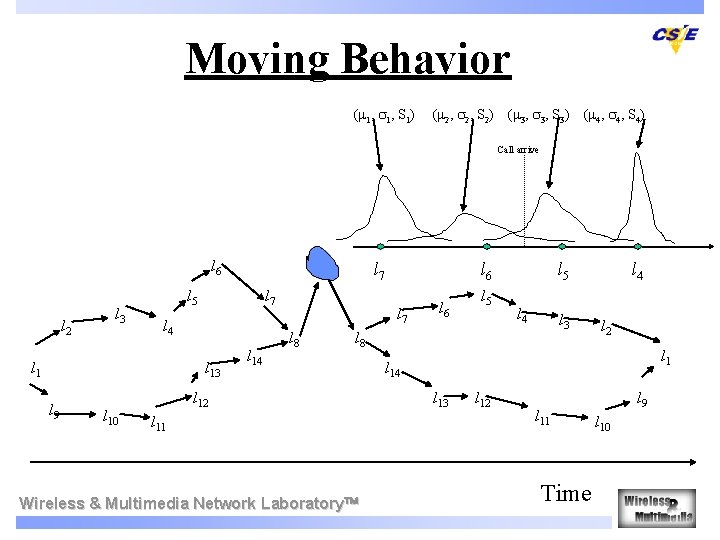
Moving Behavior ( 1, S 1) ( 2, S 2) ( 3, S 3) ( 4, S 4) Call arrive l 6 l 2 l 3 l 5 l 7 l 4 l 13 l 9 l 10 l 7 l 14 l 6 l 7 l 8 l 6 l 5 l 4 l 3 l 8 l 12 l 11 Wireless & Multimedia Network Laboratory l 4 l 2 l 14 l 13 l 12 l 11 Time l 9 l 10
Wireless & Multimedia Network Laboratory
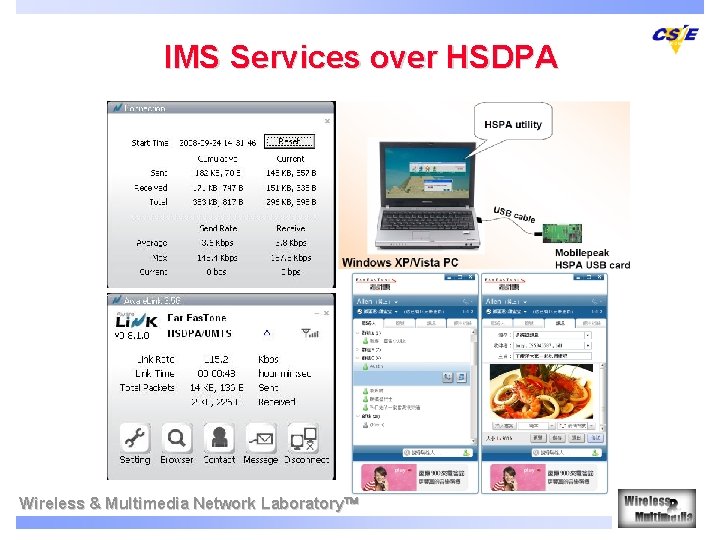
IMS Services over HSDPA Wireless & Multimedia Network Laboratory
Channel Assignment in Cellular System w Fundamental Problem: w Fixed Channel Assignment w Dynamic Channel Assignment w Hybrid Schemes w Whole Channel Usage (CDMA) w Reduce the Cell Size Wireless & Multimedia Network Laboratory
Hand-off in Cellular Networks w Transfer of mobile to a new channel when it crosses cell boundary w Handoff delay w Prioritizing handoffs to reduce probability of dropped calls w Handoff Strategies w Network Controlled handoff (NCHO) w Mobile assisted handoff (MAHO) w Mobile controlled handoff (MCHO) Wireless & Multimedia Network Laboratory
Agenda w Cellular Concepts w Channel Assignments w Handover w Next Lecture: 3 G WCDMA design Wireless & Multimedia Network Laboratory
Reading w [Katzela 96]Katzela, and M. Nahgshineh, ”Channel assignment schemes for cellular mobile telecommunication systems: a comprehensive survey, ” IEEE Personal Communications, June 1996 w [Pollinin 96], G. P. Pollini, “Trends in handover design, “IEEE Communications Magazine, March 1996. Wireless & Multimedia Network Laboratory
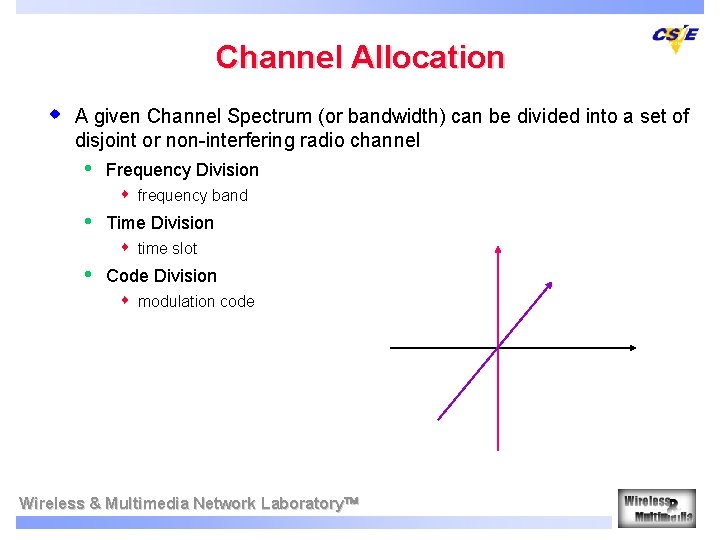
Channel Allocation w A given Channel Spectrum (or bandwidth) can be divided into a set of disjoint or non-interfering radio channel • Frequency Division s • Time Division s • frequency band time slot Code Division s modulation code Wireless & Multimedia Network Laboratory
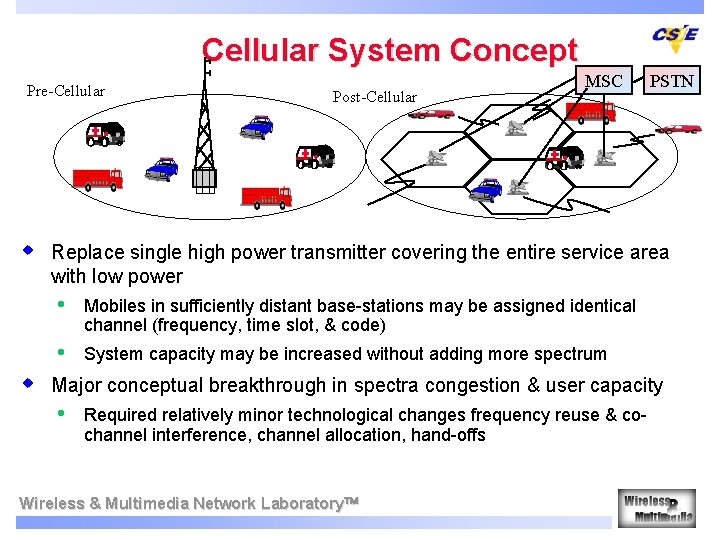
Cellular System Concept Pre-Cellular w w Post-Cellular MSC PSTN Replace single high power transmitter covering the entire service area with low power • Mobiles in sufficiently distant base-stations may be assigned identical channel (frequency, time slot, & code) • System capacity may be increased without adding more spectrum Major conceptual breakthrough in spectra congestion & user capacity • Required relatively minor technological changes frequency reuse & cochannel interference, channel allocation, hand-offs Wireless & Multimedia Network Laboratory
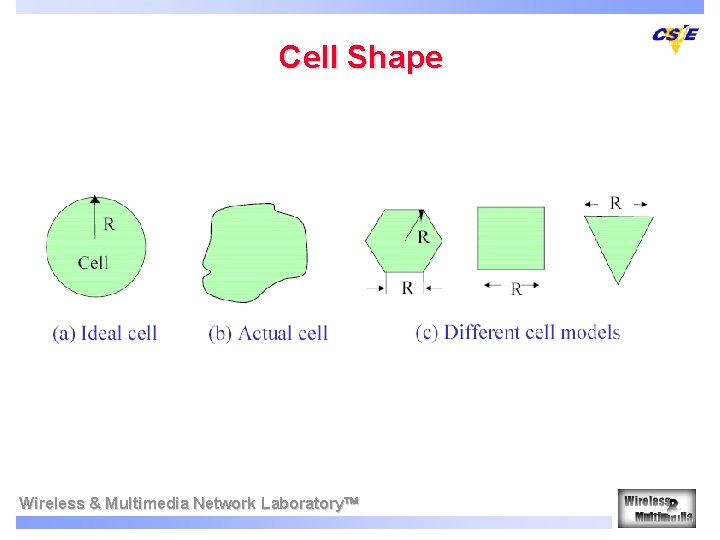
Cell Shape Wireless & Multimedia Network Laboratory
Wireless & Multimedia Network Laboratory
Wireless & Multimedia Network Laboratory
Wireless & Multimedia Network Laboratory
Wireless & Multimedia Network Laboratory
Wireless & Multimedia Network Laboratory
Wireless & Multimedia Network Laboratory
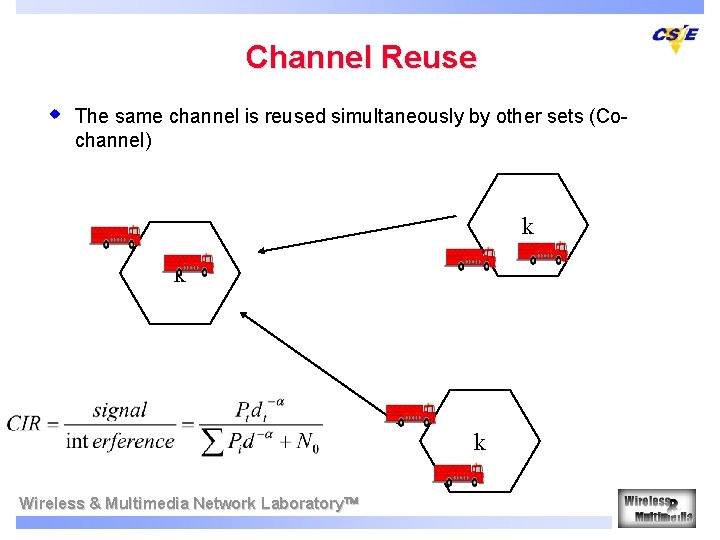
Channel Reuse w The same channel is reused simultaneously by other sets (Cochannel) k k k Wireless & Multimedia Network Laboratory
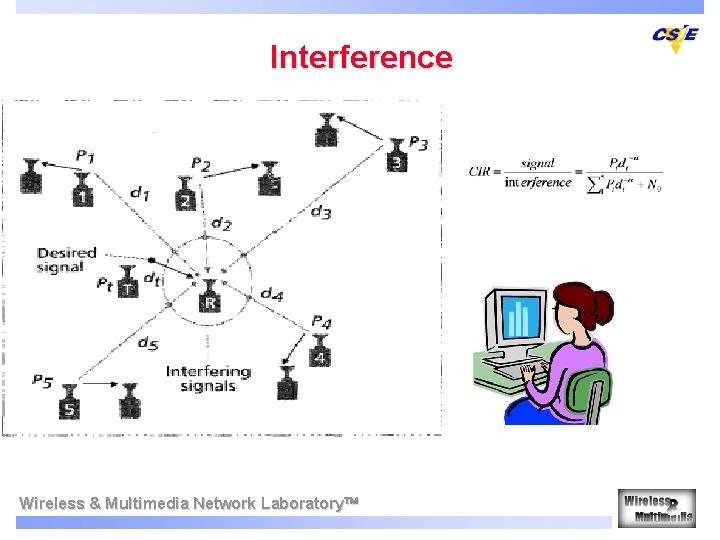
Interference Wireless & Multimedia Network Laboratory
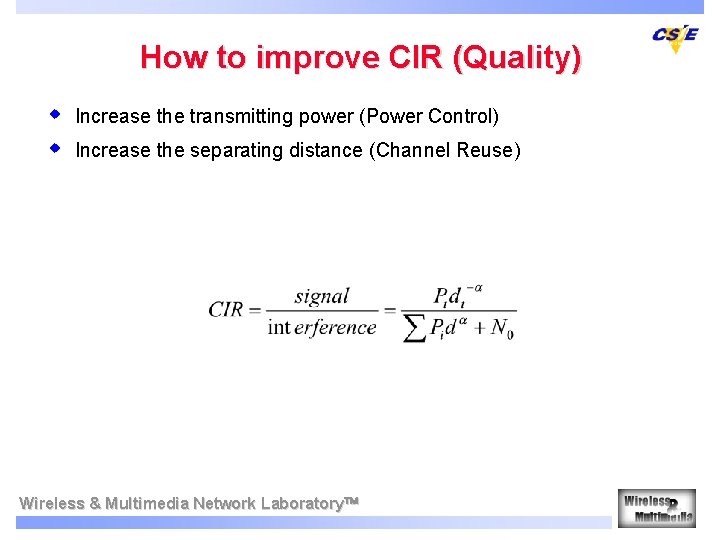
How to improve CIR (Quality) w w Increase the transmitting power (Power Control) Increase the separating distance (Channel Reuse) Wireless & Multimedia Network Laboratory
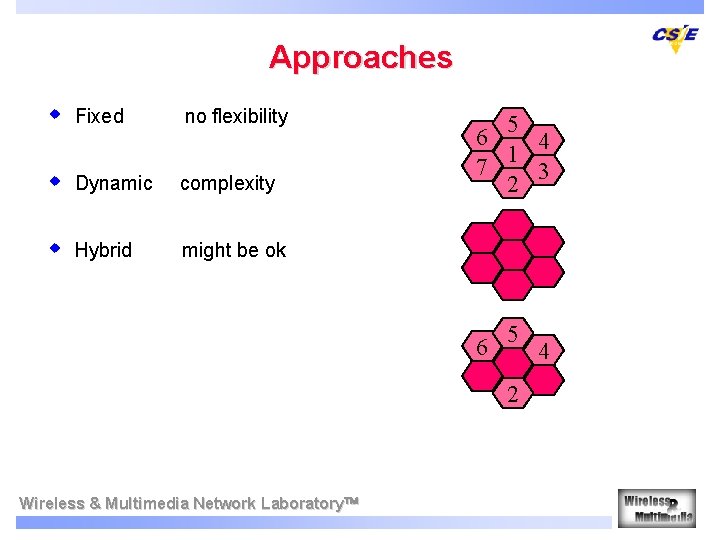
Approaches w Fixed no flexibility w Dynamic complexity w Hybrid might be ok 5 6 4 1 7 3 2 6 5 2 Wireless & Multimedia Network Laboratory 4
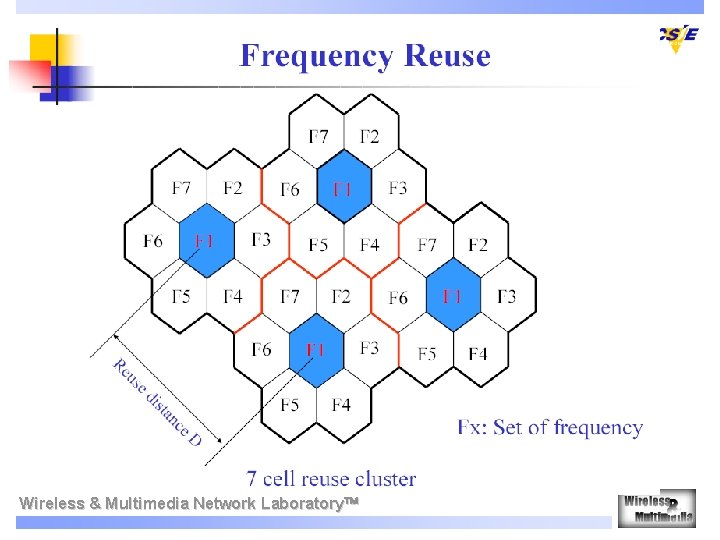
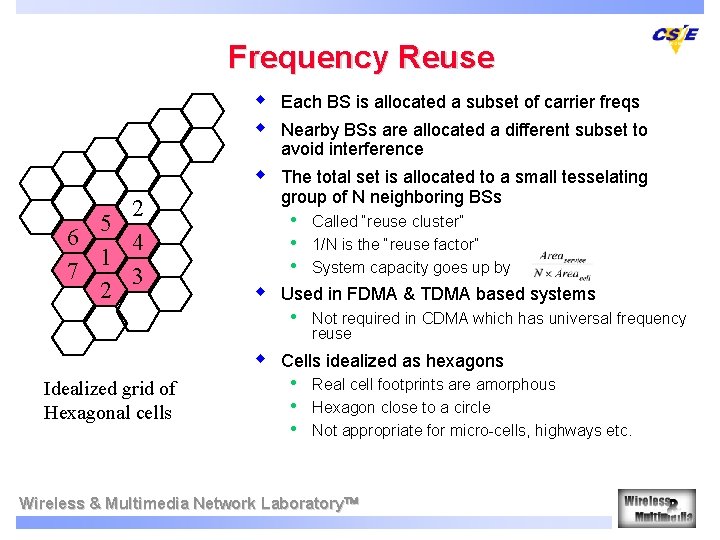
Frequency Reuse 2 5 6 4 1 7 3 2 w w Each BS is allocated a subset of carrier freqs w The total set is allocated to a small tesselating group of N neighboring BSs Nearby BSs are allocated a different subset to avoid interference • • • w Used in FDMA & TDMA based systems • w Idealized grid of Hexagonal cells Called “reuse cluster” 1/N is the “reuse factor” System capacity goes up by Not required in CDMA which has universal frequency reuse Cells idealized as hexagons • • • Real cell footprints are amorphous Hexagon close to a circle Not appropriate for micro-cells, highways etc. Wireless & Multimedia Network Laboratory
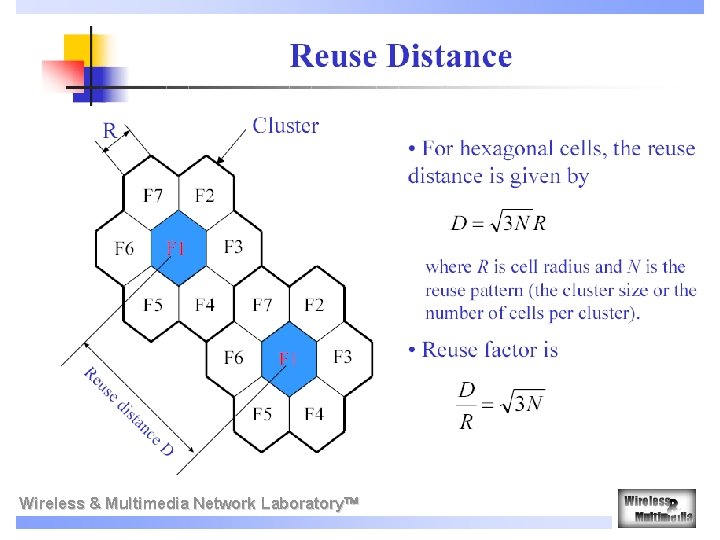
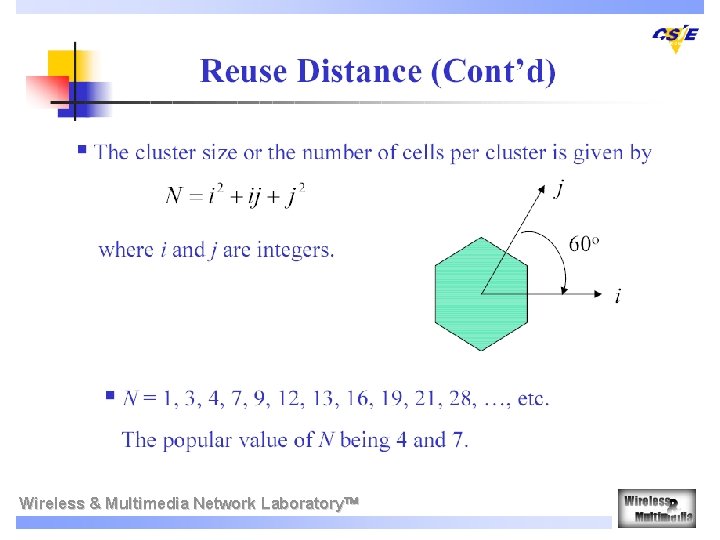
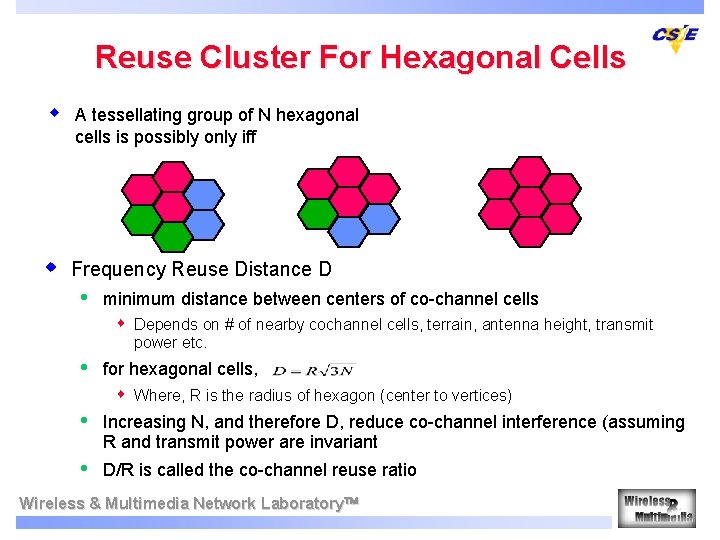
Reuse Cluster For Hexagonal Cells w A tessellating group of N hexagonal cells is possibly only iff w Frequency Reuse Distance D • minimum distance between centers of co-channel cells s • Depends on # of nearby cochannel cells, terrain, antenna height, transmit power etc. for hexagonal cells, s Where, R is the radius of hexagon (center to vertices) • Increasing N, and therefore D, reduce co-channel interference (assuming R and transmit power are invariant • D/R is called the co-channel reuse ratio Wireless & Multimedia Network Laboratory
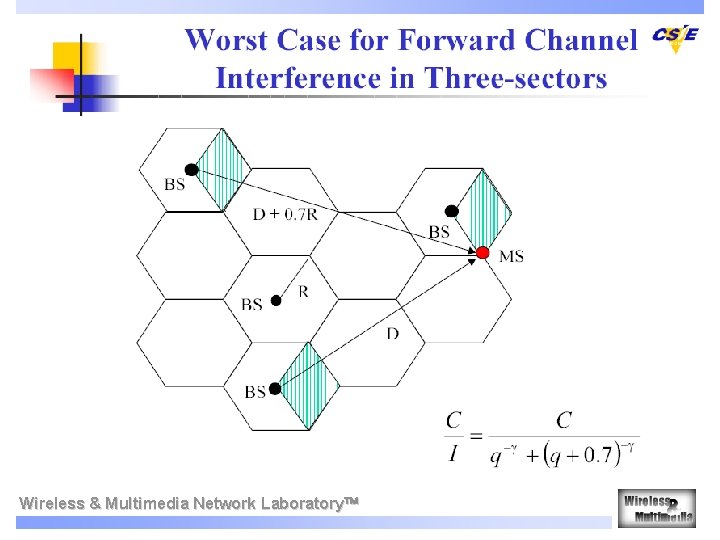
Determining Cluster Size w If N is reduced while cell area is kept constant • • w more cluster needed to cover the service area more channels per cell more system capacity achieved more co-channel interference co-channel cells are closer Goal is to maximize system capacity (or, capacity per unit area) subject to interference limitations • Minimum N such that carrier-to-interference ratio s • Reverse co-channel interference s • Interference at a BS from co-channel MHs in other BSs Forward co-channel interference s • C/I ≧(C/I)min Interference at a MH from other co-channel BSs Adjacent channel interference s s From signals in adjacent channel due to imperfect filters Don’t assign adjacent frequencies to the same cell and if possible immediate neighbors Wireless & Multimedia Network Laboratory
Determining Cluster Size N w Goal is maximize system capacity (or, capacity per unit area) subject to interference limitations • minimum N such that carrier-to-interference ratio s • reverse co-channel interference s • interference at BS from co-channel MHs in other BSs forward co-channel interference s • C/I >= (C/I)min interference at a MH from other co-channel BSs adjacent channel interference s from signals in adjacent channels due to imperfect filters Wireless & Multimedia Network Laboratory
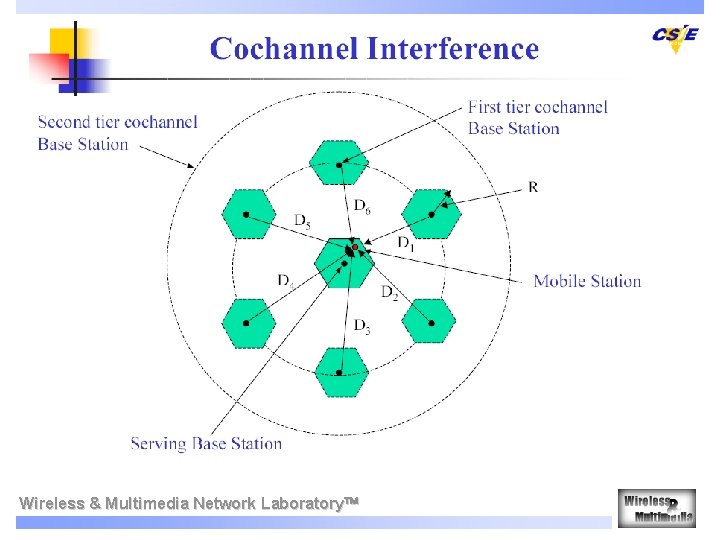
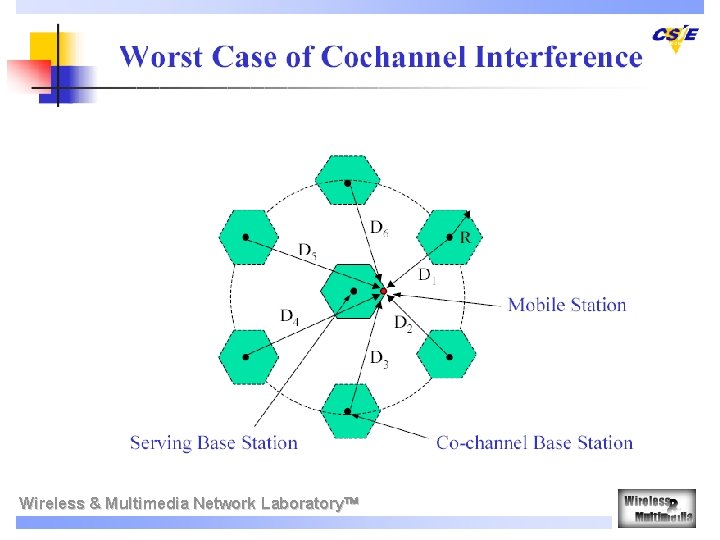
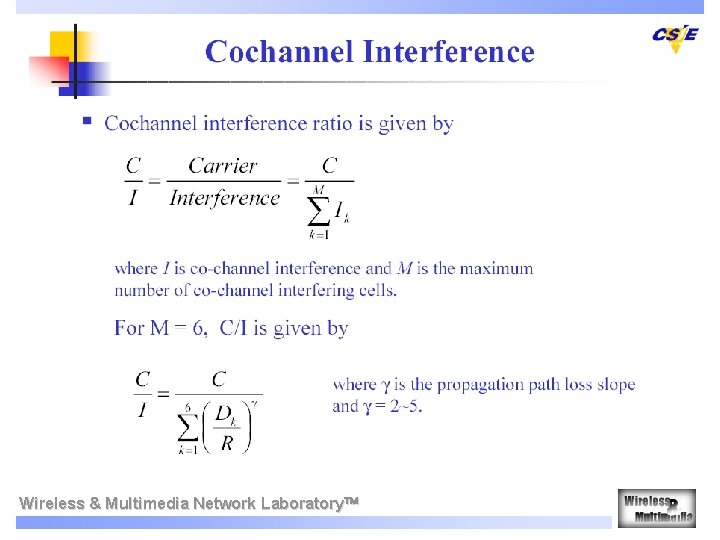
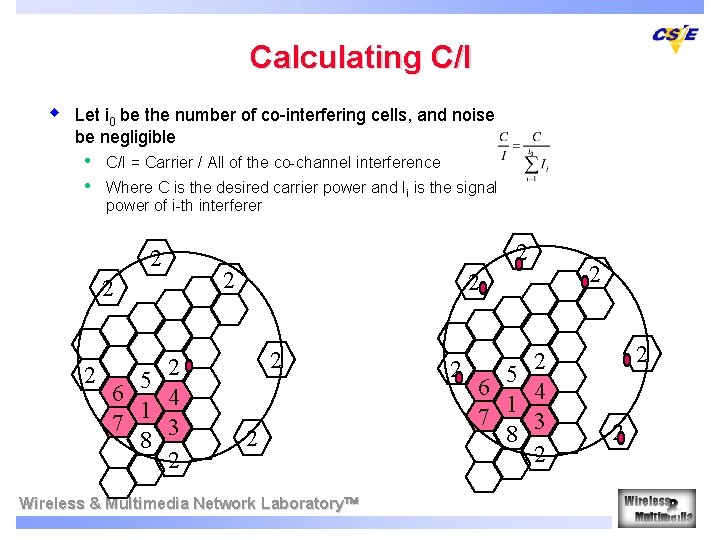
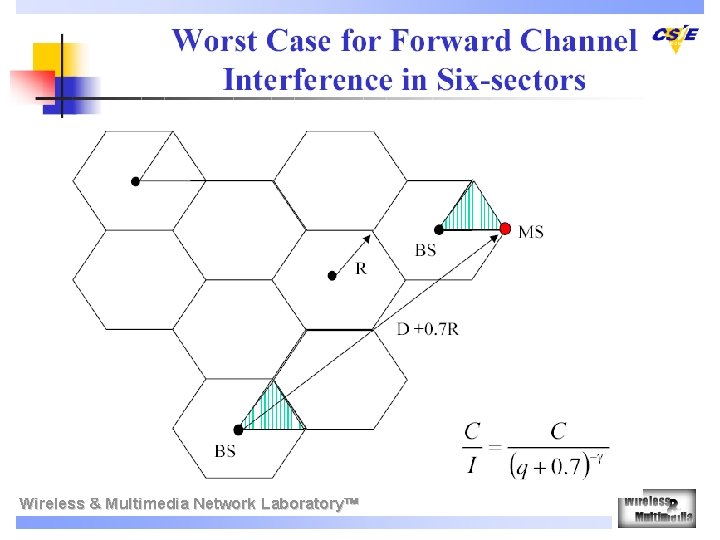
Calculating C/I w Let i 0 be the number of co-interfering cells, and noise be negligible • • C/I = Carrier / All of the co-channel interference Where C is the desired carrier power and Ii is the signal power of i-th interferer 2 2 5 6 4 1 7 3 8 2 2 2 Wireless & Multimedia Network Laboratory 2 2 5 6 4 1 7 3 8 2 2
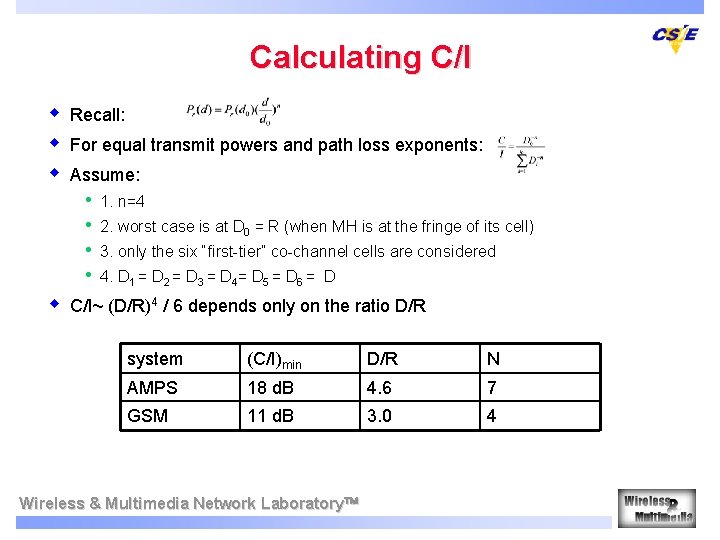
Calculating C/I w w w Recall: For equal transmit powers and path loss exponents: Assume: • • w 1. n=4 2. worst case is at D 0 = R (when MH is at the fringe of its cell) 3. only the six “first-tier” co-channel cells are considered 4. D 1 = D 2 = D 3 = D 4= D 5 = D 6 = D C/I~ (D/R)4 / 6 depends only on the ratio D/R system (C/I)min D/R N AMPS 18 d. B 4. 6 7 GSM 11 d. B 3. 0 4 Wireless & Multimedia Network Laboratory
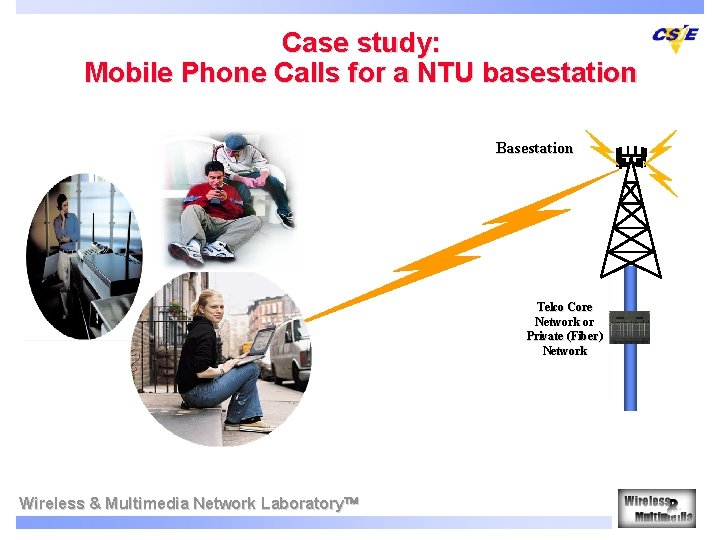
Case study: Mobile Phone Calls for a NTU basestation Basestation Telco Core Network or Private (Fiber) Network Wireless & Multimedia Network Laboratory
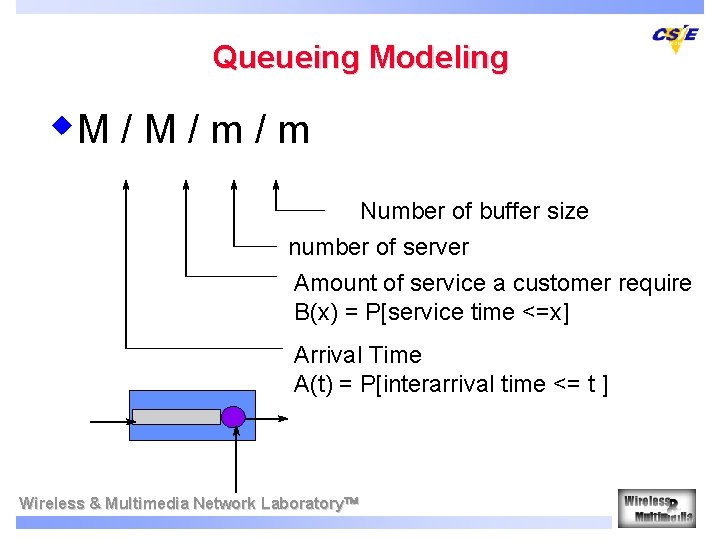
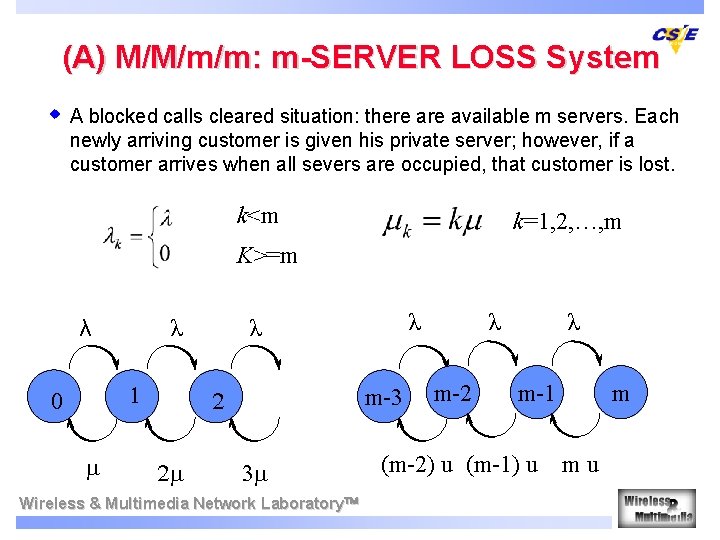
Queueing Modeling w. M / m / m Number of buffer size number of server Amount of service a customer require B(x) = P[service time <=x] Arrival Time A(t) = P[interarrival time <= t ] Wireless & Multimedia Network Laboratory
(A) M/M/m/m: m-SERVER LOSS System w A blocked calls cleared situation: there available m servers. Each newly arriving customer is given his private server; however, if a customer arrives when all severs are occupied, that customer is lost. k<m k=1, 2, …, m K>=m λ λ 1 0 m-3 2 2 λ λ 3 Wireless & Multimedia Network Laboratory λ m-2 λ m-1 (m-2) u (m-1) u m
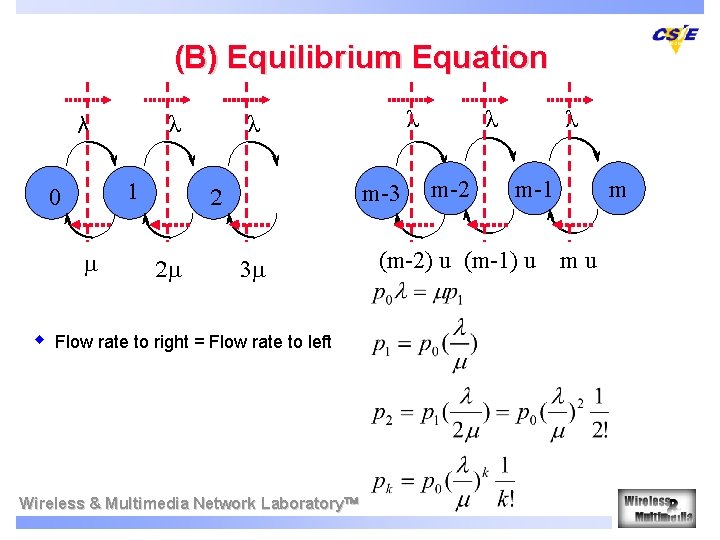
(B) Equilibrium Equation λ 1 0 w λ m-3 2 2 λ λ 3 Flow rate to right = Flow rate to left Wireless & Multimedia Network Laboratory λ m-2 λ m-1 (m-2) u (m-1) u m
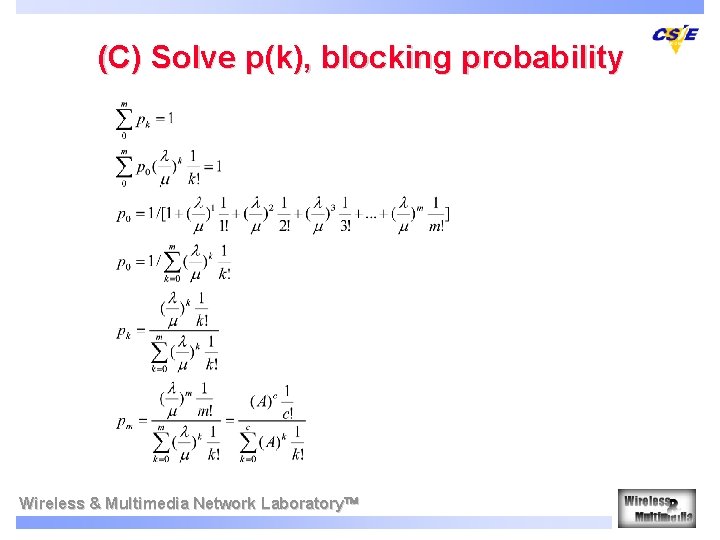
(C) Solve p(k), blocking probability Wireless & Multimedia Network Laboratory
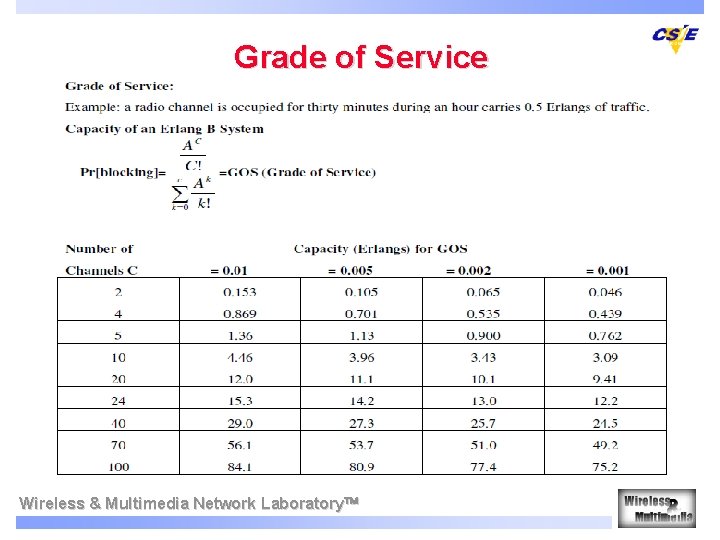
Grade of Service Wireless & Multimedia Network Laboratory
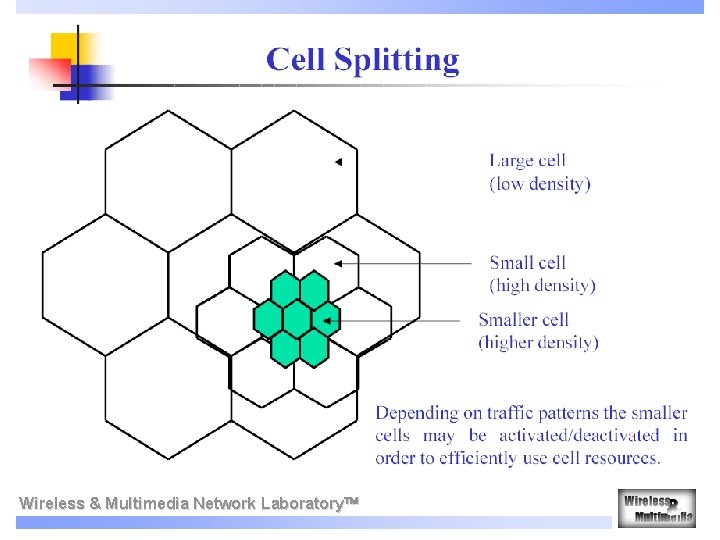
Microcells-Reducing Cell Area w IF cell area is reduced while N is kept constant • • • w C/I is unchanged because D/R is unchanged system capacity grows with radius scale factor Small cells need lower RF transmitted power • w more clusters needed to cover the service area longer battery, smaller mobile end-points Small cells result in higher cell-boundary crossing • • more signaling overhead performance degradation (more disruption) Wireless & Multimedia Network Laboratory
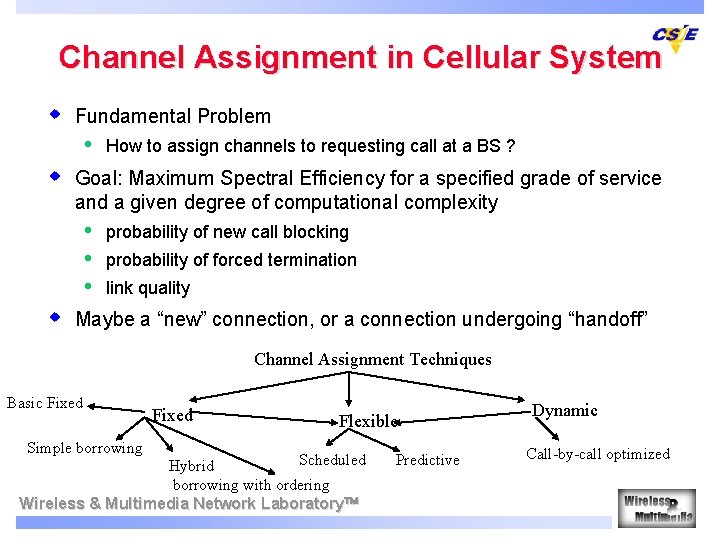
Channel Assignment in Cellular System w Fundamental Problem • w Goal: Maximum Spectral Efficiency for a specified grade of service and a given degree of computational complexity • • • w How to assign channels to requesting call at a BS ? probability of new call blocking probability of forced termination link quality Maybe a “new” connection, or a connection undergoing “handoff” Channel Assignment Techniques Basic Fixed Simple borrowing Fixed Flexible Scheduled Hybrid borrowing with ordering Wireless & Multimedia Network Laboratory Predictive Dynamic Call-by-call optimized
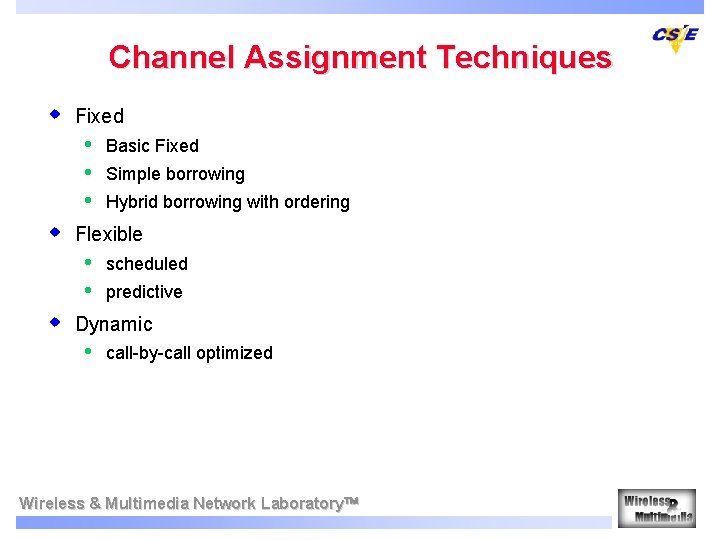
Channel Assignment Techniques w Fixed • • • w Simple borrowing Hybrid borrowing with ordering Flexible • • w Basic Fixed scheduled predictive Dynamic • call-by-call optimized Wireless & Multimedia Network Laboratory
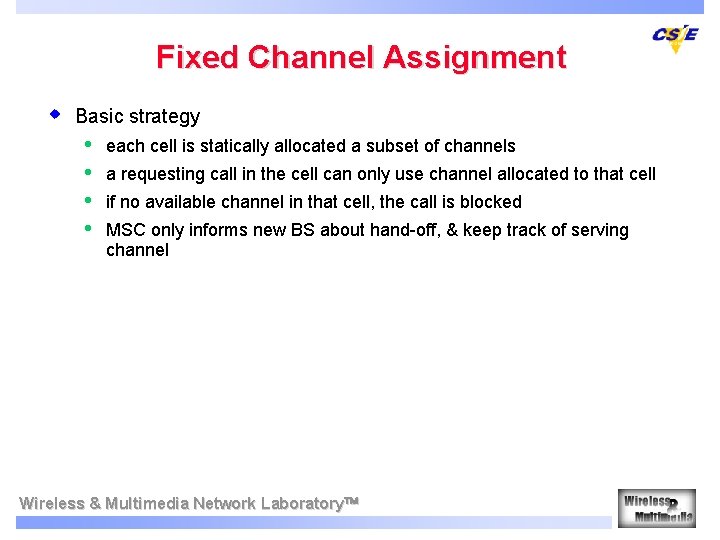
Fixed Channel Assignment w Basic strategy • • each cell is statically allocated a subset of channels a requesting call in the cell can only use channel allocated to that cell if no available channel in that cell, the call is blocked MSC only informs new BS about hand-off, & keep track of serving channel Wireless & Multimedia Network Laboratory
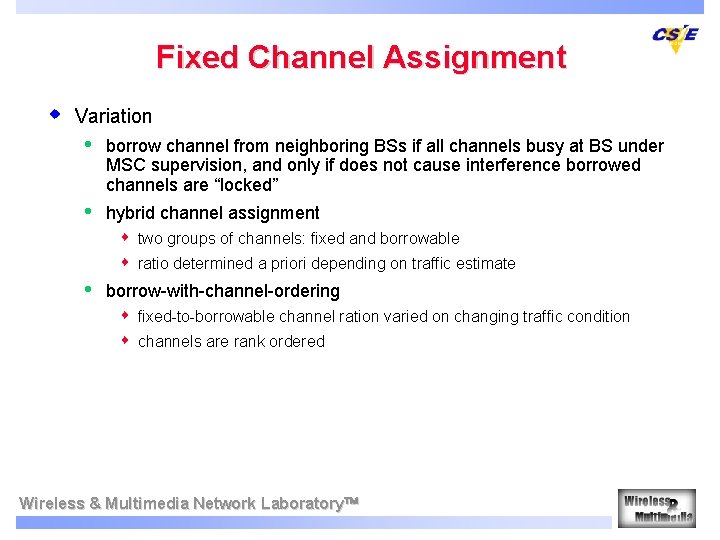
Fixed Channel Assignment w Variation • borrow channel from neighboring BSs if all channels busy at BS under MSC supervision, and only if does not cause interference borrowed channels are “locked” • hybrid channel assignment s s • two groups of channels: fixed and borrowable ratio determined a priori depending on traffic estimate borrow-with-channel-ordering s s fixed-to-borrowable channel ration varied on changing traffic condition channels are rank ordered Wireless & Multimedia Network Laboratory
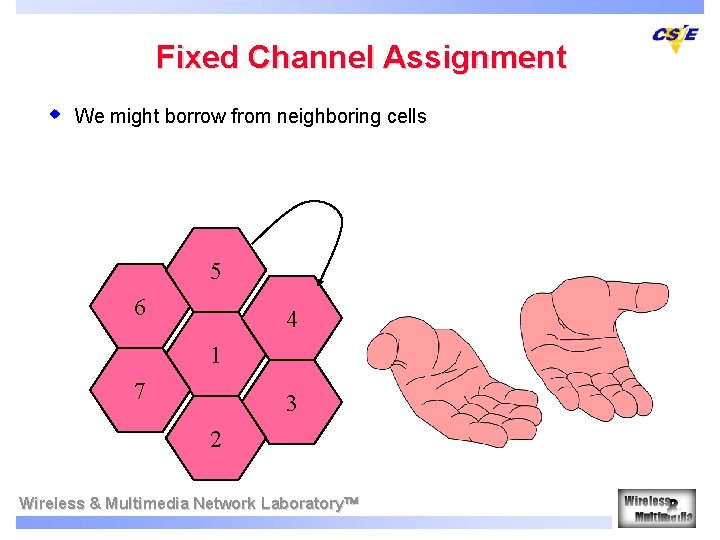
Fixed Channel Assignment w We might borrow from neighboring cells 5 6 4 1 7 3 2 Wireless & Multimedia Network Laboratory
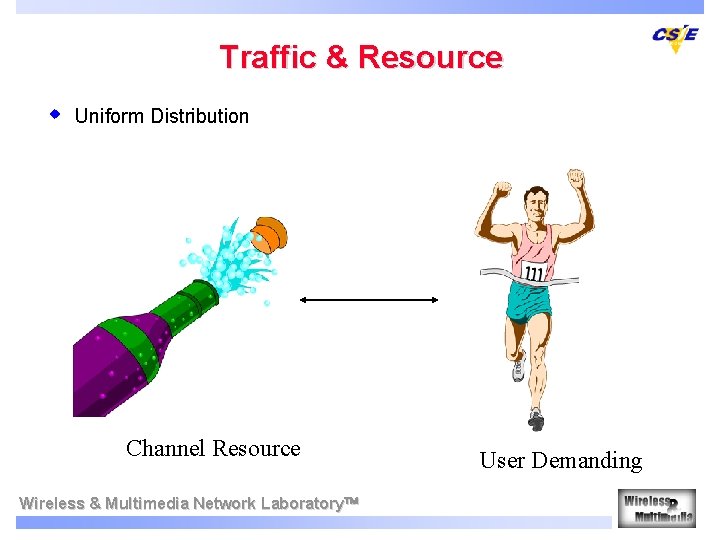
Traffic & Resource w Uniform Distribution Channel Resource Wireless & Multimedia Network Laboratory User Demanding
Dynamic & Assignment w Maybe I should assign you based on current condition Wireless & Multimedia Network Laboratory
Issues to consider w w w Selected Cost Blocking Probability Reuse Distance CIR Qo. S (Quality of Service) • • Wireless & Multimedia Network Laboratory current value handoff value
Dynamic Channel Assignment (DCA) w Basic Features • • channels not allocated to cells permanently MSC allocated channel to a call from the global pool taking into account Advantage: channel assignment may be retained across hand-off Disadvantage: interruptions, deadlocks, instability Wireless & Multimedia Network Laboratory
Dynamic Channel Assignment w DCA algorithms differ in distribution of control among BSs and MSC • Centralized DCA s • can do a globally optimized channel assignment and call rearrangement BSs need to communicate with MSC e. g. Maximum Packing Decentralized & Fully Decentralized DCA s s rely on local monitoring to make channel assignments require limited local communication among cluster of BSs Wireless & Multimedia Network Laboratory
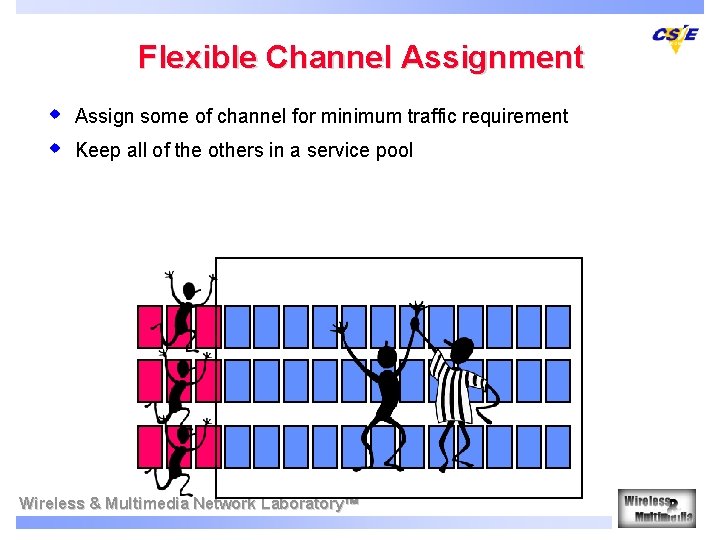
Flexible Channel Assignment w w w Combine aspects of FCA and DCA Each cell is assigned a fixed set of channel Plus, a pool of channels is reserved for flexible assignment • w MSC assigns these channels Flexible assignment strategies • Scheduled assignment: rely on known foreseeable changes in traffic pattern • Predictive assignment: based on measured traffic load at every BS Wireless & Multimedia Network Laboratory
MSC will pick up one for MH w Here you go ! Wireless & Multimedia Network Laboratory
Flexible Channel Assignment w w Assign some of channel for minimum traffic requirement Keep all of the others in a service pool Wireless & Multimedia Network Laboratory
Handoff Handling Keep the Qo. S while the user moves Wireless & Multimedia Network Laboratory
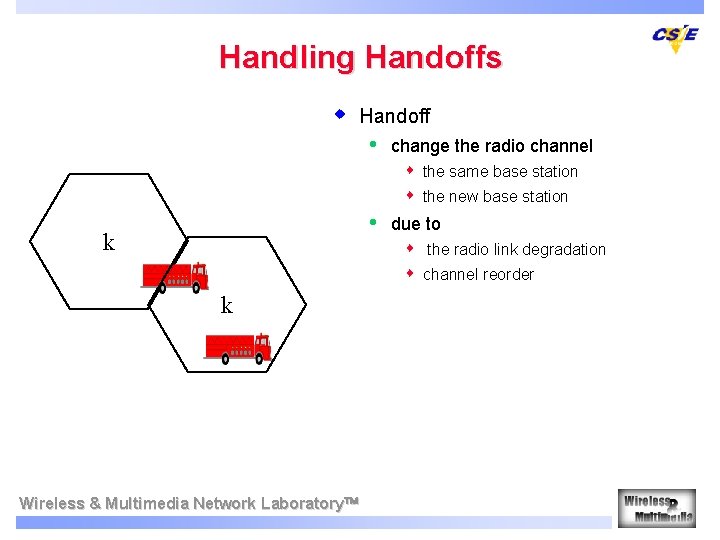
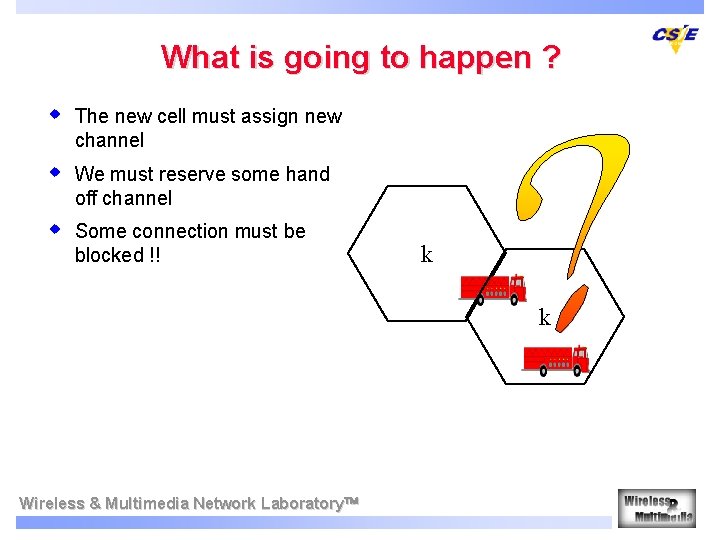
Handling Handoffs w Handoff • change the radio channel s s • k Wireless & Multimedia Network Laboratory the new base station due to s s k the same base station the radio link degradation channel reorder
What is going to happen ? w The new cell must assign new channel w We must reserve some hand off channel w Some connection must be blocked !! k k Wireless & Multimedia Network Laboratory
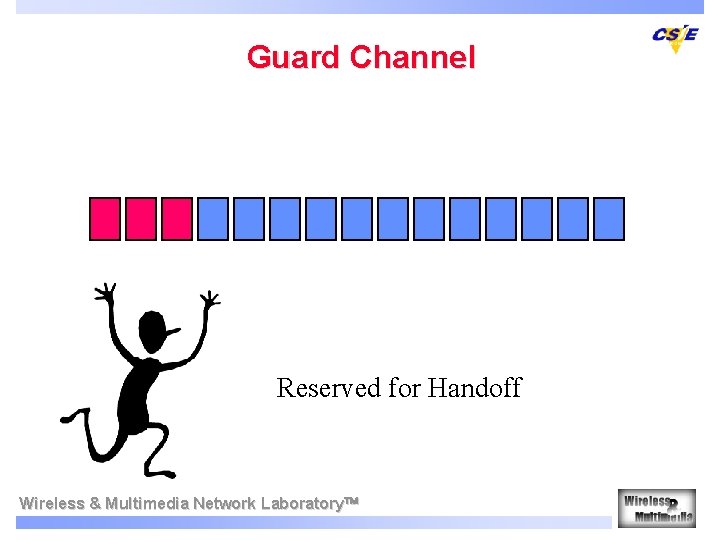
Solutions for handoff w Handoff Priority • • w guard channel for handoff how much, inefficiency Queueing of Handoff request • take a seat for future handoff Wireless & Multimedia Network Laboratory
Guard Channel Reserved for Handoff Wireless & Multimedia Network Laboratory
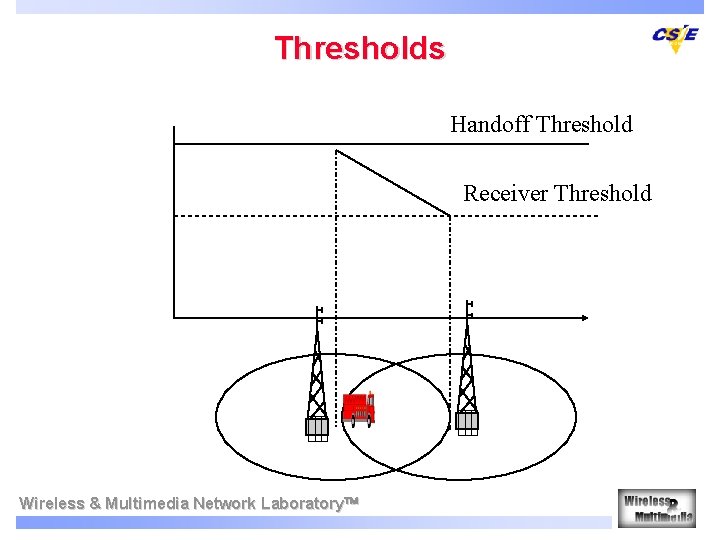
Thresholds Handoff Threshold Receiver Threshold Wireless & Multimedia Network Laboratory
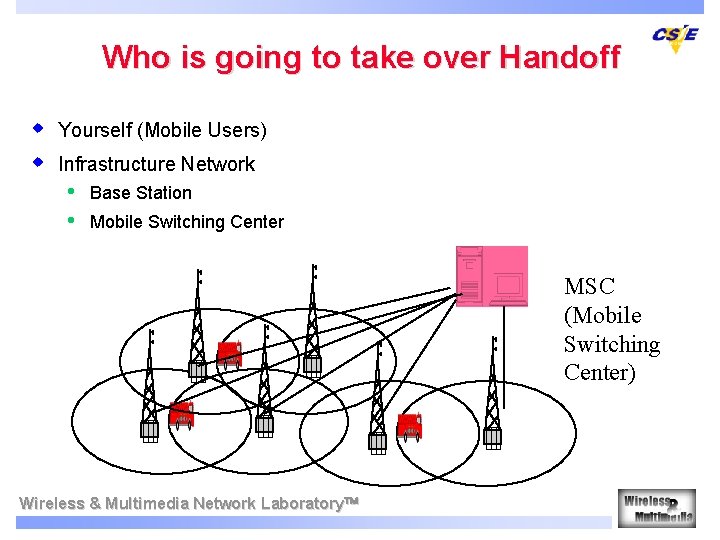
Who is going to take over Handoff w w Yourself (Mobile Users) Infrastructure Network • • Base Station Mobile Switching Center MSC (Mobile Switching Center) Wireless & Multimedia Network Laboratory
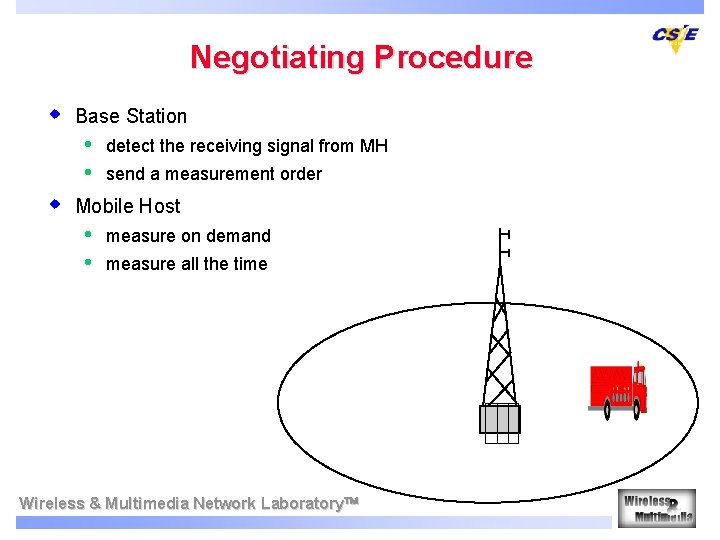
Negotiating Procedure w Base Station • • w detect the receiving signal from MH send a measurement order Mobile Host • • measure on demand measure all the time Wireless & Multimedia Network Laboratory
Hand off Procedure w Decide the New Base Station • • w MSC picks the best for MH MSC picks the candidate MH specify New Base Station decides to accept or not ? Wireless & Multimedia Network Laboratory
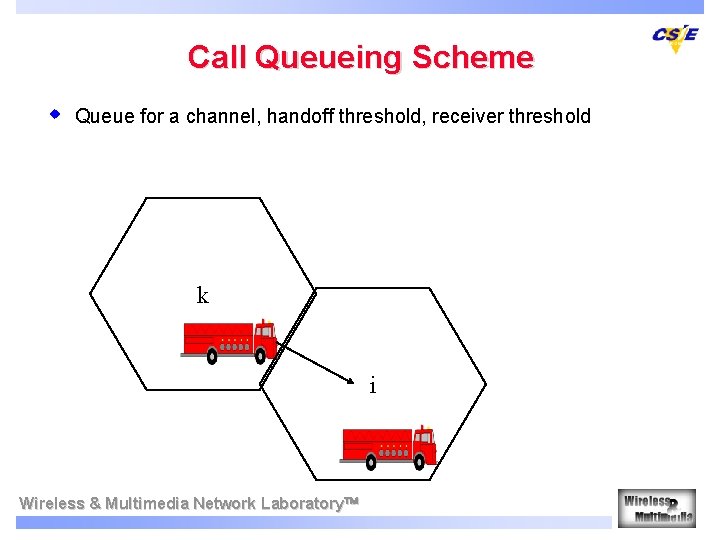
Call Queueing Scheme w Queue for a channel, handoff threshold, receiver threshold k i Wireless & Multimedia Network Laboratory
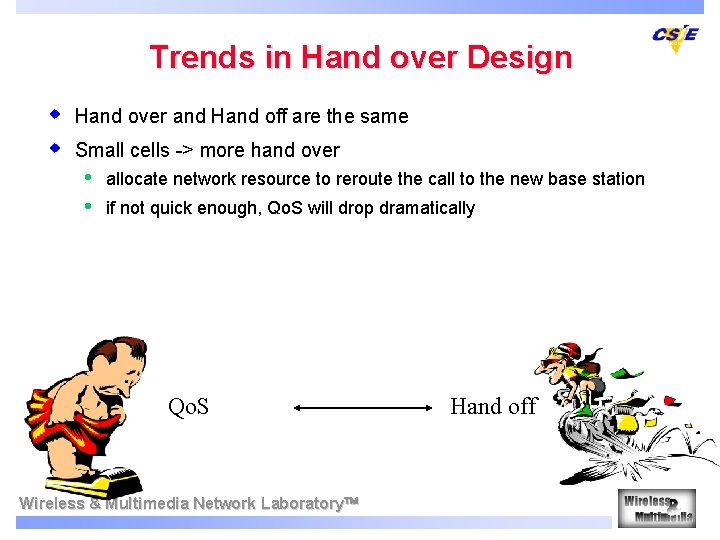
Trends in Hand over Design w w Hand over and Hand off are the same Small cells -> more hand over • • allocate network resource to reroute the call to the new base station if not quick enough, Qo. S will drop dramatically Qo. S Wireless & Multimedia Network Laboratory Hand off
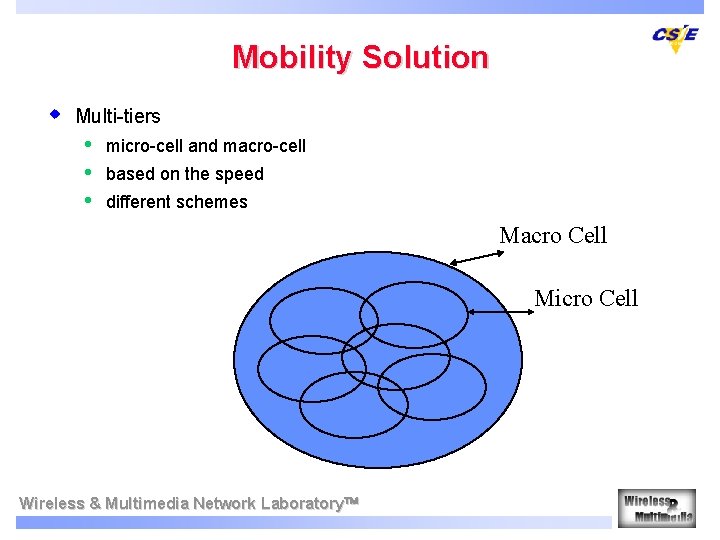
Mobility Solution w Multi-tiers • • • micro-cell and macro-cell based on the speed different schemes Macro Cell Micro Cell Wireless & Multimedia Network Laboratory
Velocity Estimation w Doppler Frequency is known -> Estimation of the velocity of the mobile users w Mobility is estimated from the time spent in a cell Wireless & Multimedia Network Laboratory
Handoff in Cellular Networks w Transfer of mobile to a new channel when it crosses cell boundary • • • identify new base station, assign new channel hand-off initiated at a carefully chosen signal level avoid triggering handoff due to momentary fades Wireless & Multimedia Network Laboratory
Hand-off w w Handoff delay & interruption • dropped (or on hold) connection if signal too low before handoff processed • performance degradation (disruption) in data stream Prioritizing handoffs to reduce probability of dropped call • • connection dropped if no spare channels in new cell • handoff queuing : time interval between handoff trigger & connection drop cell overlap, speed of mobile guard channel : subset of channels reserved for handoff requests works well with DCA Wireless & Multimedia Network Laboratory
Handoff in Cellular Networks w w w Probability of unnecessary Handoffs Hard vs. Soft handoff Hand off rate Handoff also triggers rerouting in the network layer Handoff is tightly coupled to DCA, MAC, and Networking Routing Wireless & Multimedia Network Laboratory
Handoff Strategies (I) w Network controlled handoff (NCHO) • • used in first generation analog cellular systems link quality is only monitored by the serving BS and surrounding BS handoff decision is made by the network (typically central agent) handoff delays of several seconds (10) and infrequent link quality updates Wireless & Multimedia Network Laboratory
Handoff Strategies (II) w Mobile assisted handoff • • • used in second generation digital cellular system both the mobile and the serving BS measure link quality only mobile measures link quality of alternate BSs mobile periodically sends the link quality measurements to serving BS handoff decision is made by the network handoff delays of few seconds (1 -2) and frequent link quality updates Wireless & Multimedia Network Laboratory
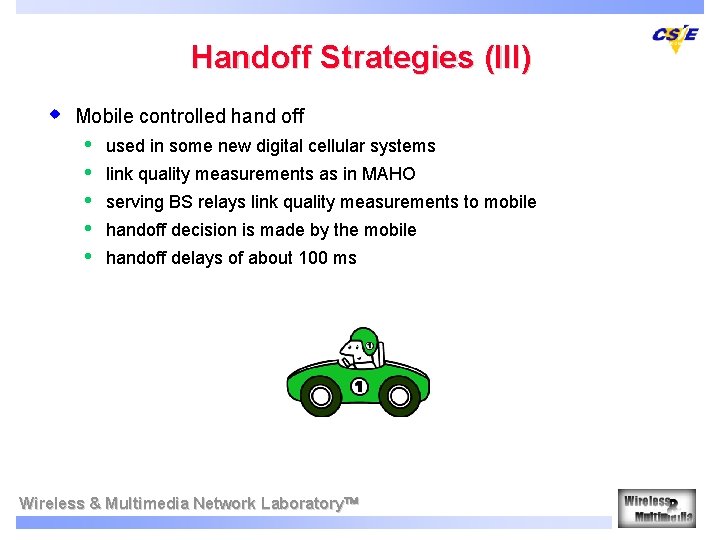
Handoff Strategies (III) w Mobile controlled hand off • • • used in some new digital cellular systems link quality measurements as in MAHO serving BS relays link quality measurements to mobile handoff decision is made by the mobile handoff delays of about 100 ms Wireless & Multimedia Network Laboratory
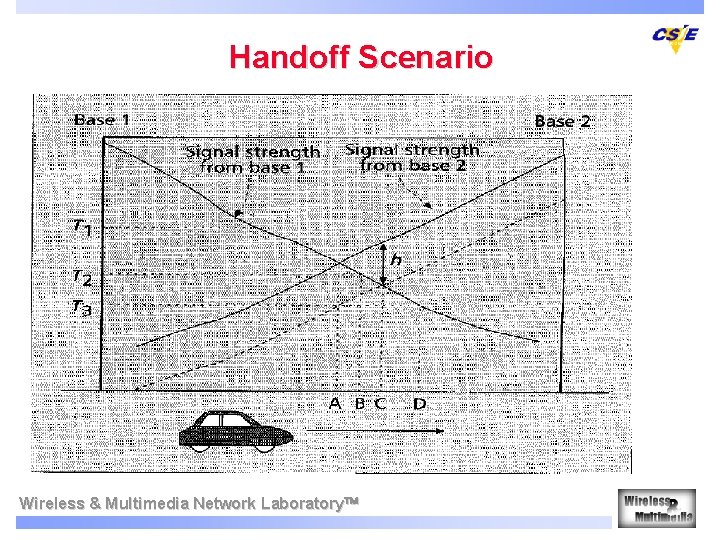
Handoff Scenario Wireless & Multimedia Network Laboratory
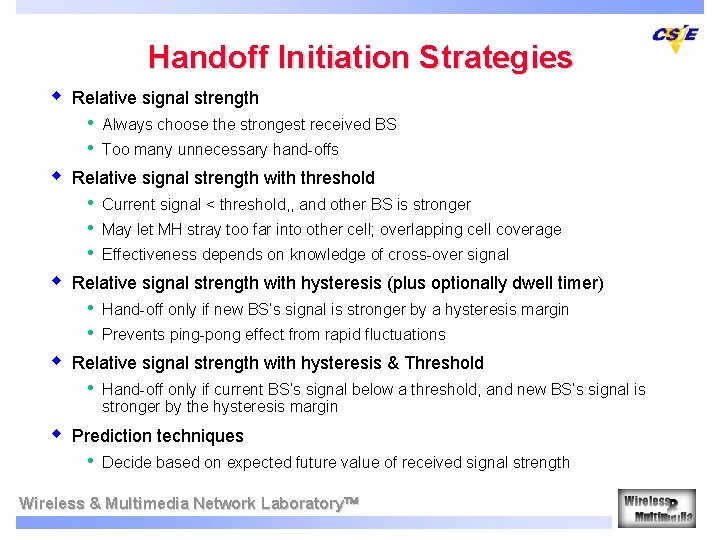
Handoff Initiation Strategies w Relative signal strength • • w May let MH stray too far into other cell; overlapping cell coverage Effectiveness depends on knowledge of cross-over signal Hand-off only if new BS’s signal is stronger by a hysteresis margin Prevents ping-pong effect from rapid fluctuations Relative signal strength with hysteresis & Threshold • w Current signal < threshold, , and other BS is stronger Relative signal strength with hysteresis (plus optionally dwell timer) • • w Too many unnecessary hand-offs Relative signal strength with threshold • • • w Always choose the strongest received BS Hand-off only if current BS’s signal below a threshold, and new BS’s signal is stronger by the hysteresis margin Prediction techniques • Decide based on expected future value of received signal strength Wireless & Multimedia Network Laboratory
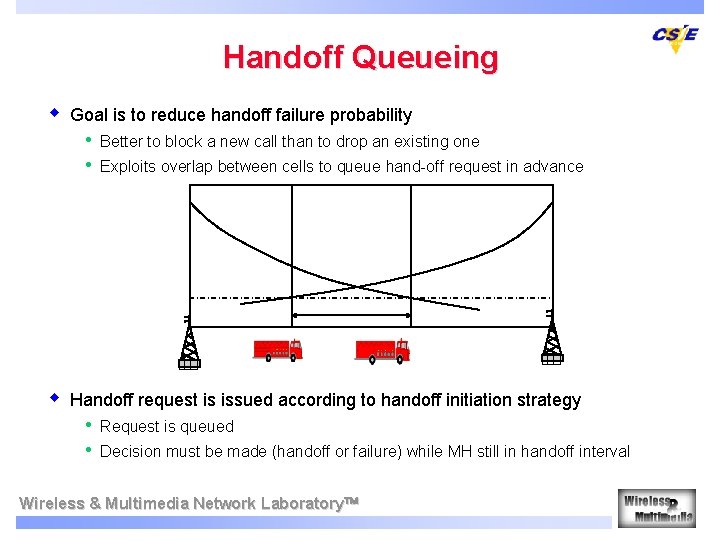
Handoff Queueing w Goal is to reduce handoff failure probability • • w Better to block a new call than to drop an existing one Exploits overlap between cells to queue hand-off request in advance Handoff request is issued according to handoff initiation strategy • • Request is queued Decision must be made (handoff or failure) while MH still in handoff interval Wireless & Multimedia Network Laboratory
Wireless & Multimedia Network Laboratory
Wireless & Multimedia Network Laboratory
Wireless & Multimedia Network Laboratory
Wireless & Multimedia Network Laboratory
Wireless & Multimedia Network Laboratory
Handoff Parameters Mobility Support~ Handover Channel Allocations: Reuse Wireless & Multimedia Network Laboratory
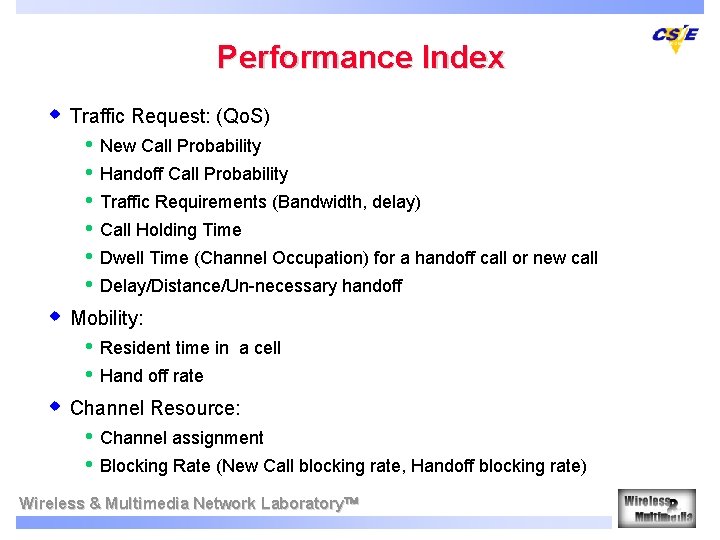
Performance Index w Traffic Request: (Qo. S) • • • New Call Probability Handoff Call Probability Traffic Requirements (Bandwidth, delay) Call Holding Time Dwell Time (Channel Occupation) for a handoff call or new call Delay/Distance/Un-necessary handoff w Mobility: • • Resident time in a cell Hand off rate w Channel Resource: • • Channel assignment Blocking Rate (New Call blocking rate, Handoff blocking rate) Wireless & Multimedia Network Laboratory
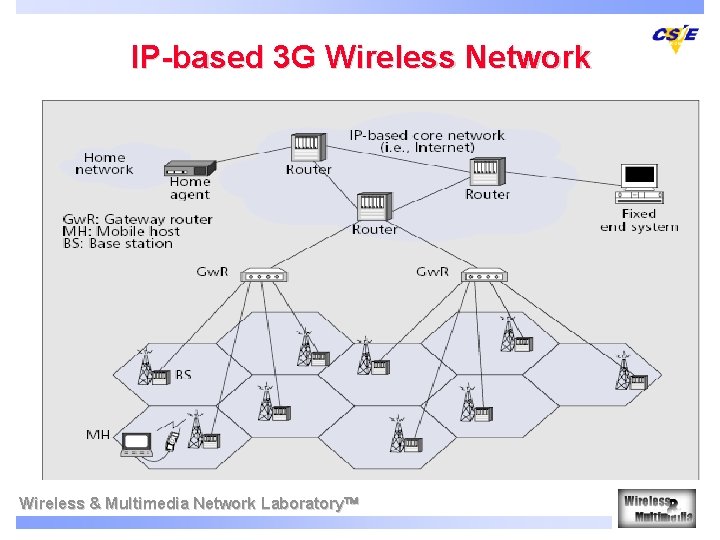
IP-based 3 G Wireless Network Wireless & Multimedia Network Laboratory
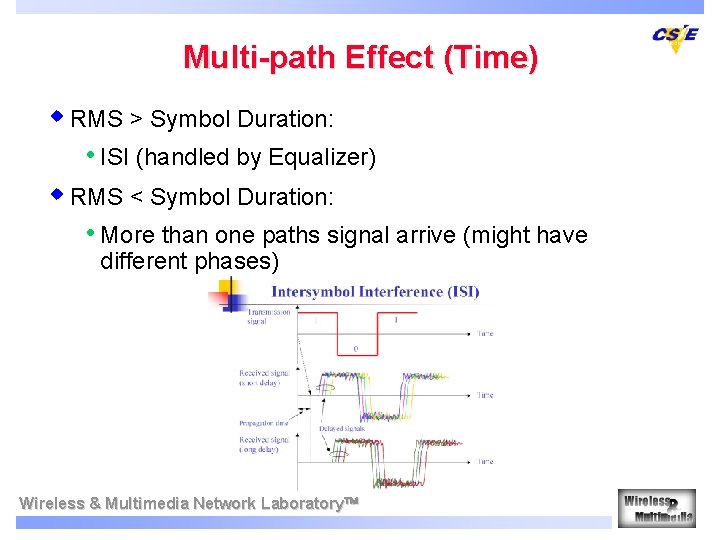
Multi-path Effect (Time) w RMS > Symbol Duration: • ISI (handled by Equalizer) w RMS < Symbol Duration: • More than one paths signal arrive (might have different phases) Wireless & Multimedia Network Laboratory