
Wireless Medium Access Control MAC Refer Section 7
- Slides: 38
Wireless Medium Access Control (MAC) (Refer Section 7. 3. 1 and 7. 3. 2 in textbook) Slides Adopted from: Romit Roy Choudhury Wireless Networking Lectures University of Illinois at Urbana Champaign 1
Wired Vs Wireless Media Access Both are on shared media. Then, what’s really the problem ? 2
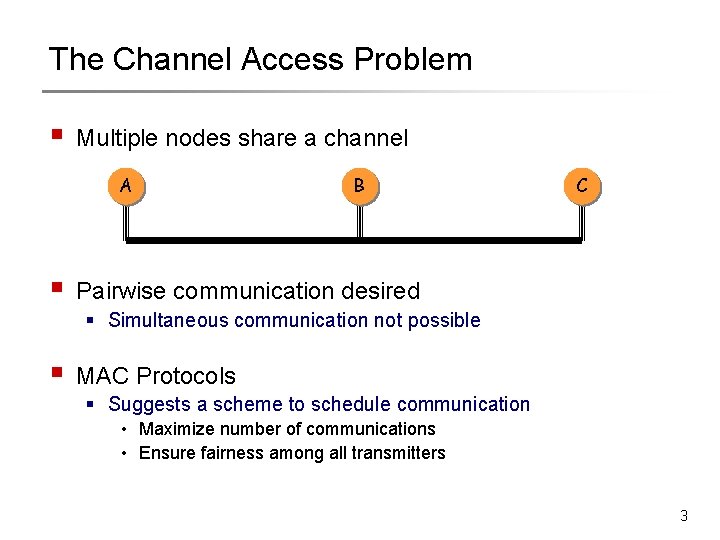
The Channel Access Problem § Multiple nodes share a channel A § B C Pairwise communication desired § Simultaneous communication not possible § MAC Protocols § Suggests a scheme to schedule communication • Maximize number of communications • Ensure fairness among all transmitters 3
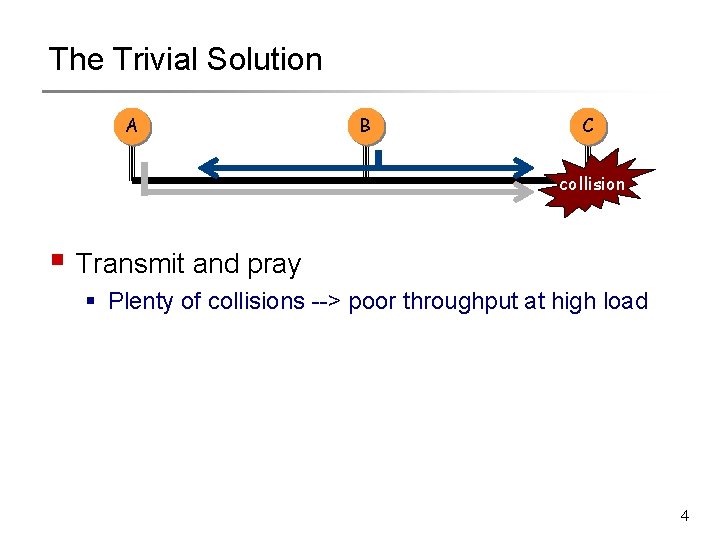
The Trivial Solution A B C collision § Transmit and pray § Plenty of collisions --> poor throughput at high load 4
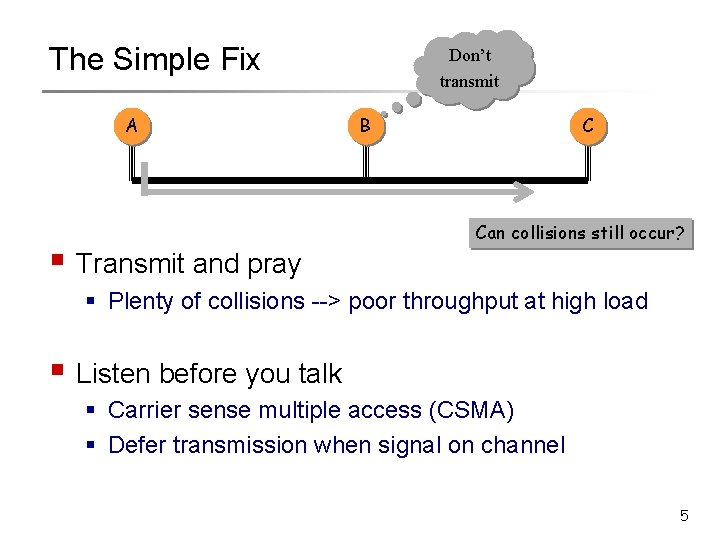
The Simple Fix A § Transmit and pray Don’t transmit B C Can collisions still occur? § Plenty of collisions --> poor throughput at high load § Listen before you talk § Carrier sense multiple access (CSMA) § Defer transmission when signal on channel 5
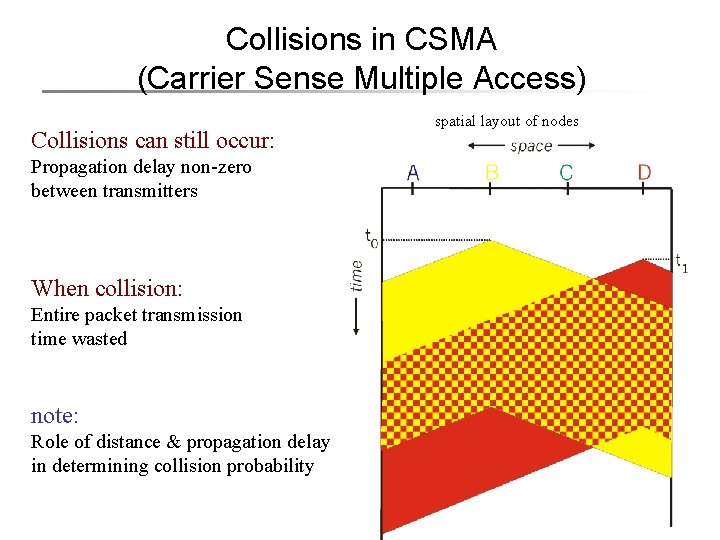
Collisions in CSMA (Carrier Sense Multiple Access) Collisions can still occur: spatial layout of nodes Propagation delay non-zero between transmitters When collision: Entire packet transmission time wasted note: Role of distance & propagation delay in determining collision probability 6
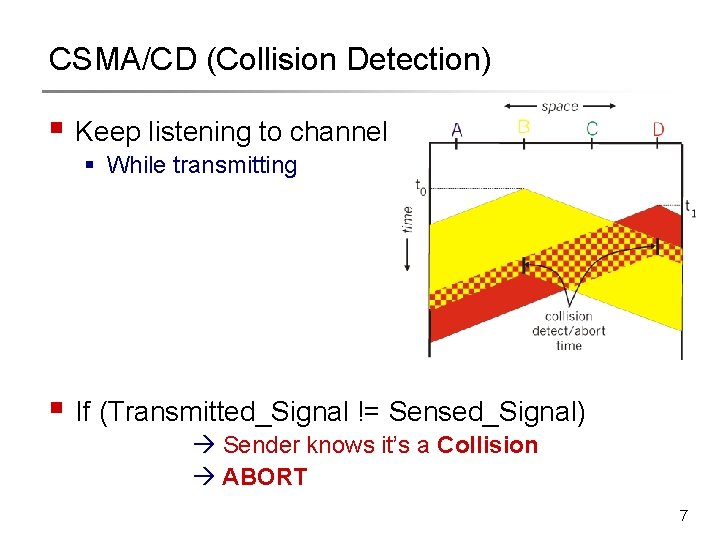
CSMA/CD (Collision Detection) § Keep listening to channel § While transmitting § If (Transmitted_Signal != Sensed_Signal) Sender knows it’s a Collision ABORT 7
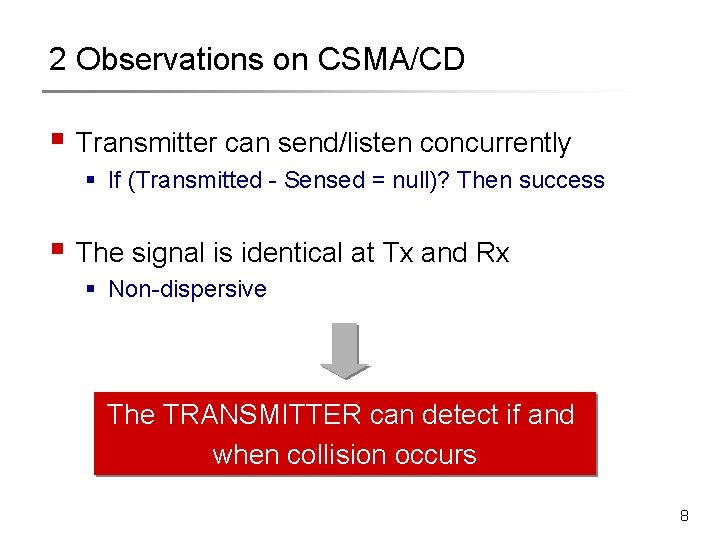
2 Observations on CSMA/CD § Transmitter can send/listen concurrently § If (Transmitted - Sensed = null)? Then success § The signal is identical at Tx and Rx § Non-dispersive The TRANSMITTER can detect if and when collision occurs 8
Unfortunately … Both observations do not hold for wireless Because … 9
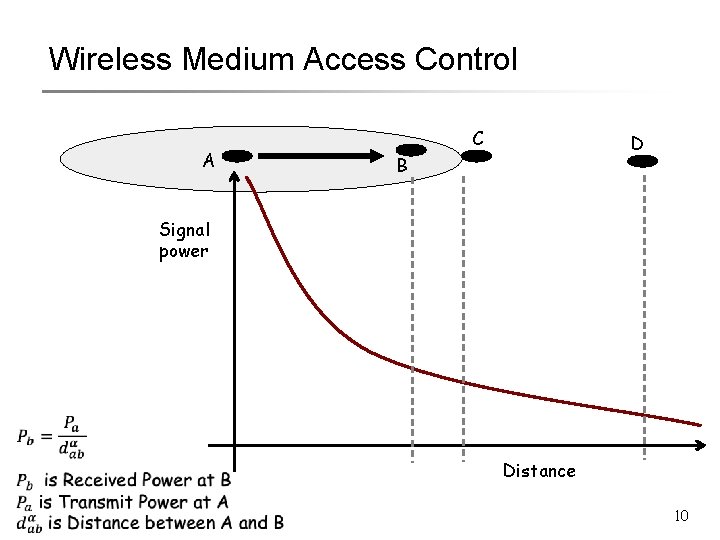
Wireless Medium Access Control A C D B Signal power Distance 10
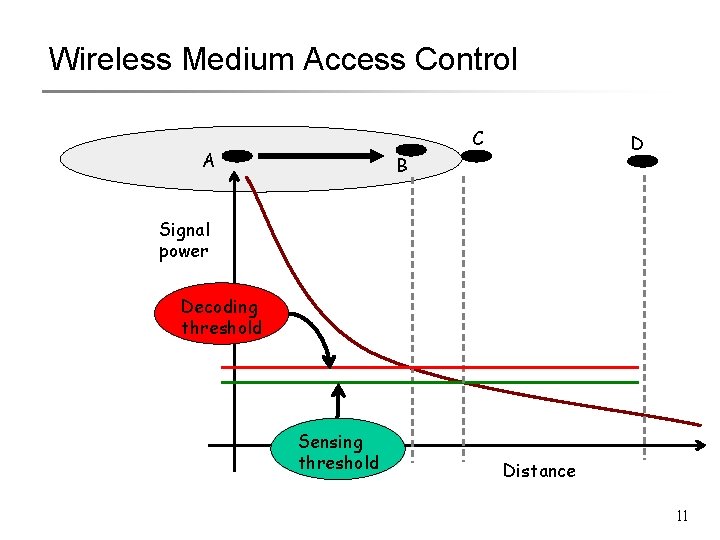
Wireless Medium Access Control C A D B Signal power Decoding threshold Sensing threshold Distance 11
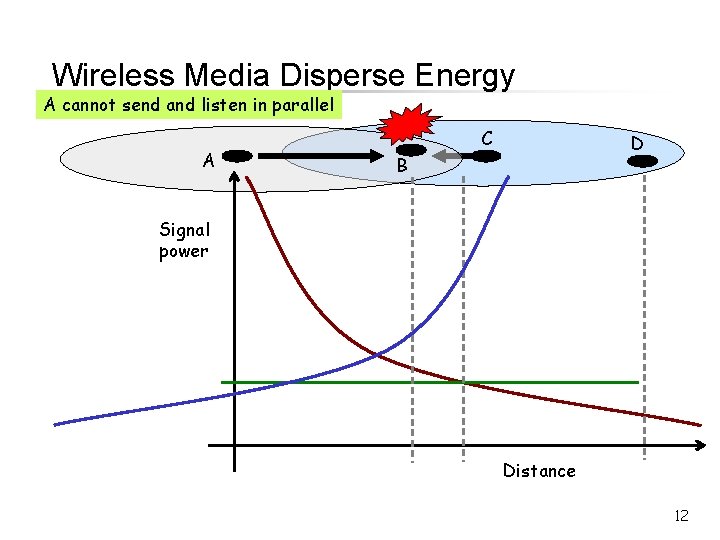
Wireless Media Disperse Energy A cannot send and listen in parallel A C D B Signal power Distance 12
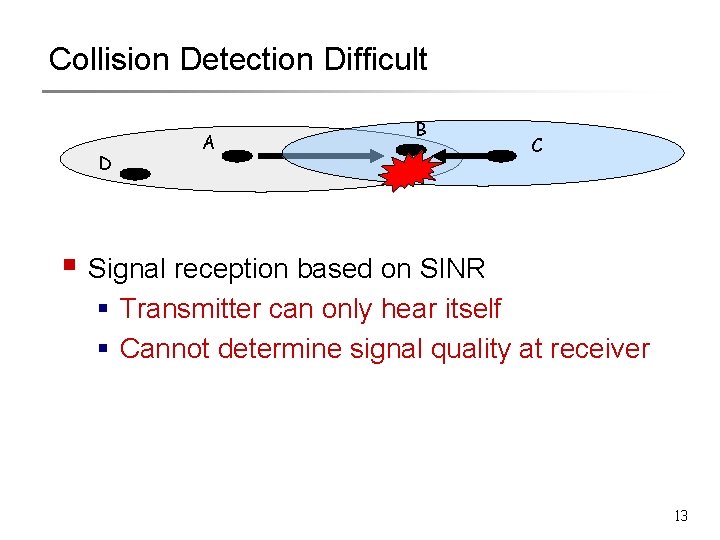
Collision Detection Difficult D A B C § Signal reception based on SINR § Transmitter can only hear itself § Cannot determine signal quality at receiver 13
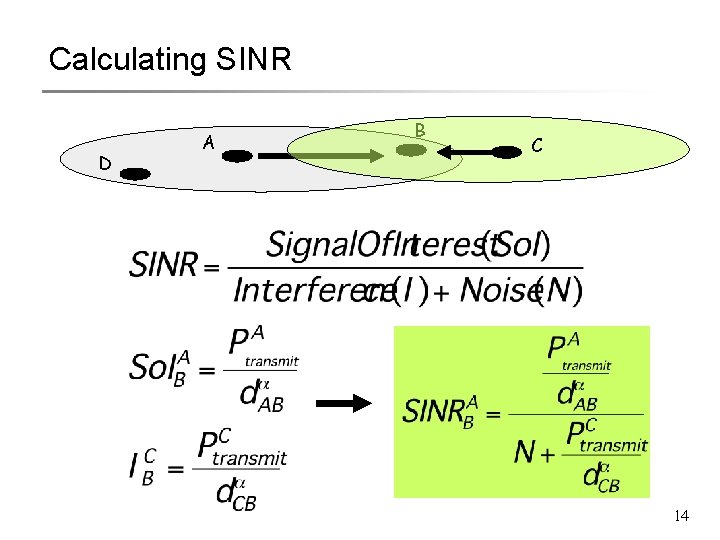
Calculating SINR D A B C 14
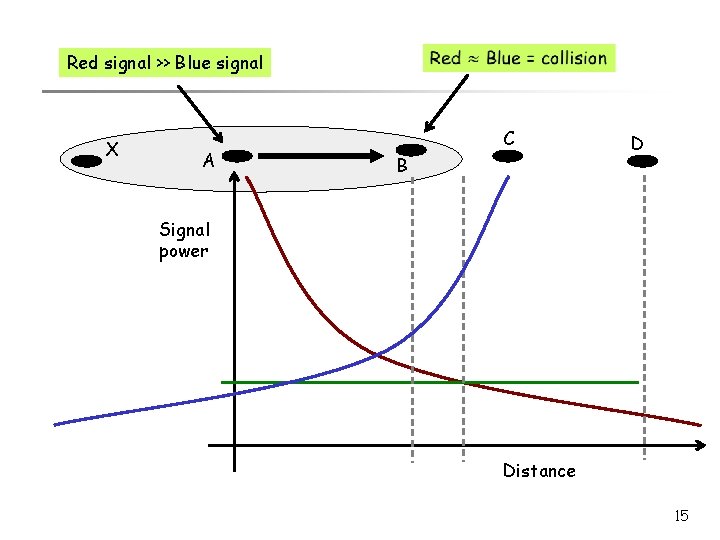
Red signal >> Blue signal X A C B D Signal power Distance 15
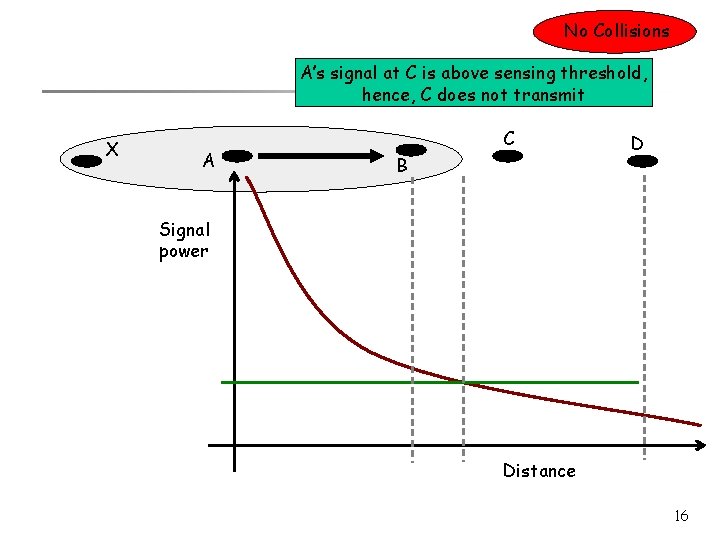
No Collisions A’s signal at C is above sensing threshold, hence, C does not transmit X A C B D Signal power Distance 16
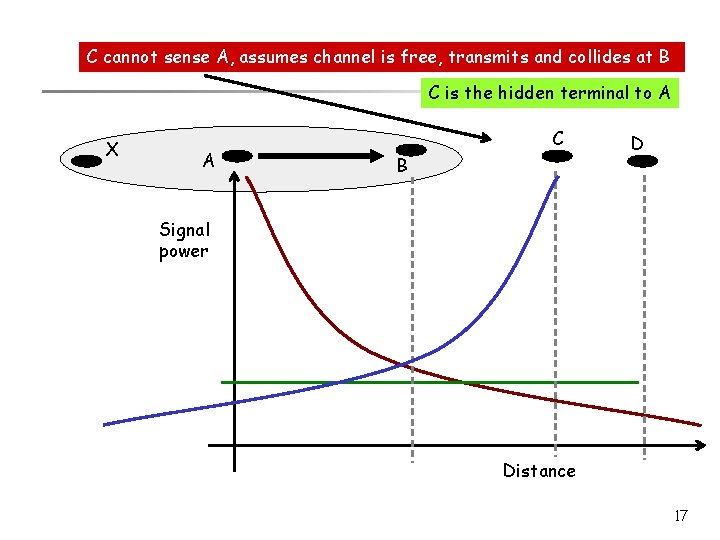
C cannot sense A, assumes channel is free, transmits and collides at B C is the hidden terminal to A X A C B D Signal power Distance 17
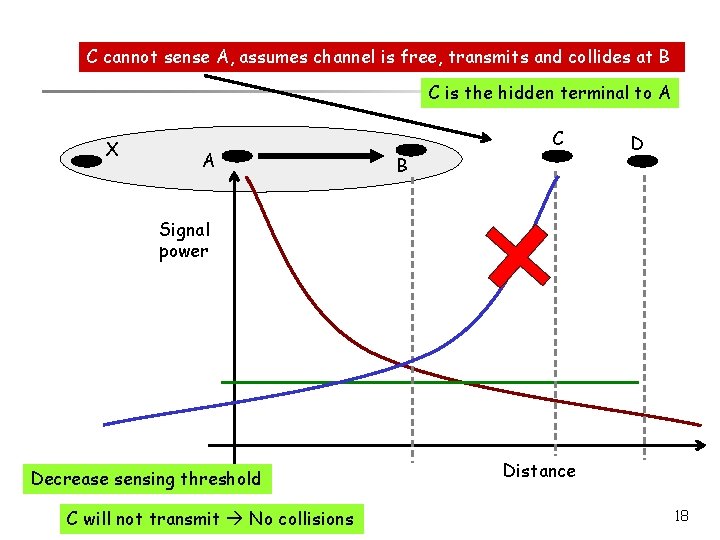
C cannot sense A, assumes channel is free, transmits and collides at B C is the hidden terminal to A X A C B D Signal power Decrease sensing threshold C will not transmit No collisions Distance 18
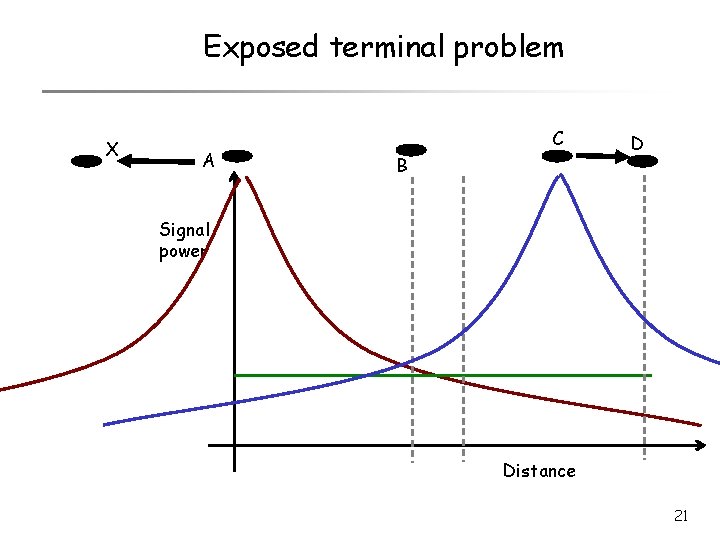
Exposed terminal problem 19
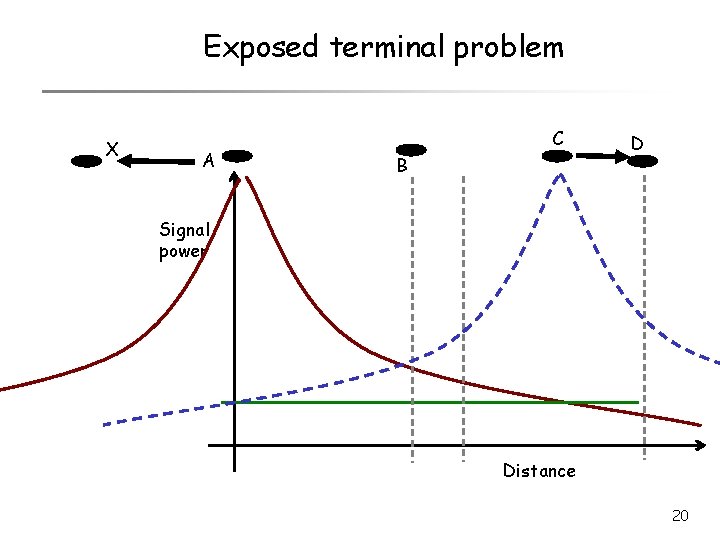
Exposed terminal problem X A C B D Signal power Distance 20
Exposed terminal problem X A C B D Signal power Distance 21
Any Questions at this point? 22
So, how do we cope with Hidden/Exposed Terminals? 23
The Emergence of MACA, MACAW, & 802. 11 § Wireless MAC proved to be non-trivial § 1992 - research by Karn (MACA) § 1994 - research by Bhargavan (MACAW) § Led to IEEE 802. 11 committee § The standard was ratified in 1999 24
So, how do we cope with Hidden/Exposed Terminals? 25
The Emergence of MACA, MACAW, & 802. 11 § Wireless MAC proved to be non-trivial § 1992 - research by Karn (MACA) § 1994 - research by Bhargavan (MACAW) § Led to IEEE 802. 11 committee § The standard was ratified in 1999 26
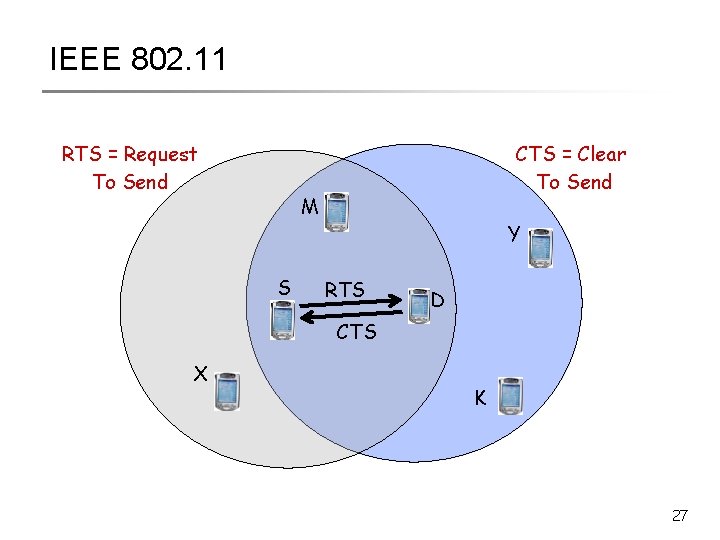
IEEE 802. 11 RTS = Request To Send CTS = Clear To Send M S Y RTS D CTS X K 27
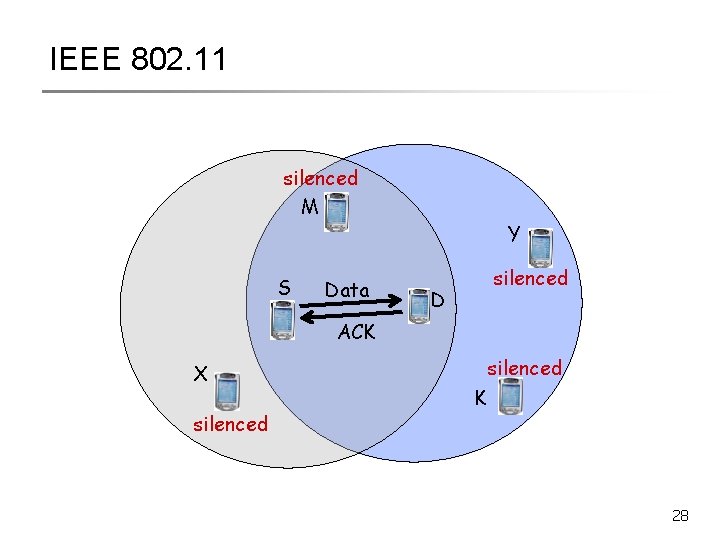
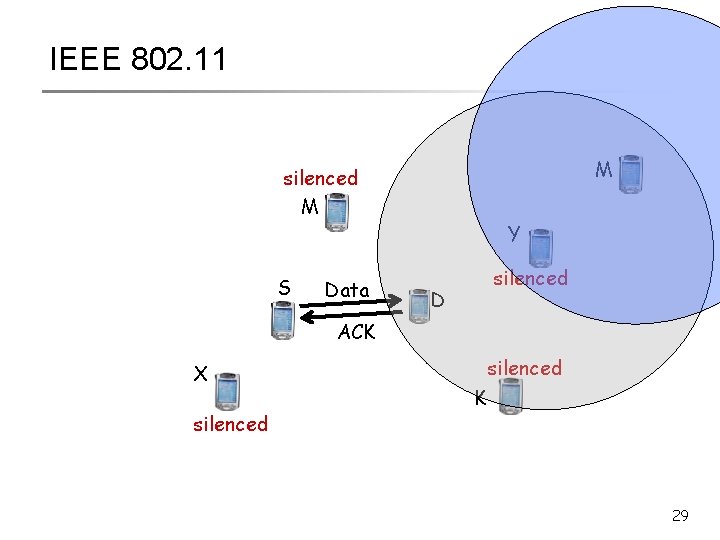
IEEE 802. 11 silenced M S Data Y D silenced ACK X silenced K 28
IEEE 802. 11 M silenced M S Data Y D silenced ACK X silenced K 29
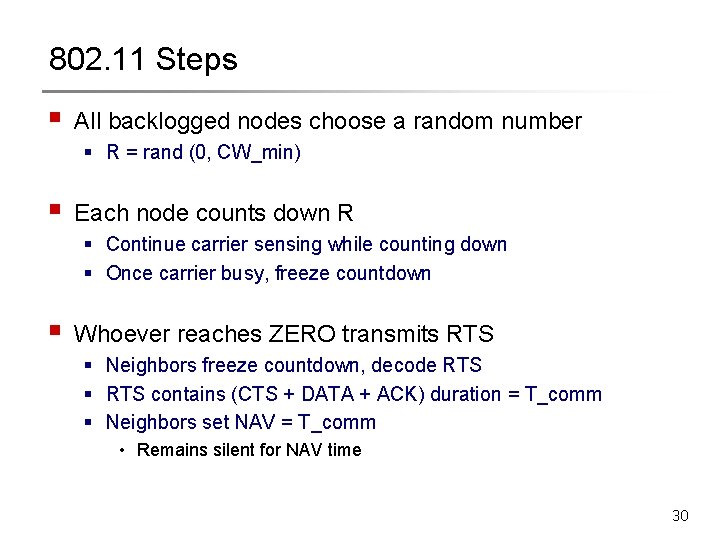
802. 11 Steps § All backlogged nodes choose a random number § R = rand (0, CW_min) § Each node counts down R § Continue carrier sensing while counting down § Once carrier busy, freeze countdown § Whoever reaches ZERO transmits RTS § Neighbors freeze countdown, decode RTS § RTS contains (CTS + DATA + ACK) duration = T_comm § Neighbors set NAV = T_comm • Remains silent for NAV time 30
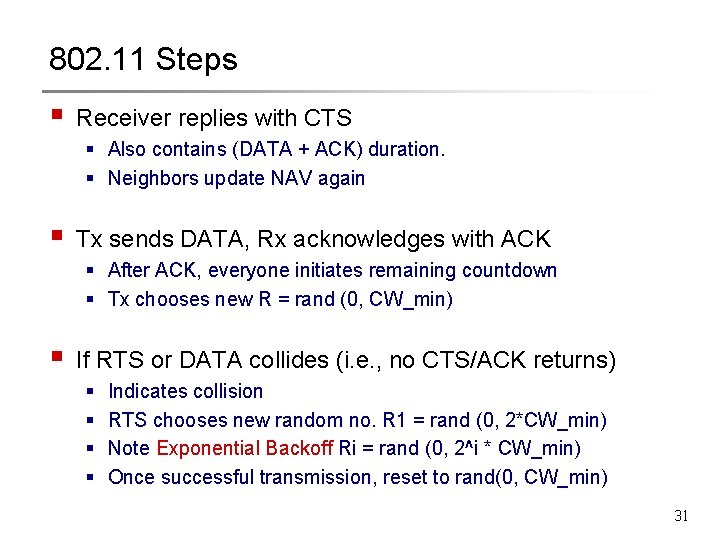
802. 11 Steps § Receiver replies with CTS § Also contains (DATA + ACK) duration. § Neighbors update NAV again § Tx sends DATA, Rx acknowledges with ACK § After ACK, everyone initiates remaining countdown § Tx chooses new R = rand (0, CW_min) § If RTS or DATA collides (i. e. , no CTS/ACK returns) § § Indicates collision RTS chooses new random no. R 1 = rand (0, 2*CW_min) Note Exponential Backoff Ri = rand (0, 2^i * CW_min) Once successful transmission, reset to rand(0, CW_min) 31
But is that enough? 32
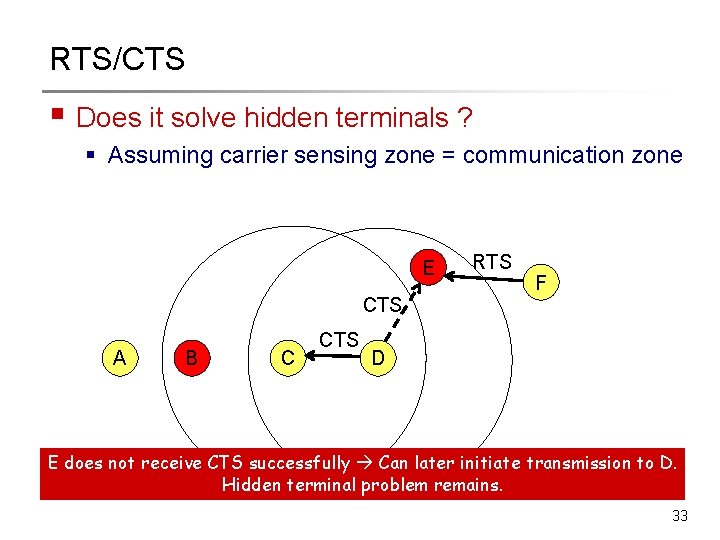
RTS/CTS § Does it solve hidden terminals ? § Assuming carrier sensing zone = communication zone E RTS F CTS A B C CTS D E does not receive CTS successfully Can later initiate transmission to D. Hidden terminal problem remains. 33
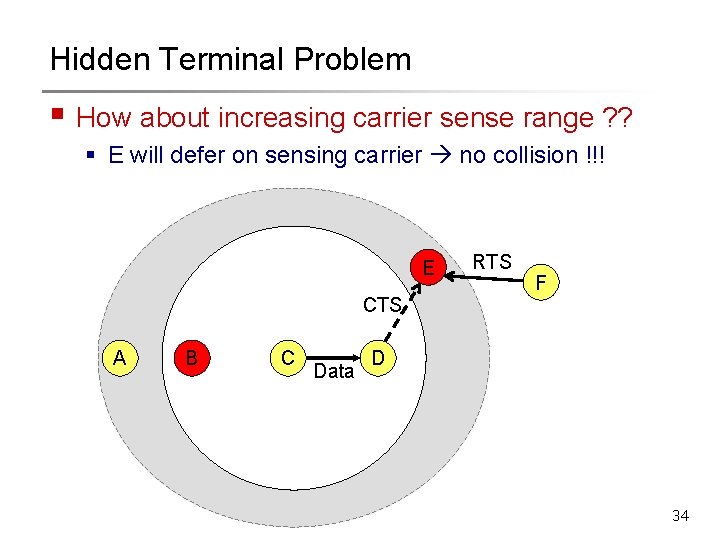
Hidden Terminal Problem § How about increasing carrier sense range ? ? § E will defer on sensing carrier no collision !!! E RTS F CTS A B C Data D 34
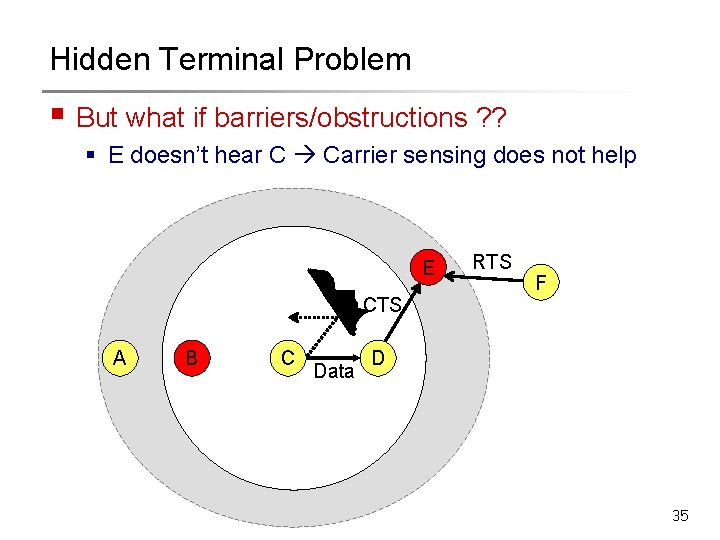
Hidden Terminal Problem § But what if barriers/obstructions ? ? § E doesn’t hear C Carrier sensing does not help E RTS F CTS A B C Data D 35
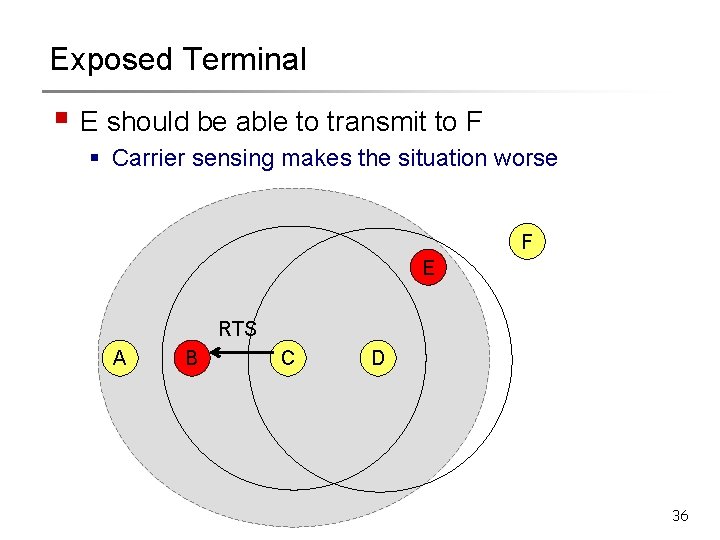
Exposed Terminal § E should be able to transmit to F § Carrier sensing makes the situation worse F E RTS A B C D 36
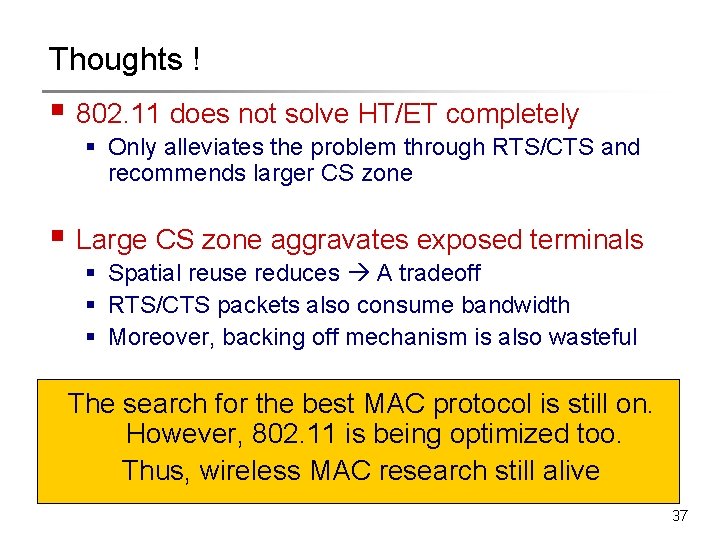
Thoughts ! § 802. 11 does not solve HT/ET completely § Only alleviates the problem through RTS/CTS and recommends larger CS zone § Large CS zone aggravates exposed terminals § Spatial reuse reduces A tradeoff § RTS/CTS packets also consume bandwidth § Moreover, backing off mechanism is also wasteful The search for the best MAC protocol is still on. However, 802. 11 is being optimized too. Thus, wireless MAC research still alive 37
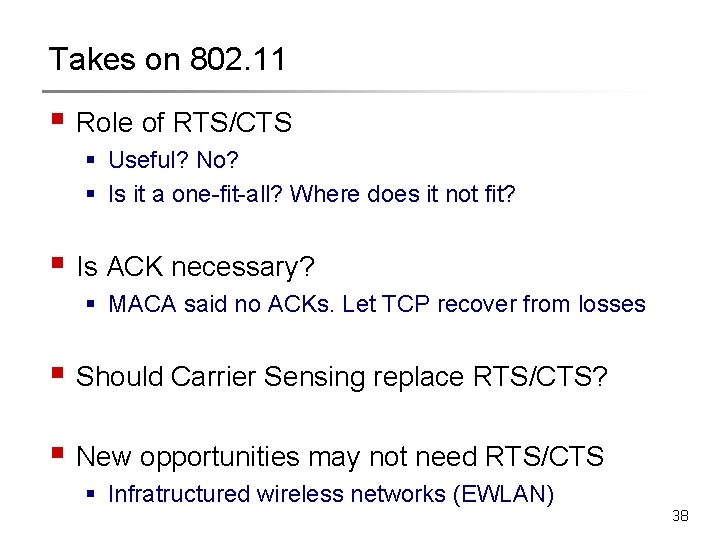
Takes on 802. 11 § Role of RTS/CTS § Useful? No? § Is it a one-fit-all? Where does it not fit? § Is ACK necessary? § MACA said no ACKs. Let TCP recover from losses § Should Carrier Sensing replace RTS/CTS? § New opportunities may not need RTS/CTS § Infratructured wireless networks (EWLAN) 38