
Wireless Local Loop WLL By Panos Tzanos Vladimerou
Wireless Local Loop (WLL) By: Panos Tzanos Vladimerou Derek Starr
Presentation Outline What is WLL? n Differences with mobile cellular systems n – Why WLL? n System Analysis – examples n The future of WLL
Definition n n What is WLL? - WLL is a system that connects subscribers to the local telephone station wirelessly. Systems WLL is based on: – – – n Cellular Satellite (specific and adjunct) Microcellular Other names – Radio In The Loop (RITL) – Fixed-Radio Access (FRA).
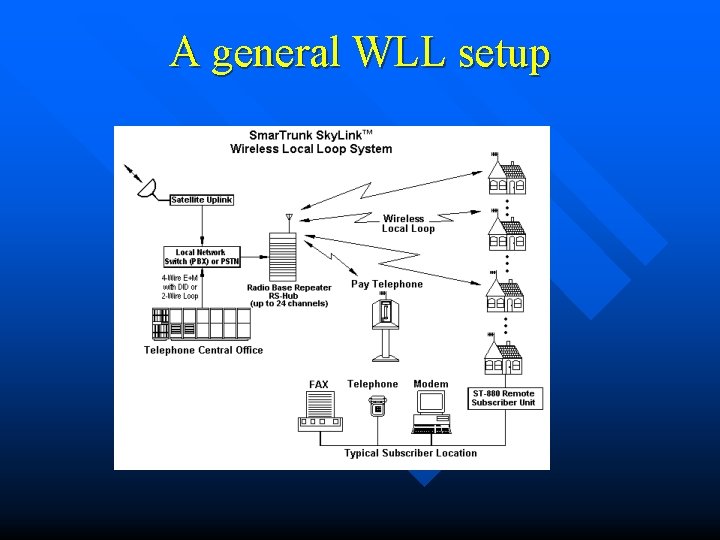
A general WLL setup
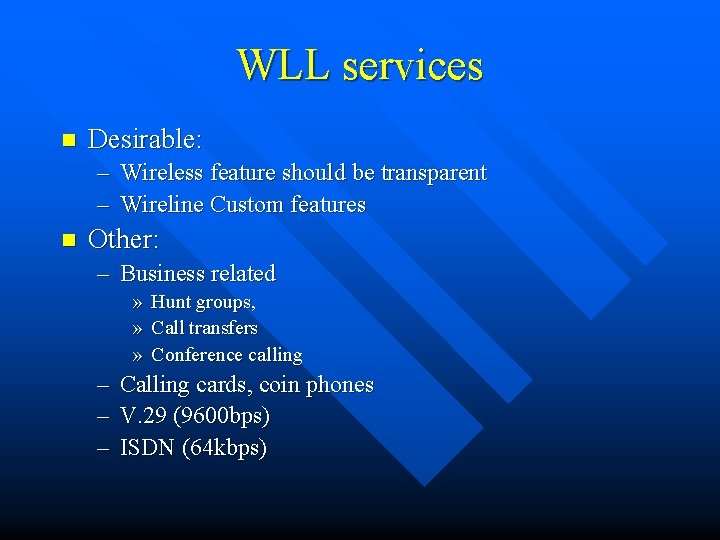
WLL services n Desirable: – Wireless feature should be transparent – Wireline Custom features n Other: – Business related » Hunt groups, » Call transfers » Conference calling – – – Calling cards, coin phones V. 29 (9600 bps) ISDN (64 kbps)
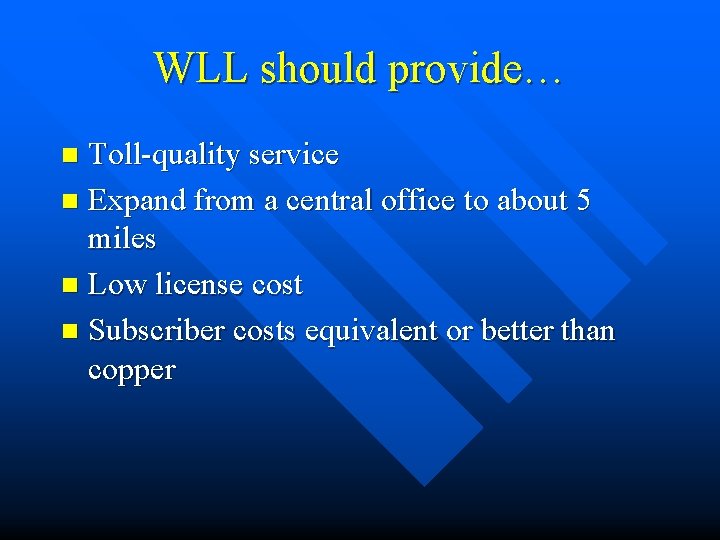
WLL should provide… Toll-quality service n Expand from a central office to about 5 miles n Low license cost n Subscriber costs equivalent or better than copper n

Ideas for U. S. market n Supplement Copper Lines – Easier third telephone line – Data service n Fixed Mobile Users – Take phone wherever you want / charged on 2 levels – “home” could mean neighborhood – Charged regular mobile rate if you’re on the road
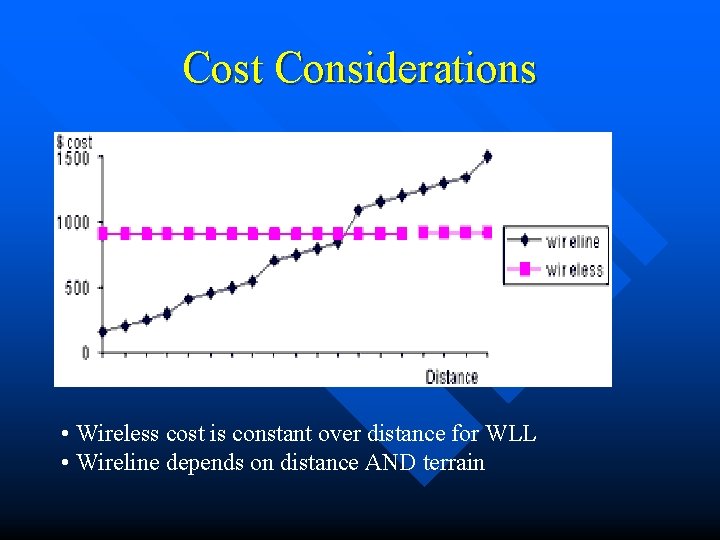
Cost Considerations • Wireless cost is constant over distance for WLL • Wireline depends on distance AND terrain
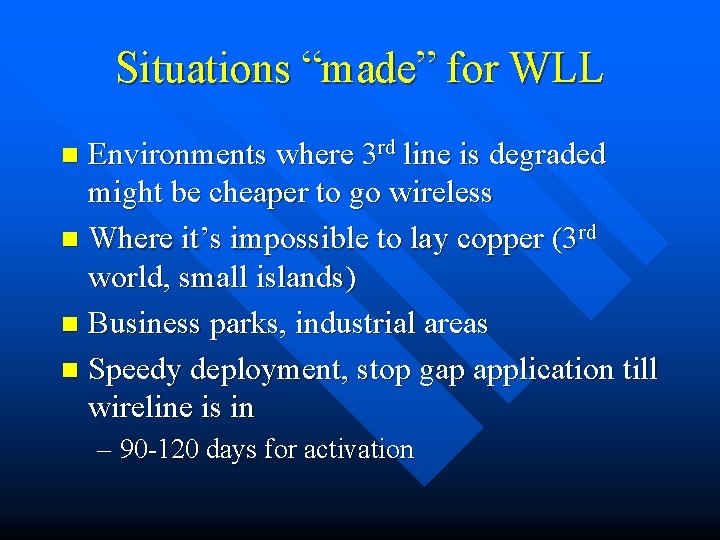
Situations “made” for WLL Environments where 3 rd line is degraded might be cheaper to go wireless n Where it’s impossible to lay copper (3 rd world, small islands) n Business parks, industrial areas n Speedy deployment, stop gap application till wireline is in n – 90 -120 days for activation

Developed vs. Developing n Developed: Wireline service – Firmly established, cellular penetration is relatively high – Incumbent operator would use it to install 2 nd, 3 rd lines, coverage to rural areas – 2 nd or 3 rd competitive operator deploy it for fast & cost effective deployment – Quick way to establish market presence – cellular complement to their offerings
Developed vs. Developing n Developing – Quick & easy to deploy in countries with little copper line service, so as to accommodate people on enormous waiting lists for basic service – Low maintenance costs – Allows more competition in provider market
Examples n UK – 150 PTOs have licenses for wireless – Focus on regional networks – WLL Commercial services » Ionica, Atlantic Telecom, Scottish Telecom n Poland – – Most exciting market in eastern Europe Local loop is the bottleneck 150, 000 WLL lines since 1996 (15% of new) Ericsson, Motorola contracts
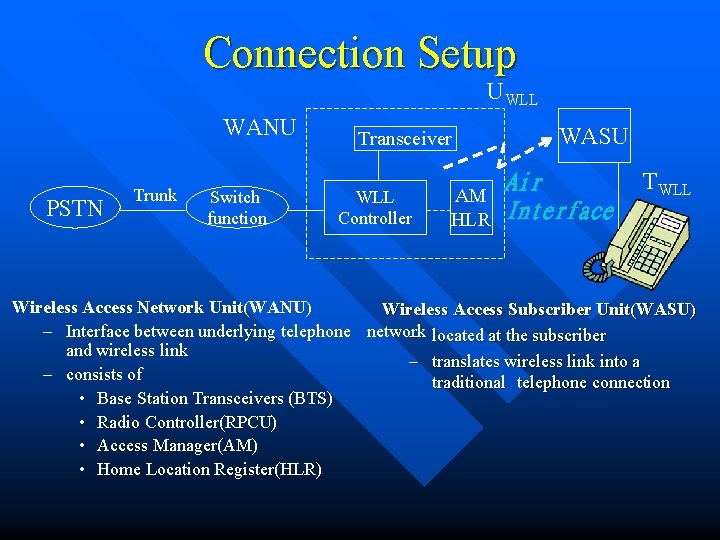
Connection Setup UWLL WANU PSTN Trunk Switch function Transceiver WLL Controller AM HLR WASU Air Interface TWLL Wireless Access Network Unit(WANU) Wireless Access Subscriber Unit(WASU) – Interface between underlying telephone network – located at the subscriber and wireless link – translates wireless link into a – consists of traditional telephone connection • Base Station Transceivers (BTS) • Radio Controller(RPCU) • Access Manager(AM) • Home Location Register(HLR)
Important Results of Fixed to Fixed Propagation in WLLs n Signal channel is not a Rayleigh fading channel: – Power control algorithms are simpler and can be utilized more effectively n Channel Randomness is lost: – Makes analysis difficult n Pathloss exponent is considerably smaller (Why? ): – – – 20 d. B/dec compared to 40 d. B/dec Decreases cell capacity Allows for larger coverage area
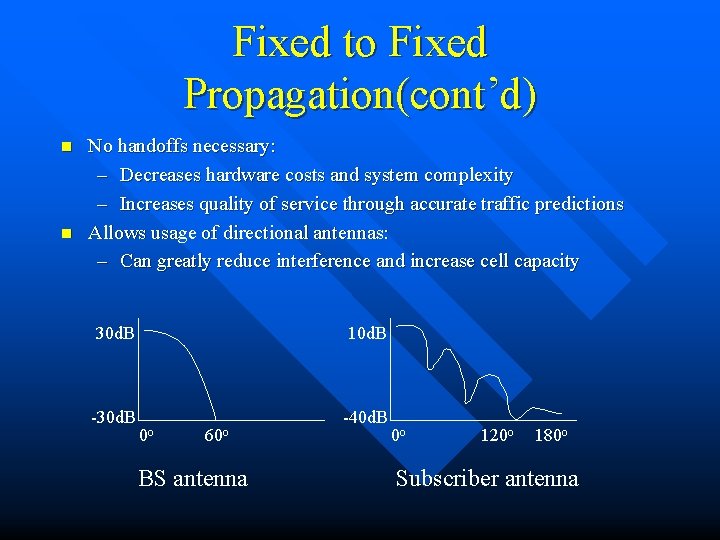
Fixed to Fixed Propagation(cont’d) n n No handoffs necessary: – Decreases hardware costs and system complexity – Increases quality of service through accurate traffic predictions Allows usage of directional antennas: – Can greatly reduce interference and increase cell capacity 30 d. B -30 d. B 10 d. B 0 o 60 o BS antenna -40 d. B 0 o 120 o 180 o Subscriber antenna
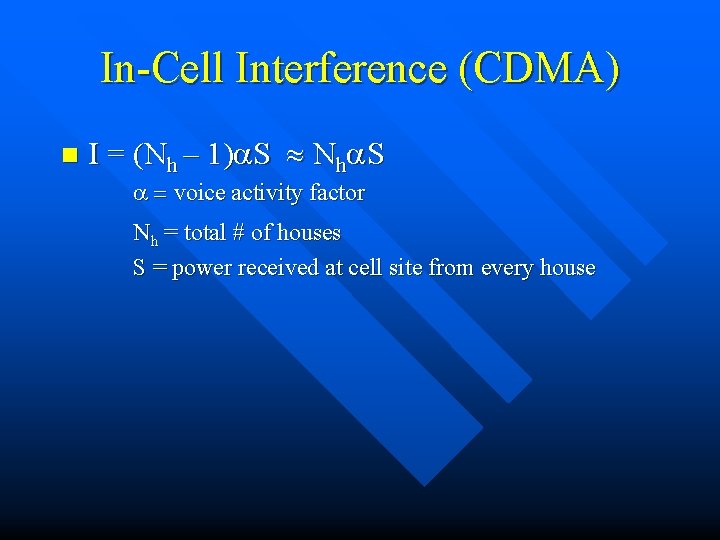
In-Cell Interference (CDMA) n I = (Nh – 1)a. S Nha. S a = voice activity factor Nh = total # of houses S = power received at cell site from every house
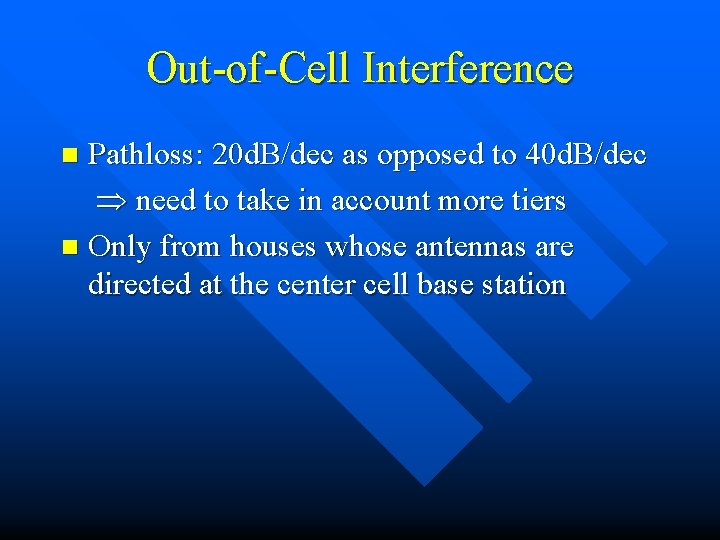
Out-of-Cell Interference Pathloss: 20 d. B/dec as opposed to 40 d. B/dec need to take in account more tiers n Only from houses whose antennas are directed at the center cell base station n
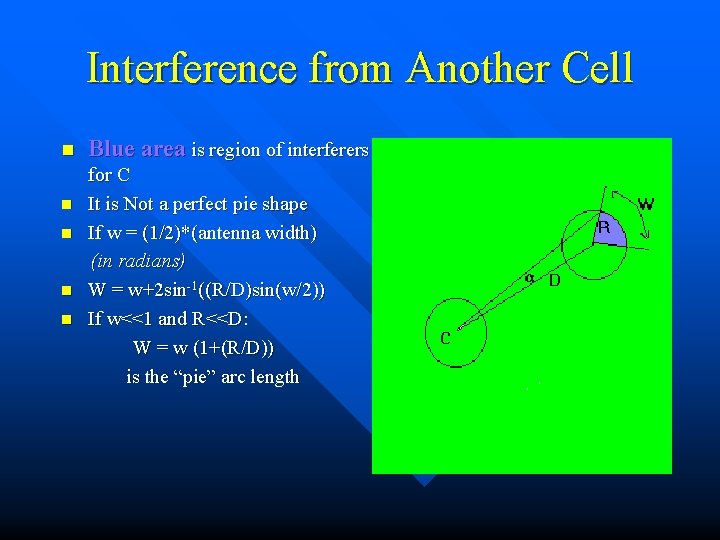
Interference from Another Cell n n n Blue area is region of interferers for C It is Not a perfect pie shape If w = (1/2)*(antenna width) (in radians) W = w+2 sin-1((R/D)sin(w/2)) If w<<1 and R<<D: W = w (1+(R/D)) is the “pie” arc length
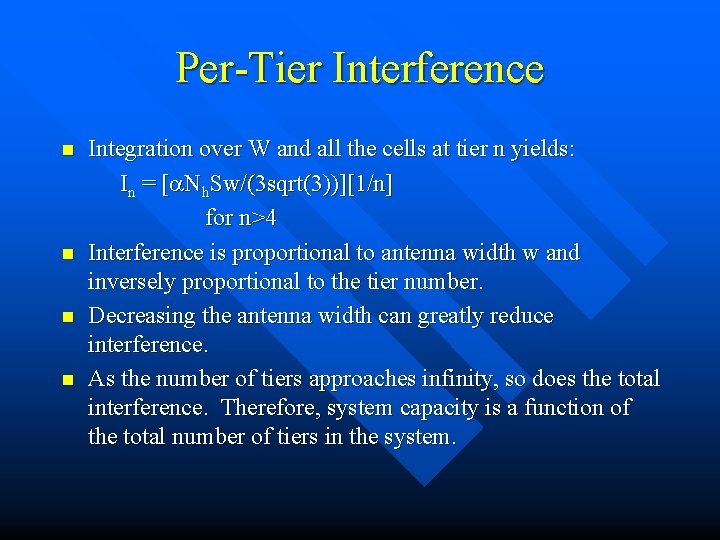
Per-Tier Interference n n Integration over W and all the cells at tier n yields: In = [a. Nh. Sw/(3 sqrt(3))][1/n] for n>4 Interference is proportional to antenna width w and inversely proportional to the tier number. Decreasing the antenna width can greatly reduce interference. As the number of tiers approaches infinity, so does the total interference. Therefore, system capacity is a function of the total number of tiers in the system.

Capacity comparison for 5 MHz spectrum allocation Detail IS-95 CDMA IS-136 TDMA ETSI (GSM) Mobile WLL Chan. BW (k. Hz) 1250 30 30 200 # channels 4 4 167 25 25 Eb/N 0 7 d. B 6 d. B 18 d. B 14 d. B 12 d. B Freq. Reuse 1 1 7 4 3 3 Effective Chan. Per sect. 4 4 7. 95 13. 92 2. 78 Erlangs per cell Per MHz 38. 3 48. 7 9. 84 19. 6 9. 12
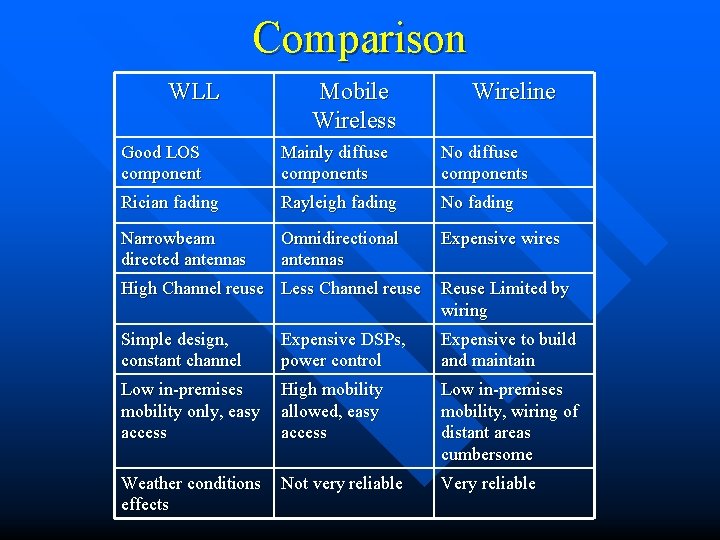
Comparison WLL Mobile Wireless Wireline Good LOS component Mainly diffuse components No diffuse components Rician fading Rayleigh fading No fading Narrowbeam directed antennas Omnidirectional antennas Expensive wires High Channel reuse Less Channel reuse Reuse Limited by wiring Simple design, constant channel Expensive DSPs, power control Expensive to build and maintain Low in-premises mobility only, easy access High mobility allowed, easy access Low in-premises mobility, wiring of distant areas cumbersome Weather conditions effects Not very reliable Very reliable
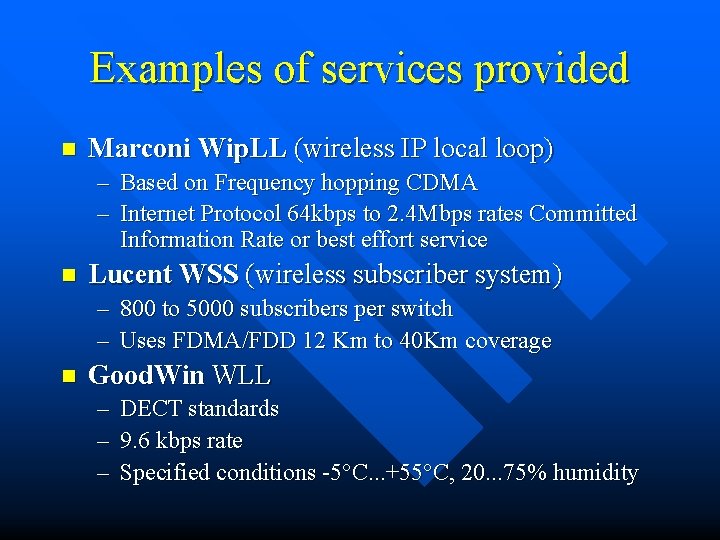
Examples of services provided n Marconi Wip. LL (wireless IP local loop) – Based on Frequency hopping CDMA – Internet Protocol 64 kbps to 2. 4 Mbps rates Committed Information Rate or best effort service n Lucent WSS (wireless subscriber system) – – n 800 to 5000 subscribers per switch Uses FDMA/FDD 12 Km to 40 Km coverage Good. Win WLL – – – DECT standards 9. 6 kbps rate Specified conditions -5°С. . . +55°С, 20. . . 75% humidity
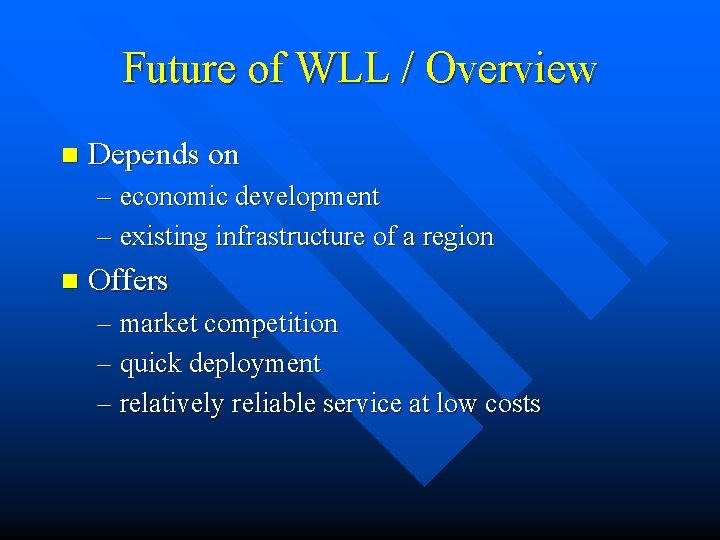
Future of WLL / Overview n Depends on – economic development – existing infrastructure of a region n Offers – market competition – quick deployment – relatively reliable service at low costs
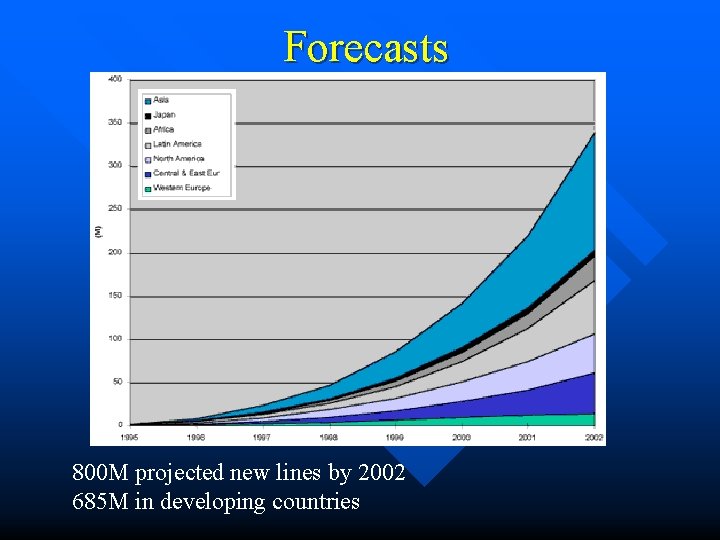
Forecasts 800 M projected new lines by 2002 685 M in developing countries
Questions? Basie station
References http: //www. tenet. res. in/Papers/wll/iete 1. html http: //bicsi. org/Wireless 2/index. htm http: //sss-mag. com/wlltutor. html http: //www. cdg. org/ http: //www. voicendata. com/may 98/will. html http: //www. cdg. org/tech/wll. asp http: //www. motorola. com/NSS/Press/press_archive_1997/19970826 a. html http: //www. mobilemark. com/WLL_antennas. html http: //www. atdi. co. uk/t_wll. htm http: //www. lucent. com/wireless/ http: //www. art-telecom. fr/communiques/pressrelease/98 -13 a. htm http: //www. fcr. fr/en/savoirfaire/blr. htm http: //www. citi. columbia. edu/wireless/col_1096. htm http: //www. telecomresearch. com/tutorials. html http: //www. kyocera. co. jp/frame/product/telecom/english/wll/index. htm http: //www. americasnetwork. com/issues/961101/110196_wll. html http: //208. 220. 133. 42/issues/199803/tci/bout. html
References http: //www. smartrunk. com/WLL/SSIWLL. html http: //www. amd. pl/products/cpd/prodover/wllsol. html http: //www. biz. uiowa. edu/class/6 K 251_park/Student-Reports/ymao/index. html http: //ieeexplore. ieee. org/iel 3/5002/13722/00632520. pdf http: //www. ece. queensu. ca/dept/vpoor. pdf http: //www. mprg. ee. vt. edu/tech_xfer/ppt/Emerging. Technology. pdf http: //www. carlsontech. com/manual 15. html http: //www. corporateinformation. com/data/statusa/chinavsat. html http: //www. hindubusinessline. com/2001/01/09/stories/14096802. htm http: //www. tradeport. org/ts/countries/brazil/mrr/mark 0115. html http: //www. atdi. com/99/p_wll. htm http: //www. marconi. com/html/news/libertywlltrials. htm http: //citeseer. nj. nec. com/359563. html http: //www. corporateinformation. com http: //www. stanford. edu/class/ee 359/ http: //www. alcatel. com/telecom/asd/products/groups/access/wireless/wllacc 1. htm http: //www. goodwin. ru: 8086/products/wll/ http: //www. goodwin. ru: 8086/dect. html (DECT standard)
References Wideband CDMA personal communications system featuring IDSN compatibility Reed Fisher, Henri Suyderhoud, Toshiro Kato, Atushi Fukasawa and Takuro Sato © 1997 IEEE Performance Analysis of WCDMA WLL Protocol Seong Won Shum, Sang Hwan Lee, Minsoo Suk, Hang Gu Bahk Hyundai Electronics ICCT’ 98 Beijing, China Capacity of a Wireless Local Loop Network based on GSM Thomas Klingenbrunn, Preben Mogensen Center for Person Kommukation, Aalborg University © 1998 IEEE Network Management Applications for wireless local loop Jelena Vucetic Paul Kline Dynamic Telecomminications, Inc. 1998
References Implementation of code acquisition and code tracking loop for CDMA wireless local loop system Jae-Wook Chung, Jin-Su Kim, Young-Gyun Jeong, Jeong-Suk Ha Electronics and Telecommincations Research Institute, Yusong, Taejon, Korea © 1998 IEEE Implementation of Base Station Receiver for CDMA Wireless Local Loop System Jae W. Chung, Jin S. Kim, Y. G. Jeong, J. S. Ha Electronics and Telecommincations Research Institute, Yusong, Taejon, Korea © 1997 IEEE Wireless Local Loop – Propagation Environment Measurements and analysis Levin M. , Katz E. , Gil A. , Freedman A. , Matityahu I. , Dilmon D. Wireless Systems Tadiran Telecommunications, Israel 1996 IEEE Issues and challenges of implementing a wireless local loop based telephone access network T. Minero, T. Babji NEC cororation, JAPAN © 1997 IEEE
References Wireless local loop: why the slow take up? Andrian May, Electronics Communication Engineering Journal 1998 A Wideband CDMA based Wireless Local Loop Protocol Mehmet Ulema and Young Ki Yoon Daewoo Telecom R&D Center © 1999 IEEE An Implementation of Wireless Local Loop fixed Station Sang Sik Lim, Mobile Telecommunication Division Electronics and Telecommunications Research Institute, Taejon, Korea © 1998 IEEE A comparison of wireless local loop with competing access technologies W. Webb, Electronics & Communication Engineering Journal 1998 Estimate of Uplink in Overlaid Macrocell/Multi-Microcell CDMA WLL Systems J. S. Roh, S. Y. Kim, S. J. Cho, S. C. Son, S. E. Cho H. J. Kang
References Wireless Local Loop Made For the USA? David Kopf, Peter Meade, America’s Network November 1996 The Performance of DS-CDMA For Wireless Local Loop Q. Bi, D. R. Pulley 1996 IEEE Wireless Local Loop: Architecture, Technologies and Services Anthony R. Noeprel, Hughes Network Systems, Yi-Bing Lin CSIE/NCTU 1998 IEEE
- Slides: 31