
Wireless IP Marko Ovaska 1998 Introduction to the
- Slides: 34
Wireless IP Marko Ovaska 1998 Introduction to the Wireless IP Basic concepts MOWGLI WAP © NOKIA wireless_ip 98. ppt / 07. 11. 1998 / MOv page: 1
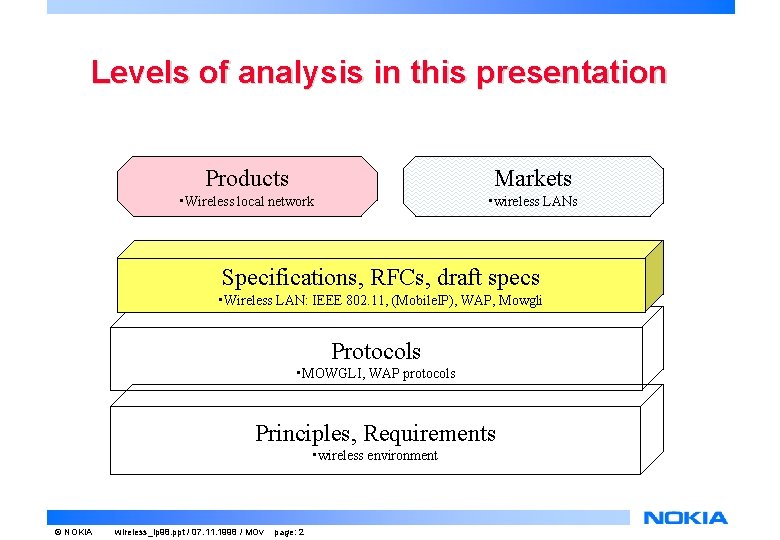
Levels of analysis in this presentation Products Markets • Wireless local network • wireless LANs Specifications, RFCs, draft specs • Wireless LAN: IEEE 802. 11, (Mobile. IP), WAP, Mowgli Protocols • MOWGLI, WAP protocols Principles, Requirements • wireless environment © NOKIA wireless_ip 98. ppt / 07. 11. 1998 / MOv page: 2
Wireless IP • Wireless environment • • mobility Internet protocol in wireless environment Non-tcp/ip solutions • • © NOKIA networks Mowgli WAP wireless_ip 98. ppt / 07. 11. 1998 / MOv page: 3
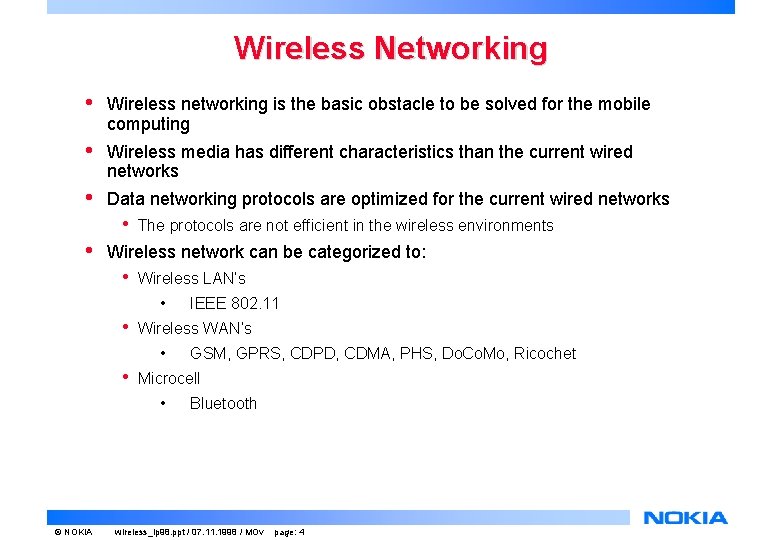
Wireless Networking • Wireless networking is the basic obstacle to be solved for the mobile computing • Wireless media has different characteristics than the current wired networks • Data networking protocols are optimized for the current wired networks • • The protocols are not efficient in the wireless environments Wireless network can be categorized to: • Wireless LAN’s • • Wireless WAN’s • • GSM, GPRS, CDPD, CDMA, PHS, Do. Co. Mo, Ricochet Microcell • © NOKIA IEEE 802. 11 Bluetooth wireless_ip 98. ppt / 07. 11. 1998 / MOv page: 4
Wireless Network • The wireless network properties differ from the wireline one • • • latency • 802. 11: round-trip 2 ms normal tcp buffer size: 8 KB, some W-WAN’s latency*bandwidth exceeds this • GSM: 0. 7 s with one byte packet extra kilo adds round trip time 0. 6 seconds per kilo • tcp throughput is related to latency: high latency, low throughput • interactive applications suffer from long latency times jitter error rate • non-transparency data connection in GSM offers less than 10 -8 bit error rate however this results in highly variable transmission delays • example: 10 Mbs LAN has an average of below 10 -9 bit error rate throughput: wireless networks could be characterized "thin” unexpected disconnections • © NOKIA will the underlying protocol support recovery? wireless_ip 98. ppt / 07. 11. 1998 / MOv page: 5
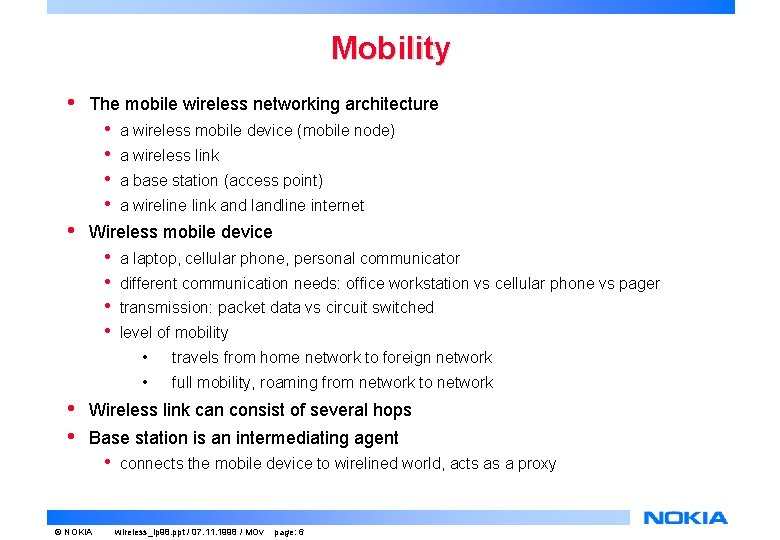
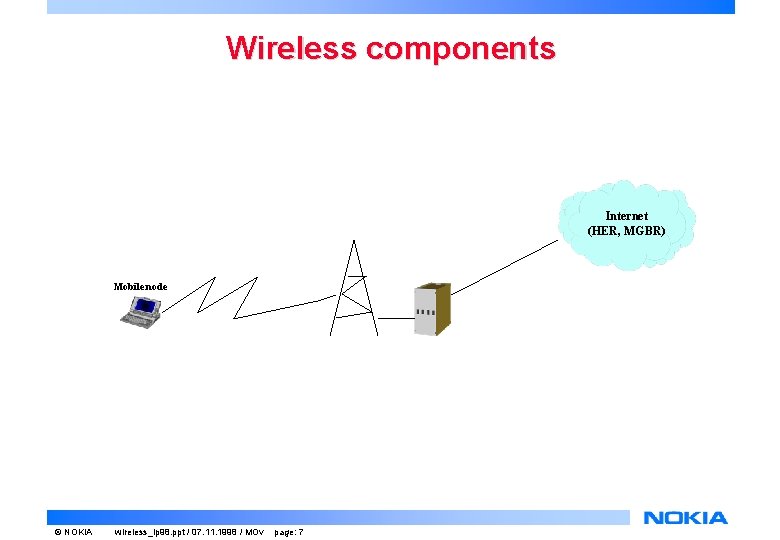
Mobility • The mobile wireless networking architecture • • • a wireless link a base station (access point) a wireline link and landline internet Wireless mobile device • • • a wireless mobile device (mobile node) a laptop, cellular phone, personal communicator different communication needs: office workstation vs cellular phone vs pager transmission: packet data vs circuit switched level of mobility • travels from home network to foreign network • full mobility, roaming from network to network Wireless link can consist of several hops Base station is an intermediating agent • © NOKIA connects the mobile device to wirelined world, acts as a proxy wireless_ip 98. ppt / 07. 11. 1998 / MOv page: 6
Wireless components Internet (HER, MGBR) Mobile node © NOKIA wireless_ip 98. ppt / 07. 11. 1998 / MOv page: 7
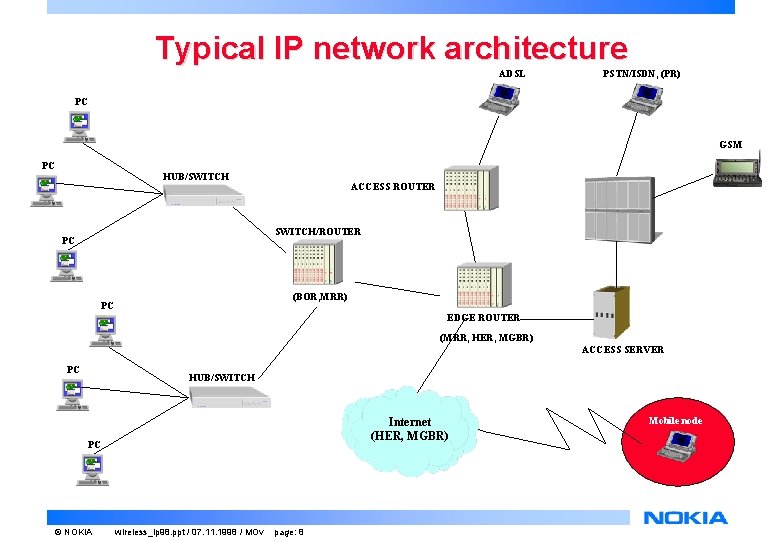
Typical IP network architecture ADSL PSTN/ISDN, (PR) PC GSM PC HUB/SWITCH ACCESS ROUTER SWITCH/ROUTER PC (BOR, MRR) PC EDGE ROUTER (MRR, HER, MGBR) ACCESS SERVER PC HUB/SWITCH Internet (HER, MGBR) PC © NOKIA wireless_ip 98. ppt / 07. 11. 1998 / MOv page: 8 Mobile node
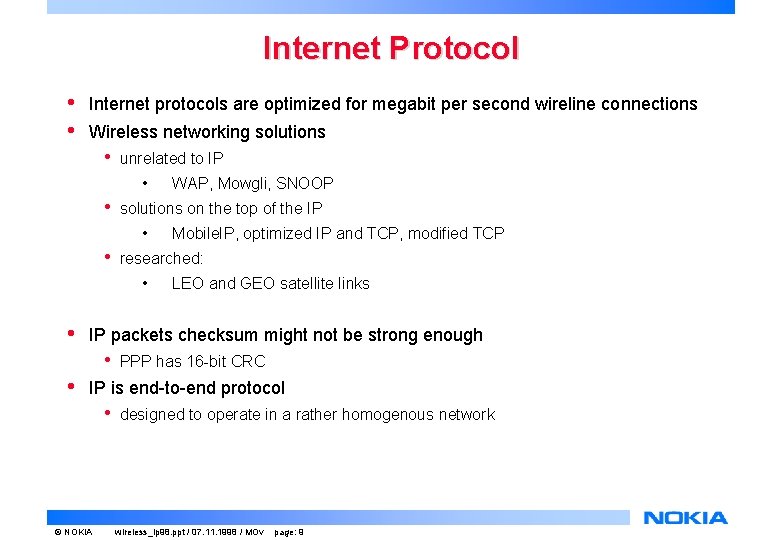
Internet Protocol • • Internet protocols are optimized for megabit per second wireline connections Wireless networking solutions • unrelated to IP • • solutions on the top of the IP • • LEO and GEO satellite links IP packets checksum might not be strong enough • • Mobile. IP, optimized IP and TCP, modified TCP researched: • • WAP, Mowgli, SNOOP PPP has 16 -bit CRC IP is end-to-end protocol • © NOKIA designed to operate in a rather homogenous network wireless_ip 98. ppt / 07. 11. 1998 / MOv page: 9
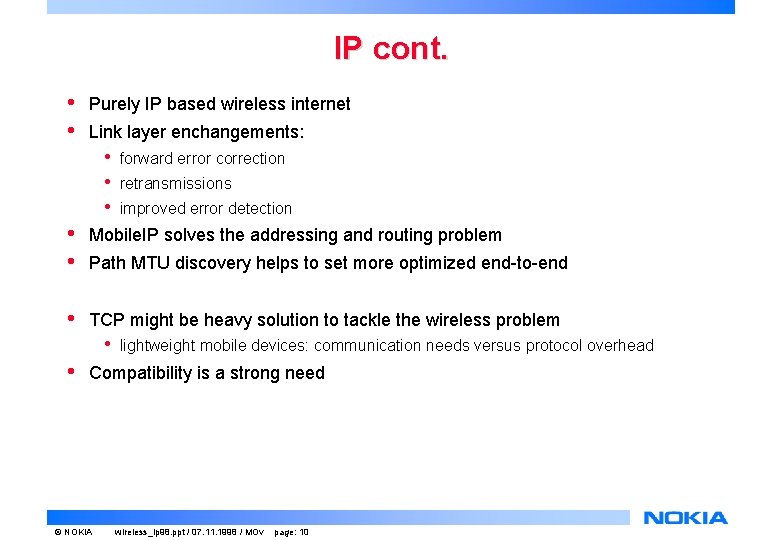
IP cont. • • Purely IP based wireless internet Link layer enchangements: • • • forward error correction retransmissions improved error detection • • Mobile. IP solves the addressing and routing problem • TCP might be heavy solution to tackle the wireless problem Path MTU discovery helps to set more optimized end-to-end • • lightweight mobile devices: communication needs versus protocol overhead Compatibility is a strong need © NOKIA wireless_ip 98. ppt / 07. 11. 1998 / MOv page: 10
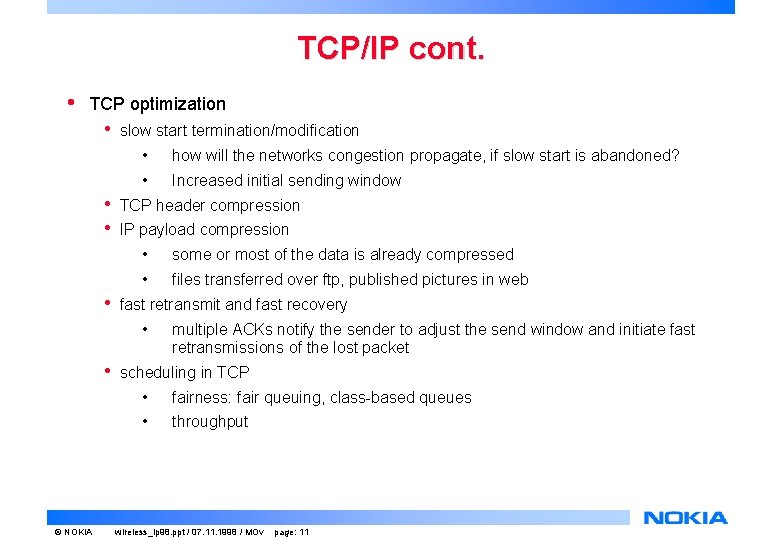
TCP/IP cont. • TCP optimization • • slow start termination/modification • how will the networks congestion propagate, if slow start is abandoned? • Increased initial sending window TCP header compression IP payload compression • some or most of the data is already compressed • files transferred over ftp, published pictures in web fast retransmit and fast recovery • • © NOKIA multiple ACKs notify the sender to adjust the send window and initiate fast retransmissions of the lost packet scheduling in TCP • fairness: fair queuing, class-based queues • throughput wireless_ip 98. ppt / 07. 11. 1998 / MOv page: 11
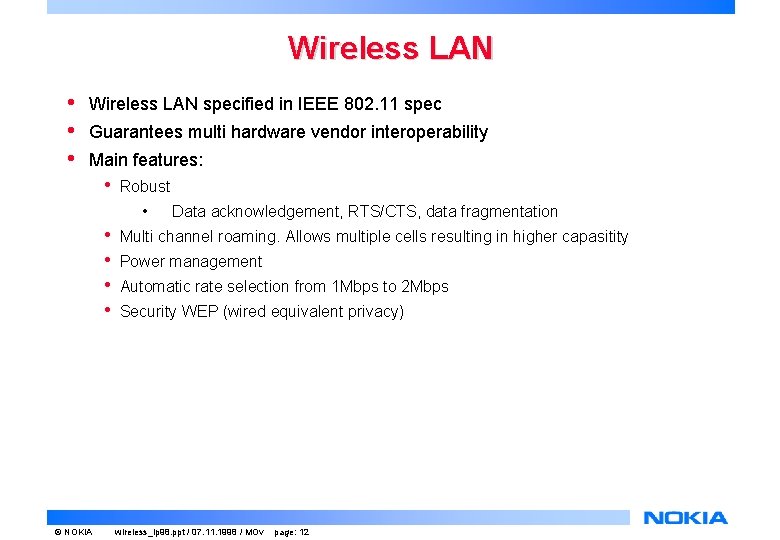
Wireless LAN • • • Wireless LAN specified in IEEE 802. 11 spec Guarantees multi hardware vendor interoperability Main features: • Robust • • • © NOKIA Data acknowledgement, RTS/CTS, data fragmentation Multi channel roaming. Allows multiple cells resulting in higher capasitity Power management Automatic rate selection from 1 Mbps to 2 Mbps Security WEP (wired equivalent privacy) wireless_ip 98. ppt / 07. 11. 1998 / MOv page: 12
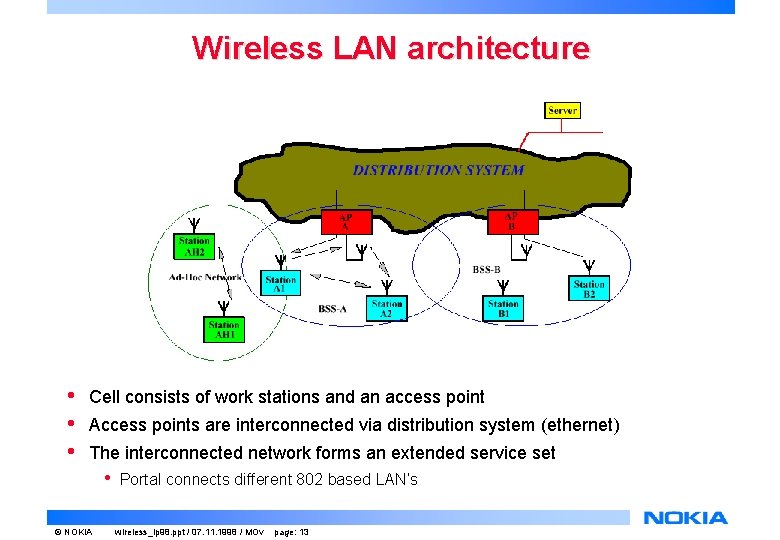
Wireless LAN architecture • • • Cell consists of work stations and an access point Access points are interconnected via distribution system (ethernet) The interconnected network forms an extended service set • © NOKIA Portal connects different 802 based LAN’s wireless_ip 98. ppt / 07. 11. 1998 / MOv page: 13
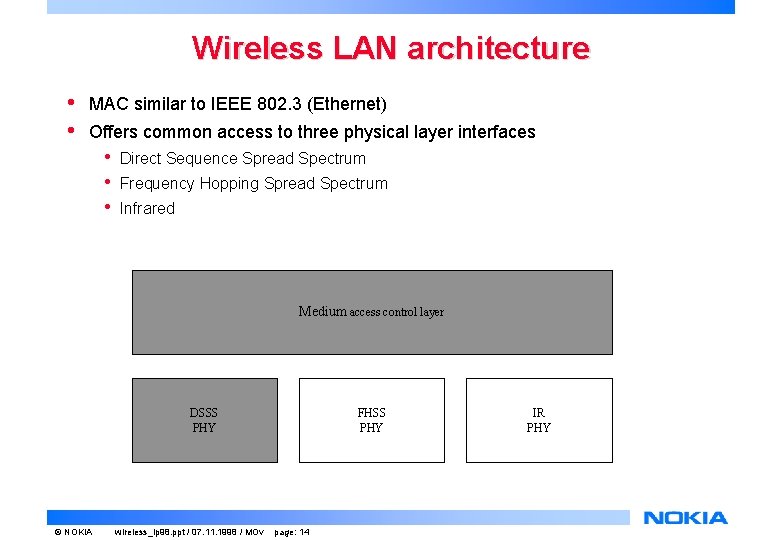
Wireless LAN architecture • • MAC similar to IEEE 802. 3 (Ethernet) Offers common access to three physical layer interfaces • • • Direct Sequence Spread Spectrum Frequency Hopping Spread Spectrum Infrared Medium access control layer DSSS PHY © NOKIA wireless_ip 98. ppt / 07. 11. 1998 / MOv FHSS PHY page: 14 IR PHY
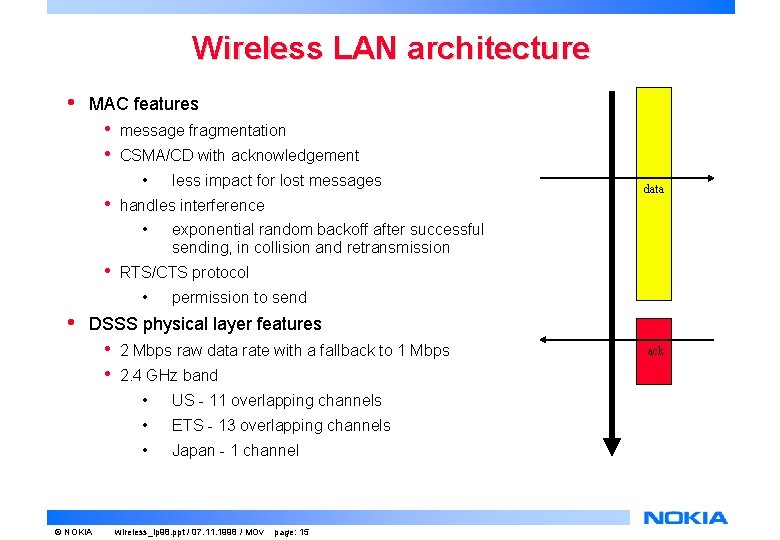
Wireless LAN architecture • MAC features • • message fragmentation CSMA/CD with acknowledgement • • handles interference • • data exponential random backoff after successful sending, in collision and retransmission RTS/CTS protocol • • less impact for lost messages permission to send DSSS physical layer features • • © NOKIA 2 Mbps raw data rate with a fallback to 1 Mbps 2. 4 GHz band • US - 11 overlapping channels • ETS - 13 overlapping channels • Japan - 1 channel wireless_ip 98. ppt / 07. 11. 1998 / MOv page: 15 ack
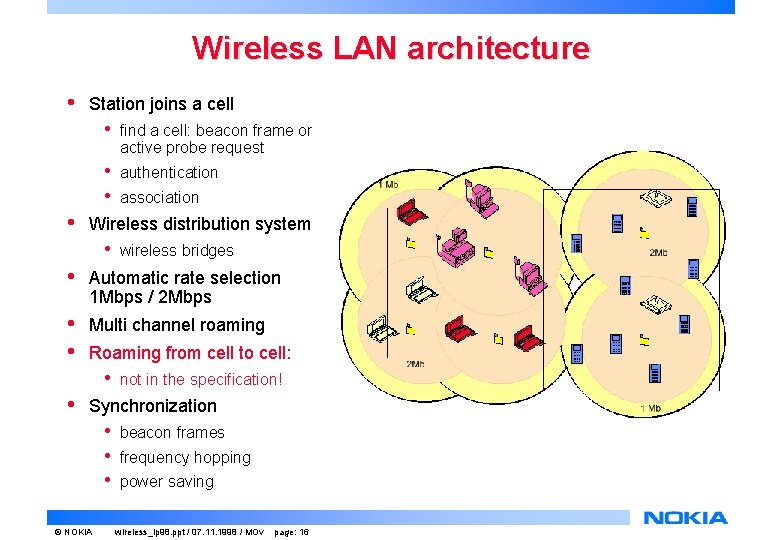
Wireless LAN architecture • • Station joins a cell • find a cell: beacon frame or active probe request • • authentication association Wireless distribution system • wireless bridges • Automatic rate selection 1 Mbps / 2 Mbps • • Multi channel roaming Roaming from cell to cell: • • not in the specification! Synchronization • • • © NOKIA beacon frames frequency hopping power saving wireless_ip 98. ppt / 07. 11. 1998 / MOv page: 16
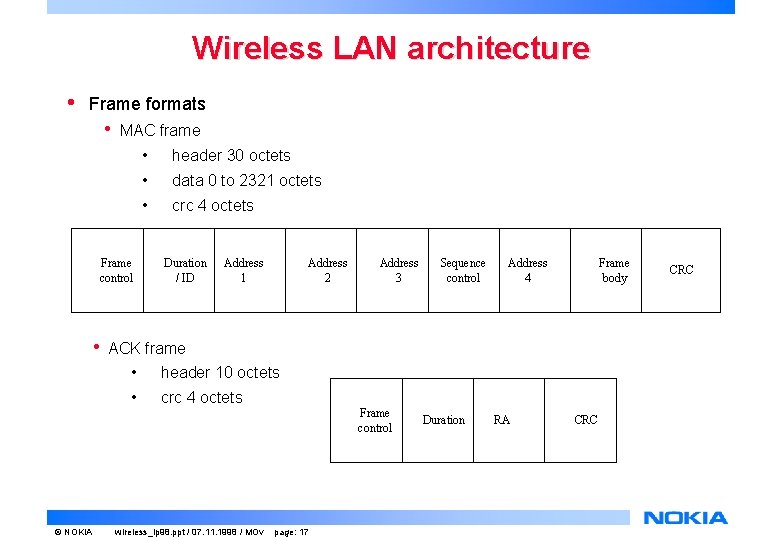
Wireless LAN architecture • Frame formats • MAC frame Frame control • © NOKIA • header 30 octets • data 0 to 2321 octets • crc 4 octets Duration / ID Address 1 Address 2 Address 3 Sequence control Address 4 Frame body ACK frame • header 10 octets • crc 4 octets wireless_ip 98. ppt / 07. 11. 1998 / MOv Frame control page: 17 Duration RA CRC
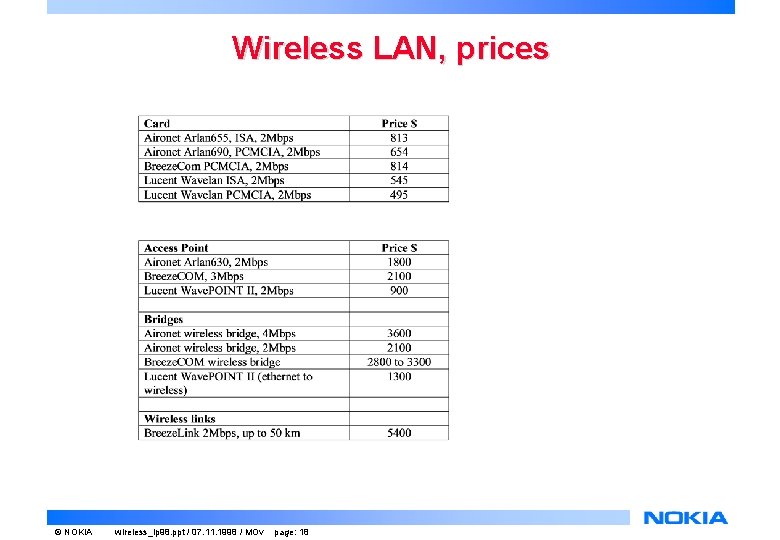
Wireless LAN, prices © NOKIA wireless_ip 98. ppt / 07. 11. 1998 / MOv page: 18
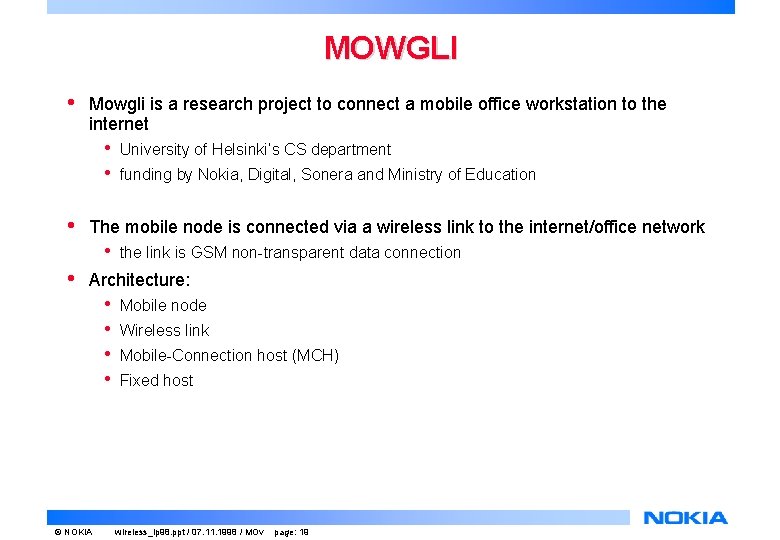
MOWGLI • Mowgli is a research project to connect a mobile office workstation to the internet • • • funding by Nokia, Digital, Sonera and Ministry of Education The mobile node is connected via a wireless link to the internet/office network • • University of Helsinki’s CS department the link is GSM non-transparent data connection Architecture: • • © NOKIA Mobile node Wireless link Mobile-Connection host (MCH) Fixed host wireless_ip 98. ppt / 07. 11. 1998 / MOv page: 19
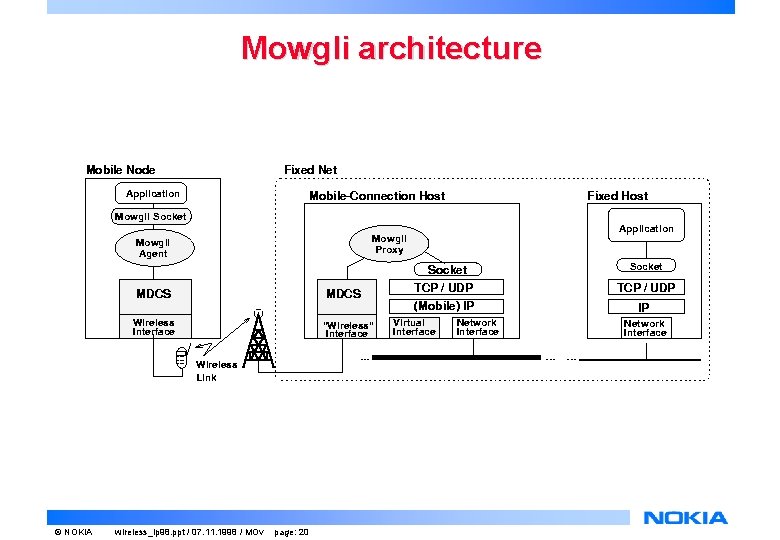
Mowgli architecture © NOKIA wireless_ip 98. ppt / 07. 11. 1998 / MOv page: 20
Mowgli • Mowgli preserves the socket interface • • • tcp/ip is replaced socket interface is modified: wireless environment related extensions Mowgli data channel service (MDCS) • • • bidirectional data channel streamed and message channels (similar to tcp and udp) 256 simultaneous channels independent per channel flow control priorities handles disconnections • • closing if idle, reconnections The MDCS properties are Mowgli socket API’s Qo. S services © NOKIA wireless_ip 98. ppt / 07. 11. 1998 / MOv page: 21
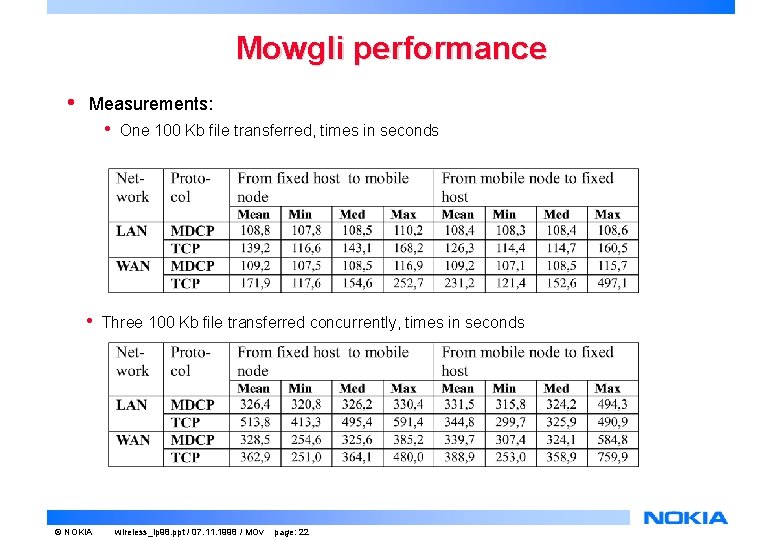
Mowgli performance • Measurements: • • © NOKIA One 100 Kb file transferred, times in seconds Three 100 Kb file transferred concurrently, times in seconds wireless_ip 98. ppt / 07. 11. 1998 / MOv page: 22
Wireless Application Protocol • • Wireless Application Protocol (WAP) is developed by WAP Forum is multivendor • • First WAP specification 1. 0 was released April 1998 • • the work groups carry on to include a broader representation WAP is aimed to • • • grounded by Ericsson, Motorola, Nokia and Unwired Planet bring Internet content to wireless mobile device create a global wireless protocol specification to work across different networks The WAP model resembles WWW-model © NOKIA wireless_ip 98. ppt / 07. 11. 1998 / MOv page: 23
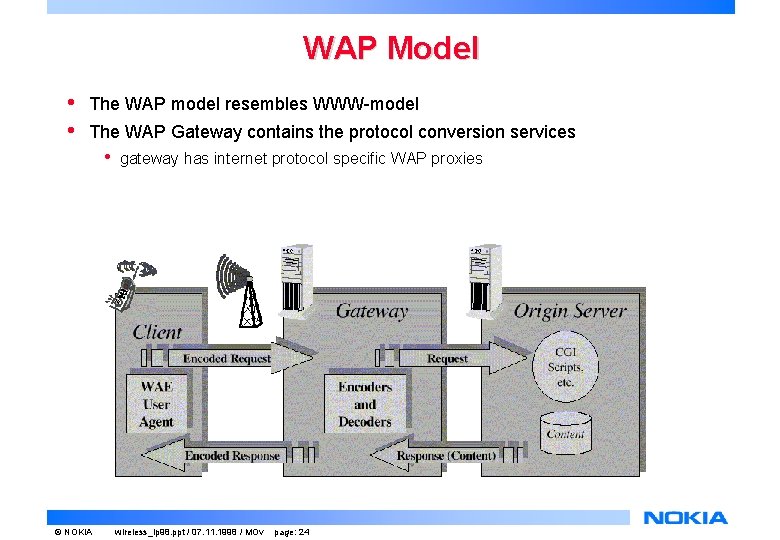
WAP Model • • The WAP model resembles WWW-model The WAP Gateway contains the protocol conversion services • © NOKIA gateway has internet protocol specific WAP proxies wireless_ip 98. ppt / 07. 11. 1998 / MOv page: 24
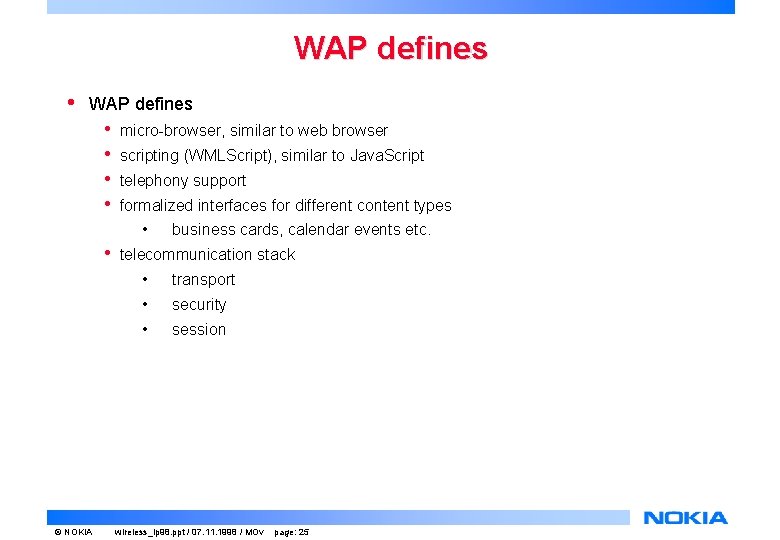
WAP defines • WAP defines • • micro-browser, similar to web browser scripting (WMLScript), similar to Java. Script telephony support formalized interfaces for different content types • • © NOKIA business cards, calendar events etc. telecommunication stack • transport • security • session wireless_ip 98. ppt / 07. 11. 1998 / MOv page: 25
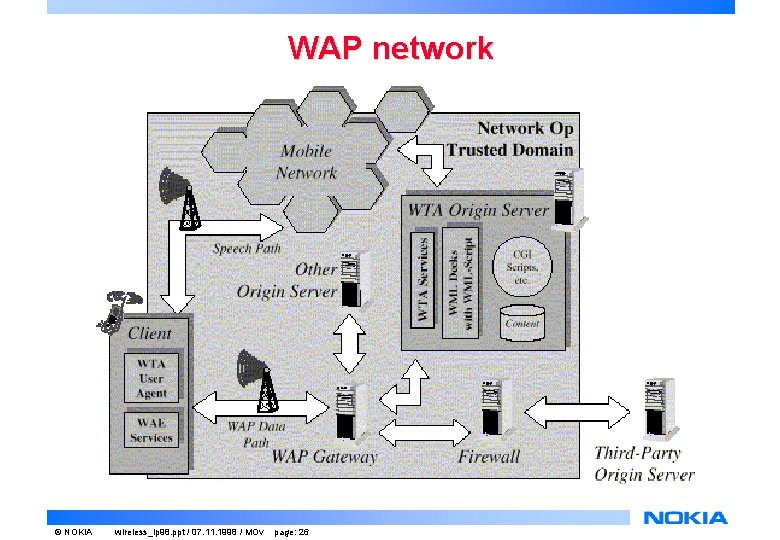
WAP network © NOKIA wireless_ip 98. ppt / 07. 11. 1998 / MOv page: 26
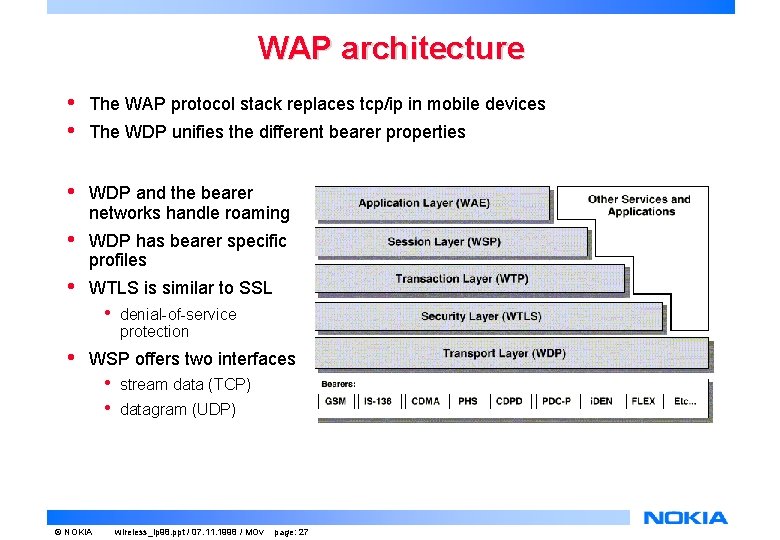
WAP architecture • • The WAP protocol stack replaces tcp/ip in mobile devices • WDP and the bearer networks handle roaming • WDP has bearer specific profiles • WTLS is similar to SSL The WDP unifies the different bearer properties • • denial-of-service protection WSP offers two interfaces • • © NOKIA stream data (TCP) datagram (UDP) wireless_ip 98. ppt / 07. 11. 1998 / MOv page: 27
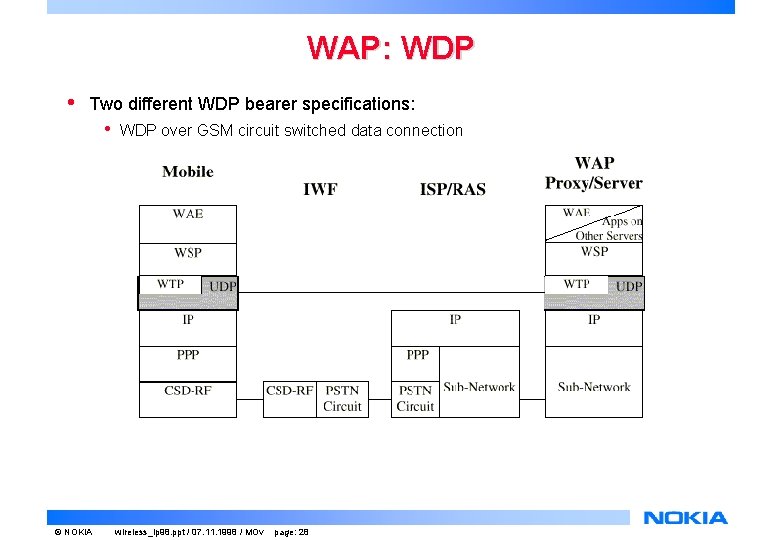
WAP: WDP • Two different WDP bearer specifications: • © NOKIA WDP over GSM circuit switched data connection wireless_ip 98. ppt / 07. 11. 1998 / MOv page: 28
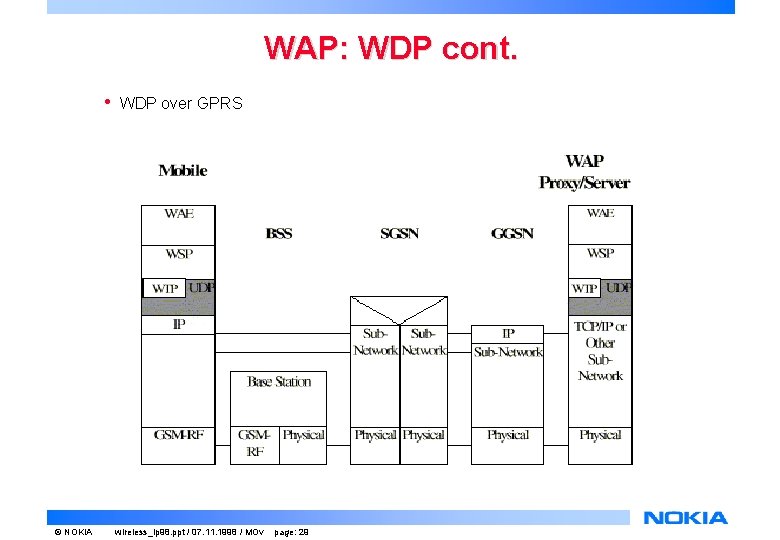
WAP: WDP cont. • © NOKIA WDP over GPRS wireless_ip 98. ppt / 07. 11. 1998 / MOv page: 29
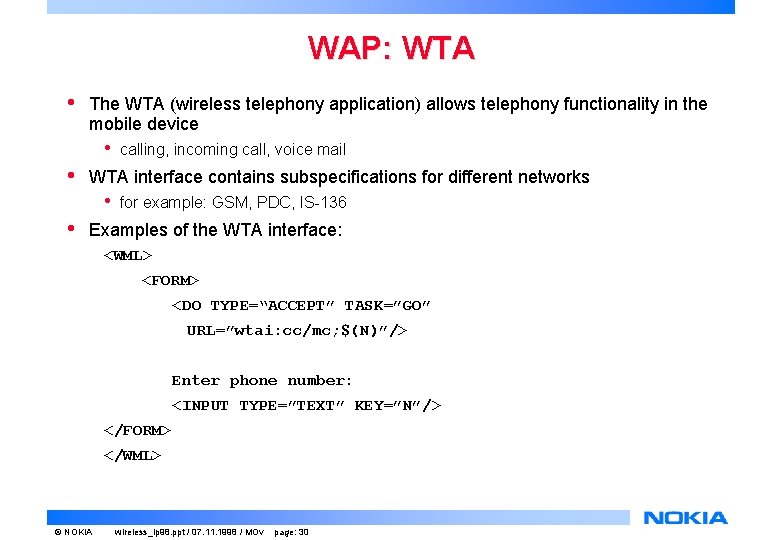
WAP: WTA • The WTA (wireless telephony application) allows telephony functionality in the mobile device • • WTA interface contains subspecifications for different networks • • calling, incoming call, voice mail for example: GSM, PDC, IS-136 Examples of the WTA interface: <WML> <FORM> <DO TYPE=“ACCEPT” TASK=”GO” URL=”wtai: cc/mc; $(N)”/> Enter phone number: <INPUT TYPE=”TEXT” KEY=”N”/> </FORM> </WML> © NOKIA wireless_ip 98. ppt / 07. 11. 1998 / MOv page: 30
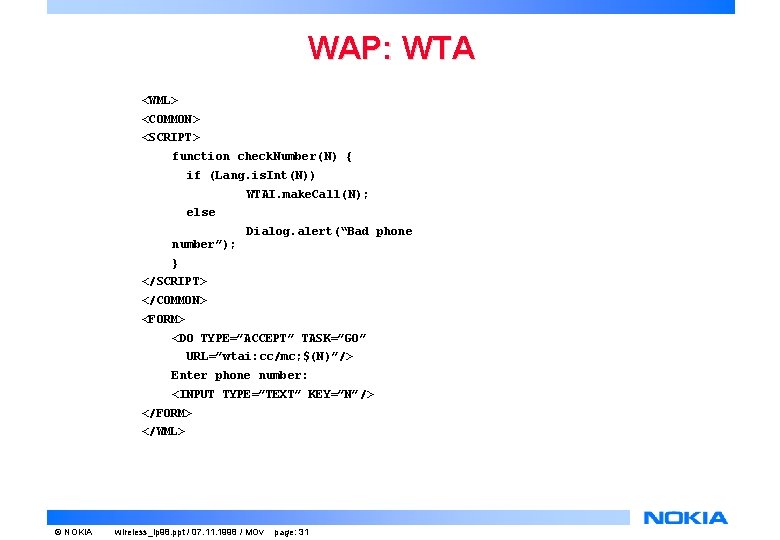
WAP: WTA <WML> <COMMON> <SCRIPT> function check. Number(N) { if (Lang. is. Int(N)) WTAI. make. Call(N); else number”); Dialog. alert(“Bad phone } </SCRIPT> </COMMON> <FORM> <DO TYPE=”ACCEPT” TASK=”GO” URL=”wtai: cc/mc; $(N)”/> Enter phone number: <INPUT TYPE=”TEXT” KEY=”N”/> </FORM> </WML> © NOKIA wireless_ip 98. ppt / 07. 11. 1998 / MOv page: 31
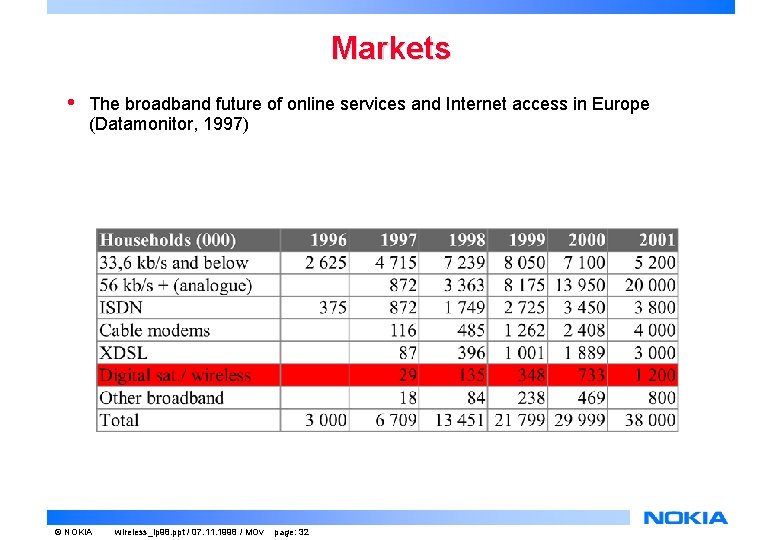
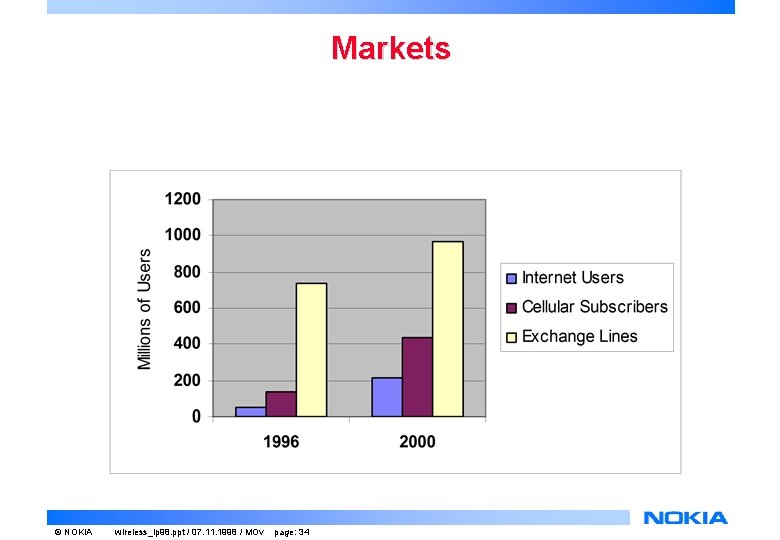
Markets • The broadband future of online services and Internet access in Europe (Datamonitor, 1997) © NOKIA wireless_ip 98. ppt / 07. 11. 1998 / MOv page: 32
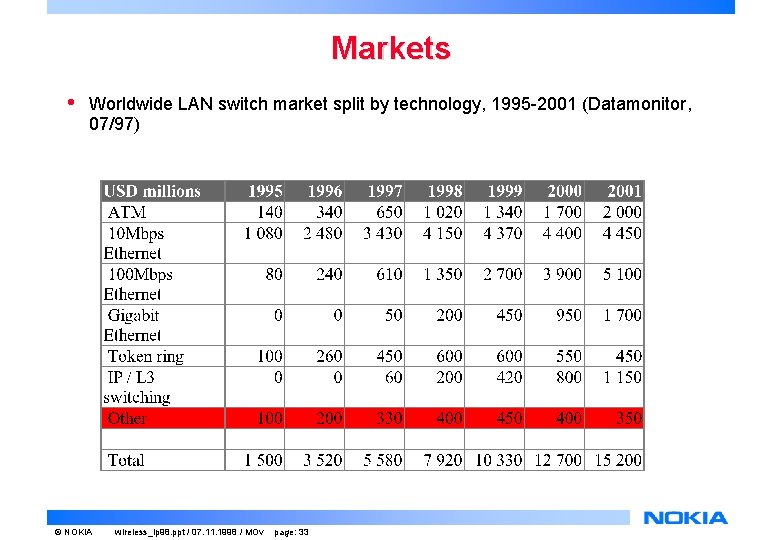
Markets • Worldwide LAN switch market split by technology, 1995 -2001 (Datamonitor, 07/97) © NOKIA wireless_ip 98. ppt / 07. 11. 1998 / MOv page: 33
Markets © NOKIA wireless_ip 98. ppt / 07. 11. 1998 / MOv page: 34