
Wireless Hotspots Current Challenges and Future Directions CSI

- Slides: 13
Wireless Hotspots: Current Challenges and Future Directions CSI 5175 Wireless and Mobile Electronic Commerce Networks and their Applications Mao Zhang 2009. 03. 20 1
Content �Introduction �An example scenario �Technological challenges �Alternative approaches to connectivity �Conclusions 2
Introduction � Today, users access the Internet at a variety of places and environments where they spend a considerable amount of time outside private networks. � Wireless local area networks (WLANs) have emerged as a promising networking platform to extend network connectivity to these public places, or hotspots. � WISPs have established Wi-Fi hotspots in increasing numbers at public venues. � Several technological and deployment challenges remaining Ø Can roam anywhere? Ø Easy configuration? Ø A common way to authenticate? Ø Payment and billing? Ø Get bandwidth required? Ø Alternative network access technologies? Ø In summary, problems include authentication, security, coverage, management, location services, billing, and interoperability. 3
An example scenario �A scenario to motivate the vision of widespread Wi-Fi availability and to explore the various barriers �Kate needs to travel from San Diego to New York to attend a business meeting. Ø A presentation needs to send to colleagues before 4 the departure Ø Register with the meeting venue’s Wi-Fi and get the location within the building to be guided to the meeting room Ø During the meeting, retrieve data from San Diego through VPN and then share with colleagues over an in-room ad hoc wireless network
Technological challenges – Authenticating to the hotspot provider � Sometimes, authentication is coupled with wireless- hop security where only authorized users receive network access. � Authentication helps the network to establish the users’ identity, while wireless-hop security ensures data privacy for authenticated users and protection for the network. � Repeat authentication at each hotspot location and the process might be configured differently. � Research questions: Ø Ease of access and mechanism Ø Authentication Latency: existing hardware mechanisms 5 such as SIM-Card based authentication? Ø User Identity: existing identities such as those already through other services Ø 3 rd party authenticators?
Technological challenges – Wirelesshop security �Security mechanisms provide data privacy to network users and also protect the network against malicious use. �Current approaches include per-user authentication, authorization of authenticated users through access keys, and access control, a number of schemes achieve security and provide authentication at MAC are being deployed in WLans Ø WEP is simple to manage in environment with 6 known users. Ø Port-based network access control: ports are configured to block all traffic except authentication
Technological challenges – Wirelesshop security - Continued �Security challenges Ø Mutual Trust: e. g. , implicit trust in the key distributor 7 in WEP Ø Dynamic Key Management: simplified and transparent key exchange and renew Ø Hardware Approaches: Are there ways to provide the robustness of 802. 1 X through alternative hardware-based approaches? Ø Denial-of-Service: Current 802. 11 Wi-Fi networks are highly susceptible to denial-of-service (Do. S) attacks Ø Malicious Attacks: Hotspots are a comparatively open environment for malicious users
Technological challenges – Network performance and Qo. S � The ability to adequately provide capacity and coverage to handle dynamically-varying, locationdependent user load. Ø Understand the users’ behavior Ø Adapt to the changing resource availability or changing traffic characteristics which is not easy Ø Suggestion if adaptation is not possible �Questions for research Ø Measurement and Modeling Ø Monitoring (measurements of throughput, channel contention, packet errors, etc. ) Ø Qo. S Enforcement: How can MAC protocols be designed to guarantee users a fair share of the wireless bandwidth and better channel utilization 8
Technological challenges – Location and context-awareness �Hotspots has the potential to make location and context-aware services more valuable and readily accessible to users �Requires a number of issues to be addressed Ø Application scenarios Ø Location Privacy and Anonymity: balance Ø Sensor Fusion: possibility to integrate multiple 9 location sensing technologies Ø Location Granularity: absolute location vs. relative location Ø Location to Place: the capability to translate geographic location information into a more usable form
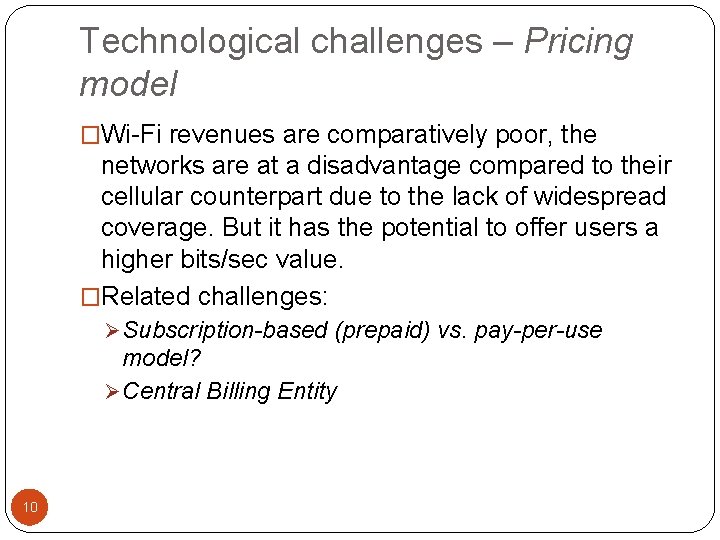
Technological challenges – Pricing model �Wi-Fi revenues are comparatively poor, the networks are at a disadvantage compared to their cellular counterpart due to the lack of widespread coverage. But it has the potential to offer users a higher bits/sec value. �Related challenges: Ø Subscription-based (prepaid) vs. pay-per-use model? Ø Central Billing Entity 10
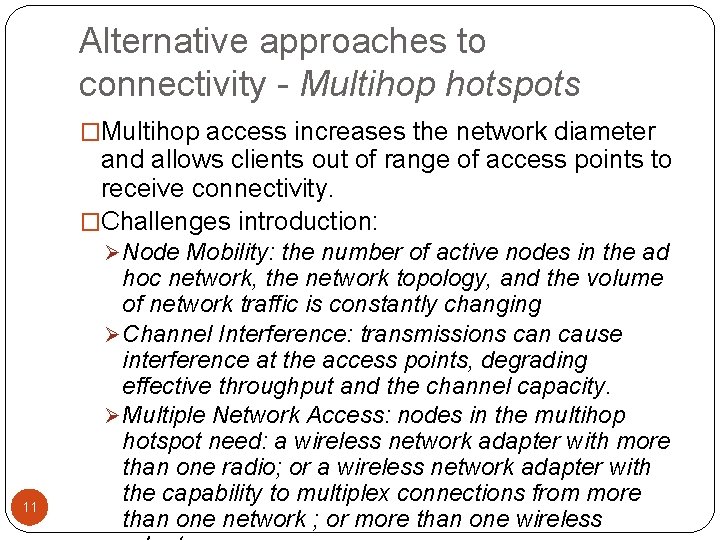
Alternative approaches to connectivity - Multihop hotspots �Multihop access increases the network diameter and allows clients out of range of access points to receive connectivity. �Challenges introduction: Ø Node Mobility: the number of active nodes in the ad 11 hoc network, the network topology, and the volume of network traffic is constantly changing Ø Channel Interference: transmissions can cause interference at the access points, degrading effective throughput and the channel capacity. Ø Multiple Network Access: nodes in the multihop hotspot need: a wireless network adapter with more than one radio; or a wireless network adapter with the capability to multiplex connections from more than one network ; or more than one wireless
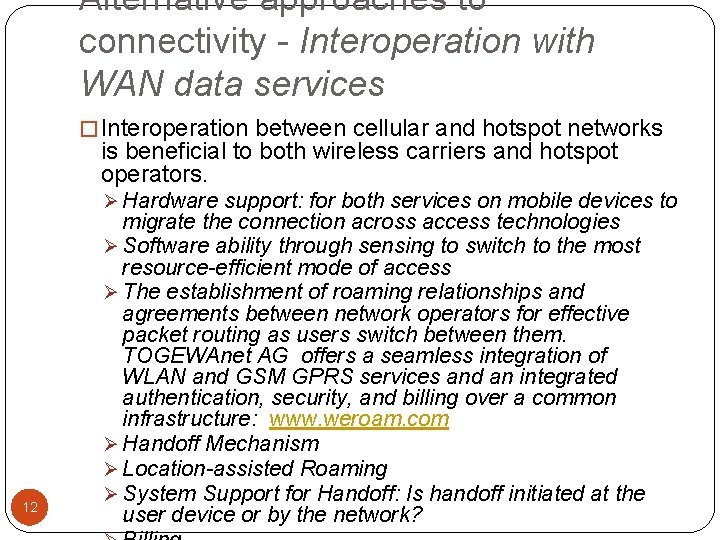
Alternative approaches to connectivity - Interoperation with WAN data services � Interoperation between cellular and hotspot networks is beneficial to both wireless carriers and hotspot operators. Ø Hardware support: for both services on mobile devices to 12 migrate the connection across access technologies Ø Software ability through sensing to switch to the most resource-efficient mode of access Ø The establishment of roaming relationships and agreements between network operators for effective packet routing as users switch between them. TOGEWAnet AG offers a seamless integration of WLAN and GSM GPRS services and an integrated authentication, security, and billing over a common infrastructure: www. weroam. com Ø Handoff Mechanism Ø Location-assisted Roaming Ø System Support for Handoff: Is handoff initiated at the user device or by the network?
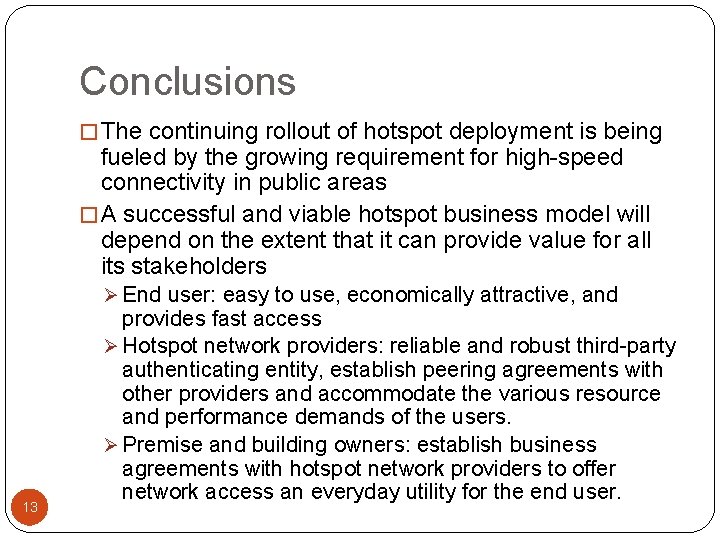
Conclusions � The continuing rollout of hotspot deployment is being fueled by the growing requirement for high-speed connectivity in public areas � A successful and viable hotspot business model will depend on the extent that it can provide value for all its stakeholders Ø End user: easy to use, economically attractive, and 13 provides fast access Ø Hotspot network providers: reliable and robust third-party authenticating entity, establish peering agreements with other providers and accommodate the various resource and performance demands of the users. Ø Premise and building owners: establish business agreements with hotspot network providers to offer network access an everyday utility for the end user.