
Wireless Ethernet Backhaul A Carriers Perspective Rajesh Yadav
Wireless Ethernet Backhaul : A Carrier’s Perspective Rajesh Yadav rajesh. yadav@verizon. com Access Network Architecture and Design Verizon Communications
Presentation Outline w Trends in Wireless Backhaul Bandwidth w Ethernet Backhaul Service Requirements w Present Wireless Backhaul Technologies w Drivers for Ethernet Backhaul over PON w Implementation of Ethernet Backhaul over GPON w Concluding Remarks © Verizon 2009 All Rights Reserved
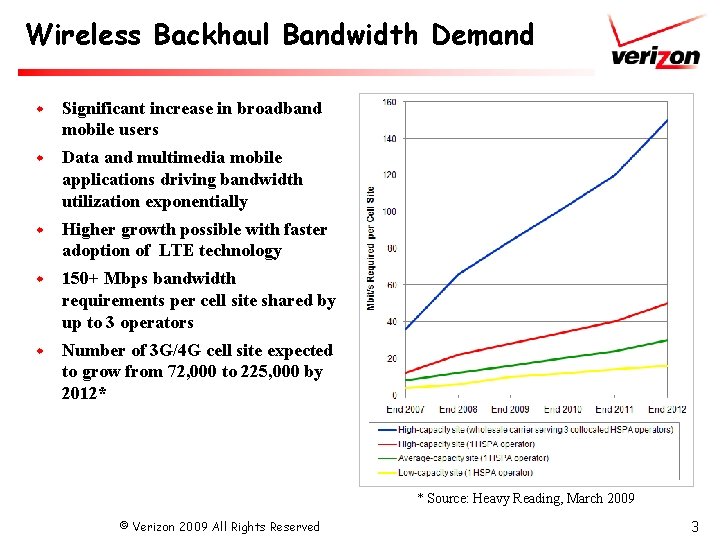
Wireless Backhaul Bandwidth Demand w Significant increase in broadband mobile users w Data and multimedia mobile applications driving bandwidth utilization exponentially w Higher growth possible with faster adoption of LTE technology w 150+ Mbps bandwidth requirements per cell site shared by up to 3 operators w Number of 3 G/4 G cell site expected to grow from 72, 000 to 225, 000 by 2012* * Source: Heavy Reading, March 2009 © Verizon 2009 All Rights Reserved 3
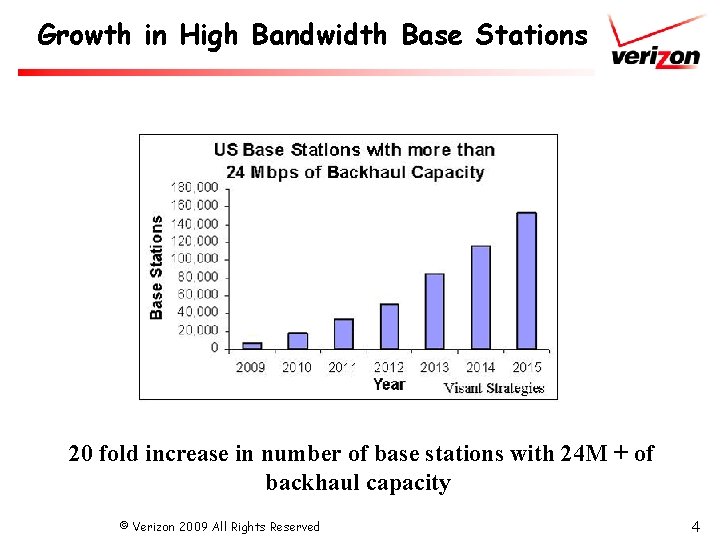
Growth in High Bandwidth Base Stations 20 fold increase in number of base stations with 24 M + of backhaul capacity © Verizon 2009 All Rights Reserved 4
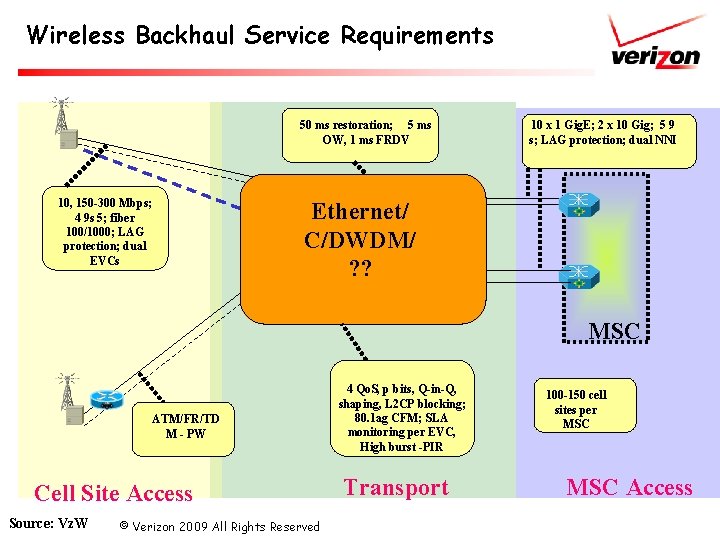
Wireless Backhaul Service Requirements 50 ms restoration; 5 ms OW, 1 ms FRDV 10, 150 -300 Mbps; 4 9 s 5; fiber 100/1000; LAG protection; dual EVCs 10 x 1 Gig. E; 2 x 10 Gig; 5 9 s; LAG protection; dual NNI Ethernet/ C/DWDM/ ? ? MSC ATM/FR/TD M - PW Cell Site Access Source: Vz. W © Verizon 2009 All Rights Reserved 4 Qo. S, p bits, Q-in-Q, shaping, L 2 CP blocking; 80. 1 ag CFM; SLA monitoring per EVC, High burst -PIR Transport 100 -150 cell sites per MSC Access
Ethernet Backhaul Service Requirements w Cost effective scalable solution for Ethernet bandwidth up to 150 -300 Mbps per cell site Initial requirements from carriers is for guaranteed bandwidth between cell site and MSC location - w Maintains the current model of using TDM based transport “pipes” Expected evolution to multiple classes of service to better match traffic characteristics to the transport need Circuit emulation support for TDM/ATM/FR Migration of cell sites with existing TDM/ATM/FR interfaces on a common Ethernet backhaul network Coexistence of TDM and Ethernet backhaul expected for sometime © Verizon 2009 All Rights Reserved
Ethernet Backhaul Service Requirements – cont. w Low latency, jitter and packet loss transport w Multiple classes of service w Transport network reliability 5 9’s 50 ms restoration desired w Timing and frequency synchronization w Performance monitoring and Real time SLAs w Comprehensive Network management and OAM capability © Verizon 2009 All Rights Reserved
Present Backhaul Technologies w Leased T 1 lines over copper Most prevalent for cell site backhaul today - w Up to 8 -10 T 1 s used per cell site Widely available High cost Not scalable to meet projected high bandwidth demands Optimized for voice traffic with dedicated bandwidth with little flexibility for bursty traffic High capacity Microwave Ethernet backhaul Better bandwidth scalability compared to leased T 1 lines Use of licensed spectrum Somewhat limited reach and line of sight requirements Susceptible to interferences © Verizon 2009 All Rights Reserved 8
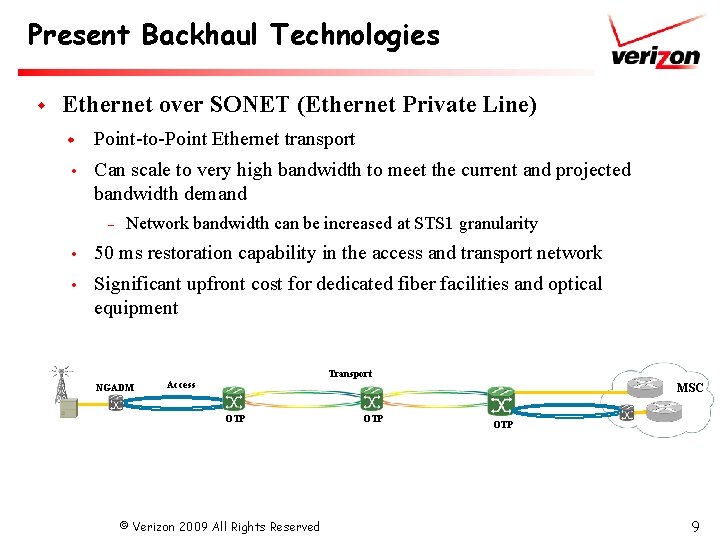
Present Backhaul Technologies w Ethernet over SONET (Ethernet Private Line) w Point-to-Point Ethernet transport Can scale to very high bandwidth to meet the current and projected bandwidth demand - Network bandwidth can be increased at STS 1 granularity 50 ms restoration capability in the access and transport network Significant upfront cost for dedicated fiber facilities and optical equipment NGADM Transport Access MSC OTP © Verizon 2009 All Rights Reserved OTP 9
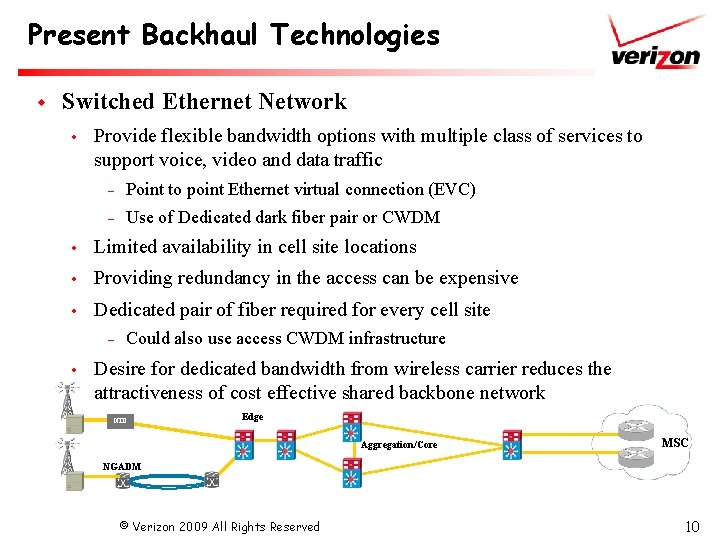
Present Backhaul Technologies w Switched Ethernet Network Provide flexible bandwidth options with multiple class of services to support voice, video and data traffic - Point to point Ethernet virtual connection (EVC) - Use of Dedicated dark fiber pair or CWDM Limited availability in cell site locations Providing redundancy in the access can be expensive Dedicated pair of fiber required for every cell site - Could also use access CWDM infrastructure Desire for dedicated bandwidth from wireless carrier reduces the attractiveness of cost effective shared backbone network NID Edge Aggregation/Core MSC NGADM © Verizon 2009 All Rights Reserved 10
Why GPON? § GPON (Gigabit Passive Optical Network) provides high bandwidth capacity which can be used in effective “pay as you grow” model 2. 4 Gbps in downstream and 1. 2 Gbps in upstream generally shared across 32 customers Cost efficient point–to–multipoint utilization of fiber without need for dedicated fiber infrastructure - Only ~25% cell site are currently passed with fiber NG PON will be able to support up to 10 Gbps § Growing availability of GPON deployment in cell site locations § Highly reliable with no active components in outside plant § Ability to provide smooth migration from current TDM based backhaul to scalable Ethernet backhaul using hybrid TDM and Ethernet backhaul model § Convergence of residential and business services over common infrastructure © Verizon 2009 All Rights Reserved 11
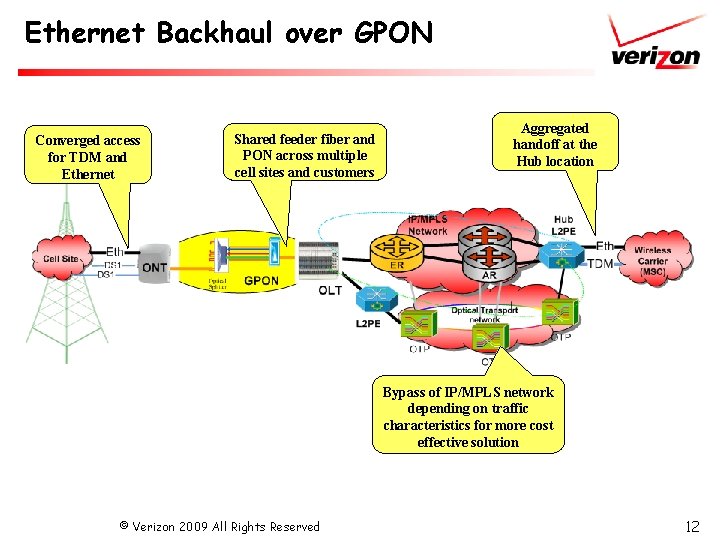
Ethernet Backhaul over GPON Converged access for TDM and Ethernet Shared feeder fiber and PON across multiple cell sites and customers Aggregated handoff at the Hub location Bypass of IP/MPLS network depending on traffic characteristics for more cost effective solution © Verizon 2009 All Rights Reserved 12
Implementation of Ethernet Backhaul over GPON w GPON ONT can cost effectively support from 10 Mbps to potentially 100 s of Mbps to a cell site Bandwidth can be added on as needed basis w Support for guaranteed bandwidth to emulate current guaranteed “pipe” model with TDM based backhaul w Evolution to model with multiple classes of services to optimize bandwidth need to the traffic characteristics for more cost efficient backhaul w Class of service differentiation based on 802. 1 p (p-bits) in VLAN header or DSCP in IP header GPON provides support for carrying both Ethernet and TDM traffic © Verizon 2009 All Rights Reserved 13
Implementation of Ethernet Backhaul over GPON – cont. w Synchronization options with Ethernet backhaul over GPON Outside of the Ethernet transport network - Packet Based synchronization using dedicated packet flow - Via GPS at base station Retention of a T 1 circuit for synchronization IEEE 1588 v 2 Clock carried by circuit emulated data (e. g. T 1) over Ethernet Transport Synchronous Ethernet - GPON Transmission Convergence (GTC) layer supports the transport of an 8 k. Hz clock via 125 ms framing Transfer of synchronization over Ethernet interface on ONT w Redundancy can be supported at the cell site by providing dual connections from diverse PONs w Encryption of traffic with in GPON for additional layer of security © Verizon 2009 All Rights Reserved 14
Concluding Remarks w Increase in bandwidth demand for mobile backhaul with new data and multimedia mobile applications and evolution to 4 G technologies is creating significant opportunity for Ethernet backhaul Wireless carriers are looking for cost effective, scalable and flexible solution to meet expected bandwidth demand w TDM and Ethernet will coexist for some time and backhaul solution should provide converged access to support this hybrid model with easy migration to Ethernet backhaul w GPON can provide scalable and cost effective “pay as grow” solution for Ethernet backhaul as the bandwidth demand for wireless backhaul grows overtime with evolution of wireless networks towards 4 G technologies © Verizon 2009 All Rights Reserved 15
- Slides: 15