
Wireless Data Processing System for Localized Io TEnabled
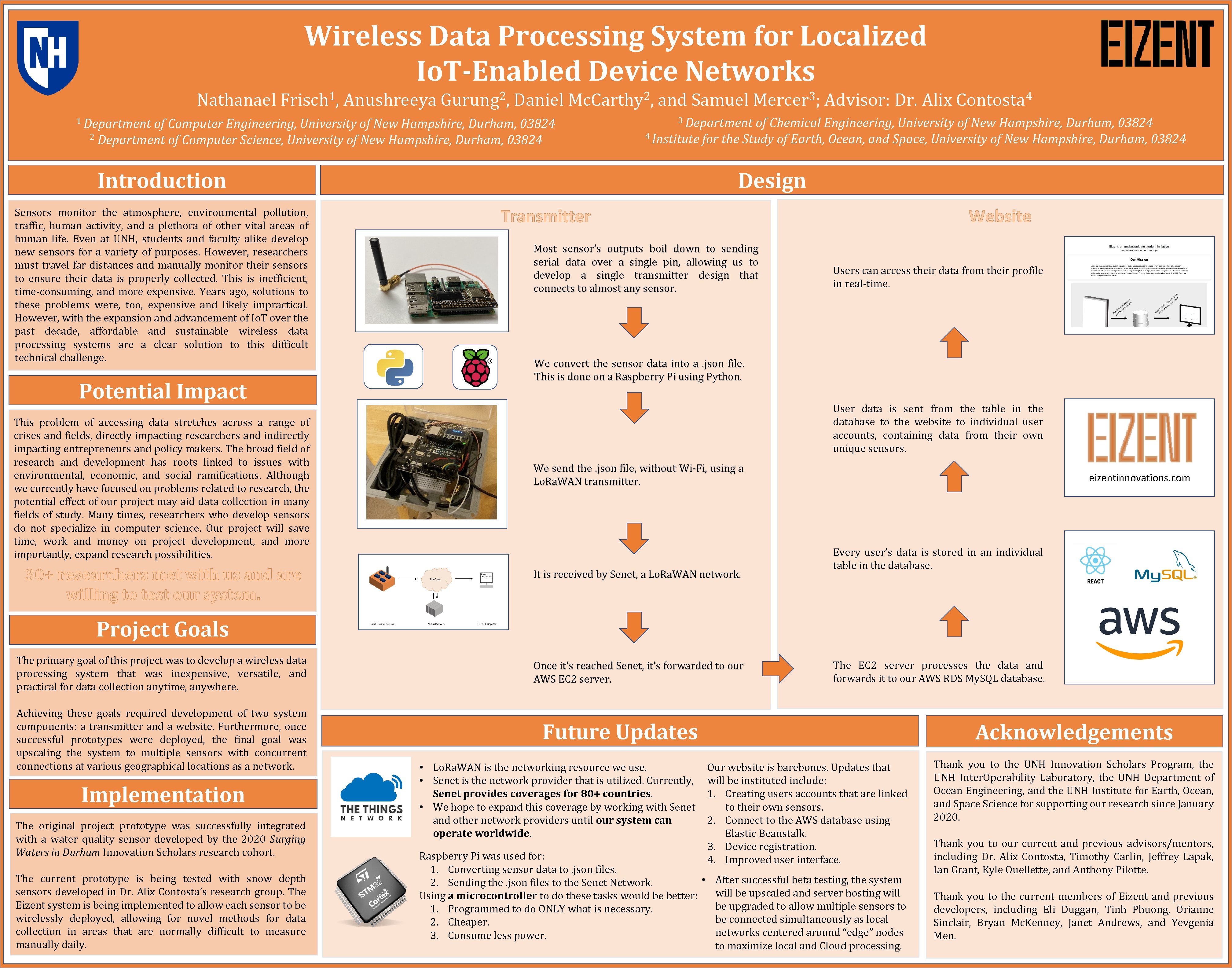
Wireless Data Processing System for Localized Io. T-Enabled Device Networks Nathanael 1 Frisch , Anushreeya 2 Gurung , Daniel 2 Mc. Carthy , 1 Department of Computer Engineering, University of New Hampshire, Durham, 03824 2 Department of Computer Science, University of New Hampshire, Durham, 03824 and Samuel Potential Impact This problem of accessing data stretches across a range of crises and fields, directly impacting researchers and indirectly impacting entrepreneurs and policy makers. The broad field of research and development has roots linked to issues with environmental, economic, and social ramifications. Although we currently have focused on problems related to research, the potential effect of our project may aid data collection in many fields of study. Many times, researchers who develop sensors do not specialize in computer science. Our project will save time, work and money on project development, and more importantly, expand research possibilities. 30+ researchers met with us and are willing to test our system. Advisor: Dr. Alix 4 Contosta 3 Department of Chemical Engineering, University of New Hampshire, Durham, 03824 4 Institute for the Study of Earth, Ocean, and Space, University of New Hampshire, Durham, 03824 Introduction Sensors monitor the atmosphere, environmental pollution, traffic, human activity, and a plethora of other vital areas of human life. Even at UNH, students and faculty alike develop new sensors for a variety of purposes. However, researchers must travel far distances and manually monitor their sensors to ensure their data is properly collected. This is inefficient, time-consuming, and more expensive. Years ago, solutions to these problems were, too, expensive and likely impractical. However, with the expansion and advancement of Io. T over the past decade, affordable and sustainable wireless data processing systems are a clear solution to this difficult technical challenge. 3 Mercer ; Design Website Transmitter Most sensor’s outputs boil down to sending serial data over a single pin, allowing us to develop a single transmitter design that connects to almost any sensor. Users can access their data from their profile in real-time. We convert the sensor data into a. json file. This is done on a Raspberry Pi using Python. User data is sent from the table in the database to the website to individual user accounts, containing data from their own unique sensors. We send the. json file, without Wi-Fi, using a Lo. Ra. WAN transmitter. It is received by Senet, a Lo. Ra. WAN network. eizentinnovations. com Every user’s data is stored in an individual table in the database. Project Goals The primary goal of this project was to develop a wireless data processing system that was inexpensive, versatile, and practical for data collection anytime, anywhere. Achieving these goals required development of two system components: a transmitter and a website. Furthermore, once successful prototypes were deployed, the final goal was upscaling the system to multiple sensors with concurrent connections at various geographical locations as a network. Implementation The original project prototype was successfully integrated with a water quality sensor developed by the 2020 Surging Waters in Durham Innovation Scholars research cohort. The current prototype is being tested with snow depth sensors developed in Dr. Alix Contosta’s research group. The Eizent system is being implemented to allow each sensor to be wirelessly deployed, allowing for novel methods for data collection in areas that are normally difficult to measure manually daily. Once it’s reached Senet, it’s forwarded to our AWS EC 2 server. The EC 2 server processes the data and forwards it to our AWS RDS My. SQL database. Future Updates • Lo. Ra. WAN is the networking resource we use. • Senet is the network provider that is utilized. Currently, Senet provides coverages for 80+ countries. • We hope to expand this coverage by working with Senet and other network providers until our system can operate worldwide. Acknowledgements Our website is barebones. Updates that will be instituted include: 1. Creating users accounts that are linked to their own sensors. 2. Connect to the AWS database using Elastic Beanstalk. 3. Device registration. 4. Improved user interface. Raspberry Pi was used for: 1. Converting sensor data to. json files. • After successful beta testing, the system 2. Sending the. json files to the Senet Network. will be upscaled and server hosting will Using a microcontroller to do these tasks would be better: be upgraded to allow multiple sensors to 1. Programmed to do ONLY what is necessary. be connected simultaneously as local 2. Cheaper. networks centered around “edge” nodes 3. Consume less power. to maximize local and Cloud processing. Thank you to the UNH Innovation Scholars Program, the UNH Inter. Operability Laboratory, the UNH Department of Ocean Engineering, and the UNH Institute for Earth, Ocean, and Space Science for supporting our research since January 2020. Thank you to our current and previous advisors/mentors, including Dr. Alix Contosta, Timothy Carlin, Jeffrey Lapak, Ian Grant, Kyle Ouellette, and Anthony Pilotte. Thank you to the current members of Eizent and previous developers, including Eli Duggan, Tinh Phuong, Orianne Sinclair, Bryan Mc. Kenney, Janet Andrews, and Yevgenia Men.
- Slides: 1