
WIRELESS CORE NETWORK EVOLUTION Scott Carlson Motorola Global
WIRELESS CORE NETWORK EVOLUTION Scott Carlson Motorola Global Telecom Solutions Sector June 5, 2004 1 © COPYRIGHT MOTOROLA 2004
Overview • Softswitch – What is it? • Softswitch in the Wireless Environment • Wireless/Wireline Convergence 2 © COPYRIGHT MOTOROLA 2004

Switching in General • Provides connectivity between users • Connects Access Networks into the Core Network • Provides advanced services – – Call Routing Call Features (3 WC, CFU, CFC, CWT, BNAT…) Call Accounting System Statistics • Interfaces to Feature Platforms – e. g. Voice Mail • Signaling interfaces to various Network Elements • Very high reliability and Qo. S requirements 3 © COPYRIGHT MOTOROLA 2004
Traditional Switches • • • 4 Circuit oriented TDM switch matrix Highly integrated Heirarchical architecture Specialized hardware © COPYRIGHT MOTOROLA 2004
Softswitch a New Approach • • • 5 Separate platforms for Call Control and Voice Path Standards defined “internal” interfaces (H. 248) Packet switching instead of TDM circuit-based Widely available hardware Allows distributed, more peer-to-peer architecture © COPYRIGHT MOTOROLA 2004

Softswitch Architecture Legacy Circuit Switch SS 7 Signaling & Control T D M Time Slot Interchange Line Interfaces SS 7 Signaling & Control SS 7 Packet Line Interfaces – Monolithic (Control + Bearer Integrated) – Proprietary Interfaces – Inefficient Resource Utilization – Limited Scalability – Higher Operating Costs – Long Feature Development Intervals 6 Soft Switch T D M TDM or IP Media Gateway TDM or IP – Disaggregated (Control separated from Bearer) – Open Interfaces – Most Efficient Resource Utilization – High Scalability – Lower Capital / Operating Costs – Rapid Feature Development © COPYRIGHT MOTOROLA 2004

Key Softswitch Benefits • Distributed architecture for more flexible network deployments • Highly scalable (up & down), independently scalable • Non-proprietary – quickly leverage technology improvements • Smaller footprint provides a reduces operations cost ~1/10 th the size of legacy switches • Lower maintenance with less hardware • IP/ATM provides a Reduced Transport Costs vs. TDM • Standards-based interfaces allow for faster feature development 7 © COPYRIGHT MOTOROLA 2004

Architecture Example Element Management System EMS Servers and RAID Æ Full O&M MSC Features Control Switch/ Call Server Æ Call processing Æ SS 7 and C 7 signaling cards Æ Accounting Session Control Manager Media Gateway Control Function SS 7 H/W Roaming Signaling Gateway Trunking Signaling Gateway CPU Media Gateway Æ Bearer Traffic Interface Æ High Port Densities Æ Multiple Transport Options 8 Scalable MGWs © COPYRIGHT MOTOROLA 2004
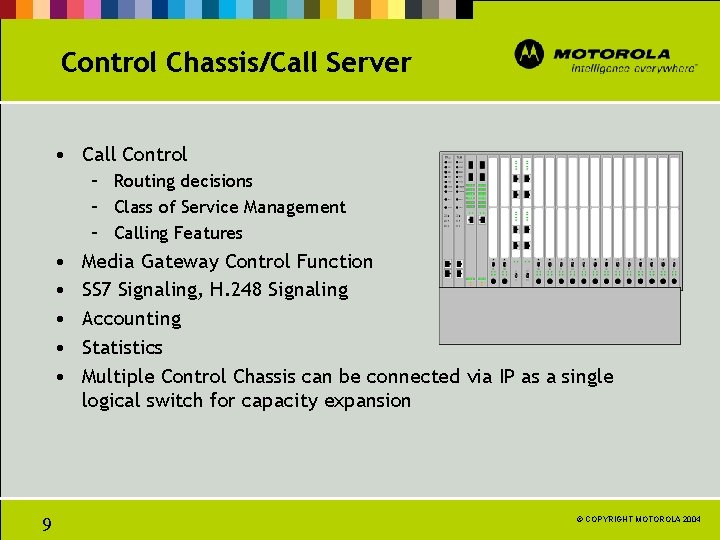
Control Chassis/Call Server • Call Control – Routing decisions – Class of Service Management – Calling Features • • • 9 Media Gateway Control Function SS 7 Signaling, H. 248 Signaling Accounting Statistics Multiple Control Chassis can be connected via IP as a single logical switch for capacity expansion © COPYRIGHT MOTOROLA 2004
Media Gateway • Supports TDM to TDM, TDM to IP and TDM to ATM under management of the Control Switch • Standards-based interoperability using H. 248/MEGACO and MGCP • Toll quality voice enabled using the G. 711 codec – Other compressed codecs can be supported such as G. 729 A, G. 723. 1 and G. 726 as well as G. 729 B and G. 711 with silence suppression – G. 168 echo cancellation algorithms and very low delay inherent provide voice quality equal to or better than the PSTN • Distributed architecture – can locate the MGW in separate frame in separate location 10 © COPYRIGHT MOTOROLA 2004
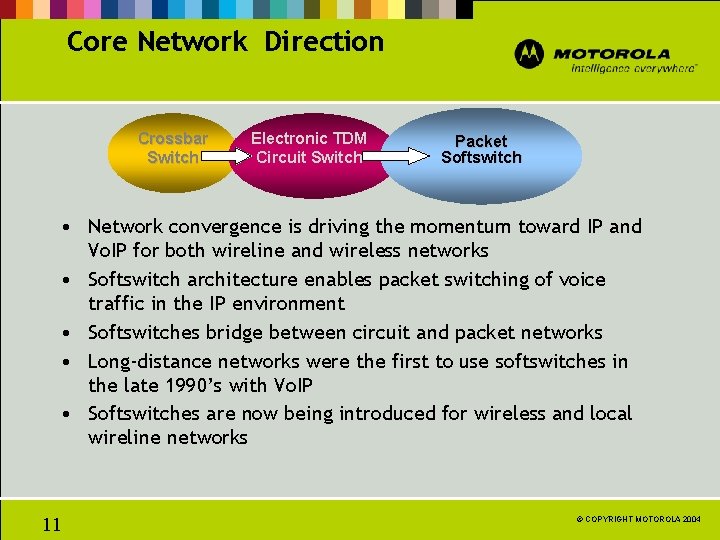
Core Network Direction Crossbar Switch Electronic TDM Circuit Switch Packet Softswitch • Network convergence is driving the momentum toward IP and Vo. IP for both wireline and wireless networks • Softswitch architecture enables packet switching of voice traffic in the IP environment • Softswitches bridge between circuit and packet networks • Long-distance networks were the first to use softswitches in the late 1990’s with Vo. IP • Softswitches are now being introduced for wireless and local wireline networks 11 © COPYRIGHT MOTOROLA 2004
Softswitch in the Wireless Environment Softswitching has become mainstream in 2004, which is a year earlier than we originally thought. It allows carriers to offer new services and lowers network operating costs. Wireline, Cable and Wireless operators as well as Enterprises are all in early deployments with this next-generation equipment. - BAIRD U. S. Equity Research 12 © COPYRIGHT MOTOROLA 2004
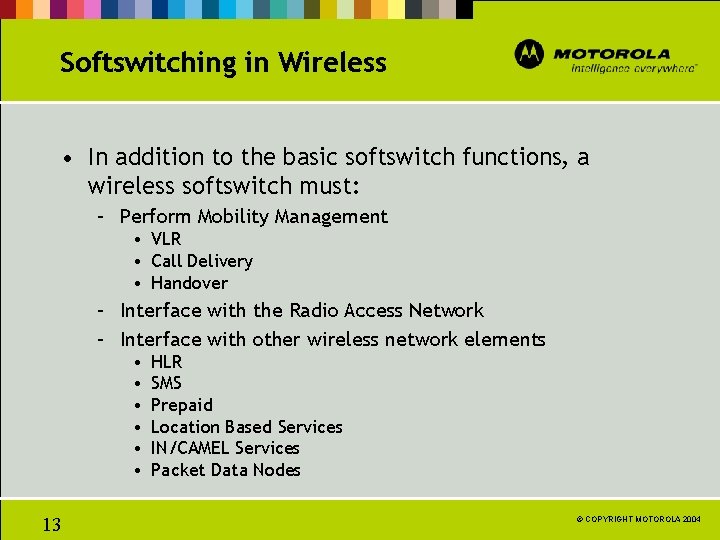
Softswitching in Wireless • In addition to the basic softswitch functions, a wireless softswitch must: – Perform Mobility Management • VLR • Call Delivery • Handover – Interface with the Radio Access Network – Interface with other wireless network elements • • • 13 HLR SMS Prepaid Location Based Services IN/CAMEL Services Packet Data Nodes © COPYRIGHT MOTOROLA 2004
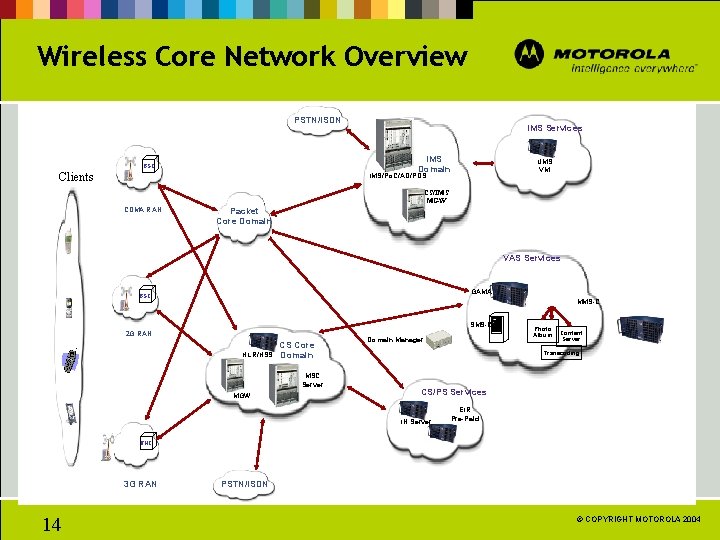
Wireless Core Network Overview PSTN/ISDN IMS Services IMS Domain BSC Clients UMS VM IMS/Po. C/AD/PDS CS/IMS MGW CDMA RAN Packet Core Domain VAS Services GAMA BSC MMS-C SMS-C 2 G RAN HLR/HSS CS Core Domain MSC Server MGW Domain Manager Photo Album Content Server Transcoding CS/PS Services IN Server EIR Pre-Paid RNC 3 G RAN 14 PSTN/ISDN © COPYRIGHT MOTOROLA 2004
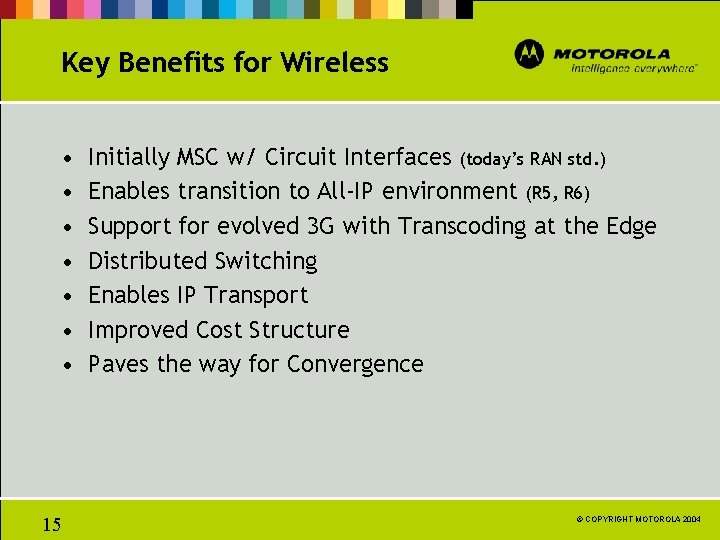
Key Benefits for Wireless • • 15 Initially MSC w/ Circuit Interfaces (today’s RAN std. ) Enables transition to All-IP environment (R 5, R 6) Support for evolved 3 G with Transcoding at the Edge Distributed Switching Enables IP Transport Improved Cost Structure Paves the way for Convergence © COPYRIGHT MOTOROLA 2004

Wireless / Wireline Convergence 16 © COPYRIGHT MOTOROLA 2004
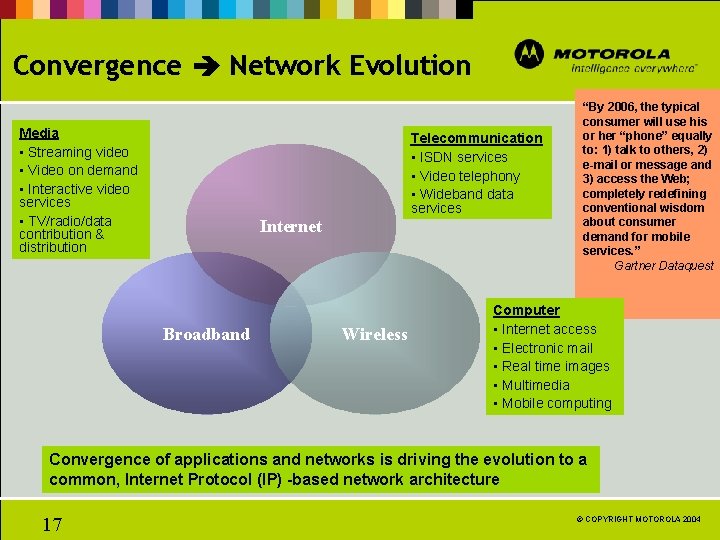
Convergence Network Evolution Media • Streaming video • Video on demand • Interactive video services • TV/radio/data contribution & distribution Telecommunication • ISDN services • Video telephony • Wideband data services Internet Broadband Wireless “By 2006, the typical consumer will use his or her “phone” equally to: 1) talk to others, 2) e-mail or message and 3) access the Web; completely redefining conventional wisdom about consumer demand for mobile services. ” Gartner Dataquest Computer • Internet access • Electronic mail • Real time images • Multimedia • Mobile computing Convergence of applications and networks is driving the evolution to a common, Internet Protocol (IP) -based network architecture 17 © COPYRIGHT MOTOROLA 2004
Core Network Convergence • Convergence can be viewed as: – Integrated Core Network / Unified Control Layer • Across access networks/devices/locations – Network that supports single device used at work, home and mobile, on various access networks – Services that can be accessed across variety of devices • IP Multimedia Subsystem (IMS) – 3 G standard for wireless and Internet convergence – Ideal solution for wireline/wireless convergence – Access independent (IP connectivity can be through GPRS, CDMA 2000, LAN etc. ) – Based on Internet standard Session Initiation Protocol (SIP) – Enables Multimedia Services 18 © COPYRIGHT MOTOROLA 2004
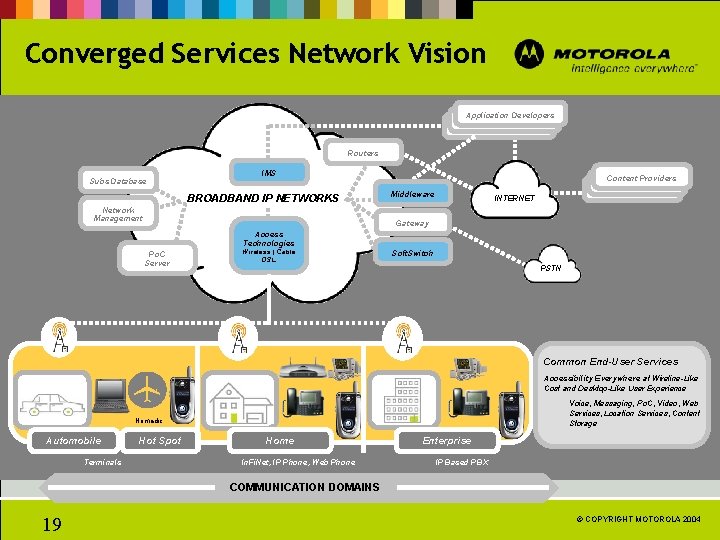
Converged Services Network Vision Application Developers Routers Subs Database IMS BROADBAND IP NETWORKS Network Management Middleware Content Providers INTERNET Gateway Access Technologies Po. C Server Wireless | Cable DSL Soft. Switch PSTN Common End-User Services Accessibility Everywhere at Wireline-Like Cost and Desktop-Like User Experience Voice, Messaging, Po. C, Video, Web Services, Location Services, Content Storage Nomadic Automobile Terminals Hot Spot Home In. Fi. Net, IP Phone, Web Phone Enterprise IP Based PBX COMMUNICATION DOMAINS 19 © COPYRIGHT MOTOROLA 2004
Seamless Mobility • Extend PBX into the mobile work place • Extend Cellular Network into WLAN environments – Optimize infrastructure costs – Optimize coverage – Manage quality of service • Residential: IMS-Packet. Cable-WLAN-Multi-mode device • Multi-mode devices – – 20 Vo. IP over WLAN Vo. IP over 3 G cellular high speed packet data GSM/CDMA voice Multimedia in all domains © COPYRIGHT MOTOROLA 2004
What are the challenges? • Intelligent management of the user experience across a variety of access networks: • Transition point between realms – IP-TDM-IP – Transcoding for voice, video • Interface with a variety of applications servers • Added complexity for Mobility Management – Inter-technology handover – Multiple standards • Qo. S Management • Requires Advanced User Devices – Multiple Radio Modes (GSM, GPRS, WLAN) – SIP Clients – New vocoders 21 © COPYRIGHT MOTOROLA 2004
The Pieces are Coming Together • Avaya, Motorola and Proxim have partnered to offer Enterprise Seamless Mobility solution due in 3 Q 04 • Several vendors have announced WLAN/cellular handsets recently – http: //www. pcworld. com/news/article/0, aid, 116334, 00. asp • Qualcomm MSM 7200 GSM/UMTS chipset supports WLAN and Bluetooth interfaces • Motorola demonstrated many of these concepts recently at WIRED Next. Fest 2004… 22 © COPYRIGHT MOTOROLA 2004
Liquid Media 23 © COPYRIGHT MOTOROLA 2004
Questions? 24 © COPYRIGHT MOTOROLA 2004
- Slides: 24