
Wireless Communication Systems CS NCTU Lecture 2 Modulation

- Slides: 48
Wireless Communication Systems @CS. NCTU Lecture 2: Modulation and Demodulation Reference: Chap. 5 in Goldsmith’s book Instructor: Kate Ching-Ju Lin (林靖茹) 1
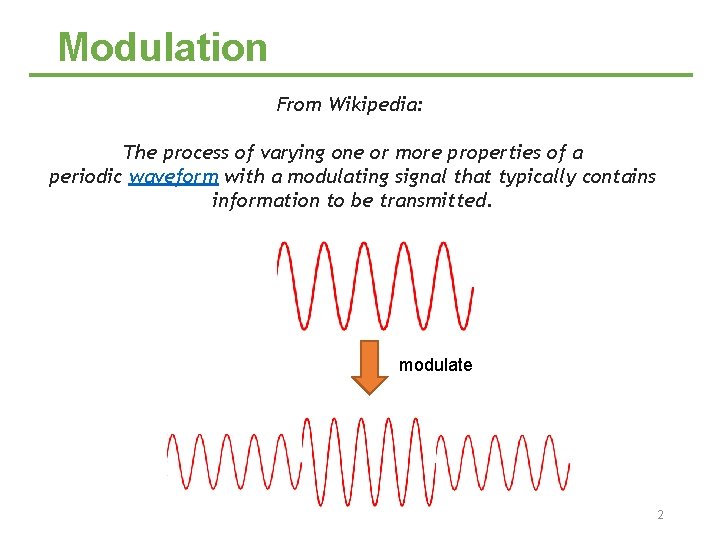
Modulation From Wikipedia: The process of varying one or more properties of a periodic waveform with a modulating signal that typically contains information to be transmitted. modulate 2
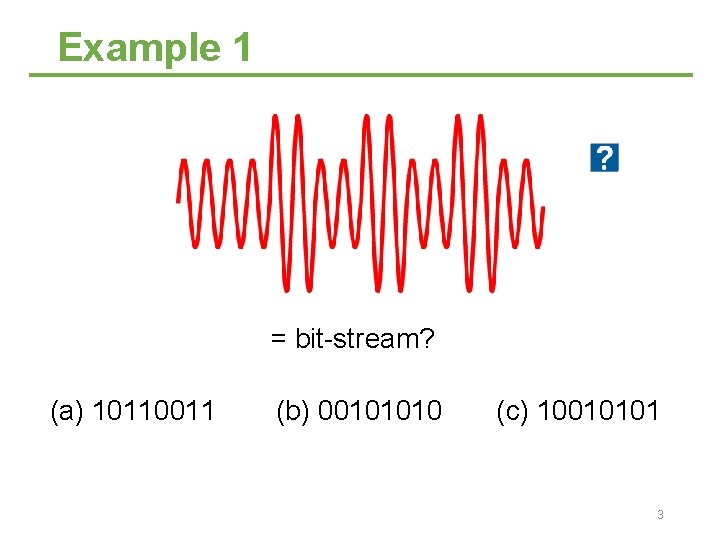
Example 1 = bit-stream? (a) 10110011 (b) 00101010 (c) 10010101 3
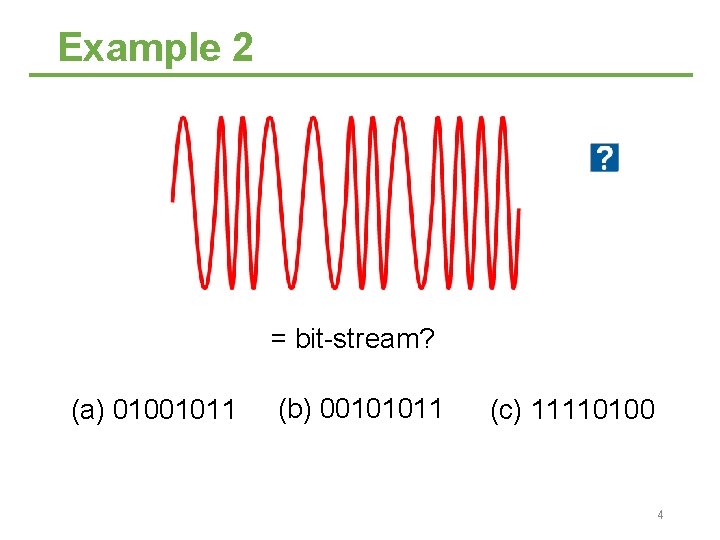
Example 2 = bit-stream? (a) 01001011 (b) 00101011 (c) 11110100 4
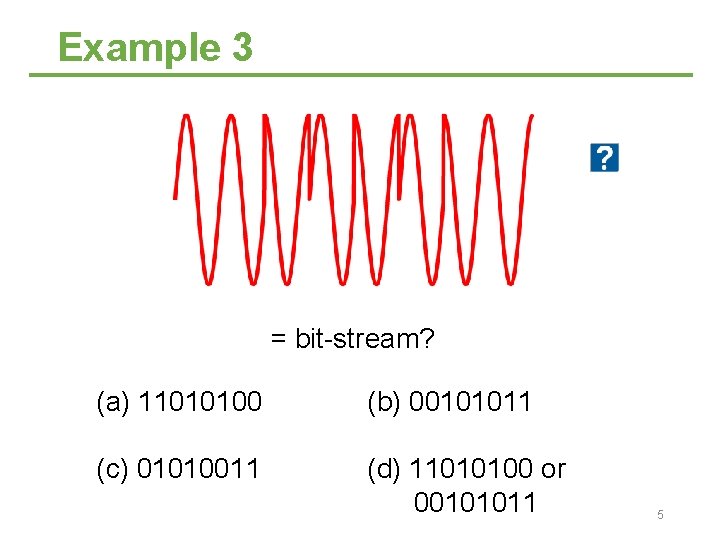
Example 3 = bit-stream? (a) 11010100 (b) 00101011 (c) 01010011 (d) 11010100 or 00101011 5
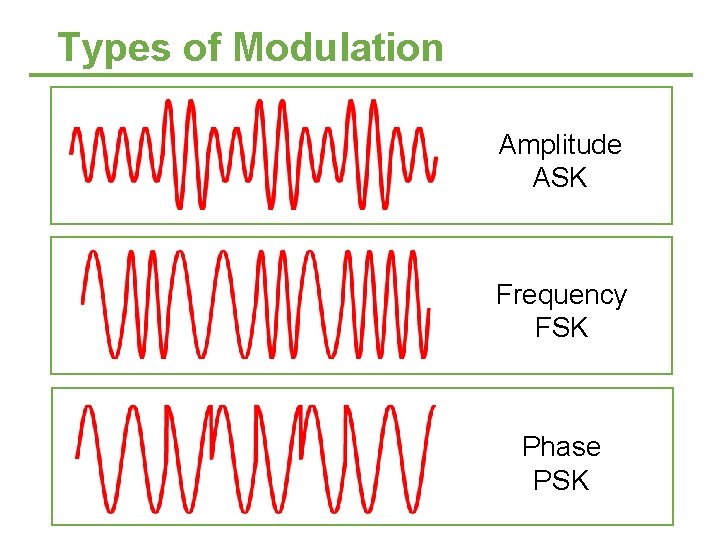
Types of Modulation Amplitude ASK Frequency FSK Phase PSK
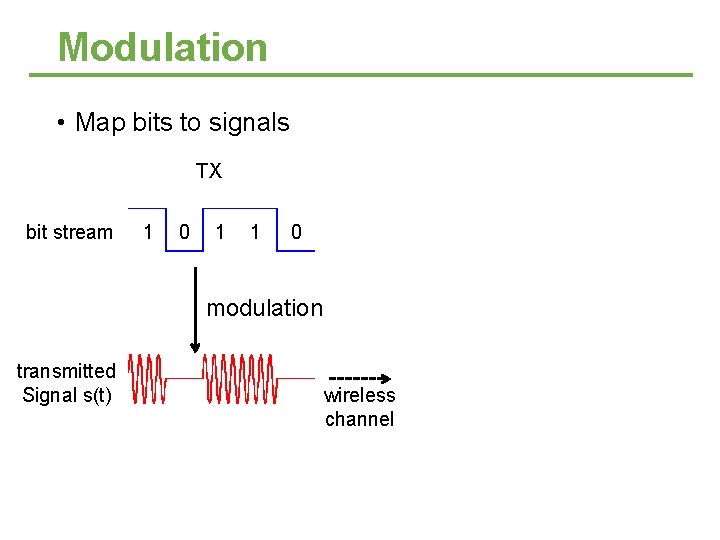
Modulation • Map bits to signals TX bit stream 1 0 1 1 0 modulation transmitted Signal s(t) wireless channel
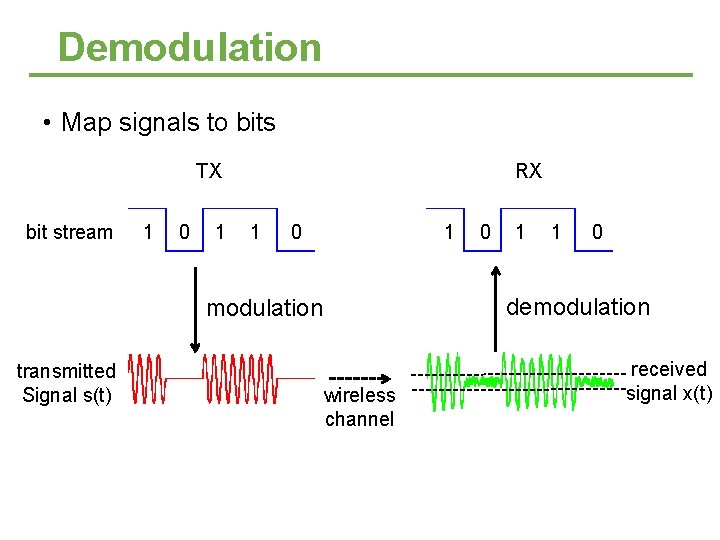
Demodulation • Map signals to bits TX bit stream 1 0 1 RX 1 0 1 1 1 0 demodulation transmitted Signal s(t) 0 wireless channel received signal x(t)
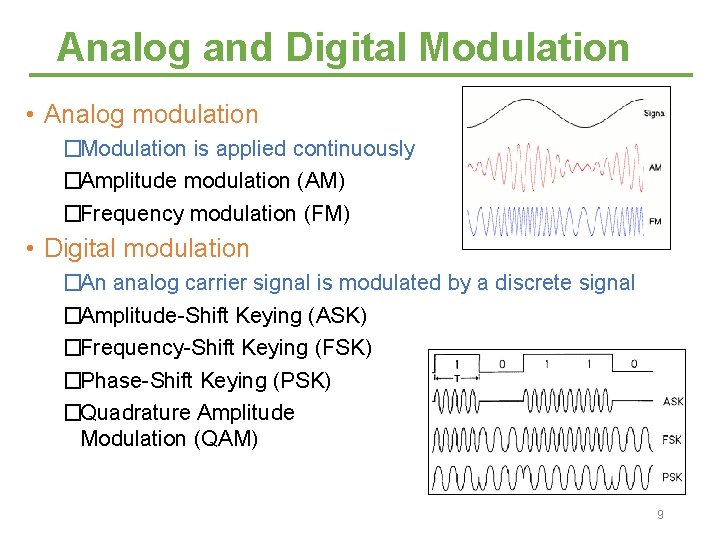
Analog and Digital Modulation • Analog modulation �Modulation is applied continuously �Amplitude modulation (AM) �Frequency modulation (FM) • Digital modulation �An analog carrier signal is modulated by a discrete signal �Amplitude-Shift Keying (ASK) �Frequency-Shift Keying (FSK) �Phase-Shift Keying (PSK) �Quadrature Amplitude Modulation (QAM) 9
Advantages of Digital Modulation • Higher data rate (given a fixed bandwidth) • More robust to channel impairment �Advanced coding/decoding can be applied to make signals less susceptible to noise and fading �Spread spectrum techniques can be applied to deal with multipath and resist interference • Suitable to multiple access �Become possible to detect multiple users simultaneously • Better security and privacy �Easier to encrypt 10
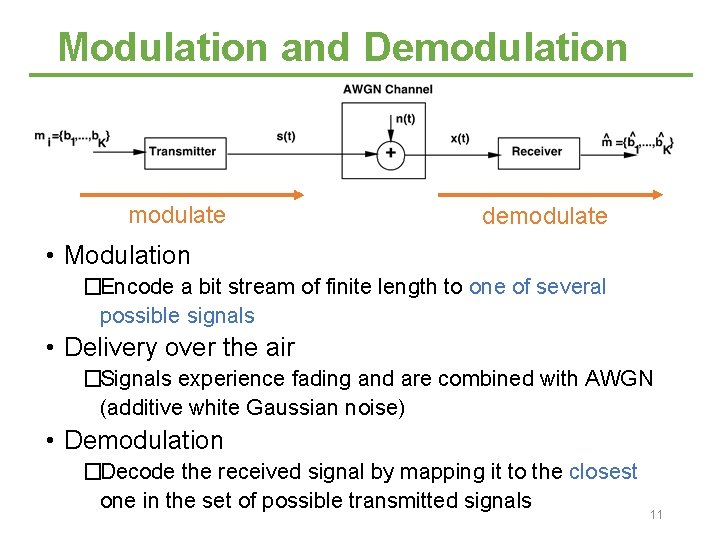
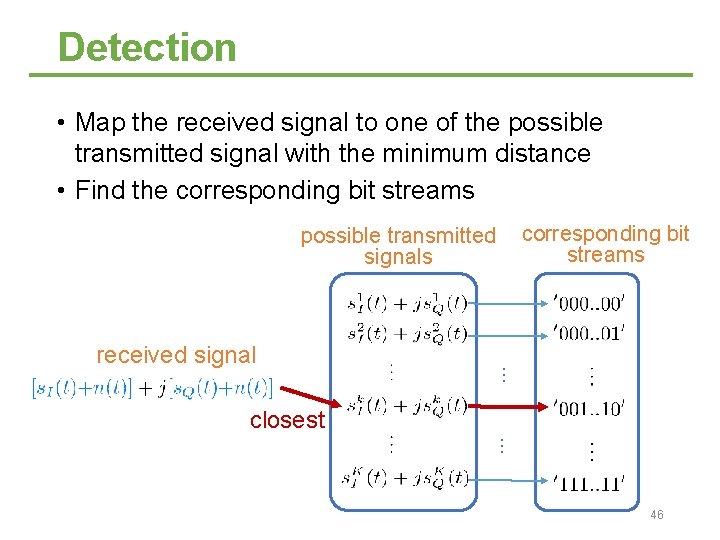
Modulation and Demodulation modulate demodulate • Modulation �Encode a bit stream of finite length to one of several possible signals • Delivery over the air �Signals experience fading and are combined with AWGN (additive white Gaussian noise) • Demodulation �Decode the received signal by mapping it to the closest one in the set of possible transmitted signals 11
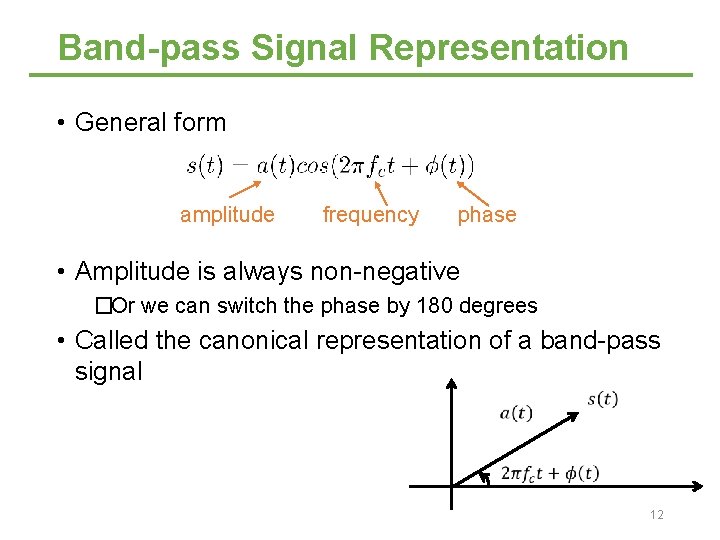
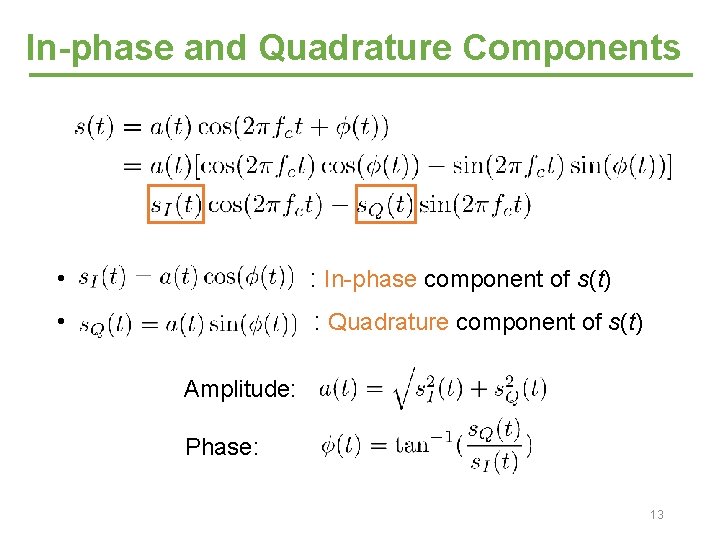
Band-pass Signal Representation • General form amplitude frequency phase • Amplitude is always non-negative �Or we can switch the phase by 180 degrees • Called the canonical representation of a band-pass signal 12
In-phase and Quadrature Components • : In-phase component of s(t) • : Quadrature component of s(t) Amplitude: Phase: 13
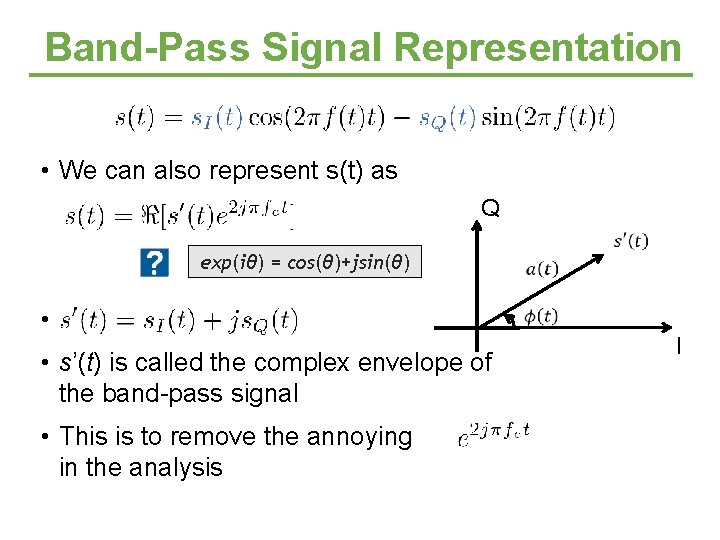
Band-Pass Signal Representation • We can also represent s(t) as Q exp(iθ) = cos(θ)+jsin(θ) • • s’(t) is called the complex envelope of the band-pass signal • This is to remove the annoying in the analysis I
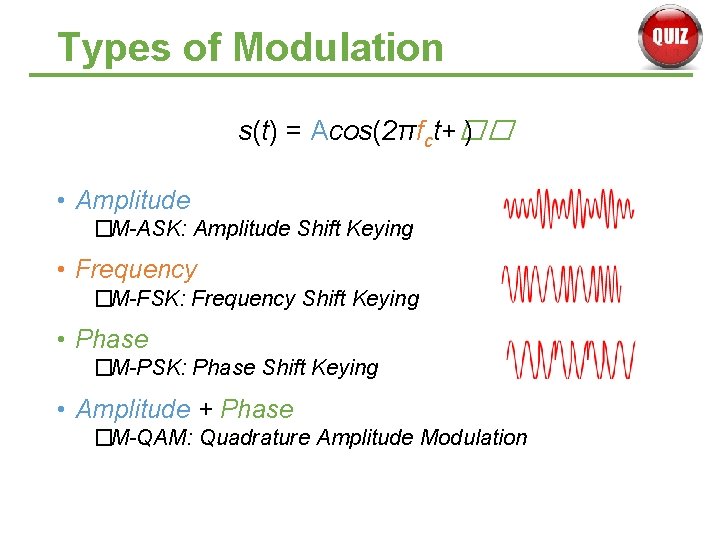
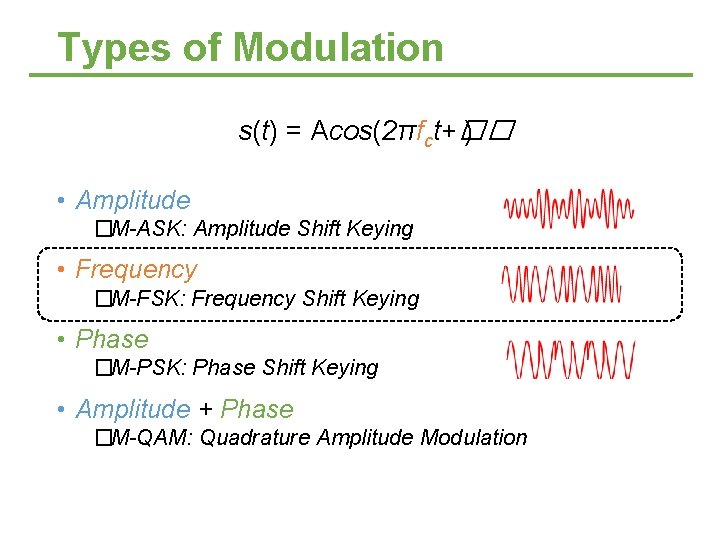
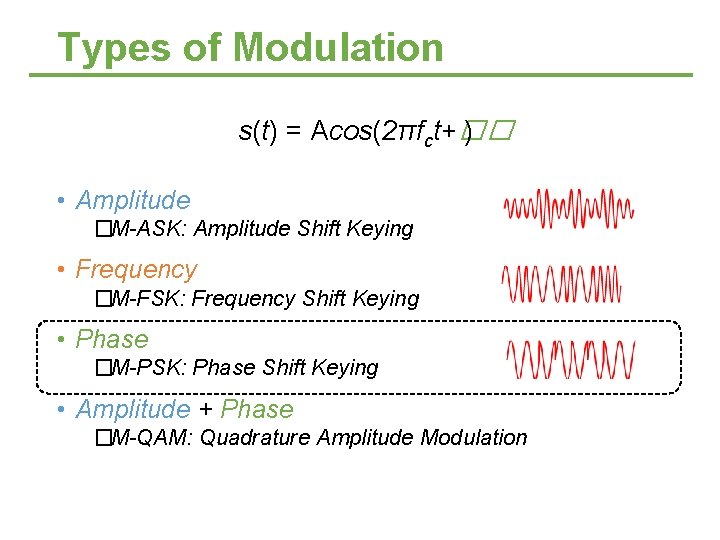
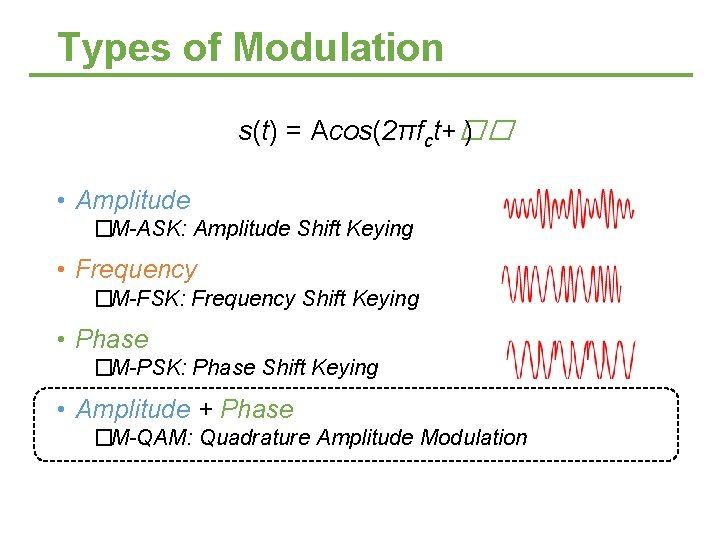
Types of Modulation s(t) = Acos(2πfct+�� ) • Amplitude �M-ASK: Amplitude Shift Keying • Frequency �M-FSK: Frequency Shift Keying • Phase �M-PSK: Phase Shift Keying • Amplitude + Phase �M-QAM: Quadrature Amplitude Modulation
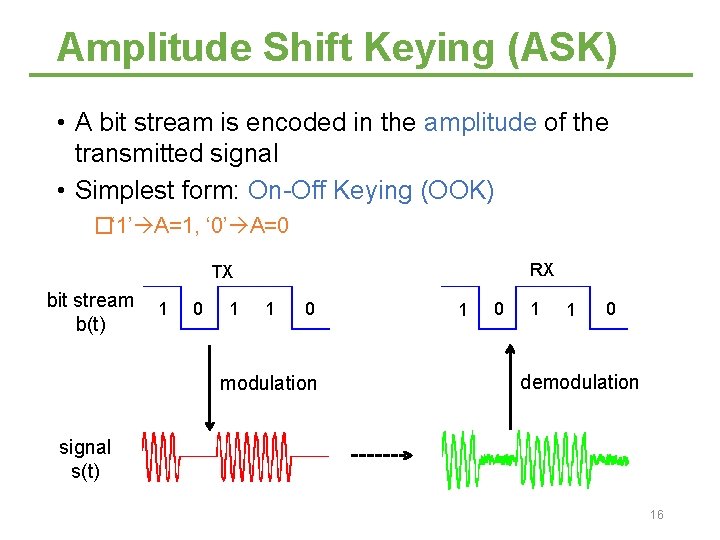
Amplitude Shift Keying (ASK) • A bit stream is encoded in the amplitude of the transmitted signal • Simplest form: On-Off Keying (OOK) �‘ 1’ A=1, ‘ 0’ A=0 RX TX bit stream b(t) 1 0 1 1 0 modulation 1 0 1 1 0 demodulation signal s(t) 16
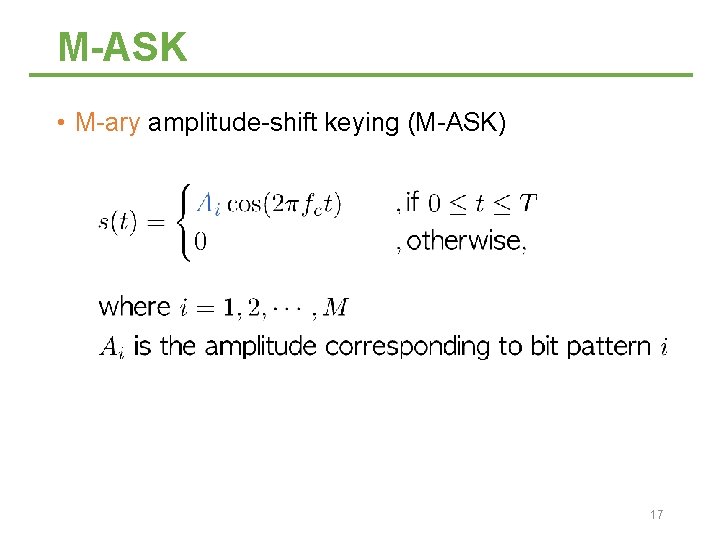
M-ASK • M-ary amplitude-shift keying (M-ASK) 17
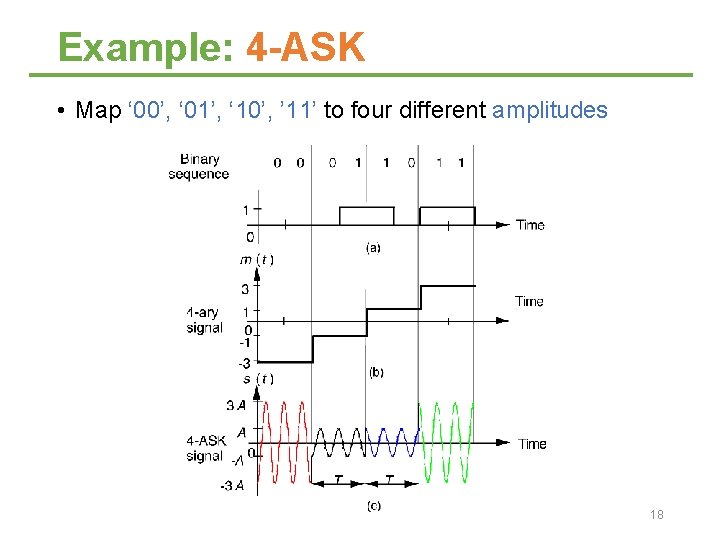
Example: 4 -ASK • Map ‘ 00’, ‘ 01’, ‘ 10’, ’ 11’ to four different amplitudes 18
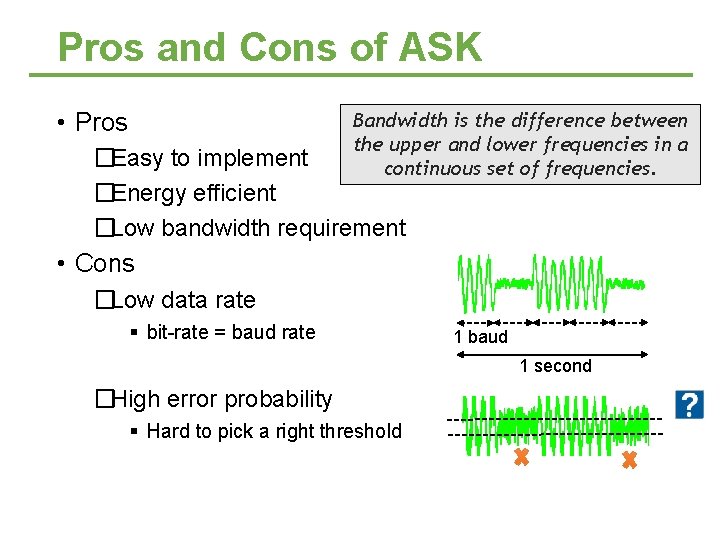
Pros and Cons of ASK • Pros Bandwidth is the difference between the upper and lower frequencies in a continuous set of frequencies. �Easy to implement �Energy efficient �Low bandwidth requirement • Cons �Low data rate § bit-rate = baud rate 1 baud 1 second �High error probability § Hard to pick a right threshold
Types of Modulation s(t) = Acos(2πfct+�� ) • Amplitude �M-ASK: Amplitude Shift Keying • Frequency �M-FSK: Frequency Shift Keying • Phase �M-PSK: Phase Shift Keying • Amplitude + Phase �M-QAM: Quadrature Amplitude Modulation
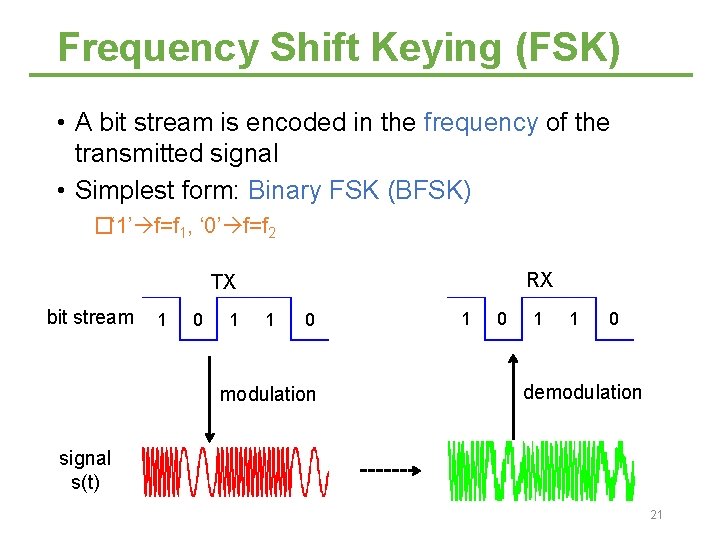
Frequency Shift Keying (FSK) • A bit stream is encoded in the frequency of the transmitted signal • Simplest form: Binary FSK (BFSK) �‘ 1’ f=f 1, ‘ 0’ f=f 2 RX TX bit stream 1 0 1 1 0 modulation 1 0 1 1 0 demodulation signal s(t) 21
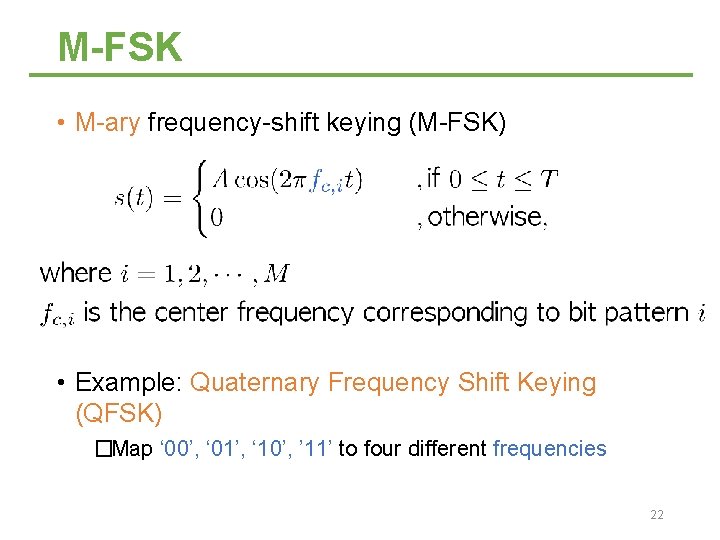
M-FSK • M-ary frequency-shift keying (M-FSK) • Example: Quaternary Frequency Shift Keying (QFSK) �Map ‘ 00’, ‘ 01’, ‘ 10’, ’ 11’ to four different frequencies 22
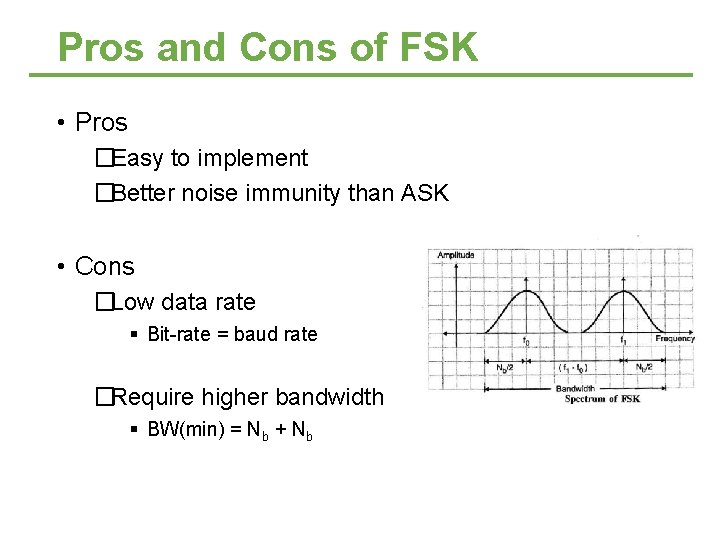
Pros and Cons of FSK • Pros �Easy to implement �Better noise immunity than ASK • Cons �Low data rate § Bit-rate = baud rate �Require higher bandwidth § BW(min) = Nb + Nb
Types of Modulation s(t) = Acos(2πfct+�� ) • Amplitude �M-ASK: Amplitude Shift Keying • Frequency �M-FSK: Frequency Shift Keying • Phase �M-PSK: Phase Shift Keying • Amplitude + Phase �M-QAM: Quadrature Amplitude Modulation
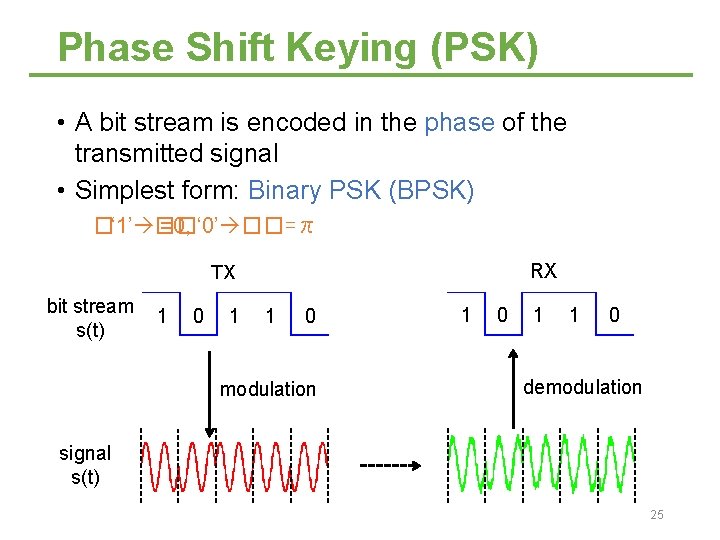
Phase Shift Keying (PSK) • A bit stream is encoded in the phase of the transmitted signal • Simplest form: Binary PSK (BPSK) �‘ 1’ �� =0, ‘ 0’ ��=π RX TX bit stream s(t) 1 0 1 1 0 modulation 1 0 1 1 0 demodulation signal s(t) 25
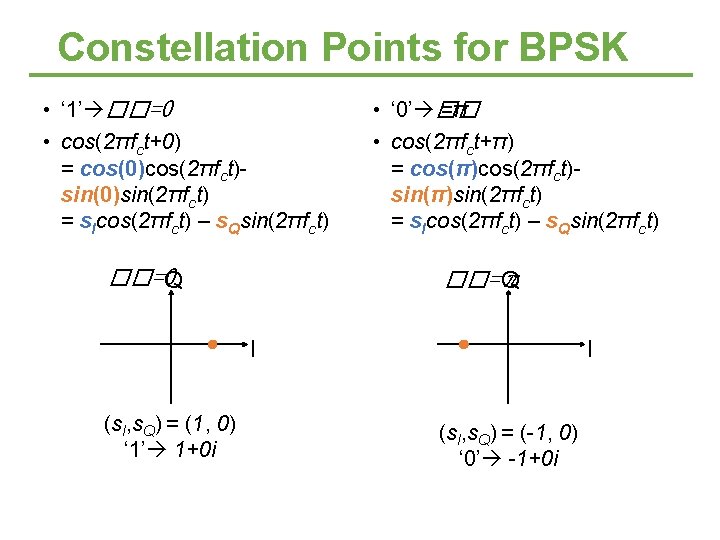
Constellation Points for BPSK • ‘ 1’ ��=0 • cos(2πfct+0) = cos(0)cos(2πfct)sin(0)sin(2πfct) = s. Icos(2πfct) – s. Qsin(2πfct) ��=0 Q • ‘ 0’ �� =π • cos(2πfct+π) = cos(π)cos(2πfct)sin(π)sin(2πfct) = s. Icos(2πfct) – s. Qsin(2πfct) ��=π Q I (s. I, s. Q) = (1, 0) ‘ 1’ 1+0 i I (s. I, s. Q) = (-1, 0) ‘ 0’ -1+0 i
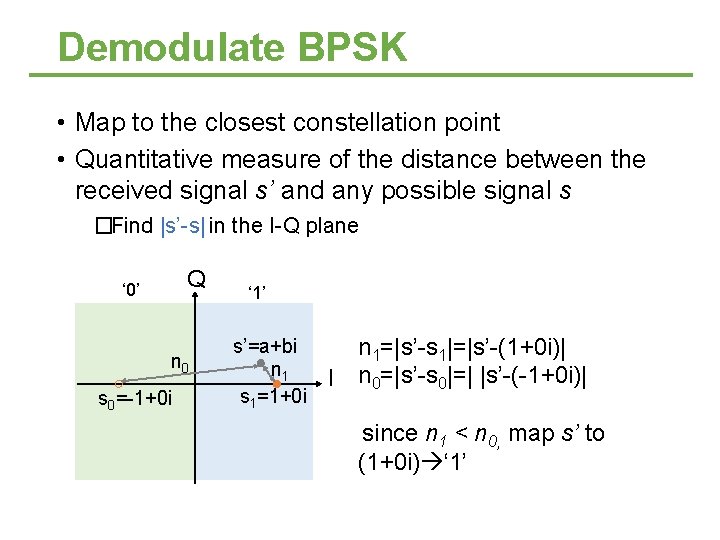
Demodulate BPSK • Map to the closest constellation point • Quantitative measure of the distance between the received signal s’ and any possible signal s �Find |s’-s| in the I-Q plane Q ‘ 0’ n 0 s 0=-1+0 i ‘ 1’ s’=a+bi n 1 s 1=1+0 i n 1=|s’-s 1|=|s’-(1+0 i)| I n 0=|s’-s 0|=| |s’-(-1+0 i)| since n 1 < n 0, map s’ to (1+0 i) ‘ 1’
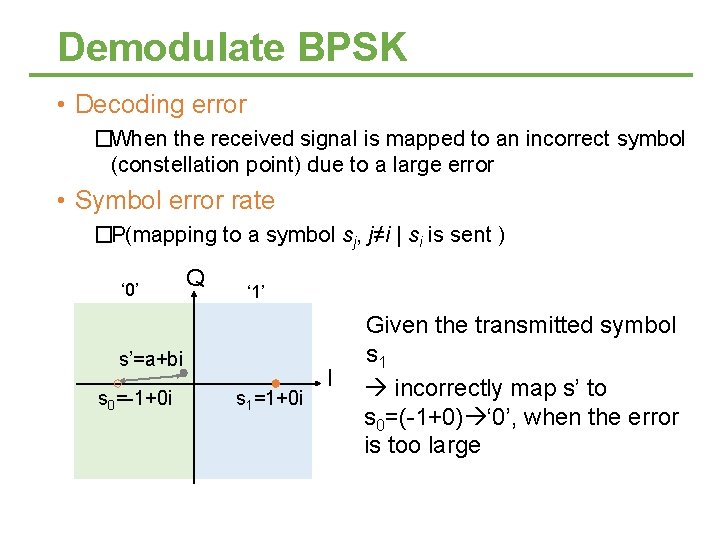
Demodulate BPSK • Decoding error �When the received signal is mapped to an incorrect symbol (constellation point) due to a large error • Symbol error rate �P(mapping to a symbol sj, j≠i | si is sent ) ‘ 0’ Q ‘ 1’ s’=a+bi s 0=-1+0 i s 1=1+0 i I Given the transmitted symbol s 1 incorrectly map s’ to s 0=(-1+0) ‘ 0’, when the error is too large
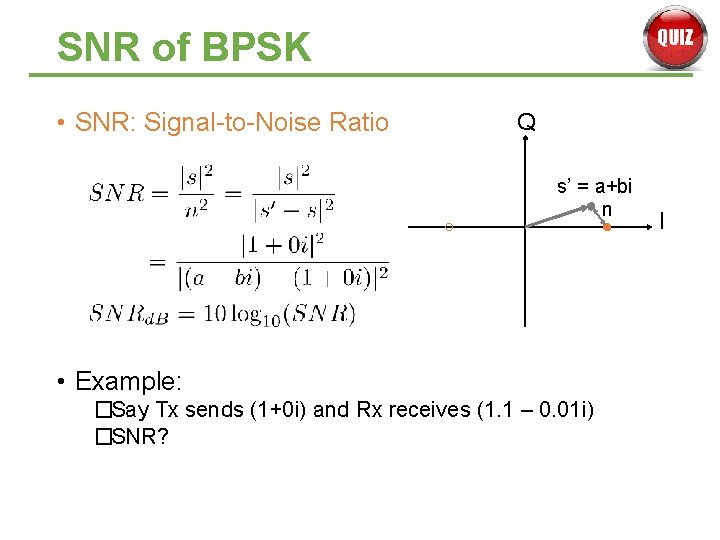
SNR of BPSK • SNR: Signal-to-Noise Ratio Q s’ = a+bi n • Example: �Say Tx sends (1+0 i) and Rx receives (1. 1 – 0. 01 i) �SNR? I
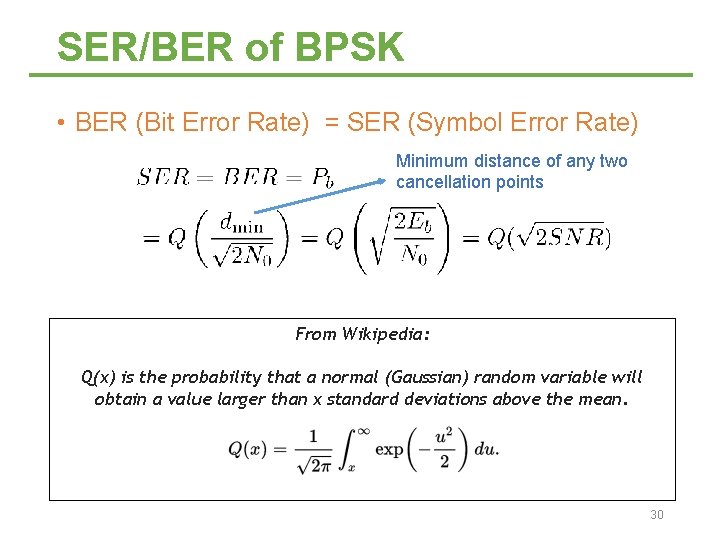
SER/BER of BPSK • BER (Bit Error Rate) = SER (Symbol Error Rate) Minimum distance of any two cancellation points From Wikipedia: Q(x) is the probability that a normal (Gaussian) random variable will obtain a value larger than x standard deviations above the mean. 30
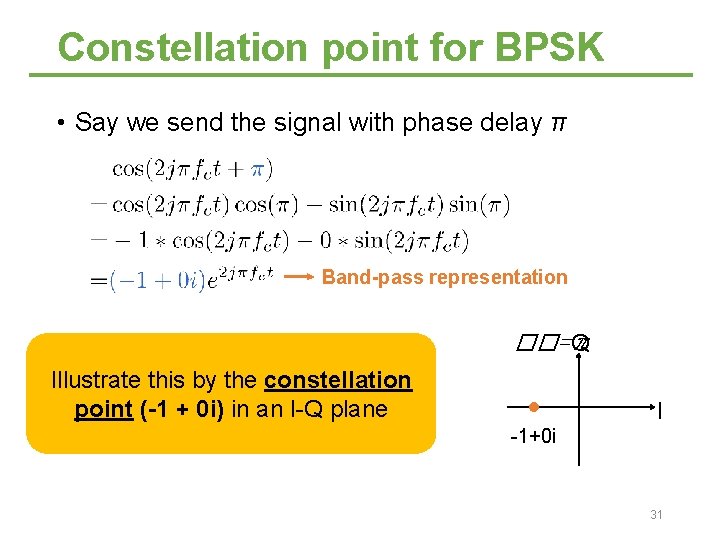
Constellation point for BPSK • Say we send the signal with phase delay π Band-pass representation ��=π Q Illustrate this by the constellation point (-1 + 0 i) in an I-Q plane I -1+0 i 31
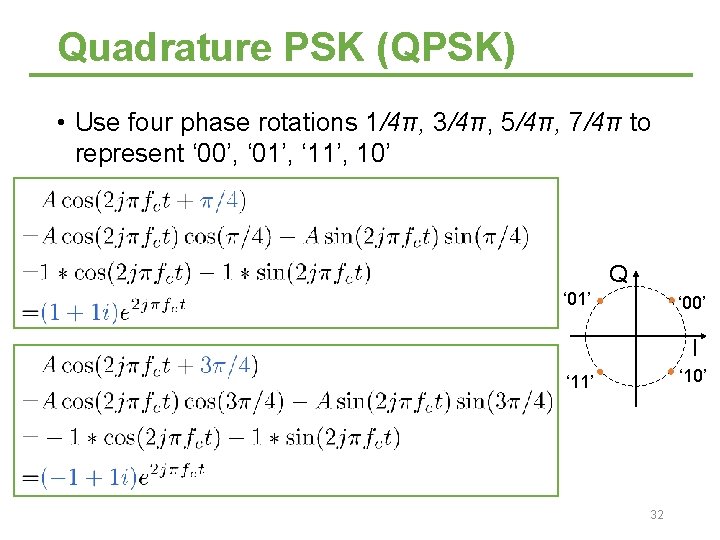
Quadrature PSK (QPSK) • Use four phase rotations 1/4π, 3/4π, 5/4π, 7/4π to represent ‘ 00’, ‘ 01’, ‘ 11’, 10’ Q ‘ 01’ ‘ 00’ I ‘ 10’ ‘ 11’ 32
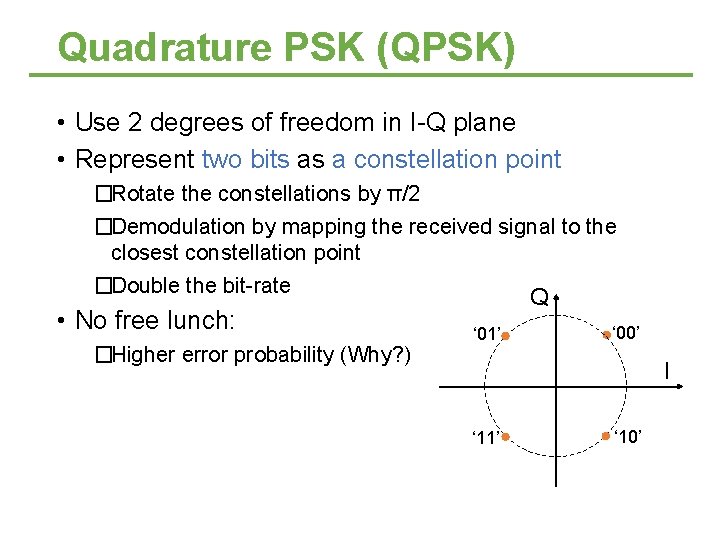
Quadrature PSK (QPSK) • Use 2 degrees of freedom in I-Q plane • Represent two bits as a constellation point �Rotate the constellations by π/2 �Demodulation by mapping the received signal to the closest constellation point �Double the bit-rate • No free lunch: �Higher error probability (Why? ) Q ‘ 01’ ‘ 00’ I ‘ 11’ ‘ 10’
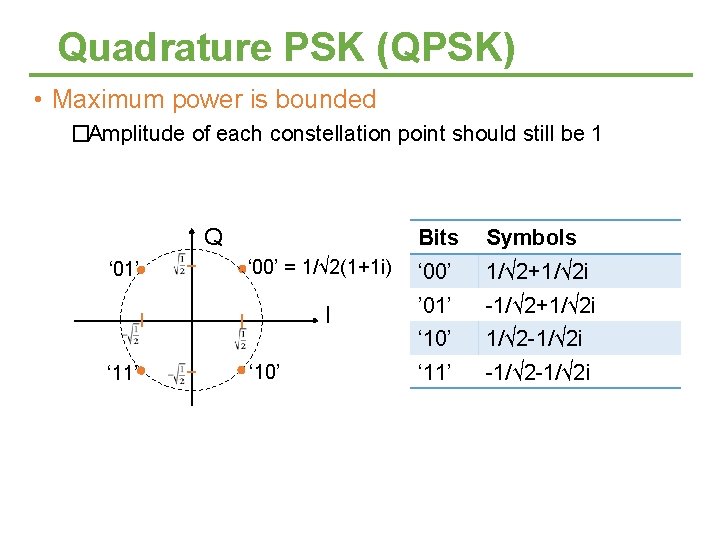
Quadrature PSK (QPSK) • Maximum power is bounded �Amplitude of each constellation point should still be 1 Q ‘ 01’ ‘ 00’ = 1/√ 2(1+1 i) I ‘ 11’ ‘ 10’ Bits Symbols ‘ 00’ 1/√ 2+1/√ 2 i ’ 01’ -1/√ 2+1/√ 2 i ‘ 10’ 1/√ 2 -1/√ 2 i ‘ 11’ -1/√ 2 i
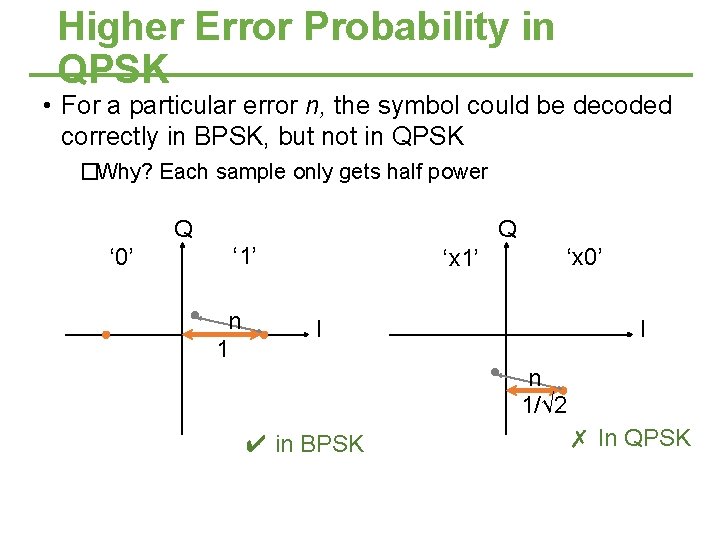
Higher Error Probability in QPSK • For a particular error n, the symbol could be decoded correctly in BPSK, but not in QPSK �Why? Each sample only gets half power Q ‘ 0’ Q ‘ 1’ n 1 ‘x 1’ I ✔ in BPSK ‘x 0’ I n 1/√ 2 ✗ In QPSK
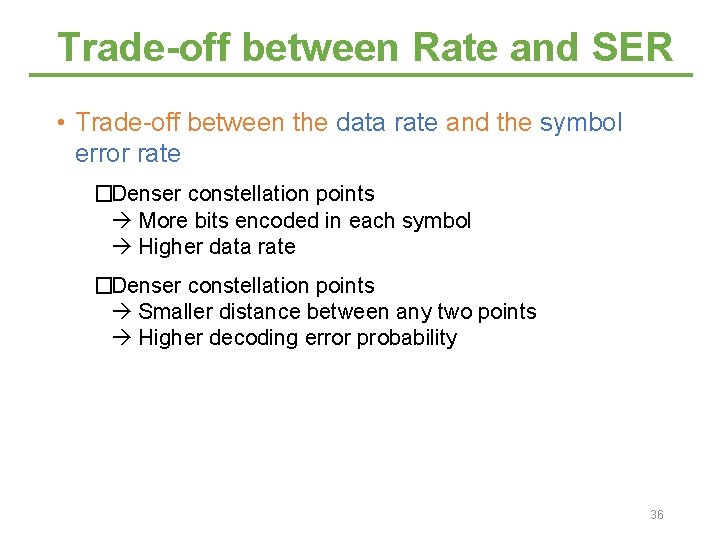
Trade-off between Rate and SER • Trade-off between the data rate and the symbol error rate �Denser constellation points More bits encoded in each symbol Higher data rate �Denser constellation points Smaller distance between any two points Higher decoding error probability 36
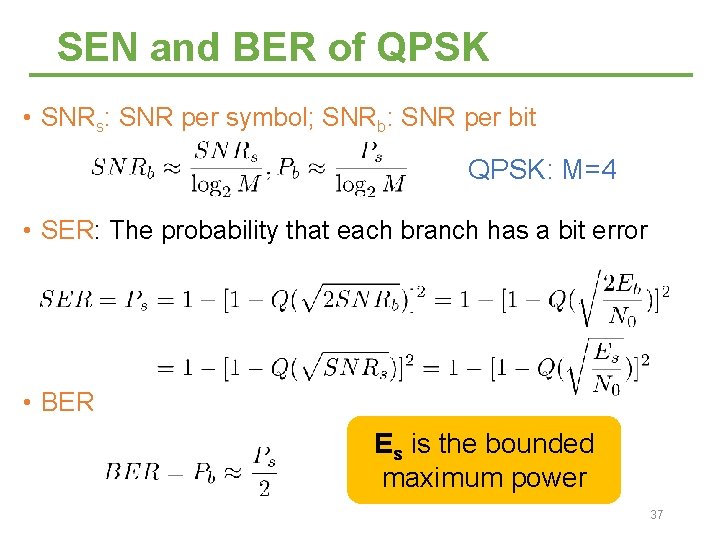
SEN and BER of QPSK • SNRs: SNR per symbol; SNRb: SNR per bit QPSK: M=4 • SER: The probability that each branch has a bit error • BER Es is the bounded maximum power 37
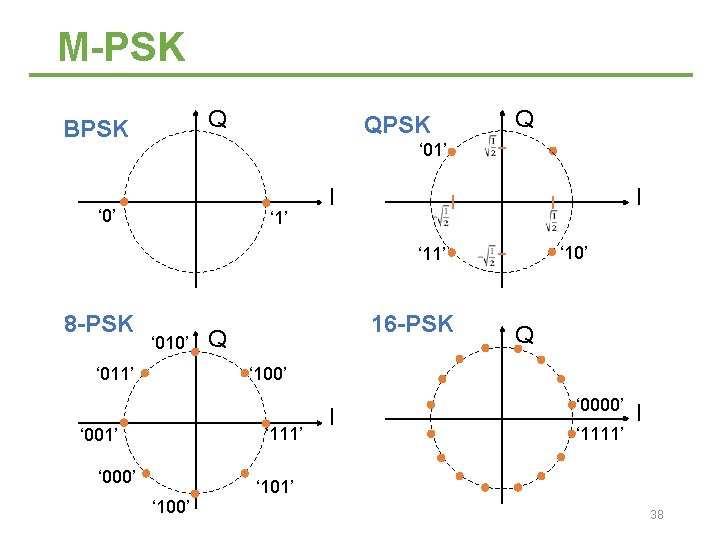
M-PSK Q BPSK Q ‘ 01’ ‘ 0’ ‘ 1’ I I ‘ 10’ ‘ 11’ 8 -PSK ‘ 010’ 16 -PSK Q Q ‘ 100’ ‘ 011’ ‘ 111’ ‘ 000’ I ‘ 0000’ ‘ 1111’ I ‘ 101’ ‘ 100’ 38
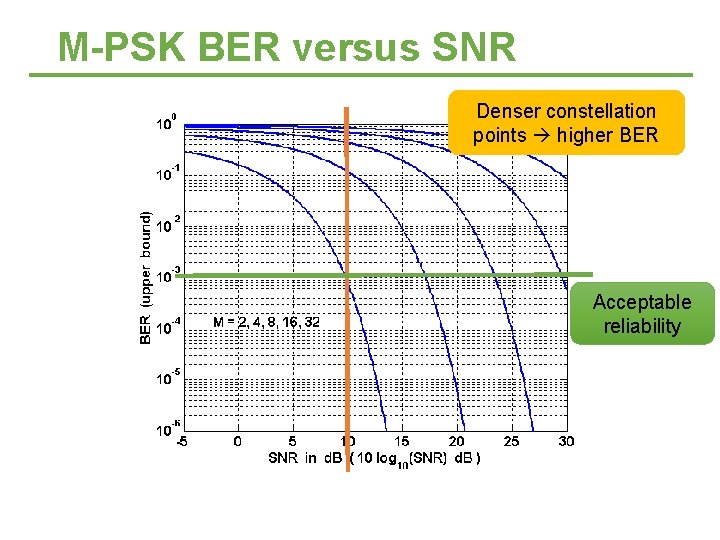
M-PSK BER versus SNR Denser constellation points higher BER Acceptable reliability
Types of Modulation s(t) = Acos(2πfct+�� ) • Amplitude �M-ASK: Amplitude Shift Keying • Frequency �M-FSK: Frequency Shift Keying • Phase �M-PSK: Phase Shift Keying • Amplitude + Phase �M-QAM: Quadrature Amplitude Modulation
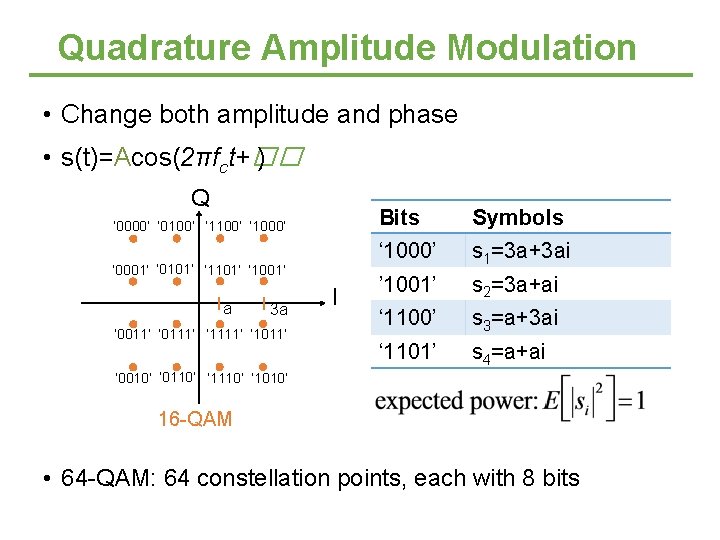
Quadrature Amplitude Modulation • Change both amplitude and phase • s(t)=Acos(2πfct+�� ) Q ‘ 0000’ ‘ 0100’ ‘ 1000’ ‘ 0001’ ‘ 0101’ ‘ 1001’ a 3 a ‘ 0011’ ‘ 0111’ ‘ 1011’ I Bits Symbols ‘ 1000’ s 1=3 a+3 ai ’ 1001’ s 2=3 a+ai ‘ 1100’ s 3=a+3 ai ‘ 1101’ s 4=a+ai ‘ 0010’ ‘ 0110’ ‘ 1010’ 16 -QAM • 64 -QAM: 64 constellation points, each with 8 bits
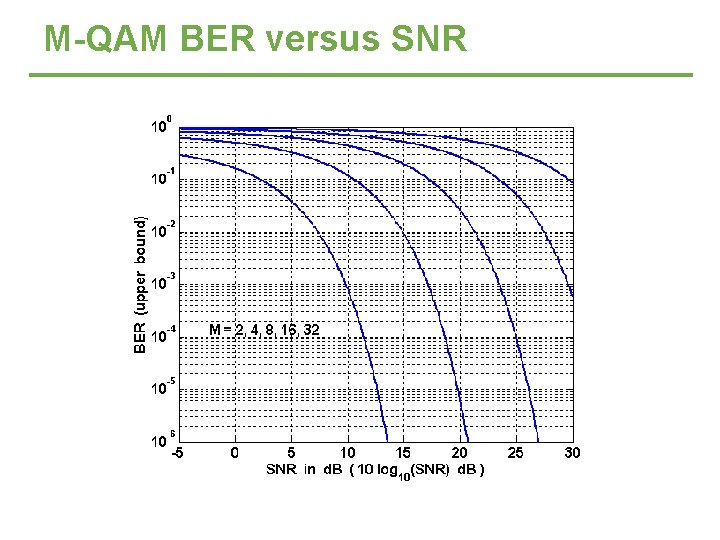
M-QAM BER versus SNR
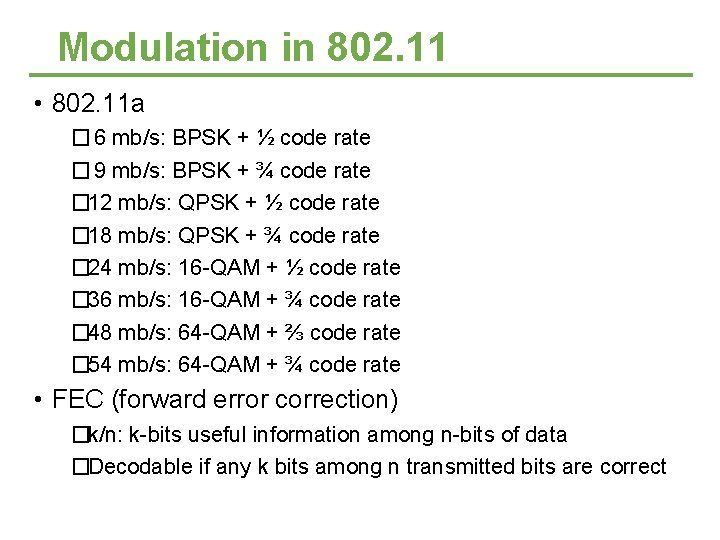
Modulation in 802. 11 • 802. 11 a � 6 mb/s: BPSK + ½ code rate � 9 mb/s: BPSK + ¾ code rate � 12 mb/s: QPSK + ½ code rate � 18 mb/s: QPSK + ¾ code rate � 24 mb/s: 16 -QAM + ½ code rate � 36 mb/s: 16 -QAM + ¾ code rate � 48 mb/s: 64 -QAM + ⅔ code rate � 54 mb/s: 64 -QAM + ¾ code rate • FEC (forward error correction) �k/n: k-bits useful information among n-bits of data �Decodable if any k bits among n transmitted bits are correct
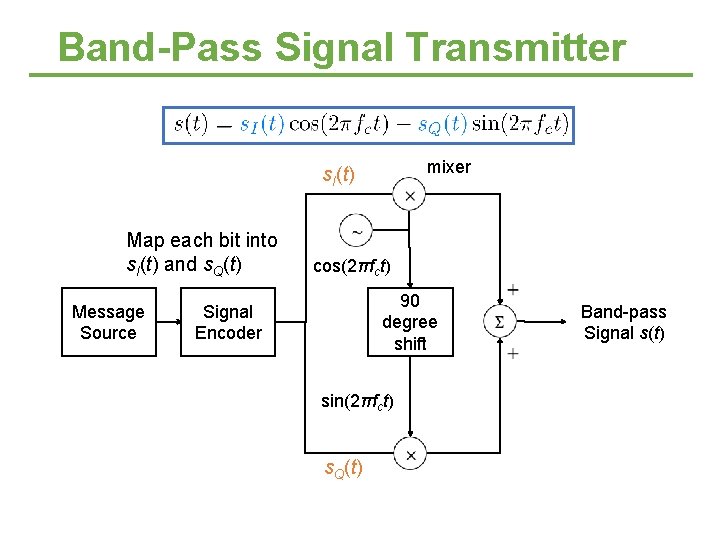
Band-Pass Signal Transmitter mixer s. I(t) Map each bit into s. I(t) and s. Q(t) Message Source cos(2πfct) 90 degree shift Signal Encoder sin(2πfct) s. Q(t) Band-pass Signal s(t)
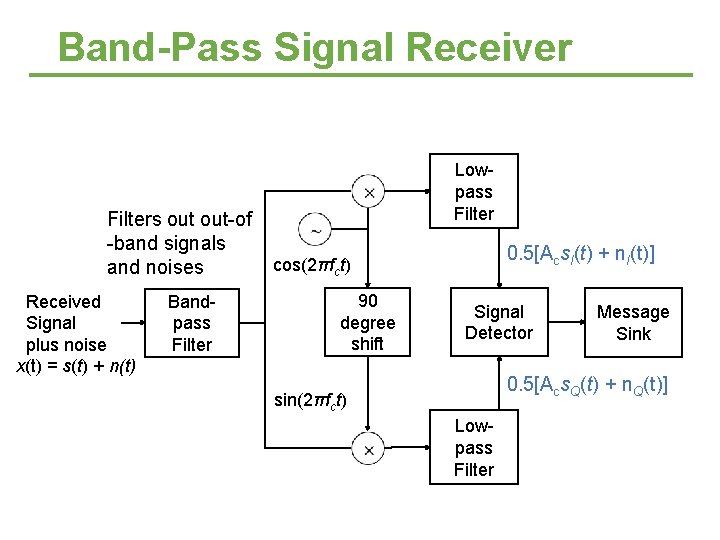
Band-Pass Signal Receiver Filters out-of -band signals and noises Received Signal plus noise x(t) = s(t) + n(t) Bandpass Filter Lowpass Filter 0. 5[Acs. I(t) + n. I(t)] cos(2πfct) 90 degree shift Signal Detector Message Sink 0. 5[Acs. Q(t) + n. Q(t)] sin(2πfct) Lowpass Filter
Detection • Map the received signal to one of the possible transmitted signal with the minimum distance • Find the corresponding bit streams possible transmitted corresponding bit streams signals … received signal closest … 46
Announcement • Install Matlab • Teaming �Elevator pitch: 2 per group (Each group talks about 3 -5 minutes. Each member needs to talk) �Lab and project: 3 -4 members per group �Send your team members to the TA (張威竣) • Sign up for the talk topic �Pick the paper (topic) according to your preference or schedule �Sign up from 18: 00@Thu (will announce the url in the announcement tab of the course website) �Pick your top five choices (from Lectures 4 -18) �FIFS 47
Quiz • What are the four types of modulation introduced in the class? • Say Tx sends (-1 + 0 i) and Rx receives -(0. 95+0. 01 i). Calculate the SNR. 48