
Wireless communication Air interface design Radio propagation mechanisms
- Slides: 56
Wireless communication Air interface design Radio propagation mechanisms ECE 431 -Wireless communication Prepared by S. Sankara Narayanan 1
Comparison of wired network vs Wireless network o Wired medium provide reliable, guided link that conducts electric signal associated with transmission of information from one terminal to another ECE 431 -Wireless communication Prepared by S. Sankara Narayanan 2
Alternatives for wired connection o High speed LAN- Twisted pair telephone wiring o Television distribution- coaxial cable o Long haul connection-optical fibre ECE 431 -Wireless communication Prepared by S. Sankara Narayanan 3
Wired medium o Wires act as filters that limit the maximum data rate of a channel. o Laying additional cable in general duplicate the medium and there by increase the bandwidth. ECE 431 -Wireless communication Prepared by S. Sankara Narayanan 4
Wireless medium o o o Unreliable Low bandwidth Broadcast in nature Supports mobility All wireless transmission share the same medium air. ECE 431 -Wireless communication Prepared by S. Sankara Narayanan 5
Wireless network operation o It operates around Ø 1 GHZ-cellular Ø 2 GHZ-PCS and WLAN Ø 5 GHZ-WLAN Ø 28 -60 GHZ-local multipoint distribution service Ø IR-Optical communication. ECE 431 -Wireless communication Prepared by S. Sankara Narayanan 6
Wireless network o As frequency of operation and data rate increases, hardware implementation cost increases and ability of radio signal penetrate through wall decreases. o As frequencies upto few GHZ, signal penetrate through walls. ECE 431 -Wireless communication Prepared by S. Sankara Narayanan 7
Wireless medium o With wireless medium we are restricted to limited band for operation. o We cannot obtain new bands or easily duplicate medium to accommodate more users. ECE 431 -Wireless communication Prepared by S. Sankara Narayanan 8
Simple method o Cellular architecture that reuse the frequency of operation when two cells are at an adequate distance from one another. ECE 431 -Wireless communication Prepared by S. Sankara Narayanan 9
Radio Propagation Cells are classified into Ø femto Ø Pico Ø Micro Ø Maga Depending on their size. ECE 431 -Wireless communication Prepared by S. Sankara Narayanan 10
Contd. . o It differs in following areas ü open area ü indoor ü urban ECE 431 -Wireless communication Prepared by S. Sankara Narayanan 11
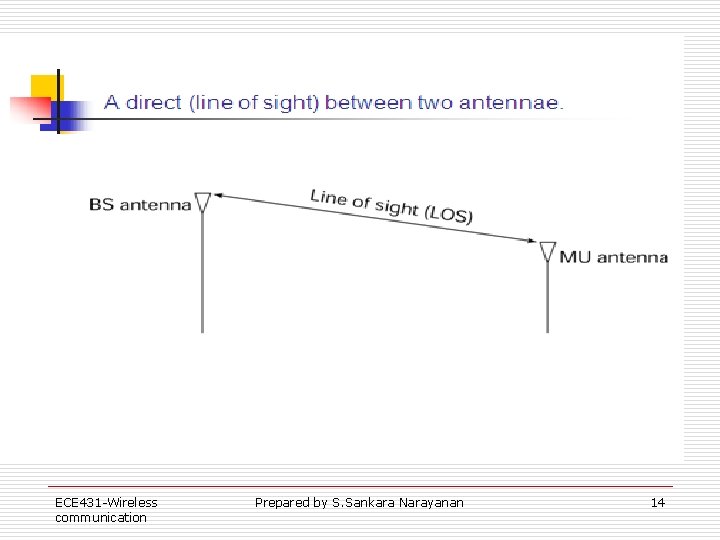
Contd. . o Open areas- signal strength falls at the square of the distance o Urban areas- shortest direct path between transmitter and receiver is usually blocked by buildings. o Indoor areas- walls, floors and interior objects with in buildings obstruct LOS communication ECE 431 -Wireless communication Prepared by S. Sankara Narayanan 12
Radio propagation mechanisms o Reflection and transmission o Diffraction o Scattering ECE 431 -Wireless communication Prepared by S. Sankara Narayanan 13
ECE 431 -Wireless communication Prepared by S. Sankara Narayanan 14
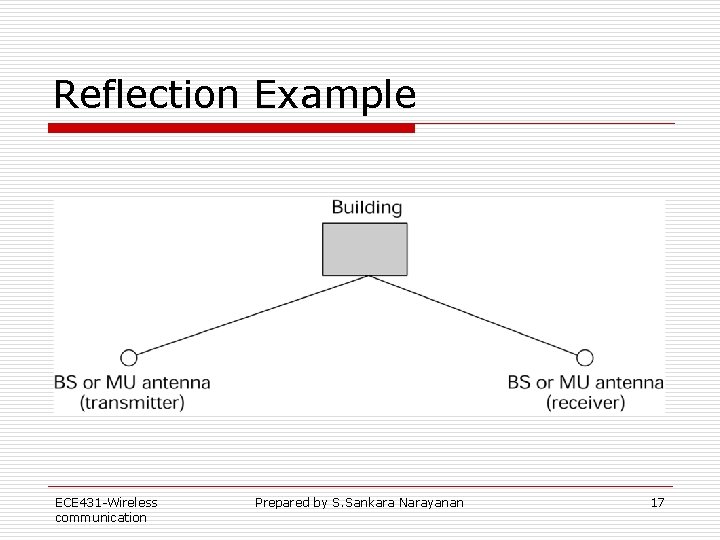
Refelction and transmission o It occurs when electro magnetic waves impinge on obstruction larger than wavelength. o Usually ray incident upon ground, wall, floor and ceiling undergo specular reflection and transmission ECE 431 -Wireless communication Prepared by S. Sankara Narayanan 15
Contd. . o Ray attenuates by factors that depends on Ø Frequncy Ø Angle of incidence Ø Nature of the medium ECE 431 -Wireless communication Prepared by S. Sankara Narayanan 16
Reflection Example ECE 431 -Wireless communication Prepared by S. Sankara Narayanan 17
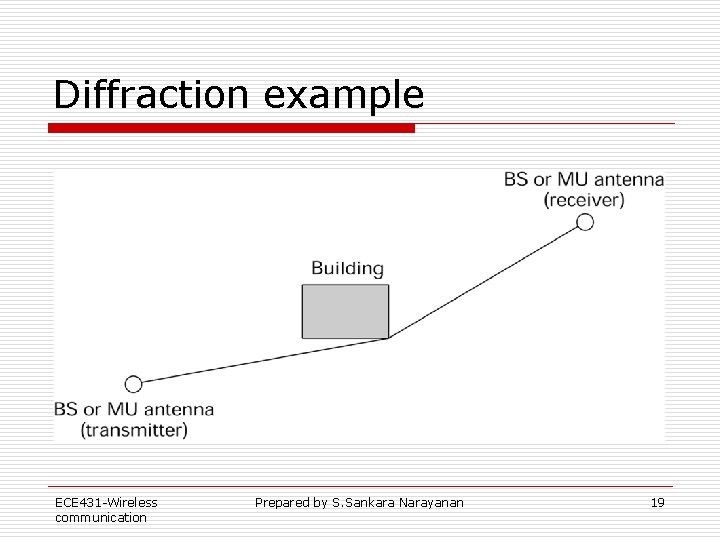
Diffraction o Diffraction - occurs at the edge of an impenetrable body that is large compared to wavelength of radio wave ECE 431 -Wireless communication Prepared by S. Sankara Narayanan 18
Diffraction example ECE 431 -Wireless communication Prepared by S. Sankara Narayanan 19
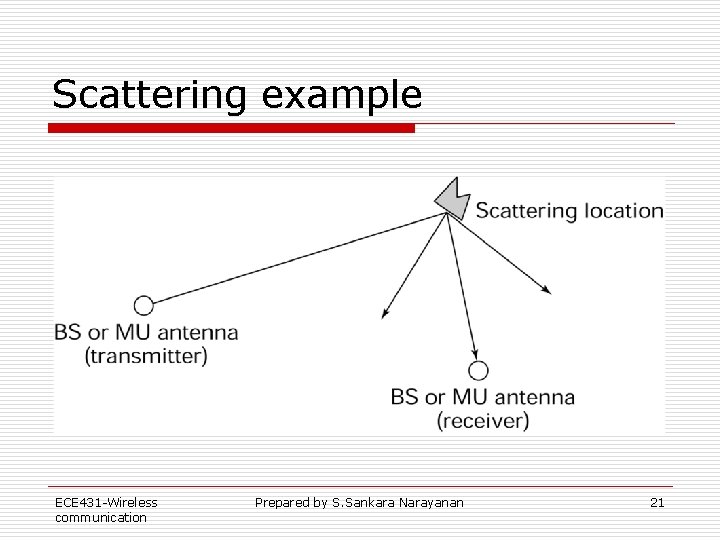
Scattering o Scattering – occurs when incoming signal hits an object whose size in the order of the wavelength of the signal or less. o Irregular objects such as walls with rough surfaces, furniture and vehicles and foliage and the like scatter rays in all the direction in the form of spherical waves. ECE 431 -Wireless communication Prepared by S. Sankara Narayanan 20
Scattering example ECE 431 -Wireless communication Prepared by S. Sankara Narayanan 21
Wireless communication Path loss modeling and signal coverage ECE 431 wireless communication prepared by S. Sankara Narayanan 22
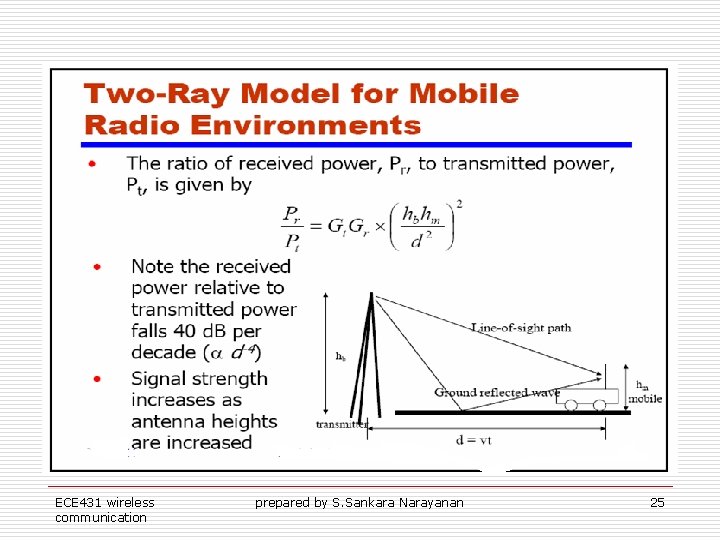
Path loss modeling and signal coverage o Calculation of signal coverage is essential for design and deployment of both narrowband wideband systems. o Unique channel model cannot describe radio propagation between transmitter and receiver. o We need several modes for a variety of environments to enable system design. ECE 431 wireless communication prepared by S. Sankara Narayanan 23
ECE 431 wireless communication prepared by S. Sankara Narayanan 24
ECE 431 wireless communication prepared by S. Sankara Narayanan 25
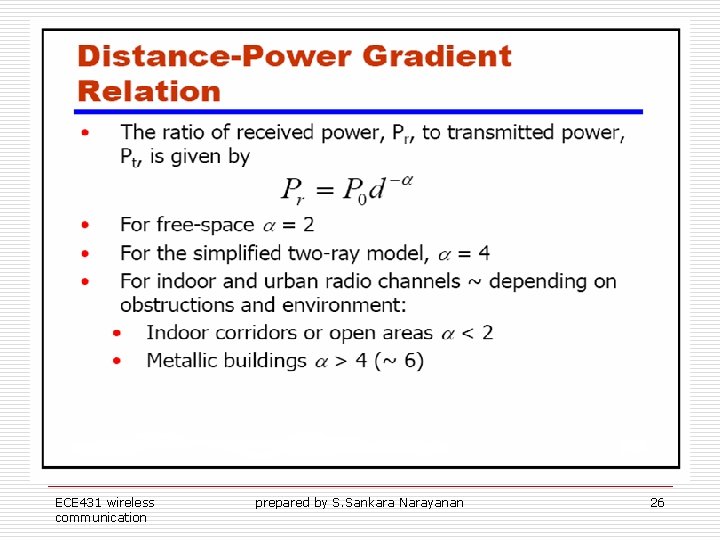
ECE 431 wireless communication prepared by S. Sankara Narayanan 26
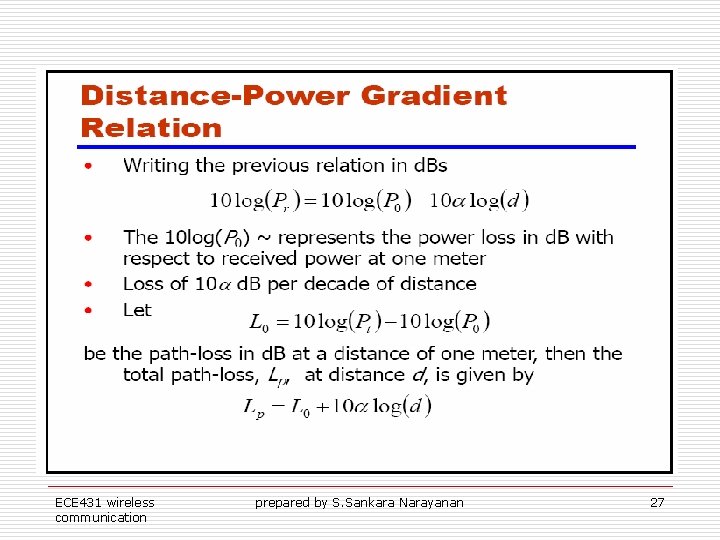
ECE 431 wireless communication prepared by S. Sankara Narayanan 27
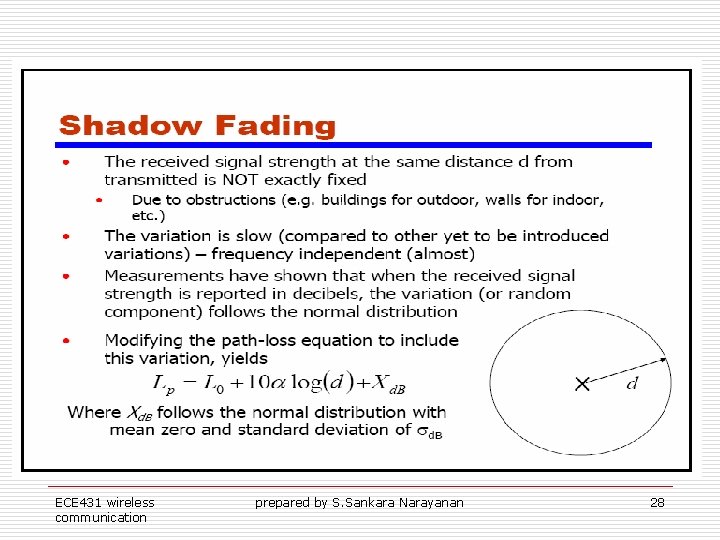
ECE 431 wireless communication prepared by S. Sankara Narayanan 28
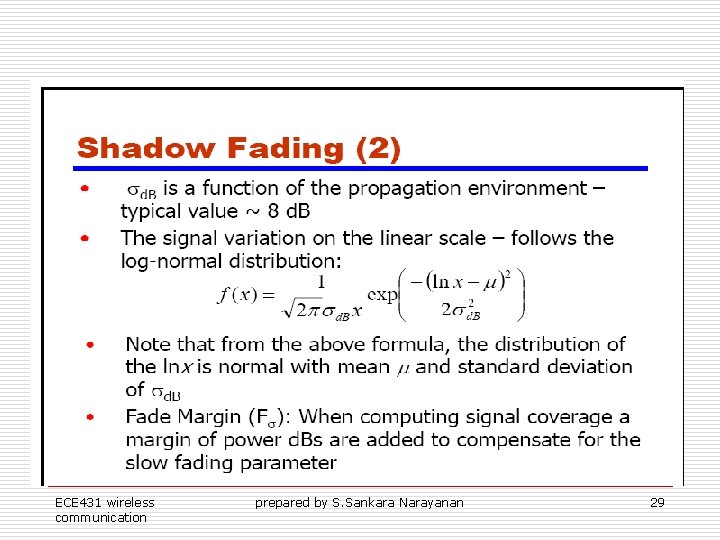
ECE 431 wireless communication prepared by S. Sankara Narayanan 29
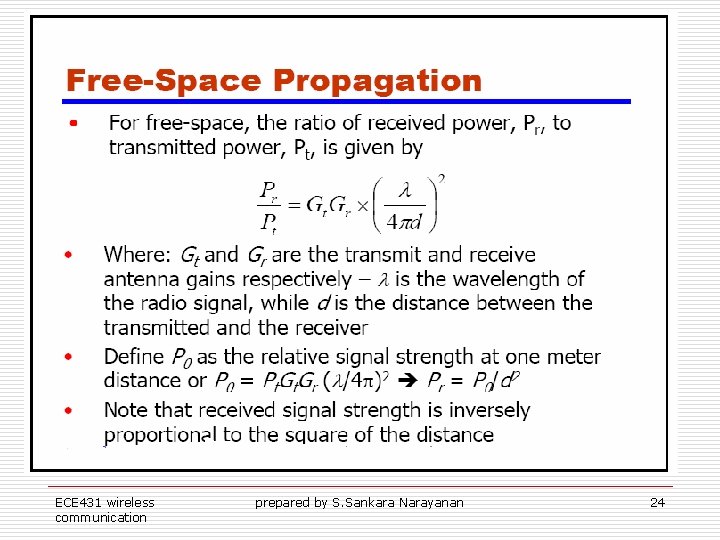
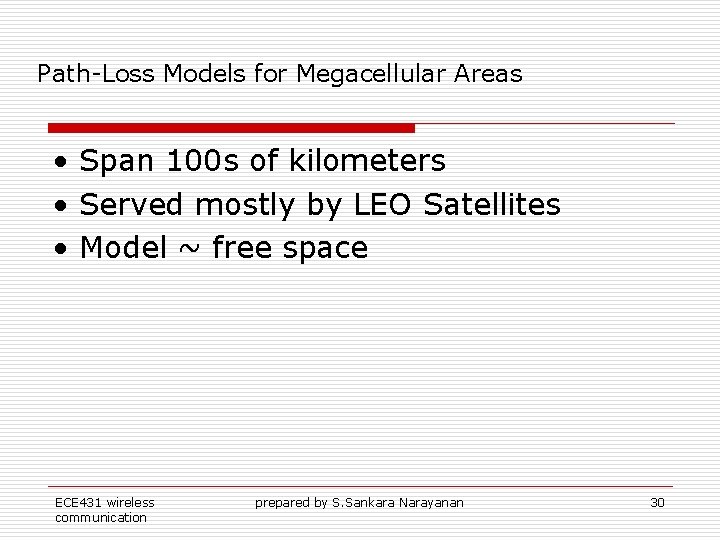
Path-Loss Models for Megacellular Areas • Span 100 s of kilometers • Served mostly by LEO Satellites • Model ~ free space ECE 431 wireless communication prepared by S. Sankara Narayanan 30
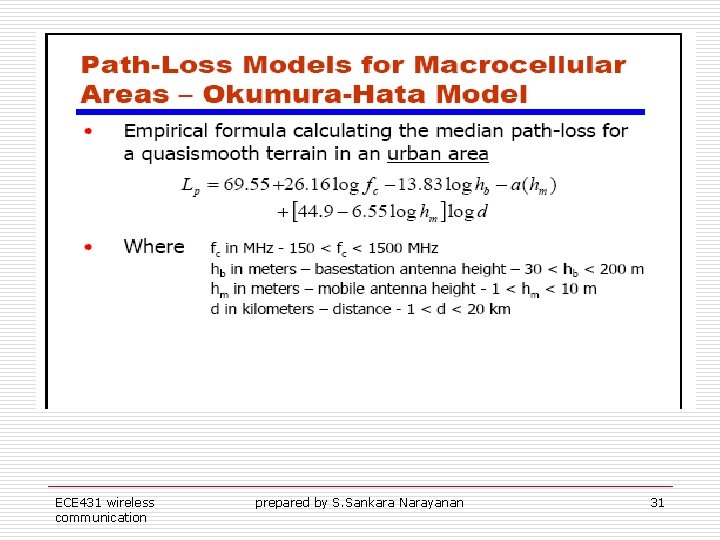
ECE 431 wireless communication prepared by S. Sankara Narayanan 31
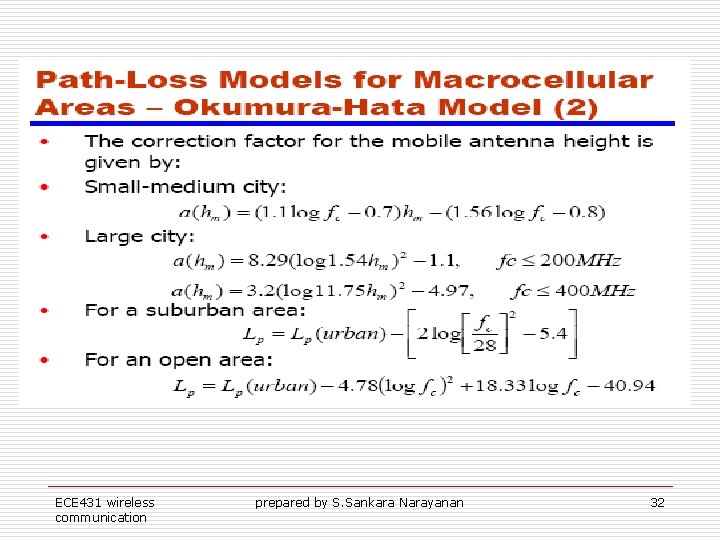
ECE 431 wireless communication prepared by S. Sankara Narayanan 32
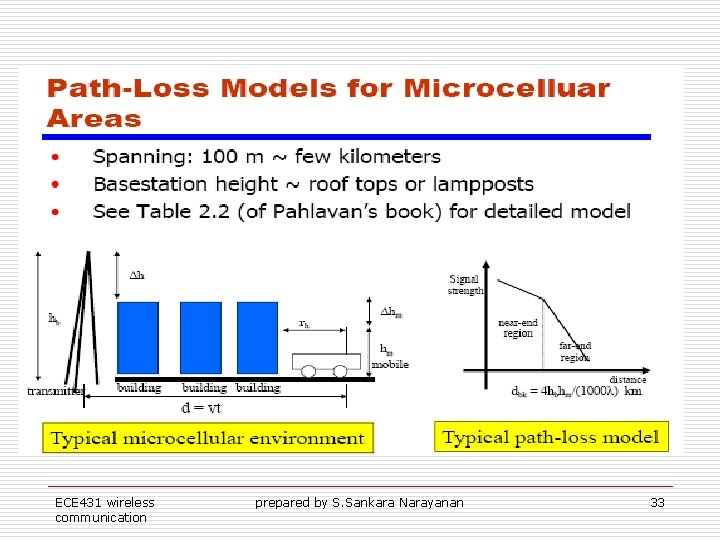
ECE 431 wireless communication prepared by S. Sankara Narayanan 33
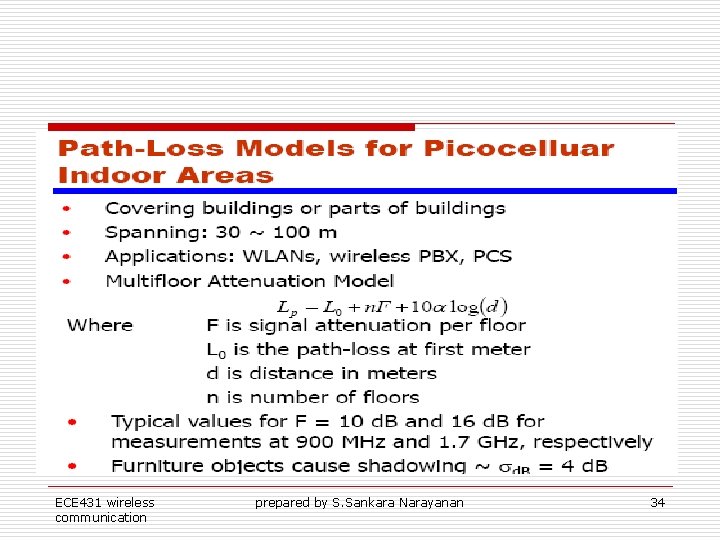
ECE 431 wireless communication prepared by S. Sankara Narayanan 34
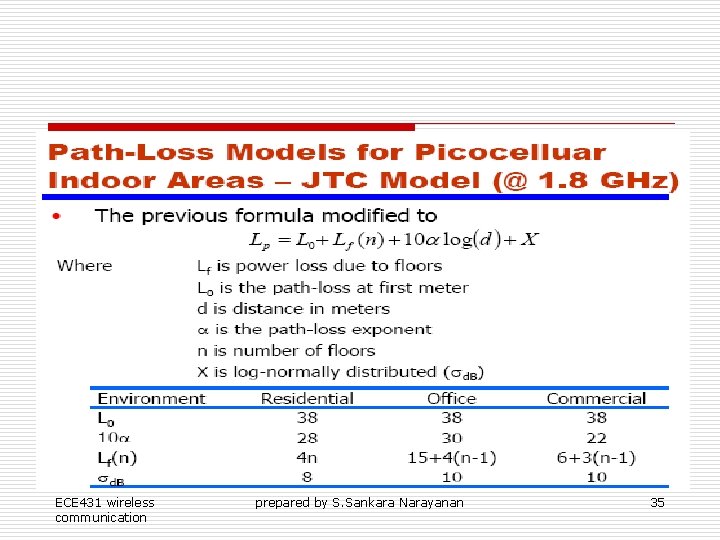
ECE 431 wireless communication prepared by S. Sankara Narayanan 35
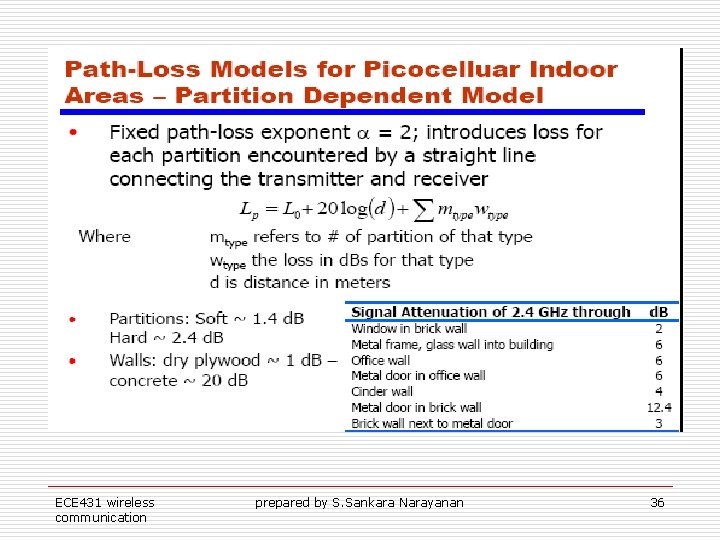
ECE 431 wireless communication prepared by S. Sankara Narayanan 36
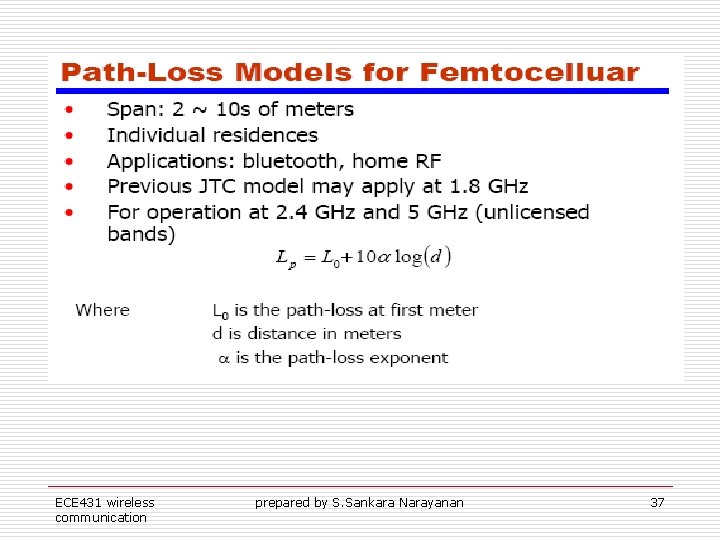
ECE 431 wireless communication prepared by S. Sankara Narayanan 37
Channel measurement and modeling o In order to study and model radio propagation characteristics there is a need to perform different types of measurements and enhance them with simulations. o It is extremely hard to analytically derive the expressions for how a radio channel may propagate through a complex environment. ECE 431 wireless communication prepared by S. Sankara Narayanan 38
Contd… o Measurements of the radio channel at the site where the wireless network is required to set up. o These could be narrowband or wideband or may be both. o The results of these measurements could be directly used or enhanced via simulations of the environment. o All the data are then included in the database ECE 431 wireless communication prepared by S. Sankara Narayanan 39
Procedure for narrowband radio channel measurement. o Radiating a continuous wave signal from a radio transmitter. o The receiver usually employs vertical dipole antenna along with position locator. o The effects of fast fading are averaged out and slow fading values are used in determining the path loss expression. ECE 431 wireless communication prepared by S. Sankara Narayanan 40
Wideband channel measurement Channel sounders to be used. The accuracy of channel depends on channel sounder Types of antennas used at the transmitter and receiver. ü Digital signal processing used. ü Accuracy of synchronization between transmitter and receiver o o ü ü ECE 431 wireless communication prepared by S. Sankara Narayanan 41
Channel sounding techniques o Spread spectrum signal with matched filter receiver. o Transmission of short RF pulse. o Use of swept carrier techniques. ECE 431 wireless communication prepared by S. Sankara Narayanan 42
Channel sounding techniques o Spread spectrum- complex to implement but provide large coverage areas o RF pulse systems- large peak power and pulse amplifiers are expensive. o swept carrier techniques- not suitable for mobile wideband measurements but quite useful in characterizing the RMS delay spread in indoor areas. ECE 431 wireless communication prepared by S. Sankara Narayanan 43
Simulation of radio channel o With the basic understanding of the radio channel, system engineers can use Simulations in software Hardware emulation of the radio channel in order to design, analyze and deploy variety of wireless communication systems. ECE 431 wireless communication prepared by S. Sankara Narayanan 44
Contd. . o Of the many areas where simulation play a role included are issues such as o Designing a cellular system where the number of base stations, frequency planning, capacity guarantees and so on can influence the economic viability and competitive edge for service providers. ECE 431 wireless communication prepared by S. Sankara Narayanan 45
Software simulation o Simulating path loss or received signal strength requires adding a random variable with the log normal distribution to the path loss. ECE 431 wireless communication prepared by S. Sankara Narayanan 46
Contd… o Radical optical methods are employed to describe and model electro magnetic wave propagation within and outside building when wavelengths of radio signals are smaller compared with dimensions of objects that are in the environment. o Such a simulation of radio channel is called ray tracing. ECE 431 wireless communication prepared by S. Sankara Narayanan 47
Refelction and transmission o It occurs when electro magnetic waves impinge on obstruction larger than wavelength. o Usually ray incident upon ground, wall, floor and ceiling undergo specular reflection and transmission ECE 431 wireless communication prepared by S. Sankara Narayanan 48
Diffraction o Diffraction - occurs at the edge of an impenetrable body that is large compared to wavelength of radio wave ECE 431 wireless communication prepared by S. Sankara Narayanan 49
Scattering o Scattering – occurs when incoming signal hits an object whose size in the order of the wavelength of the signal or less. o Irregular objects such as walls with rough surfaces, furniture and vehicles and foliage and the like scatter rays in all the direction in the form of spherical waves. ECE 431 wireless communication prepared by S. Sankara Narayanan 50
Refelction and transmission o Specular Refelction and transmission dominate indoor environment and extremely suitable for modeling with ray tracing. o When a ray is incident upon a wall voltage reflection coefficient reduce the amplitude of the reflected ray. ECE 431 wireless communication prepared by S. Sankara Narayanan 51
Refelction and transmission o If there is no absorption, transmission coefficient will account for the rest of the energy. o There is usually some amount of diffuse scattering and absorption that reduces transmitted energy, resulting in sum of the reflected and transmitted energies being less than the incident energy. ECE 431 wireless communication prepared by S. Sankara Narayanan 52
Ray tracing approach o Rays emanating from transmitter reach the receiver after transmission through and reflection from walls. o The unfolded path length determines the signal associated with a specular component. ECE 431 wireless communication prepared by S. Sankara Narayanan 53
Ray tracing approach o In order to determine all possible ray paths two approaches are exists in practice. 1. Ray shooting or ray launching 2. Image approach ECE 431 wireless communication prepared by S. Sankara Narayanan 54
Ray shooting approach o Rays are launched from transmitter at regular intervals in the order of degree. o Easier for computer implementation. ECE 431 wireless communication prepared by S. Sankara Narayanan 55
Image approach o Determines the exact ray paths between points by imaging the source in the plane of each wall. ECE 431 wireless communication prepared by S. Sankara Narayanan 56