
Wireless and Mobile Networks EECS 489 Computer Networks
Wireless and Mobile Networks EECS 489 Computer Networks http: //www. eecs. umich. edu/courses/eecs 489/w 07 Z. Morley Mao Monday March 19, 2007 Acknowledgement: Some slides taken from Kurose&Ross
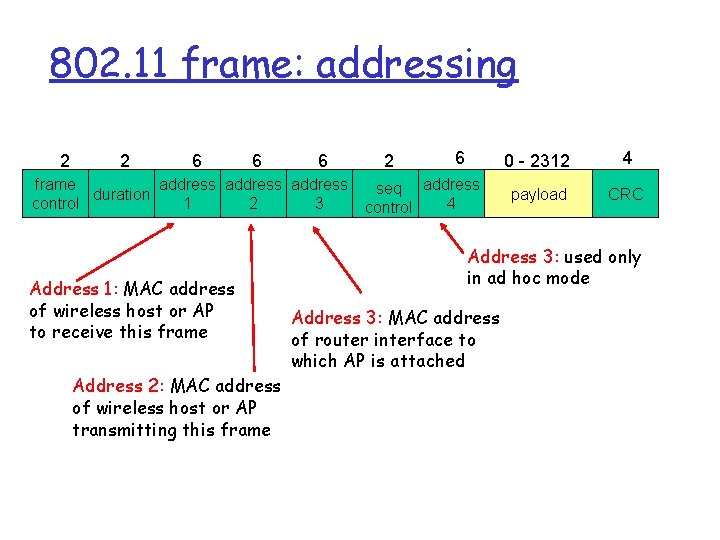
802. 11 frame: addressing 2 2 6 6 6 frame address duration control 1 2 3 Address 1: MAC address of wireless host or AP to receive this frame Address 2: MAC address of wireless host or AP transmitting this frame 2 6 seq address 4 control 0 - 2312 4 payload CRC Address 3: used only in ad hoc mode Address 3: MAC address of router interface to which AP is attached
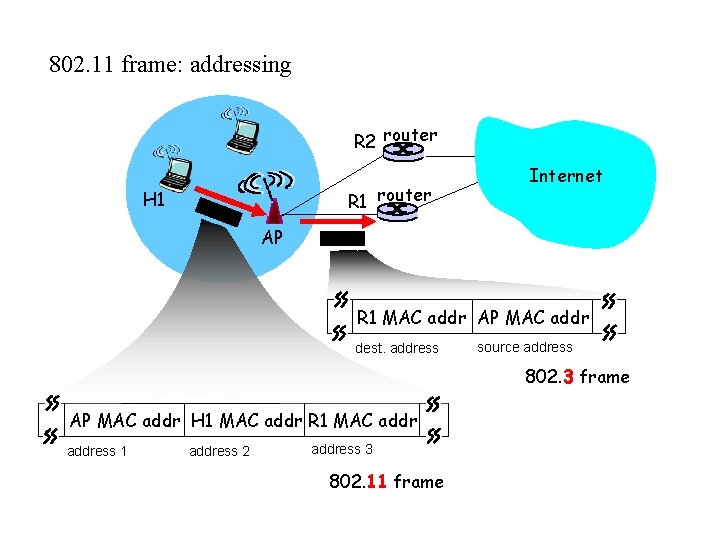
802. 11 frame: addressing R 2 router R 1 router H 1 Internet AP R 1 MAC addr AP MAC addr dest. address source address 802. 3 frame AP MAC addr H 1 MAC addr R 1 MAC address 1 address 2 address 3 802. 11 frame
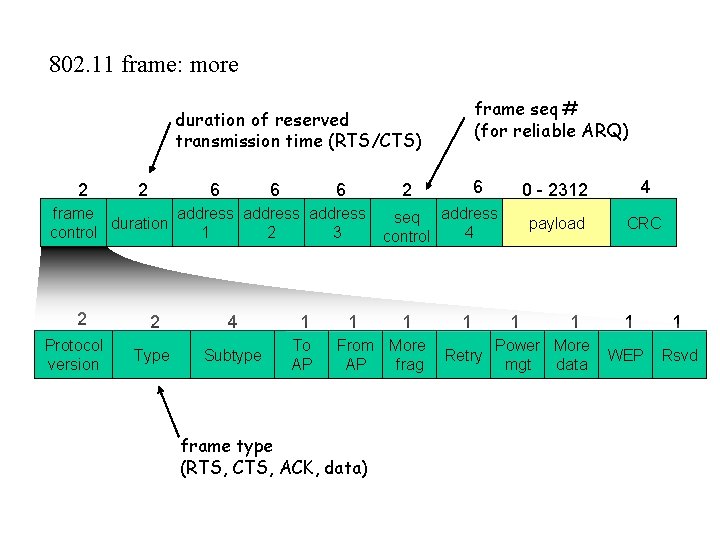
802. 11 frame: more frame seq # (for reliable ARQ) duration of reserved transmission time (RTS/CTS) 2 2 6 6 6 frame address duration control 1 2 3 2 Protocol version 2 4 1 Type Subtype To AP 6 2 1 seq address 4 control 1 From More AP frag frame type (RTS, CTS, ACK, data) 1 Retry 1 0 - 2312 4 payload CRC 1 Power More mgt data 1 1 WEP Rsvd
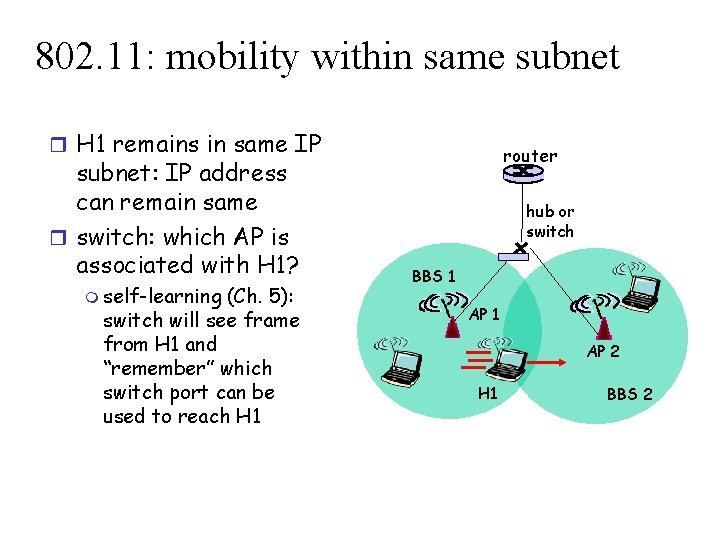
802. 11: mobility within same subnet r H 1 remains in same IP subnet: IP address can remain same r switch: which AP is associated with H 1? m self-learning (Ch. 5): switch will see frame from H 1 and “remember” which switch port can be used to reach H 1 router hub or switch BBS 1 AP 2 H 1 BBS 2
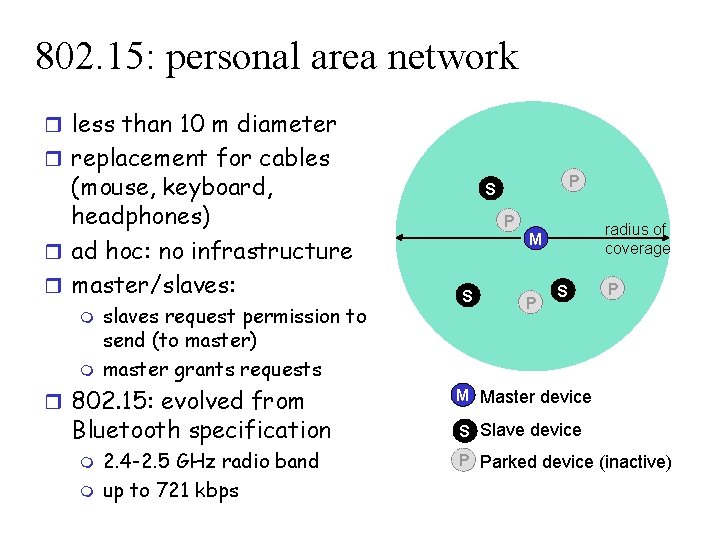
802. 15: personal area network r less than 10 m diameter r replacement for cables (mouse, keyboard, headphones) r ad hoc: no infrastructure r master/slaves: m m slaves request permission to send (to master) master grants requests r 802. 15: evolved from Bluetooth specification m m 2. 4 -2. 5 GHz radio band up to 721 kbps P S P radius of coverage M S P M Master device S Slave device P Parked device (inactive)
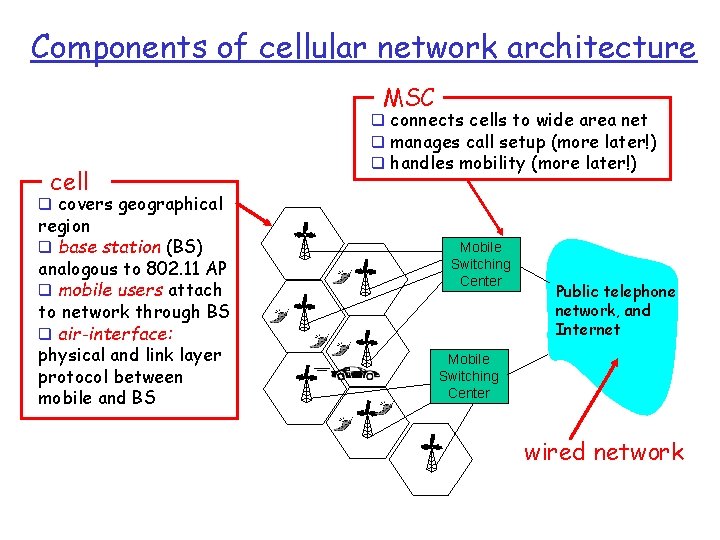
Components of cellular network architecture MSC cell q connects cells to wide area net q manages call setup (more later!) q handles mobility (more later!) q covers geographical region q base station (BS) analogous to 802. 11 AP q mobile users attach to network through BS q air-interface: physical and link layer protocol between mobile and BS Mobile Switching Center Public telephone network, and Internet Mobile Switching Center wired network
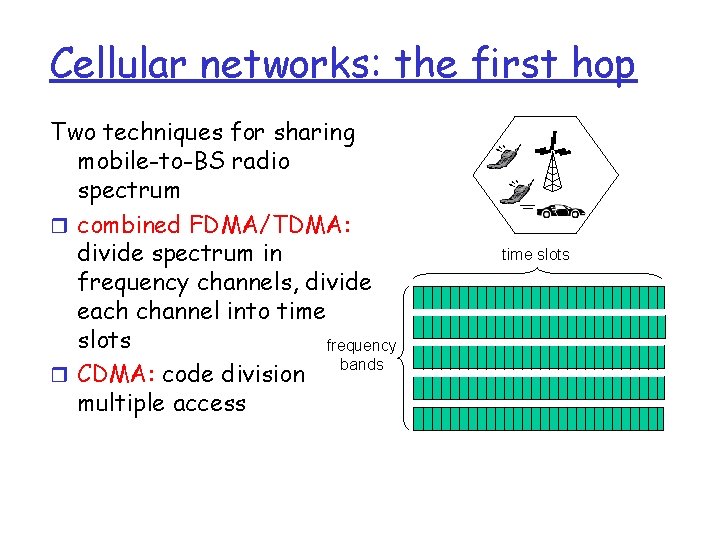
Cellular networks: the first hop Two techniques for sharing mobile-to-BS radio spectrum r combined FDMA/TDMA: divide spectrum in frequency channels, divide each channel into time slots frequency bands r CDMA: code division multiple access time slots
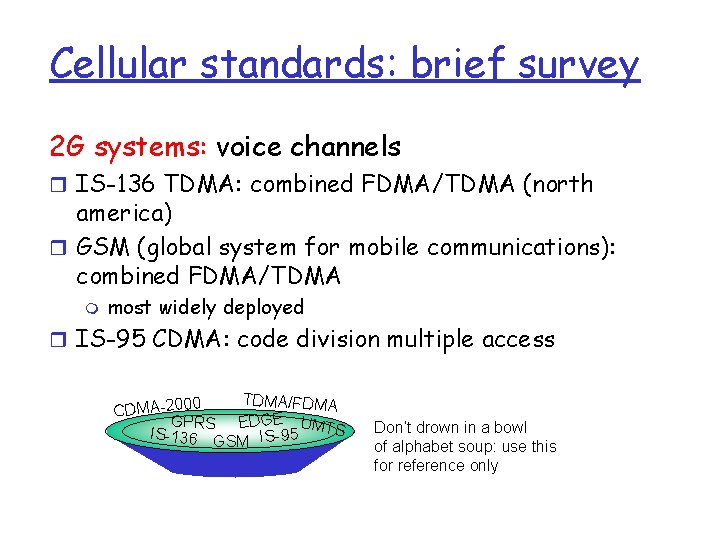
Cellular standards: brief survey 2 G systems: voice channels r IS-136 TDMA: combined FDMA/TDMA (north america) r GSM (global system for mobile communications): combined FDMA/TDMA m most widely deployed r IS-95 CDMA: code division multiple access TDMA/FDMA 0 CDMA-200 GPRS EDGE UMTS IS-136 GSM IS-95 Don’t drown in a bowl of alphabet soup: use this for reference only
Cellular standards: brief survey 2. 5 G systems: voice and data channels r for those who can’t wait for 3 G service: 2 G extensions r general packet radio service (GPRS) m evolved from GSM m data sent on multiple channels (if available) r enhanced data rates for global evolution (EDGE) m also evolved from GSM, using enhanced modulation m Date rates up to 384 K r CDMA-2000 (phase 1) m data rates up to 144 K m evolved from IS-95
Cellular standards: brief survey 3 G systems: voice/data r Universal Mobile Telecommunications Service (UMTS) m GSM next step, but using CDMA r CDMA-2000 …. . more (and more interesting) cellular topics due to mobility (stay tuned for details)
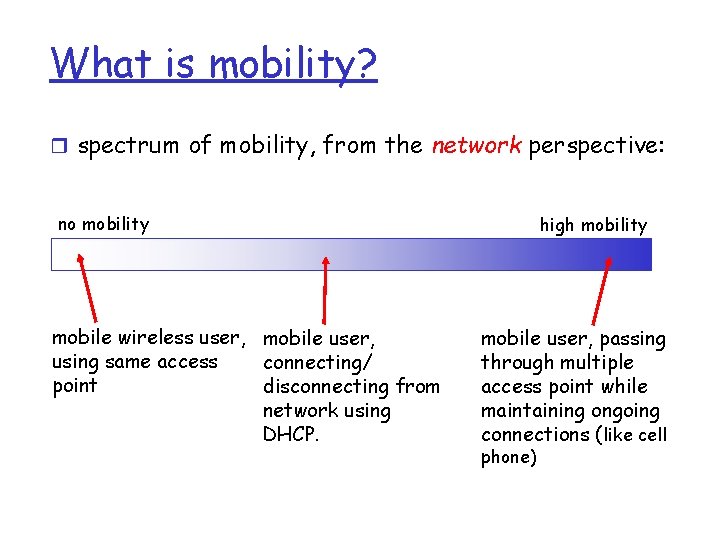
What is mobility? r spectrum of mobility, from the network perspective: no mobility mobile wireless user, mobile user, using same access connecting/ point disconnecting from network using DHCP. high mobility mobile user, passing through multiple access point while maintaining ongoing connections (like cell phone)
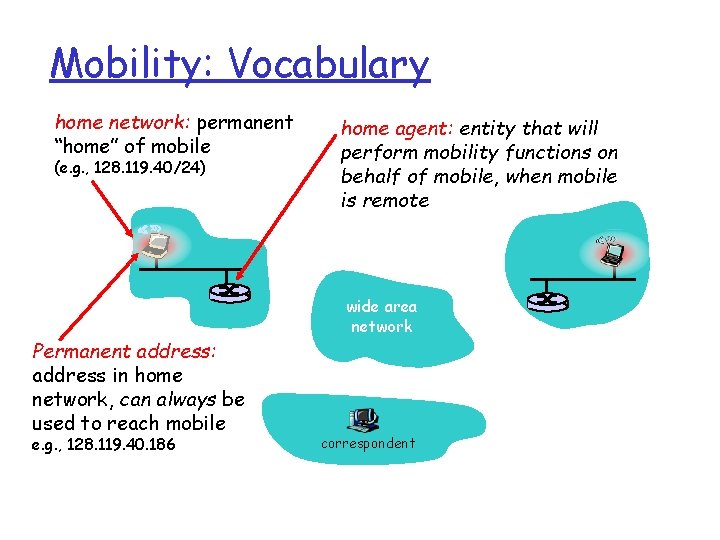
Mobility: Vocabulary home network: permanent “home” of mobile (e. g. , 128. 119. 40/24) Permanent address: address in home network, can always be used to reach mobile e. g. , 128. 119. 40. 186 home agent: entity that will perform mobility functions on behalf of mobile, when mobile is remote wide area network correspondent
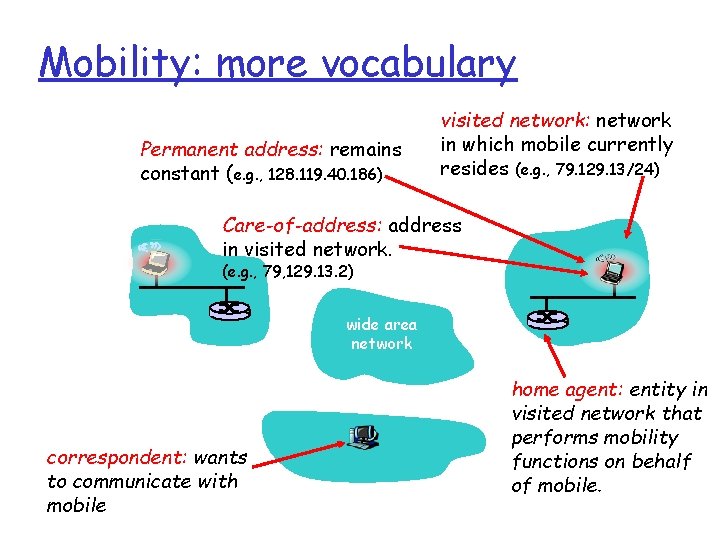
Mobility: more vocabulary Permanent address: remains constant (e. g. , 128. 119. 40. 186) visited network: network in which mobile currently resides (e. g. , 79. 129. 13/24) Care-of-address: address in visited network. (e. g. , 79, 129. 13. 2) wide area network correspondent: wants to communicate with mobile home agent: entity in visited network that performs mobility functions on behalf of mobile.
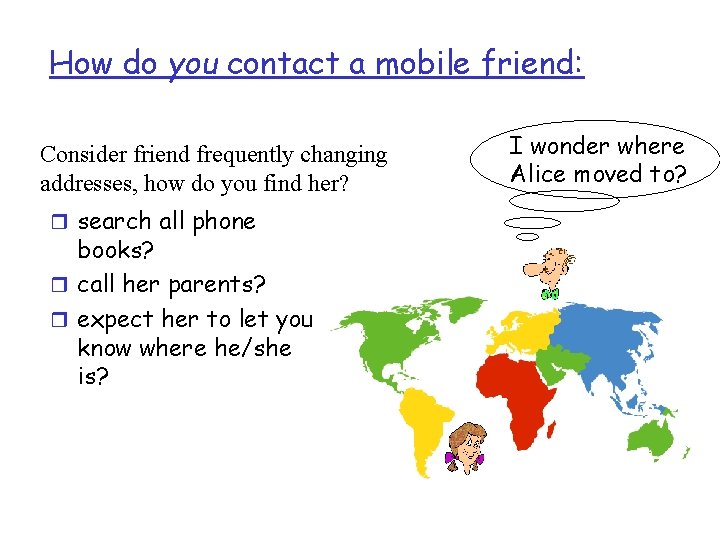
How do you contact a mobile friend: Consider friend frequently changing addresses, how do you find her? r search all phone books? r call her parents? r expect her to let you know where he/she is? I wonder where Alice moved to?
Mobility: approaches r Let routing handle it: routers advertise permanent address of mobile-nodes-in-residence via usual routing table exchange. m routing tables indicate where each mobile located m no changes to end-systems r Let end-systems handle it: m indirect routing: communication from correspondent to mobile goes through home agent, then forwarded to remote m direct routing: correspondent gets foreign address of mobile, sends directly to mobile
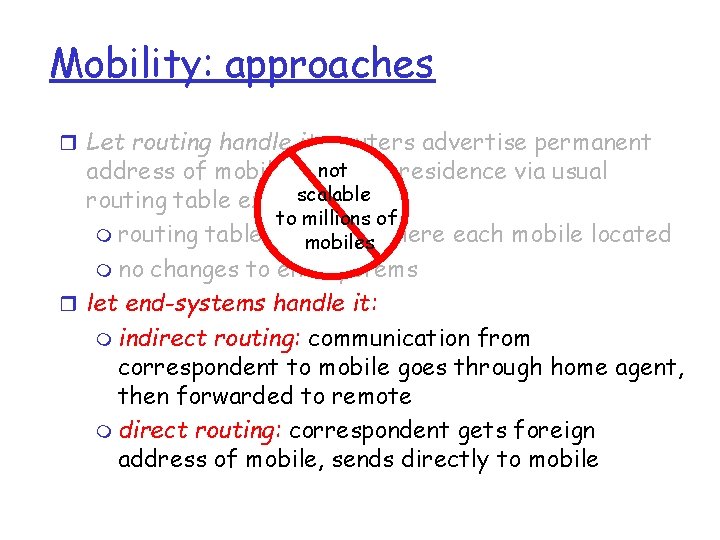
Mobility: approaches r Let routing handle it: routers advertise permanent not address of mobile-nodes-in-residence via usual scalable routing table exchange. to millions of m routing tables indicate mobiles where each mobile located m no changes to end-systems r let end-systems handle it: m indirect routing: communication from correspondent to mobile goes through home agent, then forwarded to remote m direct routing: correspondent gets foreign address of mobile, sends directly to mobile
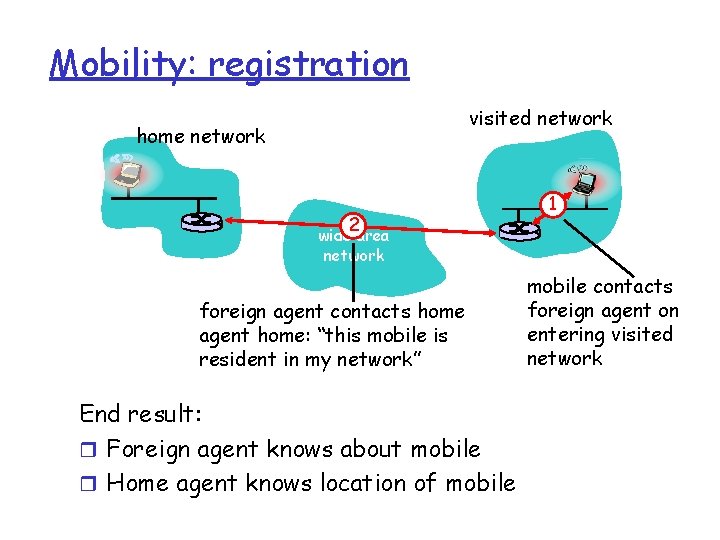
Mobility: registration visited network home network 2 1 wide area network foreign agent contacts home agent home: “this mobile is resident in my network” End result: r Foreign agent knows about mobile r Home agent knows location of mobile contacts foreign agent on entering visited network
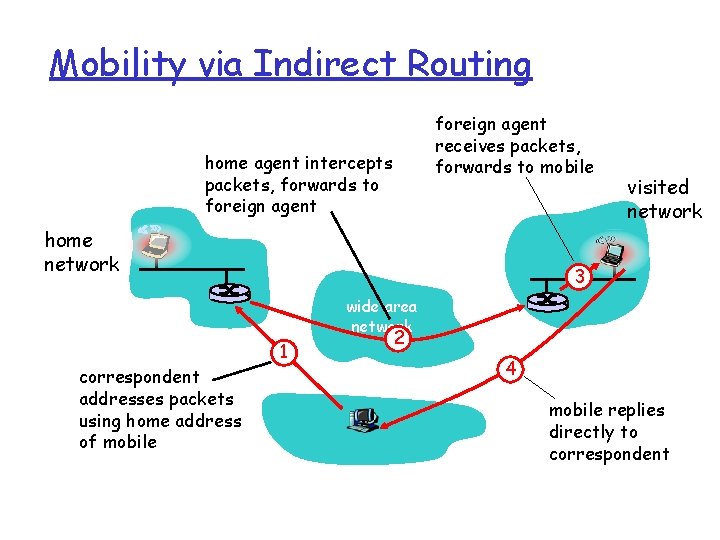
Mobility via Indirect Routing foreign agent receives packets, forwards to mobile home agent intercepts packets, forwards to foreign agent home network visited network 3 wide area network correspondent addresses packets using home address of mobile 1 2 4 mobile replies directly to correspondent
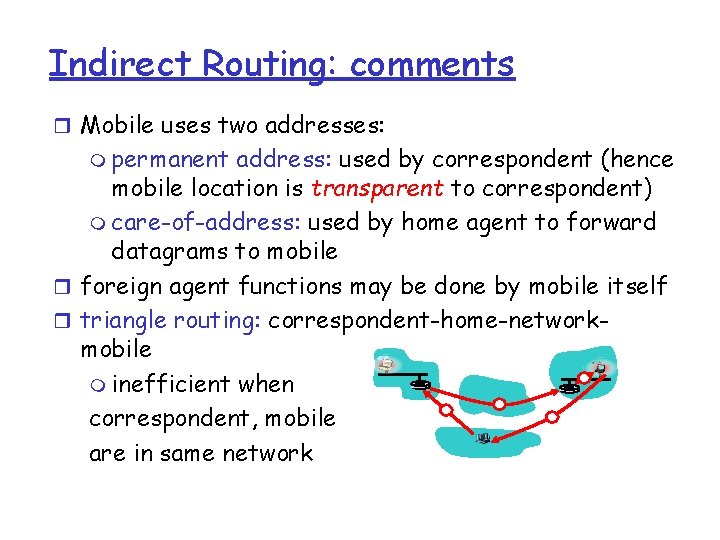
Indirect Routing: comments r Mobile uses two addresses: m permanent address: used by correspondent (hence mobile location is transparent to correspondent) m care-of-address: used by home agent to forward datagrams to mobile r foreign agent functions may be done by mobile itself r triangle routing: correspondent-home-networkmobile m inefficient when correspondent, mobile are in same network
Indirect Routing: moving between networks r suppose mobile user moves to another network m registers with new foreign agent m new foreign agent registers with home agent m home agent update care-of-address for mobile m packets continue to be forwarded to mobile (but with new care-of-address) r mobility, changing foreign networks transparent: ongoing connections can be maintained!
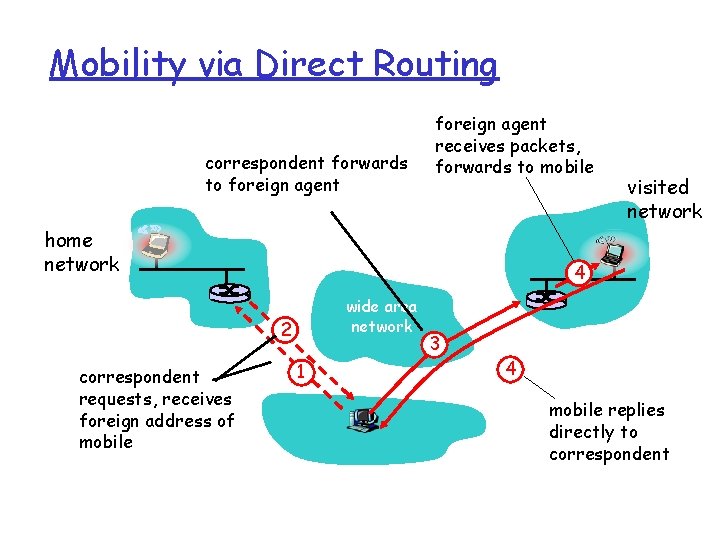
Mobility via Direct Routing correspondent forwards to foreign agent receives packets, forwards to mobile home network 4 wide area network 2 correspondent requests, receives foreign address of mobile visited network 1 3 4 mobile replies directly to correspondent
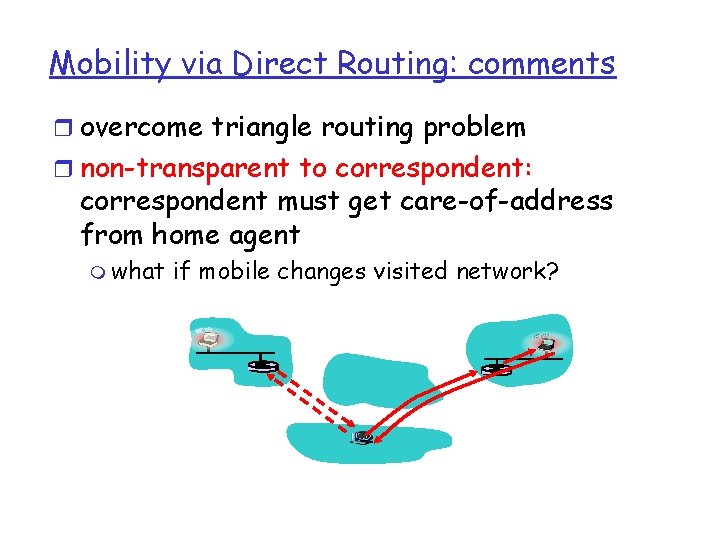
Mobility via Direct Routing: comments r overcome triangle routing problem r non-transparent to correspondent: correspondent must get care-of-address from home agent m what if mobile changes visited network?
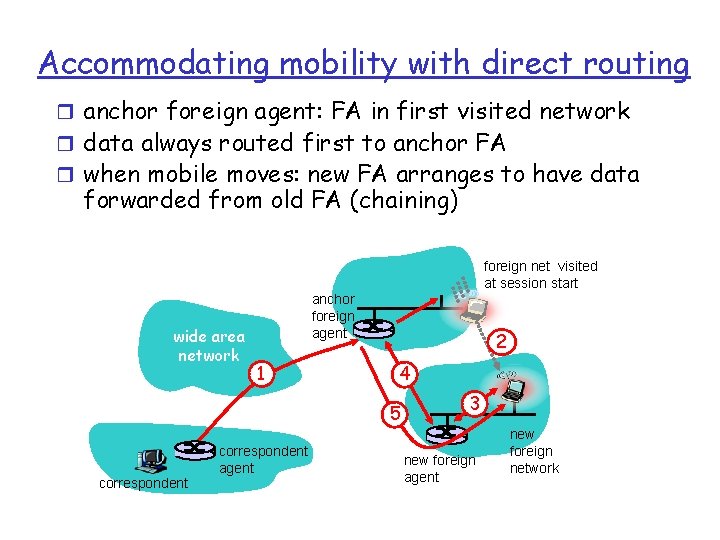
Accommodating mobility with direct routing r anchor foreign agent: FA in first visited network r data always routed first to anchor FA r when mobile moves: new FA arranges to have data forwarded from old FA (chaining) foreign net visited at session start wide area network anchor foreign agent 1 2 4 5 correspondent agent 3 new foreign agent new foreign network
Mobile IP r RFC 3220 r has many features we’ve seen: m home agents, foreign-agent registration, care-of-addresses, encapsulation (packet-within-a-packet) r three components to standard: m indirect routing of datagrams m agent discovery m registration with home agent
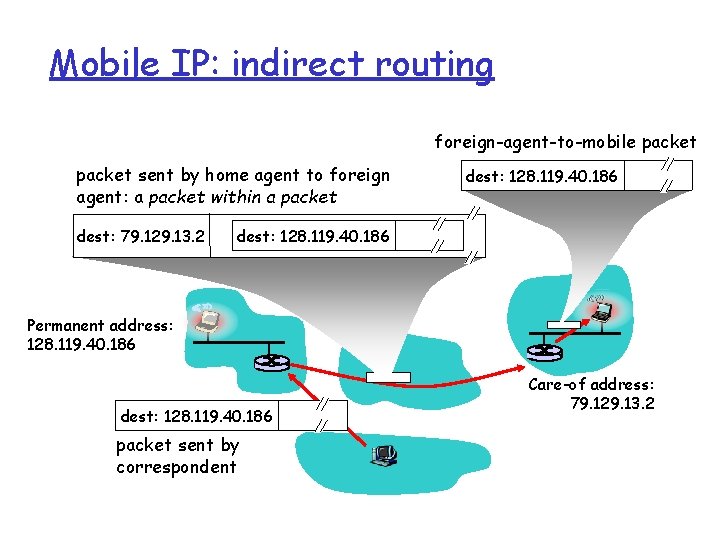
Mobile IP: indirect routing foreign-agent-to-mobile packet sent by home agent to foreign agent: a packet within a packet dest: 79. 129. 13. 2 dest: 128. 119. 40. 186 Permanent address: 128. 119. 40. 186 dest: 128. 119. 40. 186 packet sent by correspondent Care-of address: 79. 129. 13. 2
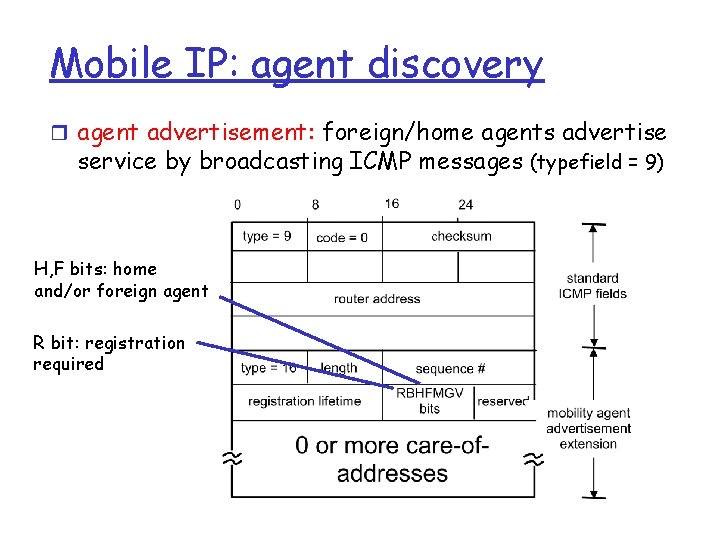
Mobile IP: agent discovery r agent advertisement: foreign/home agents advertise service by broadcasting ICMP messages (typefield = 9) H, F bits: home and/or foreign agent R bit: registration required
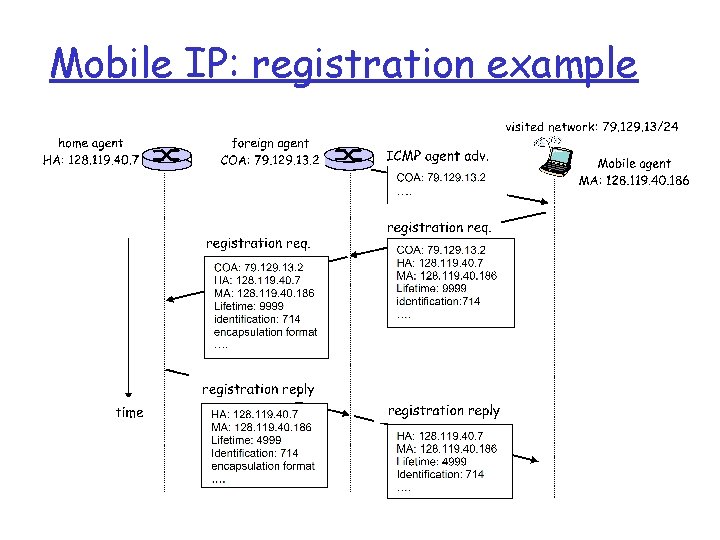
Mobile IP: registration example
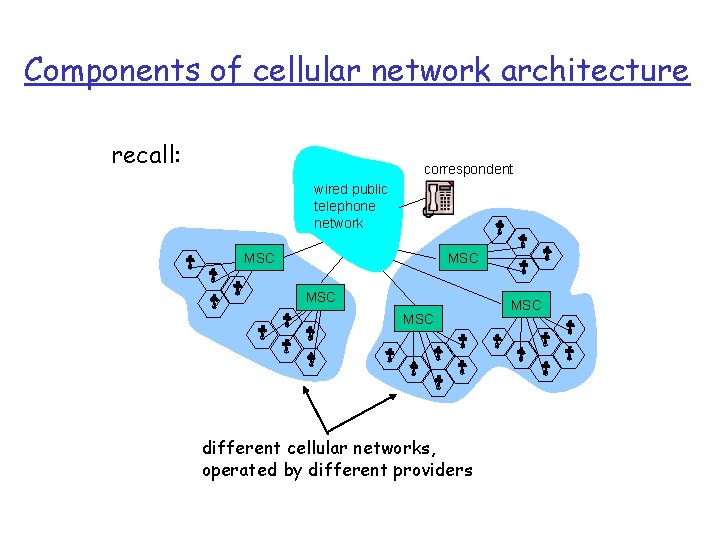
Components of cellular network architecture recall: correspondent wired public telephone network MSC MSC different cellular networks, operated by different providers MSC
Handling mobility in cellular networks r home network: network of cellular provider you subscribe to (e. g. , Sprint PCS, Verizon) m home location register (HLR): database in home network containing permanent cell phone #, profile information (services, preferences, billing), information about current location (could be in another network) r visited network: network in which mobile currently resides m visitor location register (VLR): database with entry for each user currently in network m could be home network
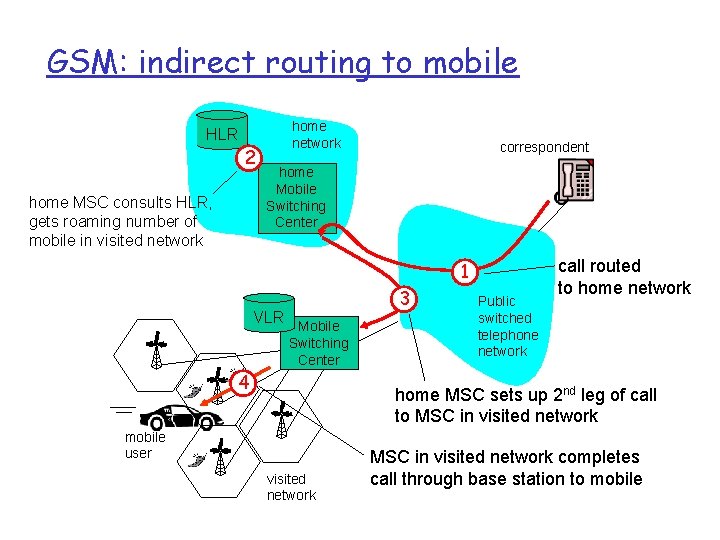
GSM: indirect routing to mobile home network HLR 2 home MSC consults HLR, gets roaming number of mobile in visited network correspondent home Mobile Switching Center 1 VLR 3 Mobile Switching Center 4 Public switched telephone network call routed to home network home MSC sets up 2 nd leg of call to MSC in visited network mobile user visited network MSC in visited network completes call through base station to mobile
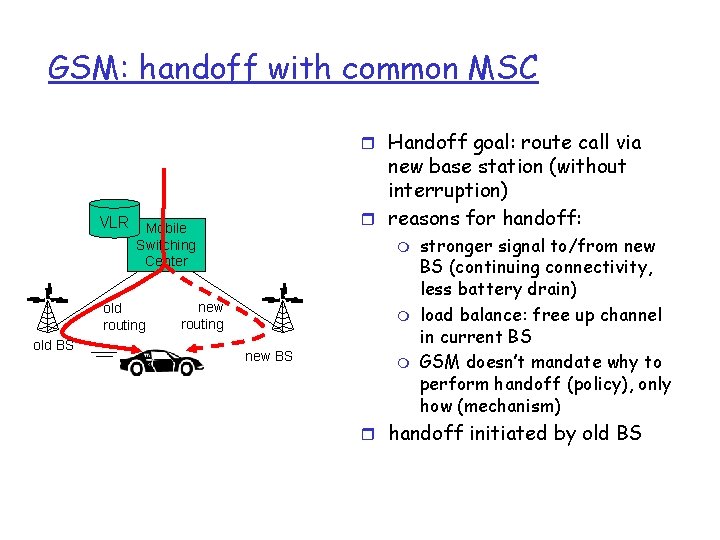
GSM: handoff with common MSC r Handoff goal: route call via new base station (without interruption) r reasons for handoff: VLR Mobile Switching Center old routing old BS m new routing m new BS m stronger signal to/from new BS (continuing connectivity, less battery drain) load balance: free up channel in current BS GSM doesn’t mandate why to perform handoff (policy), only how (mechanism) r handoff initiated by old BS
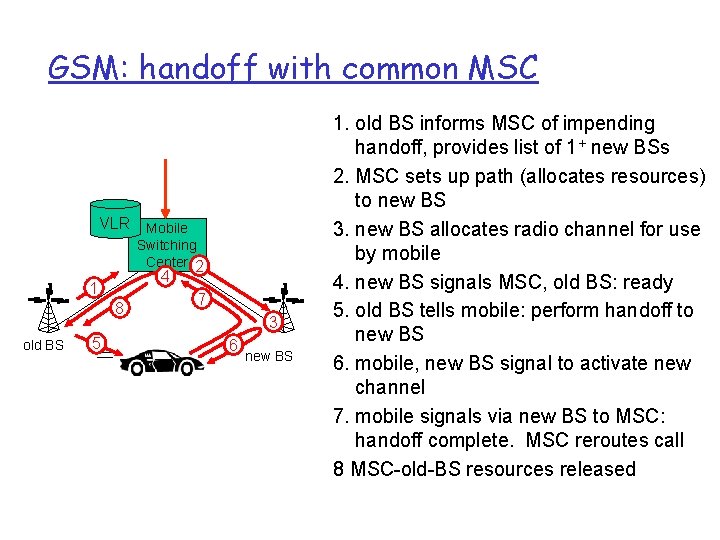
GSM: handoff with common MSC VLR Mobile Switching Center 2 4 1 8 old BS 5 7 3 6 new BS 1. old BS informs MSC of impending handoff, provides list of 1+ new BSs 2. MSC sets up path (allocates resources) to new BS 3. new BS allocates radio channel for use by mobile 4. new BS signals MSC, old BS: ready 5. old BS tells mobile: perform handoff to new BS 6. mobile, new BS signal to activate new channel 7. mobile signals via new BS to MSC: handoff complete. MSC reroutes call 8 MSC-old-BS resources released
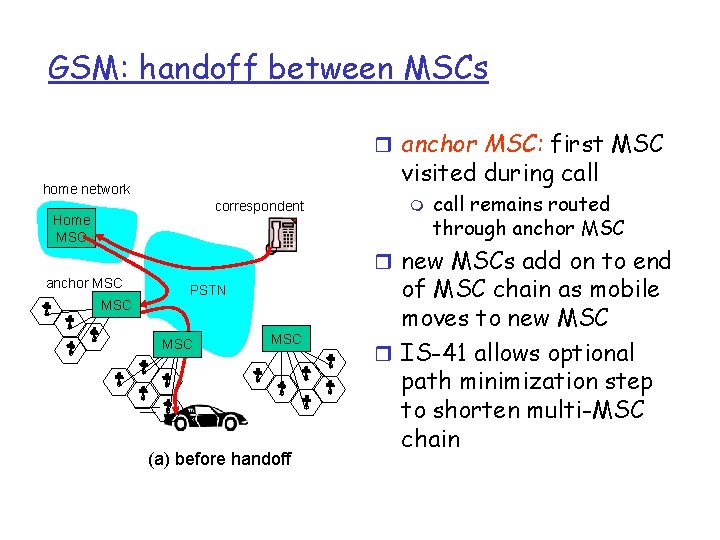
GSM: handoff between MSCs r anchor MSC: first MSC visited during call home network correspondent Home MSC anchor MSC m call remains routed through anchor MSC r new MSCs add on to end PSTN MSC (a) before handoff of MSC chain as mobile moves to new MSC r IS-41 allows optional path minimization step to shorten multi-MSC chain
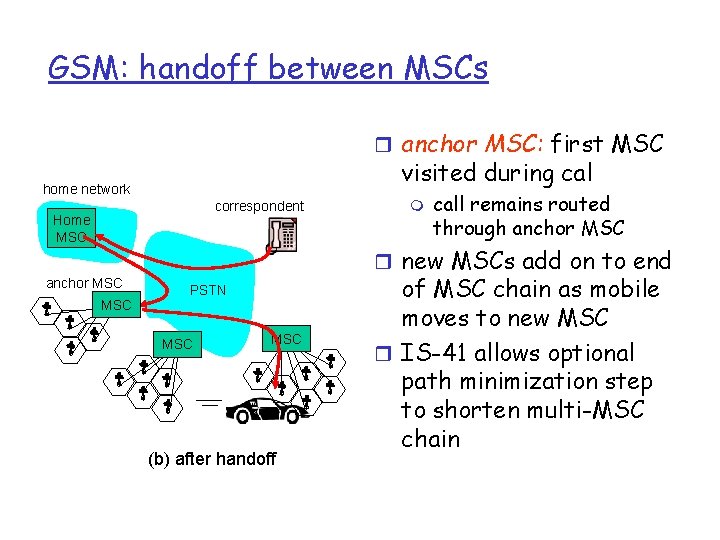
GSM: handoff between MSCs r anchor MSC: first MSC visited during cal home network correspondent Home MSC anchor MSC m call remains routed through anchor MSC r new MSCs add on to end PSTN MSC (b) after handoff of MSC chain as mobile moves to new MSC r IS-41 allows optional path minimization step to shorten multi-MSC chain
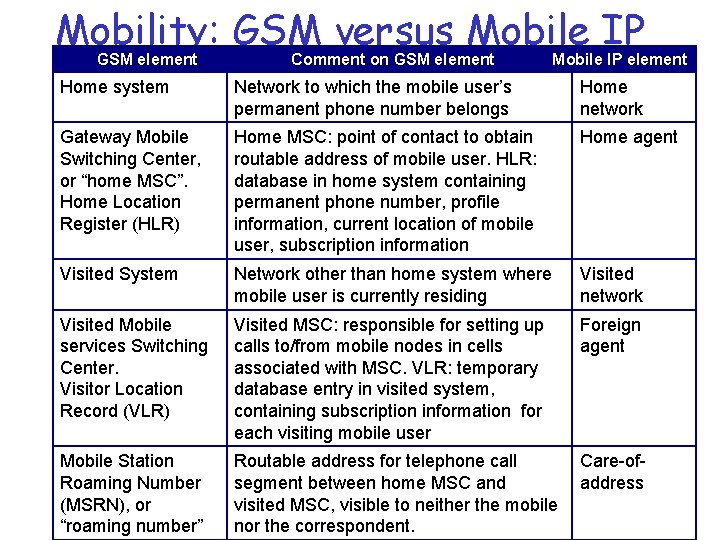
Mobility: GSM versus Mobile IP GSM element Comment on GSM element Mobile IP element Home system Network to which the mobile user’s permanent phone number belongs Home network Gateway Mobile Switching Center, or “home MSC”. Home Location Register (HLR) Home MSC: point of contact to obtain routable address of mobile user. HLR: database in home system containing permanent phone number, profile information, current location of mobile user, subscription information Home agent Visited System Network other than home system where mobile user is currently residing Visited network Visited Mobile services Switching Center. Visitor Location Record (VLR) Visited MSC: responsible for setting up calls to/from mobile nodes in cells associated with MSC. VLR: temporary database entry in visited system, containing subscription information for each visiting mobile user Foreign agent Mobile Station Roaming Number (MSRN), or “roaming number” Routable address for telephone call segment between home MSC and visited MSC, visible to neither the mobile nor the correspondent. Care-ofaddress
Wireless, mobility: impact on higher layer protocols r logically, impact should be minimal … m best effort service model remains unchanged m TCP and UDP can (and do) run over wireless, mobile r … but performance-wise: m packet loss/delay due to bit-errors (discarded packets, delays for link-layer retransmissions), and handoff m TCP interprets loss as congestion, will decrease congestion window un-necessarily m delay impairments for real-time traffic m limited bandwidth of wireless links
Chapter 6 Summary Wireless r wireless links: m m m capacity, distance channel impairments CDMA r IEEE 802. 11 (“wi-fi”) m CSMA/CA reflects wireless channel characteristics r cellular access m architecture m standards (e. g. , GSM, CDMA-2000, UMTS) Mobility r principles: addressing, routing to mobile users m m m home, visited networks direct, indirect routing care-of-addresses r case studies m mobile IP m mobility in GSM r impact on higher-layer protocols
- Slides: 38