
Wire System Maintenance Reporting Codes Pall B Arnason
Wire System Maintenance Reporting Codes Pall B. Arnason Team Leader, Advanced Development Programs Wiring Systems Branch Aging Aircraft IPT / AIR-4. 4. 4. 3
Background: Navy Maintenance Levels • Navy Has Three Levels of Maintenance for Aircraft: – Organizational “O” Level - on Aircraft Maintenance – Intermediate “I” Level - off Aircraft Maintenance and Occasional on Aircraft Maintenance When Required – Depot “D” Level - Industrial Based “Heavy” Maintenance and Refurbishment

Background: Naval Aviation Maintenance Program All Three Levels of Maintenance Governed by One Document: OPNAVINST 4790. 2 NAMP i Establishes Central Maintenance Data System to Record Data About - Equipment Maintainability and Reliability - Equipment Configuration, Including Alteration and TD Status - Equipment Mission Capability and Utilization - Material Usage - Material Non-Availability - Maintenance and Material Processing Times - Weapon System and Maintenance Material Costing
Background: Maintenance Data Many Combinations of Reports May Be Generated From Maintenance Data, Including: - Maintenance Actions by Component or Aircraft Serial Number - Repair Cycle Data - Monthly Equipment Mission Capability - Man Hours Expended and Cost Data - Top Level Logistics Data
Background: Work Unit Codes The Maintenance Data System Requires the Establishment of Codes for the Recording of Data on Maintenance Action Forms: Work Unit Code ( WUC) - A one, three, five or seven character numeric or alpha/numeric code. It identifies a system, subsystem, set, major component, repairable subassembly, or part of an end item. 11 XXXXX Airframe 14 XXXXX Flight Controls 42 XXXXX Electrical Systems
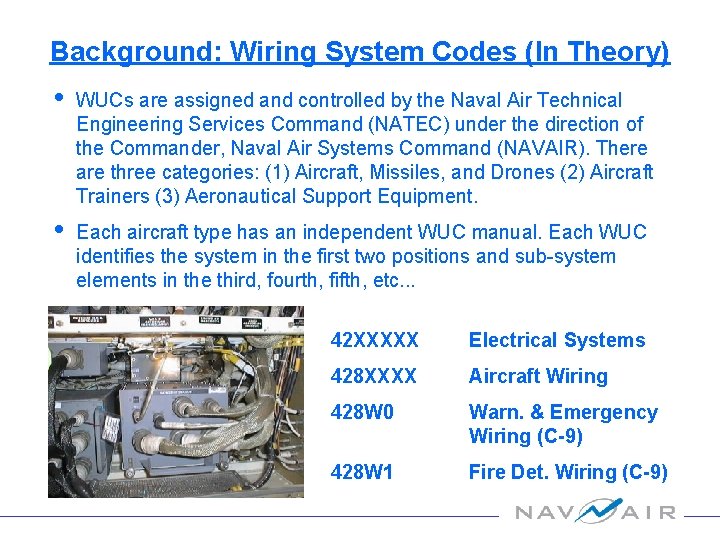
Background: Wiring System Codes (In Theory) i WUCs are assigned and controlled by the Naval Air Technical Engineering Services Command (NATEC) under the direction of the Commander, Naval Air Systems Command (NAVAIR). There are three categories: (1) Aircraft, Missiles, and Drones (2) Aircraft Trainers (3) Aeronautical Support Equipment. i Each aircraft type has an independent WUC manual. Each WUC identifies the system in the first two positions and sub-system elements in the third, fourth, fifth, etc. . . 42 XXXXX Electrical Systems 428 XXXX Aircraft Wiring 428 W 0 Warn. & Emergency Wiring (C-9) 428 W 1 Fire Det. Wiring (C-9)
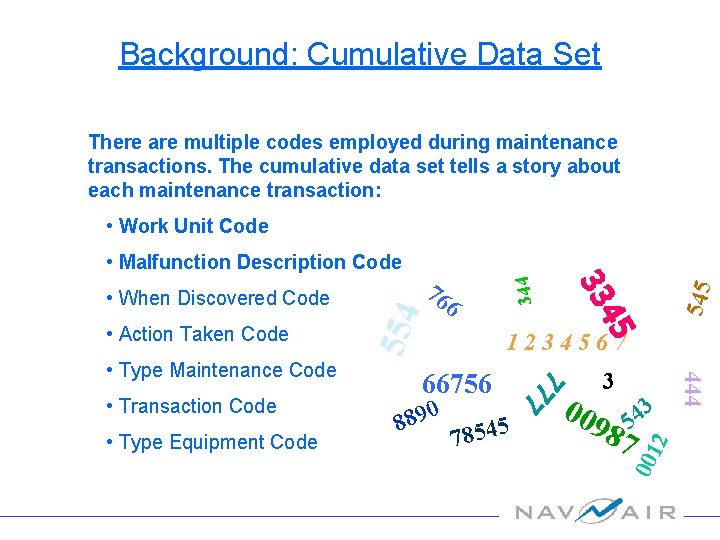
Background: Cumulative Data Set There are multiple codes employed during maintenance transactions. The cumulative data set tells a story about each maintenance transaction: • Work Unit Code 0 9 8 8 545 344 78545 00 3 98 3 4 5 7 001 2 • Type Equipment Code 66756 444 • Transaction Code 1234567 7 • Type Maintenance Code 6 45 • Action Taken Code 76 33 • When Discovered Code 554 • Malfunction Description Code
VIDS/MAF And NALCOMIS i All Codes and Data Are Entered in Specified Fields on the Visual Information System / Maintenance Action Form (VIDS/MAF) i The VIDS/MAF Contains Multiple Fields for Data Entry Before During and After Maintenance Actions i Navy Now Uses Electronic Format for VIDS/MAF Known As NALCOMIS i NALCOMIS Permits the Maintenance Activities to Track VIDS/MAF Information From Cradle to Grave and Communicate With Supply Electronically i NALCOMIS Data Is Backed up on Tape and Tapes Are Forwarded to Mechanicsburg, PA for Entry Into the Central NALDA (Logistics) Data Base
How We Use The Data • Multiple Reports Can Be Generated Through NALDA to Provide Analysis Information for Virtually All Aspects of Maintenance • NALDA Data Is Used to Identify Top 10 Readiness Degraders • The Navy Safety Center Tracks Hazardous Material Reports by Work Unit Code • NAVAIR Developing A Metrics Program For Aircraft Wire Systems (AIR-4. 4. 7)
Problems With Wire System Reporting • Current Work Unit Codes Identify Subsystem Wiring and Give No Indication of Zone or Area of Failures (Hot Spots) • Generic or Not Otherwise Covered (NOC) WUC’s Are Used Too Often • Current Malfunction Codes Do Not Provide Adequate Information to Determine Actual Failures Occurring or Conditions That Lead To Failure (Degenerative Conditions) • NALDA Data Is Limited In Its Utility For Reliability Centered Maintenance (RCM) Analysis For Wiring Systems
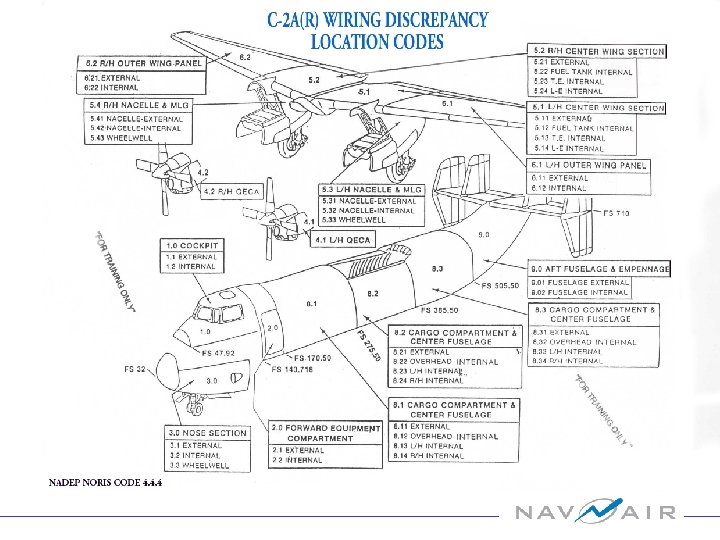
The Change (Drum Roll Please) • Work Unit Code Guide for Aeronautical Equipment Changed 8 March 2002 Directing Location Based WUC’s for Wiring and Fiber Optic Wiring (Implementation Controlled By Fleet Support Teams) • 4790. 2 Change Committee Has Approved Special Wiring Malfunction Codes
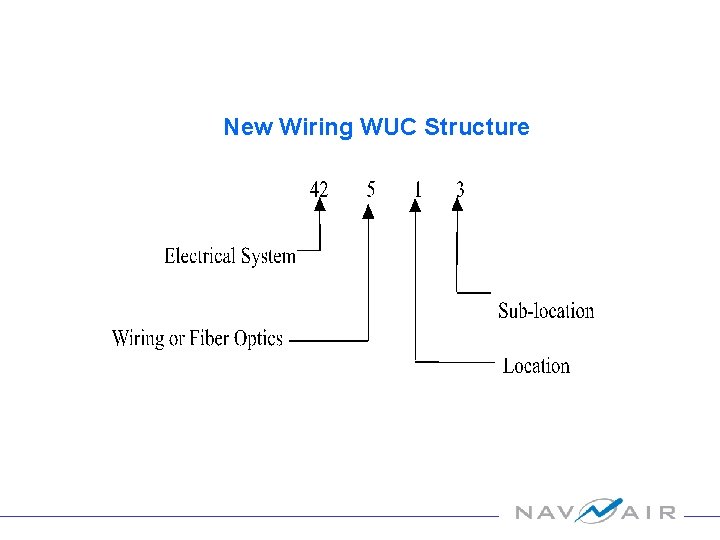
New Wiring WUC Structure
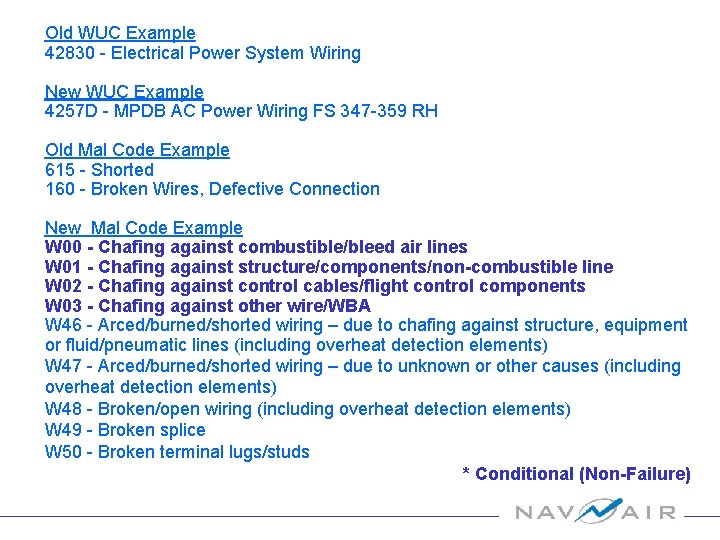
Old WUC Example 42830 - Electrical Power System Wiring New WUC Example 4257 D - MPDB AC Power Wiring FS 347 -359 RH Old Mal Code Example 615 - Shorted 160 - Broken Wires, Defective Connection New Mal Code Example W 00 - Chafing against combustible/bleed air lines W 01 - Chafing against structure/components/non-combustible line W 02 - Chafing against control cables/flight control components W 03 - Chafing against other wire/WBA W 46 - Arced/burned/shorted wiring – due to chafing against structure, equipment or fluid/pneumatic lines (including overheat detection elements) W 47 - Arced/burned/shorted wiring – due to unknown or other causes (including overheat detection elements) W 48 - Broken/open wiring (including overheat detection elements) W 49 - Broken splice W 50 - Broken terminal lugs/studs * Conditional (Non-Failure)
Delete
Benefits • Actual Failures Identified • Conditional (Non-Failure) Flaws Identified • Quickly Highlights Troublesome Areas of the Aircraft • Better Metrics For RCM Analysis and Planned Maintenance
Future Plans NAVAIR Wire System Metrics Program: • Verified Failures • Mission Aborts (Before-Flight and In-Flight) • Non-Mission Capable Hours • Partial Mission Capable Hours • Zonal and Component Tracking / Wiring Specific RCM Analysis • Direct Links to Wiring Diagnostics • Identification of Training Deficiencies Joint Council On Aging Aircraft (JCAA): • Investigating Joint Service Methods to Improve Wire System Reporting
- Slides: 16