
WIR SCHAFFEN WISSEN HEUTE FR MORGEN Daniela Kiselev
- Slides: 21
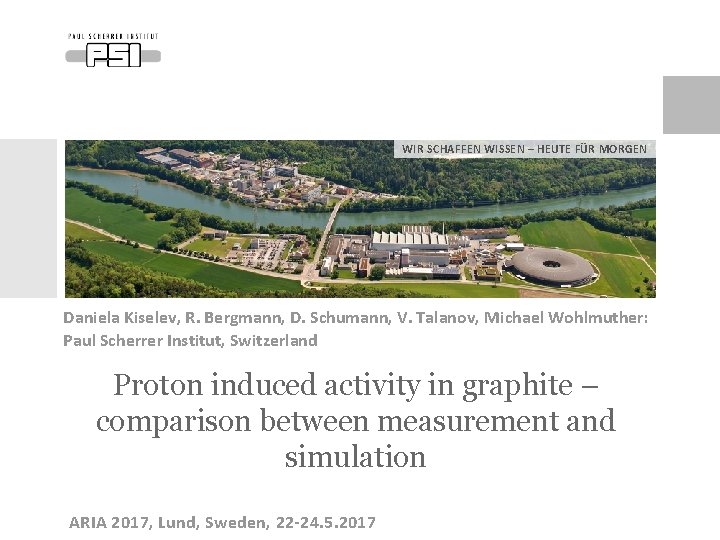
WIR SCHAFFEN WISSEN – HEUTE FÜR MORGEN Daniela Kiselev, R. Bergmann, D. Schumann, V. Talanov, Michael Wohlmuther: Paul Scherrer Institut, Switzerland Proton induced activity in graphite – comparison between measurement and simulation ARIA 2017, Lund, Sweden, 22 -24. 5. 2017
Motivation Disposal of radioactive waste (specially targets) - Authorities need complete (calculated) nuclide inventory of long-lived isotopes (T 1/2 > 60 d) - Predictions have to be (partly) validated Radioisotopes in (pure) activated graphite: H-3, Be-7, Be-10, C-14 Be-7(T 1/2 = 53 d): determines high dose rate H-3: problem of outgassing as graphite is porous (during operation or later) C-14 (T 1/2 = 5730 y): long-lived candidate for migration in the final repository special measures for disposal of radioactive graphite (also due to the presence of Cl-36) 590 Me. V protons on (quite) pure graphite: - simple system well suited for benchmarking Here: MCNPX 2. 7. 0 + BERTINI-Dresner-RAL & INCL 4. 6/ABLA 07 Measured isotopes: H-3, Be-7, Be-10, C-14, Na-22, Al-26, Ti-44, Mn-54
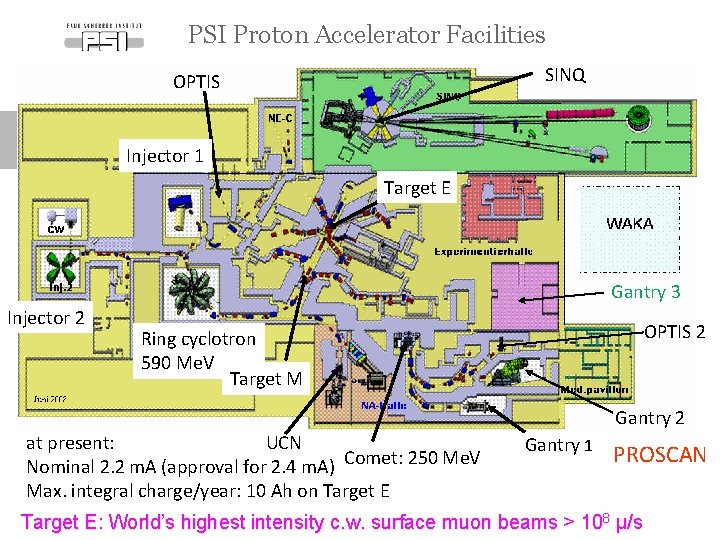
PSI Proton Accelerator Facilities SINQ OPTIS Injector 1 Target E Gantry 3 Injector 2 OPTIS 2 Ring cyclotron 590 Me. V Target M Gantry 2 at present: UCN Nominal 2. 2 m. A (approval for 2. 4 m. A) Comet: 250 Me. V Max. integral charge/year: 10 Ah on Target E Gantry 1 PROSCAN Target E: World’s highest intensity c. w. surface muon beams > 108 µ/s
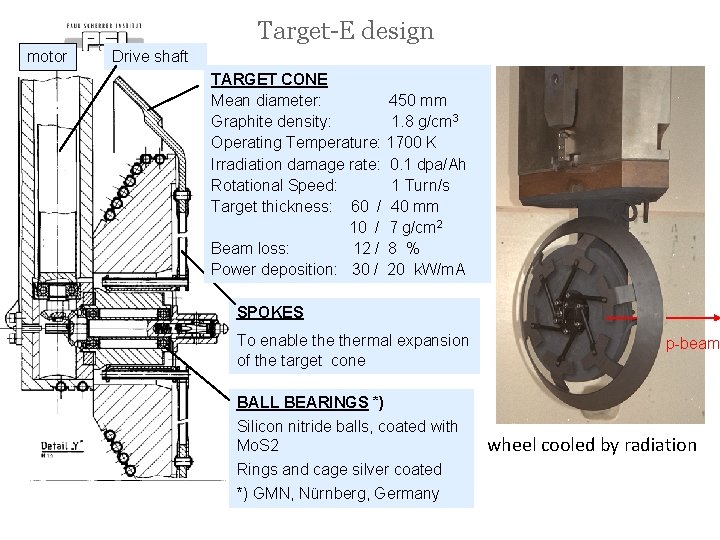
Target-E design motor Drive shaft TARGET CONE Mean diameter: 450 mm Graphite density: 1. 8 g/cm 3 Operating Temperature: 1700 K Irradiation damage rate: 0. 1 dpa/Ah Rotational Speed: 1 Turn/s Target thickness: 60 / 40 mm 10 / 7 g/cm 2 Beam loss: 12 / 8 % Power deposition: 30 / 20 k. W/m. A SPOKES To enable thermal expansion of the target cone BALL BEARINGS *) Silicon nitride balls, coated with Mo. S 2 Rings and cage silver coated *) GMN, Nürnberg, Germany p-beam wheel cooled by radiation
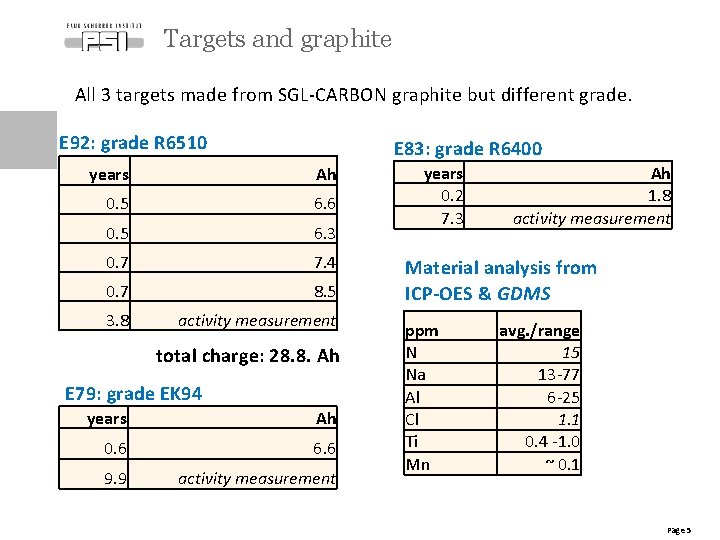
Targets and graphite All 3 targets made from SGL-CARBON graphite but different grade. E 92: grade R 6510 E 83: grade R 6400 years Ah 0. 5 6. 6 0. 5 6. 3 0. 7 7. 4 0. 7 8. 5 3. 8 activity measurement total charge: 28. 8. Ah E 79: grade EK 94 years Ah 0. 6 6. 6 9. 9 activity measurement years 0. 2 7. 3 Ah 1. 8 activity measurement Material analysis from ICP-OES & GDMS ppm N Na Al Cl Ti Mn avg. /range 15 13 -77 6 -25 1. 1 0. 4 -1. 0 ~ 0. 1 Page 5
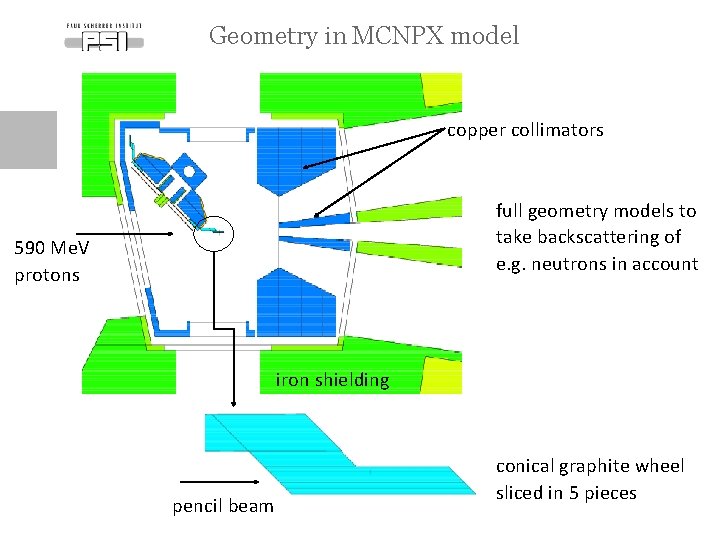
Geometry in MCNPX model copper collimators full geometry models to take backscattering of e. g. neutrons in account 590 Me. V protons iron shielding pencil beam conical graphite wheel sliced in 5 pieces
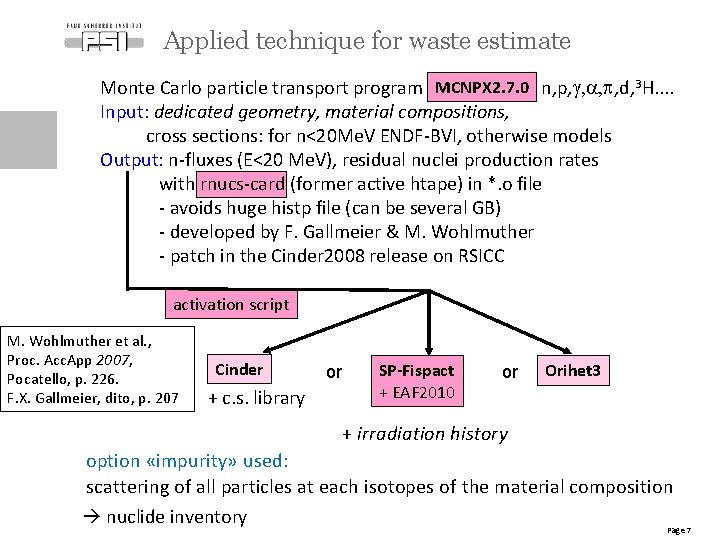
Applied technique for waste estimate Monte Carlo particle transport program MCNPX 2. 7. 0 : n, p, g, a, p, d, 3 H. . Input: dedicated geometry, material compositions, cross sections: for n<20 Me. V ENDF-BVI, otherwise models Output: n-fluxes (E<20 Me. V), residual nuclei production rates with rnucs-card (former active htape) in *. o file - avoids huge histp file (can be several GB) - developed by F. Gallmeier & M. Wohlmuther - patch in the Cinder 2008 release on RSICC activation script M. Wohlmuther et al. , Proc. Acc. App 2007, Pocatello, p. 226. F. X. Gallmeier, dito, p. 207 Cinder + c. s. library or SP-Fispact + EAF 2010 or Orihet 3 + irradiation history option «impurity» used: scattering of all particles at each isotopes of the material composition nuclide inventory Page 7
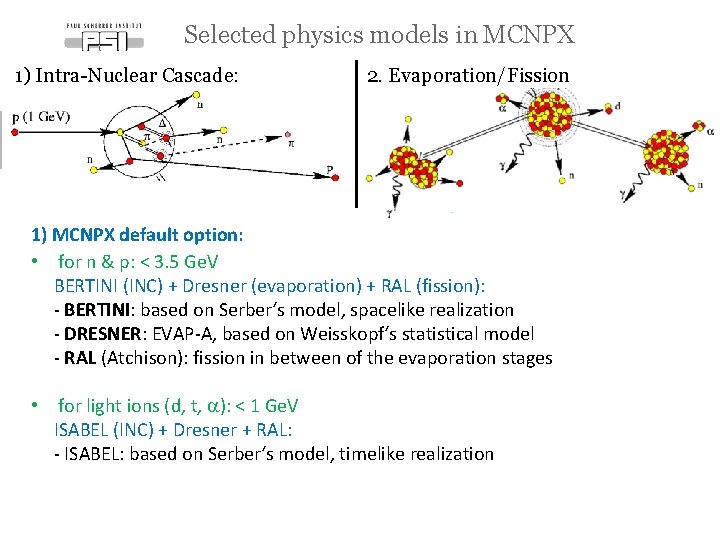
Selected physics models in MCNPX 1) Intra-Nuclear Cascade: 2. Evaporation/Fission 1) MCNPX default option: • for n & p: < 3. 5 Ge. V BERTINI (INC) + Dresner (evaporation) + RAL (fission): - BERTINI: based on Serber‘s model, spacelike realization - DRESNER: EVAP-A, based on Weisskopf‘s statistical model - RAL (Atchison): fission in between of the evaporation stages • for light ions (d, t, a): < 1 Ge. V ISABEL (INC) + Dresner + RAL: - ISABEL: based on Serber‘s model, timelike realization
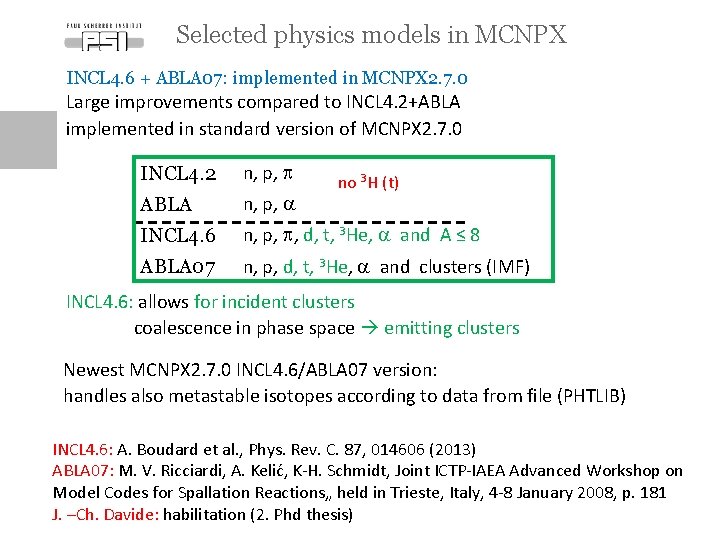
Selected physics models in MCNPX INCL 4. 6 + ABLA 07: implemented in MCNPX 2. 7. 0 Large improvements compared to INCL 4. 2+ABLA implemented in standard version of MCNPX 2. 7. 0 INCL 4. 2 n, p, p ABLA n, p, a INCL 4. 6 n, p, p, d, t, 3 He, a and A ≤ 8 ABLA 07 n, p, d, t, 3 He, a and clusters (IMF) no 3 H (t) INCL 4. 6: allows for incident clusters coalescence in phase space emitting clusters Newest MCNPX 2. 7. 0 INCL 4. 6/ABLA 07 version: handles also metastable isotopes according to data from file (PHTLIB) INCL 4. 6: A. Boudard et al. , Phys. Rev. C. 87, 014606 (2013) ABLA 07: M. V. Ricciardi, A. Kelić, K-H. Schmidt, Joint ICTP-IAEA Advanced Workshop on Model Codes for Spallation Reactions„ held in Trieste, Italy, 4 -8 January 2008, p. 181 J. –Ch. Davide: habilitation (2. Phd thesis)
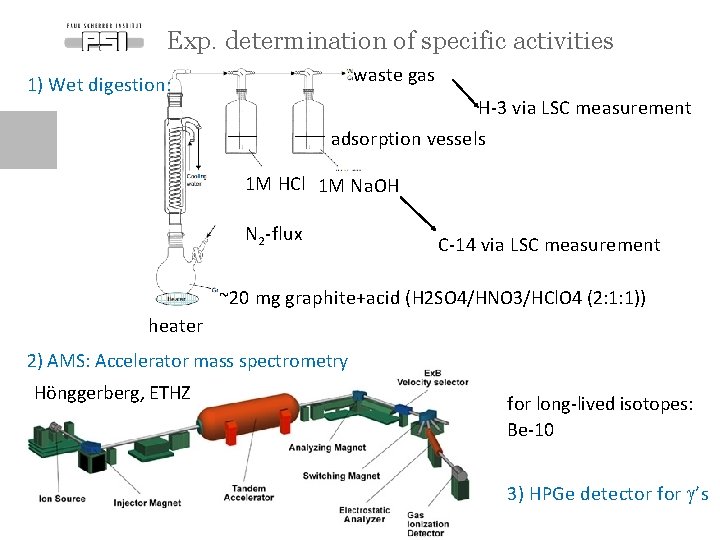
Exp. determination of specific activities waste gas 1) Wet digestion: H-3 via LSC measurement adsorption vessels 1 M HCl 1 M Na. OH N 2 -flux C-14 via LSC measurement ~20 mg graphite+acid (H 2 SO 4/HNO 3/HCl. O 4 (2: 1: 1)) heater 2) AMS: Accelerator mass spectrometry Hönggerberg, ETHZ for long-lived isotopes: Be-10 3) HPGe detector for g’s
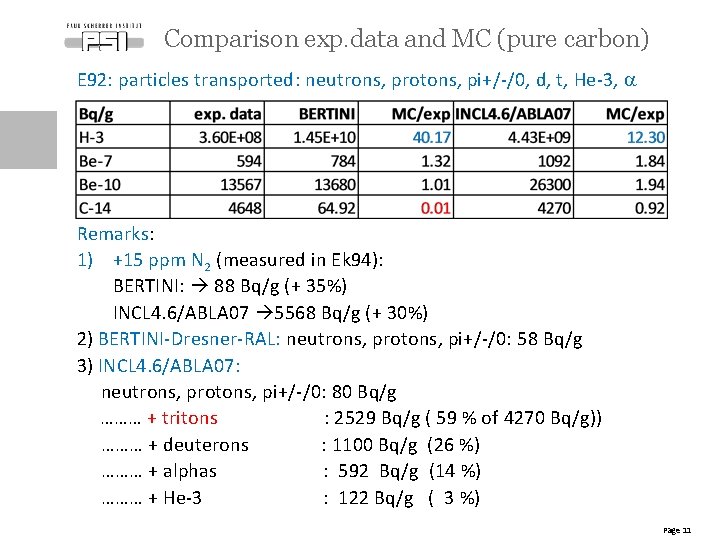
Comparison exp. data and MC (pure carbon) E 92: particles transported: neutrons, protons, pi+/-/0, d, t, He-3, a Remarks: 1) +15 ppm N 2 (measured in Ek 94): BERTINI: 88 Bq/g (+ 35%) INCL 4. 6/ABLA 07 5568 Bq/g (+ 30%) 2) BERTINI-Dresner-RAL: neutrons, protons, pi+/-/0: 58 Bq/g 3) INCL 4. 6/ABLA 07: neutrons, protons, pi+/-/0: 80 Bq/g ……… + tritons : 2529 Bq/g ( 59 % of 4270 Bq/g)) ……… + deuterons : 1100 Bq/g (26 %) ……… + alphas : 592 Bq/g (14 %) ……… + He-3 : 122 Bq/g ( 3 %) Page 11
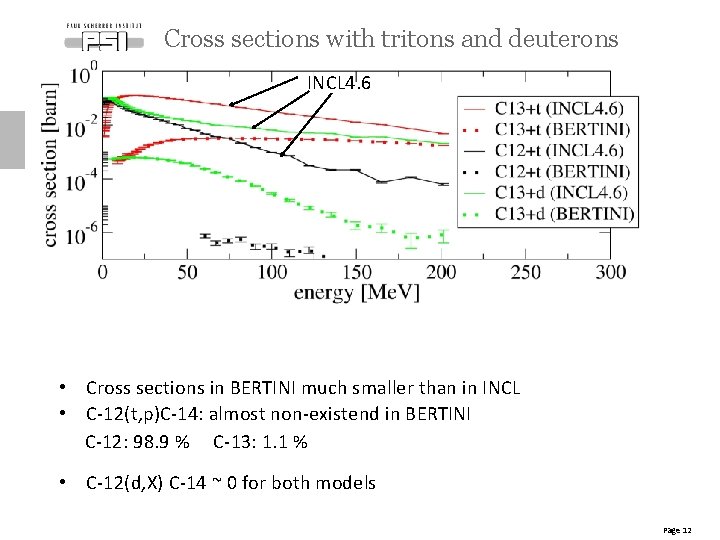
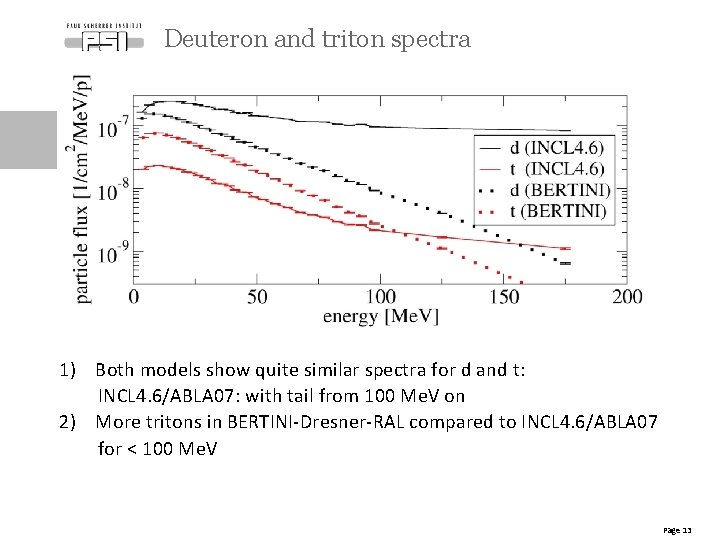
Cross sections with tritons and deuterons INCL 4. 6 • Cross sections in BERTINI much smaller than in INCL • C-12(t, p)C-14: almost non-existend in BERTINI C-12: 98. 9 % C-13: 1. 1 % • C-12(d, X) C-14 ~ 0 for both models Page 12
Deuteron and triton spectra 1) Both models show quite similar spectra for d and t: INCL 4. 6/ABLA 07: with tail from 100 Me. V on 2) More tritons in BERTINI-Dresner-RAL compared to INCL 4. 6/ABLA 07 for < 100 Me. V Page 13
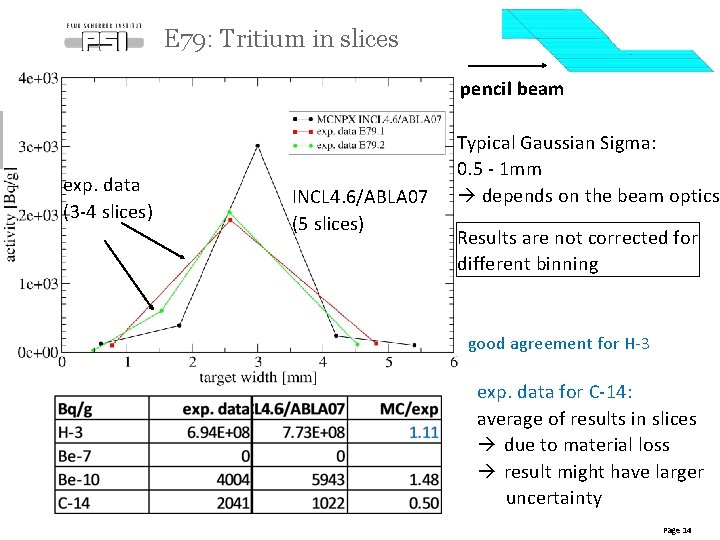
E 79: Tritium in slices pencil beam exp. data (3 -4 slices) INCL 4. 6/ABLA 07 (5 slices) Typical Gaussian Sigma: 0. 5 - 1 mm depends on the beam optics Results are not corrected for different binning good agreement for H-3 exp. data for C-14: average of results in slices due to material loss result might have larger uncertainty Page 14
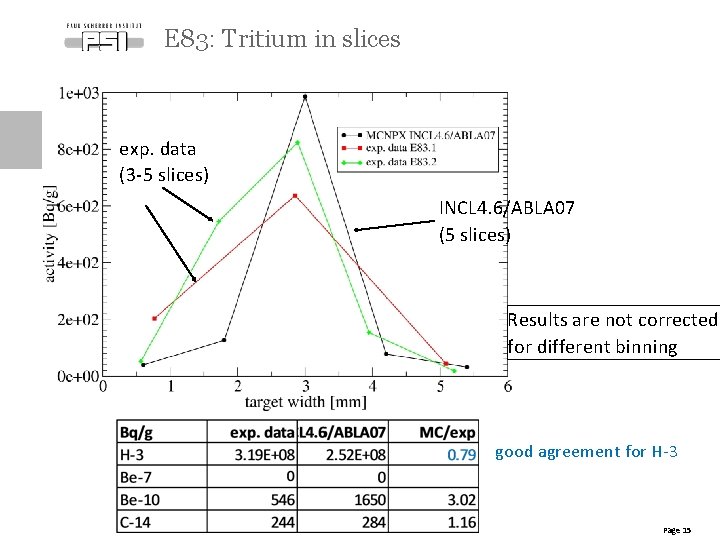
E 83: Tritium in slices exp. data (3 -5 slices) INCL 4. 6/ABLA 07 (5 slices) Results are not corrected for different binning good agreement for H-3 Page 15
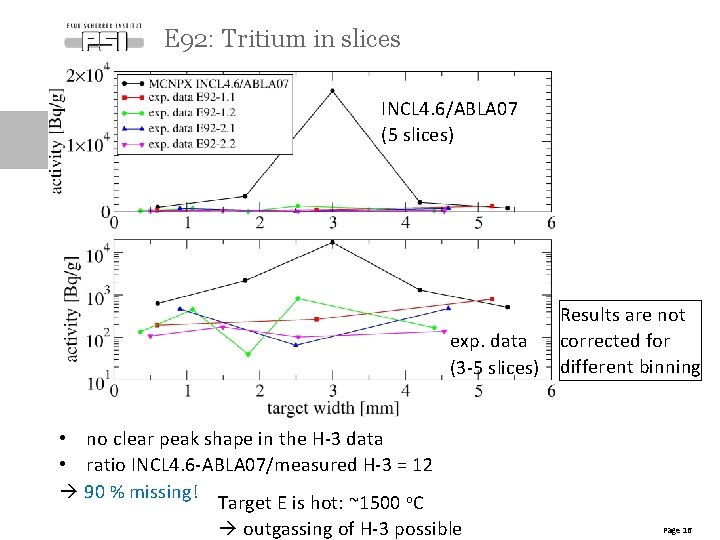
E 92: Tritium in slices INCL 4. 6/ABLA 07 (5 slices) exp. data (3 -5 slices) • no clear peak shape in the H-3 data • ratio INCL 4. 6 -ABLA 07/measured H-3 = 12 90 % missing! Target E is hot: ~1500 o. C outgassing of H-3 possible Results are not corrected for different binning Page 16
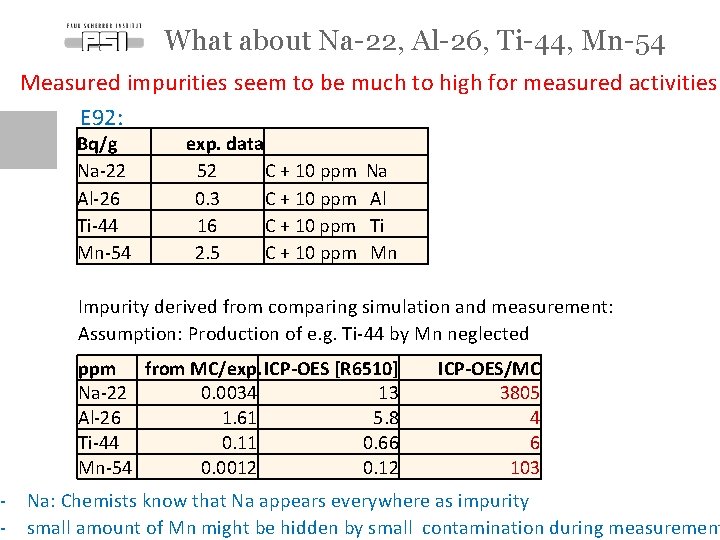
- What about Na-22, Al-26, Ti-44, Mn-54 Measured impurities seem to be much to high for measured activities E 92: Bq/g Na-22 Al-26 Ti-44 Mn-54 exp. data 52 C + 10 ppm 0. 3 C + 10 ppm 16 C + 10 ppm 2. 5 C + 10 ppm Na Al Ti Mn Impurity derived from comparing simulation and measurement: Assumption: Production of e. g. Ti-44 by Mn neglected ppm from MC/exp. ICP-OES [R 6510] Na-22 0. 0034 13 Al-26 1. 61 5. 8 Ti-44 0. 11 0. 66 Mn-54 0. 0012 0. 12 ICP-OES/MC 3805 4 6 103 Na: Chemists know that Na appears everywhere as impurity small amount of Mn might be hidden by small contamination during measurement
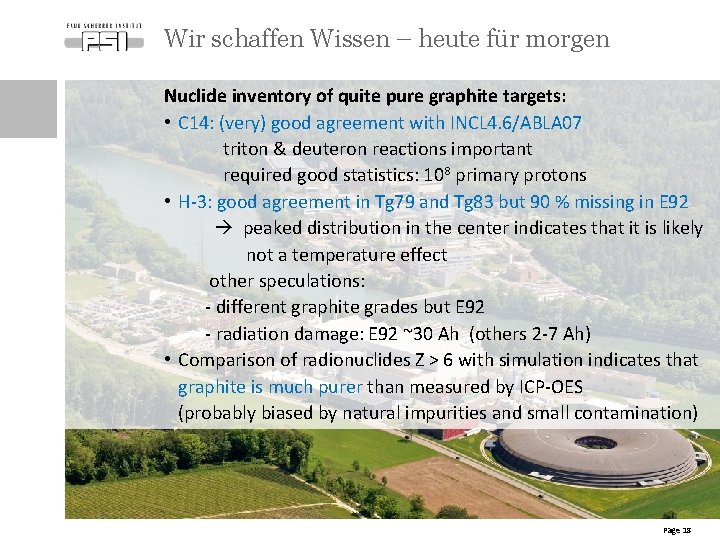
Wir schaffen Wissen – heute für morgen Nuclide inventory of quite pure graphite targets: • C 14: (very) good agreement with INCL 4. 6/ABLA 07 triton & deuteron reactions important required good statistics: 108 primary protons • H-3: good agreement in Tg 79 and Tg 83 but 90 % missing in E 92 peaked distribution in the center indicates that it is likely not a temperature effect other speculations: - different graphite grades but E 92 - radiation damage: E 92 ~30 Ah (others 2 -7 Ah) • Comparison of radionuclides Z > 6 with simulation indicates that graphite is much purer than measured by ICP-OES (probably biased by natural impurities and small contamination) Page 18
Wir schaffen Wissen – heute für morgen Acknowledgement • Jean-Christophe DAVID for INCL 4. 6/ABLA 07 and support during implementation in MCNPX Seite 19
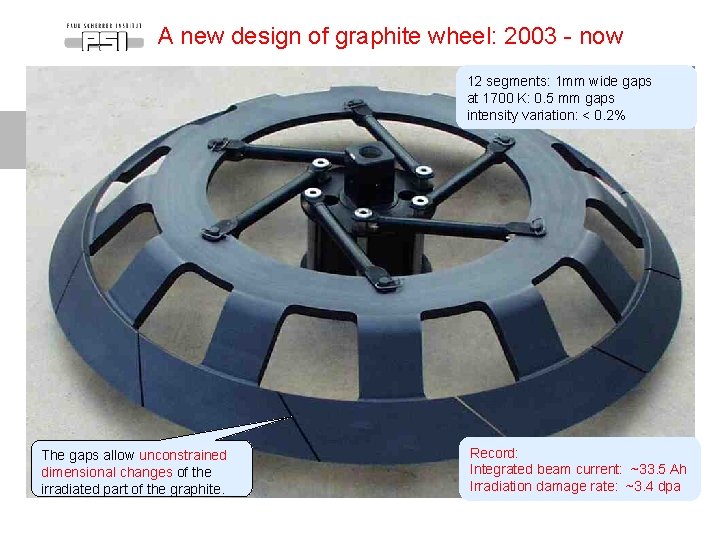
A new design of graphite wheel: 2003 - now 12 segments: 1 mm wide gaps at 1700 K: 0. 5 mm gaps intensity variation: < 0. 2% The gaps allow unconstrained dimensional changes of the irradiated part of the graphite. Record: Integrated beam current: ~33. 5 Ah Irradiation damage rate: ~3. 4 dpa
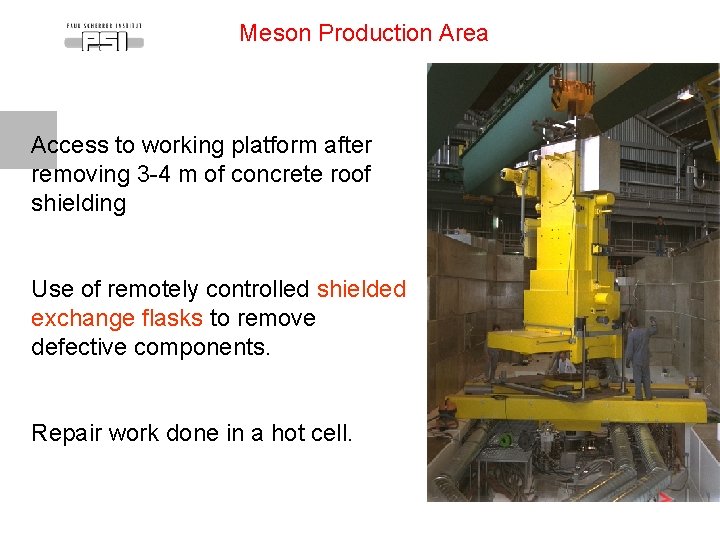
Meson Production Area Access to working platform after removing 3 -4 m of concrete roof shielding Use of remotely controlled shielded exchange flasks to remove defective components. Repair work done in a hot cell.