
WIOA Employer Effectiveness Performance Measures Purpose of Performance
- Slides: 14
WIOA Employer Effectiveness Performance Measures
Purpose of Performance Measures 1 • Performance accountability - Strategic focus on setting goals – Comparison of actual performance to performance targets – Comparison of performance across similar programs • Performance Management – Tactical focus on improving practice to accomplish goals – Tracking performance on intermediate goals that influence program goals 1 Jonathan Ladinsky – From WIA to WIOA: Lessons for the Implementation of WIOA 2
Types of Performance Measures • Outcome Measures – focus on program consequences – Typically ratios or percentages rather than counts to facilitate comparison – Outcomes can be intermediate or final • Process Measures – focus on the processes that lead to outcomes – Collected while participants are still in the program – Emphasis on what is considered “best practice” 3
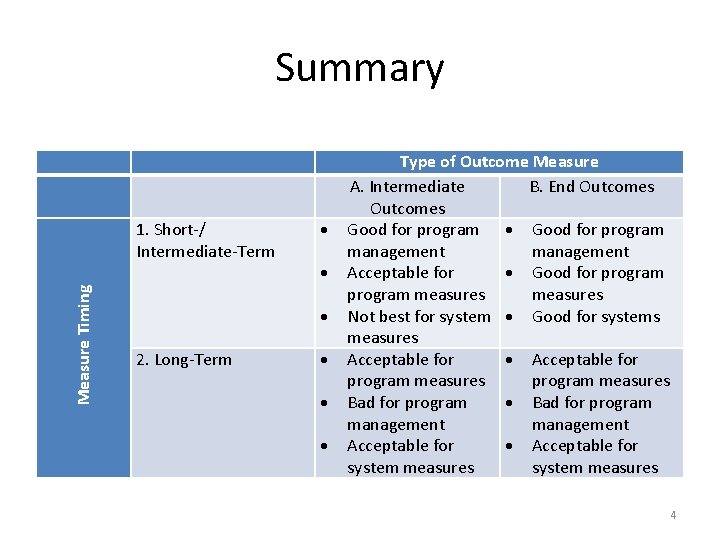
Summary Measure Timing 1. Short-/ Intermediate-Term 2. Long-Term Type of Outcome Measure A. Intermediate B. End Outcomes Good for program management Acceptable for Good for program measures Not best for system Good for systems measures Acceptable for program measures Bad for program management Acceptable for system measures 4
Workforce System Measures • Measures the outcome commonalities across programs – VR measures would be the same as the measures of other programs (long term) • Measures of the uniqueness of each program’s outcomes (intermediate or short term) – VR measures would be different than other program measures – These measures would be unique to VR to assist tactical decision making 5
Criteria for Identifying and Selecting Performance Measures (PM) • Relevance – PM must relate to the program • Timely – PM provide information in time to affect decisionmaking • Accuracy – PM calculations must be consistent • Actionable – PM enable managers and practitioners to make decisions and act • Understandable – PM mean the same to all users • Standardized – PM must be measured the same across all programs while program measures should be the same within programs • Affordable – PM data collections must be reasonable • Complete – PM must measure all important program aspects 6
Employer Services Measures • Employer Penetration Rate – Numerator: Total number of establishments receiving a service during reporting period – Denominator: Total number of establishments • Repeat Business Customers – Numerator: same as above and who received a service anytime within the prior three years – Denominator: Number of unique establishments who have received a service previously in the last three years 7
The Value of Employer Service Measures • Represent process measures rather than employment-related outcomes • Processes that are critical to outcomes for the VR system • Processes not typically measured in the past – Previous measures focused on supply-side – Demand-side ignored • Not measured = Not done very much • Measured = Done much more 8
Examples of Services (DOL Guidance) • Employer Information and Support Services (staffassisted) • Workforce Recruitment and Assistance (staff-assisted) • Engaged in Strategic Planning/Economic Development • Accessing Untapped Labor Pools (promoting supply side) • Training Services (for establishments) • Incumbent Worker Training Services (job retention) • Rapid Response/Business Downsizing Assistance • Planning Layoff Response 9
Advisory Committee on Increasing Competitive Integrated Employment for Individuals with Disabilities (Interim Report September 2015) Demand-Side Perspective What do employers need to help them be successful in hiring, onboarding, and retaining workers with disabilities? 10
What Employers Need Employers need evidence and examples that persons with disabilities both want to work and are qualified and dedicated employees – Success stories from businesses that have strategically developed a more inclusive workforce model can be promoted to illustrate the benefits from a business perspective – Positive impacts on the business bottom line can occur at businesses of all sizes and in all locations; however, evidence and examples from a variety of businesses and industries – small, mid-size, and large – are needed to advance the narrative 11
Engaging Employers through Meeting Their Needs • VR services staff should be prepared to help businesses develop targeted plans for increasing employment • Businesses need access to support and guidance to develop more inclusive hiring practices and eliminate barriers so that individuals with disabilities apply and self-identify • Concerns are most effectively alleviated not through the dissemination of written information, but through personal contact • Establishing business-to-business peer connections are critical to assisting companies in learning more about employing people with disabilities 12
Value of Business Partnerships • Many businesses are either not aware of or do not use the supports and services already available through state VR agencies • Businesses can help develop performance metrics to ensure that both job seekers and employers are effectively served • Outreach and innovation efforts directed to businesses must include the recognition and importance of developing relationships with businesses of all sizes • VR staff need guidance and support on effective practices for bringing small businesses to the table and customizing initiatives to meet the needs of businesses of any size 13
Resources • • Marketing models for VR Projects With Industry experience Demand-side services Dual customer models RSA Business Roundtables (New Editions) CSAVR/NET – Business Partners Employer Openness Survey – an assessment to identify individual employer needs for support 14