
WIOA 101 Overview The Workforce Innovation and Opportunity

- Slides: 19
WIOA 101 Overview The Workforce Innovation and Opportunity Act of 2014 August 2018
Brief History • Workforce Investment Act (WIA) enacted in 1998 • Provided authorizing legislation for oversight and administration of public employment and training programs delivered through statewide system of “one-stop” centers • President signed WIOA into law on July 22, 2014, to replace the Workforce Investment Act • WIOA became effective on July 1, 2015, with final regulations effective October 18, 2016, and full implementation phased in during PY 16 -PY 18
Titles of the Act Title I: Workforce Development Activities Title II: Adult Education and Literacy Title III: Amendments to the Wagner-Peyser Act Title IV: Amendments to the Rehabilitation Act Title V: General Provisions
Key Themes • Utilization of sector partnerships and career pathways • Emphasis on employer engagement and work-based learning • Enhanced services to low income, veterans, out-of-school youth, individuals with disabilities and other target groups most in need • Coordination and integration across core programs
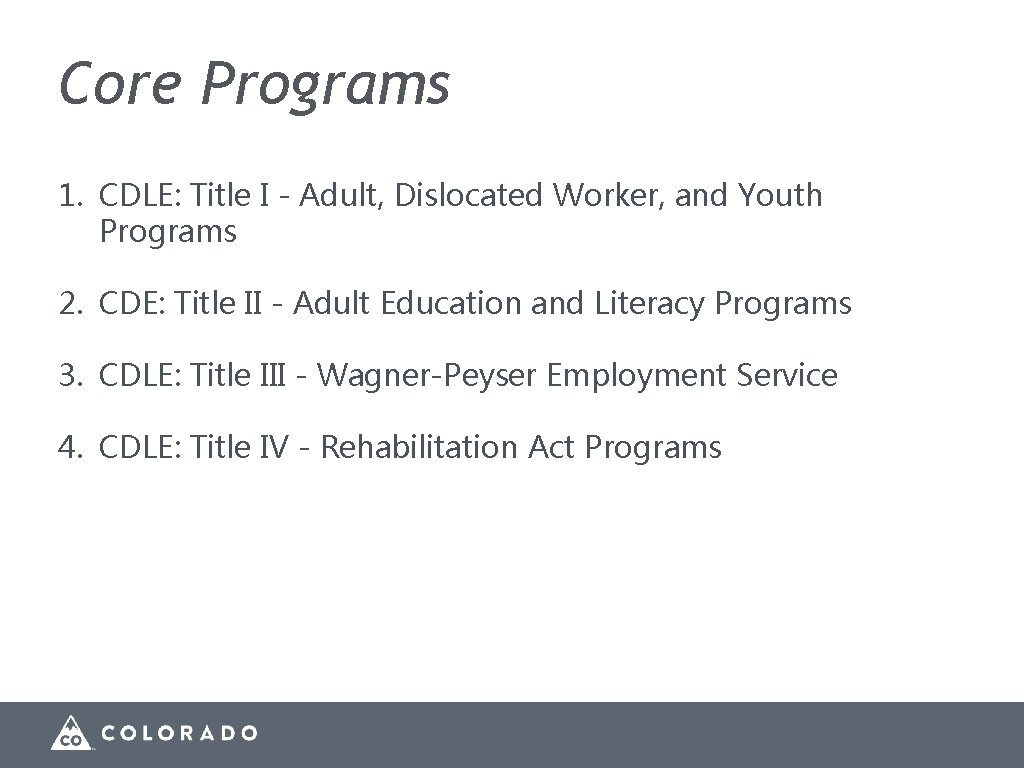
Core Programs 1. CDLE: Title I - Adult, Dislocated Worker, and Youth Programs 2. CDE: Title II - Adult Education and Literacy Programs 3. CDLE: Title III - Wagner-Peyser Employment Service 4. CDLE: Title IV - Rehabilitation Act Programs
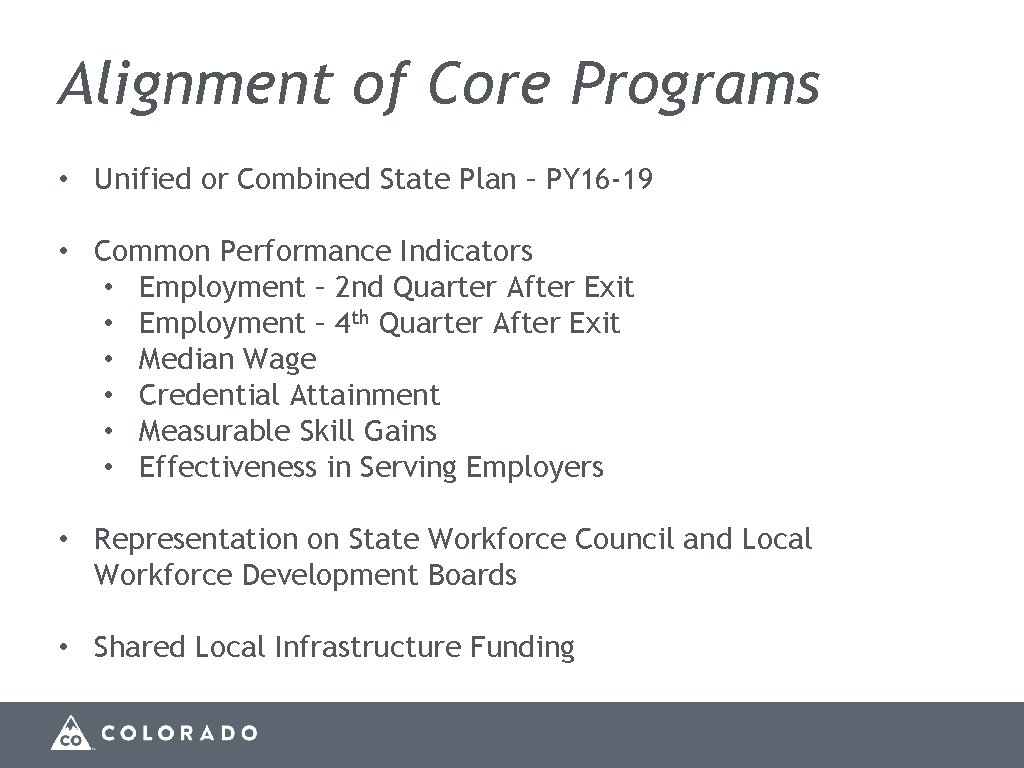
Alignment of Core Programs • Unified or Combined State Plan – PY 16 -19 • Common Performance Indicators • Employment – 2 nd Quarter After Exit • Employment – 4 th Quarter After Exit • Median Wage • Credential Attainment • Measurable Skill Gains • Effectiveness in Serving Employers • Representation on State Workforce Council and Local Workforce Development Boards • Shared Local Infrastructure Funding
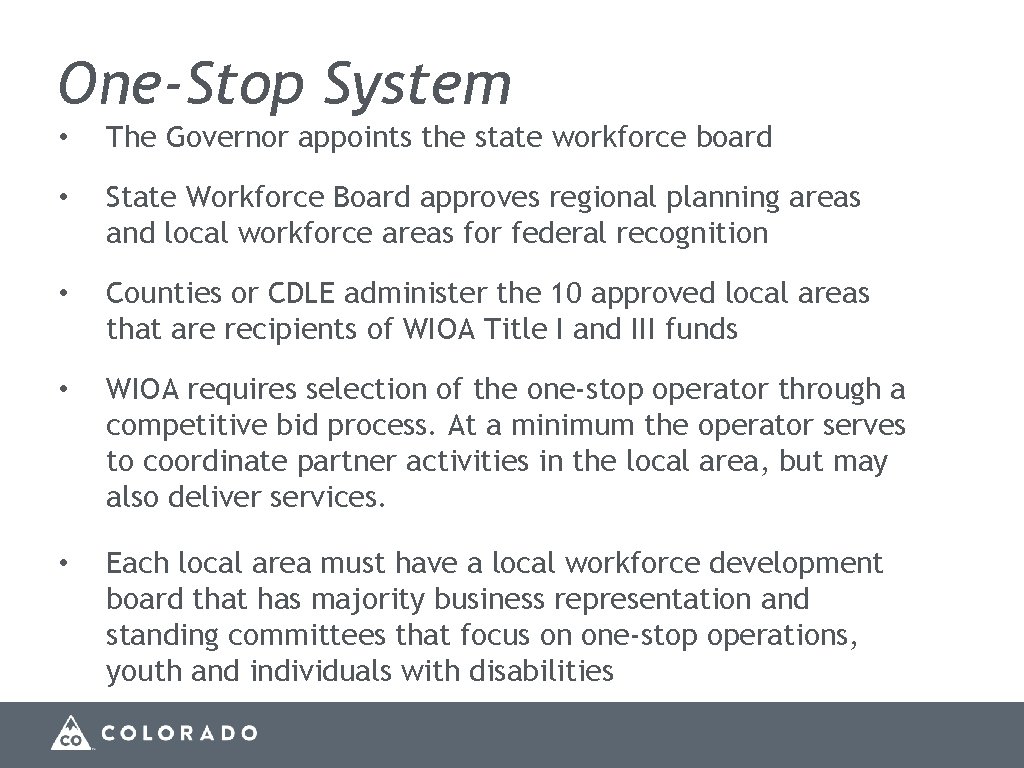
One-Stop System • The Governor appoints the state workforce board • State Workforce Board approves regional planning areas and local workforce areas for federal recognition • Counties or CDLE administer the 10 approved local areas that are recipients of WIOA Title I and III funds • WIOA requires selection of the one-stop operator through a competitive bid process. At a minimum the operator serves to coordinate partner activities in the local area, but may also deliver services. • Each local area must have a local workforce development board that has majority business representation and standing committees that focus on one-stop operations, youth and individuals with disabilities
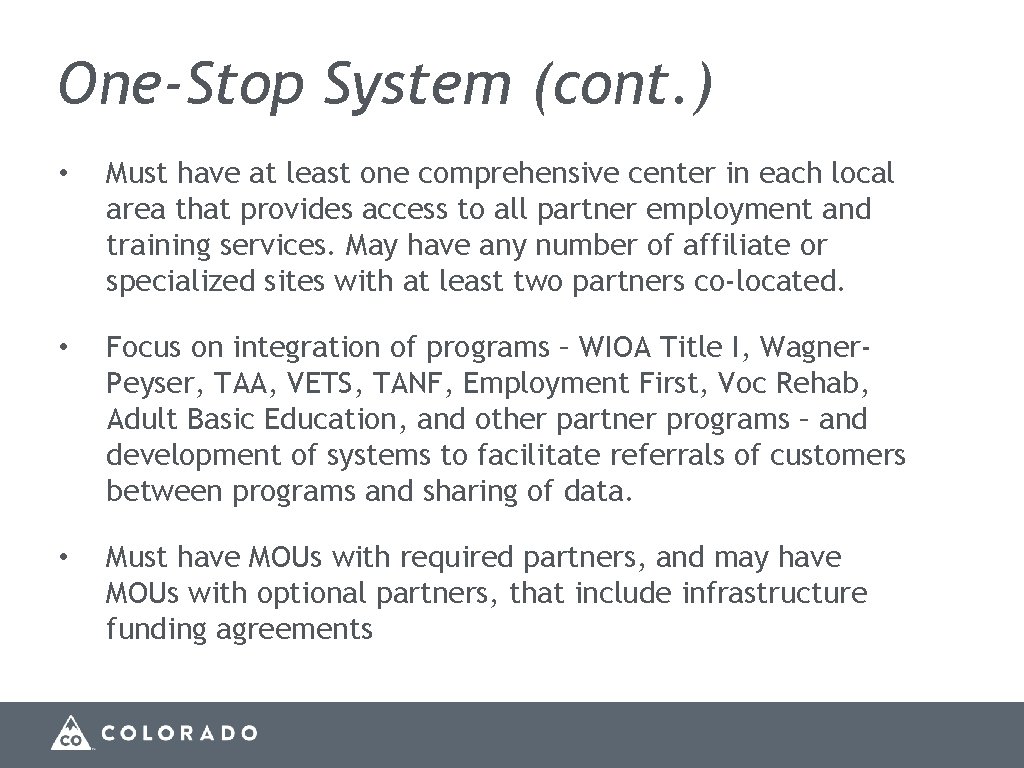
One-Stop System (cont. ) • Must have at least one comprehensive center in each local area that provides access to all partner employment and training services. May have any number of affiliate or specialized sites with at least two partners co-located. • Focus on integration of programs – WIOA Title I, Wagner. Peyser, TAA, VETS, TANF, Employment First, Voc Rehab, Adult Basic Education, and other partner programs – and development of systems to facilitate referrals of customers between programs and sharing of data. • Must have MOUs with required partners, and may have MOUs with optional partners, that include infrastructure funding agreements
Title I Adult and Dislocated Worker Programs • Priority of service in the Adult program for public assistance recipients, low income and basic skills deficient. DWs must have lost employment through no fault of their own • Career and training services for those 18 and older that lead to successful employment outcomes • Increased local flexibility for work-based learning options (OJTs, incumbent worker training, transitional jobs, apprenticeships, and internships) • Required use of the Eligible Training Provider List for classroom training • All six of the WIOA performance indicators apply
Title I Youth Program • Serves in-school youth (ages 14 -21) and out-of-school youth (ages 16 -24) with barriers to employment and low income • Requires a minimum of 75% of program funds used for out-ofschool youth and a maximum of 25% of program funds used for in-school youth • Requires 20% of all youth funds to be spent on work experiences and work-based learning • Requires comprehensive assessment and case management, plus access to 14 youth program elements and 12 months of followup after exiting the program • Youth Program Element Examples: Drug/alcohol counseling, entrepreneurial training, adult mentoring, tutoring, etc. • All six WIOA performance indicators apply, but the two employment measures include post secondary school as a positive outcome
Title III Employment Service • The program must be co-located in the one-stop centers – no stand alone offices • Serves all job seekers and businesses, with a mandate to assist UI claimants with reemployment • Provides career services (but not supportive or training services) that are focused on job placement outcomes • May be the first services provided to job seekers prior to enrollment in a WIOA or partner program • Is the primary source of funding for business services activities • Four WIOA performance indicators apply: the two employment measures, median earnings, and effectiveness in serving employers
How is WIOA Funded? • Congress appropriates new funds each year, which are formula-allocated to states by USDOL • The WIOA program year is July 1 through June 30 • Funds are used for 3 years at the state level, but only 2 years at the local level • States reserve some of the funds for administration and discretionary initiatives, but most funds are formulaallocated to local areas
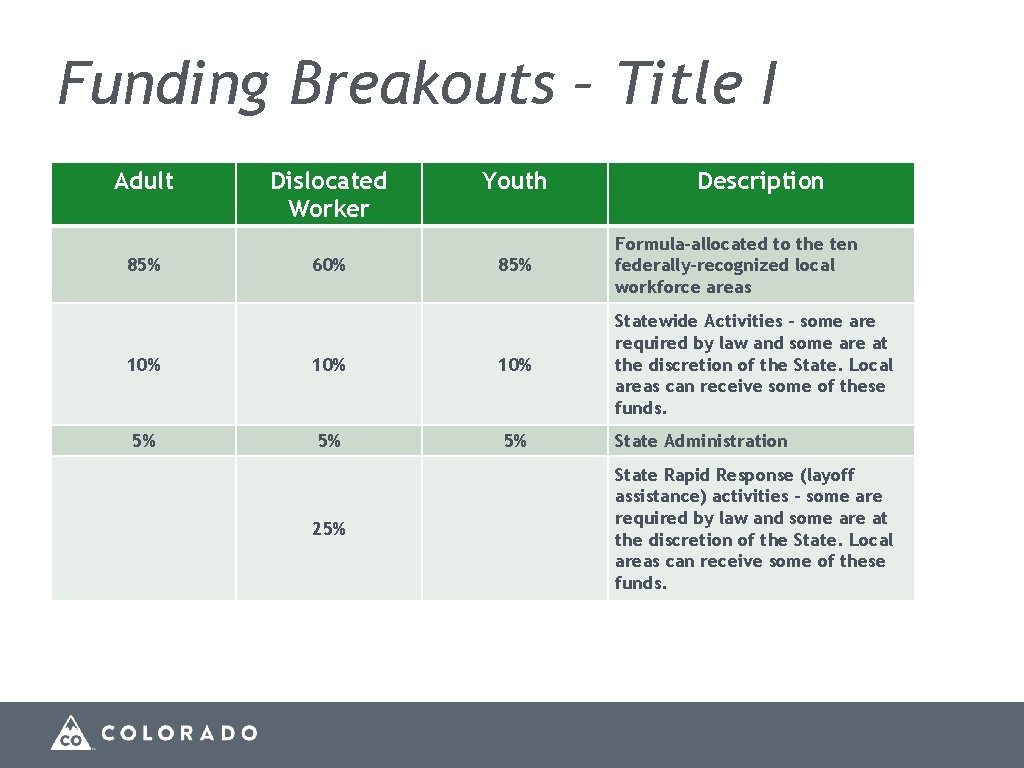
Funding Breakouts – Title I Adult 85% Dislocated Worker 60% Youth Description 85% Formula-allocated to the ten federally-recognized local workforce areas 10% 10% Statewide Activities – some are required by law and some are at the discretion of the State. Local areas can receive some of these funds. 5% 5% 5% State Administration 25% State Rapid Response (layoff assistance) activities – some are required by law and some are at the discretion of the State. Local areas can receive some of these funds.
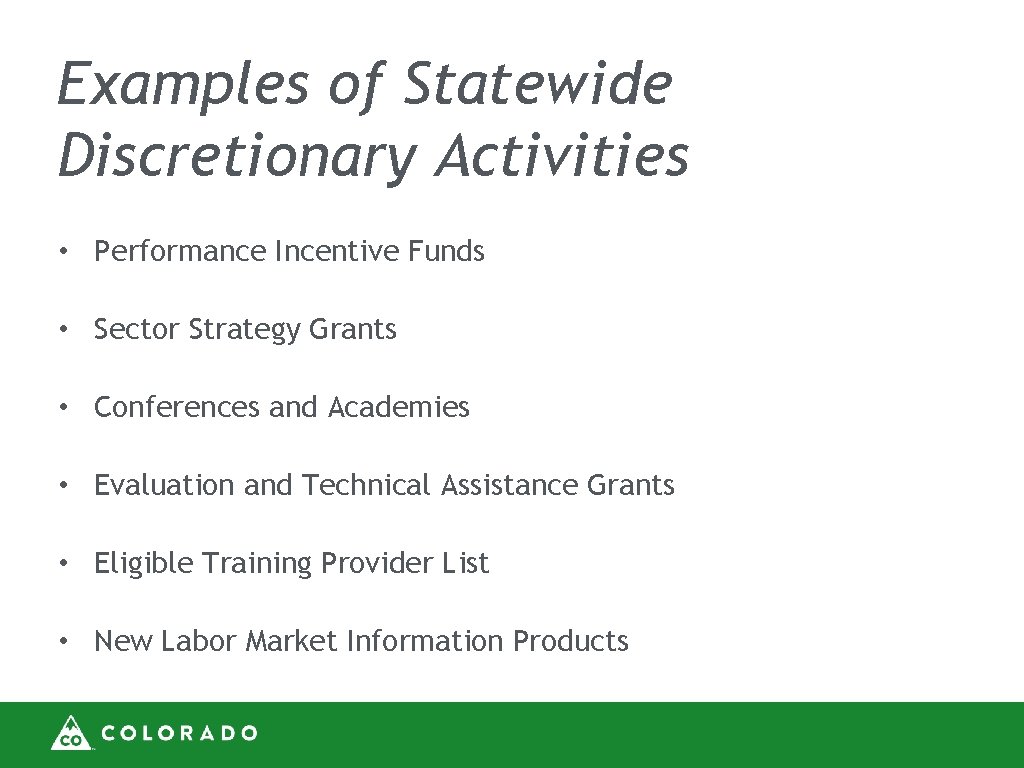
Examples of Statewide Discretionary Activities • Performance Incentive Funds • Sector Strategy Grants • Conferences and Academies • Evaluation and Technical Assistance Grants • Eligible Training Provider List • New Labor Market Information Products
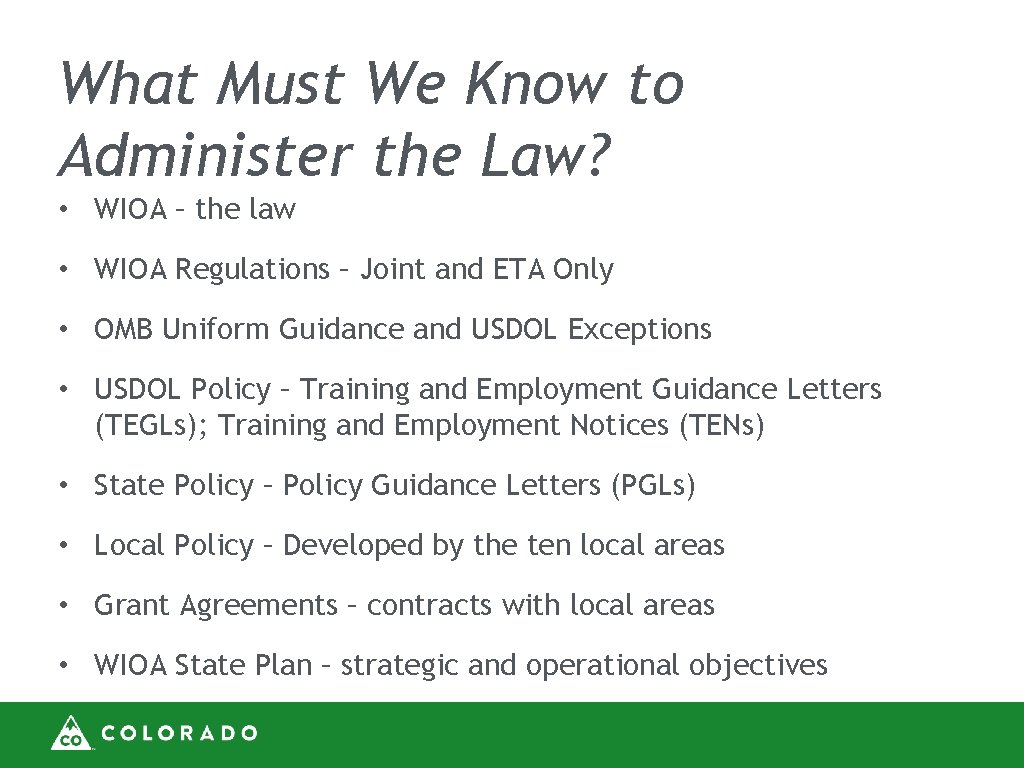
What Must We Know to Administer the Law? • WIOA – the law • WIOA Regulations – Joint and ETA Only • OMB Uniform Guidance and USDOL Exceptions • USDOL Policy – Training and Employment Guidance Letters (TEGLs); Training and Employment Notices (TENs) • State Policy – Policy Guidance Letters (PGLs) • Local Policy – Developed by the ten local areas • Grant Agreements – contracts with local areas • WIOA State Plan – strategic and operational objectives
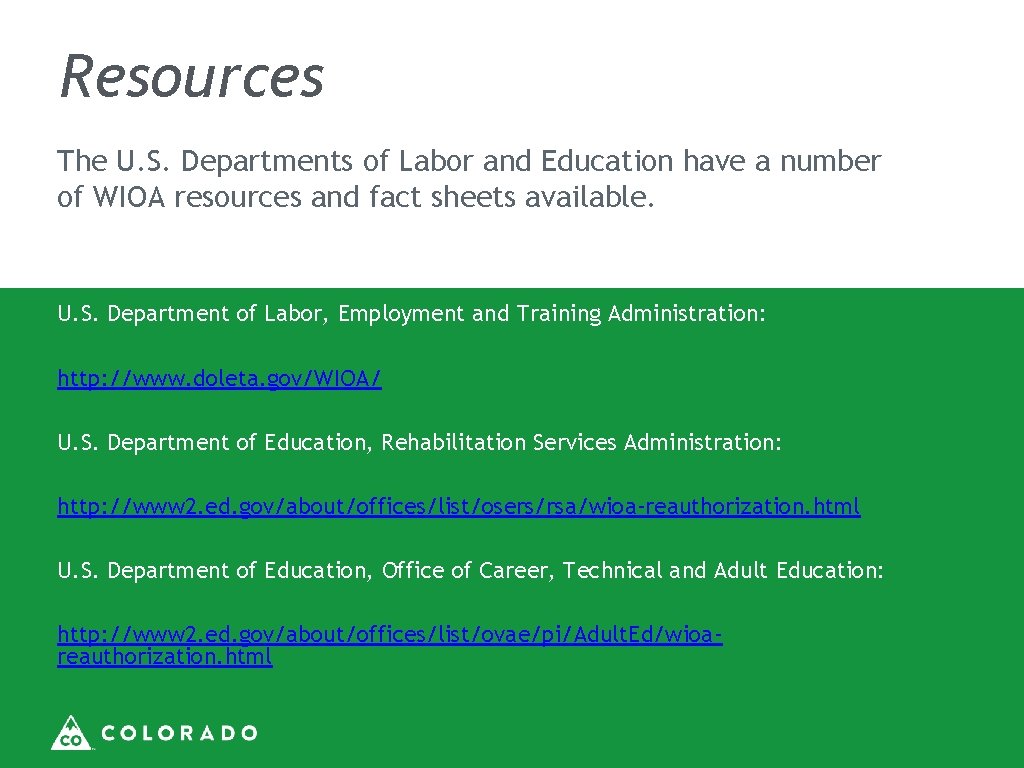
Resources The U. S. Departments of Labor and Education have a number of WIOA resources and fact sheets available. U. S. Department of Labor, Employment and Training Administration: http: //www. doleta. gov/WIOA/ U. S. Department of Education, Rehabilitation Services Administration: http: //www 2. ed. gov/about/offices/list/osers/rsa/wioa-reauthorization. html U. S. Department of Education, Office of Career, Technical and Adult Education: http: //www 2. ed. gov/about/offices/list/ovae/pi/Adult. Ed/wioareauthorization. html
Resources (cont. ) Additional WIOA resources are available through federal and state websites. U. S. Department of Labor, Employment and Training Administration Policy Letters https: //wdr. doleta. gov/directives/ Workforce GPS Technical Assistance and Training Resources https: //www. workforcegps. org/sitecore/content/global/home Colorado Department of Labor and Employment Policy Guidance Letters https: //www. colorado. gov/cdle/pgl Colorado Workforce Development Council – includes WIOA State Plan https: //www. colorado. gov/pacific/cwdc
Thank You! Additional questions can be submitted to the Regional Liaisons at Workforce Development Programs • Rob Hanni rob. hanni@state. co. us • Andrew Galloway • Jesus Borrego andrew. galloway@state. co. us jesus. borrego@state. co. us