
Winter survival kits cold weather gear and winterizing

- Slides: 30
Winter survival kits, cold weather gear, and winterizing your home and car Jennifer Assante, Green CERT 11/18/2019
Role of CERT in Disaster Preparedness • The Community Emergency Response Team (CERT) program educates volunteers about disaster preparedness for the hazards that may impact their area and trains them in basic disaster response skills • Basic CERT training addresses hazards specific to the community and actions that participants and their families take before, during and after a disaster Remember: As a CERT member, you cannot help your friends, neighbors and your community unless your home and your loved ones are taken care first and are safe.
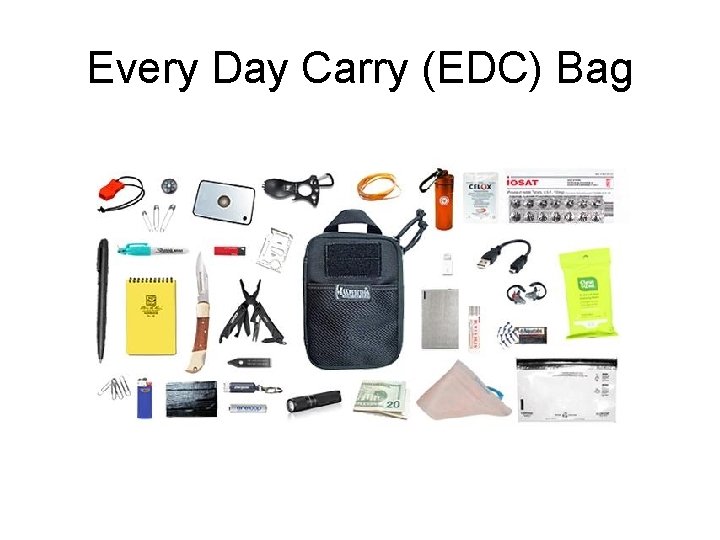
Every Day Carry (EDC) Bag
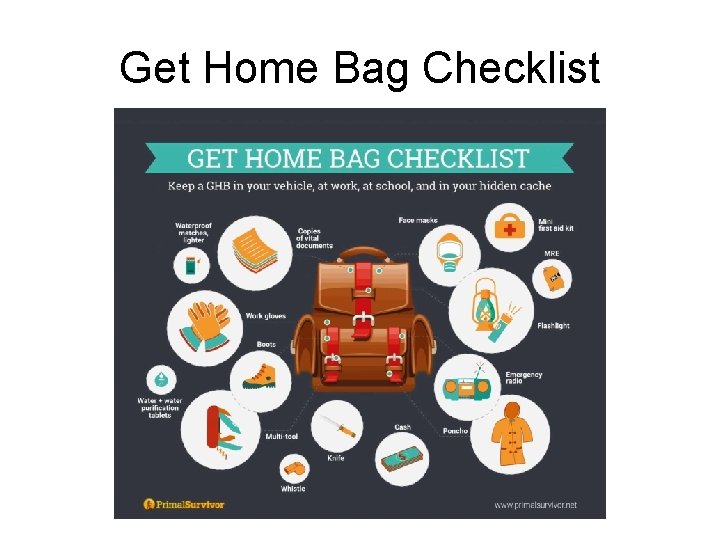
Get Home Bag Checklist
Purpose of the EDC/GHB • The core principles of EDC are utility, versatility, portability. • The everyday carry philosophy is built upon the cornerstones of utility and preparedness. Each component of your EDC should serve a purpose or have at least one specific, useful function. • An everyday carry “bag” is a place for you to deposit the survival items that you carry with you every day. If you want to prepare yourself for a variety of disasters and emergencies, you'll need to carry more items than everyone else. • The Everyday Carry Bag is all about making a setup that fits your needs. Just as no two people are exactly alike, their respective EDCs will vary significantly.
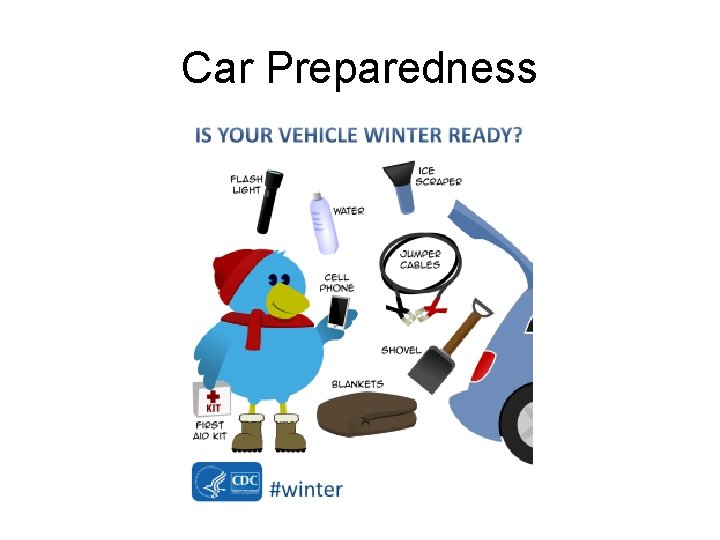
Car Preparedness
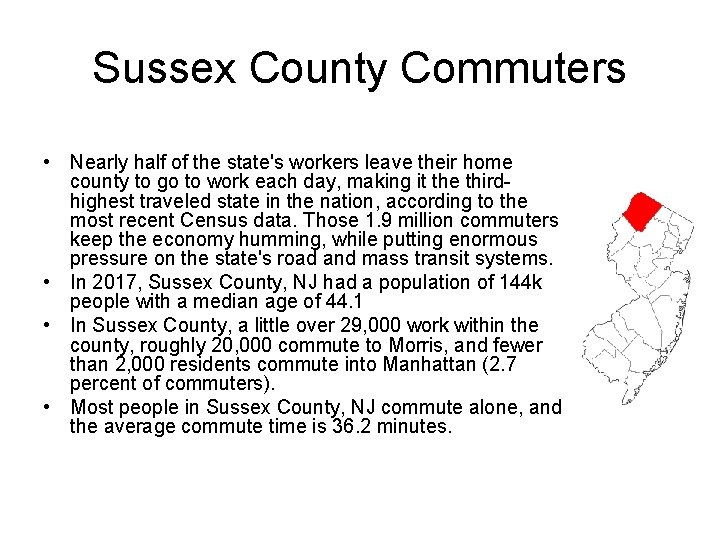
Sussex County Commuters • Nearly half of the state's workers leave their home county to go to work each day, making it the thirdhighest traveled state in the nation, according to the most recent Census data. Those 1. 9 million commuters keep the economy humming, while putting enormous pressure on the state's road and mass transit systems. • In 2017, Sussex County, NJ had a population of 144 k people with a median age of 44. 1 • In Sussex County, a little over 29, 000 work within the county, roughly 20, 000 commute to Morris, and fewer than 2, 000 residents commute into Manhattan (2. 7 percent of commuters). • Most people in Sussex County, NJ commute alone, and the average commute time is 36. 2 minutes.
The 25 N. J. towns with the longest commute times By Carla Astudillo | NJ Advance Media for NJ. com 24. Jefferson Township Average Travel Time to Work: 37. 4 min. 16. West Milford Average Travel Time to Work: 38. 6 min 12. Wantage Township Average Travel Time to Work: 39 min. 9. Sparta Average Travel Time to Work: 40. 6 min. 5. Vernon Township Average Travel Time to Work: 41. 9 min. You know how traffic is on a good day…and you know what happens to traffic during snowstorms…are you prepared if you can’t get home?
When to start thinking about winter safety? • If you live in an area with severe winters, it’s important to prepare for the winter season. • Nasty winter weather can happen as early as September in some parts of the U. S. , but winter formally starts on December 21 st. • So if you live in an area where winter is a risk, try doing your annual preparedness review when the leaves start to fall.
How to winterize your car Schedule a yearly service/maintenance in late summer fall to address the following: • Washer fluid: Top up. You don’t want to run out while driving in freezing rain or sleet. Only use fluid that’s cold-weather rated for a minimum -20 F. • Tires: Make sure they have plenty of tread. If you aren’t sure how to determine this, get them checked out. Many tire stores will do a tread check for free. Alternatively, place a quarter into several tread grooves across the tire. If part of Washington’s head is always covered by the tread, you have more than 4/32 inch of tread depth left, which is OK. Have a good set of all weather or Snow tires put on your car. • Tire pressure: Tires lose pressure in the winter because cold air contracts. • Brakes: If they’re squeaking or feel soft, get them checked. It’s hard enough to stop on icy roads with proper brakes, let alone worn-out ones. • Wiper blades: Make sure you have a good set of wiper blades. • Battery: Don’t be the unlucky person with a dead winter battery. Some brick-and-mortar retailers, like Auto. Zone, will test your battery for free so you know it can still properly hold a charge. • Oil: Use 5 W-30 weight oil, which is common for year-round use. • Engine air filter: Remove it and hold a lamp or flashlight to it. If you see light through most of the filter, it’s got plenty of life. But if the light is mostly blocked, replace it. • Coolant: You want a 50 -50 mixture of antifreeze and water in the radiator. • Belts and hoses: Especially for older vehicles, make sure drive belts aren’t cracked or frayed. Ensure belt clamps aren’t loose. • Door weather stripping: Wipe the soft, rubbery black strips inside the doors with Armor All or silicone spray lubricant to keep them from freezing shut. Lastly… • Gas: Don’t run it until it’s empty. Some say to drive in the “top half” of the tank with more frequent refills, so you’re less likely to be caught with little or no fuel. Having a full tank also helps prevent moisture from freezing in the gas lines. Keep your gas tank at least half full at all times, and always fill up the day before a storm.
Preparing for a Winter Storm • During extremely cold weather or winter storms, staying warm and safe can be a challenge. • Winter storms can bring cold temperatures, power failures, loss of communication services, and icy roads. • To keep yourself and your loved ones safe, you should know how to prepare your home and your car before a winter storm hits. • #1 rule - only drive if you HAVE to!
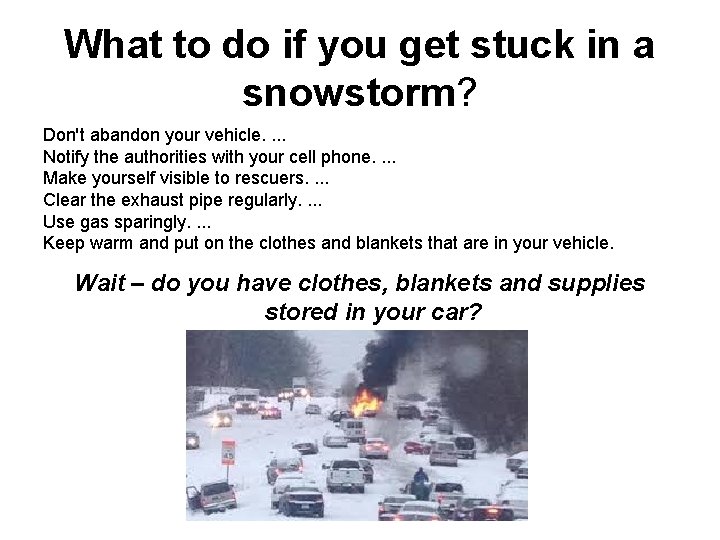
What to do if you get stuck in a snowstorm? Don't abandon your vehicle. . Notify the authorities with your cell phone. . Make yourself visible to rescuers. . Clear the exhaust pipe regularly. . Use gas sparingly. . Keep warm and put on the clothes and blankets that are in your vehicle. Wait – do you have clothes, blankets and supplies stored in your car?
Other Driving Tips • Tip #1: Don’t Drive! • If you are stranded and need to leave your vehicle for any reason, make sure to leave a note with your name, medical info, contact info, the time you left, and direction you started walking. • If it is blizzarding and you need to leave the car (for example, to clear the exhaust pipe of snow), tie rope to your wrist and then the car door in case you lose sight of the vehicle. • Snow can plug your vehicle’s exhaust system and cause deadly carbon monoxide gas to enter your car. If you are stuck or stranded, only run the engine for 10 -15 minutes an hour, and make sure the exhaust pipe is free of snow. • If you are stuck for a while, make sure you have some games, cards or books in your car - you will want something to pass the time, especially if you have kids!
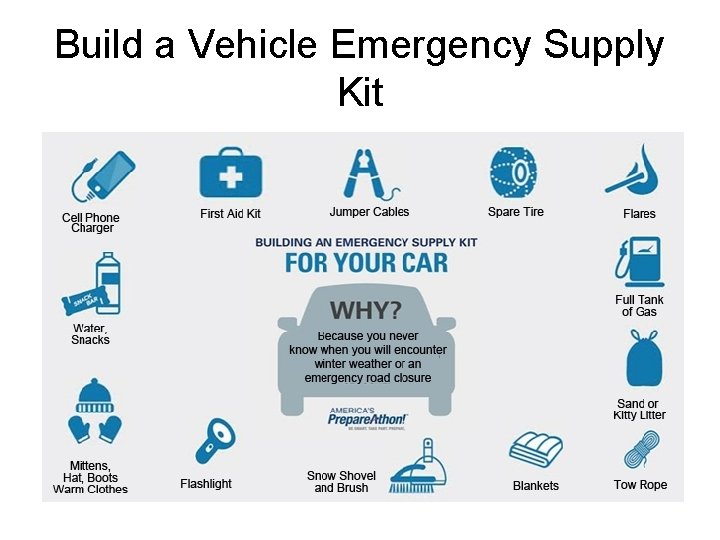
Build a Vehicle Emergency Supply Kit
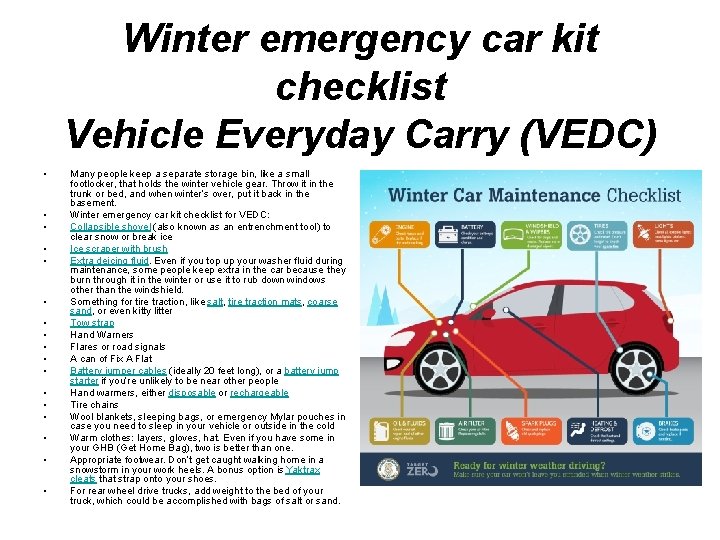
Winter emergency car kit checklist Vehicle Everyday Carry (VEDC) • • • • • Many people keep a separate storage bin, like a small footlocker, that holds the winter vehicle gear. Throw it in the trunk or bed, and when winter’s over, put it back in the basement. Winter emergency car kit checklist for VEDC: Collapsible shovel (also known as an entrenchment tool) to clear snow or break ice Ice scraper with brush Extra deicing fluid. Even if you top up your washer fluid during maintenance, some people keep extra in the car because they burn through it in the winter or use it to rub down windows other than the windshield. Something for tire traction, like salt, tire traction mats, coarse sand, or even kitty litter Tow strap Hand Warners Flares or road signals A can of Fix A Flat Battery jumper cables (ideally 20 feet long), or a battery jump starter if you’re unlikely to be near other people Hand warmers, either disposable or rechargeable Tire chains Wool blankets, sleeping bags, or emergency Mylar pouches in case you need to sleep in your vehicle or outside in the cold Warm clothes: layers, gloves, hat. Even if you have some in your GHB (Get Home Bag), two is better than one. Appropriate footwear. Don’t get caught walking home in a snowstorm in your work heels. A bonus option is Yaktrax cleats that strap onto your shoes. For rear wheel drive trucks, add weight to the bed of your truck, which could be accomplished with bags of salt or sand.
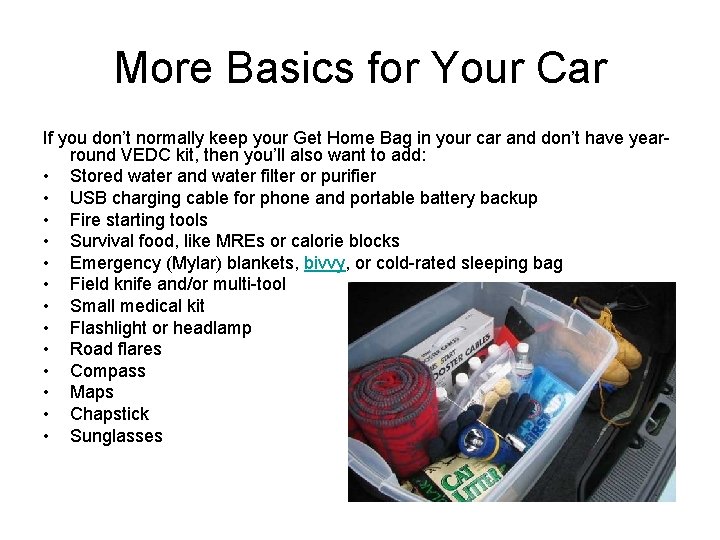
More Basics for Your Car If you don’t normally keep your Get Home Bag in your car and don’t have yearround VEDC kit, then you’ll also want to add: • Stored water and water filter or purifier • USB charging cable for phone and portable battery backup • Fire starting tools • Survival food, like MREs or calorie blocks • Emergency (Mylar) blankets, bivvy, or cold-rated sleeping bag • Field knife and/or multi-tool • Small medical kit • Flashlight or headlamp • Road flares • Compass • Maps • Chapstick • Sunglasses
Cell Phones and Cold Weather • • • Cell phones are made to operate in temperatures above 32 degrees. In freezing conditions, many smartphones will start experiencing problems like shutting off, shortened battery life, display problems or even the glass shattering. Most smartphone batteries are lithium-ion, which can stop discharging electricity in extremely cold temperatures Keep it in your pocket - Even something as simple as keeping your phone in your pocket or bag can help shield it from icy temperatures. Keeping your phone in your pocket will also allow it to benefit from your body heat to help keep it close to optimal temperatures. Wait to charge your phone - While most performance issues related to cold weather are temporary, Apple warns that charging i. OS devices in extreme temperatures can damage the devices further. Turn your phone off - i. Phones, i. Pads, i. Pods and Apple Watches all have a working temperature range of about 32 to 95 degrees. However, when not in use, the safe range increases to -4 to 113 degrees.
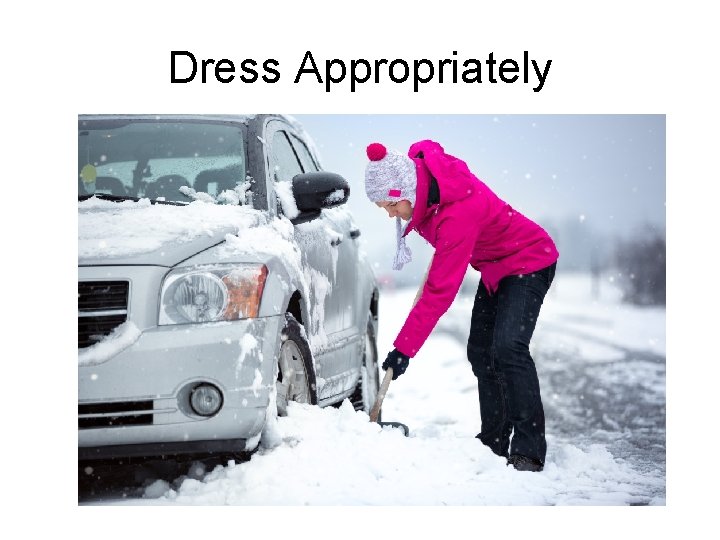
Dress Appropriately
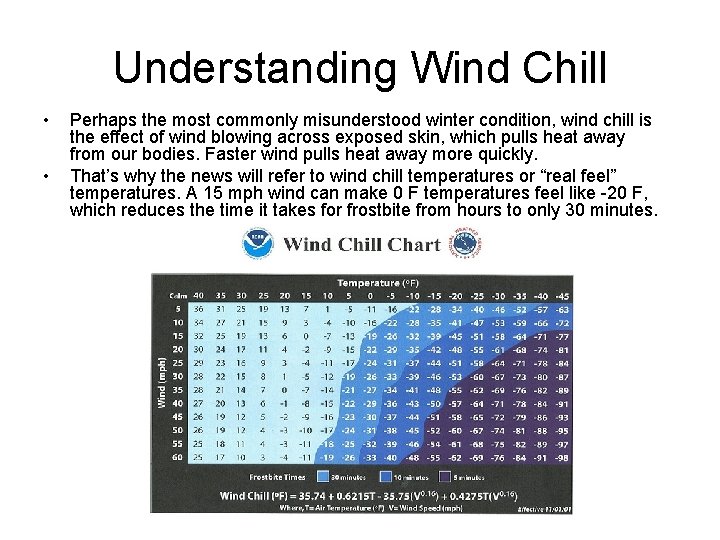
Understanding Wind Chill • • Perhaps the most commonly misunderstood winter condition, wind chill is the effect of wind blowing across exposed skin, which pulls heat away from our bodies. Faster wind pulls heat away more quickly. That’s why the news will refer to wind chill temperatures or “real feel” temperatures. A 15 mph wind can make 0 F temperatures feel like -20 F, which reduces the time it takes for frostbite from hours to only 30 minutes.
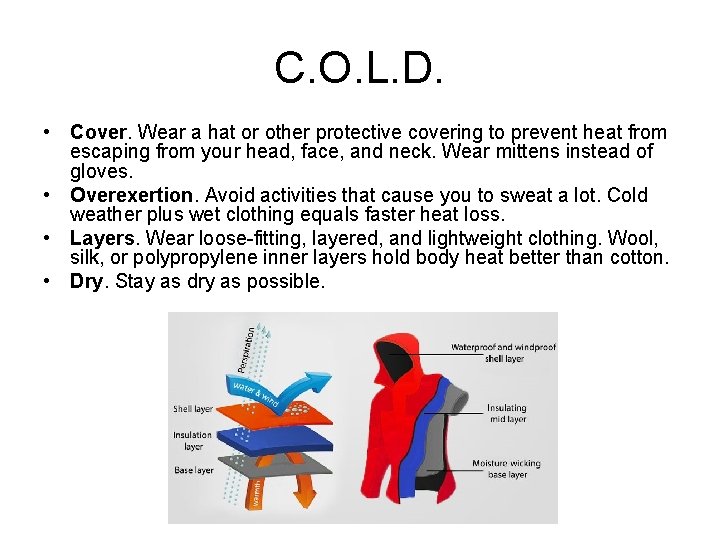
C. O. L. D. • Cover. Wear a hat or other protective covering to prevent heat from escaping from your head, face, and neck. Wear mittens instead of gloves. • Overexertion. Avoid activities that cause you to sweat a lot. Cold weather plus wet clothing equals faster heat loss. • Layers. Wear loose-fitting, layered, and lightweight clothing. Wool, silk, or polypropylene inner layers hold body heat better than cotton. • Dry. Stay as dry as possible.
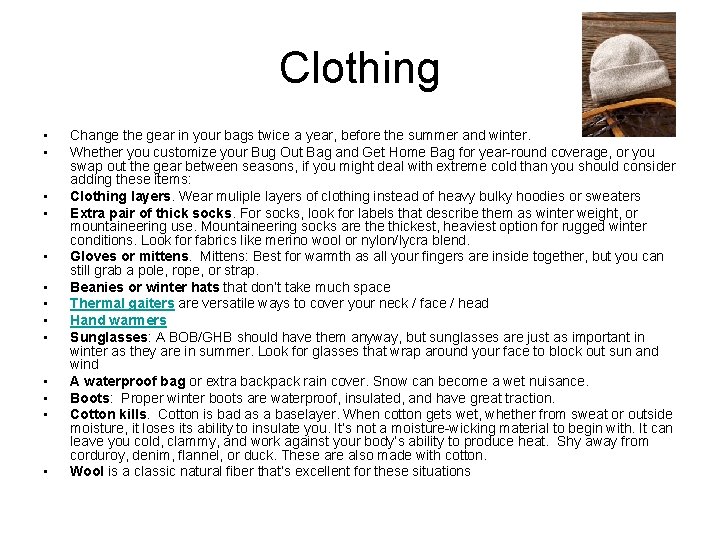
Clothing • • • • Change the gear in your bags twice a year, before the summer and winter. Whether you customize your Bug Out Bag and Get Home Bag for year-round coverage, or you swap out the gear between seasons, if you might deal with extreme cold than you should consider adding these items: Clothing layers. Wear muliple layers of clothing instead of heavy bulky hoodies or sweaters Extra pair of thick socks. For socks, look for labels that describe them as winter weight, or mountaineering use. Mountaineering socks are thickest, heaviest option for rugged winter conditions. Look for fabrics like merino wool or nylon/lycra blend. Gloves or mittens. Mittens: Best for warmth as all your fingers are inside together, but you can still grab a pole, rope, or strap. Beanies or winter hats that don’t take much space Thermal gaiters are versatile ways to cover your neck / face / head Hand warmers Sunglasses: A BOB/GHB should have them anyway, but sunglasses are just as important in winter as they are in summer. Look for glasses that wrap around your face to block out sun and wind A waterproof bag or extra backpack rain cover. Snow can become a wet nuisance. Boots: Proper winter boots are waterproof, insulated, and have great traction. Cotton kills. Cotton is bad as a baselayer. When cotton gets wet, whether from sweat or outside moisture, it loses its ability to insulate you. It’s not a moisture-wicking material to begin with. It can leave you cold, clammy, and work against your body’s ability to produce heat. Shy away from corduroy, denim, flannel, or duck. These are also made with cotton. Wool is a classic natural fiber that’s excellent for these situations
Preparing Your Home
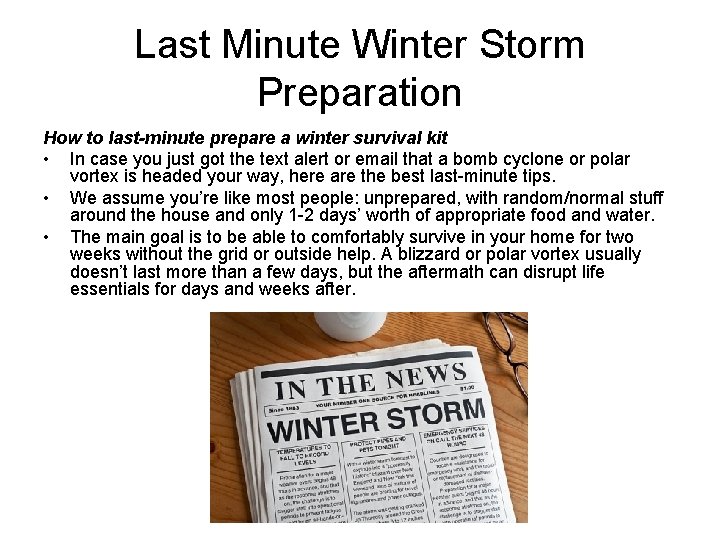
Last Minute Winter Storm Preparation How to last-minute prepare a winter survival kit • In case you just got the text alert or email that a bomb cyclone or polar vortex is headed your way, here are the best last-minute tips. • We assume you’re like most people: unprepared, with random/normal stuff around the house and only 1 -2 days’ worth of appropriate food and water. • The main goal is to be able to comfortably survive in your home for two weeks without the grid or outside help. A blizzard or polar vortex usually doesn’t last more than a few days, but the aftermath can disrupt life essentials for days and weeks after.
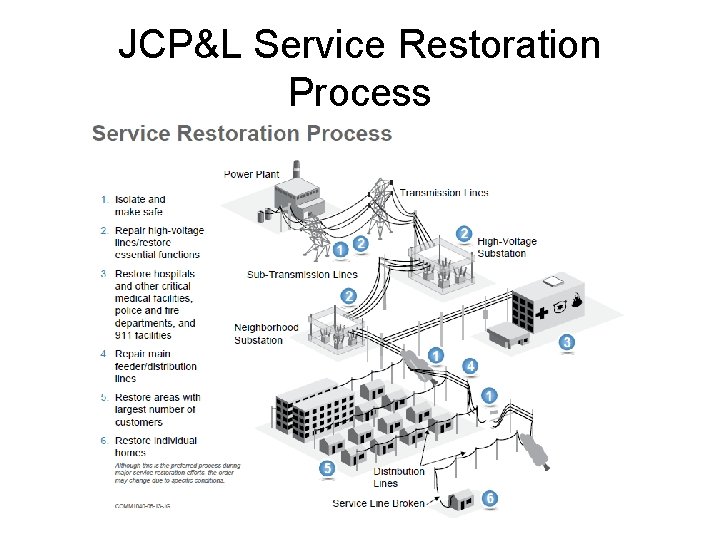
JCP&L Service Restoration Process
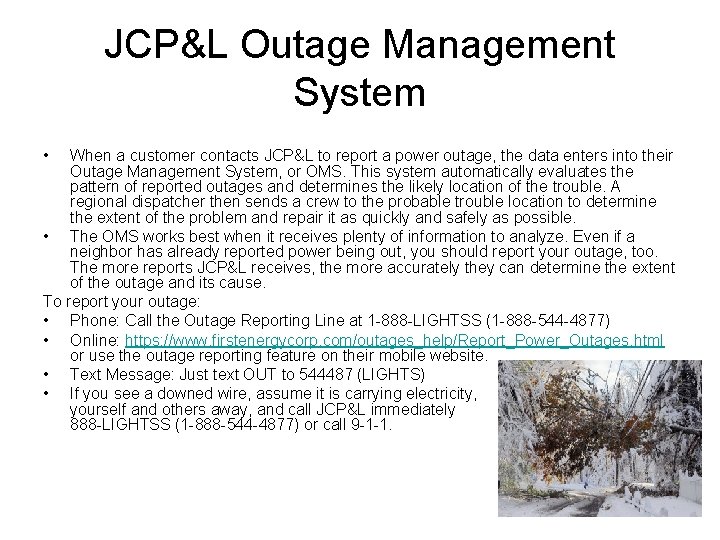
JCP&L Outage Management System • When a customer contacts JCP&L to report a power outage, the data enters into their Outage Management System, or OMS. This system automatically evaluates the pattern of reported outages and determines the likely location of the trouble. A regional dispatcher then sends a crew to the probable trouble location to determine the extent of the problem and repair it as quickly and safely as possible. • The OMS works best when it receives plenty of information to analyze. Even if a neighbor has already reported power being out, you should report your outage, too. The more reports JCP&L receives, the more accurately they can determine the extent of the outage and its cause. To report your outage: • Phone: Call the Outage Reporting Line at 1 -888 -LIGHTSS (1 -888 -544 -4877) • Online: https: //www. firstenergycorp. com/outages_help/Report_Power_Outages. html or use the outage reporting feature on their mobile website. • Text Message: Just text OUT to 544487 (LIGHTS) • If you see a downed wire, assume it is carrying electricity, keep yourself and others away, and call JCP&L immediately at 1888 -LIGHTSS (1 -888 -544 -4877) or call 9 -1 -1.
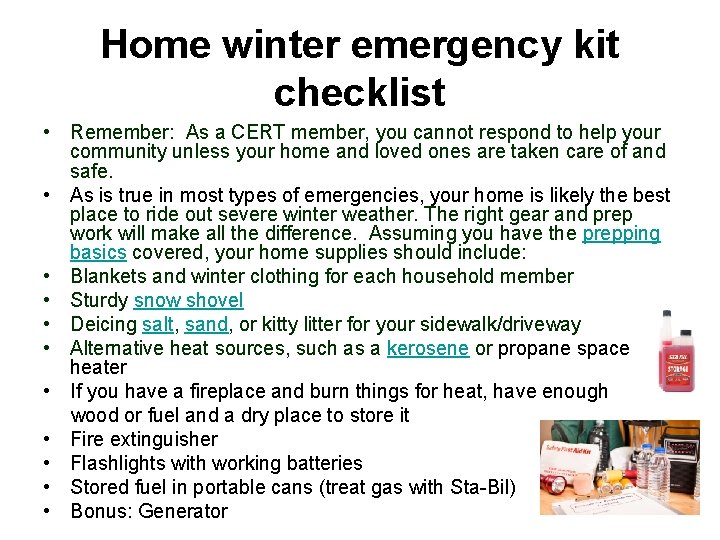
Home winter emergency kit checklist • Remember: As a CERT member, you cannot respond to help your community unless your home and loved ones are taken care of and safe. • As is true in most types of emergencies, your home is likely the best place to ride out severe winter weather. The right gear and prep work will make all the difference. Assuming you have the prepping basics covered, your home supplies should include: • Blankets and winter clothing for each household member • Sturdy snow shovel • Deicing salt, sand, or kitty litter for your sidewalk/driveway • Alternative heat sources, such as a kerosene or propane space heater • If you have a fireplace and burn things for heat, have enough wood or fuel and a dry place to store it • Fire extinguisher • Flashlights with working batteries • Stored fuel in portable cans (treat gas with Sta-Bil) • Bonus: Generator
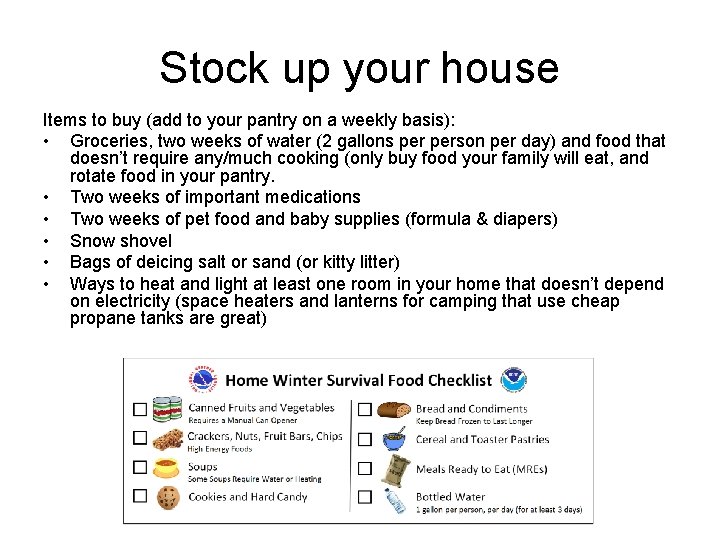
Stock up your house Items to buy (add to your pantry on a weekly basis): • Groceries, two weeks of water (2 gallons person per day) and food that doesn’t require any/much cooking (only buy food your family will eat, and rotate food in your pantry. • Two weeks of important medications • Two weeks of pet food and baby supplies (formula & diapers) • Snow shovel • Bags of deicing salt or sand (or kitty litter) • Ways to heat and light at least one room in your home that doesn’t depend on electricity (space heaters and lanterns for camping that use cheap propane tanks are great)
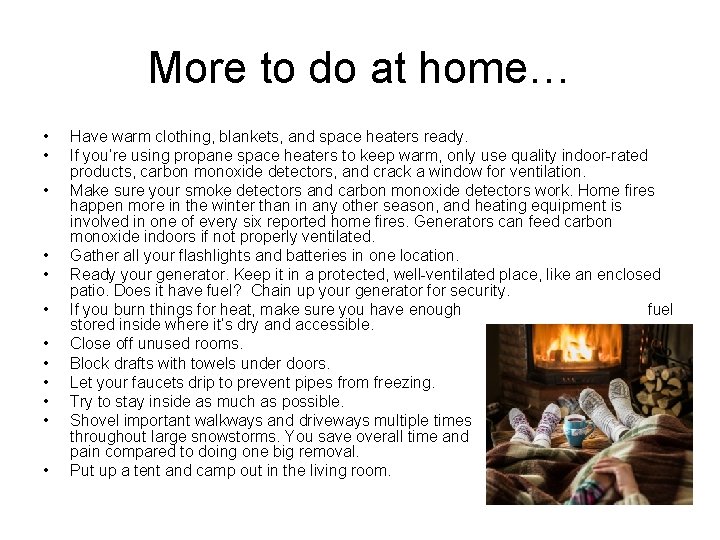
More to do at home… • • • Have warm clothing, blankets, and space heaters ready. If you’re using propane space heaters to keep warm, only use quality indoor-rated products, carbon monoxide detectors, and crack a window for ventilation. Make sure your smoke detectors and carbon monoxide detectors work. Home fires happen more in the winter than in any other season, and heating equipment is involved in one of every six reported home fires. Generators can feed carbon monoxide indoors if not properly ventilated. Gather all your flashlights and batteries in one location. Ready your generator. Keep it in a protected, well-ventilated place, like an enclosed patio. Does it have fuel? Chain up your generator for security. If you burn things for heat, make sure you have enough fuel stored inside where it’s dry and accessible. Close off unused rooms. Block drafts with towels under doors. Let your faucets drip to prevent pipes from freezing. Try to stay inside as much as possible. Shovel important walkways and driveways multiple times throughout large snowstorms. You save overall time and pain compared to doing one big removal. Put up a tent and camp out in the living room.
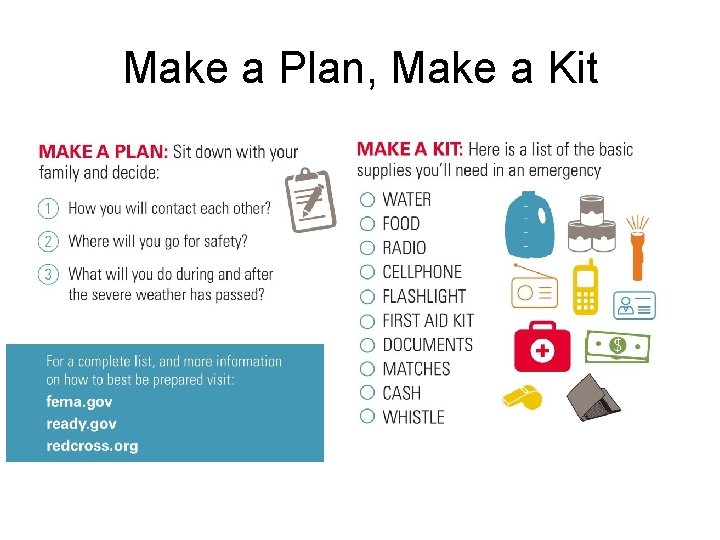
Make a Plan, Make a Kit
Resources • Ready. Gov https: //www. ready. gov/winter-weather • Center for Disease Control and Prevention: https: //www. cdc. gov/disasters/winter/beforestorm/prepar ehome. html • The Prepared: https: //theprepared. com/situations/guides/prepare-severe -cold-winterize-checklist/#vedc • Fema. Gov https: //www. fema. gov/media-librarydata/149400882617276 da 095 c 3 a 5 d 6502 ec 66 e 3 b 81 d 5 bb 12 a/FEMA_2017_Wi nter. Storm_HTP_FINAL. pdf • First Energy Corp: https: //www. firstenergycorp. com/content/customer/outag es_help/storm_info. html