
Winter Edwin Morgan Winter Edwin Morgan The poem
- Slides: 13
Winter – Edwin Morgan
Winter – Edwin Morgan • The poem is full of nihilism*: – things keep dying, decaying and disappearing. • First colour, then sounds fade away • The poem is full of monstrous and disturbing images • ‘Winter’ = a nature poem about death (like ‘Hyena’!) * The idea that life has no meaning
Winter – Themes • Nihilism (world / life has no meaning) • Despair • Humanity’s lack of importance in the world • Nature
Winter – Form • Free verse • First person narrator • Present tense (sense of immediacy? )
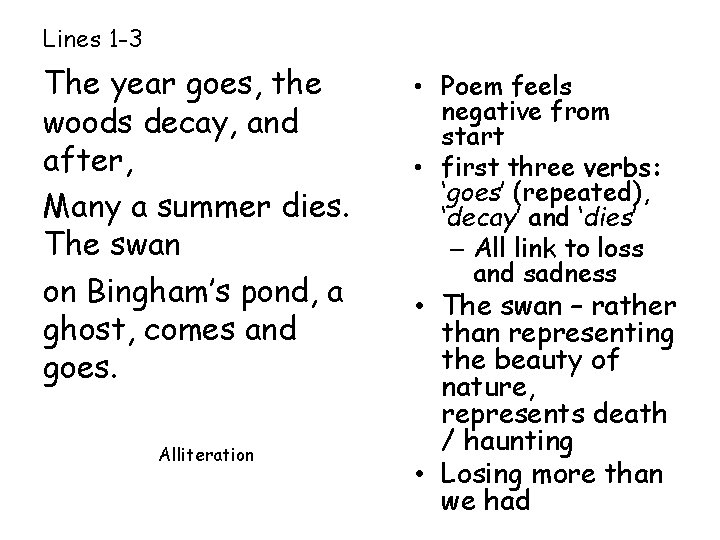
Lines 1 -3 The year goes, the woods decay, and after, Many a summer dies. The swan on Bingham’s pond, a ghost, comes and goes. Alliteration • Poem feels negative from start • first three verbs: ‘goes’ (repeated), ‘decay’ and ‘dies’ – All link to loss and sadness • The swan – rather than representing the beauty of nature, represents death / haunting • Losing more than we had
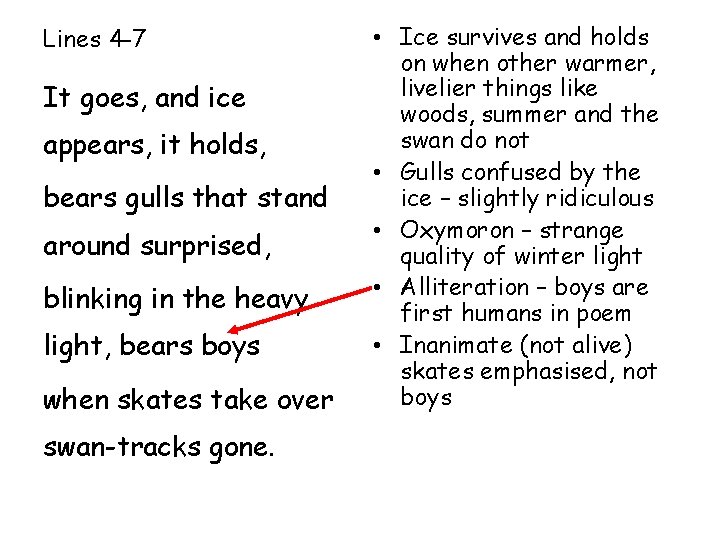
Lines 4 -7 It goes, and ice appears, it holds, bears gulls that stand around surprised, blinking in the heavy light, bears boys when skates take over swan-tracks gone. • Ice survives and holds on when other warmer, livelier things like woods, summer and the swan do not • Gulls confused by the ice – slightly ridiculous • Oxymoron – strange quality of winter light • Alliteration – boys are first humans in poem • Inanimate (not alive) skates emphasised, not boys
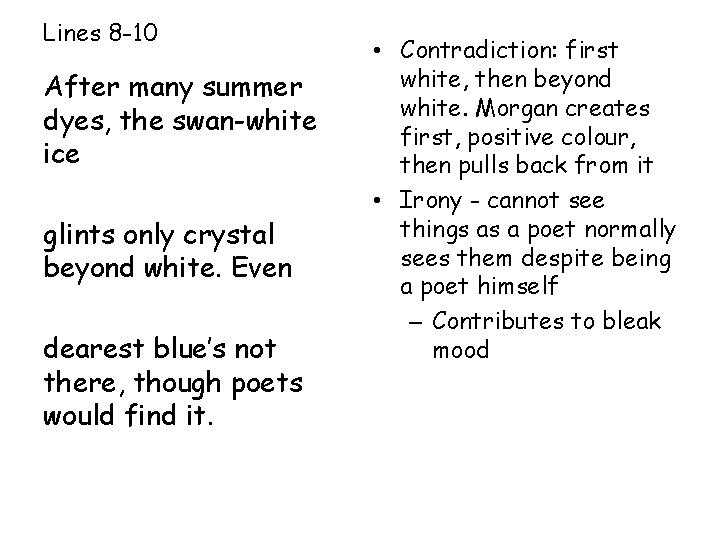
Lines 8 -10 After many summer dyes, the swan-white ice glints only crystal beyond white. Even dearest blue’s not there, though poets would find it. • Contradiction: first white, then beyond white. Morgan creates first, positive colour, then pulls back from it • Irony - cannot see things as a poet normally sees them despite being a poet himself – Contributes to bleak mood
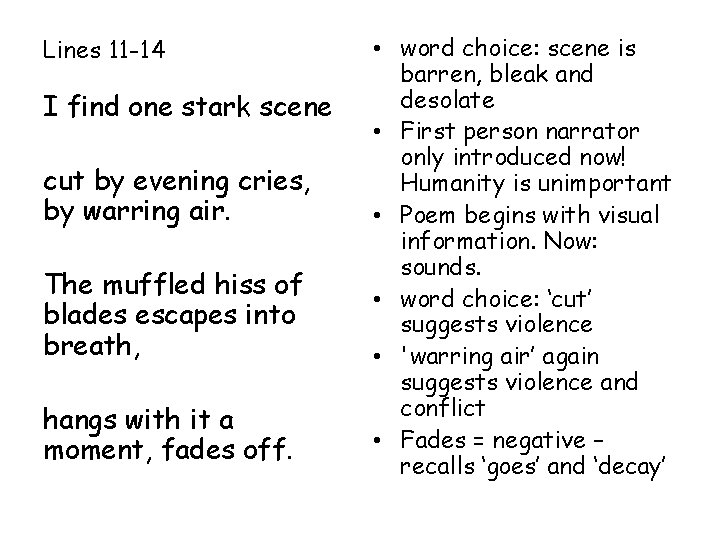
Lines 11 -14 I find one stark scene cut by evening cries, by warring air. The muffled hiss of blades escapes into breath, hangs with it a moment, fades off. • word choice: scene is barren, bleak and desolate • First person narrator only introduced now! Humanity is unimportant • Poem begins with visual information. Now: sounds. • word choice: ‘cut’ suggests violence • 'warring air’ again suggests violence and conflict • Fades = negative – recalls ‘goes’ and ‘decay’
Lines 15 -16 Fades off, goes, the scene, the voices fade, the line of trees, the woods that fall, decay • Two more uses of ‘fades’ – three in total! We are losing something – analogy between winter and death • Recalls first line – repetition of decay
Lines 17 -18 and break, the dark comes down, the shouts run off into it and disappear. • humanity leaves the poem. First the ‘voices fade’ (15) as the boys skate away. Then ‘shouts’ ‘disappear’. • The darkness = more powerful than the children. – boys become not people but just noises, ‘shouts’, who disappear into it. – swan / gulls/ skating boys all now gone – Only living thing left = ‘woods’ which are decaying / falling / breaking (hardly full of life)
Lines 19 - 21 At last the lamps go too, when fog drives monstrous down the dual carriageway out to the west… • Fog personified – actively threatening – Word choice suggests something evil lying in wait • Even nature is left behind – ugly / artificial motorway • End of the world / frontier? Meaning is ambiguous
Lines 21 - 24 …and even in my room and on this paper I do not know about that grey dead pane of ice that sees nothing and that nothing sees. • very small space, ‘in my room/ and on this paper’. narrator feels vulnerable and helpless. • Ambiguity - does ‘not know’ about ice contradicts earlier lines • The ending = very nihilistic: nothingness • Repetition
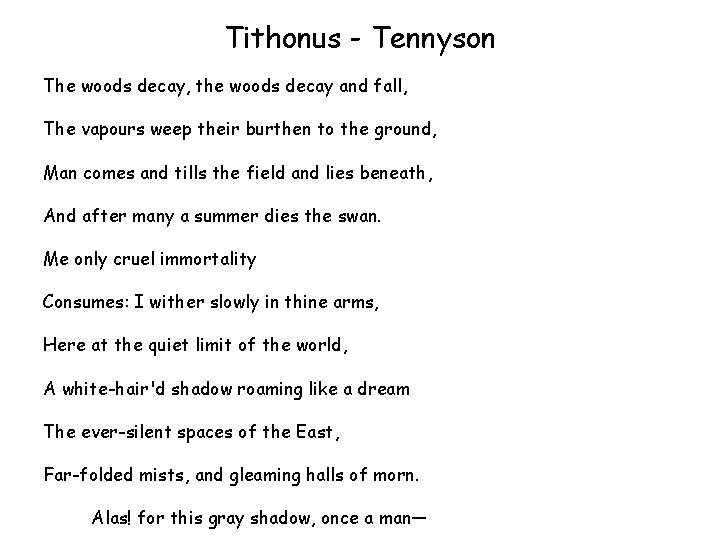
Tithonus - Tennyson The woods decay, the woods decay and fall, The vapours weep their burthen to the ground, Man comes and tills the field and lies beneath, And after many a summer dies the swan. Me only cruel immortality Consumes: I wither slowly in thine arms, Here at the quiet limit of the world, A white-hair'd shadow roaming like a dream The ever-silent spaces of the East, Far-folded mists, and gleaming halls of morn. Alas! for this gray shadow, once a man—