
Winter 2013 ECE 458 Internet Security How the
- Slides: 40
Winter 2013 ECE 458 Internet Security: How the Internet works and some basic vulnerabilities Dan Boneh (Modified by Vijay Ganesh)
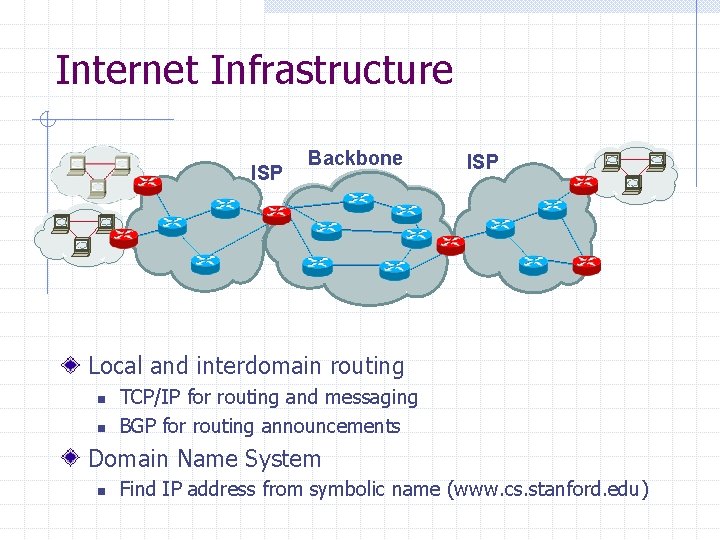
Internet Infrastructure ISP Backbone ISP Local and interdomain routing n n TCP/IP for routing and messaging BGP for routing announcements Domain Name System n Find IP address from symbolic name (www. cs. stanford. edu)
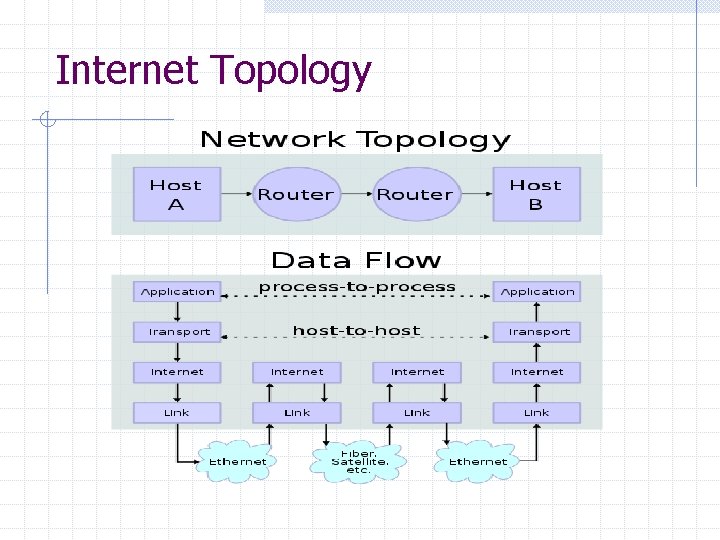
Internet Topology
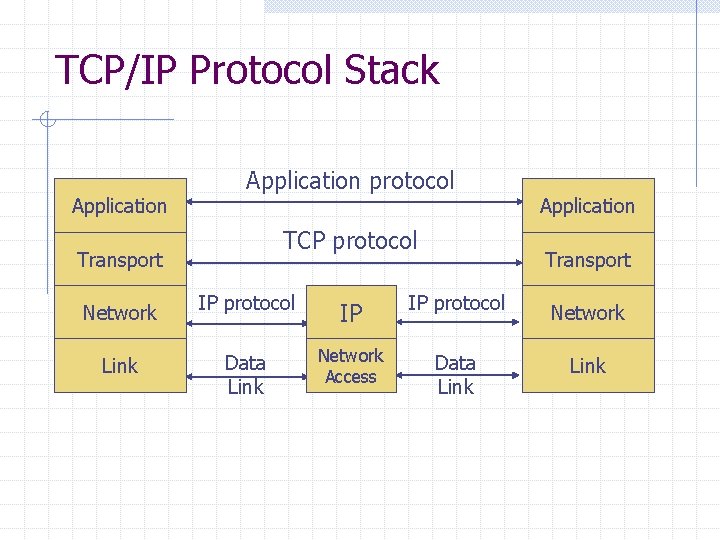
TCP/IP Protocol Stack Application protocol TCP protocol Transport Application Transport Network IP protocol IP IP protocol Network Link Data Link Network Access Data Link
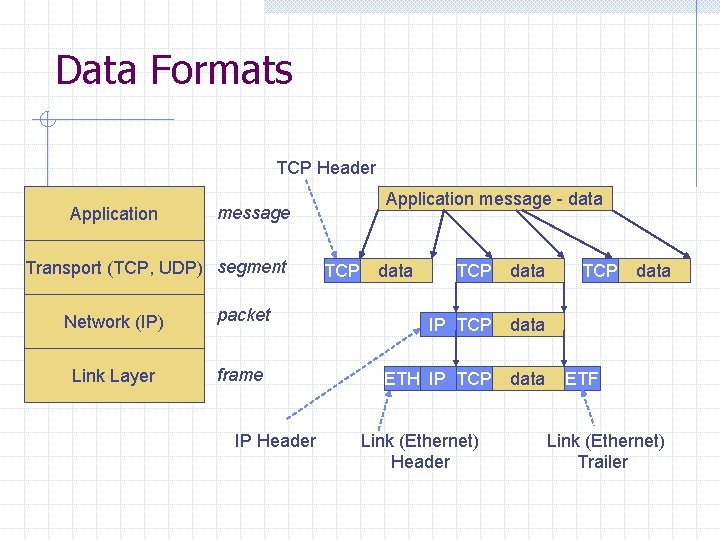
Data Formats TCP Header Application message - data message Transport (TCP, UDP) segment Network (IP) packet Link Layer frame IP Header TCP data IP TCP data ETH IP TCP data Link (Ethernet) Header TCP data ETF Link (Ethernet) Trailer
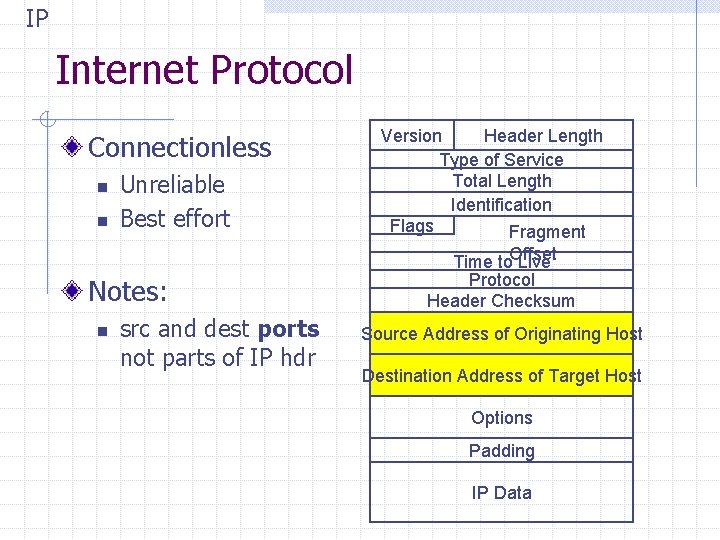
IP Internet Protocol Connectionless n n Unreliable Best effort Notes: n src and dest ports not parts of IP hdr Version Header Length Type of Service Total Length Identification Flags Fragment Time to. Offset Live Protocol Header Checksum Source Address of Originating Host Destination Address of Target Host Options Padding IP Data
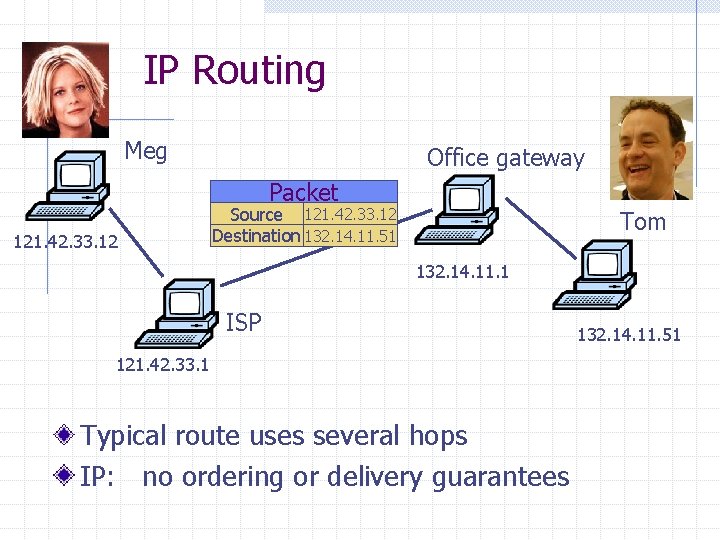
IP Routing Meg Office gateway Packet 121. 42. 33. 12 Source 121. 42. 33. 12 Destination 132. 14. 11. 51 Tom 132. 14. 11. 1 ISP 121. 42. 33. 1 Typical route uses several hops IP: no ordering or delivery guarantees 132. 14. 11. 51
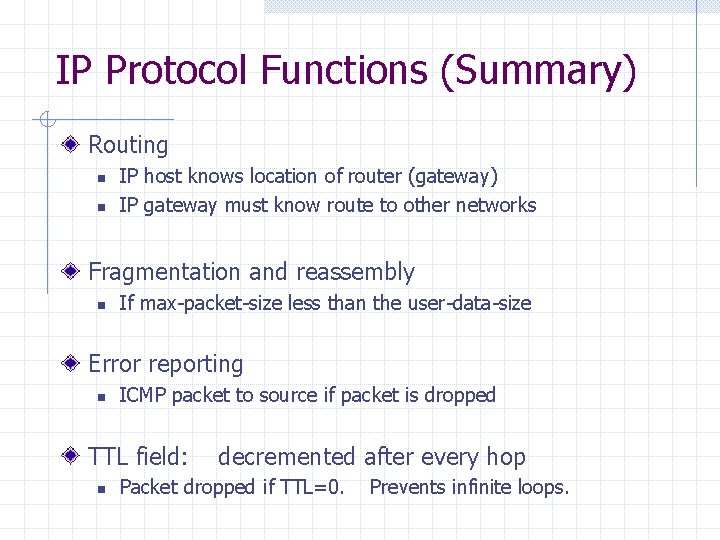
IP Protocol Functions (Summary) Routing n n IP host knows location of router (gateway) IP gateway must know route to other networks Fragmentation and reassembly n If max-packet-size less than the user-data-size Error reporting n ICMP packet to source if packet is dropped TTL field: n decremented after every hop Packet dropped if TTL=0. Prevents infinite loops.
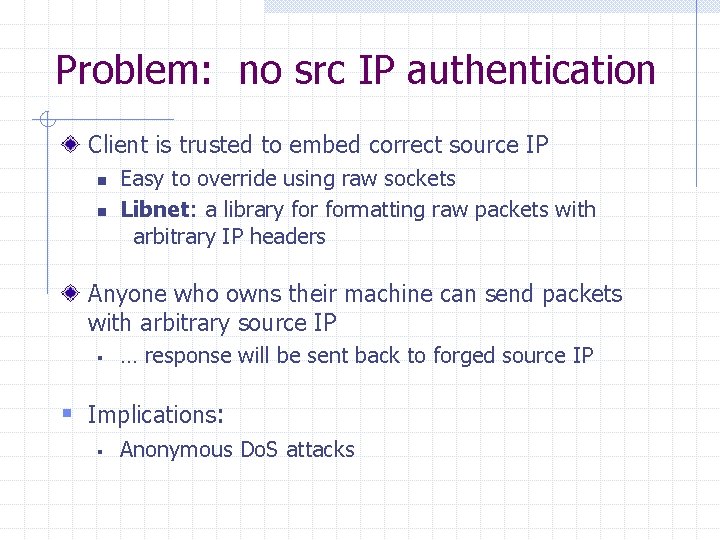
Problem: no src IP authentication Client is trusted to embed correct source IP n n Easy to override using raw sockets Libnet: a library formatting raw packets with arbitrary IP headers Anyone who owns their machine can send packets with arbitrary source IP § … response will be sent back to forged source IP § Implications: § Anonymous Do. S attacks
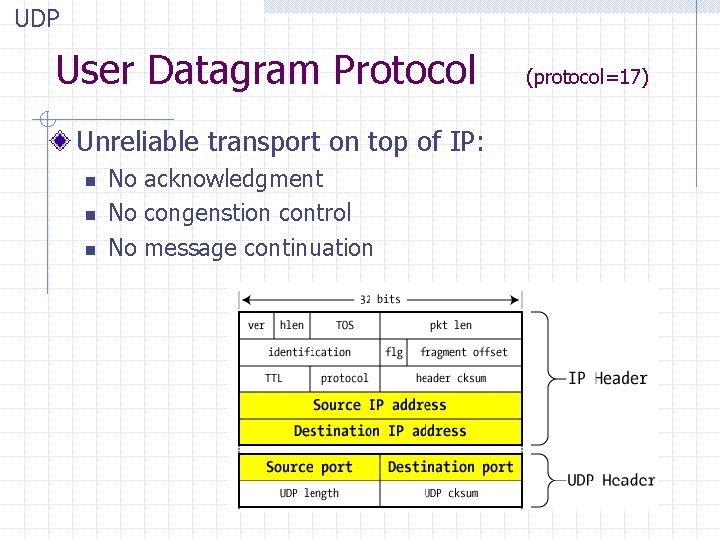
UDP User Datagram Protocol Unreliable transport on top of IP: n n n No acknowledgment No congenstion control No message continuation (protocol=17)
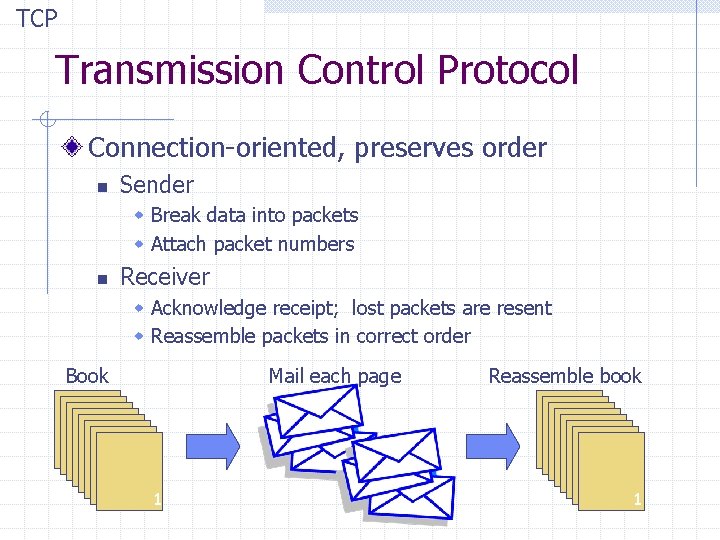
TCP Transmission Control Protocol Connection-oriented, preserves order n Sender w Break data into packets w Attach packet numbers n Receiver w Acknowledge receipt; lost packets are resent w Reassemble packets in correct order Book Mail each page Reassemble book 1 19 1 5 1
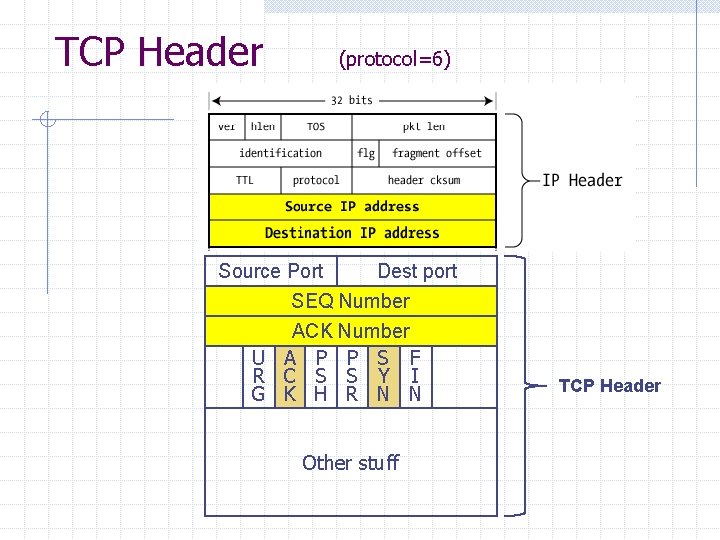
TCP Header (protocol=6) Source Port Dest port SEQ Number ACK Number U A P P S F R C S S Y I G K H R N N Other stuff TCP Header
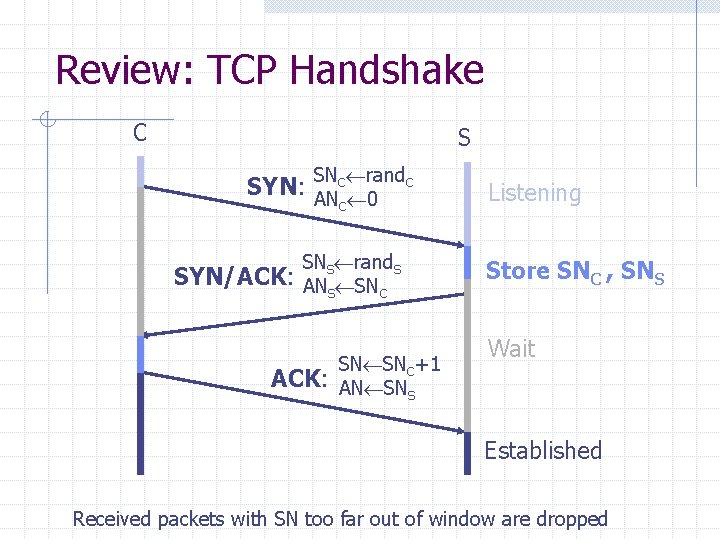
Review: TCP Handshake C S SN rand. C SYN: ANC 0 C SYN/ACK: SNS rand. S ANS SNC ACK: SN SNC+1 AN SNS Listening Store SNC , SNS Wait Established Received packets with SN too far out of window are dropped
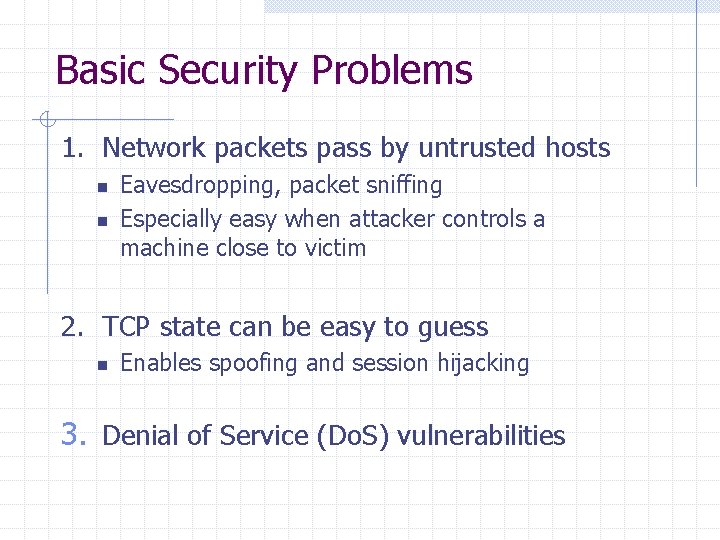
Basic Security Problems 1. Network packets pass by untrusted hosts n n Eavesdropping, packet sniffing Especially easy when attacker controls a machine close to victim 2. TCP state can be easy to guess n Enables spoofing and session hijacking 3. Denial of Service (Do. S) vulnerabilities
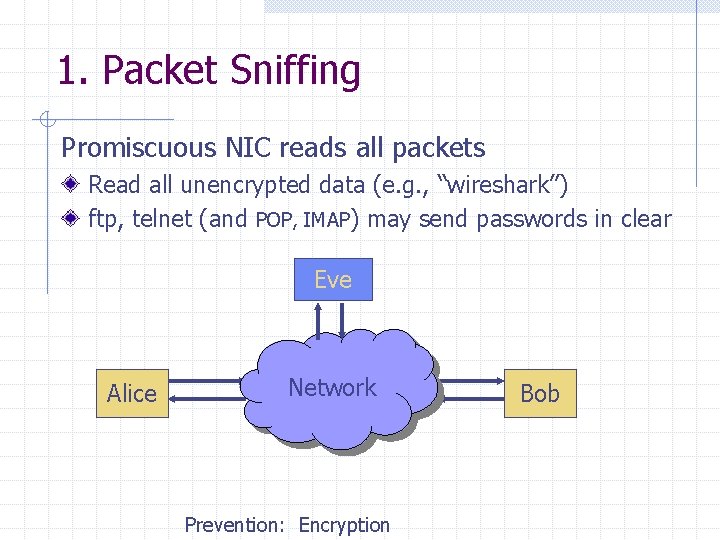
1. Packet Sniffing Promiscuous NIC reads all packets Read all unencrypted data (e. g. , “wireshark”) ftp, telnet (and POP, IMAP) may send passwords in clear Eve Alice Network Prevention: Encryption Bob
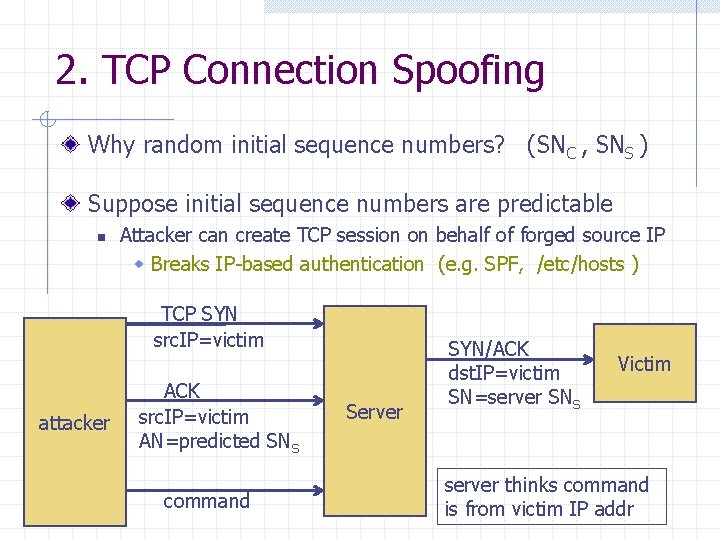
2. TCP Connection Spoofing Why random initial sequence numbers? (SNC , SNS ) Suppose initial sequence numbers are predictable n Attacker can create TCP session on behalf of forged source IP w Breaks IP-based authentication (e. g. SPF, /etc/hosts ) TCP SYN src. IP=victim attacker ACK src. IP=victim AN=predicted SNS command Server SYN/ACK dst. IP=victim SN=server SNS Victim server thinks command is from victim IP addr
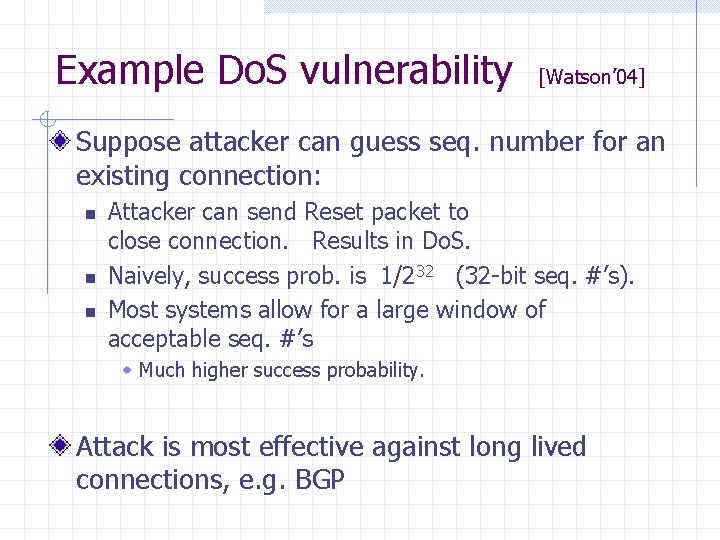
Example Do. S vulnerability [Watson’ 04] Suppose attacker can guess seq. number for an existing connection: n n n Attacker can send Reset packet to close connection. Results in Do. S. Naively, success prob. is 1/232 (32 -bit seq. #’s). Most systems allow for a large window of acceptable seq. #’s w Much higher success probability. Attack is most effective against long lived connections, e. g. BGP
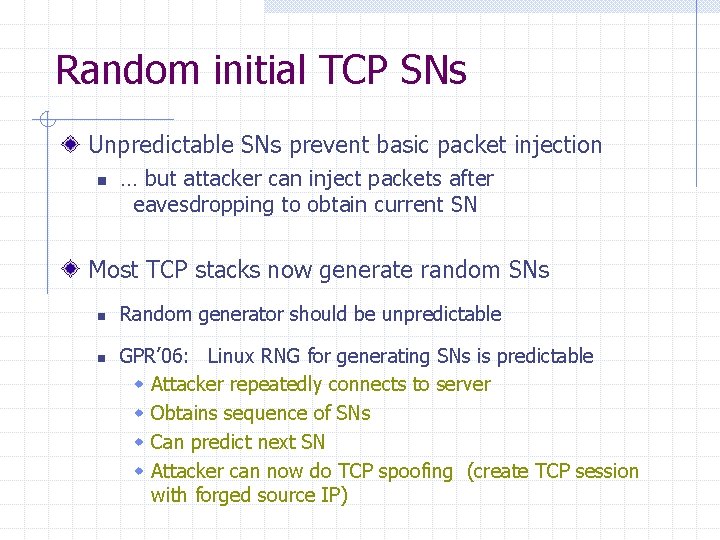
Random initial TCP SNs Unpredictable SNs prevent basic packet injection n … but attacker can inject packets after eavesdropping to obtain current SN Most TCP stacks now generate random SNs n n Random generator should be unpredictable GPR’ 06: Linux RNG for generating SNs is predictable w Attacker repeatedly connects to server w Obtains sequence of SNs w Can predict next SN w Attacker can now do TCP spoofing (create TCP session with forged source IP)
Routing Vulnerabilities
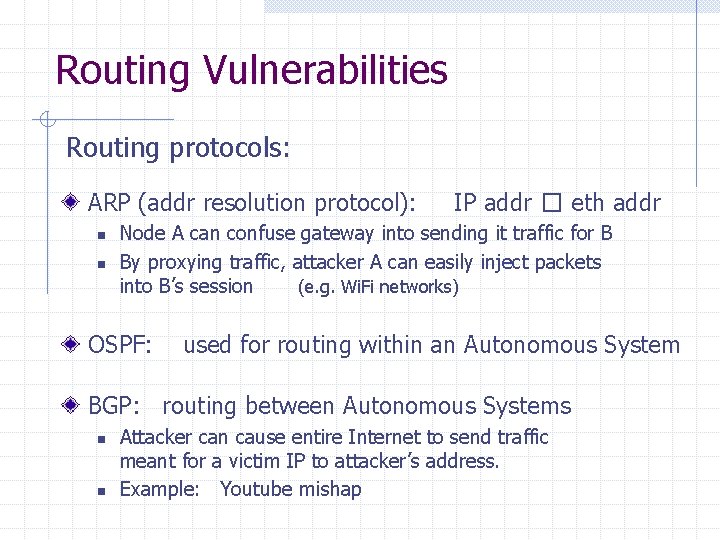
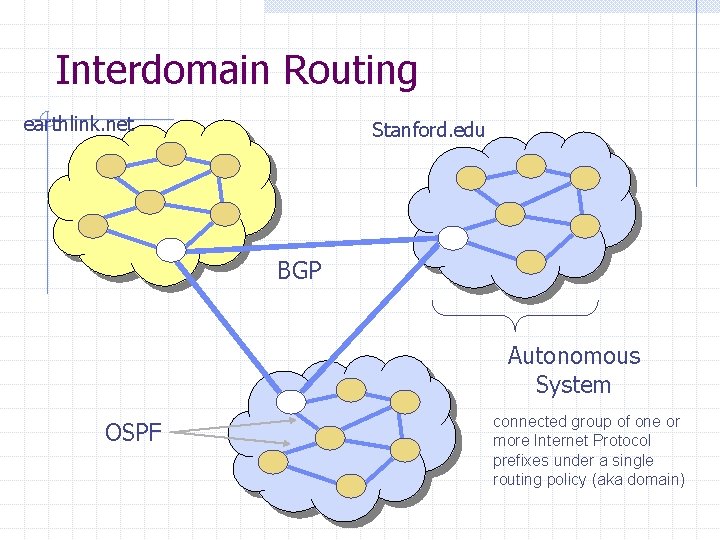
Routing Vulnerabilities Routing protocols: ARP (addr resolution protocol): n n IP addr � eth addr Node A can confuse gateway into sending it traffic for B By proxying traffic, attacker A can easily inject packets into B’s session (e. g. Wi. Fi networks) OSPF: used for routing within an Autonomous System BGP: routing between Autonomous Systems n n Attacker can cause entire Internet to send traffic meant for a victim IP to attacker’s address. Example: Youtube mishap
Interdomain Routing earthlink. net Stanford. edu BGP Autonomous System OSPF connected group of one or more Internet Protocol prefixes under a single routing policy (aka domain)
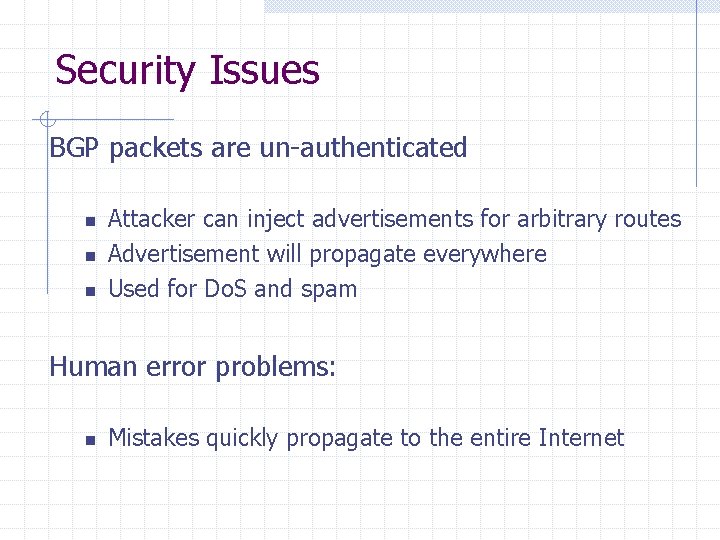
Security Issues BGP packets are un-authenticated n n n Attacker can inject advertisements for arbitrary routes Advertisement will propagate everywhere Used for Do. S and spam Human error problems: n Mistakes quickly propagate to the entire Internet
Domain Name System
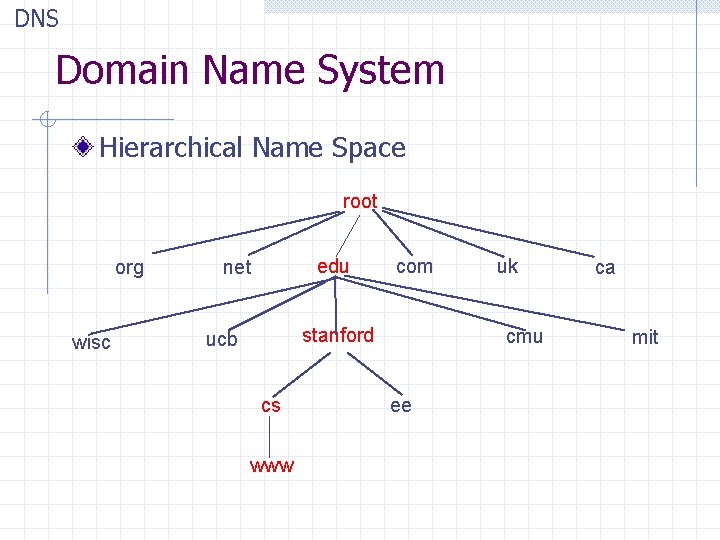
DNS Domain Name System Hierarchical Name Space root org wisc edu net com stanford ucb cs www uk cmu ee ca mit
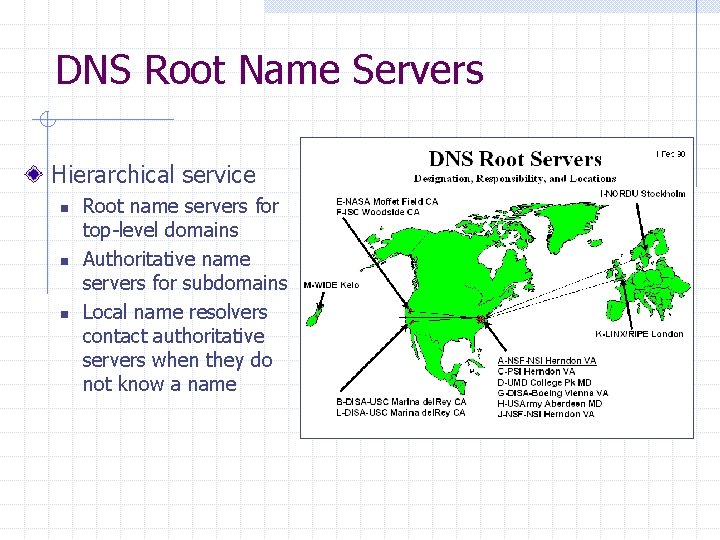
DNS Root Name Servers Hierarchical service n n n Root name servers for top-level domains Authoritative name servers for subdomains Local name resolvers contact authoritative servers when they do not know a name
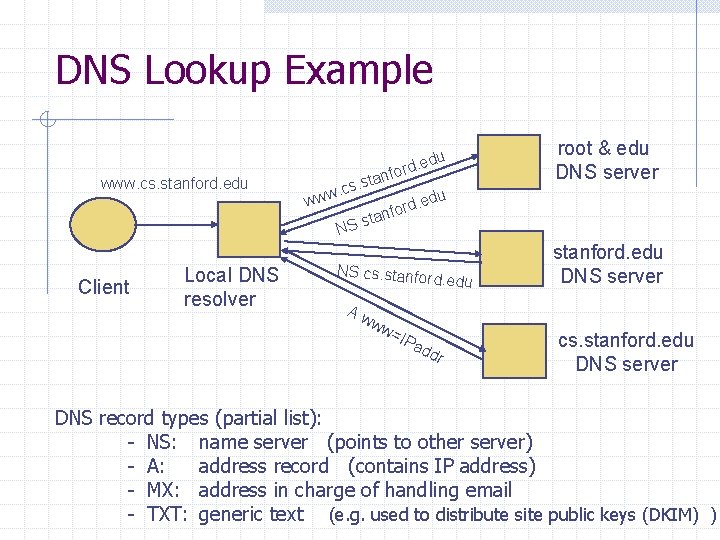
DNS Lookup Example www. cs. stanford. edu Client Local DNS resolver edu. d r o nf a t s. . cs www. edu d r o f stan S N NS cs. stanford . edu root & edu DNS server stanford. edu DNS server Aw ww = IPa dd r cs. stanford. edu DNS server DNS record types (partial list): - NS: name server (points to other server) - A: address record (contains IP address) - MX: address in charge of handling email - TXT: generic text (e. g. used to distribute site public keys (DKIM) )
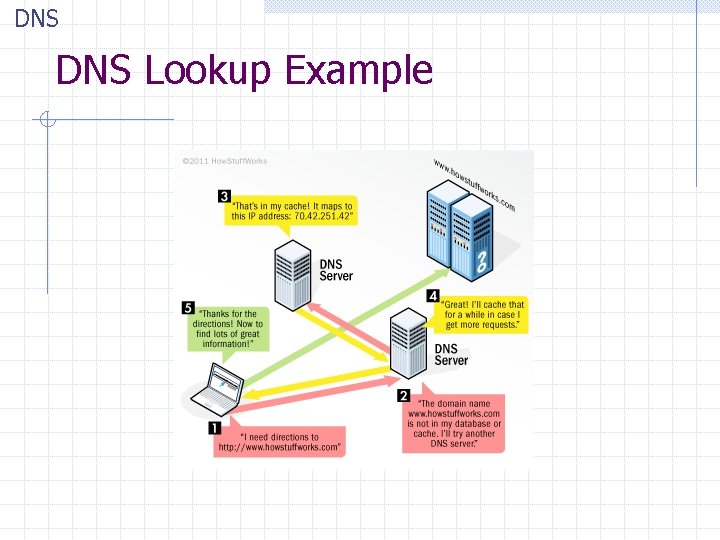
DNS Lookup Example
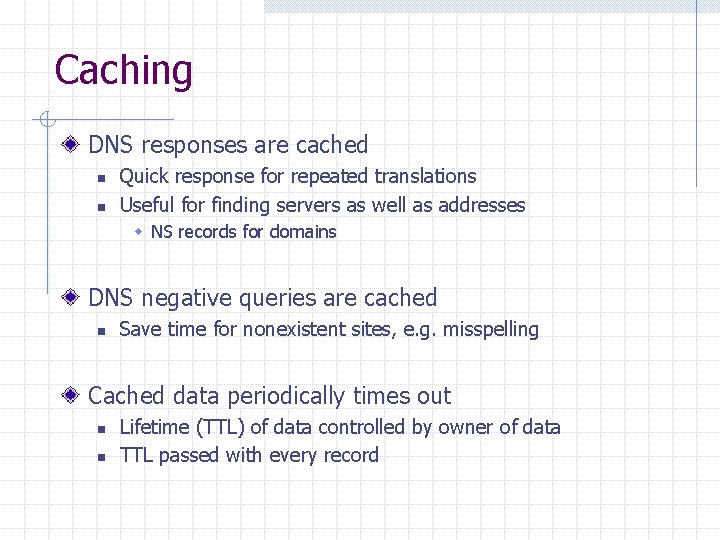
Caching DNS responses are cached n n Quick response for repeated translations Useful for finding servers as well as addresses w NS records for domains DNS negative queries are cached n Save time for nonexistent sites, e. g. misspelling Cached data periodically times out n n Lifetime (TTL) of data controlled by owner of data TTL passed with every record
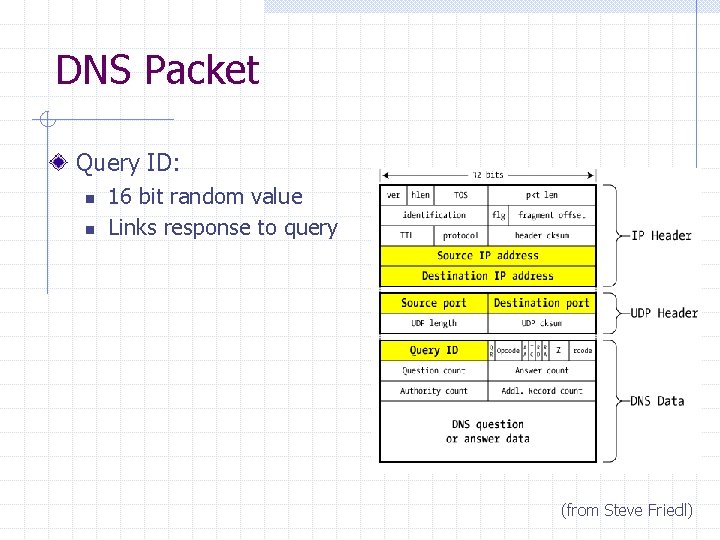
DNS Packet Query ID: n n 16 bit random value Links response to query (from Steve Friedl)
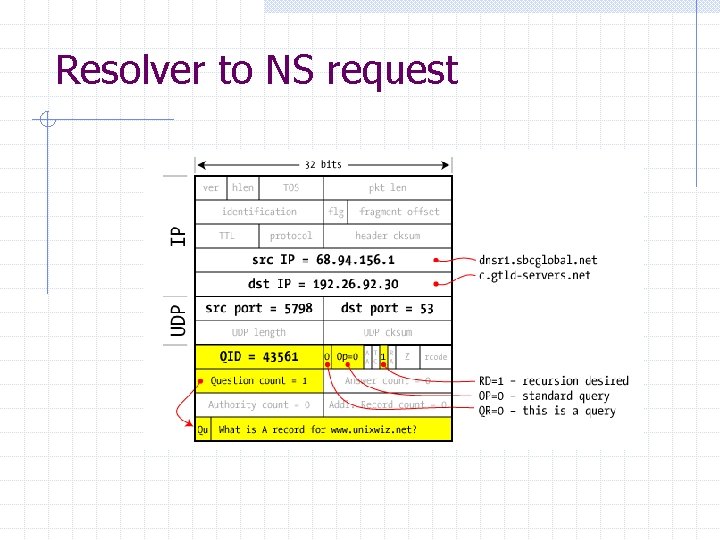
Resolver to NS request
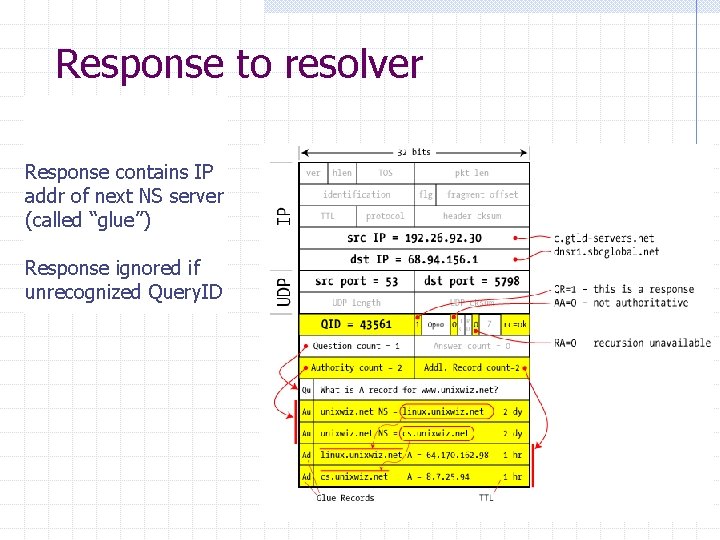
Response to resolver Response contains IP addr of next NS server (called “glue”) Response ignored if unrecognized Query. ID
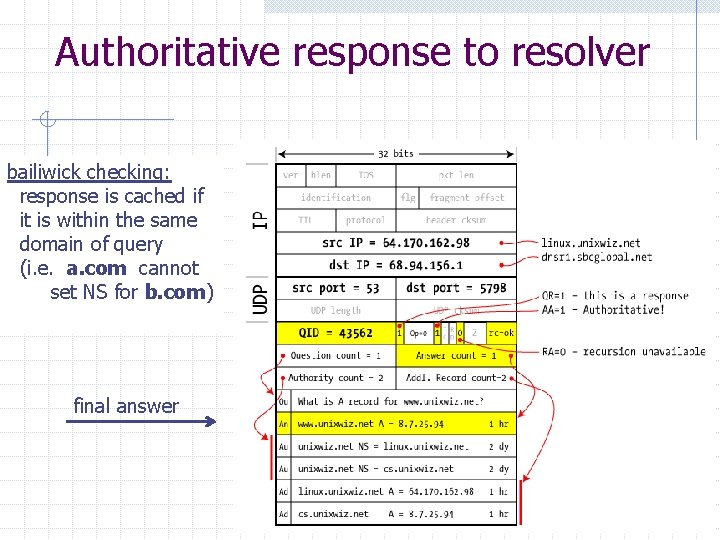
Authoritative response to resolver bailiwick checking: response is cached if it is within the same domain of query (i. e. a. com cannot set NS for b. com) final answer
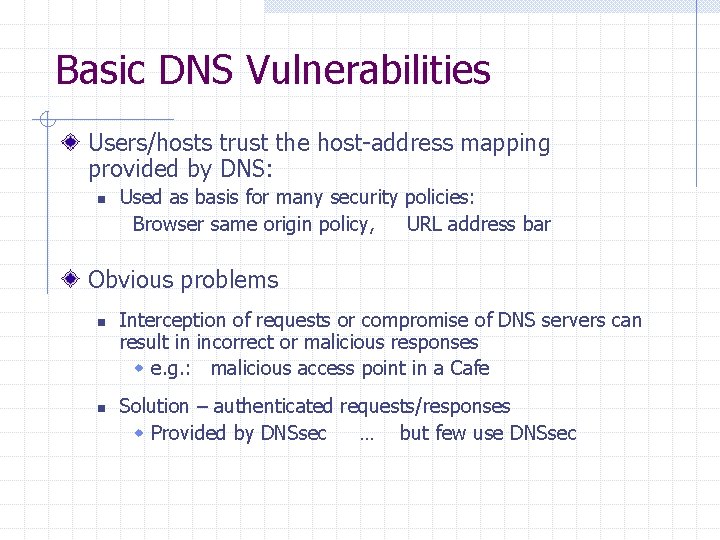
Basic DNS Vulnerabilities Users/hosts trust the host-address mapping provided by DNS: n Used as basis for many security policies: Browser same origin policy, URL address bar Obvious problems n n Interception of requests or compromise of DNS servers can result in incorrect or malicious responses w e. g. : malicious access point in a Cafe Solution – authenticated requests/responses w Provided by DNSsec … but few use DNSsec
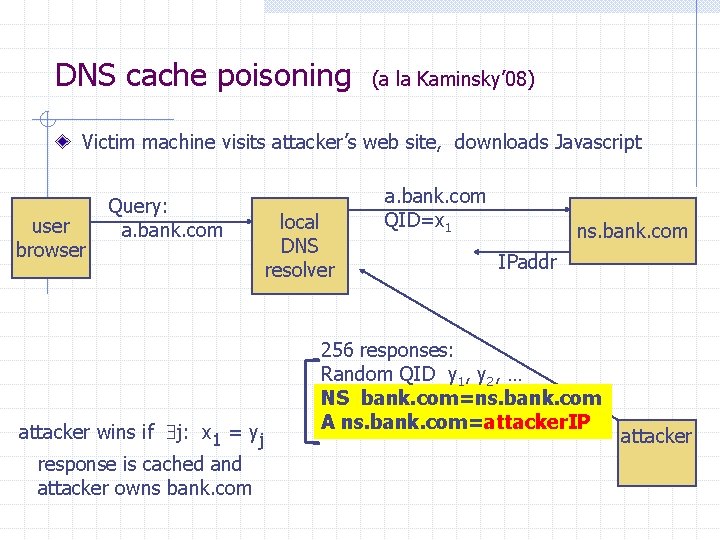
DNS cache poisoning (a la Kaminsky’ 08) Victim machine visits attacker’s web site, downloads Javascript user browser Query: a. bank. com attacker wins if j: x 1 = yj response is cached and attacker owns bank. com local DNS resolver a. bank. com QID=x 1 ns. bank. com IPaddr 256 responses: Random QID y 1, y 2, … NS bank. com=ns. bank. com A ns. bank. com=attacker. IP attacker
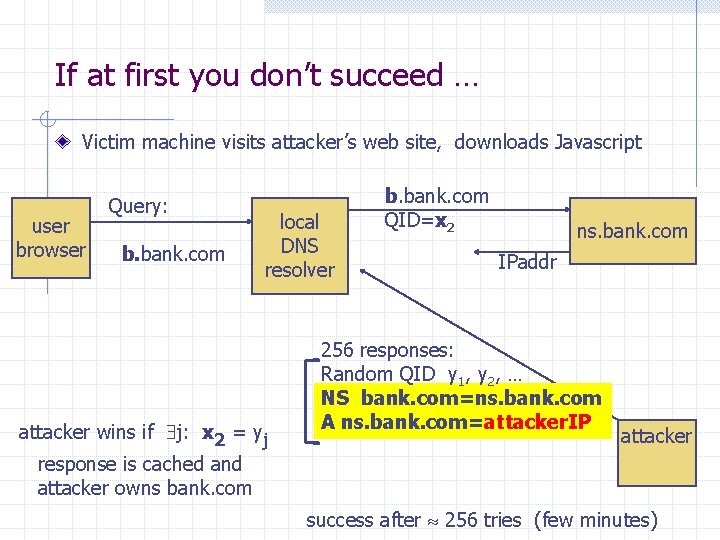
If at first you don’t succeed … Victim machine visits attacker’s web site, downloads Javascript user browser Query: b. bank. com local DNS resolver attacker wins if j: x 2 = yj response is cached and attacker owns bank. com b. bank. com QID=x 2 ns. bank. com IPaddr 256 responses: Random QID y 1, y 2, … NS bank. com=ns. bank. com A ns. bank. com=attacker. IP attacker success after 256 tries (few minutes)
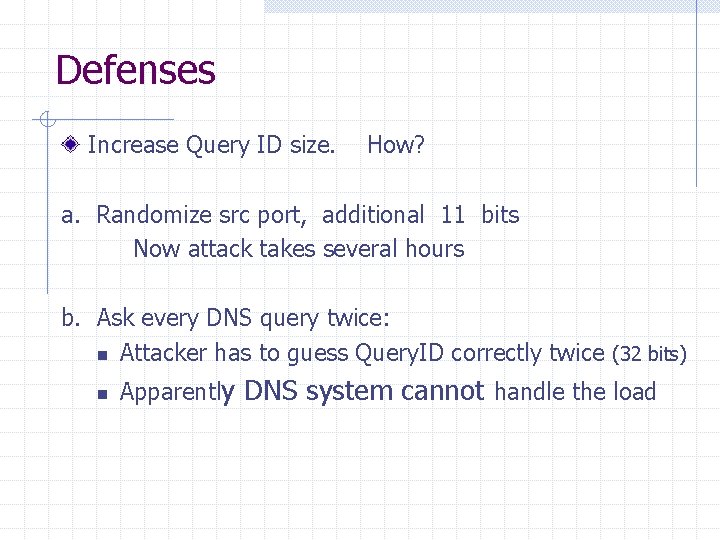
Defenses Increase Query ID size. How? a. Randomize src port, additional 11 bits Now attack takes several hours b. Ask every DNS query twice: n Attacker has to guess Query. ID correctly twice (32 bits) n Apparently DNS system cannot handle the load
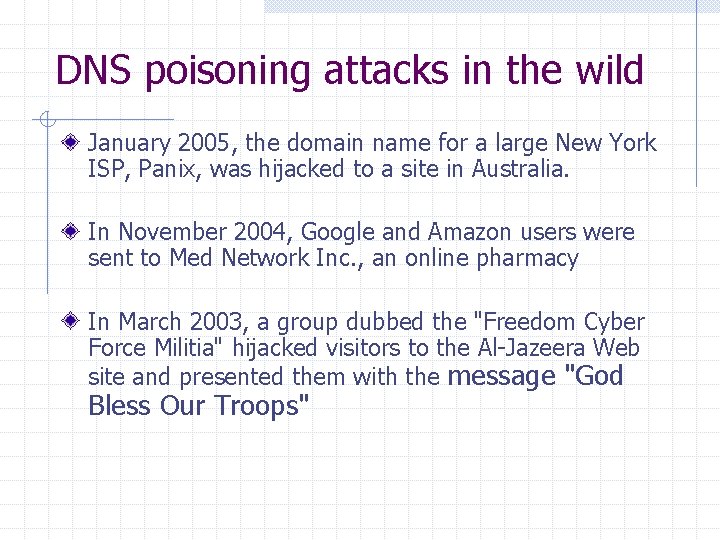
DNS poisoning attacks in the wild January 2005, the domain name for a large New York ISP, Panix, was hijacked to a site in Australia. In November 2004, Google and Amazon users were sent to Med Network Inc. , an online pharmacy In March 2003, a group dubbed the "Freedom Cyber Force Militia" hijacked visitors to the Al-Jazeera Web site and presented them with the message "God Bless Our Troops"
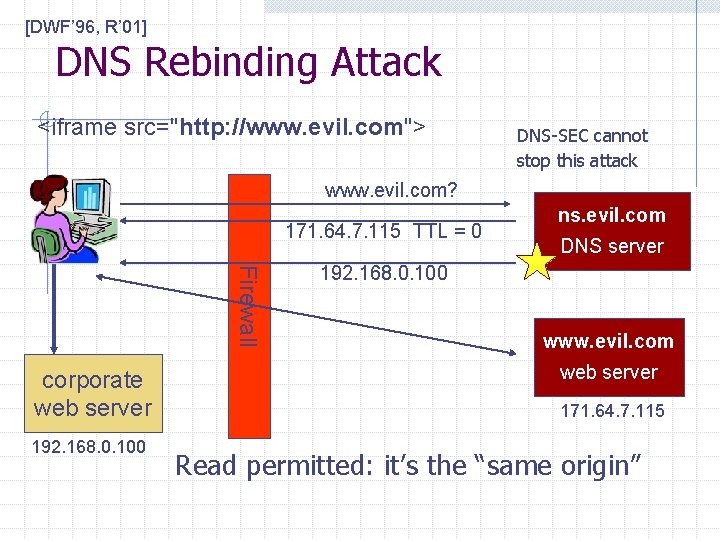
[DWF’ 96, R’ 01] DNS Rebinding Attack <iframe src="http: //www. evil. com"> DNS-SEC cannot stop this attack www. evil. com? 171. 64. 7. 115 TTL = 0 Firewall corporate web server 192. 168. 0. 100 ns. evil. com DNS server 192. 168. 0. 100 www. evil. com web server 171. 64. 7. 115 Read permitted: it’s the “same origin”
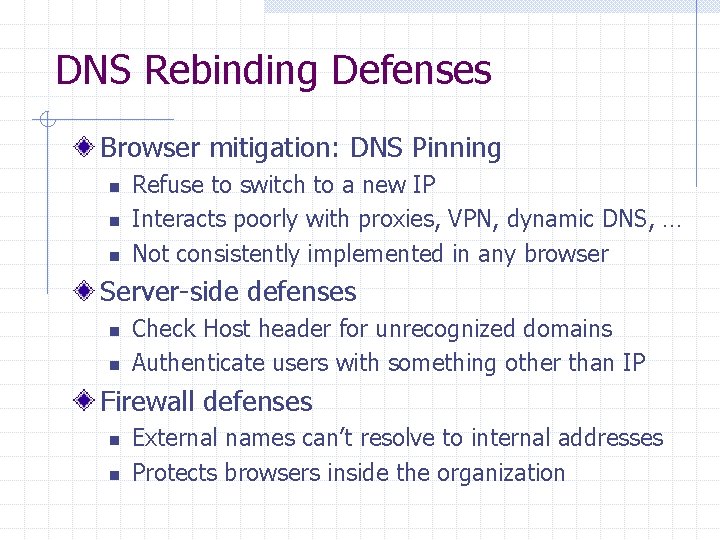
DNS Rebinding Defenses Browser mitigation: DNS Pinning n n n Refuse to switch to a new IP Interacts poorly with proxies, VPN, dynamic DNS, … Not consistently implemented in any browser Server-side defenses n n Check Host header for unrecognized domains Authenticate users with something other than IP Firewall defenses n n External names can’t resolve to internal addresses Protects browsers inside the organization
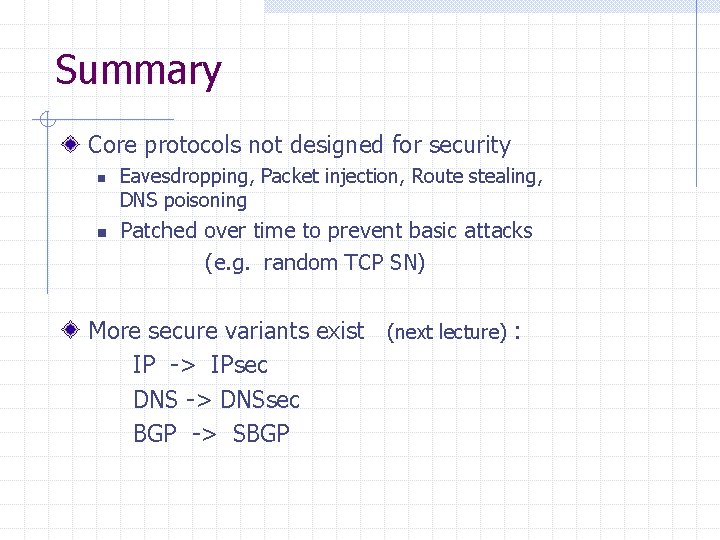
Summary Core protocols not designed for security n n Eavesdropping, Packet injection, Route stealing, DNS poisoning Patched over time to prevent basic attacks (e. g. random TCP SN) More secure variants exist (next lecture) : IP -> IPsec DNS -> DNSsec BGP -> SBGP