
Winning or Losing a CPS Case in the






- Slides: 33
Winning or Losing a CPS Case in the First Sixty Days Mark Briggs, J. D. , CWLS El Paso April 1, 2016
The First Sixty Days • Clock starts at removal • Critical time lines for parents and their relatives • Interventions and alternative resolutions • Criminal & collateral matters • Tactical considerations • Service Plan – the outline of the case
The Constitution • At its core, child welfare law brings to issue one of the most basic fundamental rights: the parents’ right to raise their children. A Child Welfare lawyer is a Constitutional Lawyer. Although state law predominates in child welfare cases, the United States Supreme Court has, on several occasions, discussed the parameters of a parent’s rights. Every child welfare attorney should know two cases: • Stanley v. Illinois, 405 U. S. 645, 92 S. Ct. 1208 (1972). • Troxel v. Granville, 530 U. S 57, 120 S. Ct. 2054 (2000).
Constitutional Rights • Both the parent and the child have protected rights under the U. S. Constitution. • These are equal and one is no greater than the other. • The 14 th Amendment requires states to protect those rights. • Right of family integrity Troxel v. Granville 530 U. S 57, 120 S. Ct. 2054 (2000)
Troxel, 530 U. S. 57, 120 S. Ct. 2054 (2000) “The interest of parents in the care, custody and control of their children is perhaps the oldest of the fundamental liberty interests recognized by this Court. “Accordingly, so long as a parent adequately cares for his or her child (i. e. , is fit), there will normally be no reason for the state to inject itself into the private realm of the family to further question the ability of that parent to make the best decisions concerning the rearing of that parent’s children.
THE MOST IMPORTANT THING YOU WILL LEARN ALL DAY! www. dfps. state. tx. us/handbooks/cps/ Playbook for the other team. Skim it at least once before each new case.
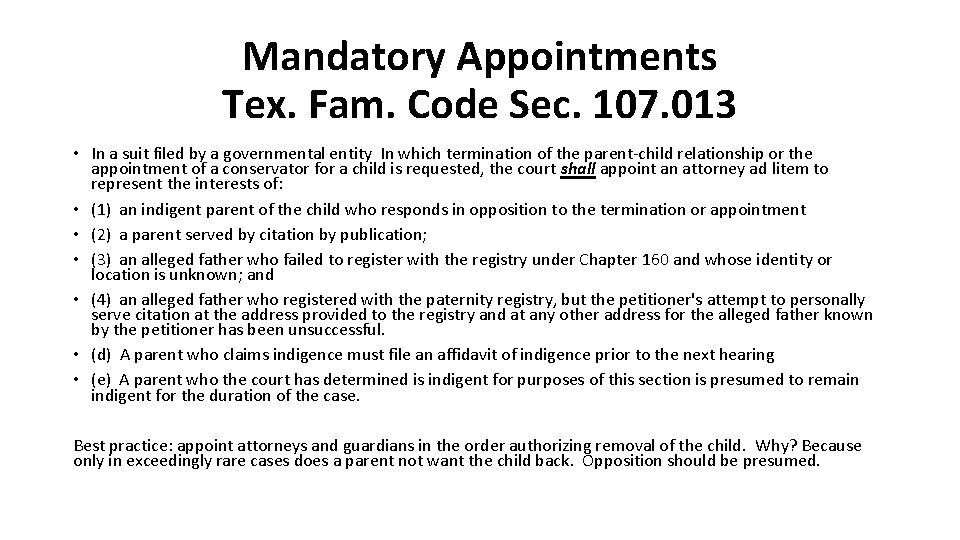
Mandatory Appointments Tex. Fam. Code Sec. 107. 013 • In a suit filed by a governmental entity In which termination of the parent-child relationship or the appointment of a conservator for a child is requested, the court shall appoint an attorney ad litem to represent the interests of: • (1) an indigent parent of the child who responds in opposition to the termination or appointment • (2) a parent served by citation by publication; • (3) an alleged father who failed to register with the registry under Chapter 160 and whose identity or location is unknown; and • (4) an alleged father who registered with the paternity registry, but the petitioner's attempt to personally serve citation at the address provided to the registry and at any other address for the alleged father known by the petitioner has been unsuccessful. • (d) A parent who claims indigence must file an affidavit of indigence prior to the next hearing • (e) A parent who the court has determined is indigent for purposes of this section is presumed to remain indigent for the duration of the case. Best practice: appoint attorneys and guardians in the order authorizing removal of the child. Why? Because only in exceedingly rare cases does a parent not want the child back. Opposition should be presumed.
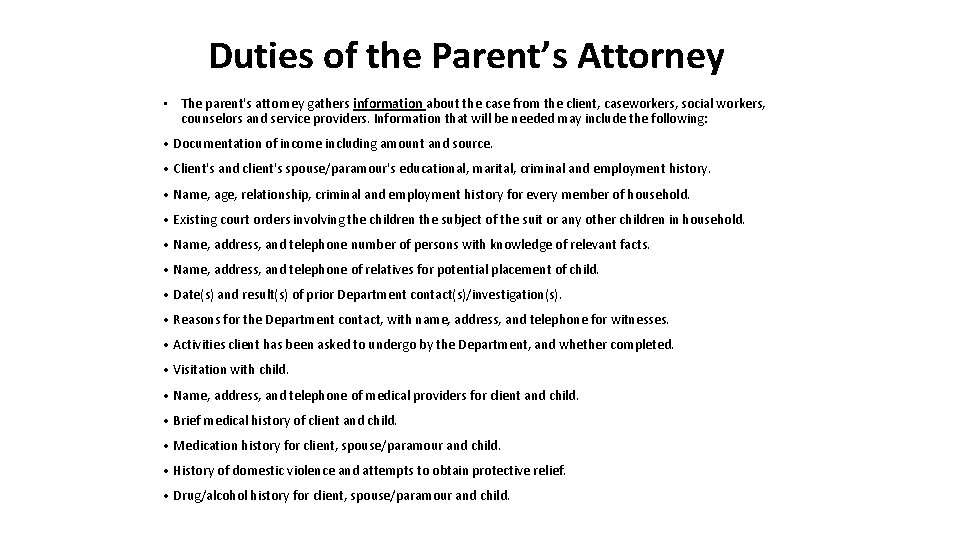
Duties of the Parent’s Attorney • The parent's attorney gathers information about the case from the client, caseworkers, social workers, counselors and service providers. Information that will be needed may include the following: • Documentation of income including amount and source. • Client's and client's spouse/paramour's educational, marital, criminal and employment history. • Name, age, relationship, criminal and employment history for every member of household. • Existing court orders involving the children the subject of the suit or any other children in household. • Name, address, and telephone number of persons with knowledge of relevant facts. • Name, address, and telephone of relatives for potential placement of child. • Date(s) and result(s) of prior Department contact(s)/investigation(s). • Reasons for the Department contact, with name, address, and telephone for witnesses. • Activities client has been asked to undergo by the Department, and whether completed. • Visitation with child. • Name, address, and telephone of medical providers for client and child. • Brief medical history of client and child. • Medication history for client, spouse/paramour and child. • History of domestic violence and attempts to obtain protective relief. • Drug/alcohol history for client, spouse/paramour and child.
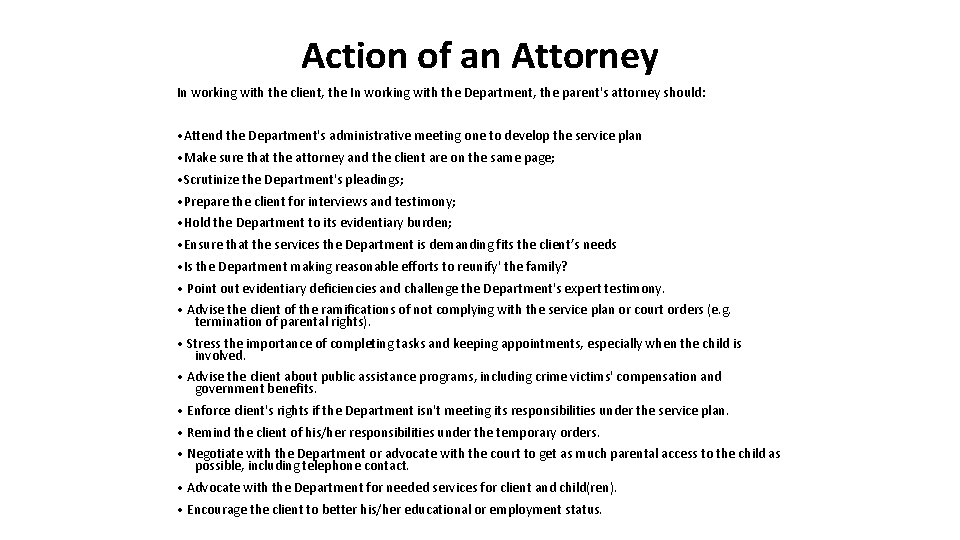
Action of an Attorney In working with the client, the In working with the Department, the parent's attorney should: • Attend the Department's administrative meeting one to develop the service plan • Make sure that the attorney and the client are on the same page; • Scrutinize the Department's pleadings; • Prepare the client for interviews and testimony; • Hold the Department to its evidentiary burden; • Ensure that the services the Department is demanding fits the client’s needs • Is the Department making reasonable efforts to reunify' the family? • Point out evidentiary deficiencies and challenge the Department's expert testimony. • Advise the client of the ramifications of not complying with the service plan or court orders (e. g. termination of parental rights). • Stress the importance of completing tasks and keeping appointments, especially when the child is involved. • Advise the client about public assistance programs, including crime victims' compensation and government benefits. • Enforce client's rights if the Department isn't meeting its responsibilities under the service plan. • Remind the client of his/her responsibilities under the temporary orders. • Negotiate with the Department or advocate with the court to get as much parental access to the child as possible, including telephone contact. • Advocate with the Department for needed services for client and child(ren). • Encourage the client to better his/her educational or employment status.
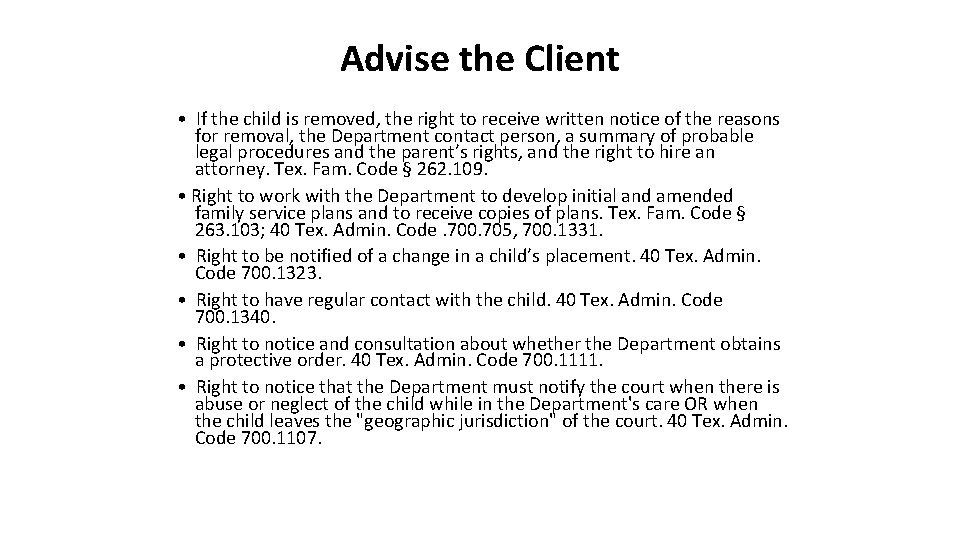
Advise the Client • If the child is removed, the right to receive written notice of the reasons for removal, the Department contact person, a summary of probable legal procedures and the parent’s rights, and the right to hire an attorney. Tex. Fam. Code § 262. 109. • Right to work with the Department to develop initial and amended family service plans and to receive copies of plans. Tex. Fam. Code § 263. 103; 40 Tex. Admin. Code. 700. 705, 700. 1331. • Right to be notified of a change in a child’s placement. 40 Tex. Admin. Code 700. 1323. • Right to have regular contact with the child. 40 Tex. Admin. Code 700. 1340. • Right to notice and consultation about whether the Department obtains a protective order. 40 Tex. Admin. Code 700. 1111. • Right to notice that the Department must notify the court when there is abuse or neglect of the child while in the Department's care OR when the child leaves the "geographic jurisdiction" of the court. 40 Tex. Admin. Code 700. 1107.
Advise the Client • The parents’ attorney advises the parent of statutory notice and participation rights under the Texas Family Code and the Texas Administrative Code, including the following: • Right to receive information on nature of complaint or reason for contact; right to complain; right to review records; right to see counsel and information on legal resources; right to access child, if removed; right to information on available community services if parent is a victim of domestic violence. Tex. Fam. Code § 261. 307; 40 Tex. Admin. Code 700. 508 (b). • Right to receive notice that child was interviewed by the Department. Fam. Code Ann. § 261. 311. • Right to request Administrative Review (AR) to contest accusation of abuse or neglect within 45 days of receipt of findings; review may be stayed if court case pending; AR request does not delay removal/court action. 40 Tex. Admin. Code 700. 516.
Advise the Client • Know when to hold ‘em. . • Advising clients to accept services even when they don’t want to; • Negotiating specific services with the Department; • Calling the Department’s bluff ; • Know when to fold ‘em. . • Agreeing to the finding, order or petition; • Concurrent criminal or custodial case;
Collect Evidence • The parent's attorney gathers evidence from the client and the Department, including. copies of the following: • court orders and live pleadings; • the Department's correspondence/ documents; • police reports; • immunization records and report cards; • client statements; and • photographs of child;
A CPS Lawsuit is a SAPCR • CPS cases incorporate statutes, rules, and case law that are particular to child protection suits, but the bulk of SAPCR law apply to these cases as well. • Moreover, the judges who are assigned to child protection courts typically have backgrounds in family law and understand apply general family law principles to these proceedings. • Finally, appellate court opinions in the child protection realm consistently refer to CPS cases as SAPCRs
Interventions and Alternate Resolutions • Interventions in the case are subject to standing requirements of TFC 102. 003(a)(9) and TFC 102. 004. • In most cases, interveners may have 30 days to intervene in the case. • There is no statutory right to counsel for an intervener. • Interveners are usually grandparents, close relatives but may also be fictive kin with a sufficiently lengthy relationship with the children. • Explore and if necessary, refer to another attorney
Interventions • A well-timed intervention may end the need for CPS involvement. • Reasonable efforts – preventing the need for removal or minimizing the harmful effects to the children of the removal • Consent to the intervention may be evidence of parental commitment to the children’s well-being. • Many times intervenor may have legal standing but may be disqualified by departmental POLICY from being considered a placement for the children.
Pre-262 Hearing Mediation • A court-ordered mediation provides an opportunity for the parties to discuss potential resolutions that would not or could not be ordered by the court. • For instance, agreeing to making grandma managing conservator when she might not otherwise qualify as a placement and thereby end the case before it started. • Negotiate placement which is often more important than temporary conservatorship • Opportunity to “air it out” -- which might lead to an agreement to the temporary order. • It never hurts to ask – if the judge is busy, she might agree
Non-Offending Parent • What to do with a dad (or mom) who wasn’t there and was not part of the events which led to the removal. • Stanley v. Illinois – a fit parent presumptively acts in the best interests of the child. For 40 years, the Department simply ignored this. • Formerly, under the Interstate Compact for Placement of Children, TFC 162. 102, an out-of-state parent was out-of-luck getting his child without there first being a home study. • By extension, in-state non-offending parents were treated the same way. • Beginning in 2015, the Department changed policy. Now, a parent has a much better chance especially if there is a pre-existing court order establishing the parent’s conservatorship • The Department sometimes still tries to turn this around by asking the parent to show that he or she is fit. It’s the Department’s burden to show the parent is NOT fit. • Be aware that the offending parent may fail to disclose the whereabouts of the non-offending parent because they would rather have the child in foster care than see the other parent have the child, often for selfish reasons. • Fit does not mean PERFECT. Fit means at the time of removal.
Absent Parent The alleged father (or missing mom) may be a fit, non-offending parent. The offending parent may fail to disclose the location or identity of the other parent because the offending parent does not want the child placed with the other for any number of reasons: - child support - criminal activity - simplicity (life is complicated) BUT, do not assume the other parent wants to be located. Just because you might, doesn’t mean the absent parent shares your view. The absent parent may have good reason to want to remain anonymous or hidden.
The Compromised Client • Because of diagnosed or undiagnosed mental disease, debilitating drug or alcohol use, PTSD, closed head trauma or other problem, you have reason to question your client’s ability to act in his or her own best interest. • Request a guardian ad litem from the court. • Mandatory for minor parents. • In extreme cases, because of danger to themselves or others a full probate guardianship may be necessary. • Note the Department has little or no funding for adult psychiatric services. • Remember the Americans with Disabilities Act.
Texas Disciplinary Rule of Professional Conduct 1. 08(g) • Requires a lawyer to “take reasonable actions to secure the appointment of a guardian or other legal representative for, or seek other protective orders with respect to, a client whenever the lawyer reasonably believes that the client lacks legal competence and that such action should be taken to protect the client. ” • Legal incapacity is not a ground for termination.
Continuing, Exclusive Jurisdiction • The Department must request identification of the court of continuing, exclusive jurisdiction after a full adversary hearing when the court makes temporary orders. Tex. Fam. Code § 262. 202. • Because the Department sometimes delays in making the request, the parent's lawyer should also request identification of the court of continuing, exclusive jurisdiction and seek transfer when necessary. • The primary reason for this is to ensure that the court has jurisdiction to decide the case. • In addition, if a Texas court previously made final orders, documents in that case may reveal necessary parties who must be served, child support obligations, and other important information about the case that may be useful to the parent's lawyer.
Adversary Hearing Tex. Fam. Code Sec. 262. 201 • The full adversary hearing must be scheduled no later than fourteen (14) days after the child's removal. • The Texas Family Code makes the parents the presumptive winners of this hearing. • At the conclusion of the full adversary hearing, the court shall order the return of the child to the parent unless the court finds sufficient evidence to satisfy' a person of ordinary prudence and caution that: 1. there was a danger to the physical health or safety of the child which was caused by an act or failure to act of the person entitled to possession and for the child to remain in the home is contrary to the welfare of the child; 2. the urgent need for the protection required the immediate removal of the child and reasonable efforts were made to eliminate or prevent the child's removal; and 3. reasonable efforts have been made to enable the child to return home, but there is a substantial risk of a continuing danger if the child is returned home.
PRESUMPTIVE WINNERS? Although the parents are presumptive winners, the dynamics of the process are such that the presumption is not difficult to overcome. First, the standard of proof is "sufficient evidence to satisfy a person of ordinary prudence and caution, " a unique standard in the Texas Family Code and one apparently less stringent than a preponderance of evidence standard. The test is akin to "probable cause, " but the drafters avoided that terminology because of its strong overtone of criminal law. Second, the court has already ratified the removal of the child, either before or shortly after the fact. Consequently, unless the Department and the court misperceived the danger; it is unlikely that the earlier conclusion will be revised.
Gates v. TDPRS, 5 th Cir. , 06 -20763 • The short version of Gates is that there must be an immediate, identifiable danger to life or limb of the child for the Department to remove without first seeking a court order. • Challenge at the 14 -day hearing • Remedy: no exigent circumstances – the child is returned • Does not prevent the Department from returning the child, obtaining an order and re-removing. (But how does that really look to the judge? )
ICWA and the 14 -Day Hearing Is your client a member or could be a member of a federally recognized Native-American tribe? • Indian Child Welfare Act • Heightened Burden of Proof • Notice to the Tribe – the tribe is a necessary party if they so choose. • Case could be removed to tribal court • Area of (relatively) rapidly developing federal case law.
Temporary Orders If the court does find sufficient evidence to satisfy' a person of ordinary prudence and caution, the court must make temporary orders as it would in any other SAPCR. These include temporary orders such as appointment of temporary conservators; provisions for placement; visitation and child support; temporary injunctions; and/or orders requiring rehabilitative services to parents and the child. Tex. Fam. Code § 262. 201(c). If the Department has sought termination based on criminal activity for which the parent has been indicted, the court may deny the parent contact with the child until the criminal case is resolved. Tex. Fam. Code § 161. 2011(c). Always consider the Fifth Amendment implications of testifying if there is the possibility of criminal charges
TFC 161. 001(b)(1)(O) • (The parent) failed to comply with the provisions of a court order that specifically established the actions necessary for the parent to obtain the return of a child who has been placed in the permanent or temporary managing conservatorship of (TDFPS) for not less than nine months as a result of the child’s removal from the parent under Chapter 262 for the abuse or neglect of the child. • Pragmatically, this is the only ground of termination that the lawyer can mess up to the detriment of his client.
The Service Plan Meeting • Usually about 14 days after the 14 -day or 262 hearing, a service plan meeting is held at the department. There, the case worker, her supervisor and the parent and perhaps others will map out the services necessary “for the parent to obtain the return of a child” to be adopted as the order of the court. • THE ATTORNEY FOR THE PARENT SHOULD ATTEND. • Just as it’s a sword to terminate, it can be a shield when your client has done all the services. • Be leery of services listed that the Department does not pay for or provide. • The services should be related to the conduct which lead to the removal • You don’t have to agree to the services; if you can’t agree, take it to the judge.
Monitoring: Status Hearing The status hearing occurs within the first sixty (60) days after the appointment of the Department as a child's temporary managing conservator. Its purpose is to review the child’s status and the service plan developed for the child and the parent. Tex. Fam. Code § 263. 201. Procedures for these hearings also require the court to review efforts to bring in unserved parties. This includes evaluating whether a parent who is before the court has provided identification and location information and whether the Department exercised "due diligence" to bring in necessary parties.
Status Hearing • Watch out for proposed orders that contain more court-ordered services then discussed at the service plan meeting. Occasionally, attorneys representing the Department will play social worker and slip services into the proposed order that they think are needed. • Extra services often lead to “setting up for failure” because of the impracticality of having an indigent client traveling many miles many times per week for compliance. • Your job as attorney for the parent is to see that “Failure is not an option. ” • Also be aware that, theoretically, your client should have turned over names of family members and other potential placements with contact information prior to this hearing. Getting this done early gives you, as the attorney, options down the road; the more unlikely it is for your client to have the children returned, the more critical it is to identify potential placements as possible.
Final Word: Paternalism • Walking in their moccasins. • Walking on lava. • Avoid Judgment
Mark G. Briggs, J. D. , C. W. L. S. Attorney / Mediator Briggs & Associates, P. C. 3609 Montana Ave. El Paso, Texas 79903 -4322 (915) 779 -0039 (915) 771 -0271 (fax) mark@briggslaw. org