
Winning Independence 1 What roles did women and
- Slides: 16
Winning Independence
1. What roles did women and African Americans have in the war? 2. How did the war progress until it ended at Yorktown? 3. What did American colonists gain from winning the war?
A. Spain, France and the Netherlands joined in the war against Britain. 1. Supplied medicine, cloth , muskets and gunpowder to the Americans 2. Also provided loans B. Foreign Individuals contribute to the war 1. Bernardo de Galvez- Seized British forts along the MS River and Gulf of Mexico. Drove British out of West Florida (Galveston, TX, named after him) 2. Marquis de Lafayette- got France to send soldiers over to fight with the Patriots 3. Friedrich Von Steuben (Prussia) helped to train the troops to march and drill. 4. Thaddeus Kosciuszko and Casimir Pulaski (Poland)-Helped build forts and defense and helped to train the cavalry.
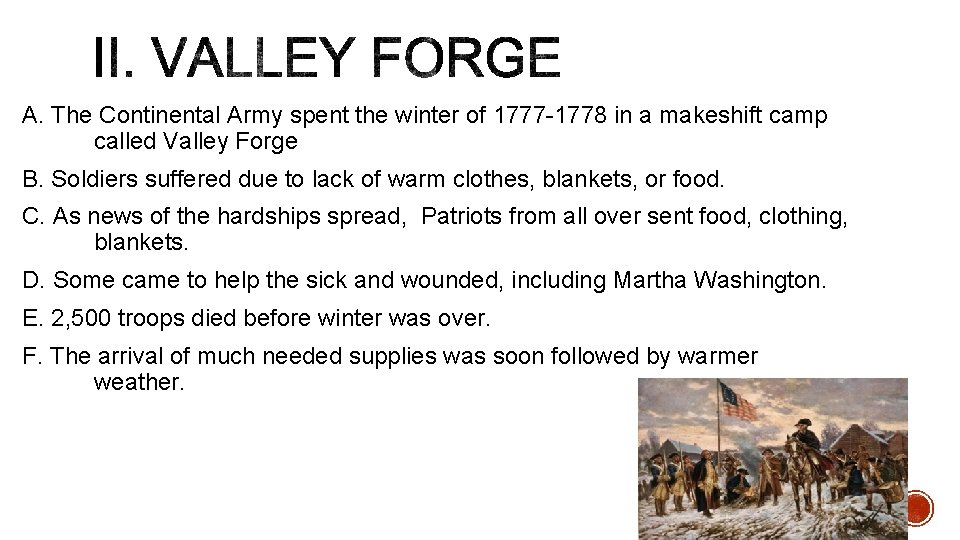
A. The Continental Army spent the winter of 1777 -1778 in a makeshift camp called Valley Forge B. Soldiers suffered due to lack of warm clothes, blankets, or food. C. As news of the hardships spread, Patriots from all over sent food, clothing, blankets. D. Some came to help the sick and wounded, including Martha Washington. E. 2, 500 troops died before winter was over. F. The arrival of much needed supplies was soon followed by warmer weather.
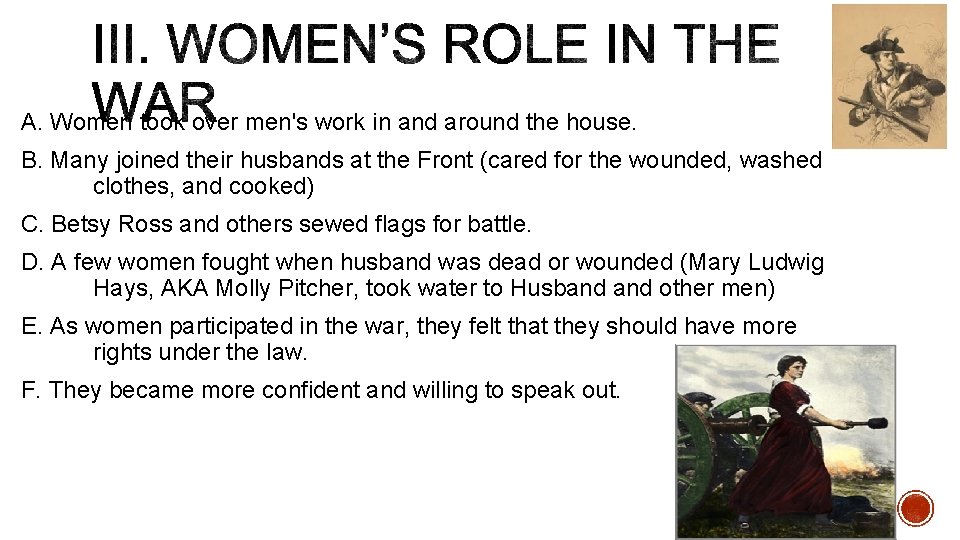
A. Women took over men's work in and around the house. B. Many joined their husbands at the Front (cared for the wounded, washed clothes, and cooked) C. Betsy Ross and others sewed flags for battle. D. A few women fought when husband was dead or wounded (Mary Ludwig Hays, AKA Molly Pitcher, took water to Husband other men) E. As women participated in the war, they felt that they should have more rights under the law. F. They became more confident and willing to speak out.
A. 1776 -500, 000 African Americans lived in the colonies. B. Continental Congress refused to allow them to join the army. C. British offered enslaved black men freedom if they fought for them. Washington was afraid that this would increase size of British army. D. He asked Congress to allow FREE African Americans to fight. E. 5, 000 black men from all colonies served, Exception was South Carolina F. 2, 000 served in navy- the navy allowed black men to join from the start.
1. Several thousand black men joined the British side by the end of the war so that they could be free men. 2. Black Patriots hoped the end of war would bring an end to slavery. - Cited the Declaration of Independence for saying “ all men are created equal” -Some white leaders wanted the same. 3. James Otis said “colonists are by the law of nature free born, as indeed all men are, white or black. ” Quakers spoke out against slavery 4. By 1770 s, slavery was declining in the North. During the war many colonies wanted to make slavery illegal. (Massachusetts, New Hampshire, and Pennsylvania)
A. As war spread west, both sides tried to win support of the Indian tribes. British were more successful by convincing the Indians that a Patriot win would mean more white settlers coming into their territory. B. In the South, the British were supported by several Indian tribes (Cherokee, Creek, Choctaw and Chickasaw) C. The British encouraged them to attack settlements to the North and South.
A. The south became main battleground in 1778. the new British commander knew many loyalists lived in the south. He hoped that if the British marched through they would join them. B. This worked at first but, things changed in Carolina. Loyalists and Patriots conducted raids against one another. They destroyed property, land killed civilians and tortured prisoners. -Many settlers began to side with the Patriots C. January 1781 - General Morgan won an important victory at Cowpens, SC. He used a new technique 1. Organized his men into two lines. 2. First line would fire twice then retreat 3. British thinking that the Patriots were running away would run right into the second line of fire (victory) D. Morgan and General Green Combined their armies to fight General Cornwallis at Guilford Courthouse. Bloody battle-Americans retreated but British lost a large number of men swamp Fox-Francis Marion
A. Benedict Arnold’s betrayal 1. formerly one of America’s best generals now commanded British troops 2. captured and burned the capital of Richmond, VA and other colonial towns. 3. turned traitor in September 1780 while commanding West Point fort in New York 4. angry because he felt Washington had not given him the credit he was owed for his victories. He also was in need of money 5. Secretly agreed to turn over West Point to the British. This would give the British control in New York. 6. Plot was uncovered by a Patriot patrol, but , Arnold was able to escape and join the British
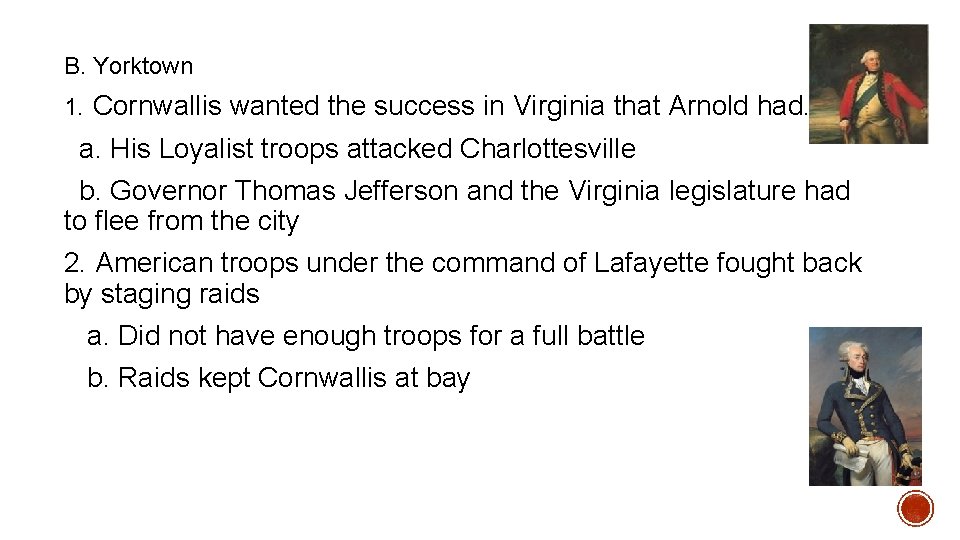
B. Yorktown 1. Cornwallis wanted the success in Virginia that Arnold had. a. His Loyalist troops attacked Charlottesville b. Governor Thomas Jefferson and the Virginia legislature had to flee from the city 2. American troops under the command of Lafayette fought back by staging raids a. Did not have enough troops for a full battle b. Raids kept Cornwallis at bay
3. Cornwallis did not agree with orders to send part of his troops to New York. Instead he Retreated to Yorktown peninsula confident that he could be supplied by sea 4. Washington saw an opportunity to trap Cornwallis in Yorktown a. American and French troops marched from New York to join Lafayette in Virginia b. French Navy cut off Cornwallis from supplies. He and his army had no escape by Land or sea
C. Victory At Yorktown 1. By the end of September 1781 - More than 16, 000 American and French troops laid siege on Cornwallis’ army of less than 8, 000 men. 2. Cornwallis held out for a few weeks. With Casualties mounting and food and all supplies running low, General Cornwallis realized it was hopeless 3. Cornwallis surrendered on October 19, 1781
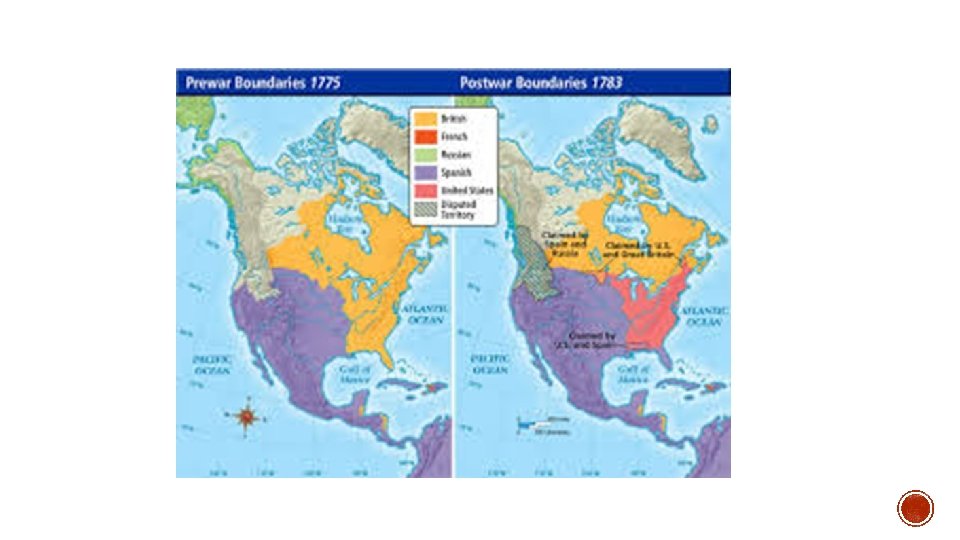
1. Talks for peace started in Paris in 1782 2. Continental Congress sent 4 men to work out the treaty. (Ben Franklin, John Jay, John Adams and Henry Laurens) 3. Treaty of Paris made Britain recognize the United States as an independent nation. a. b. c. 1. Borders were from the 13 colonies to the Mississippi River and north to Great Lakes and south to Florida. 2. Florida was given back to Spain 3. Americans agreed to ask State legislatures to pay Loyalists for lost property (most states ignored) 4. April 15, 1783 the treaty Was approved.
A. Geography played an important role 1. British had to ship all supplies over sea 2. Patriots were spread out in a wide area 3. Americans were familiar with area B. Foreign Help (French and Spanish) C. Growing American Patriotism