
Winfried Weissenhorn IBS Grenoble HIV envelope proteins EHVA
Winfried Weissenhorn, IBS Grenoble HIV envelope proteins EHVA Satellite Meeting, IAS 2017 Conference Non-ARV Based Interventions to Combat HIV/AIDS: New Insights and Initiatives July 23 rd 2017, Paris This project has received funding from the European Union’s horizon 2020 research and innovation programme under grant agreement No 681032 and No 681137 1
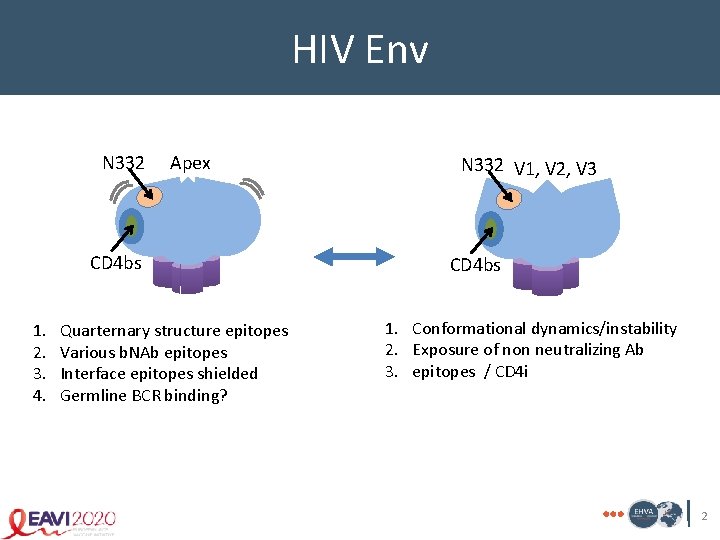
HIV Env N 332 Apex CD 4 bs 1. 2. 3. 4. Quarternary structure epitopes Various b. NAb epitopes Interface epitopes shielded Germline BCR binding? N 332 V 1, V 2, V 3 CD 4 bs 1. Conformational dynamics/instability 2. Exposure of non neutralizing Ab 3. epitopes / CD 4 i 2
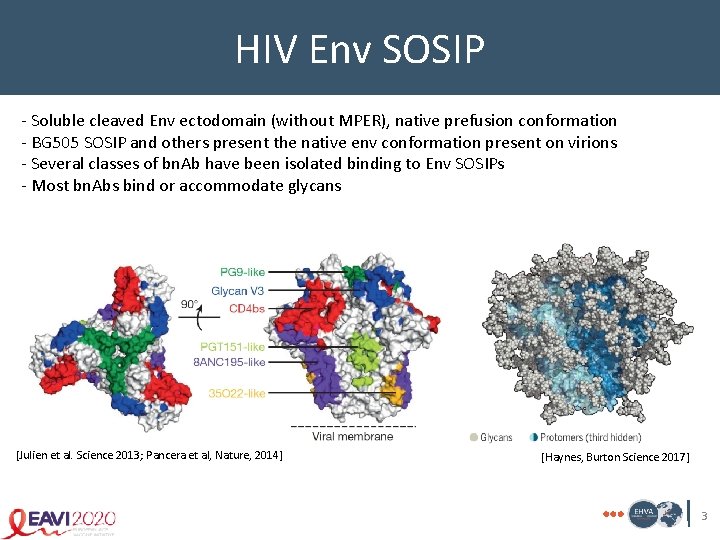
HIV Env SOSIP - Soluble cleaved Env ectodomain (without MPER), native prefusion conformation - BG 505 SOSIP and others present the native env conformation present on virions - Several classes of bn. Ab have been isolated binding to Env SOSIPs - Most bn. Abs bind or accommodate glycans [Julien et al. Science 2013; Pancera et al, Nature, 2014] [Haynes, Burton Science 2017] 3
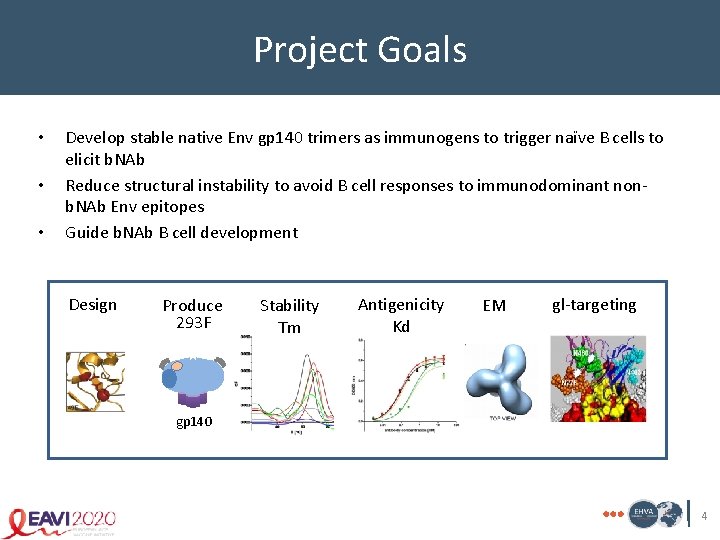
Project Goals • • • Develop stable native Env gp 140 trimers as immunogens to trigger naïve B cells to elicit b. NAb Reduce structural instability to avoid B cell responses to immunodominant nonb. NAb Env epitopes Guide b. NAb B cell development Design Produce 293 F Stability Tm Antigenicity Kd EM gl-targeting gp 140 4
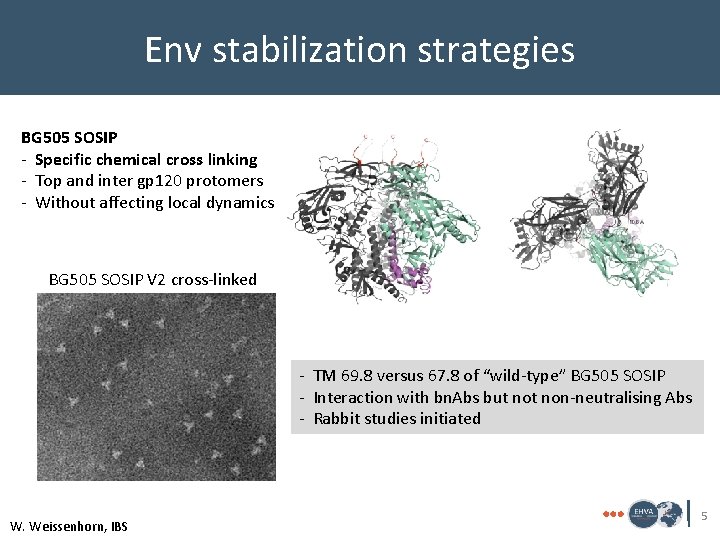
Env stabilization strategies BG 505 SOSIP - Specific chemical cross linking - Top and inter gp 120 protomers - Without affecting local dynamics BG 505 SOSIP V 2 cross-linked - TM 69. 8 versus 67. 8 of “wild-type” BG 505 SOSIP - Interaction with bn. Abs but non-neutralising Abs - Rabbit studies initiated W. Weissenhorn, IBS 5
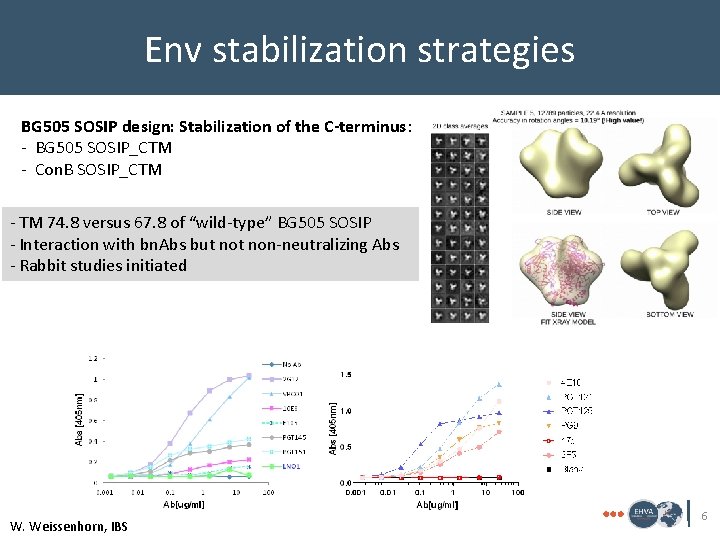
Env stabilization strategies BG 505 SOSIP design: Stabilization of the C-terminus: - BG 505 SOSIP_CTM - Con. B SOSIP_CTM - TM 74. 8 versus 67. 8 of “wild-type” BG 505 SOSIP - Interaction with bn. Abs but non-neutralizing Abs - Rabbit studies initiated W. Weissenhorn, IBS 6
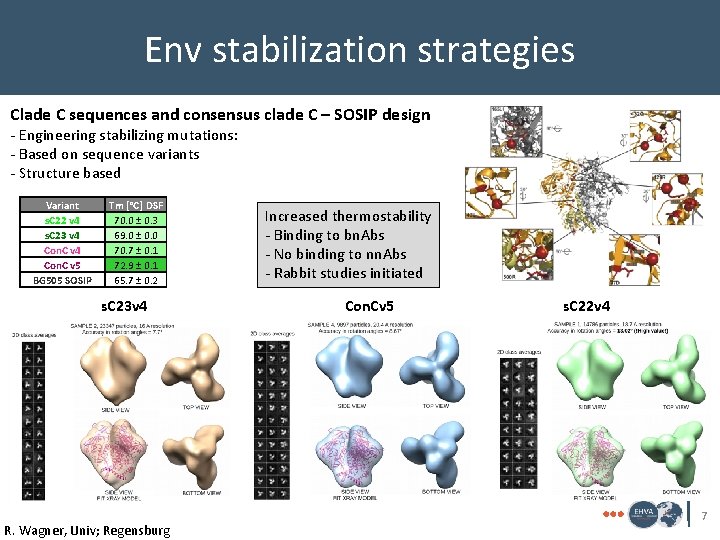
Env stabilization strategies Clade C sequences and consensus clade C – SOSIP design - Engineering stabilizing mutations: - Based on sequence variants - Structure based Variant s. C 22 v 4 s. C 23 v 4 Con. C v 5 BG 505 SOSIP Tm [°C] DSF Tm [°C] DSC 70. 0 ± 0. 3 n. d. 69. 0 ± 0. 0 71. 1 70. 7 ± 0. 1 71. 7 72. 9 ± 0. 1 75. 1 65. 7 ± 0. 2 67. 6 s. C 23 v 4 R. Wagner, Univ; Regensburg Increased thermostability - Binding to bn. Abs - No binding to nn. Abs - Rabbit studies initiated Con. Cv 5 s. C 22 v 4 7
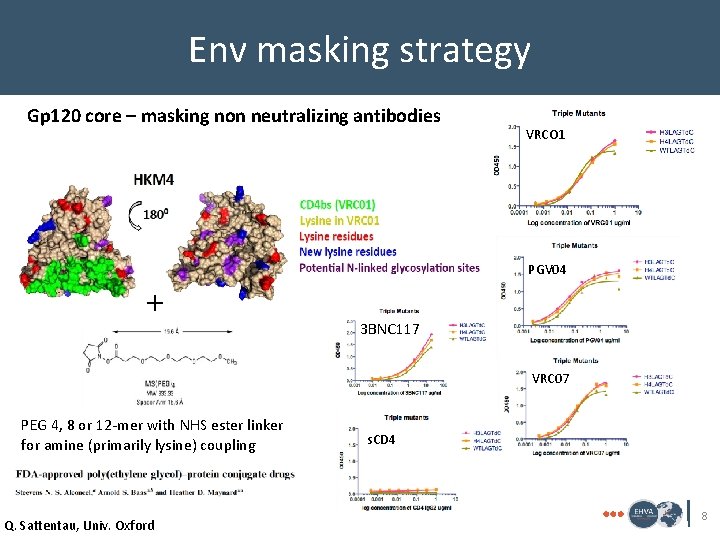
Env masking strategy Gp 120 core – masking non neutralizing antibodies VRCO 1 PGV 04 + 3 BNC 117 VRC 07 PEG 4, 8 or 12 -mer with NHS ester linker for amine (primarily lysine) coupling Q. Sattentau, Univ. Oxford s. CD 4 8
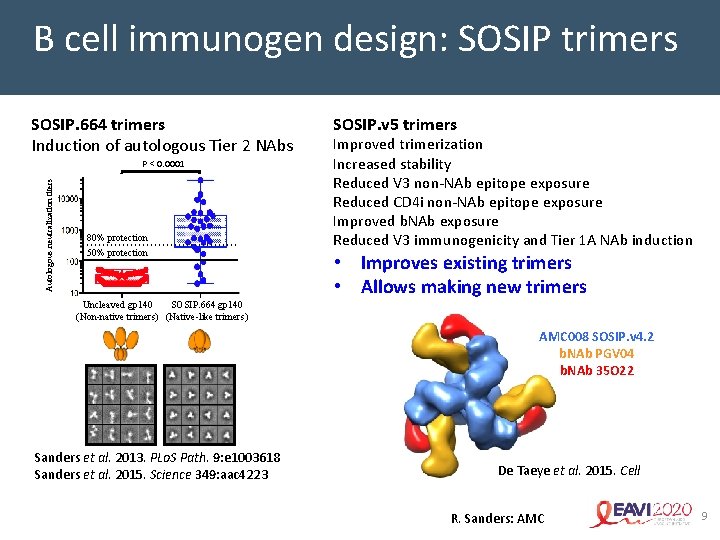
B cell immunogen design: SOSIP trimers SOSIP. 664 trimers Induction of autologous Tier 2 NAbs Autologous neutralization titers P < 0. 0001 80% protection 50% protection SOSIP. v 5 trimers Improved trimerization Increased stability Reduced V 3 non-NAb epitope exposure Reduced CD 4 i non-NAb epitope exposure Improved b. NAb exposure Reduced V 3 immunogenicity and Tier 1 A NAb induction • Improves existing trimers • Allows making new trimers Uncleaved gp 140 SOSIP. 664 gp 140 (Non-native trimers) (Native-like trimers) AMC 008 SOSIP. v 4. 2 b. NAb PGV 04 b. NAb 35 O 22 Sanders et al. 2013. PLo. S Path. 9: e 1003618 Sanders et al. 2015. Science 349: aac 4223 De Taeye et al. 2015. Cell R. Sanders: AMC 9
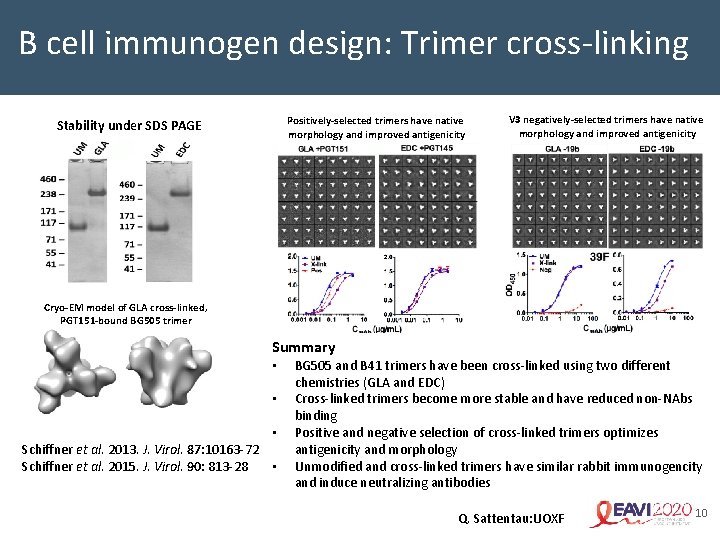
B cell immunogen design: Trimer cross-linking Positively-selected trimers have native morphology and improved antigenicity Stability under SDS PAGE V 3 negatively-selected trimers have native morphology and improved antigenicity Cryo-EM model of GLA cross-linked, PGT 151 -bound BG 505 trimer Summary • • • Schiffner et al. 2013. J. Virol. 87: 10163 -72 • Schiffner et al. 2015. J. Virol. 90: 813 -28 BG 505 and B 41 trimers have been cross-linked using two different chemistries (GLA and EDC) Cross-linked trimers become more stable and have reduced non-NAbs binding Positive and negative selection of cross-linked trimers optimizes antigenicity and morphology Unmodified and cross-linked trimers have similar rabbit immunogencity and induce neutralizing antibodies Q. Sattentau: UOXF 10
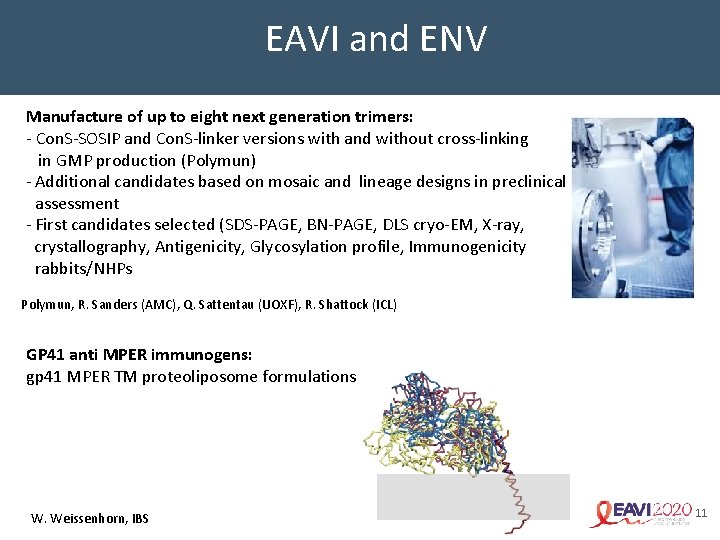
EAVI and ENV Manufacture of up to eight next generation trimers: - Con. S-SOSIP and Con. S-linker versions with and without cross-linking in GMP production (Polymun) - Additional candidates based on mosaic and lineage designs in preclinical assessment - First candidates selected (SDS-PAGE, BN-PAGE, DLS cryo-EM, X-ray, crystallography, Antigenicity, Glycosylation profile, Immunogenicity rabbits/NHPs Polymun, R. Sanders (AMC), Q. Sattentau (UOXF), R. Shattock (ICL) GP 41 anti MPER immunogens: gp 41 MPER TM proteoliposome formulations W. Weissenhorn, IBS 11
Challenges - Improving Env stability that the “top” can no longer “open” - Still retaining sufficient conformational flexibility - Stability in the vaccine formulation - What are the preferred structures/conformations of Env required to induce bn. Abs? - What are the preferred sequences of env immunogens to induce bn. Abs? - Which Env can efficiently engage germline BCRs - How is the induction of bn. Abs regulated compared to easily induced non-neutralizing Abs? bn. Ab generation requires extensive virus Env diversification high somatic hypermutation poor immunogenicity of glycans/diversity of glycans bn. Abs autoreactivity or polyreactivity immune tolerance control may reduce the pool of reactive B cells 12
Acknowledgment Coordinators: Y. Levy, INSERM G. Pantaleo, CHUV Lausanne ENV design: Q. Sattentau, Univ. of Oxford R. Wagner, Univ of Regensburg W. Weissenhorn, IBS , CEA-CNRS-UGA This project has received funding from the European Union’s horizon 2020 research and innovation programme under grant agreement No 681032 as well as funding from the Swiss government (through the State Secretariat for Education, Research and Innovation, SERI) under grant agreement No. 15. 0337. The opinions expressed and arguments employed herein do not necessarily reflect the official views of the Swiss Government. Coordinator: R. Shattock, Imperial College Env design: R. Sanders, Univ. Amsterdam R. Shattock, Imperial College Q. Sattentau, Univ. of Oxford W. Weissenhorn, IBS, CEA-CNRS-UGA This project has received funding from the European Union’s horizon 2020 research and innovation programme under grant agreement No and No 681137 13
Acknowledgment Antibodies Dennis R Burton Barton F Haynes Michel C. Nussenzweig Mark Connors John R Mascola James Robinson Antonio Lanzavecchia Polymun 14
- Slides: 14