
Windows NT History Design Principles System Components Environmental

- Slides: 29
Windows NT � History � Design Principles � System Components � Environmental Subsystems � Programmer Interface Operating System Concepts 23. 1 Silberschatz and Galvin 1999
Windows NT � 32 -bit preemptive multitasking operating system for modern microprocessors. � Key goals for the system: � portability � security � POSIX compliance � multiprocessor support � extensibility � international support � compatibility with MS-DOS and MS-Windows applications. � Uses a micro-kernel architecture. � Available in two versions, Windows NT Workstation and Windows NT Server. Operating System Concepts 23. 2 Silberschatz and Galvin 1999
History � In 1988, Microsoft decided to develop a “new technology” (NT) portable operating system that supported both the OS/2 and POSIX APIs. � Originally, NT was supposed to use the OS/2 API as its native environment but during development NT was changed t use the Win 32 API, reflecting the popularity of Windows 3. 0. Operating System Concepts 23. 3 Silberschatz and Galvin 1999
Design Principles � Extensibility — layered architecture. � NT executive, which runs in protected mode, provides the basic system services. � On top of the executive, several server subsystems operate in user mode. � Modular structure allows additional environmental subsystems to be added without affecting the executive. � Portability — NT can be moved from on hardware architecture to another with relatively few changes. � Written in C and C++. � Processor-dependent code is isolated in a dynamic link library (DLL) called the “hardware abstraction layer” (HAL). Operating System Concepts 23. 4 Silberschatz and Galvin 1999
Design Principles (Cont. ) � Reliability — NT uses hardware protection for virtual memory, and software protection mechanisms for operating system resources. � Compatibility — applications that follow the IEEE 1003. 1 (POSIX) standard can be complied to run on NT without changing the source code. � Performance — NT subsystems can communicate with one another via high-performance message passing. � Preemption of low priority threads enables the system to respond quickly to external events. � Designed for symmetrical multiprocessing. � International support — supports different locales via the national language support (NLS) API. Operating System Concepts 23. 5 Silberschatz and Galvin 1999
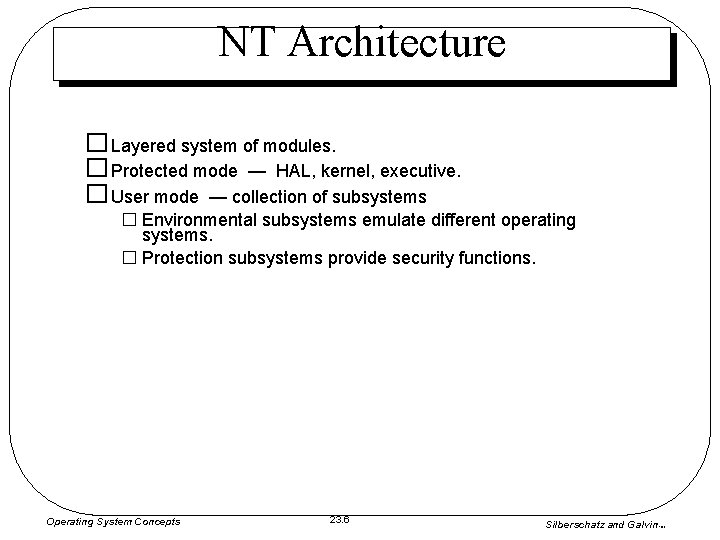
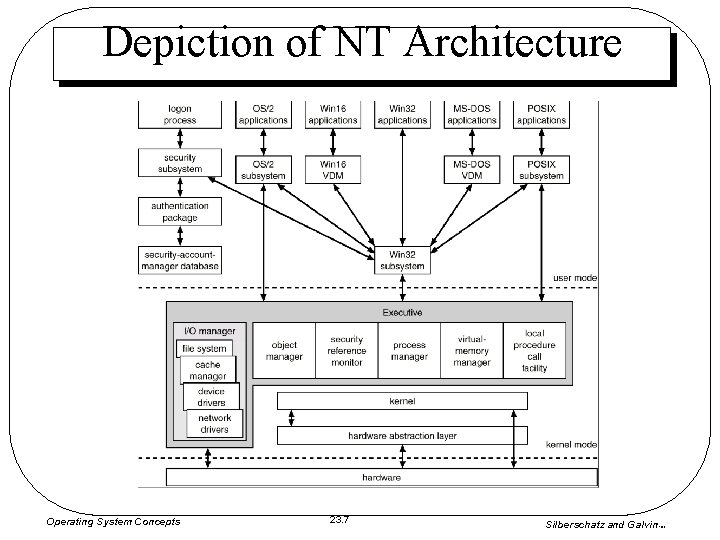
NT Architecture � Layered system of modules. � Protected mode — HAL, kernel, executive. � User mode — collection of subsystems � Environmental subsystems emulate different operating systems. � Protection subsystems provide security functions. Operating System Concepts 23. 6 Silberschatz and Galvin 1999
Depiction of NT Architecture Operating System Concepts 23. 7 Silberschatz and Galvin 1999
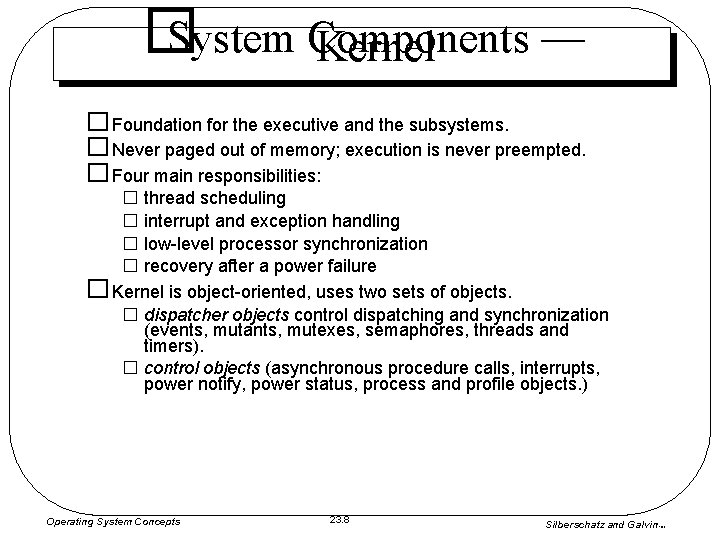
� System Components — Kernel � Foundation for the executive and the subsystems. � Never paged out of memory; execution is never preempted. � Four main responsibilities: � thread scheduling � interrupt and exception handling � low-level processor synchronization � recovery after a power failure � Kernel is object-oriented, uses two sets of objects. � dispatcher objects control dispatching and synchronization (events, mutants, mutexes, semaphores, threads and timers). � control objects (asynchronous procedure calls, interrupts, power notify, power status, process and profile objects. ) Operating System Concepts 23. 8 Silberschatz and Galvin 1999
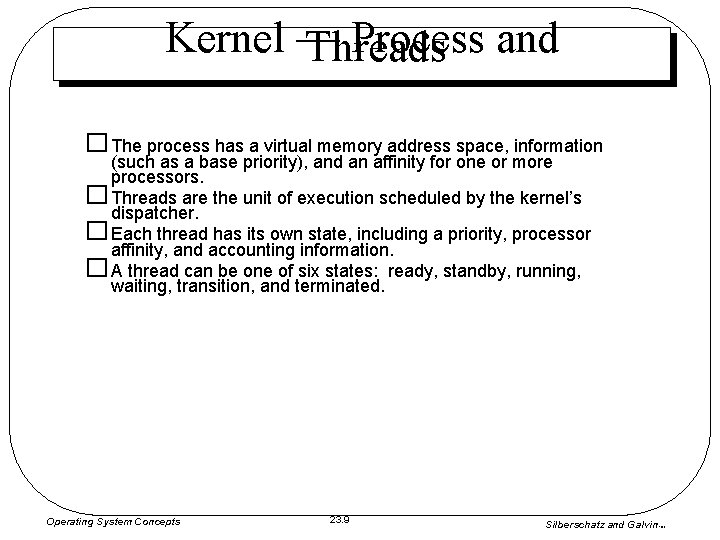
Kernel — Process and Threads � The process has a virtual memory address space, information (such as a base priority), and an affinity for one or more processors. � Threads are the unit of execution scheduled by the kernel’s dispatcher. � Each thread has its own state, including a priority, processor affinity, and accounting information. � A thread can be one of six states: ready, standby, running, waiting, transition, and terminated. Operating System Concepts 23. 9 Silberschatz and Galvin 1999
Kernel — Trap Handling � The kernel provides trap handling when exceptions and interrupts are generated by hardware of software. � Exceptions that cannot be handled by the trap handler are handled by the kernel's exception dispatcher. � The interrupt dispatcher in the kernel handles interrupts by calling either an interrupt service routine (such as in a device driver) or an internal kernel routine. � The kernel uses spin locks that reside in global memory to achieve multiprocessor mutual exclusion. Operating System Concepts 23. 10 Silberschatz and Galvin 1999
Executive — Object Manager � NT uses objects for all its services and entities; the object manger supervises the use of all the objects. � Generates an object handle � Checks security. � Keeps track of which processes are using each object. � Objects are manipulated by a standard set of methods, namely create, open, close, delete, query name, parse and security. Operating System Concepts 23. 11 Silberschatz and Galvin 1999
Executive — Virtual Memory Manager � The design of the VM manager assumes that the underlying hardware supports virtual to physical mapping a paging mechanism, transparent cache coherence on multiprocessor systems, and virtual addressing aliasing. � The VM manager in NT uses a page-based management scheme with a page size of 4 KB. � The NT manager uses a two step process to allocate memory. � The first step reserves a portion of the process’s address space. � The second step commits the allocation by assigning space in the NT paging file. Operating System Concepts 23. 12 Silberschatz and Galvin 1999
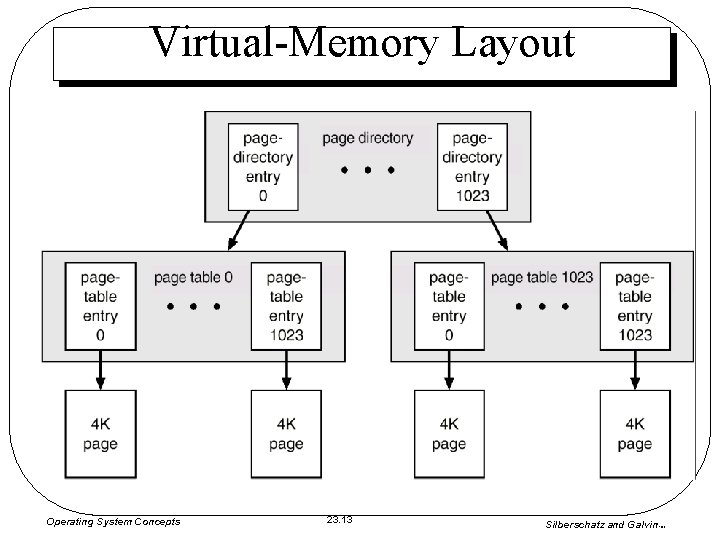
Virtual-Memory Layout Operating System Concepts 23. 13 Silberschatz and Galvin 1999
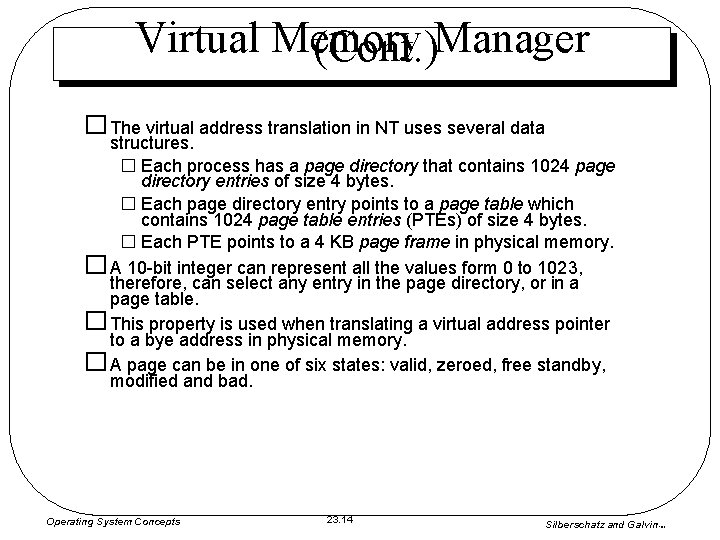
Virtual Memory (Cont. )Manager � The virtual address translation in NT uses several data structures. � Each process has a page directory that contains 1024 page directory entries of size 4 bytes. � Each page directory entry points to a page table which contains 1024 page table entries (PTEs) of size 4 bytes. � Each PTE points to a 4 KB page frame in physical memory. � A 10 -bit integer can represent all the values form 0 to 1023, therefore, can select any entry in the page directory, or in a page table. � This property is used when translating a virtual address pointer to a bye address in physical memory. � A page can be in one of six states: valid, zeroed, free standby, modified and bad. Operating System Concepts 23. 14 Silberschatz and Galvin 1999
Executive — Process Manager � Provides services for creating, deleting, and using threads and processes. � Issues such as parent/child relationships or process hierarchies are left to the particular environmental subsystem that owns the process. Operating System Concepts 23. 15 Silberschatz and Galvin 1999
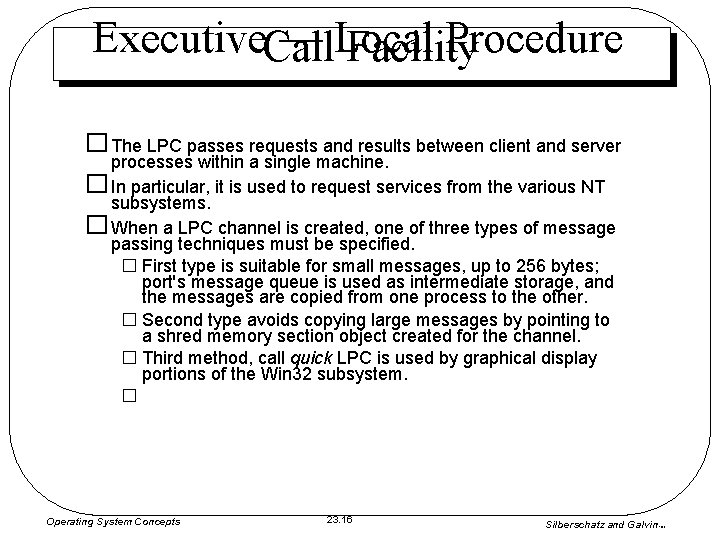
Executive. Call — Local Procedure Facility � The LPC passes requests and results between client and server processes within a single machine. � In particular, it is used to request services from the various NT subsystems. � When a LPC channel is created, one of three types of message passing techniques must be specified. � First type is suitable for small messages, up to 256 bytes; port's message queue is used as intermediate storage, and the messages are copied from one process to the other. � Second type avoids copying large messages by pointing to a shred memory section object created for the channel. � Third method, call quick LPC is used by graphical display portions of the Win 32 subsystem. � Operating System Concepts 23. 16 Silberschatz and Galvin 1999
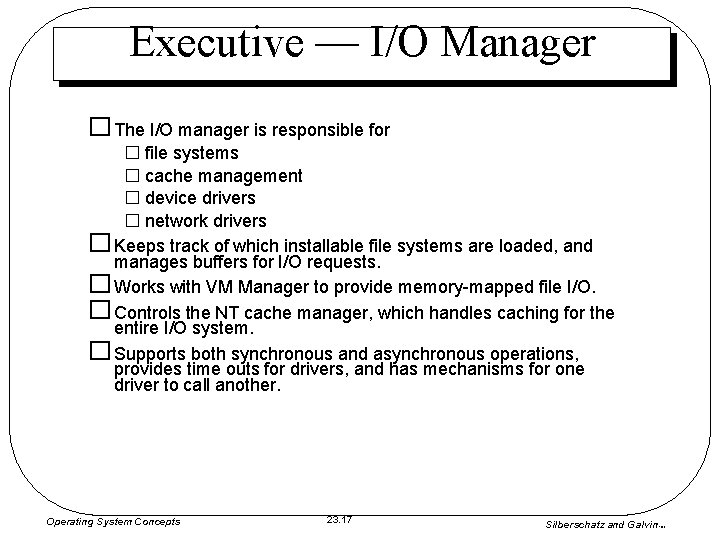
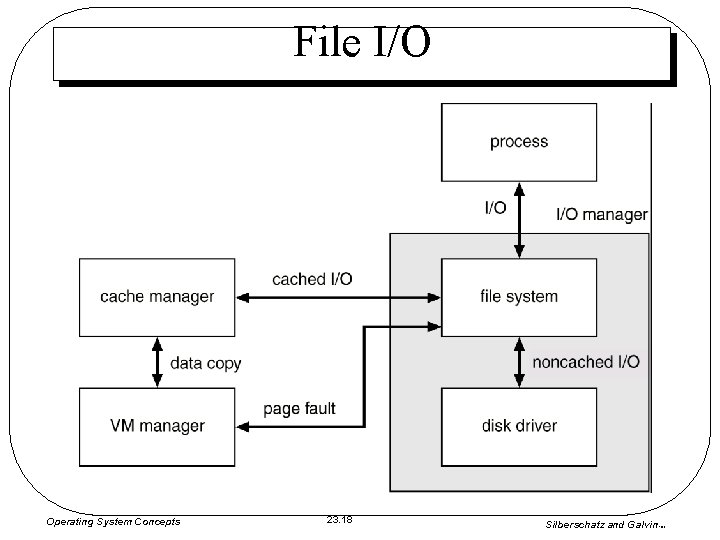
Executive — I/O Manager � The I/O manager is responsible for � file systems � cache management � device drivers � network drivers � Keeps track of which installable file systems are loaded, and manages buffers for I/O requests. � Works with VM Manager to provide memory-mapped file I/O. � Controls the NT cache manager, which handles caching for the entire I/O system. � Supports both synchronous and asynchronous operations, provides time outs for drivers, and has mechanisms for one driver to call another. Operating System Concepts 23. 17 Silberschatz and Galvin 1999
File I/O Operating System Concepts 23. 18 Silberschatz and Galvin 1999
Executive —Manager Security Reference � The object-oriented nature of NT enables the use of a uniform mechanism to perform runtime access validation and audit checks for every entity in the system. � Whenever a process opens a handle to an object, the security reference monitor checks the process’s security token and the object’s access control list to see whether the process has the necessary rights. Operating System Concepts 23. 19 Silberschatz and Galvin 1999
Environmental Subsystems � User-mode processes layered over the native NT executive services to enable NT to run programs developed for other operating system. � NT uses the Win 32 subsystem as the main operating environment; Win 32 is used to start all processes. It also provides all the keyboard, mouse and graphical display capabilities. � MS-DOS environment is provided by a Win 32 application called the virtual dos machine (VDM), a user-mode process that is paged and dispatched like any other NT thread. Operating System Concepts 23. 20 Silberschatz and Galvin 1999
Environmental Subsystems (Cont. ) � 16 -Bit Windows Environment: � Provided by a VDM that incorporates Windows on Windows. � Provides the Windows 3. 1 kernel routines and sub routines for window manager and GDI functions. � The POSIX subsystem is designed to run POSIX applications following the POSIX. 1 standard which is based on the UNIX model. Operating System Concepts 23. 21 Silberschatz and Galvin 1999
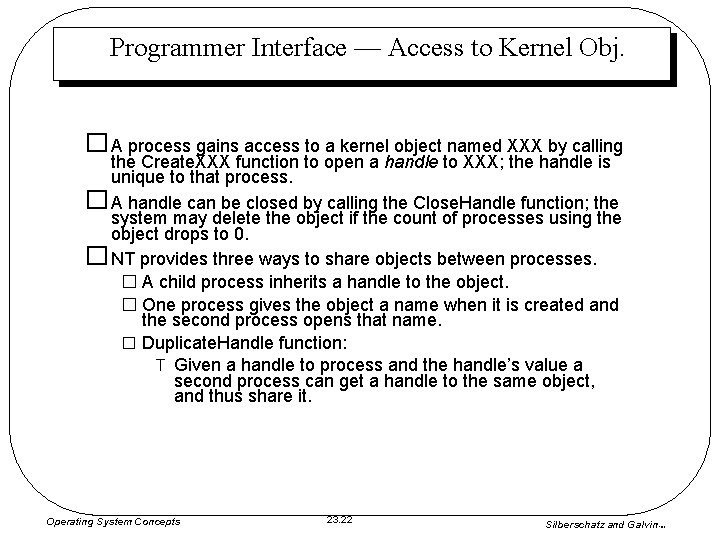
Programmer Interface — Access to Kernel Obj. � A process gains access to a kernel object named XXX by calling the Create. XXX function to open a handle to XXX; the handle is unique to that process. � A handle can be closed by calling the Close. Handle function; the system may delete the object if the count of processes using the object drops to 0. � NT provides three ways to share objects between processes. � A child process inherits a handle to the object. � One process gives the object a name when it is created and the second process opens that name. � Duplicate. Handle function: T Given a handle to process and the handle’s value a second process can get a handle to the same object, and thus share it. Operating System Concepts 23. 22 Silberschatz and Galvin 1999
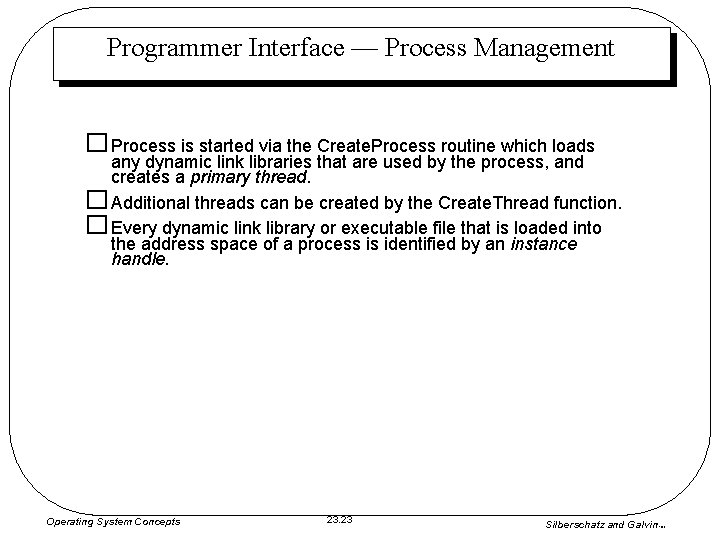
Programmer Interface — Process Management � Process is started via the Create. Process routine which loads any dynamic link libraries that are used by the process, and creates a primary thread. � Additional threads can be created by the Create. Thread function. � Every dynamic link library or executable file that is loaded into the address space of a process is identified by an instance handle. Operating System Concepts 23. 23 Silberschatz and Galvin 1999
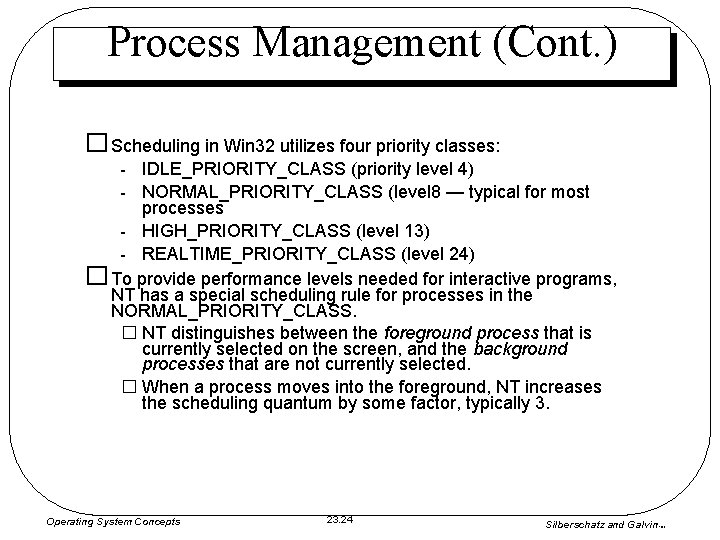
Process Management (Cont. ) � Scheduling in Win 32 utilizes four priority classes: - IDLE_PRIORITY_CLASS (priority level 4) - NORMAL_PRIORITY_CLASS (level 8 — typical for most processes - HIGH_PRIORITY_CLASS (level 13) - REALTIME_PRIORITY_CLASS (level 24) � To provide performance levels needed for interactive programs, NT has a special scheduling rule for processes in the NORMAL_PRIORITY_CLASS. � NT distinguishes between the foreground process that is currently selected on the screen, and the background processes that are not currently selected. � When a process moves into the foreground, NT increases the scheduling quantum by some factor, typically 3. Operating System Concepts 23. 24 Silberschatz and Galvin 1999
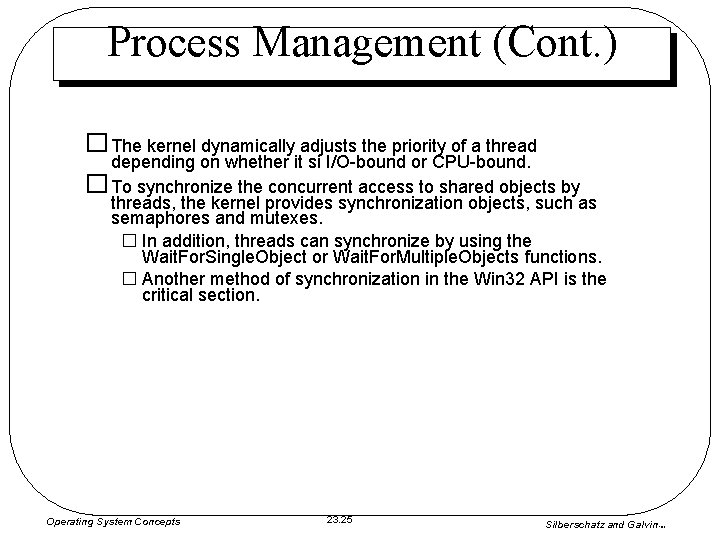
Process Management (Cont. ) � The kernel dynamically adjusts the priority of a thread depending on whether it si I/O-bound or CPU-bound. � To synchronize the concurrent access to shared objects by threads, the kernel provides synchronization objects, such as semaphores and mutexes. � In addition, threads can synchronize by using the Wait. For. Single. Object or Wait. For. Multiple. Objects functions. � Another method of synchronization in the Win 32 API is the critical section. Operating System Concepts 23. 25 Silberschatz and Galvin 1999
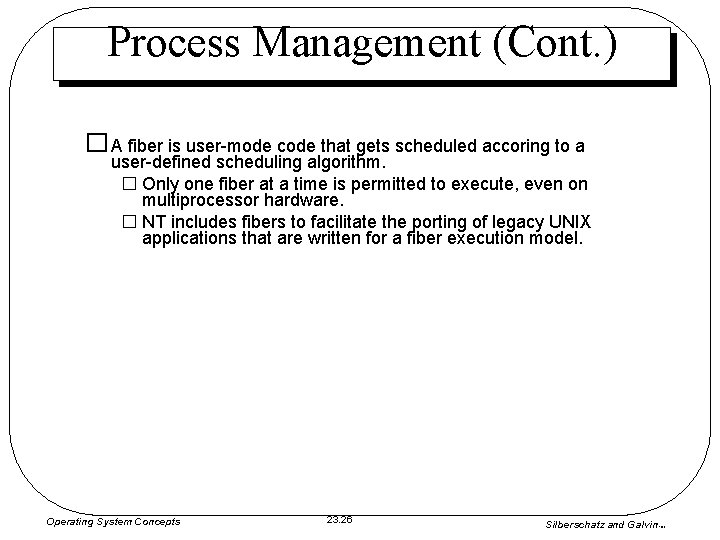
Process Management (Cont. ) � A fiber is user-mode code that gets scheduled accoring to a user-defined scheduling algorithm. � Only one fiber at a time is permitted to execute, even on multiprocessor hardware. � NT includes fibers to facilitate the porting of legacy UNIX applications that are written for a fiber execution model. Operating System Concepts 23. 26 Silberschatz and Galvin 1999
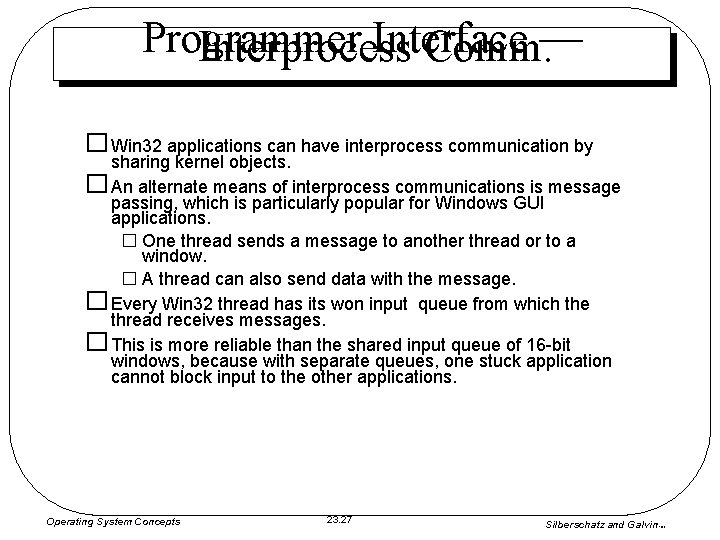
Programmer Interface Interprocess Comm. — � Win 32 applications can have interprocess communication by sharing kernel objects. � An alternate means of interprocess communications is message passing, which is particularly popular for Windows GUI applications. � One thread sends a message to another thread or to a window. � A thread can also send data with the message. � Every Win 32 thread has its won input queue from which the thread receives messages. � This is more reliable than the shared input queue of 16 -bit windows, because with separate queues, one stuck application cannot block input to the other applications. Operating System Concepts 23. 27 Silberschatz and Galvin 1999
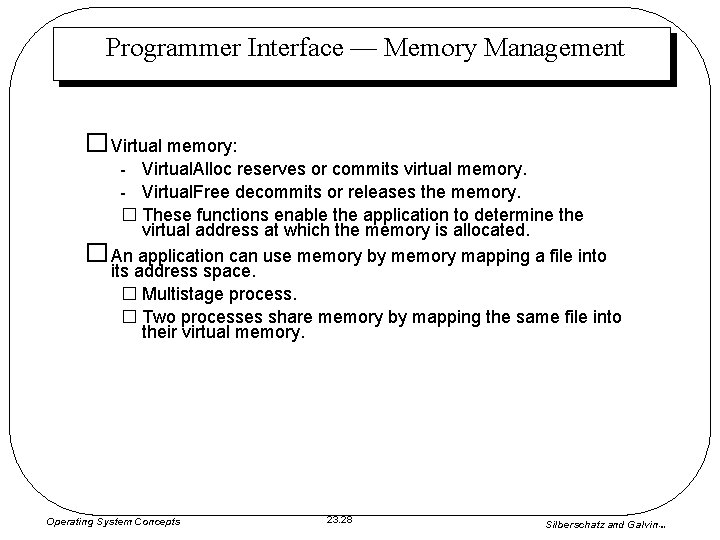
Programmer Interface — Memory Management � Virtual memory: - Virtual. Alloc reserves or commits virtual memory. - Virtual. Free decommits or releases the memory. � These functions enable the application to determine the virtual address at which the memory is allocated. � An application can use memory by memory mapping a file into its address space. � Multistage process. � Two processes share memory by mapping the same file into their virtual memory. Operating System Concepts 23. 28 Silberschatz and Galvin 1999
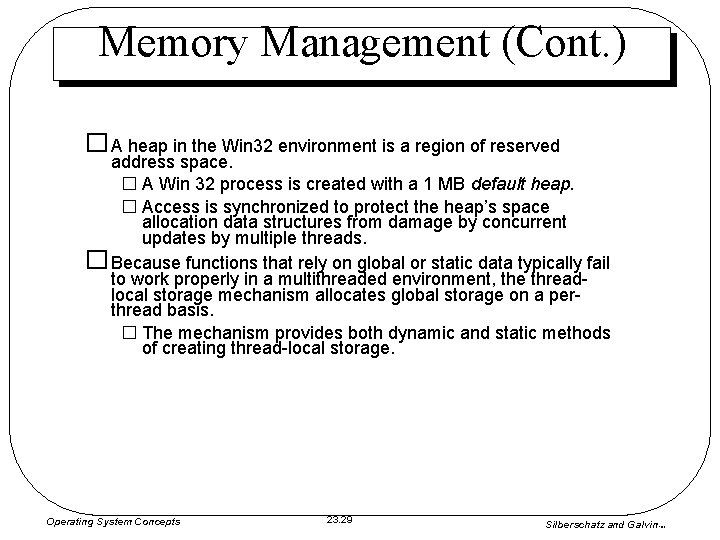
Memory Management (Cont. ) � A heap in the Win 32 environment is a region of reserved address space. � A Win 32 process is created with a 1 MB default heap. � Access is synchronized to protect the heap’s space allocation data structures from damage by concurrent updates by multiple threads. � Because functions that rely on global or static data typically fail to work properly in a multithreaded environment, the threadlocal storage mechanism allocates global storage on a perthread basis. � The mechanism provides both dynamic and static methods of creating thread-local storage. Operating System Concepts 23. 29 Silberschatz and Galvin 1999