
Window Communication Foundation Jim Fawcett CSE 775 Distributed
Window Communication Foundation Jim Fawcett CSE 775 – Distributed Objects Spring 2009
Primary References • Inside Windows Communication Foundation, Justin Smith, Microsoft Press, 2007 • Programming WCF Services, Juval Lowy, O’Reilly, 2009 • Windows Communication Foundation Unleashed, Mc. Murtry, Mercuri, Watling, Winkler, SAMS, 2007 • Pro WCF, Peiris and Mulder, apress, 2007 • Root of MSDN documentation • MSDN WCF Architecture Overview • Self-signed certificates, finding keys, . . . Petar Vucetin blog 2
References • • MSDN WCF Root Page WCF Feature Details Distributed. NET Learn ABCs Of Programming WCF Service Station Serialization in Windows Communication Foundation Service Station WCF Messaging Fundamentals Windows Communication Foundation Glossary Windows Communication Foundation Tools Tutorials on WCF, WPF, and more 3
References – Web Model How to Create a Basic Web-Style Service WCF Web Programming Model Overview Web Programming Model WCF Web Programming Object Model WCF Syndication HTTP Programming with WCF and the. NET Framework 3. 5 • Creating WCF AJAX Services without ASP. NET • Creating WCF Services for ASP. NET AJAX • • •
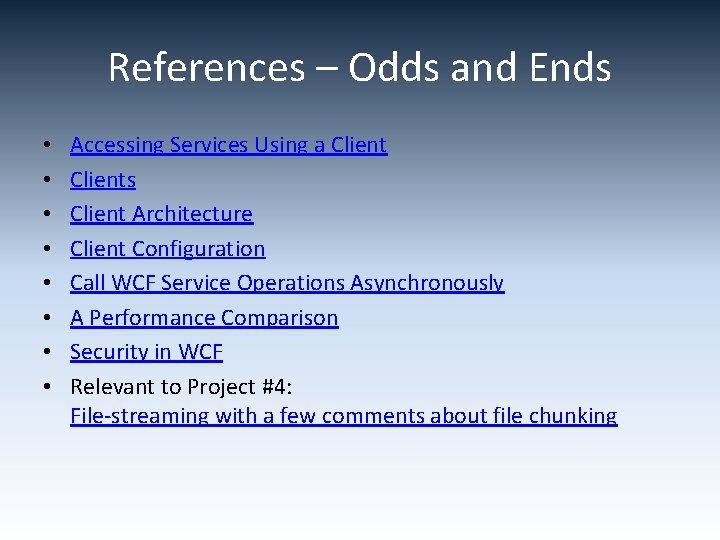
References – Odds and Ends • • Accessing Services Using a Clients Client Architecture Client Configuration Call WCF Service Operations Asynchronously A Performance Comparison Security in WCF Relevant to Project #4: File-streaming with a few comments about file chunking
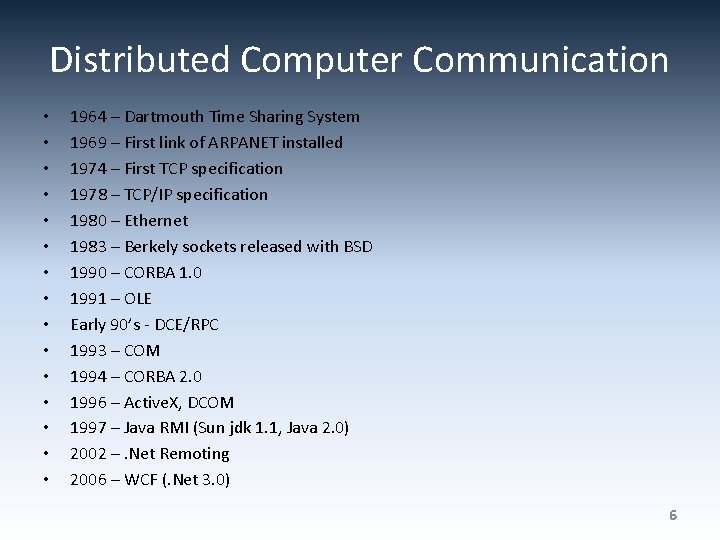
Distributed Computer Communication • • • • 1964 – Dartmouth Time Sharing System 1969 – First link of ARPANET installed 1974 – First TCP specification 1978 – TCP/IP specification 1980 – Ethernet 1983 – Berkely sockets released with BSD 1990 – CORBA 1. 0 1991 – OLE Early 90’s - DCE/RPC 1993 – COM 1994 – CORBA 2. 0 1996 – Active. X, DCOM 1997 – Java RMI (Sun jdk 1. 1, Java 2. 0) 2002 –. Net Remoting 2006 – WCF (. Net 3. 0) 6
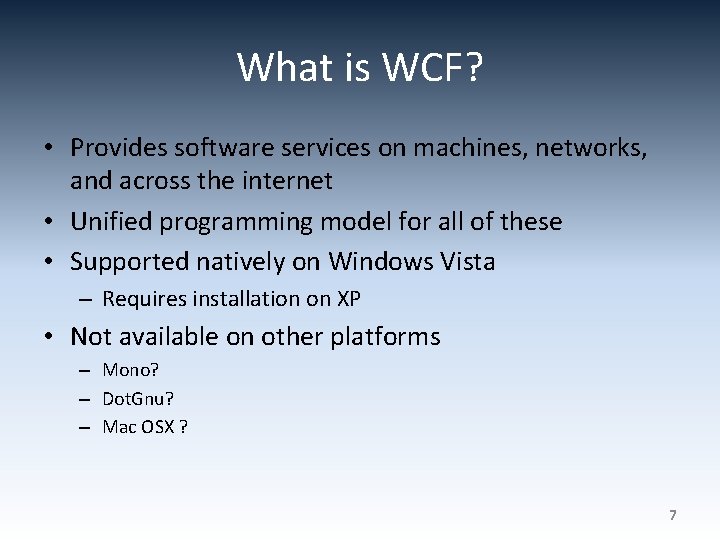
What is WCF? • Provides software services on machines, networks, and across the internet • Unified programming model for all of these • Supported natively on Windows Vista – Requires installation on XP • Not available on other platforms – Mono? – Dot. Gnu? – Mac OSX ? 7
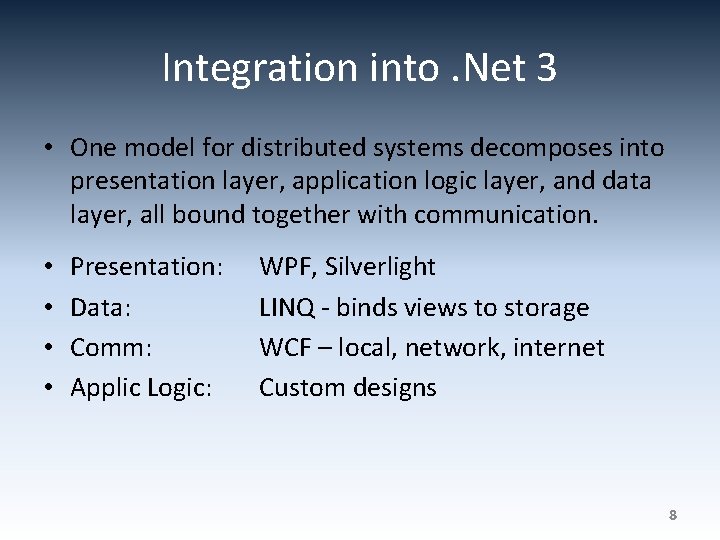
Integration into. Net 3 • One model for distributed systems decomposes into presentation layer, application logic layer, and data layer, all bound together with communication. • • Presentation: Data: Comm: Applic Logic: WPF, Silverlight LINQ - binds views to storage WCF – local, network, internet Custom designs 8
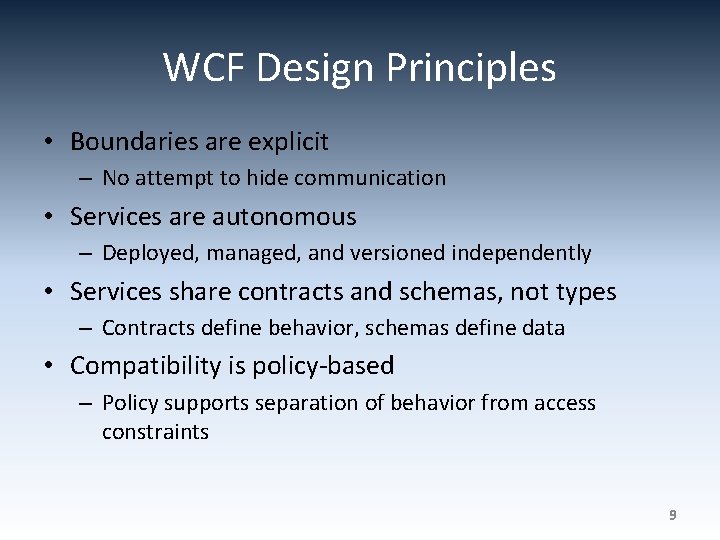
WCF Design Principles • Boundaries are explicit – No attempt to hide communication • Services are autonomous – Deployed, managed, and versioned independently • Services share contracts and schemas, not types – Contracts define behavior, schemas define data • Compatibility is policy-based – Policy supports separation of behavior from access constraints 9
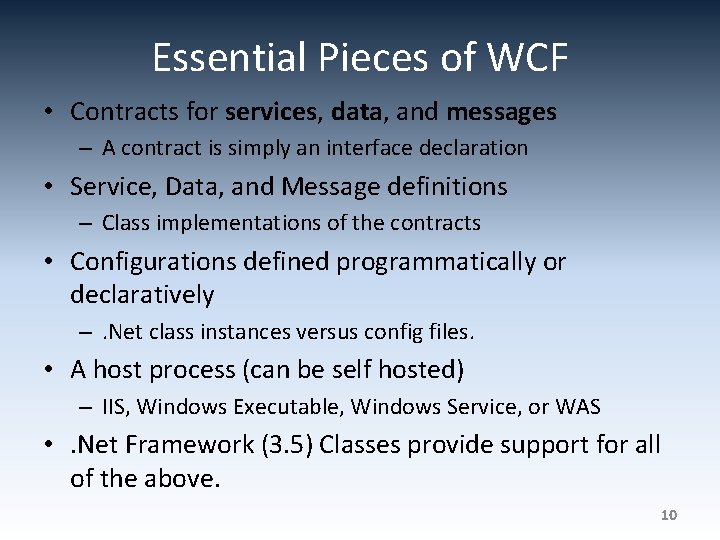
Essential Pieces of WCF • Contracts for services, data, and messages – A contract is simply an interface declaration • Service, Data, and Message definitions – Class implementations of the contracts • Configurations defined programmatically or declaratively –. Net class instances versus config files. • A host process (can be self hosted) – IIS, Windows Executable, Windows Service, or WAS • . Net Framework (3. 5) Classes provide support for all of the above. 10
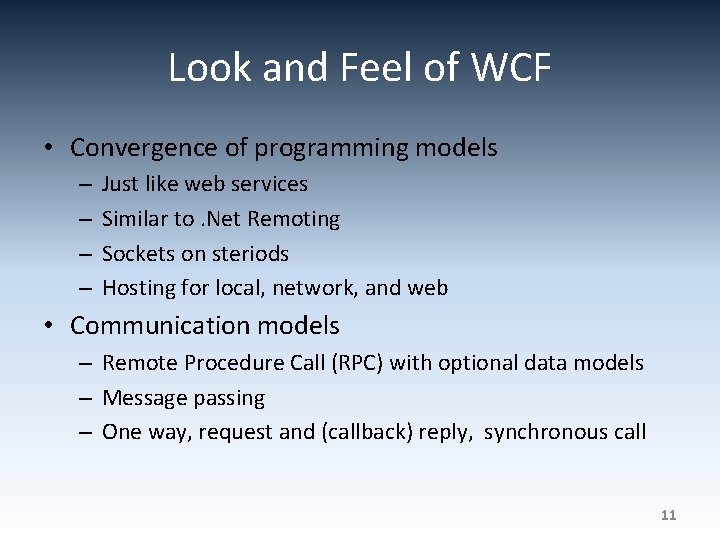
Look and Feel of WCF • Convergence of programming models – – Just like web services Similar to. Net Remoting Sockets on steriods Hosting for local, network, and web • Communication models – Remote Procedure Call (RPC) with optional data models – Message passing – One way, request and (callback) reply, synchronous call 11
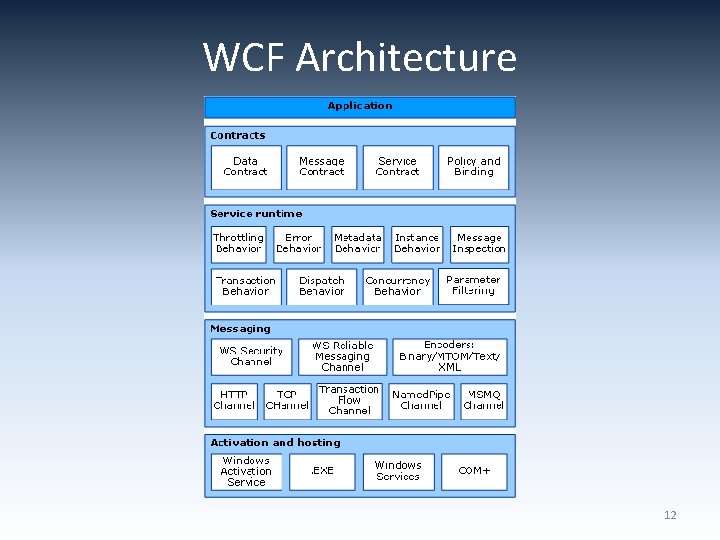
WCF Architecture 12
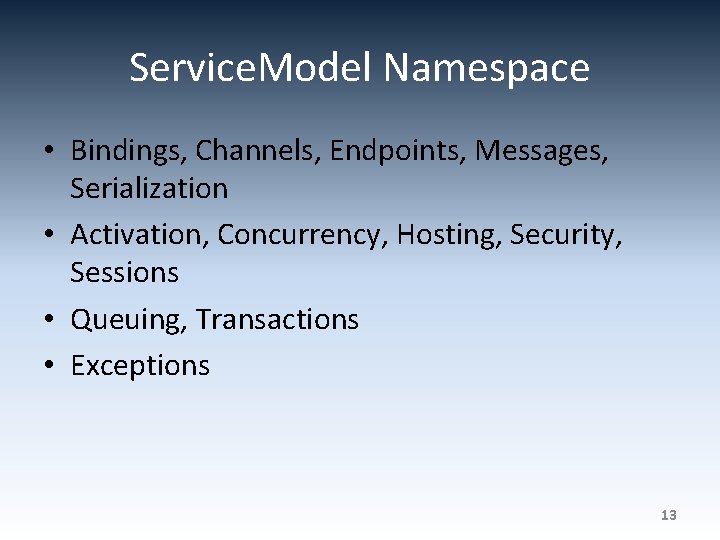
Service. Model Namespace • Bindings, Channels, Endpoints, Messages, Serialization • Activation, Concurrency, Hosting, Security, Sessions • Queuing, Transactions • Exceptions 13
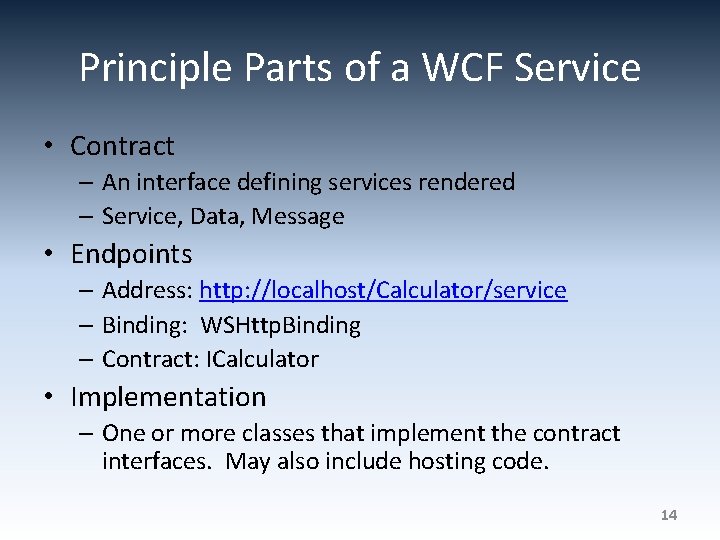
Principle Parts of a WCF Service • Contract – An interface defining services rendered – Service, Data, Message • Endpoints – Address: http: //localhost/Calculator/service – Binding: WSHttp. Binding – Contract: ICalculator • Implementation – One or more classes that implement the contract interfaces. May also include hosting code. 14
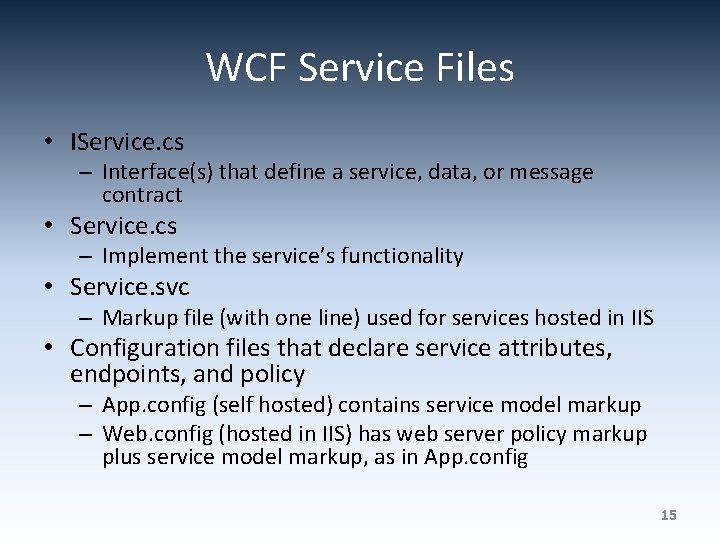
WCF Service Files • IService. cs – Interface(s) that define a service, data, or message contract • Service. cs – Implement the service’s functionality • Service. svc – Markup file (with one line) used for services hosted in IIS • Configuration files that declare service attributes, endpoints, and policy – App. config (self hosted) contains service model markup – Web. config (hosted in IIS) has web server policy markup plus service model markup, as in App. config 15
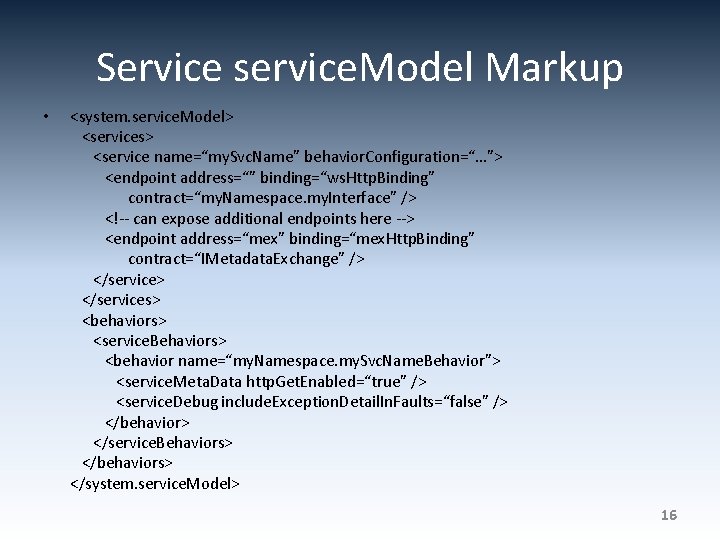
Service service. Model Markup • <system. service. Model> <services> <service name=“my. Svc. Name” behavior. Configuration=“…”> <endpoint address=“” binding=“ws. Http. Binding” contract=“my. Namespace. my. Interface” /> <!-- can expose additional endpoints here --> <endpoint address=“mex” binding=“mex. Http. Binding” contract=“IMetadata. Exchange” /> </services> <behaviors> <service. Behaviors> <behavior name=“my. Namespace. my. Svc. Name. Behavior”> <service. Meta. Data http. Get. Enabled=“true” /> <service. Debug include. Exception. Detail. In. Faults=“false” /> </behavior> </service. Behaviors> </behaviors> </system. service. Model> 16
Channels • Channels are the vehicles that transport messages. They provide: – Transport protocols via bindings • Http, WSHttp, Tcp, MSMQ, named pipes – Encoding and Encryption – Reliable sessions – Communication modes • Simplex, duplex, send and wait – Security modes 17
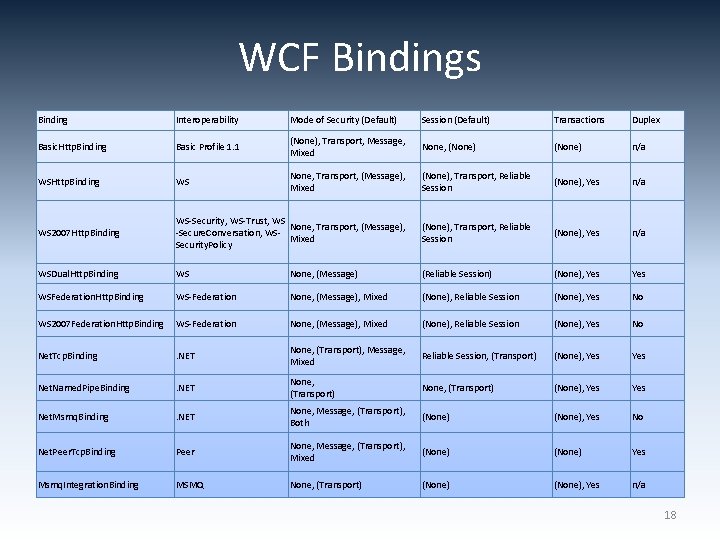
WCF Bindings Binding Interoperability Mode of Security (Default) Session (Default) Transactions Duplex Basic. Http. Binding Basic Profile 1. 1 (None), Transport, Message, Mixed None, (None) n/a WSHttp. Binding WS None, Transport, (Message), Mixed (None), Transport, Reliable Session (None), Yes n/a WS 2007 Http. Binding WS-Security, WS-Trust, WS None, Transport, (Message), -Secure. Conversation, WSMixed Security. Policy (None), Transport, Reliable Session (None), Yes n/a WSDual. Http. Binding WS None, (Message) (Reliable Session) (None), Yes WSFederation. Http. Binding WS-Federation None, (Message), Mixed (None), Reliable Session (None), Yes No WS 2007 Federation. Http. Binding WS-Federation None, (Message), Mixed (None), Reliable Session (None), Yes No Net. Tcp. Binding . NET None, (Transport), Message, Mixed Reliable Session, (Transport) (None), Yes Net. Named. Pipe. Binding . NET None, (Transport) (None), Yes Net. Msmq. Binding . NET None, Message, (Transport), Both (None), Yes No Net. Peer. Tcp. Binding Peer None, Message, (Transport), Mixed (None) Yes Msmq. Integration. Binding MSMQ None, (Transport) (None), Yes n/a 18
Interoperability • Channel protocols determine interoperability with other platforms: – – Basic. Http. Binding universal interoperability WSHttp. Binding platforms that use ws extensions Net. Tcp. Binding . Net on both ends MSMQ WCF to pre WCF windows platforms 19
Service Behaviors • Instancing: – – Singleton: one instance for all clients Per call: one instance per service call Private session: one instance per client session Shared session: one instance per session shared between clients • Concurrency models for instances: – Single: one thread at a time accesses instance – Multiple: more than one thread may enter instance – Reentrant: threads make recursive calls without deadlock 20
Other Service Behaviors • Throttling: – Limits on number of messages, instances, and threads a service can process simultaneously • Error handling: – Options to handle, let framework handle, and report to client • Metadata: – Services can be self-describing, providing MEX endpoints • Lifetime: – Can specify session duration, service operations to initiate sessions and others to terminate sessions • Security: – Can specify message confidentiality, integrity, authentication, authorization, auditing, and replay detection. 21
![Structuring Service Code Service Class Attribute Service contract interface [Service. Contract] Service operation method](http://slidetodoc.com/presentation_image_h2/3484af8996d5f1fa8b9eaf9667934ca5/image-22.jpg "Structuring Service Code Service Class Attribute Service contract interface [Service. Contract] Service operation method")
Structuring Service Code Service Class Attribute Service contract interface [Service. Contract] Service operation method [Operation. Contract] Implementation class [Service. Behavior] Derive from contract interface Implementation method [Operation. Behavior] Data Contract class [Data. Contract] class [Data. Member] member Message Contract interface [Message. Contract] interface [Message. Header] member [Message. Body] member 22
Building Clients • Build proxy with svcutil – Visual Studio will do that if you add a service or web reference – Proxy code is in a subdirectory under the project. • Add proxy code to project • Add “using System. Service. Model” to client code • Build and run 23
Generating Proxies • Svc. Util. exe generates code: – from a mex endpoint: svcutil http: //localhost/my. Service – from WSDL or XSD files: svcutil my. Service. wsdl • Svc. Util. exe generates WSDL and XSD files from a service library: – svcutil my. Service. dll 24
25
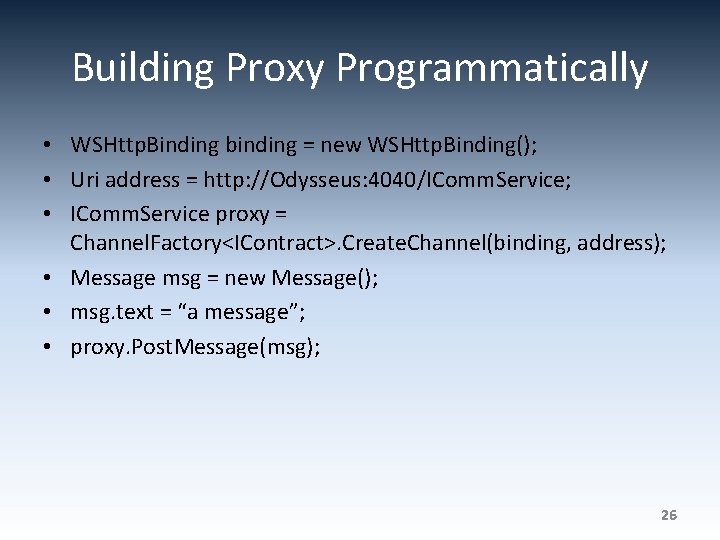
Building Proxy Programmatically • WSHttp. Binding binding = new WSHttp. Binding(); • Uri address = http: //Odysseus: 4040/IComm. Service; • IComm. Service proxy = Channel. Factory<IContract>. Create. Channel(binding, address); • Message msg = new Message(); • msg. text = “a message”; • proxy. Post. Message(msg); 26
End of Presentation 27
- Slides: 27