
Window Coating Absorbance Spectra Lisa Pawlowicz 17 August
Window Coating Absorbance Spectra Lisa Pawlowicz 17 August 2010
Overview Materials and Methods Absorbance of Substrates Absorbance due to In 2 O 3 (ITO) Absorbance due to Mg. O Topics for Further Investigation 2
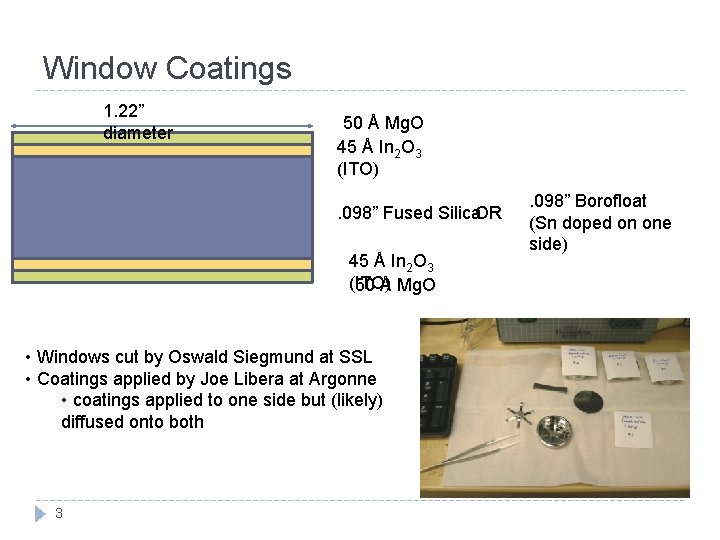
Window Coatings 1. 22” diameter 50 Å Mg. O 45 Å In 2 O 3 (ITO). 098” Fused Silica. OR 45 Å In 2 O 3 (ITO) 50 Å Mg. O • Windows cut by Oswald Siegmund at SSL • Coatings applied by Joe Libera at Argonne • coatings applied to one side but (likely) diffused onto both 3 . 098” Borofloat (Sn doped on one side)
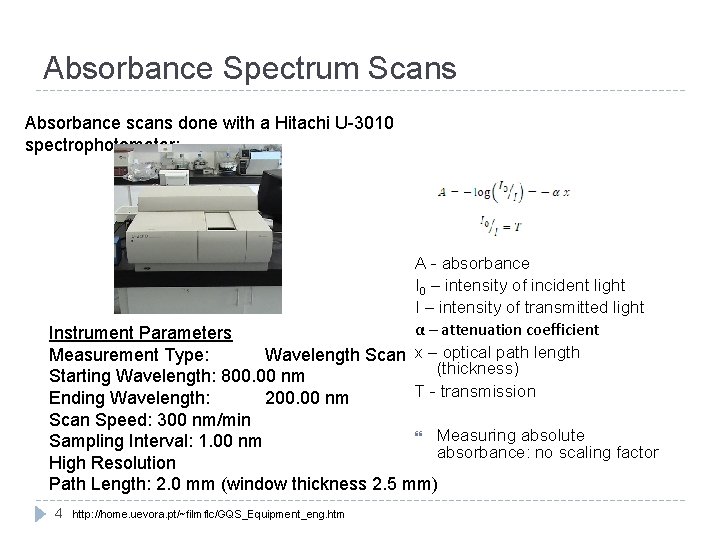
Absorbance Spectrum Scans Absorbance scans done with a Hitachi U-3010 spectrophotometer: A - absorbance I 0 – intensity of incident light I – intensity of transmitted light α – attenuation coefficient Instrument Parameters Measurement Type: Wavelength Scan x – optical path length (thickness) Starting Wavelength: 800. 00 nm T - transmission Ending Wavelength: 200. 00 nm Scan Speed: 300 nm/min Measuring absolute Sampling Interval: 1. 00 nm absorbance: no scaling factor High Resolution Path Length: 2. 0 mm (window thickness 2. 5 mm) 4 http: //home. uevora. pt/~filmflc/GQS_Equipment_eng. htm
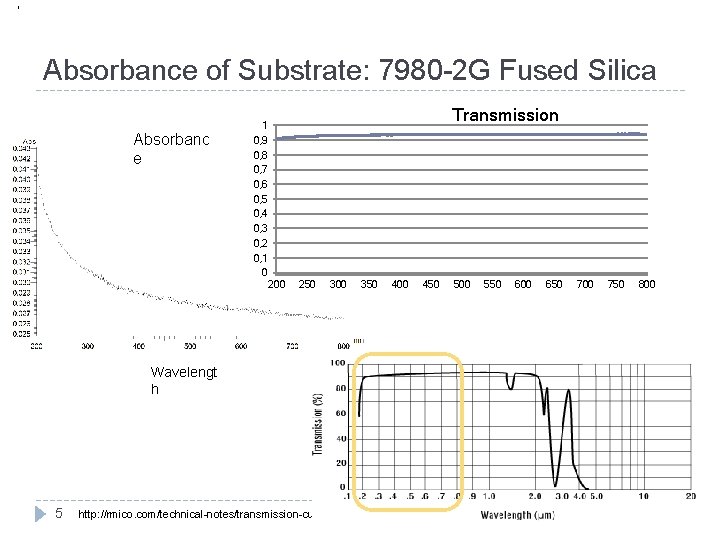
, Absorbance of Substrate: 7980 -2 G Fused Silica Absorbanc e Transmission 1 0, 9 0, 8 0, 7 0, 6 0, 5 0, 4 0, 3 0, 2 0, 1 0 200 250 300 Wavelengt h 5 http: //rmico. com/technical-notes/transmission-curves 350 400 450 500 550 600 650 700 750 800
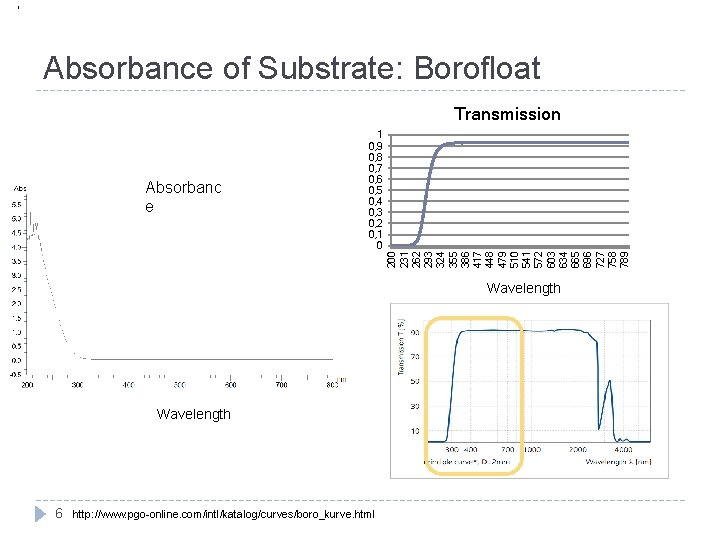
, Absorbance of Substrate: Borofloat Absorbanc e 1 0, 9 0, 8 0, 7 0, 6 0, 5 0, 4 0, 3 0, 2 0, 1 0 200 231 262 293 324 355 386 417 448 479 510 541 572 603 634 665 696 727 758 789 Transmission Wavelength 6 http: //www. pgo-online. com/intl/katalog/curves/boro_kurve. html
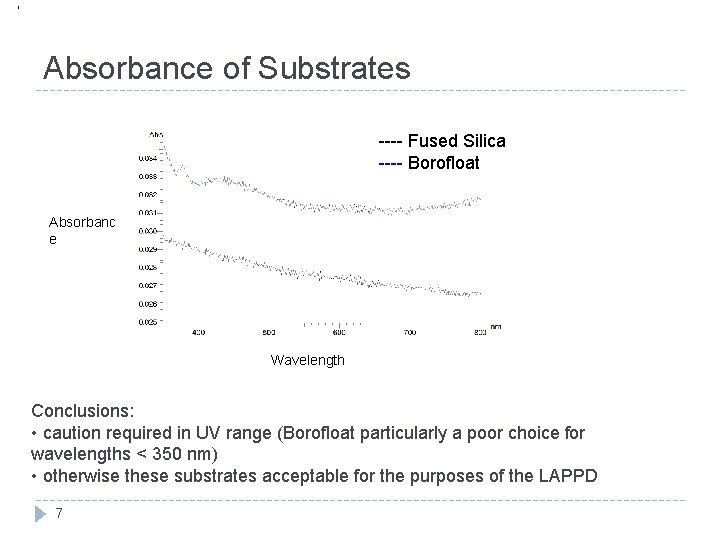
, Absorbance of Substrates ---- Fused Silica ---- Borofloat Absorbanc e Wavelength Conclusions: • caution required in UV range (Borofloat particularly a poor choice for wavelengths < 350 nm) • otherwise these substrates acceptable for the purposes of the LAPPD 7
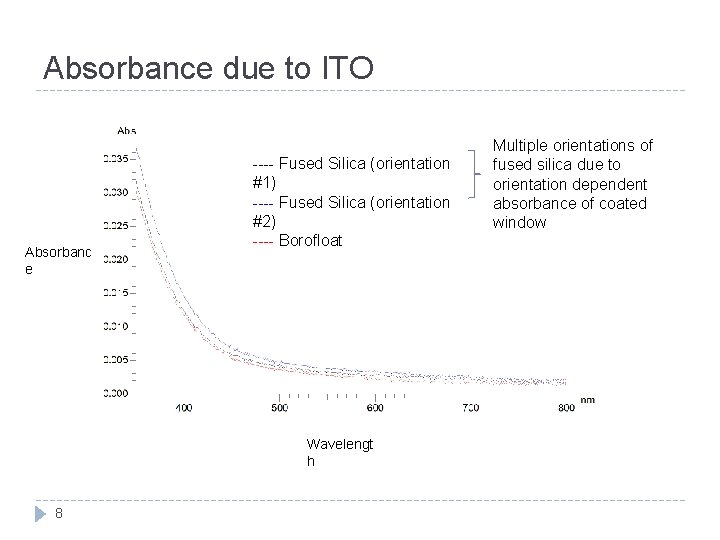
Absorbance due to ITO Absorbanc e ---- Fused Silica (orientation #1) ---- Fused Silica (orientation #2) ---- Borofloat Wavelengt h 8 Multiple orientations of fused silica due to orientation dependent absorbance of coated window
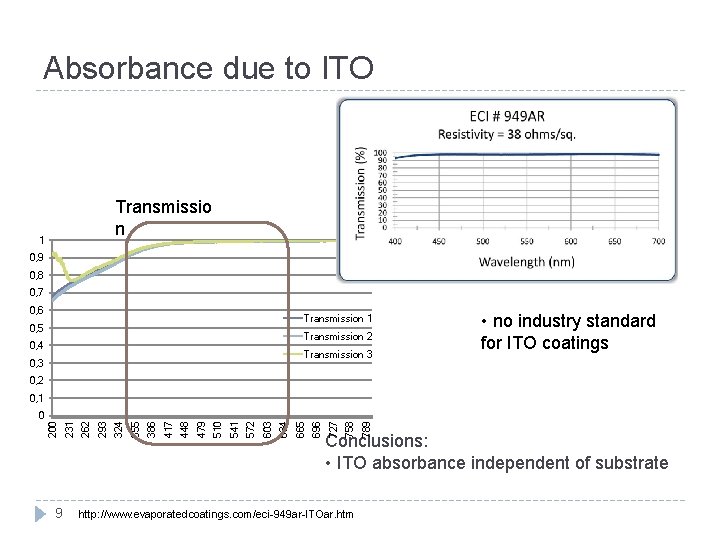
Absorbance due to ITO Transmissio n 1 0, 9 0, 8 0, 7 0, 6 Transmission 1 0, 5 Transmission 2 0, 4 Transmission 3 0, 3 • no industry standard for ITO coatings 0, 2 9 789 758 727 696 665 634 603 572 541 510 479 448 417 386 355 324 293 262 231 0 200 0, 1 Conclusions: • ITO absorbance independent of substrate http: //www. evaporatedcoatings. com/eci-949 ar-ITOar. htm
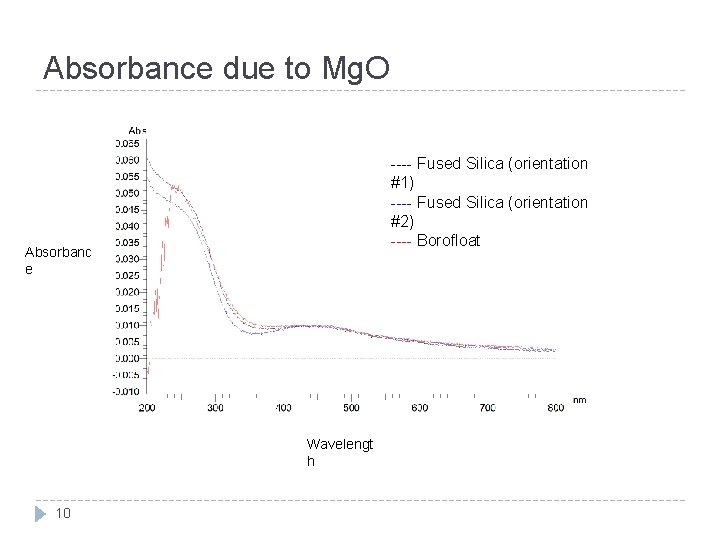
Absorbance due to Mg. O ---- Fused Silica (orientation #1) ---- Fused Silica (orientation #2) ---- Borofloat Absorbanc e Wavelengt h 10
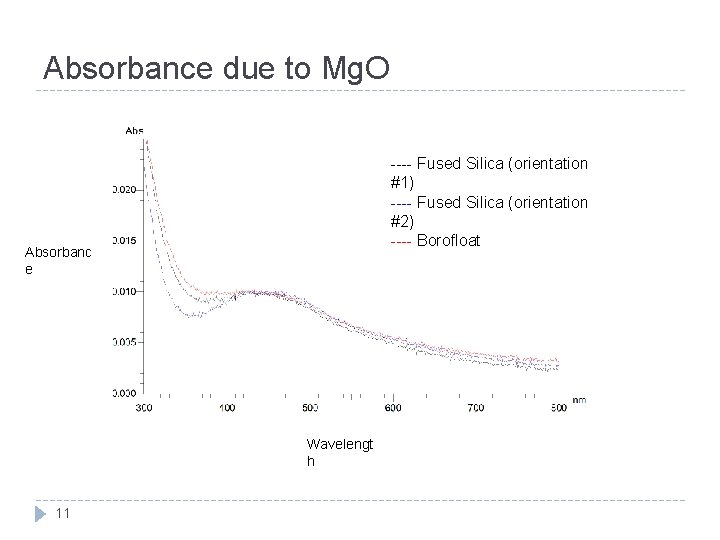
Absorbance due to Mg. O ---- Fused Silica (orientation #1) ---- Fused Silica (orientation #2) ---- Borofloat Absorbanc e Wavelengt h 11
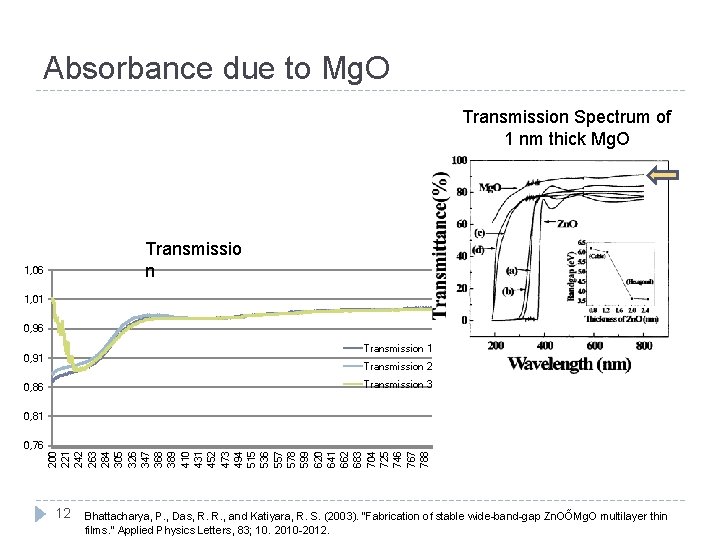
Absorbance due to Mg. O Transmission Spectrum of 1 nm thick Mg. O Transmissio n 1, 06 1, 01 0, 96 Transmission 1 0, 91 Transmission 2 Transmission 3 0, 86 0, 76 200 221 242 263 284 305 326 347 368 389 410 431 452 473 494 515 536 557 578 599 620 641 662 683 704 725 746 767 788 0, 81 12 Bhattacharya, P. , Das, R. R. , and Katiyara, R. S. (2003). “Fabrication of stable wide-band-gap Zn. OÕMg. O multilayer thin films. ” Applied Physics Letters, 83; 10. 2010 -2012.
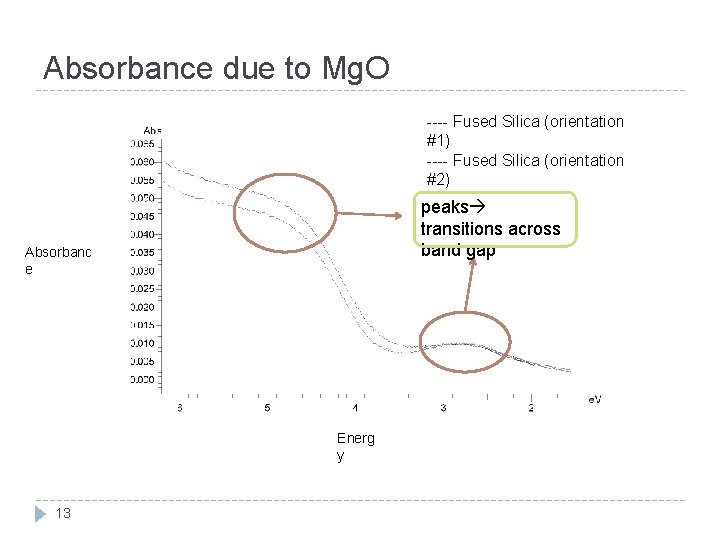
Absorbance due to Mg. O ---- Fused Silica (orientation #1) ---- Fused Silica (orientation #2) peaks transitions across band gap Absorbanc e Energ y 13
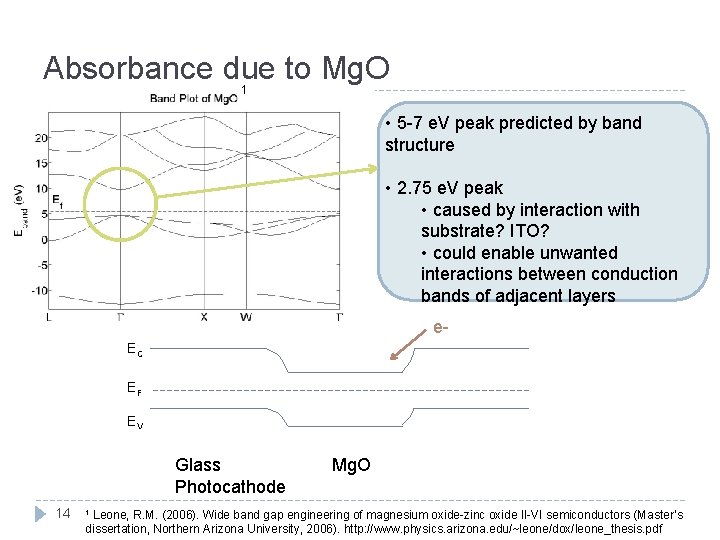
Absorbance due to Mg. O 1 • 5 -7 e. V peak predicted by band structure • 2. 75 e. V peak • caused by interaction with substrate? ITO? • could enable unwanted interactions between conduction bands of adjacent layers e. EC EF EV Glass Photocathode 14 Mg. O Leone, R. M. (2006). Wide band gap engineering of magnesium oxide-zinc oxide II-VI semiconductors (Master’s dissertation, Northern Arizona University, 2006). http: //www. physics. arizona. edu/~leone/dox/leone_thesis. pdf 1
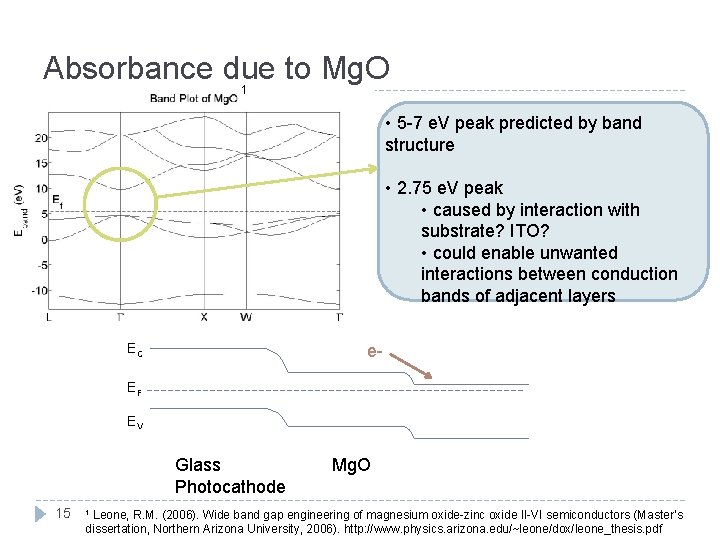
Absorbance due to Mg. O 1 • 5 -7 e. V peak predicted by band structure • 2. 75 e. V peak • caused by interaction with substrate? ITO? • could enable unwanted interactions between conduction bands of adjacent layers EC e- EF EV Glass Photocathode 15 Mg. O Leone, R. M. (2006). Wide band gap engineering of magnesium oxide-zinc oxide II-VI semiconductors (Master’s dissertation, Northern Arizona University, 2006). http: //www. physics. arizona. edu/~leone/dox/leone_thesis. pdf 1
Absorbance due to Mg. O • • Conclusions: Mg. O absorbance doesn’t match literature Mg. O absorbance shows some dependence on substrate • • • Orientation dependence implies uneven coating Spectroscopic measurements necessary to ensure quality of samples Interactions between layers could cause complications 16
Topics for Further Investigation Why is there a 2. 75 e. V peak in the Mg. O absorbance spectrum? How do the 5 e. V and 2. 75 e. V peaks in the Mg. O absorbance spectrum affect Mg. O’s functionality? How would tempering the different materials affect their absorbance spectra? How do absorbance spectra differ between batches of windows and films? 17
- Slides: 17