
Window A is a pane of glass 4



- Slides: 16
Window A is a pane of glass 4 millimeters thick, as shown above. Window B is a sandwich consisting of two extremely thin layers of glass separated by an air gap 2 millimeters thick, as shown above. If thermal conductivities of glass and air are 0. 8 watt/meter C and 0. 025 watt/meter C, respectively, then the ratio of the heat flow through window A to the heat flow through window B is A. B. C. D. E. 2 4 8 16 32
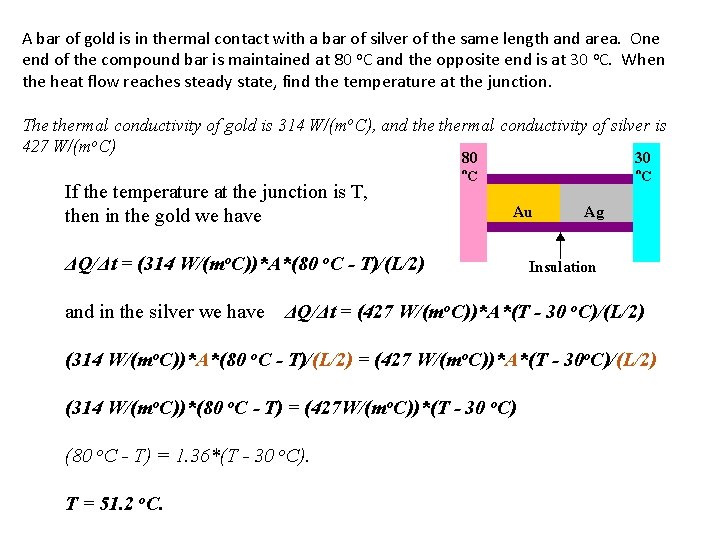
A bar of gold is in thermal contact with a bar of silver of the same length and area. One end of the compound bar is maintained at 80 o. C and the opposite end is at 30 o. C. When the heat flow reaches steady state, find the temperature at the junction. The thermal conductivity of gold is 314 W/(mo. C), and thermal conductivity of silver is 427 W/(mo. C) If the temperature at the junction is T, then in the gold we have ΔQ/Δt = (314 W/(mo. C))*A*(80 o. C - T)/(L/2) and in the silver we have ΔQ/Δt = (427 W/(mo. C))*A*(T - 30 o. C)/(L/2) (314 W/(mo. C))*A*(80 o. C - T)/(L/2) = (427 W/(mo. C))*A*(T - 30 o. C)/(L/2) (314 W/(mo. C))*(80 o. C - T) = (427 W/(mo. C))*(T - 30 o. C) (80 o. C - T) = 1. 36*(T - 30 o. C). T = 51. 2 o. C.
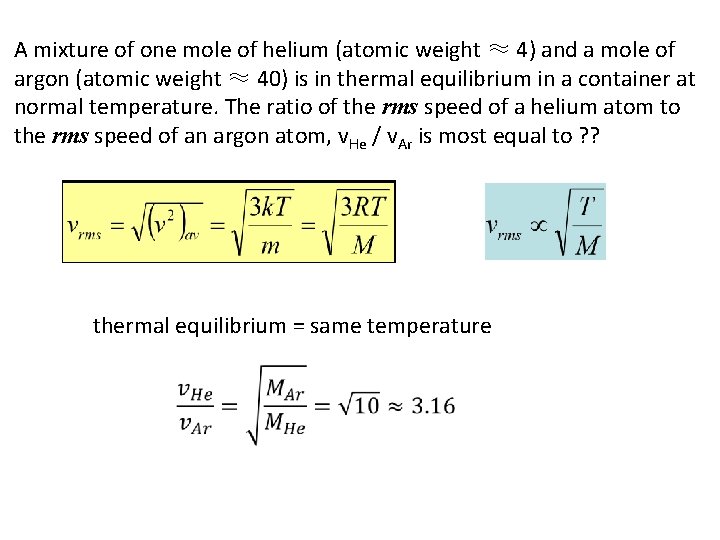
A mixture of one mole of helium (atomic weight ≈ 4) and a mole of argon (atomic weight ≈ 40) is in thermal equilibrium in a container at normal temperature. The ratio of the rms speed of a helium atom to the rms speed of an argon atom, v. He / v. Ar is most equal to ? ? thermal equilibrium = same temperature
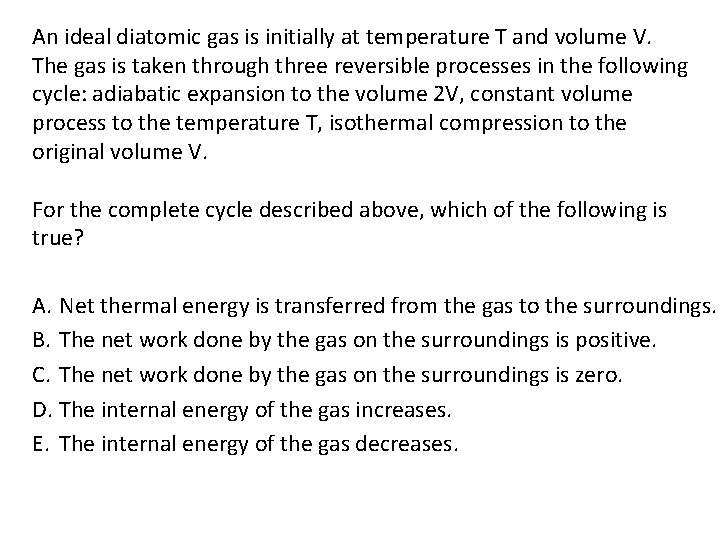
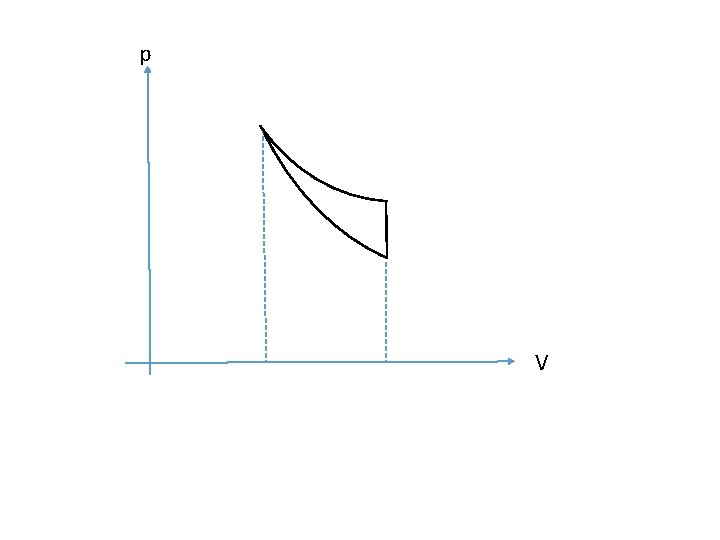
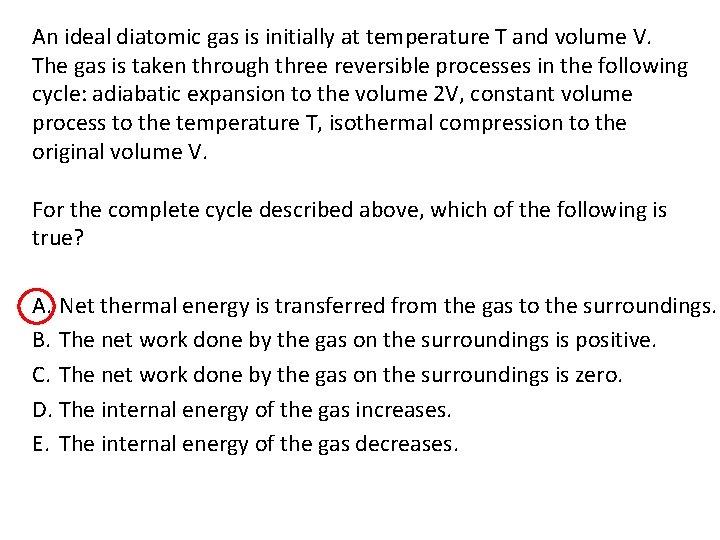
An ideal diatomic gas is initially at temperature T and volume V. The gas is taken through three reversible processes in the following cycle: adiabatic expansion to the volume 2 V, constant volume process to the temperature T, isothermal compression to the original volume V. For the complete cycle described above, which of the following is true? A. Net thermal energy is transferred from the gas to the surroundings. B. The net work done by the gas on the surroundings is positive. C. The net work done by the gas on the surroundings is zero. D. The internal energy of the gas increases. E. The internal energy of the gas decreases.
p V
An ideal diatomic gas is initially at temperature T and volume V. The gas is taken through three reversible processes in the following cycle: adiabatic expansion to the volume 2 V, constant volume process to the temperature T, isothermal compression to the original volume V. For the complete cycle described above, which of the following is true? A. Net thermal energy is transferred from the gas to the surroundings. B. The net work done by the gas on the surroundings is positive. C. The net work done by the gas on the surroundings is zero. D. The internal energy of the gas increases. E. The internal energy of the gas decreases.
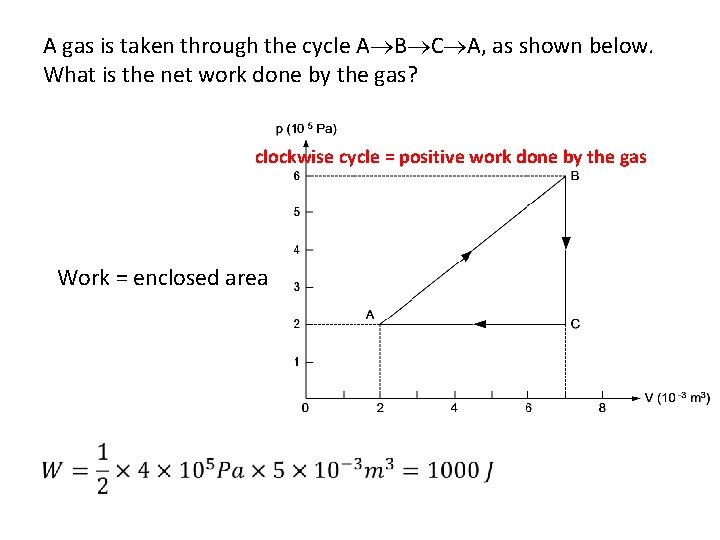
A gas is taken through the cycle A B C A, as shown below. What is the net work done by the gas? clockwise cycle = positive work done by the gas Work = enclosed area
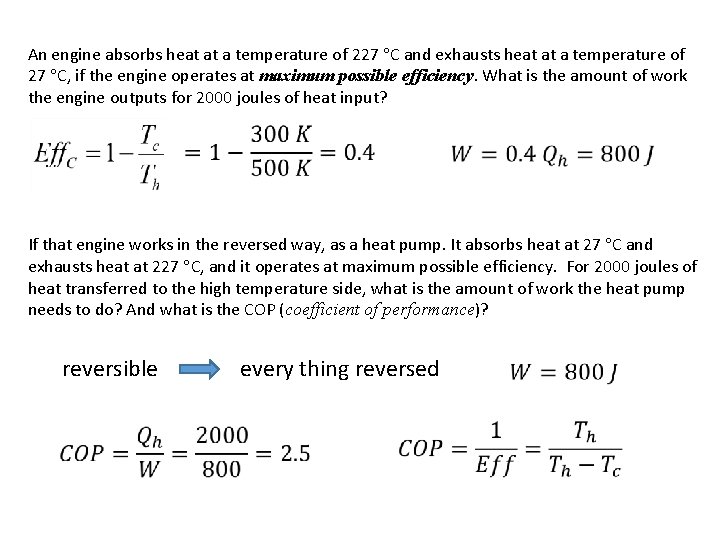
An engine absorbs heat at a temperature of 227 C and exhausts heat at a temperature of 27 C, if the engine operates at maximum possible efficiency. What is the amount of work the engine outputs for 2000 joules of heat input? If that engine works in the reversed way, as a heat pump. It absorbs heat at 27 C and exhausts heat at 227 C, and it operates at maximum possible efficiency. For 2000 joules of heat transferred to the high temperature side, what is the amount of work the heat pump needs to do? And what is the COP (coefficient of performance)? reversible every thing reversed
The maximum theoretical efficiency of engine
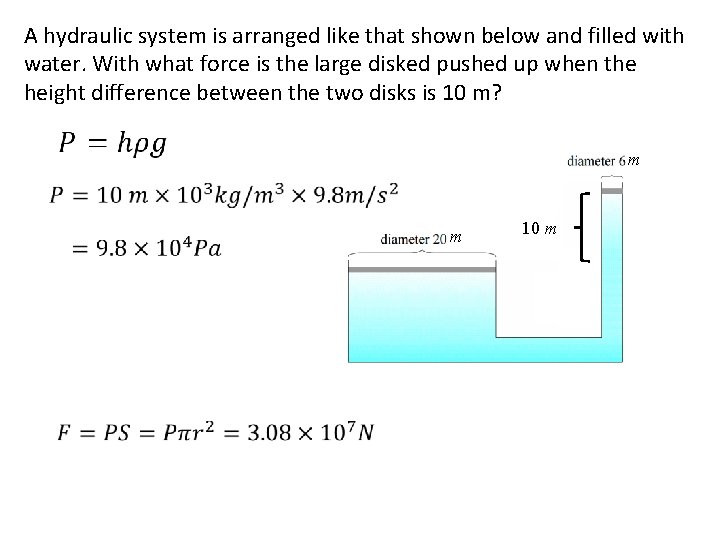
A hydraulic system is arranged like that shown below and filled with water. With what force is the large disked pushed up when the height difference between the two disks is 10 m? m 10 m
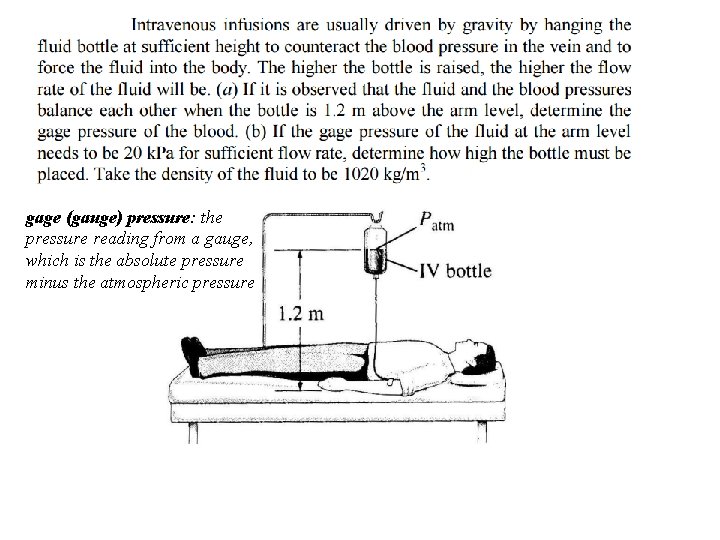
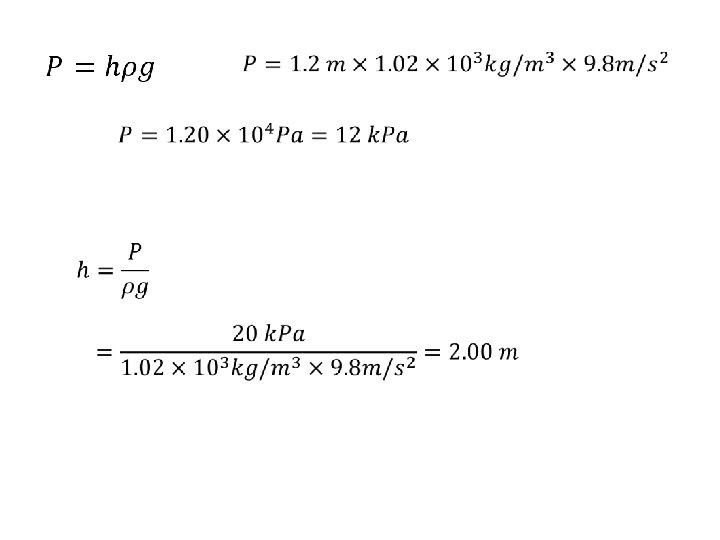
gage (gauge) pressure: the pressure reading from a gauge, which is the absolute pressure minus the atmospheric pressure
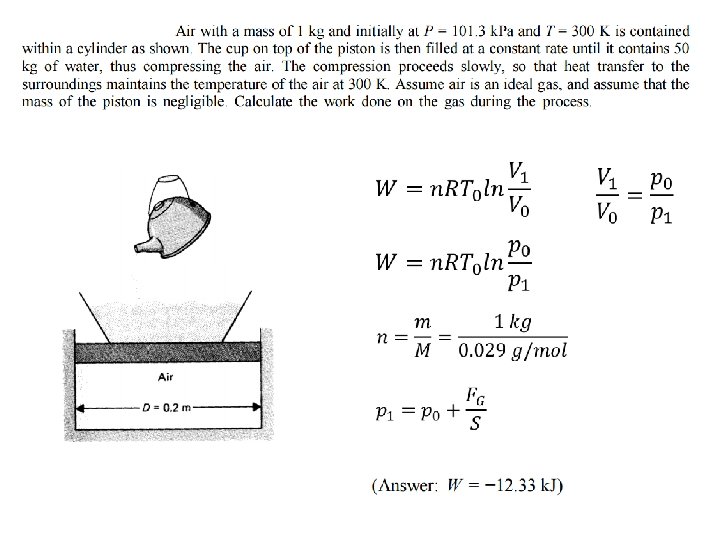
A mole of ideal gas initially at temperature T 0 and volume V 0 undergoes a reversible isothermal expansion to volume V 1. If the ratio of specific heats is cp/cv= and if R is the gas constant, the work done is
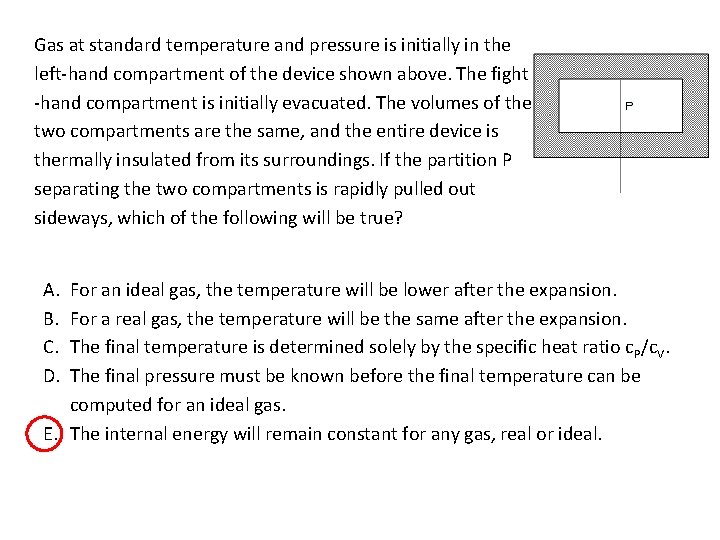
Gas at standard temperature and pressure is initially in the left-hand compartment of the device shown above. The fight -hand compartment is initially evacuated. The volumes of the two compartments are the same, and the entire device is thermally insulated from its surroundings. If the partition P separating the two compartments is rapidly pulled out sideways, which of the following will be true? A. B. C. D. For an ideal gas, the temperature will be lower after the expansion. For a real gas, the temperature will be the same after the expansion. The final temperature is determined solely by the specific heat ratio c P/c. V. The final pressure must be known before the final temperature can be computed for an ideal gas. E. The internal energy will remain constant for any gas, real or ideal.