
Wind Turbine Final Report Wind TER Wind Turbine
Wind Turbine Final Report Wind. TER – Wind Turbine Energy Resources Kristina Monakhova – Program Manager Elizabeth Yasuna – Executive Director Dominick Farina – Business Development Kyle Zalud – Technical Lead EAS 140 D 2 -E, Zack Bauer, Nikita Ranjit Goraksha

Project Objectives Purpose: Design efficient wind turbines for small and large scale applications Goals: • Build and improve a wind turbine • Strive for continuous improvement • Create a scientific foundation for future improvements/innovations • Focus on simplcity and reliability Source: http: //learn. kidwind. org/sites/default/files/windturbinebladedesign. ppt

Background Research - Design Factors for Wind Turbines • Number of blades • Angle of blades • Shape of blades • Blade Twist • Blade Length • Blade materials • Generator • Gear ratios • Oil/Lubricant used • Height of tower • Rotational Speed
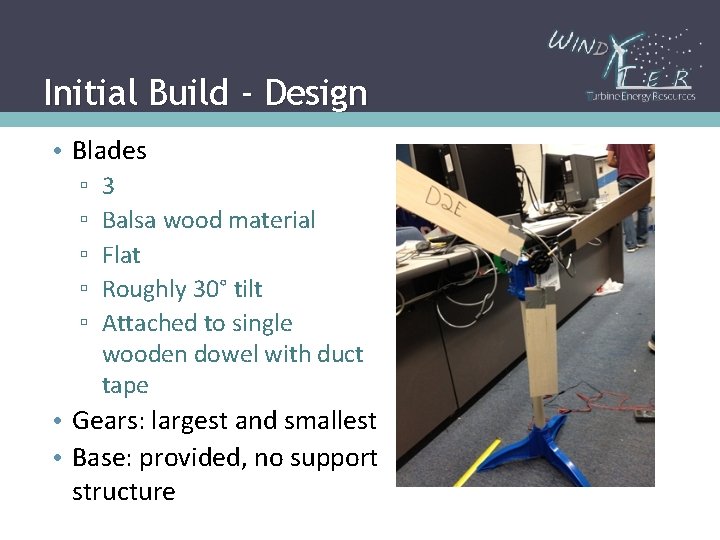
Initial Build - Design • Blades ▫ ▫ ▫ 3 Balsa wood material Flat Roughly 30° tilt Attached to single wooden dowel with duct tape • Gears: largest and smallest • Base: provided, no support structure
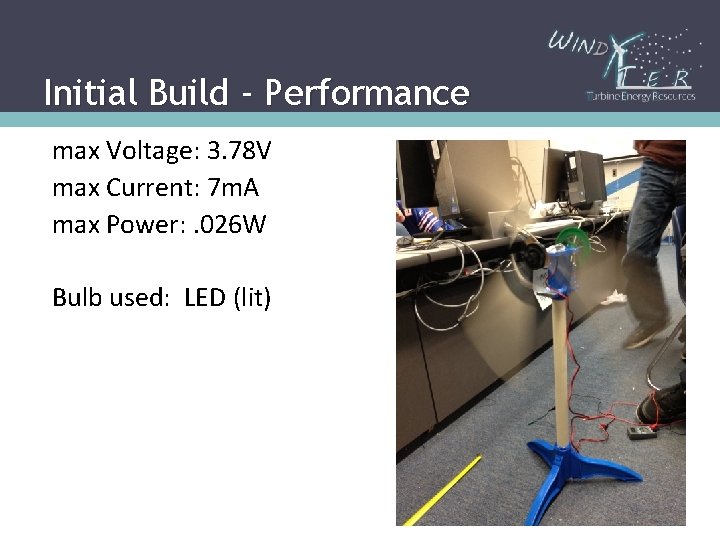
Initial Build - Performance max Voltage: 3. 78 V max Current: 7 m. A max Power: . 026 W Bulb used: LED (lit)
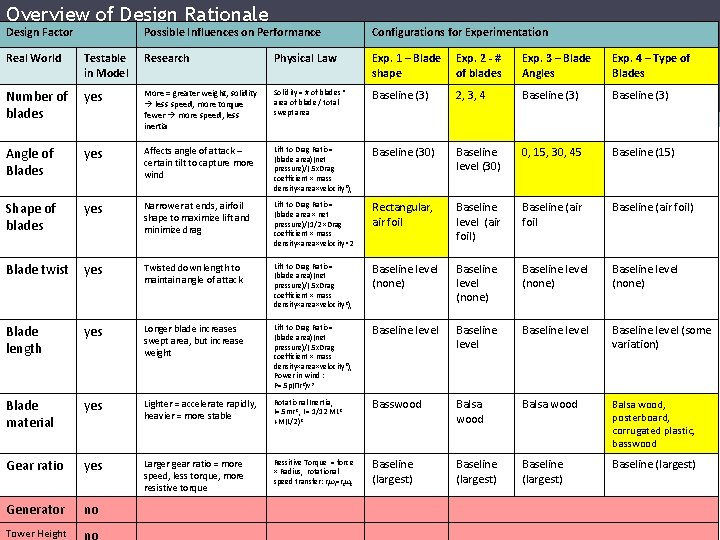
Overview of Design Rationale Design Factor Possible Influences on Performance Configurations for Experimentation Real World Testable in Model Research Physical Law Exp. 1 – Blade shape Exp. 2 - # of blades Exp. 3 – Blade Angles Exp. 4 – Type of Blades Number of blades yes More = greater weight, solidity less speed, more torque fewer more speed, less inertia Solidity = # of blades * area of blade / total swept area Baseline (3) 2, 3, 4 Baseline (3) Angle of Blades yes Affects angle of attack – certain tilt to capture more wind Lift to Drag Ratio= (blade area)(net pressure)/(. 5 x. Drag coefficient × mass density×area×velocity 2), Baseline (30) Baseline level (30) 0, 15, 30, 45 Baseline (15) Shape of blades yes Narrower at ends, airfoil shape to maximize lift and minimize drag Lift to Drag Ratio= (blade area × net pressure)/(1/2 ×Drag coefficient × mass density×area×velocity^2 Rectangular, air foil Baseline level (air foil) Baseline (air foil) Blade twist yes Twisted down length to maintain angle of attack Lift to Drag Ratio= (blade area)(net pressure)/(. 5 x. Drag coefficient × mass density×area×velocity 2), Baseline level (none) Blade length yes Longer blade increases swept area, but increase weight Lift to Drag Ratio= (blade area)(net pressure)/(. 5 x. Drag coefficient × mass density×area×velocity 2), Power in wind : P=. 5ρ(Πr 2)v 3 Baseline level (some variation) Blade material yes Lighter = accelerate rapidly, heavier = more stable Rotational Inertia, I=. 5 mr 2 , I = 1/12 ML 2 +M(L/2)2 Basswood Balsa wood, posterboard, corrugated plastic, basswood Gear ratio yes Larger gear ratio = more speed, less torque, more resistive torque Ressitive Torque = force × Radius, rotational speed transfer: rlωl=rsωs Baseline (largest) Generator no Tower Height no
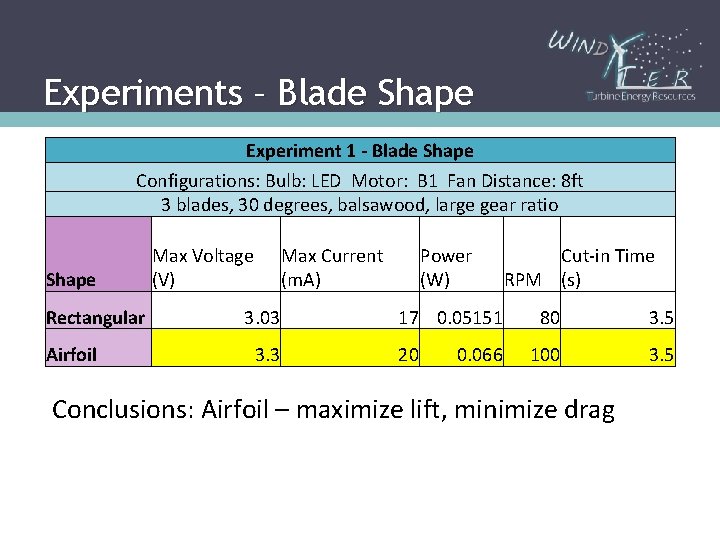
Experiments – Blade Shape Experiment 1 - Blade Shape Configurations: Rectangular, Air foil Configurations: Bulb: LED Motor: B 1 Fan Distance: 8 ft 3 blades, 30 degrees, balsawood, large gear ratio Rectangular Shape Rectangular Airfoil Max Voltage (V) Max Current (m. A) 3. 03 3. 3 Power Cut-in Time (W) RPM (s) Airfoil 17 0. 05151 80 3. 5 20 0. 066 100 Conclusions: Airfoil – maximize lift, minimize drag 3. 5
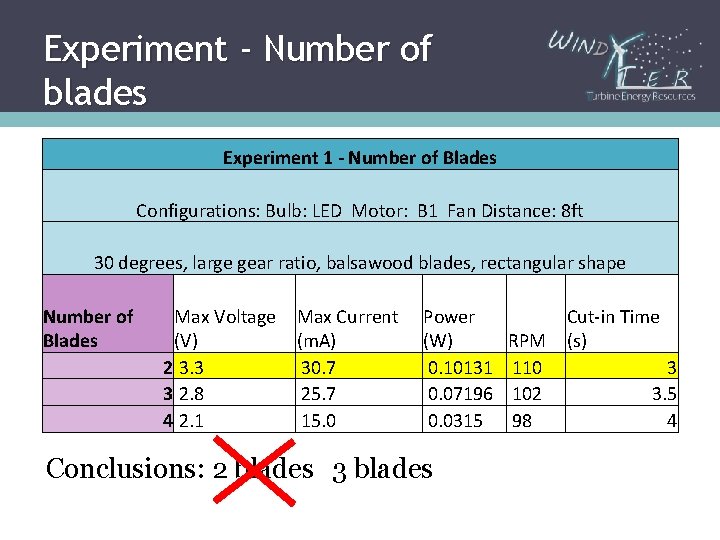
Experiment - Number of blades Configurations: Experiment 1 - Number of Blades Configurations: Bulb: LED Motor: B 1 Fan Distance: 8 ft a A a a A A 30 degrees, large gear ratio, balsawood blades, rectangular shape Number of Blades 2 Max Voltage (V) 2 3. 3 3 2. 8 blades 4 2. 1 Max Current (m. A) 30. 7 25. 7 315. 0 blades Power Cut-in Time (W) RPM (s) 0. 10131 110 3 0. 07196 102 3. 5 blades 0. 0315 498 4 Conclusions: 2 blades 3 blades
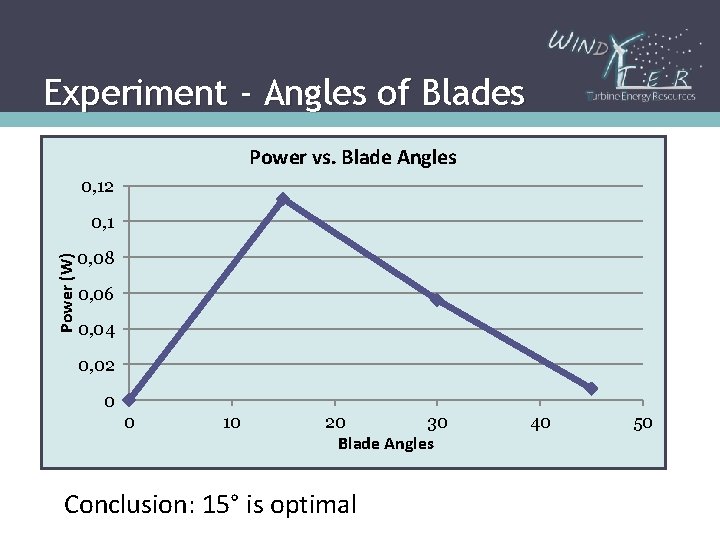
Experiment - Angles of Blades Configurations: 0 °, 15 °, vs. 30 Blade 45 Angles °Angle Experiment 2 °, - Blade Power 0, 12 Configurations: Bulb: LED Motor: B 1 Fan Distance: 8 ft 0, 1 Power (W) 0° 15° 2 blades, balsawood blades, large gear ratio, rectangular shape 0, 08 Top View 0, 06 Angle 0, 04 (degrees) 0, 02 Max Voltage Max Current (V) (m. A) Power (W) 0 0 15 Side View 030 45 Cut-in Time (s) RPM 0 0 3. 3 34. 1 0. 11253 81 3 20 19 30 0. 05605 Blade Angles 4085 50 3 49 3. 5 10 2. 95 2. 8 Conclusion: 15° is optimal 2. 3 0. 00644
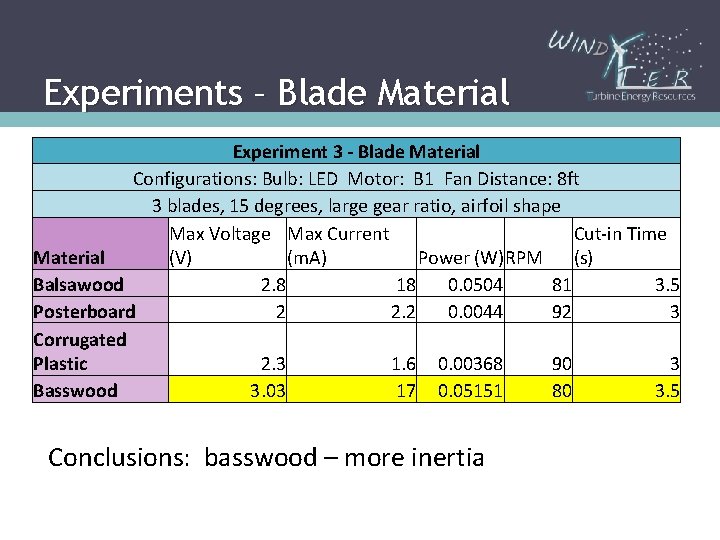
Experiments – Blade Material Configurations: Experiment 3 - Blade Material Configurations: Bulb: LED Motor: B 1 Fan Distance: 8 ft 3 blades, 15 degrees, large gear ratio, airfoil shape Max Voltage Max Current Cut-in Time Balsawood Basswood Material (V) (m. A) Power (W)RPM (s) Balsawood 2. 8 18 0. 0504 81 3. 5 Posterboard 2 2. 2 0. 0044 92 3 Corrugated Plastic 2. 3 1. 6 0. 00368 90 3 Posterboard Corrogated Basswood 3. 03 17 0. 05151 Plastic 80 3. 5 Conclusions: basswood – more inertia
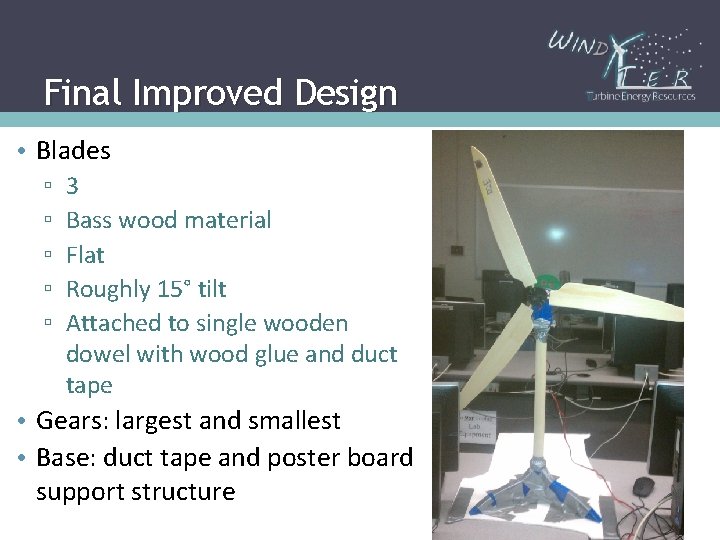
Final Improved Design • Blades ▫ ▫ ▫ 3 Bass wood material Flat Roughly 15° tilt Attached to single wooden dowel with wood glue and duct tape • Gears: largest and smallest • Base: duct tape and poster board support structure
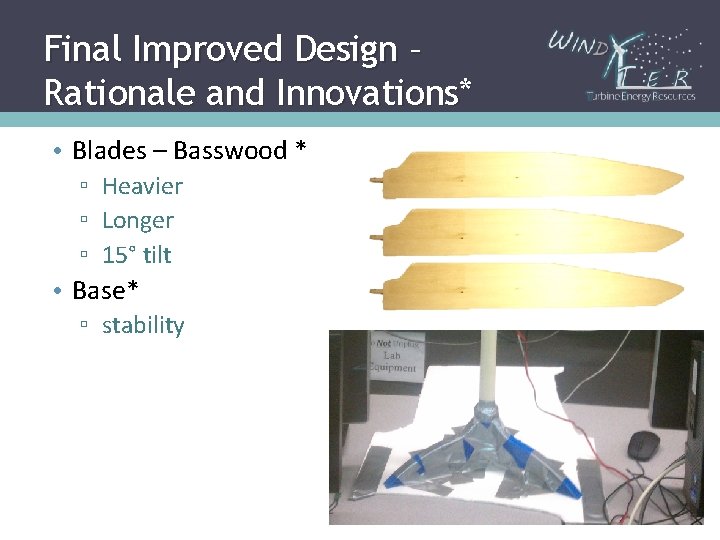
Final Improved Design – Rationale and Innovations* • Blades – Basswood * ▫ Heavier ▫ Longer ▫ 15° tilt • Base* ▫ stability
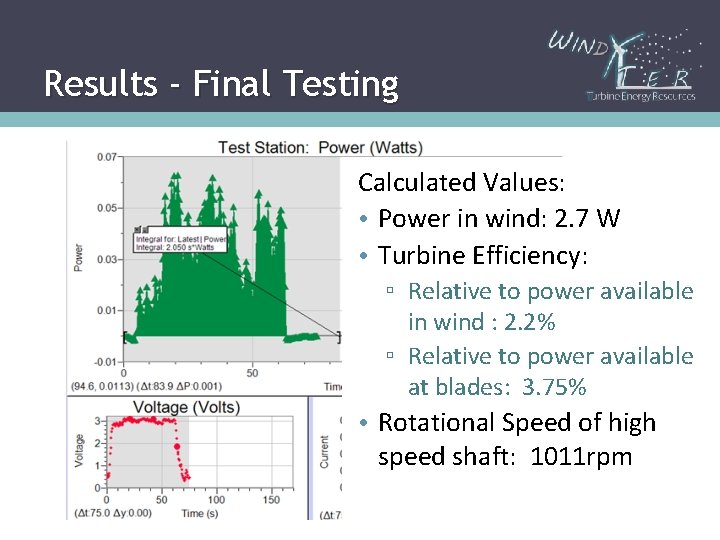
Results - Final Testing Calculated Values: • 2. 05 Ws • 3 V, • Power in wind: 2. 7 W. 02 A • Turbine Efficiency: • 160 rpm ▫ Relative to power available in wind : 2. 2% ▫ Relative to power available at blades: 3. 75% • Rotational Speed of high speed shaft: 1011 rpm
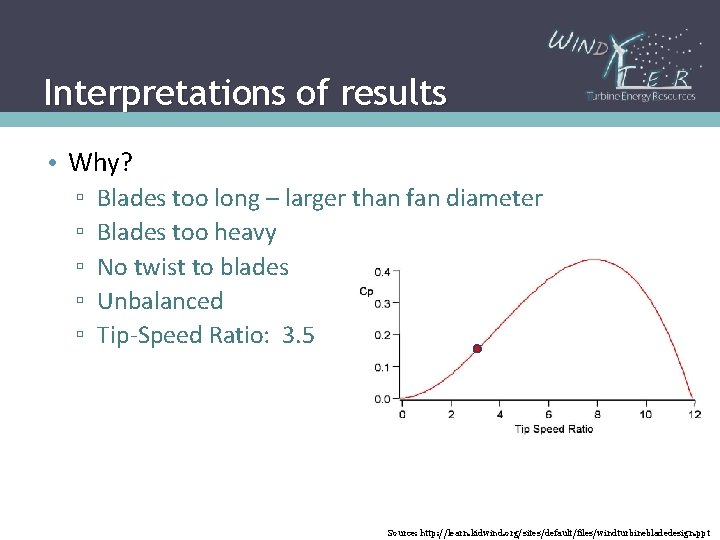
Interpretations of results • • Successful: Why? ▫▫ ▫▫ ▫▫ Very consistent Blades too long voltage – larger than fan diameter Fairly Bladesconsistent too heavycurrent/power Kept on spinning No twist to bladesafter 60 s • Unsuccessful ▫ Unbalanced ▫ Low current and power Tip-Speed Ratio: 3. 5 ▫ High cut-in time Source: http: //learn. kidwind. org/sites/default/files/windturbinebladedesign. ppt
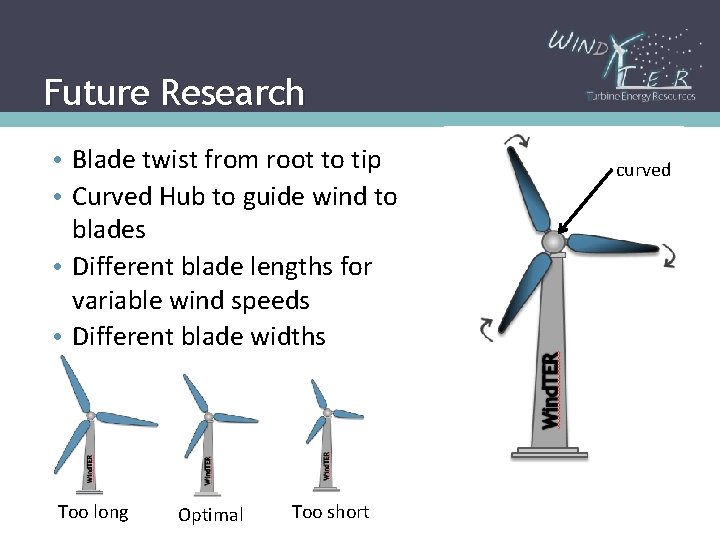
Future Research • Blade twist from root to tip • Curved Hub to guide wind to blades • Different blade lengths for variable wind speeds • Different blade widths Too long Optimal Too short curved
Questions?
- Slides: 16