
Wind Turbine Design and Implementation Phase II Introduction
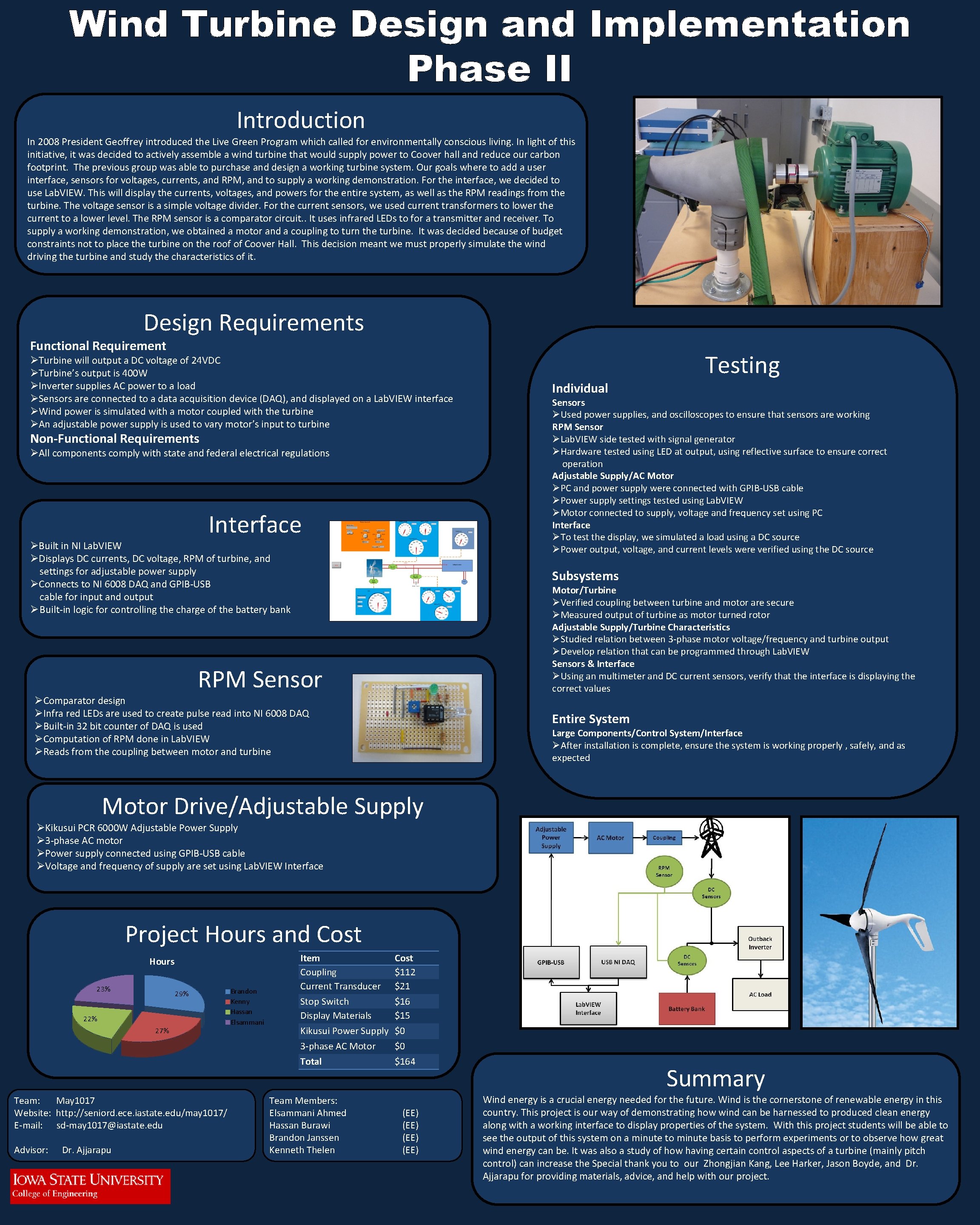
Wind Turbine Design and Implementation Phase II Introduction In 2008 President Geoffrey introduced the Live Green Program which called for environmentally conscious living. In light of this initiative, it was decided to actively assemble a wind turbine that would supply power to Coover hall and reduce our carbon footprint. The previous group was able to purchase and design a working turbine system. Our goals where to add a user interface, sensors for voltages, currents, and RPM, and to supply a working demonstration. For the interface, we decided to use Lab. VIEW. This will display the currents, voltages, and powers for the entire system, as well as the RPM readings from the turbine. The voltage sensor is a simple voltage divider. For the current sensors, we used current transformers to lower the current to a lower level. The RPM sensor is a comparator circuit. . It uses infrared LEDs to for a transmitter and receiver. To supply a working demonstration, we obtained a motor and a coupling to turn the turbine. It was decided because of budget constraints not to place the turbine on the roof of Coover Hall. This decision meant we must properly simulate the wind driving the turbine and study the characteristics of it. Design Requirements Functional Requirement ØTurbine will output a DC voltage of 24 VDC ØTurbine’s output is 400 W ØInverter supplies AC power to a load ØSensors are connected to a data acquisition device (DAQ), and displayed on a Lab. VIEW interface ØWind power is simulated with a motor coupled with the turbine ØAn adjustable power supply is used to vary motor’s input to turbine Non-Functional Requirements ØAll components comply with state and federal electrical regulations Interface ØBuilt in NI Lab. VIEW ØDisplays DC currents, DC voltage, RPM of turbine, and settings for adjustable power supply ØConnects to NI 6008 DAQ and GPIB-USB cable for input and output Ø Built-in logic for controlling the charge of the battery bank Individual Testing Sensors ØUsed power supplies, and oscilloscopes to ensure that sensors are working RPM Sensor ØLab. VIEW side tested with signal generator ØHardware tested using LED at output, using reflective surface to ensure correct operation Adjustable Supply/AC Motor ØPC and power supply were connected with GPIB-USB cable ØPower supply settings tested using Lab. VIEW ØMotor connected to supply, voltage and frequency set using PC Interface ØTo test the display, we simulated a load using a DC source ØPower output, voltage, and current levels were verified using the DC source Subsystems Motor/Turbine ØVerified coupling between turbine and motor are secure ØMeasured output of turbine as motor turned rotor Adjustable Supply/Turbine Characteristics ØStudied relation between 3 -phase motor voltage/frequency and turbine output ØDevelop relation that can be programmed through Lab. VIEW Sensors & Interface ØUsing an multimeter and DC current sensors, verify that the interface is displaying the correct values RPM Sensor ØComparator design ØInfra red LEDs are used to create pulse read into NI 6008 DAQ ØBuilt-in 32 bit counter of DAQ is used ØComputation of RPM done in Lab. VIEW ØReads from the coupling between motor and turbine Entire System Large Components/Control System/Interface ØAfter installation is complete, ensure the system is working properly , safely, and as expected Motor Drive/Adjustable Supply ØKikusui PCR 6000 W Adjustable Power Supply Ø 3 -phase AC motor ØPower supply connected using GPIB-USB cable ØVoltage and frequency of supply are set using Lab. VIEW Interface Project Hours and Cost Hours 23% 29% 22% 27% Team: May 1017 Website: http: //seniord. ece. iastate. edu/may 1017/ E-mail: sd-may 1017@iastate. edu Advisor: Dr. Ajjarapu Brandon Kenny Hassan Elsammani Item Coupling Current Transducer Stop Switch Display Materials Kikusui Power Supply 3 -phase AC Motor Total Team Members: Elsammani Ahmed Hassan Burawi Brandon Janssen Kenneth Thelen Cost $112 $21 $16 $15 $0 $0 $164 (EE) Summary Wind energy is a crucial energy needed for the future. Wind is the cornerstone of renewable energy in this country. This project is our way of demonstrating how wind can be harnessed to produced clean energy along with a working interface to display properties of the system. With this project students will be able to see the output of this system on a minute to minute basis to perform experiments or to observe how great wind energy can be. It was also a study of how having certain control aspects of a turbine (mainly pitch control) can increase the Special thank you to our Zhongjian Kang, Lee Harker, Jason Boyde, and Dr. Ajjarapu for providing materials, advice, and help with our project.
- Slides: 1