
Wind Power Factors Affecting It Wind Speed is
- Slides: 47
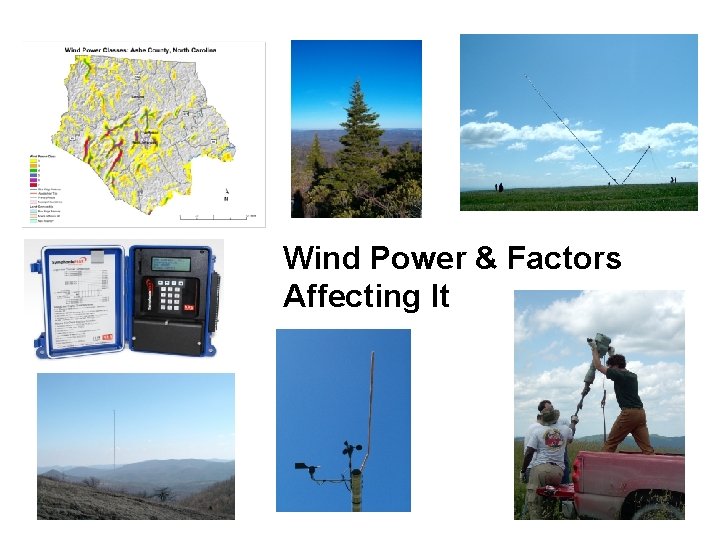
Wind Power & Factors Affecting It
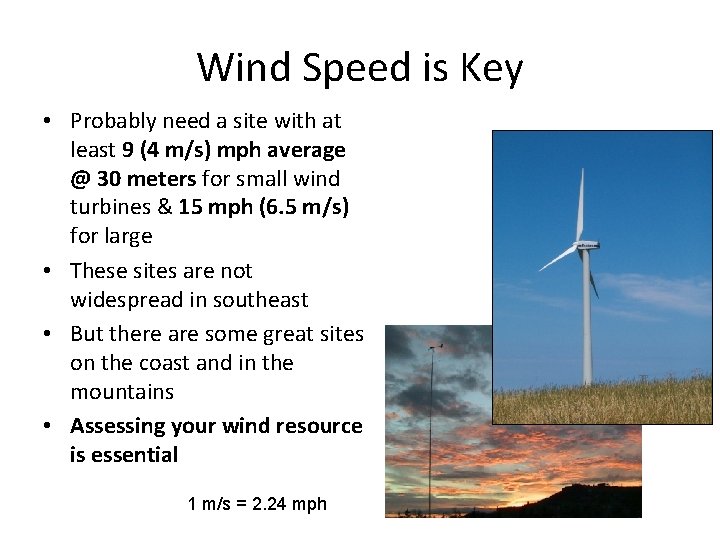
Wind Speed is Key • Probably need a site with at least 9 (4 m/s) mph average @ 30 meters for small wind turbines & 15 mph (6. 5 m/s) for large • These sites are not widespread in southeast • But there are some great sites on the coast and in the mountains • Assessing your wind resource is essential 1 m/s = 2. 24 mph
Annual Average Wind Speeds & Energy Output Marginal site vs. Good site Example: Bergey XL. 1 ($6500 system) • 4 m/s* avg. wind site • “Marginal” Site – AEO=1920 k. Wh/year – Lower output – $/k. Wh/20 yr = $0. 17 – Higher cost per KWH • 7 m/s avg. wind site • “Good” Site – AEO=4800 k. Wh/year – 2. 5 x higher output – $/kwh/20 yrs = $0. 07 – Lower cost of energy 240% difference in cost/k. Wh between good and marginal sites * 1 m/s = 2. 24 mph
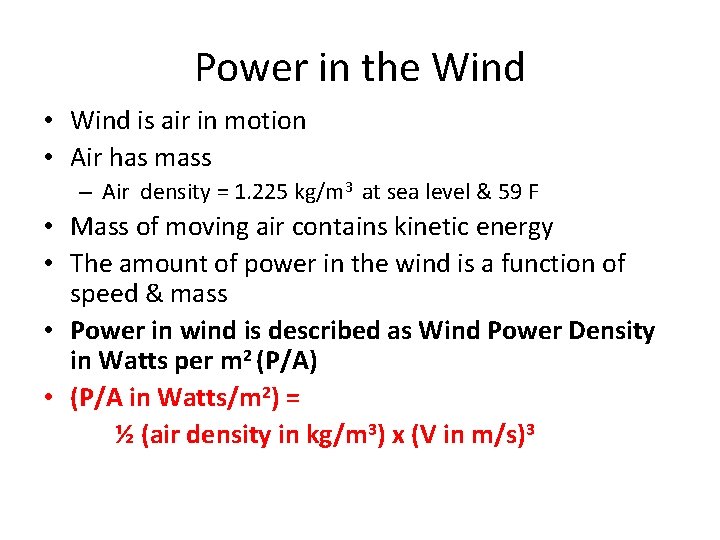
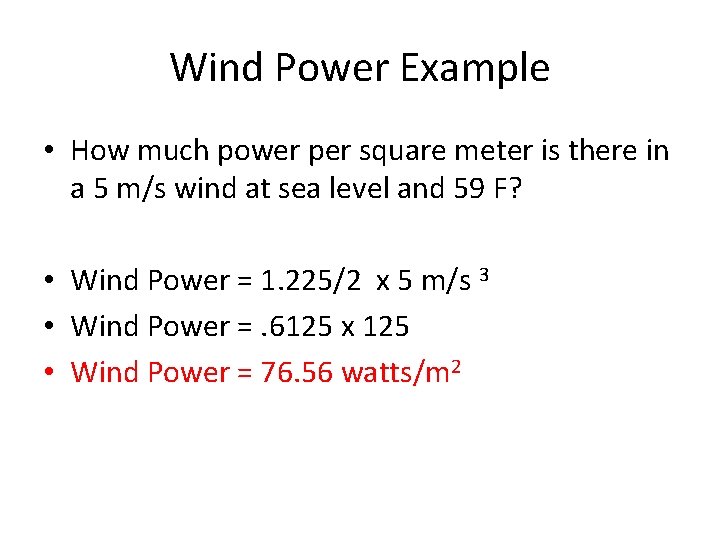
Power in the Wind • Wind is air in motion • Air has mass – Air density = 1. 225 kg/m 3 at sea level & 59 F • Mass of moving air contains kinetic energy • The amount of power in the wind is a function of speed & mass • Power in wind is described as Wind Power Density in Watts per m 2 (P/A) • (P/A in Watts/m 2) = ½ (air density in kg/m 3) x (V in m/s)3
Wind Power Example • How much power per square meter is there in a 5 m/s wind at sea level and 59 F? • Wind Power = 1. 225/2 x 5 m/s 3 • Wind Power =. 6125 x 125 • Wind Power = 76. 56 watts/m 2
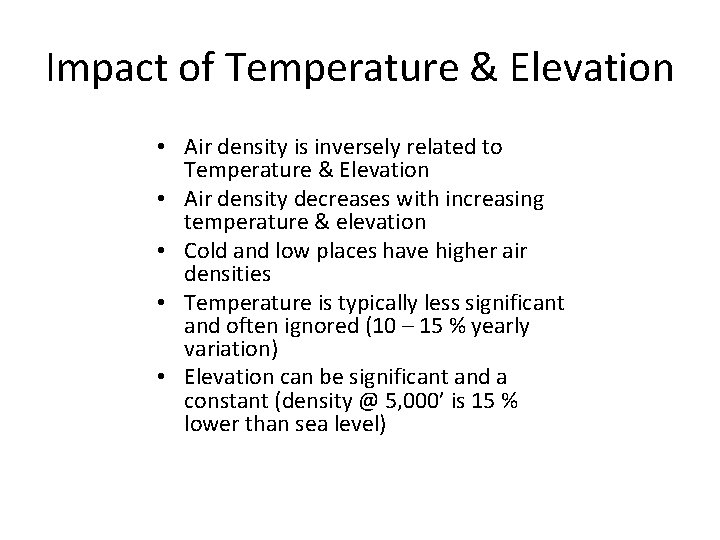
Impact of Temperature & Elevation • Air density is inversely related to Temperature & Elevation • Air density decreases with increasing temperature & elevation • Cold and low places have higher air densities • Temperature is typically less significant and often ignored (10 – 15 % yearly variation) • Elevation can be significant and a constant (density @ 5, 000’ is 15 % lower than sea level)
Air Density Changes with Elevation
Air Density Changes with Temperature
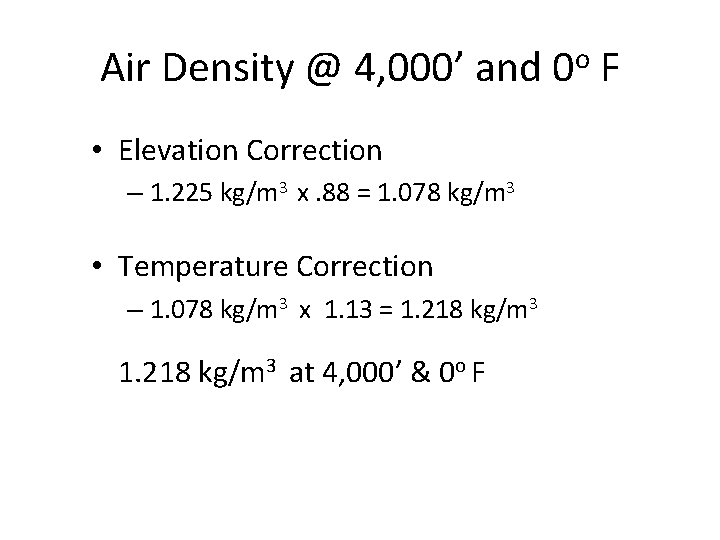
Air Density @ 4, 000’ and 0 o F • Elevation Correction – 1. 225 kg/m 3 x. 88 = 1. 078 kg/m 3 • Temperature Correction – 1. 078 kg/m 3 x 1. 13 = 1. 218 kg/m 3 at 4, 000’ & 0 o F
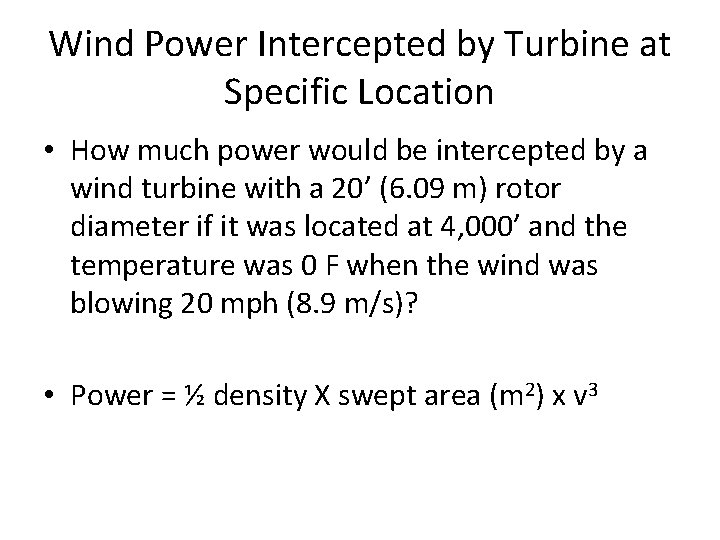
Wind Power Intercepted by Turbine at Specific Location • How much power would be intercepted by a wind turbine with a 20’ (6. 09 m) rotor diameter if it was located at 4, 000’ and the temperature was 0 F when the wind was blowing 20 mph (8. 9 m/s)? • Power = ½ density X swept area (m 2) x v 3
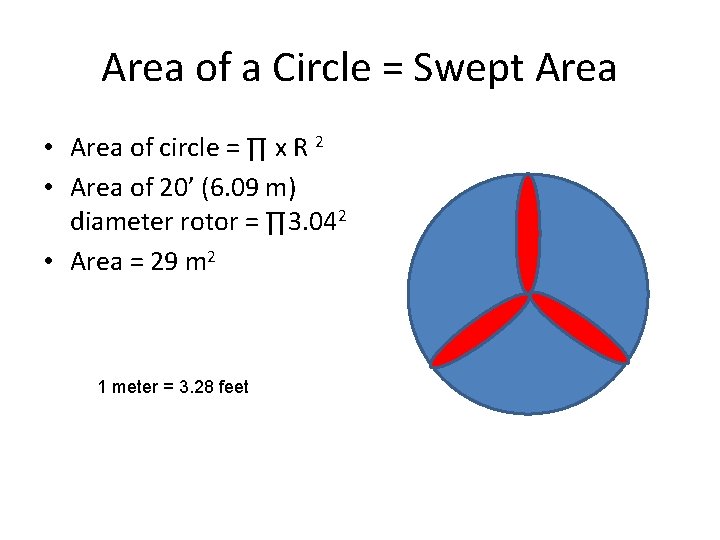
Area of a Circle = Swept Area • Area of circle = ∏ x R 2 • Area of 20’ (6. 09 m) diameter rotor = ∏ 3. 042 • Area = 29 m 2 1 meter = 3. 28 feet
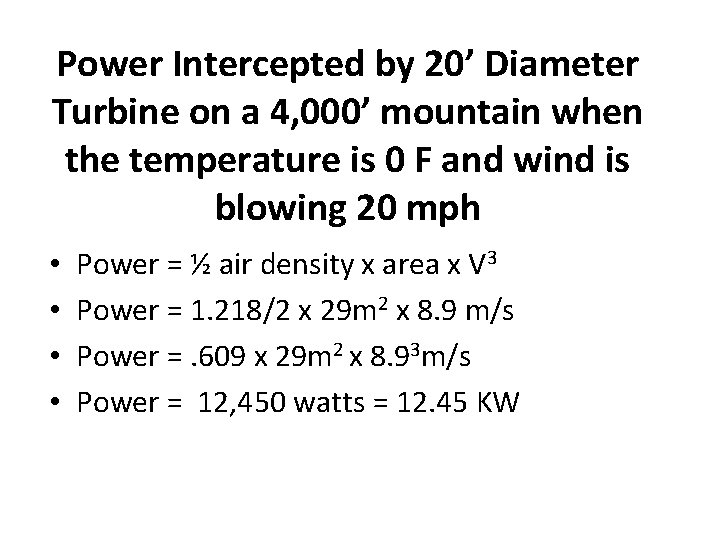
Power Intercepted by 20’ Diameter Turbine on a 4, 000’ mountain when the temperature is 0 F and wind is blowing 20 mph • • Power = ½ air density x area x V 3 Power = 1. 218/2 x 29 m 2 x 8. 9 m/s Power =. 609 x 29 m 2 x 8. 93 m/s Power = 12, 450 watts = 12. 45 KW
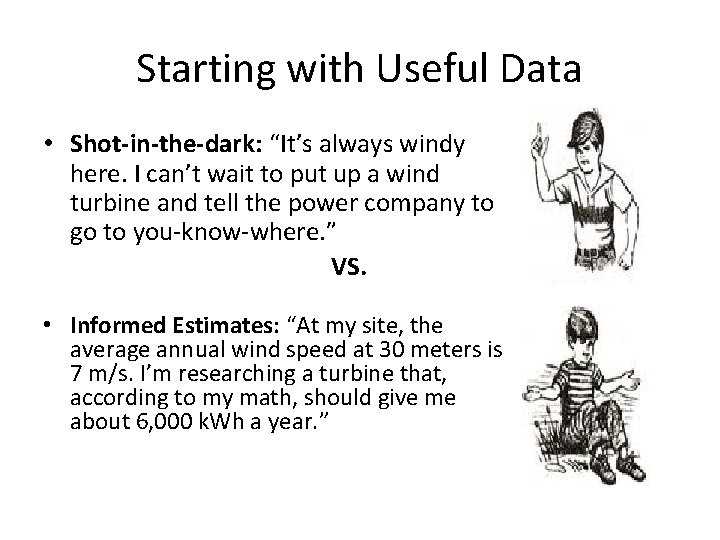
Starting with Useful Data • Shot-in-the-dark: “It’s always windy here. I can’t wait to put up a wind turbine and tell the power company to go to you-know-where. ” VS. • Informed Estimates: “At my site, the average annual wind speed at 30 meters is 7 m/s. I’m researching a turbine that, according to my math, should give me about 6, 000 k. Wh a year. ”
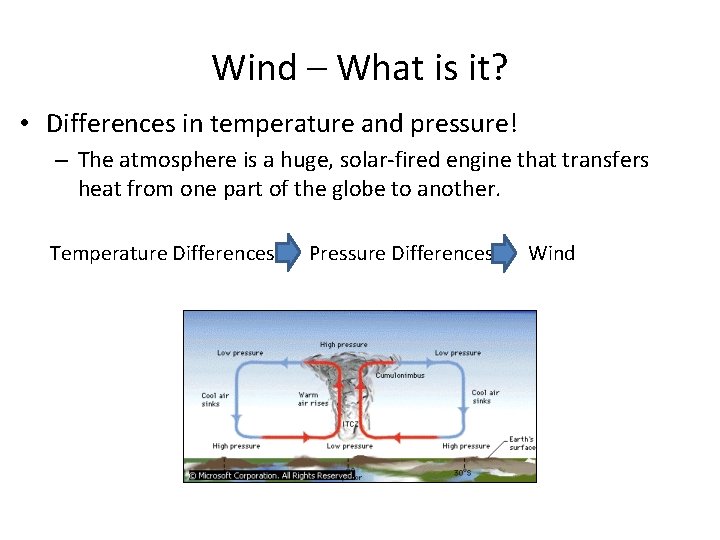
Wind – What is it? • Differences in temperature and pressure! – The atmosphere is a huge, solar-fired engine that transfers heat from one part of the globe to another. Temperature Differences Pressure Differences Wind
Wind – What is it? • This process repeats itself daily everywhere, working cyclically like the crankshaft in a car. • Sometimes this daily effect is overshadowed by large-scale low and high pressure events (fronts and storms) • Most of the wind we feel is caused by a pressure differential of only 1% • The strength of air movement can be accelerated or slowed by several key factors. . .
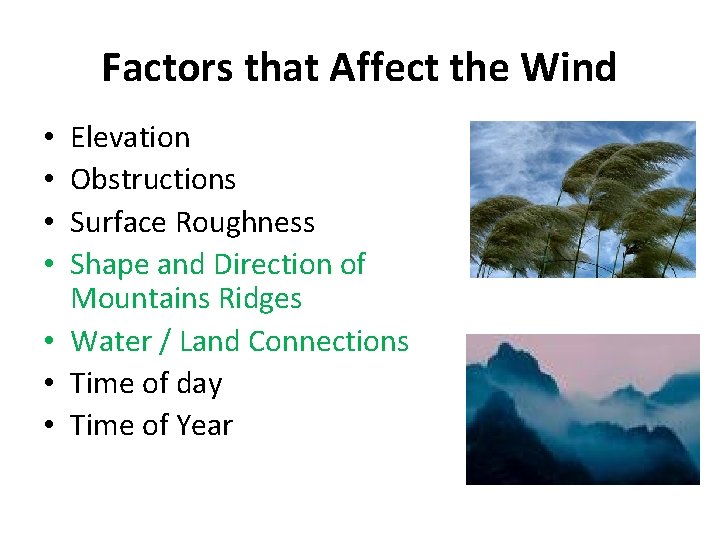
Factors that Affect the Wind Elevation Obstructions Surface Roughness Shape and Direction of Mountains Ridges • Water / Land Connections • Time of day • Time of Year • •
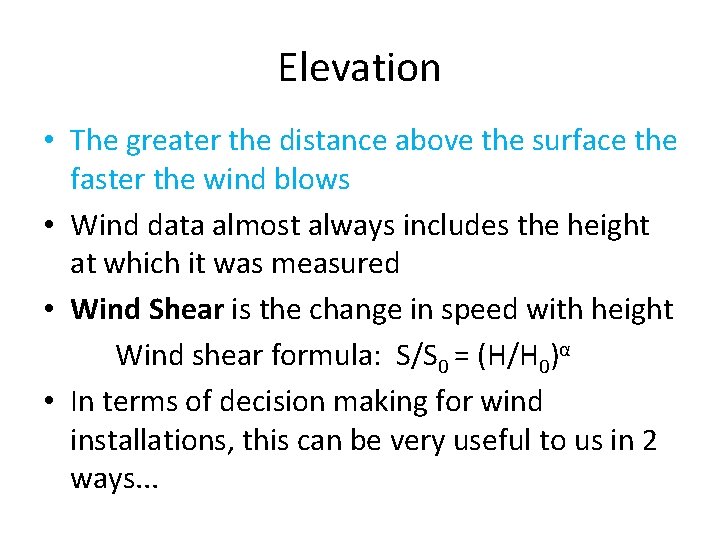
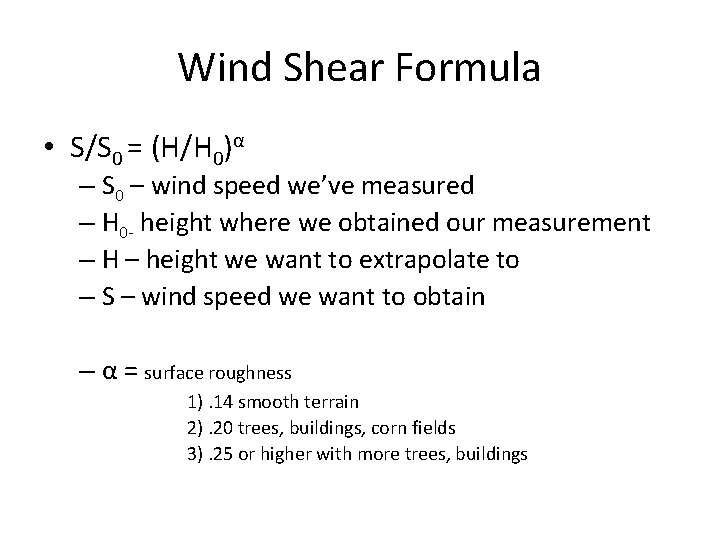
Elevation • The greater the distance above the surface the faster the wind blows • Wind data almost always includes the height at which it was measured • Wind Shear is the change in speed with height Wind shear formula: S/S 0 = (H/H 0)α • In terms of decision making for wind installations, this can be very useful to us in 2 ways. . .
Elevation & Wind Velocity in Western NC
Wind Speed and Power Increase with Height Above the Ground
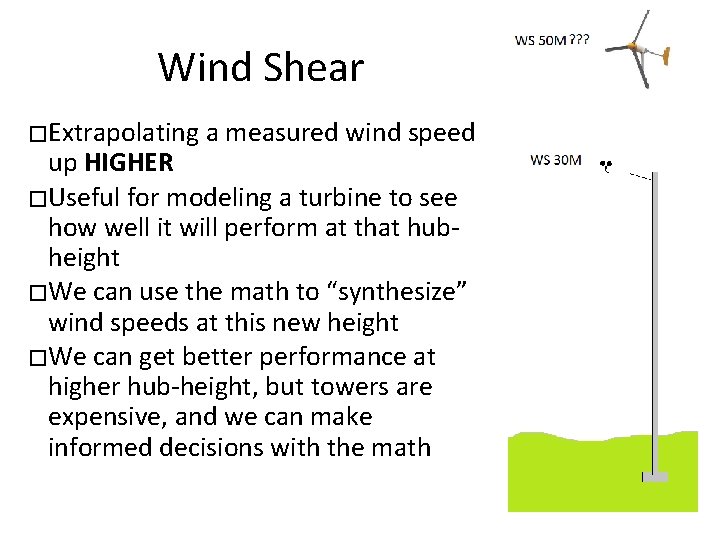
Wind Shear � Extrapolating a measured wind speed up HIGHER � Useful for modeling a turbine to see how well it will perform at that hubheight � We can use the math to “synthesize” wind speeds at this new height � We can get better performance at higher hub-height, but towers are expensive, and we can make informed decisions with the math
Wind Shear Formula • S/S 0 = (H/H 0)α – S 0 – wind speed we’ve measured – H 0 - height where we obtained our measurement – H – height we want to extrapolate to – S – wind speed we want to obtain – α = surface roughness 1). 14 smooth terrain 2). 20 trees, buildings, corn fields 3). 25 or higher with more trees, buildings
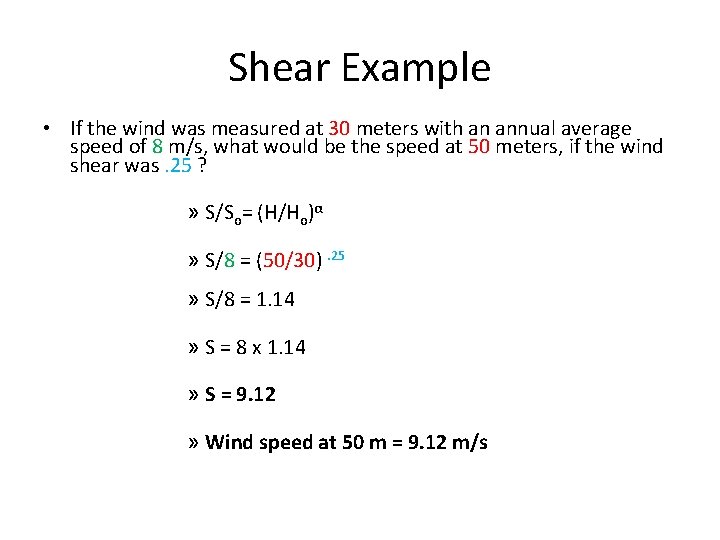
Shear Example • If the wind was measured at 30 meters with an annual average speed of 8 m/s, what would be the speed at 50 meters, if the wind shear was. 25 ? » S/So= (H/Ho)α » S/8 = (50/30). 25 » S/8 = 1. 14 » S = 8 x 1. 14 » S = 9. 12 » Wind speed at 50 m = 9. 12 m/s
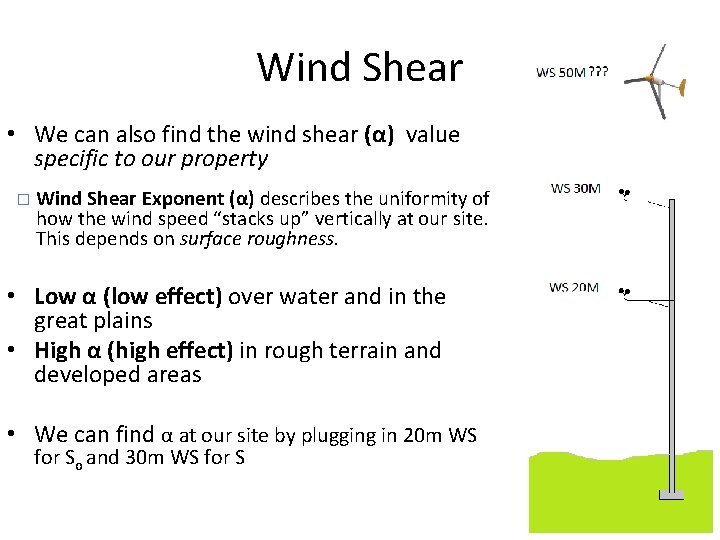
Wind Shear • We can also find the wind shear (α) value specific to our property � Wind Shear Exponent (α) describes the uniformity of how the wind speed “stacks up” vertically at our site. This depends on surface roughness. • Low α (low effect) over water and in the great plains • High α (high effect) in rough terrain and developed areas • We can find α at our site by plugging in 20 m WS for So and 30 m WS for S
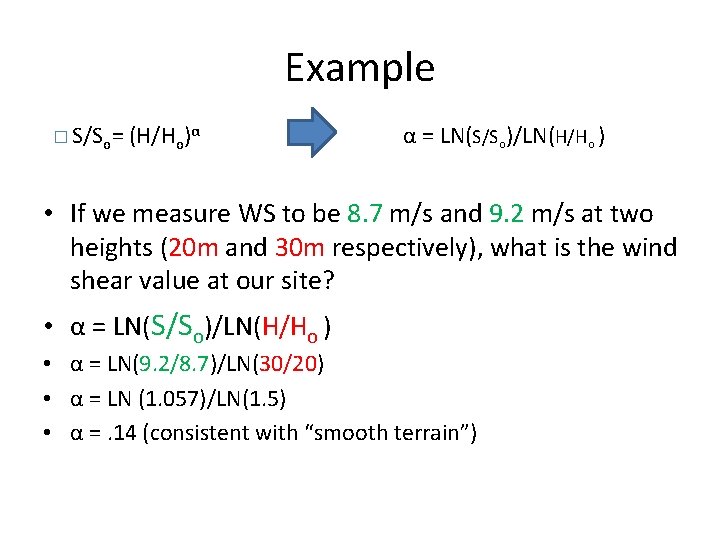
Example � S/So= (H/Ho)α α = LN(S/So)/LN(H/Ho ) • If we measure WS to be 8. 7 m/s and 9. 2 m/s at two heights (20 m and 30 m respectively), what is the wind shear value at our site? • α = LN(S/So)/LN(H/Ho ) • α = LN(9. 2/8. 7)/LN(30/20) • α = LN (1. 057)/LN(1. 5) • α =. 14 (consistent with “smooth terrain”)
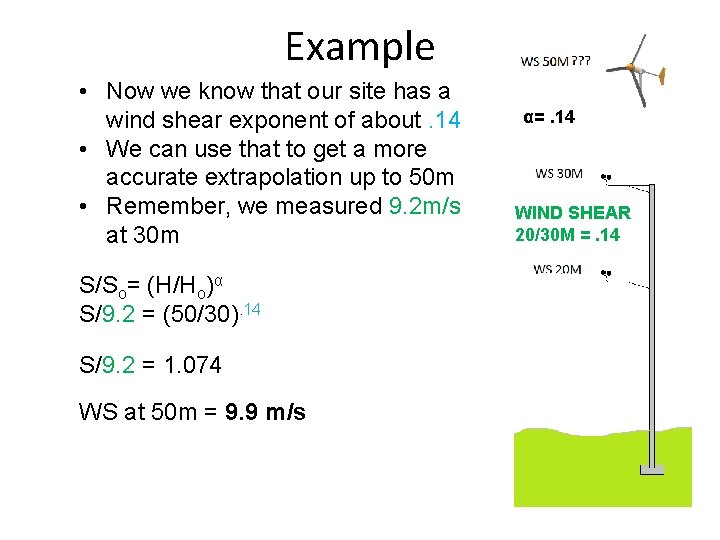
Example • Now we know that our site has a wind shear exponent of about. 14 • We can use that to get a more accurate extrapolation up to 50 m • Remember, we measured 9. 2 m/s at 30 m S/So= (H/Ho)α S/9. 2 = (50/30). 14 S/9. 2 = 1. 074 WS at 50 m = 9. 9 m/s α=. 14 WIND SHEAR 20/30 M =. 14
Factors that Affect the Wind • • Elevation Obstructions Surface Roughness Shape and Direction of Mountains Ridges Temperature Inversions Water / Land Connections Time of day Time of Year
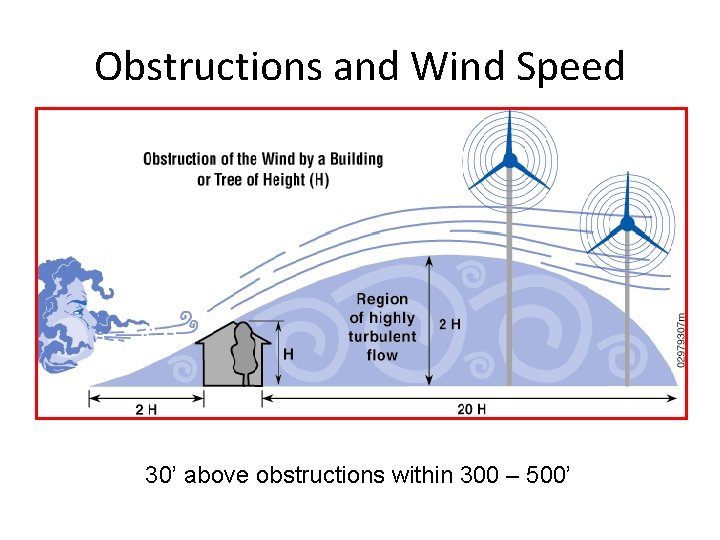
Obstructions and wind speed • Buildings, thick forests, and other manmade and natural obstructions create significant obstacles to the wind. • We can’t see it, but the region of disturbed flow downwind of an obstacle is twice the height of that obstacle and quite long. • For example, a 30 -ft tall house creates a region of turbulence that is 60 ft high and 600 ft long (2 football fields!).
Obstructions and Wind Speed 30’ above obstructions within 300 – 500’
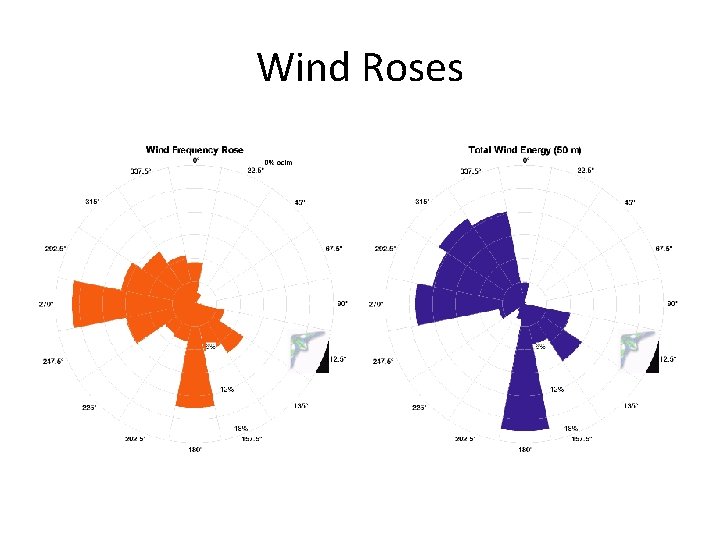
Wind Roses
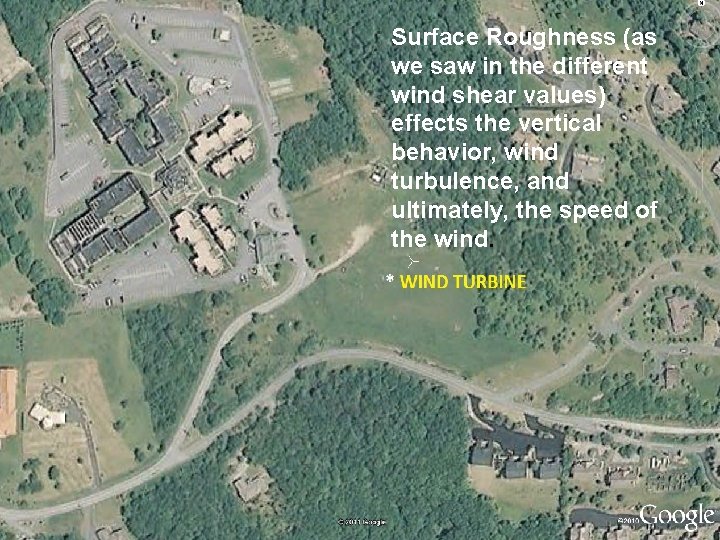
Surface Roughness (as we saw in the different wind shear values) effects the vertical behavior, wind turbulence, and ultimately, the speed of the wind.
Surface Roughness and wind speed • Frictional effects caused by surface roughness decrease as you get away from them (get higher) • And… the rate at which the wind speed increases (α) varies directly with how rough the surface is. • Flat and smooth = 1/7 or. 14 (the amount of friction applied to the wind by open ground) • Grass, crops, hedges, trees, buildings all impede moving air (through friction) as it interacts with the ground
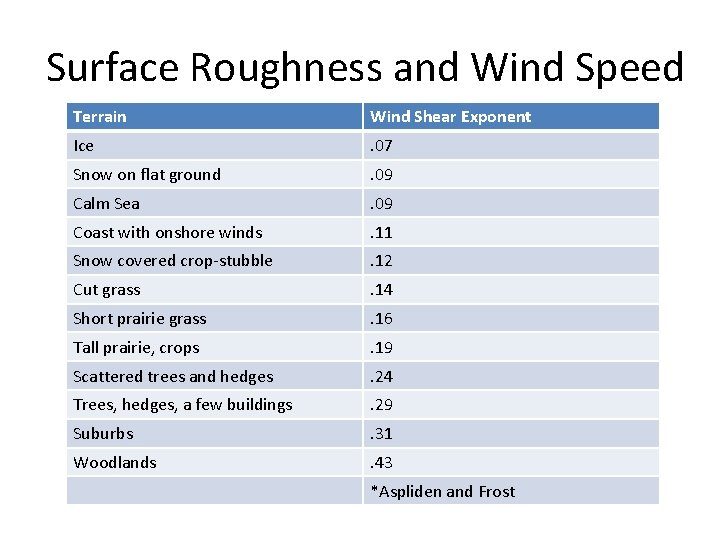
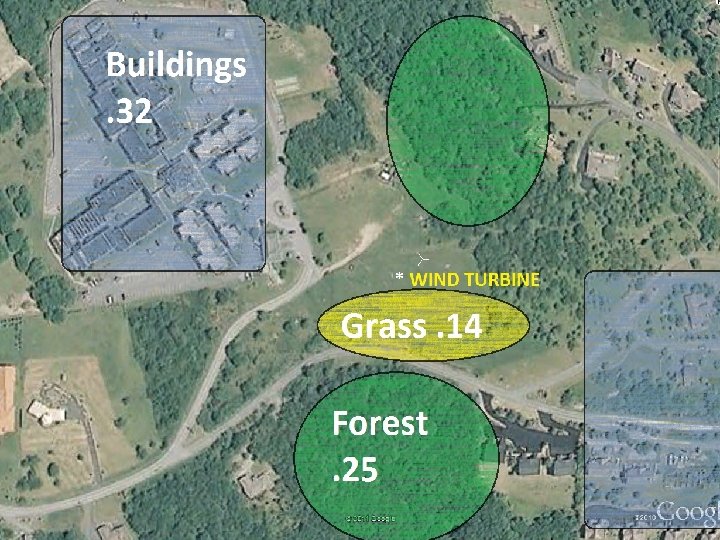
Surface Roughness and Wind Speed Terrain Wind Shear Exponent Ice . 07 Snow on flat ground . 09 Calm Sea . 09 Coast with onshore winds . 11 Snow covered crop-stubble . 12 Cut grass . 14 Short prairie grass . 16 Tall prairie, crops . 19 Scattered trees and hedges . 24 Trees, hedges, a few buildings . 29 Suburbs . 31 Woodlands . 43 *Aspliden and Frost
Factors that Affect the Wind Elevation Obstructions Surface Roughness Shape and Direction of Mountains Ridges • Water / Land Connections • Time of day • Time of Year • •
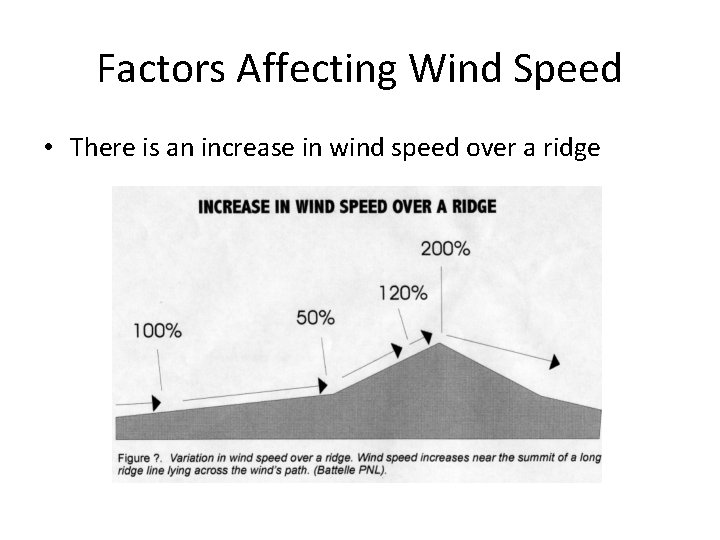
Factors Affecting Wind Speed • There is an increase in wind speed over a ridge
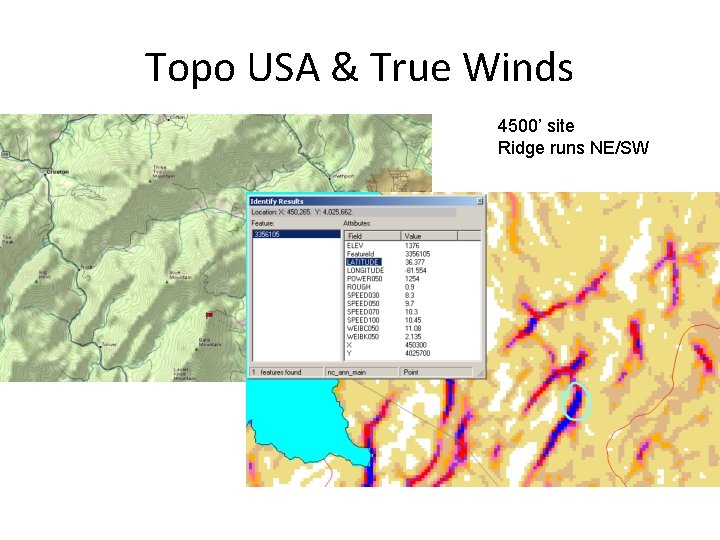
Topo USA & True Winds 4500’ site Ridge runs NE/SW
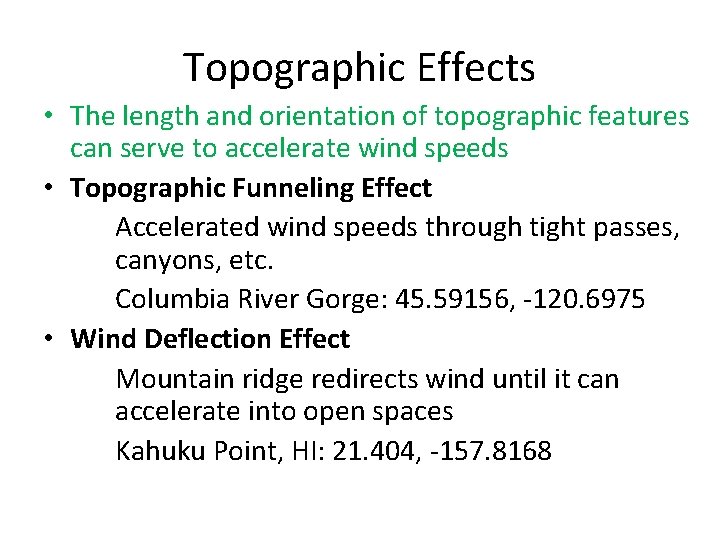
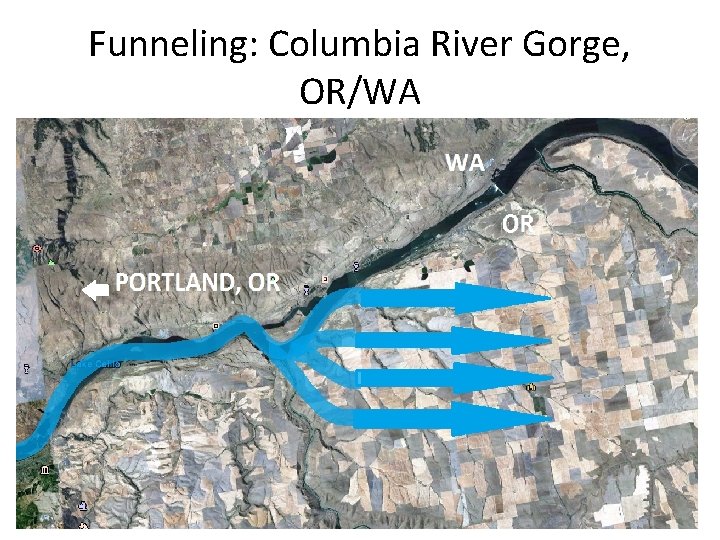
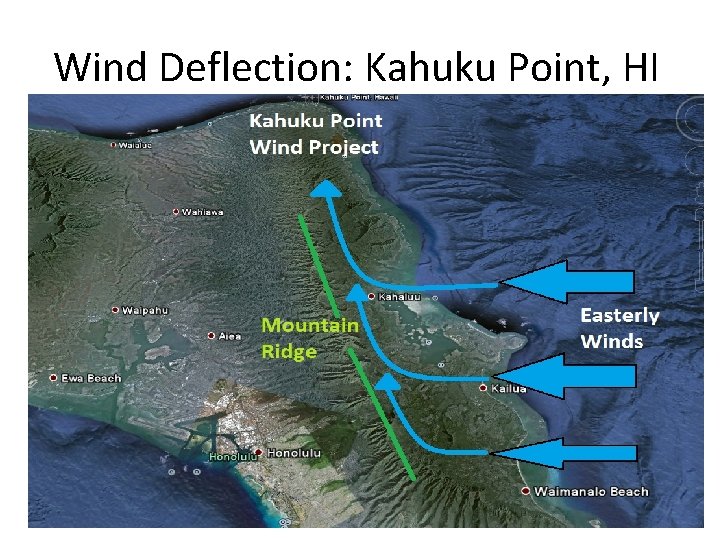
Topographic Effects • The length and orientation of topographic features can serve to accelerate wind speeds • Topographic Funneling Effect Accelerated wind speeds through tight passes, canyons, etc. Columbia River Gorge: 45. 59156, -120. 6975 • Wind Deflection Effect Mountain ridge redirects wind until it can accelerate into open spaces Kahuku Point, HI: 21. 404, -157. 8168
Funneling: Columbia River Gorge, OR/WA
Wind Deflection: Kahuku Point, HI
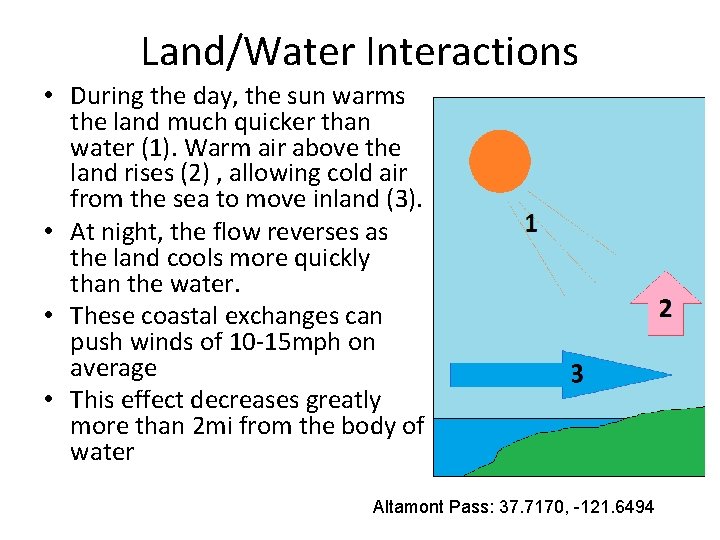
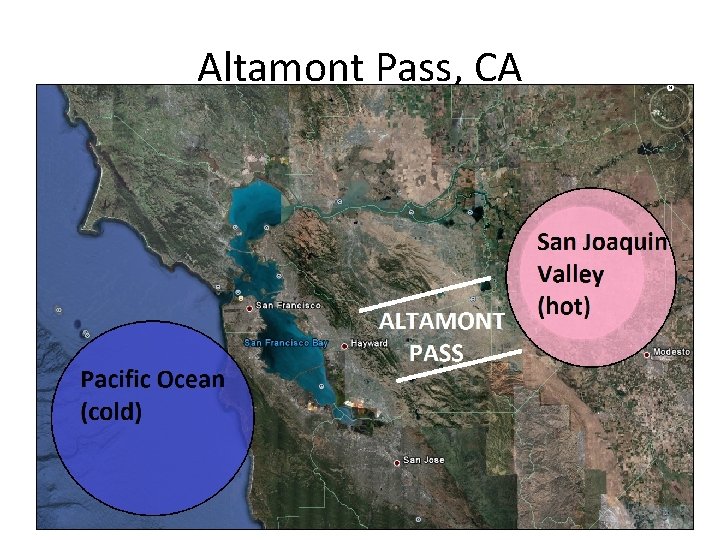
Land/Water Interactions • During the day, the sun warms the land much quicker than water (1). Warm air above the land rises (2) , allowing cold air from the sea to move inland (3). • At night, the flow reverses as the land cools more quickly than the water. • These coastal exchanges can push winds of 10 -15 mph on average • This effect decreases greatly more than 2 mi from the body of water Altamont Pass: 37. 7170, -121. 6494
Altamont Pass, CA
Factors that Affect the Wind • • Elevation Obstructions Surface Roughness Shape and Direction of Mountains Ridges Temperature Inversions Water / Land Connections Time of day Time of Year
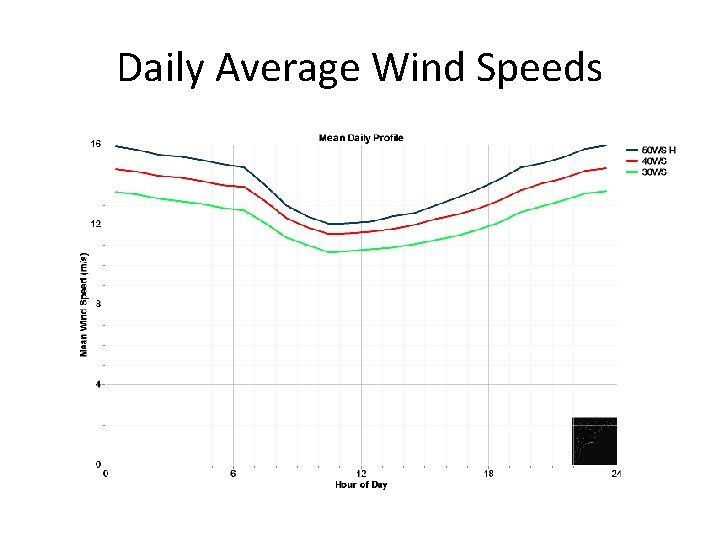
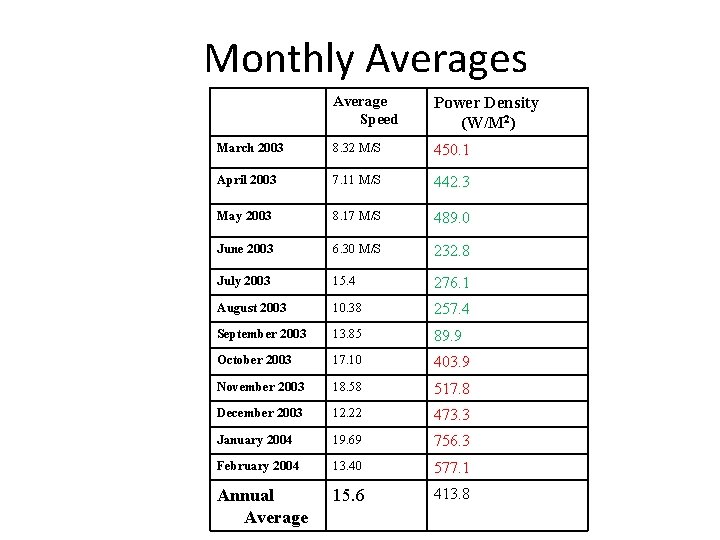
Time of Day/Time of Year and Wind • Average annual wind speed is important, but not very descriptive. Wind varies greatly through the year and through the day. • Monthly Pattern: Generally, summer and fall winds are light (driven mostly by convection cycle) and increase in winter and spring (storms and fronts). • Diurnal (daily) Pattern: Wind speeds often increase in the morning and late evening after convective circulation has been set in motion.
Daily Average Wind Speeds
Monthly Average Wind Speeds
Monthly Averages Average Speed Power Density (W/M 2) March 2003 8. 32 M/S 450. 1 April 2003 7. 11 M/S 442. 3 May 2003 8. 17 M/S 489. 0 June 2003 6. 30 M/S 232. 8 July 2003 15. 4 276. 1 August 2003 10. 38 257. 4 September 2003 13. 85 89. 9 October 2003 17. 10 403. 9 November 2003 18. 58 517. 8 December 2003 12. 22 473. 3 January 2004 19. 69 756. 3 February 2004 13. 40 577. 1 Annual Average 15. 6 413. 8
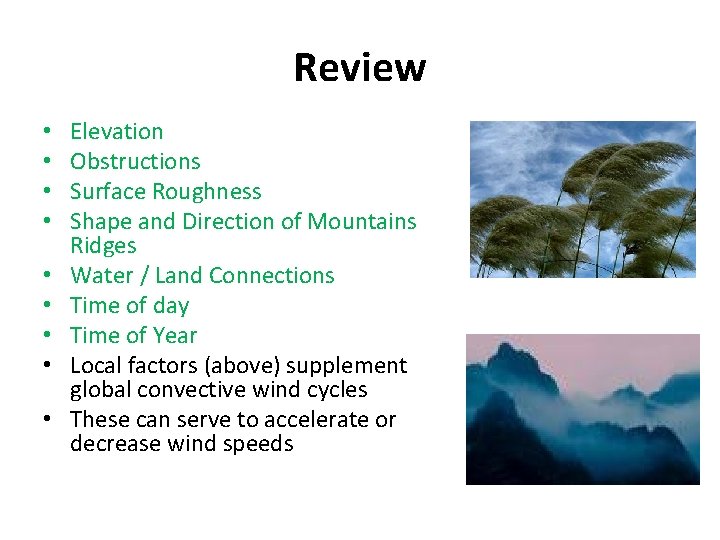
Review • • • Elevation Obstructions Surface Roughness Shape and Direction of Mountains Ridges Water / Land Connections Time of day Time of Year Local factors (above) supplement global convective wind cycles These can serve to accelerate or decrease wind speeds