
Wind Observations in the Global Observing System a
Wind Observations in the Global Observing System – a WMO Perspective Lidar Working Group Meeting, Miami, Feb 8 -9 2011 Lars Peter Riishojgaard, Chair CBS OPAG-IOS and Jerome Lafeuille, Observing Systems Division, WMO
Outline • Mass and wind in the Global Observing System • WMO, WWW and the GOS • The WMO Rolling Requirements Review – • CBS, OPAG-IOS, Expert Teams, Workshops WMO Vision for the GOS in 2025 Lidar Working Group, Miami, Feb 8 -9 2011 2
Upper-air observation requirements for NWP • Numerical weather prediction requires independent and global observations of the mass (temperature) and wind fields • The global three-dimensional mass field is well observed from space • No existing space-based observing system provides vertically resolved wind information => horizontal coverage of wind profiles is sparse • The lack of wind measurements is widely believed to be one of the main limiting factors for progress in NWP skill at all temporal ranges – Especially critical as we progress to smaller and smaller scales where wind/mass balance assumptions break down 3
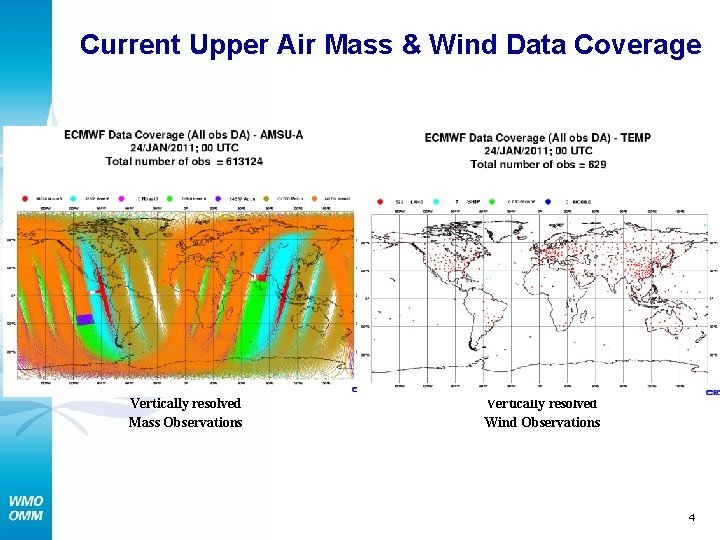
Current Upper Air Mass & Wind Data Coverage Vertically resolved Mass Observations Vertically resolved Wind Observations 4
WMO, WWW and the GOS • WMO: World Meteorological Organization; a specialized agency of the United Nations; the UN system's authoritative voice on meteorology, climatology, hydrology – WWW, World Weather Watch: Core WMO programme since 1963; observing systems, information systems and telecommunication facilities, and data-processing and forecasting centres; backbone for efficient meteorological and hydrological services, worldwide – Key WWW components: • GTS; Global Telecommunications System • GOS; Global Observing System Lidar Working Group, Miami, Feb 8 -9 2011 5

WMO Global Observing System • Coordinated system of methods and facilities for making meteorological and other environmental observations on a global scale in support of all WMO Programmes – – – Surface stations Upper-air network Marine observations Aircraft Satellite systems • Owned and operated by WMO member states on behalf of WMO; subject to WMO Regulatory Materials • Rolling Requirements Review: WMO process for capturing and vetting requirements for the GOS Lidar Working Group, Miami, Feb 8 -9 2011 6
The Rolling Requirements Review (RRR) in the WMO structure • Commission for Basic Systems; one of eight WMO Technical Commissions. President: Fred Branski, NOAA/NWS – … – OPAG for the Integrated Observing System; one of four OPAGs under CBS. Chair: L. P. Riishojgaard, JCSDA • … • Expert Team on the Evolution of the Global Observing System; one of six Expert Teams under OPAG-IOS. Chair: John Eyre, Met Office – Requirements database (by application area) for Global NWP, Regional NWP, Nowcasting, Agrometeorology, etc. – Capabilities database (by observing system), e. g. RAOBS, GEO imagers, AMDAR, buoys, etc. – Gap analysis; Statements of Guidance – Implementation plan – Vision for the GOS in 2025 Lidar Working Group, Miami, Feb 8 -9 2011 7
RRR (I) • ET-EGOS – Meets once a year in Geneva – Responsible for all requirements, all application areas – Interacts with other CBS Expert Teams, teams from other WMO Technical Commissions and co-sponsored programs (e. g. GCOS) • WMO Rapporteur on Scientific Evaluation of Impact Studies (formerly Rapporteur on OSEs and OSSEs) – Responsible for gathering community input specifically on NWP • WMO Workshop on the Impact of Various Observing Systems on NWP – Every four years, by invitation only, organized by Rapporteur on SEIS and OPAG-IOS – All major NWP Centers meet to compare impacts of all major elements of the GOS – OSEs and adjoint sensitivity diagnostics – (Next Workshop: May 29 – June 1, 2012 in the US; venue TBD) Lidar Working Group, Miami, Feb 8 -9 2011 8
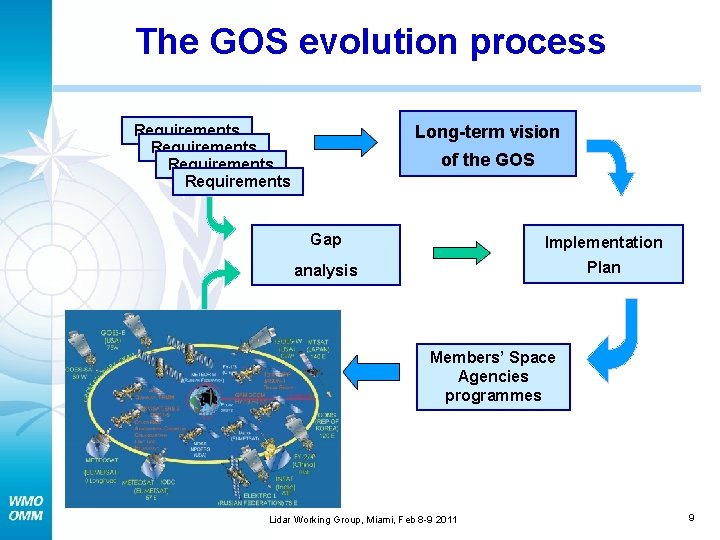
The GOS evolution process Long-term vision Requirements of the GOS Gap Implementation analysis Plan Members’ Space Agencies programmes Lidar Working Group, Miami, Feb 8 -9 2011 9
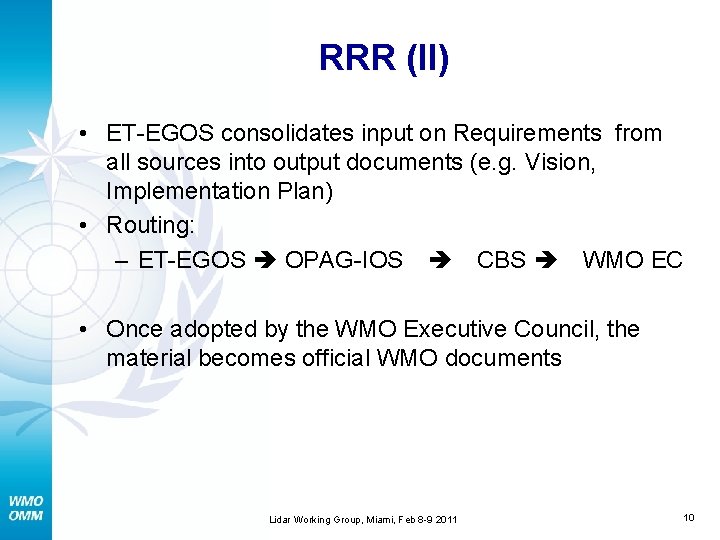
RRR (II) • ET-EGOS consolidates input on Requirements from all sources into output documents (e. g. Vision, Implementation Plan) • Routing: – ET-EGOS OPAG-IOS CBS WMO EC • Once adopted by the WMO Executive Council, the material becomes official WMO documents Lidar Working Group, Miami, Feb 8 -9 2011 10
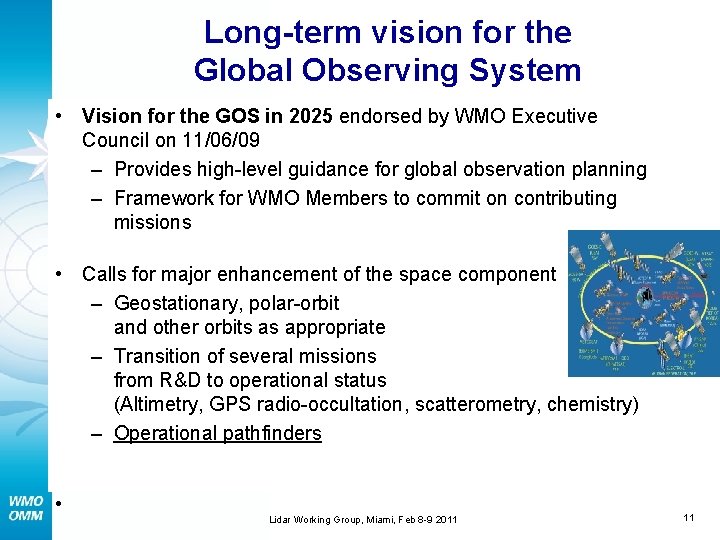
Long-term vision for the Global Observing System • Vision for the GOS in 2025 endorsed by WMO Executive Council on 11/06/09 – Provides high-level guidance for global observation planning – Framework for WMO Members to commit on contributing missions • Calls for major enhancement of the space component – Geostationary, polar-orbit and other orbits as appropriate – Transition of several missions from R&D to operational status (Altimetry, GPS radio-occultation, scatterometry, chemistry) – Operational pathfinders • Lidar Working Group, Miami, Feb 8 -9 2011 11
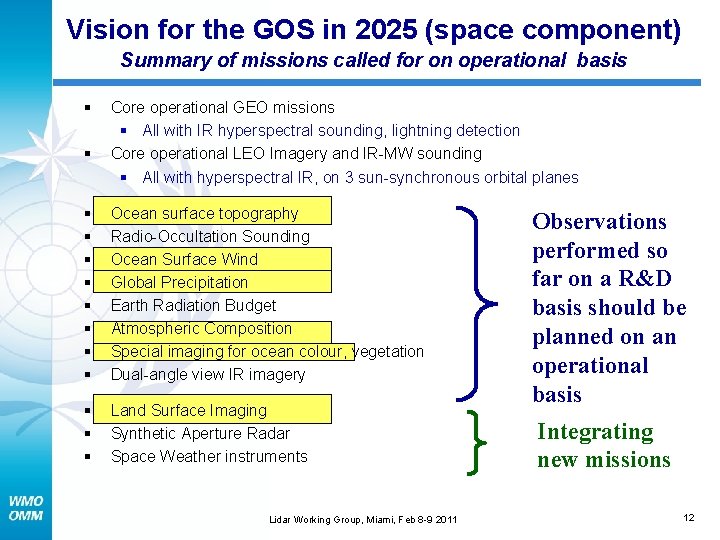
Vision for the GOS in 2025 (space component) Summary of missions called for on operational basis § § Core operational GEO missions § All with IR hyperspectral sounding, lightning detection Core operational LEO Imagery and IR-MW sounding § All with hyperspectral IR, on 3 sun-synchronous orbital planes § § § § Ocean surface topography Radio-Occultation Sounding Ocean Surface Wind Global Precipitation Earth Radiation Budget Atmospheric Composition Special imaging for ocean colour, vegetation Dual-angle view IR imagery § § § Land Surface Imaging Synthetic Aperture Radar Space Weather instruments Lidar Working Group, Miami, Feb 8 -9 2011 Observations performed so far on a R&D basis should be planned on an operational basis Integrating new missions 12
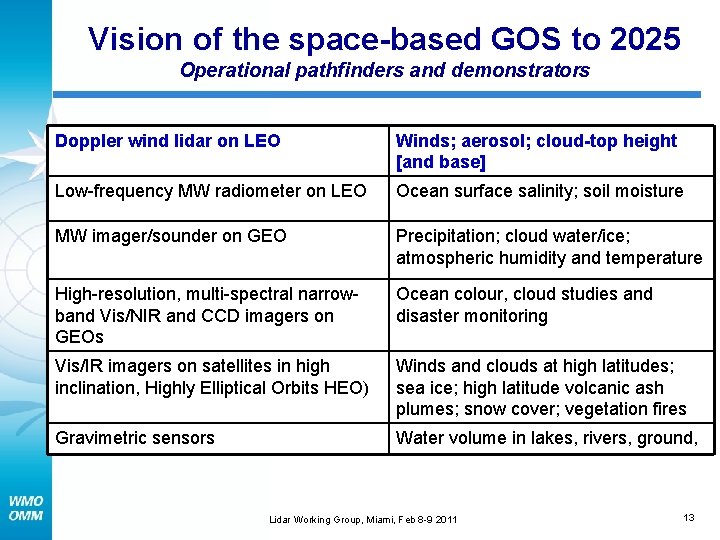
Vision of the space-based GOS to 2025 Operational pathfinders and demonstrators Doppler wind lidar on LEO Winds; aerosol; cloud-top height [and base] Low-frequency MW radiometer on LEO Ocean surface salinity; soil moisture MW imager/sounder on GEO Precipitation; cloud water/ice; atmospheric humidity and temperature High-resolution, multi-spectral narrowband Vis/NIR and CCD imagers on GEOs Ocean colour, cloud studies and disaster monitoring Vis/IR imagers on satellites in high inclination, Highly Elliptical Orbits HEO) Winds and clouds at high latitudes; sea ice; high latitude volcanic ash plumes; snow cover; vegetation fires Gravimetric sensors Water volume in lakes, rivers, ground, Lidar Working Group, Miami, Feb 8 -9 2011 13
Summary • As of June 2009, space-based wind lidars as operational pathfinders are part of the official WMO Vision for the Global Observing System 2025 – This means that the heads of the National Meteorogical and Hydrological Services of the WMO member states have signed off on this • WMO does not own or implement satellite systems – Requirements, performance databases and gap analysis lead to implementation plan and vision – Can act as a forcing function on national and international implementation plans Lidar Working Group, Miami, Feb 8 -9 2011 14
- Slides: 14