
Wind Loads The Nature of Wind CE 694
- Slides: 12
Wind Loads: The Nature of Wind CE 694 R – Fall 2007 T. Bart Quimby, P. E. , Ph. D. UAA Civil Engineering Quimby & Associates
Methods of Research n Field Observations n FEMA funds recognizance teams to visit disaster sites. n Data collected from field observations has improved with the advent of video cameras! n Experimental n Wind Tunnel Studies. n Computational n Computation Fluid Mechanics requires huge amounts of computing capacity. UAA Civil Engineering
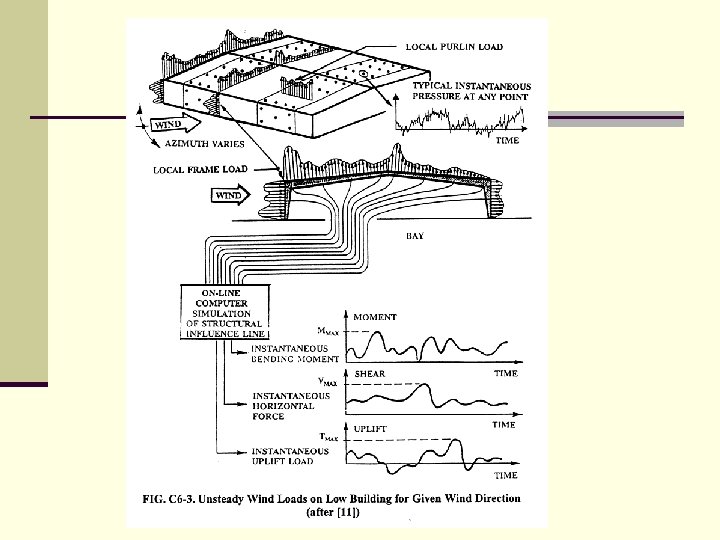
The Nature of Wind n Wind is chaotic n Wind speed varies considerably at any given instant in time. n Wind speed generally increases with height n Gust size varies along wind, across wind, and vertical n We try to make sense out of this chaos with general approximations. UAA Civil Engineering
UAA Civil Engineering
UAA Civil Engineering
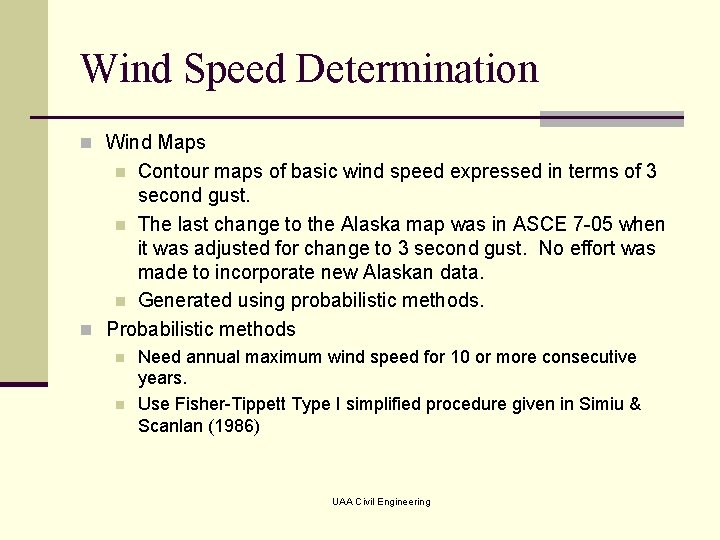
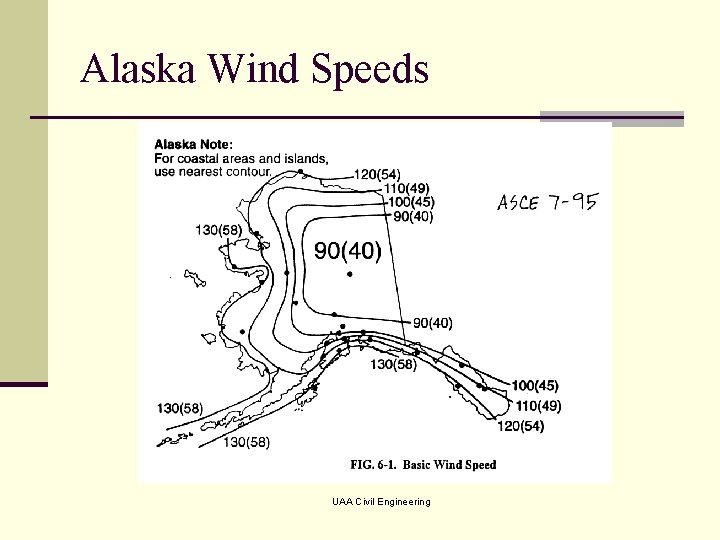
Wind Speed Determination n Wind Maps Contour maps of basic wind speed expressed in terms of 3 second gust. n The last change to the Alaska map was in ASCE 7 -05 when it was adjusted for change to 3 second gust. No effort was made to incorporate new Alaskan data. n Generated using probabilistic methods. n Probabilistic methods n n n Need annual maximum wind speed for 10 or more consecutive years. Use Fisher-Tippett Type I simplified procedure given in Simiu & Scanlan (1986) UAA Civil Engineering
Alaska Wind Speeds UAA Civil Engineering
Measurement of Wind Speed n Old methods measured wind in terms of “fastest-mile” at 10 m (33') above ground at Exposure C. n Current methods of determining wind speed is in terms of “ 3 - second gust” speed. n Important to know basis for wind speed n n Wind speeds used in designs prior to ASCE 7 -95 are not directly comparable to wind speeds in current designs. 75 mph “fastest-mile” = 90 mph “ 3 -second gust” Hurricane 120 mph “fastest-mile” = 152 mph “ 3 -sec. gust” See ASCE 7 -95 Commentary 6. 5. 2. n ASCE 7 -95 and later uses 3 second gust speeds. n Basic Wind Speed is determined for a 50 -yr mean recurrence interval (MRI). n Can convert to other MRI using ASCE 7 -05 Table C 6 -7. UAA Civil Engineering
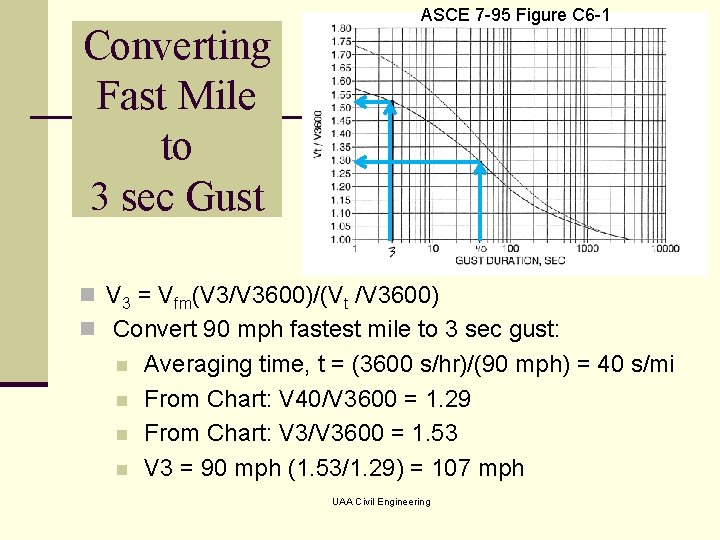
Converting Fast Mile to 3 sec Gust ASCE 7 -95 Figure C 6 -1 n V 3 = Vfm(V 3/V 3600)/(Vt /V 3600) n Convert 90 mph fastest mile to 3 sec gust: n n Averaging time, t = (3600 s/hr)/(90 mph) = 40 s/mi From Chart: V 40/V 3600 = 1. 29 From Chart: V 3/V 3600 = 1. 53 V 3 = 90 mph (1. 53/1. 29) = 107 mph UAA Civil Engineering
Variation of Wind Speed with Height n Ground obstructions retard the movement of air close to the ground surface, reducing wind speed n At some height above ground, the movement of air is no longer affected by ground obstruction. This is called Gradient Height, Zg, which is function of surface roughness. n ASCE 7 use an empirical power law equation to compute the variation in wind speed with height and surface roughness. n See ASCE 7 -05 Commentary 6. 5. 6. 6. UAA Civil Engineering
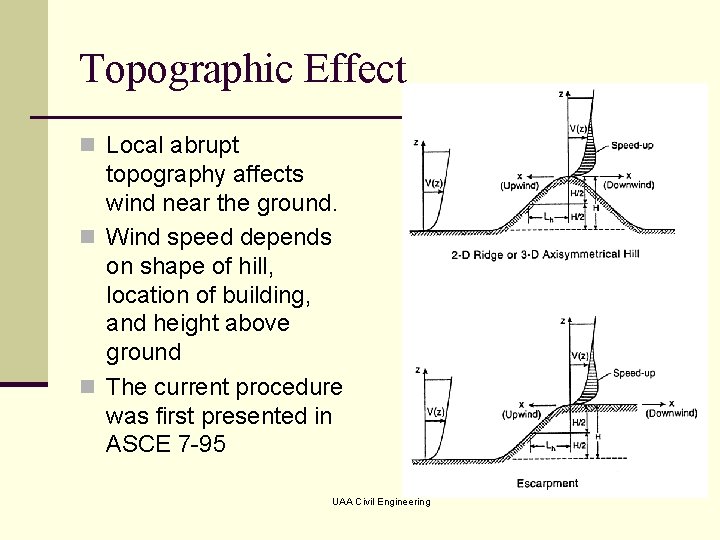
Topographic Effect n Local abrupt topography affects wind near the ground. n Wind speed depends on shape of hill, location of building, and height above ground n The current procedure was first presented in ASCE 7 -95 UAA Civil Engineering
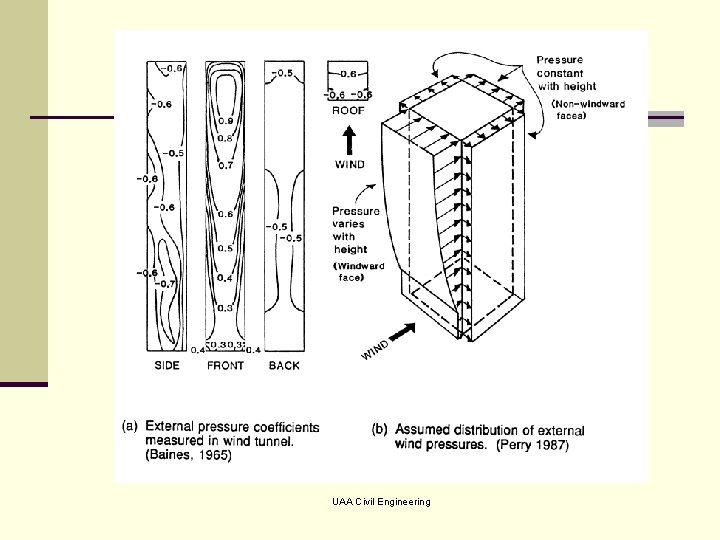
Wind/Structure Interaction n Aerodynamics: Pressure and Force Coefficients n Buffeting: Along-Wind Resonance n Only important for flexible structures. n Vortex Shedding n Not included in ASCE 7 n Aeroelastic: Galloping, Flutter n Requires wind tunnel testing UAA Civil Engineering