
Wind Atlas for South Africa WASA Andre Otto


![Extreme Wind Atlas 1: 50 yr 10 min wind speed [m/s] @ 10 m](https://slidetodoc.com/presentation_image/76cfc6ba624cd603c64c44354d2be0a8/image-13.jpg "Extreme Wind Atlas 1: 50 yr 10 min wind speed [m/s] @ 10 m")
- Slides: 20
Wind Atlas for South Africa (WASA) Andre Otto Renewable Energy Technical Advisor, SANEDI
Outline – – – – South Africa Energy Overview South Africa GHG Emissions Why Wind Resource Assessment Historical South African Wind Atlases Wind Atlas for South Africa (WASA) Project WASA method Wind Measurements for Verification Verified Numerical Wind Atlas High Resolution Wind Resource Map Application Extreme Wind Atlas Application Time Series Application WASA User Statistics Conclusion
South Africa Energy Overview
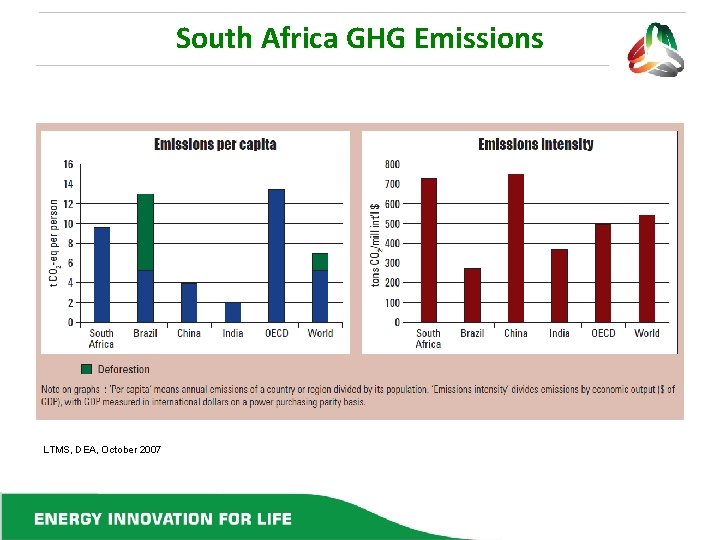
South Africa GHG Emissions LTMS, DEA, October 2007
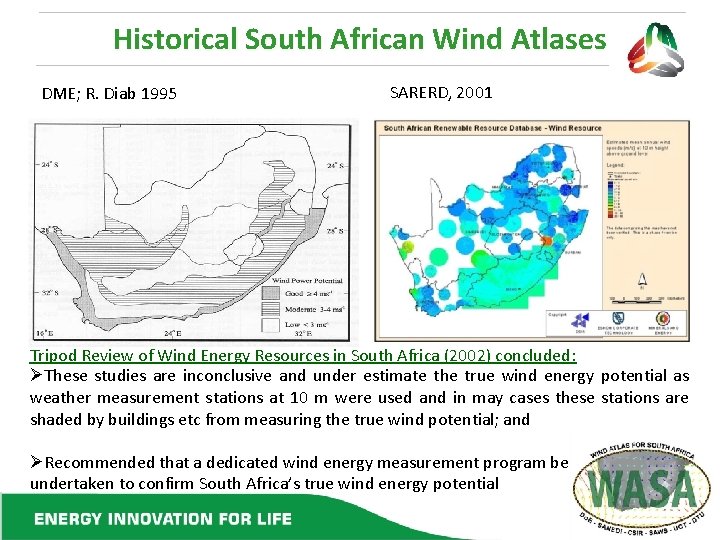
Historical South African Wind Atlases DME; R. Diab 1995 SARERD, 2001 Tripod Review of Wind Energy Resources in South Africa (2002) concluded: ØThese studies are inconclusive and under estimate the true wind energy potential as weather measurement stations at 10 m were used and in may cases these stations are shaded by buildings etc from measuring the true wind potential; and ØRecommended that a dedicated wind energy measurement program be undertaken to confirm South Africa’s true wind energy potential
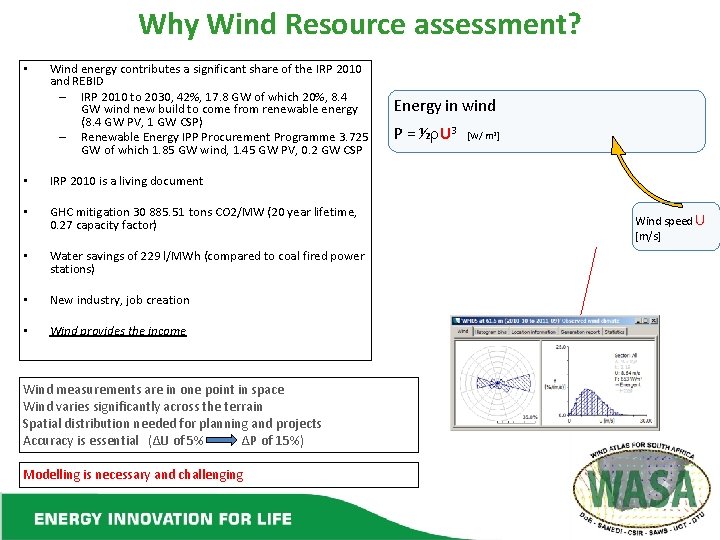
Why Wind Resource assessment? • Wind energy contributes a significant share of the IRP 2010 and REBID – IRP 2010 to 2030, 42%, 17. 8 GW of which 20%, 8. 4 GW wind new build to come from renewable energy (8. 4 GW PV, 1 GW CSP) – Renewable Energy IPP Procurement Programme 3. 725 GW of which 1. 85 GW wind, 1. 45 GW PV, 0. 2 GW CSP • IRP 2010 is a living document • GHC mitigation 30 885. 51 tons CO 2/MW (20 year lifetime, 0. 27 capacity factor) • Water savings of 229 l/MWh (compared to coal fired power stations) • New industry, job creation • Wind provides the income Wind measurements are in one point in space Wind varies significantly across the terrain Spatial distribution needed for planning and projects Accuracy is essential (ΔU of 5% ΔP of 15%) Modelling is necessary and challenging Energy in wind P = ½ U 3 [W/ m 2] Wind speed U [m/s]
Wind Atlas for South Africa (WASA) : The Wind Atlas for South Africa (WASA) project (2009 – 2014) is a Capacity Development and Research Cooperation Initiative of the South African Department of Energy (Do. E). Principal funders are: the Royal Danish Embassy DKK 9, 998, 441 and Global Environmental Facility (GEF) R 8 million through the South African Wind Energy Programme (SAWEP). SANEDI (South African National Energy Development Institute) – executing agency – contracting the implementing partners – coordination and dissemination UCT CSAG (Climate System Analysis Group, University of Cape Town) – mesoscale modelling CSIR (Built Environment, Council for Scientific and Industrial Research) – Measurements, microscale modelling, application SAWS (South African Weather Service) – extreme wind assessment DTU Wind Energy* (Dept of Wind Energy, Technical University of Denmark) – partner in all activities
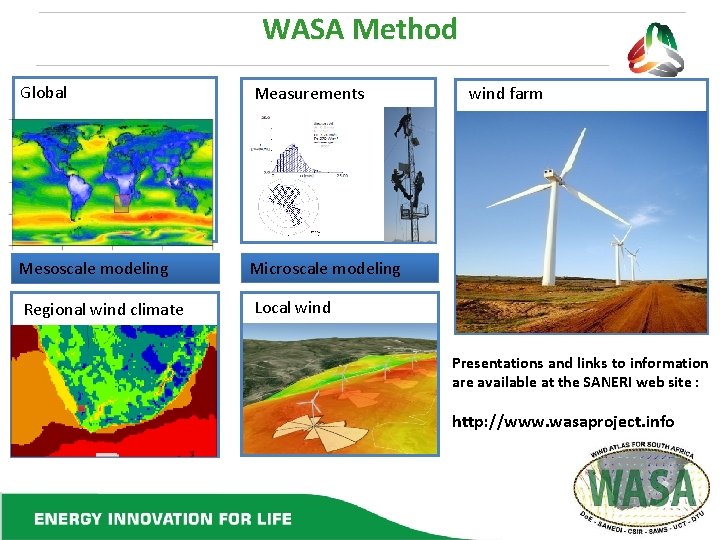
WASA Method Global Measurements wind farm G Mesoscale modeling Microscale modeling Regional wind climate Local wind Global wind resources Presentations and links to information are available at the SANERI web site : http: //www. wasaproject. info
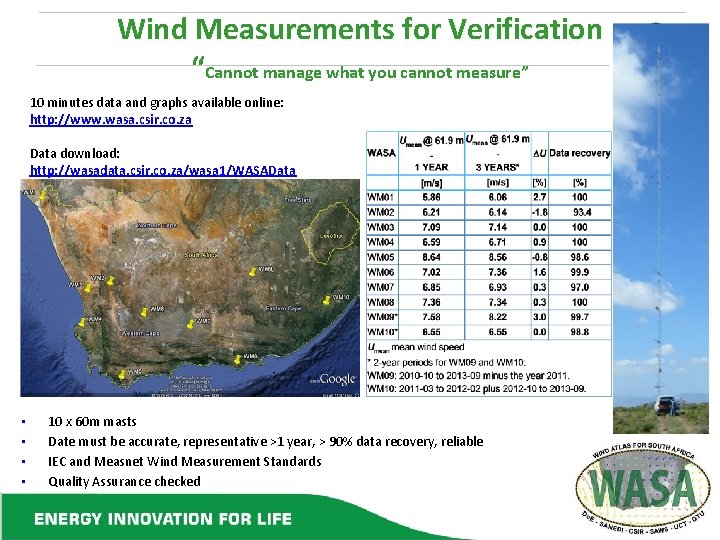
Wind Measurements for Verification “Cannot manage what you cannot measure” 10 minutes data and graphs available online: http: //www. wasa. csir. co. za Data download: http: //wasadata. csir. co. za/wasa 1/WASAData • • 10 x 60 m masts Date must be accurate, representative >1 year, > 90% data recovery, reliable IEC and Measnet Wind Measurement Standards Quality Assurance checked
Verified Numerical Wind Atlas (VNWA) for South Africa - WRF based April 2014 (generalised wind climate – flat terrain, 3 km x 3 km resolution) Database access through Tadpole (Google Earth) http: //wasaclimates. eu/Tadpole/Viewer? gid=08 aee 5 e 5 -e 31 f-416 a-ad 12 -9 a 7 a 4 d 26 f 92 e
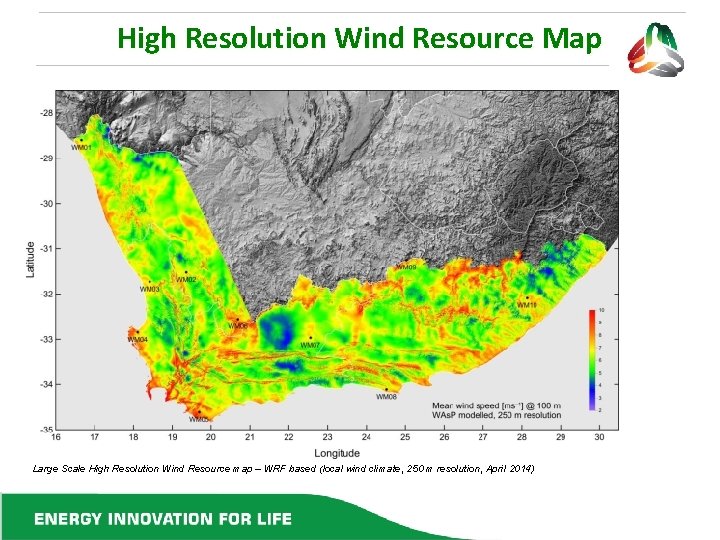
High Resolution Wind Resource Map Large Scale High Resolution Wind Resource map – WRF based (local wind climate, 250 m resolution, April 2014)
High Resolution Wind Resource Map Application The High Resolution Wind Resource Map depicts the local wind climate that a wind turbine would encounter and offers the following important benefits for developers, policy makers, utilities and industry: Ø Cost and timing savings as the bankability of a potential wind farm site can be estimated with known and traceable accuracy*; Ø Levels the playing field between small or large industry players to identify and develop project sites for wind farms*; Ø Assists the South African Government in estimating the potential yield of the wind energy resources; Ø Identification of potential wind development zones in line with the strategic environmental framework or assessments (SEA) studies (e. g. Dept Environmental Affairs SEA for Solar PV and Wind http: //www. csir. co. za/nationalwindsolarsea/ Ø Long-term grid planning. *Physical wind measurements are still required by financiers to confirm the bankability of a wind farm project at the identified site(s).
Extreme Wind Atlas 1: 50 yr 10 min wind speed [m/s] @ 10 m above ground level (standard conditions)
Extreme Wind Atlas Application Wind constitutes most critical environmental loading affecting structural design of built environment in South Africa and information on extreme winds is also essential in the design of wind farms – situated in areas with relatively strong winds. Providing input data (1: 50 yr 10 min average wind speed (standard conditions) in calculating the 10 minute average wind speed at hub height that is used to determine the Wind Turbine Class that would stand the extreme winds
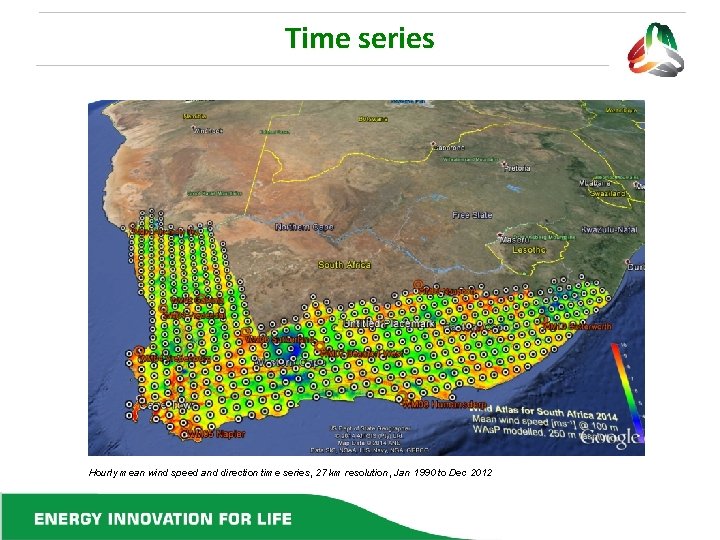
Time series Hourly mean wind speed and direction time series, 27 km resolution, Jan 1990 to Dec 2012
Time Series Application Study the annual, seasonal and diurnal variations in wind resources As input to power system modelling Study the geographical cross correlation of wind across South Africa Used for long-term correction of the wind resources given by the WRF wind climate files (“lib” files)
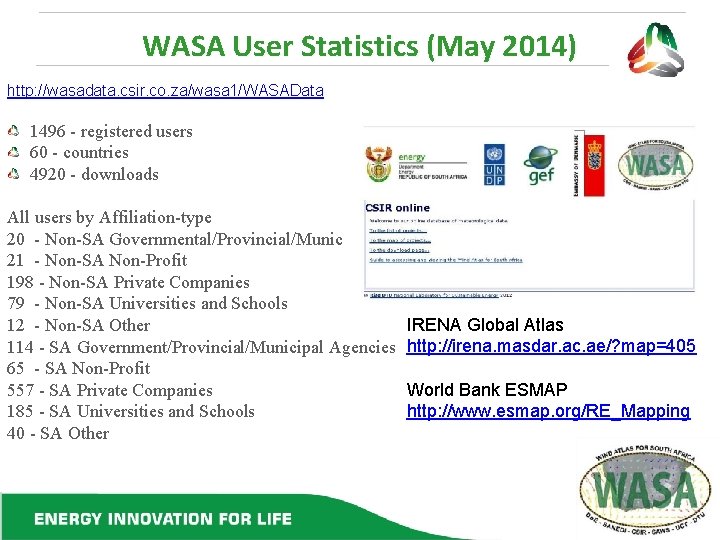
WASA User Statistics (May 2014) http: //wasadata. csir. co. za/wasa 1/WASAData 1496 - registered users 60 - countries 4920 - downloads All users by Affiliation-type 20 - Non-SA Governmental/Provincial/Municipal Agencies 21 - Non-SA Non-Profit 198 - Non-SA Private Companies 79 - Non-SA Universities and Schools IRENA Global Atlas 12 - Non-SA Other 114 - SA Government/Provincial/Municipal Agencies http: //irena. masdar. ac. ae/? map=405 65 - SA Non-Profit World Bank ESMAP 557 - SA Private Companies http: //www. esmap. org/RE_Mapping 185 - SA Universities and Schools 40 - SA Other
Conclusion ØState of the Art Wind Atlas method ØPublic domain through websites ØTransparent methodology no “black box” ØVerified with proper wind measurements, traceable ØData + Application, Guidelines ØLevel playing field ØSave time and money ØNot a substitution for mandatory wind measurements ØSouth Africa has an excellent wind resource that compares with the best in the world.
WASA Websites http: //www. wasaproject. info/ (information, presentations etc) http: //www. wasa. csir. co. za (wind measurement mast online graphs) http: //wasadata. csir. co. za/wasa 1/WASAData (data downloads) WRF http: //veaonline. risoe. dk/wasa (WRF wind forecasting) Numerical Wind Atlas database access through Tadpole (Google Earth) http: //wasaclimates. eu/Tadpole/Viewer? gid=08 aee 5 e 5 -e 31 f-416 a-ad 12 -9 a 7 a 4 d 26 f 92 e
ept of Energy oma Qase rector Renewable Energy l: +27 (0)12 406 7687 el: ell: +27(0)79 889 9225 oma. qase@energy. gov. za Thank you andreo@sanedi. org. za +27 (0)82 877 0128 SANEDI Dr Thembakazi Mali Senior Manager: Clean Energy Solutions Tel. +27 (0)10 201 4782 Cell. +27 (0)82 326 9501 thembakazim@sanedi. org. za