
WIND AND SOLAR ENERGY CONVERSION MODEL GUIDELINES CONSULTATION
- Slides: 13
WIND AND SOLAR ENERGY CONVERSION MODEL GUIDELINES CONSULTATION UPDATE – SEPTEMBER 2016 26 September 2016 PRESENTED BY MARCELLE GANNON SLIDE 1
SESSION OVERVIEW • Status of Consultation Process • Local Limit and Wind Speed Changes • Extreme Wind Cut-out / Other Cut-out • “Possible Power” / “Estimated Power” Proposal • Next Steps SLIDE 2
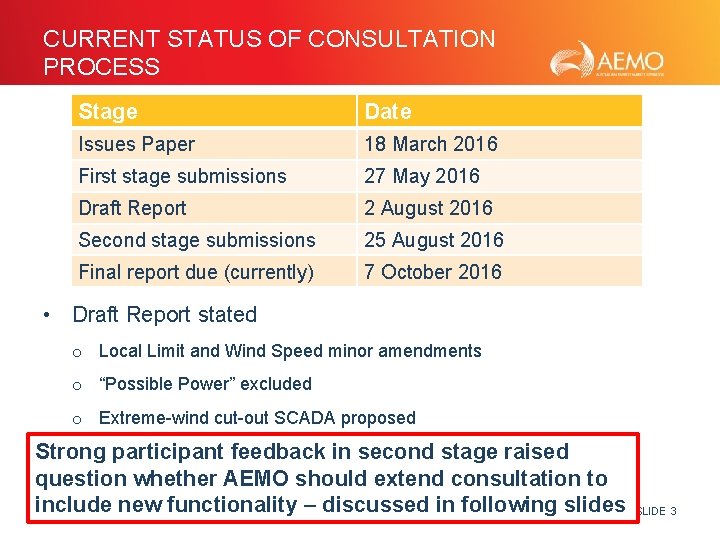
CURRENT STATUS OF CONSULTATION PROCESS Stage Date Issues Paper 18 March 2016 First stage submissions 27 May 2016 Draft Report 2 August 2016 Second stage submissions 25 August 2016 Final report due (currently) 7 October 2016 • Draft Report stated o Local Limit and Wind Speed minor amendments o “Possible Power” excluded o Extreme-wind cut-out SCADA proposed Strong participant feedback in second stage raised question whether AEMO should extend consultation to include new functionality – discussed in following slides SLIDE 3
LOCAL LIMIT AND WIND SPEED • Local Limit SCADA signal resolved o Small amendments following second stage consultation o AEMO working on distribution network limit constraint equations • Wind Speed SCADA signal definition resolved SLIDE 4
TURBINE CUT-OUT • Draft report proposed new “Extreme wind cut-out” SCADA o To improve accuracy of AWEFS dispatch forecast when wind farm constrained during extreme wind events • Feedback in submissions: o May be expensive or difficult for some farms o Many causes for cut-out or reduced production • Ideas for a signal to allow AWEFS to model more of this behaviour more accurately in dispatch? o Turbines ready-to-run in next 5 minutes? o Share of capacity ready-to-run in next 5 minutes? • AEMO needs some signal to represent what’s happening in times of cut-out SLIDE 5
“ESTIMATED POWER” PROPOSAL • Substantial participant feedback in second stage • “Estimated Power” name to avoid confusion with existing “Possible Power” in control systems • Participants keen to provide a signal to incorporate all factors affecting wind farm operation, including: o Wind speed / direction at each turbine o Effects of high wind speed, extreme wind direction change, site temperature, wind sector management o Dynamic effects of turbine pausing and feathering SLIDE 6
“ESTIMATED POWER” PROPOSAL • AEMO would analyse the accuracy of trial data supplied by participants – we need to work with you • AEMO would concurrently consult with participants • Regular reporting back with full transparency on outcomes o If it meets requirements for system security and market outcomes, should we then implement “Estimated Power”? o If it doesn’t meet requirements, should we then require the highwind cut-out signal or an alternative cut-out signal? • Post-implementation o AEMO would continue to measure performance and assess reliability SLIDE 7
PROPOSED “ESTIMATED POWER” DEFINITION • Optional SCADA signal o The Generator’s forecast of active power at the end of the next dispatch interval o Subject only to technical factors affecting operation of its generation and connection assets o Calculated assuming no distribution or transmission network constraints apply to the next dispatch interval SLIDE 8
“ESTIMATED POWER” PROPOSAL • Q: How much detail to put in the definition? • Q: Overlap with the “Local Limit”? • Q: Useful for your farm, or too complex? • Q: Also for solar farms? SLIDE 9
NEXT STEPS FOR CURRENT CONSULTATION • Next report published 14 Oct 2016 Ø A week delayed to incorporate the complexity of the issues raised in the second stage submissions and discussions. • Two Options: o 1 – End consultation now, with “Estimated Power” not in ECM Guidelines o 2 – Third round of consultation, to propose “Estimated Power” in ECM Guidelines SLIDE 10
NEXT STEPS FOR CURRENT CONSULTATION • “Estimated Power” accuracy assessment o Accuracy assessment can start now using SCADA and historical data under Option 1 or 2 • Local Limit o Option 1: Implementation work can commence from October o Option 2: Implementation delayed, though background work will minimise delay • “Estimated Power” o Option 1: New full consultation would be required to put “Estimated Power” into ECM Guidelines – minimum 4 months o Option 2: Could allow proposals with respect to “Estimated Power” to be implemented without new full consultation • Question: Which option is preferred? SLIDE 11
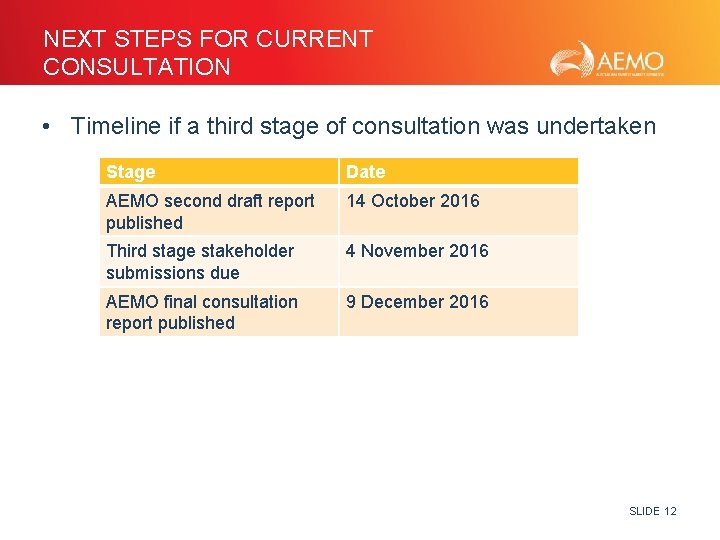
NEXT STEPS FOR CURRENT CONSULTATION • Timeline if a third stage of consultation was undertaken Stage Date AEMO second draft report published 14 October 2016 Third stage stakeholder submissions due 4 November 2016 AEMO final consultation report published 9 December 2016 SLIDE 12
ADDITIONAL CONSULTATION AND INVESTIGATION UNDERWAY/PROPOSED • Power curve tuning o AEMO has been working with AWEFS vendor to improve the power curve tuning algorithm o Design improvements in final stage of negotiation • Scoping of a full review of AWEFS o Continuing investigation into accuracy improvements to AWEFS other than Estimated Power • Transparency and Bidding of Availability SLIDE 13