
Win TR55 Introduction and Background z Objectives The
Win. TR-55: Introduction and Background z. Objectives: • The basics • History of Win. TR-55 • Nuts & bolts of algorithms • Demo of model interface
Why model? z. To estimate conditions where measurements are not available or possible. z. To test system understanding. z. To facilitate design.

Topology of Win. TR-55 z Empirical vs. Conceptual z Stochastic vs. Deterministic z Lumped vs. Distributed z Continuous vs. Event-based vs. Peak discharge

History of TR-55 z. Developed by SCS (now NRCS) for agricultural watersheds in 1954 z. Widely accepted, yet no peer review z. Adapted for urban watersheds z. Poor performance in forested watersheds

TR-55 methodology: Runoff z Rainfall (P) separated into: y Rainfall excess (Q) y Initial abstraction (Ia) – interception, infiltration, and depression storage y Retention (F) – proportion retained, infiltrated z Basic assumption: z CN is a function of S, the potential maximum retention z → Runoff equation:
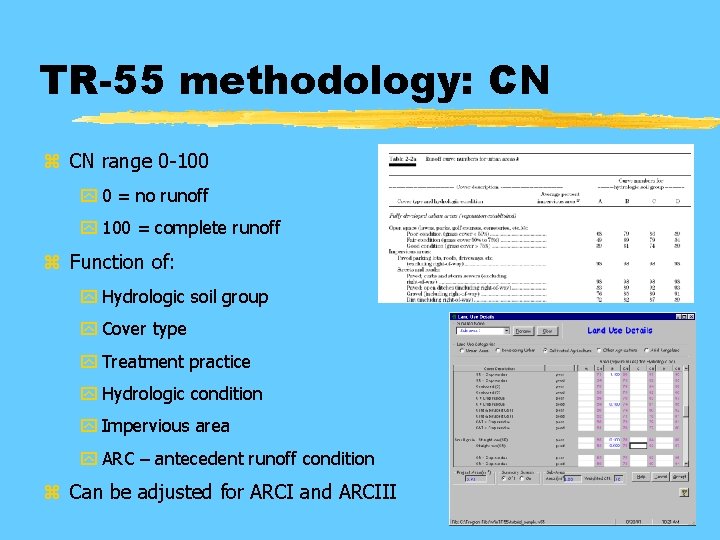
TR-55 methodology: CN z CN range 0 -100 y 0 = no runoff y 100 = complete runoff z Function of: y Hydrologic soil group y Cover type y Treatment practice y Hydrologic condition y Impervious area y ARC – antecedent runoff condition z Can be adjusted for ARCI and ARCIII

TR-55 methodology: Tc z Time it takes water to travel from most hydrologically distant portion of watershed to the outlet. z Many ways to calculate: y With limited data: y NRCS method: x Sheet flow f(length, slope, Manning’s n) x Shallow concentrated flow f(length, slope, Manning’s n) x Channel flow f(length, slope, Manning’s n, channel dimensions) z Other methods incorporate rainfall intensity
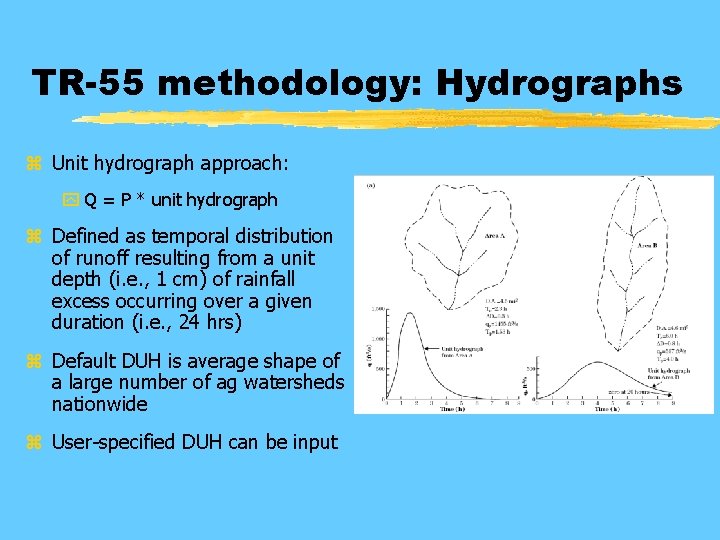
TR-55 methodology: Hydrographs z Unit hydrograph approach: y Q = P * unit hydrograph z Defined as temporal distribution of runoff resulting from a unit depth (i. e. , 1 cm) of rainfall excess occurring over a given duration (i. e. , 24 hrs) z Default DUH is average shape of a large number of ag watersheds nationwide z User-specified DUH can be input

TR-55 methodology: Routing z Muskingum-Cunge method z Most widely used method of stream-channel routing z Oj+1 = C 1 Ij+1 + C 2 Ij + C 3 Oj z Constants are based on travel time through reach
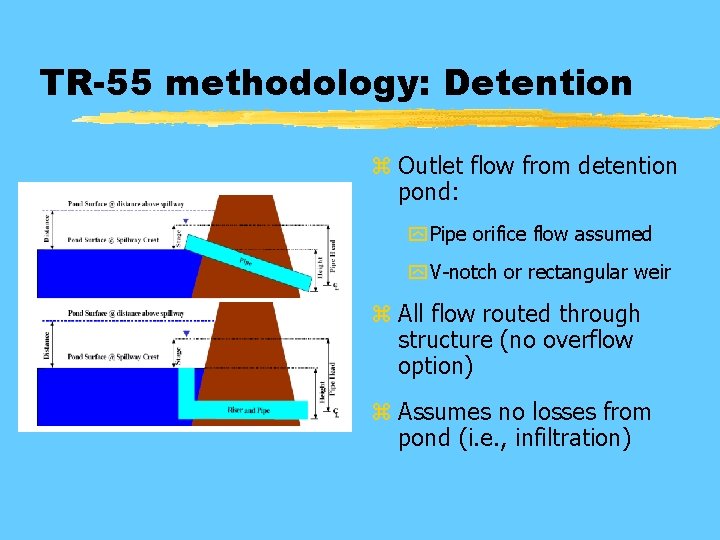
TR-55 methodology: Detention z Outlet flow from detention pond: y Pipe orifice flow assumed y V-notch or rectangular weir z All flow routed through structure (no overflow option) z Assumes no losses from pond (i. e. , infiltration)
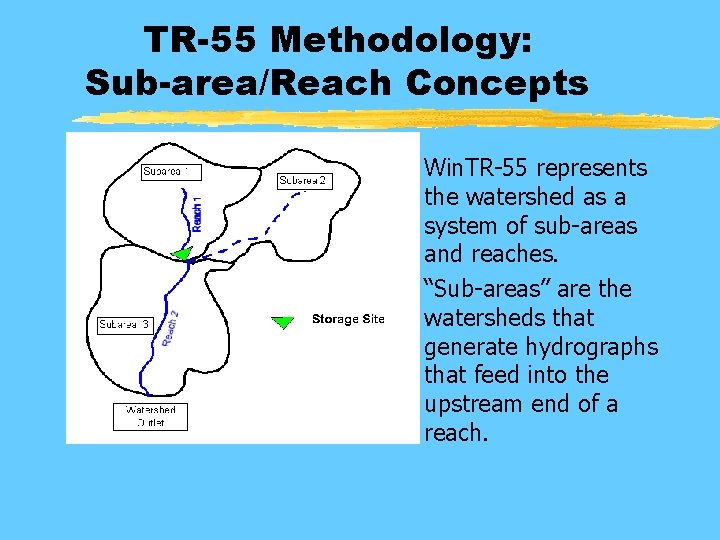
TR-55 Methodology: Sub-area/Reach Concepts z Win. TR-55 represents the watershed as a system of sub-areas and reaches. z “Sub-areas” are the watersheds that generate hydrographs that feed into the upstream end of a reach.
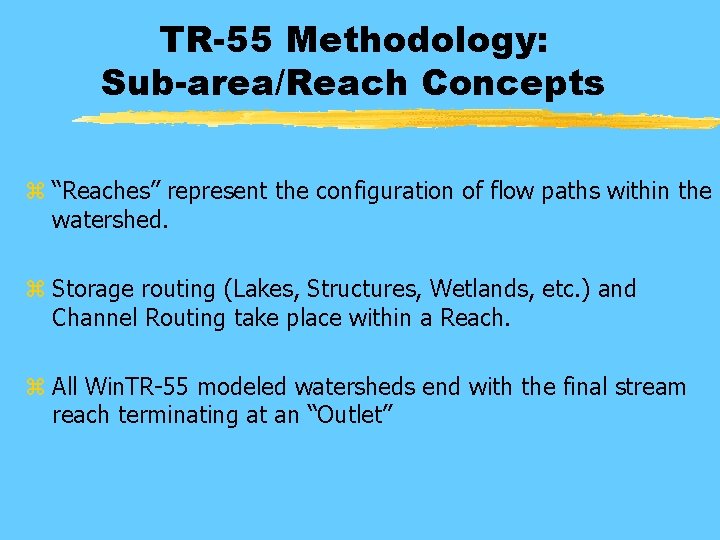
TR-55 Methodology: Sub-area/Reach Concepts z “Reaches” represent the configuration of flow paths within the watershed. z Storage routing (Lakes, Structures, Wetlands, etc. ) and Channel Routing take place within a Reach. z All Win. TR-55 modeled watersheds end with the final stream reach terminating at an “Outlet”
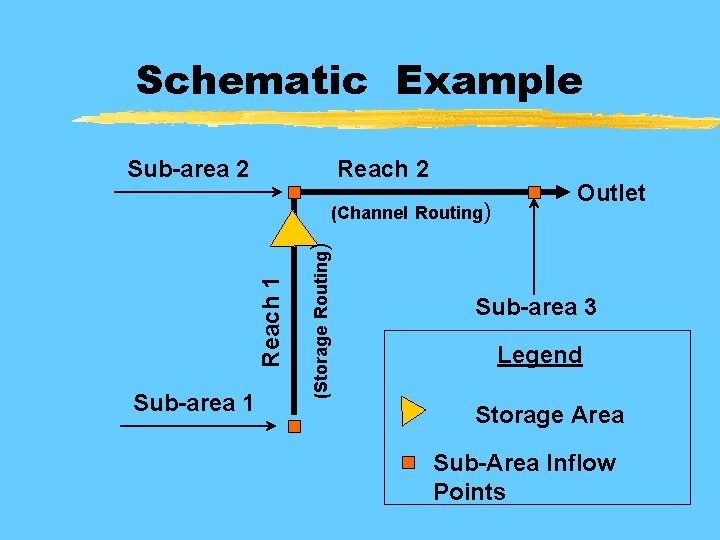
Schematic Example Sub-area 2 Reach 2 Sub-area 1 (Storage Routing) Reach 1 (Channel Routing) Outlet Sub-area 3 Legend Storage Area Sub-Area Inflow Points
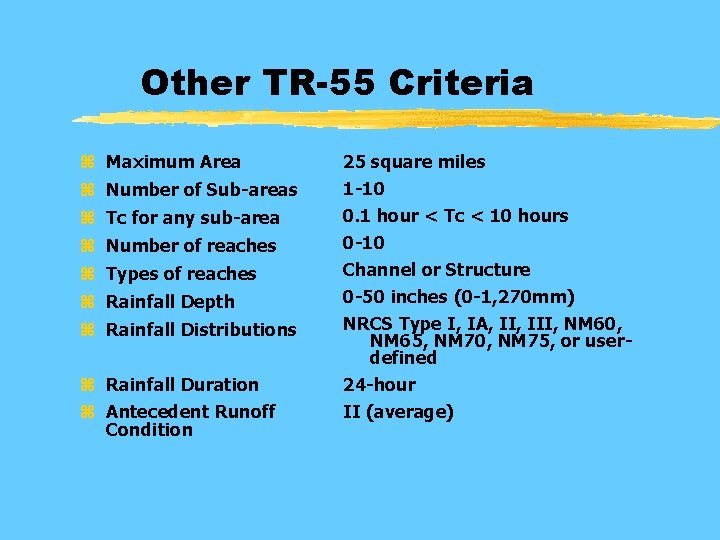
Other TR-55 Criteria z Maximum Area 25 square miles z Number of Sub-areas 1 -10 z Tc for any sub-area 0. 1 hour < Tc < 10 hours 0 -10 Channel or Structure z Number of reaches z Types of reaches z Rainfall Depth z Rainfall Distributions z Rainfall Duration z Antecedent Runoff Condition 0 -50 inches (0 -1, 270 mm) NRCS Type I, IA, III, NM 60, NM 65, NM 70, NM 75, or userdefined 24 -hour II (average)
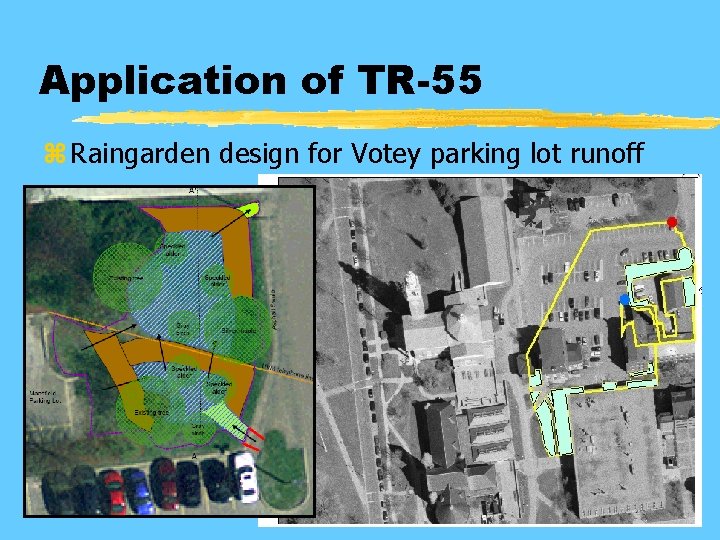
Application of TR-55 z Raingarden design for Votey parking lot runoff
- Slides: 15