
William Stallings Computer Organization and Architecture 9 th

- Slides: 28
+ William Stallings Computer Organization and Architecture 9 th Edition
+ Chapter 18 Multicore Computers
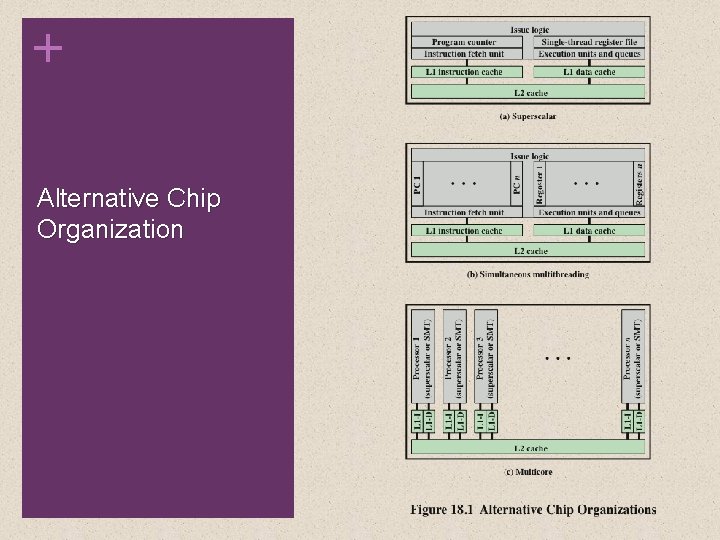
+ Alternative Chip Organization
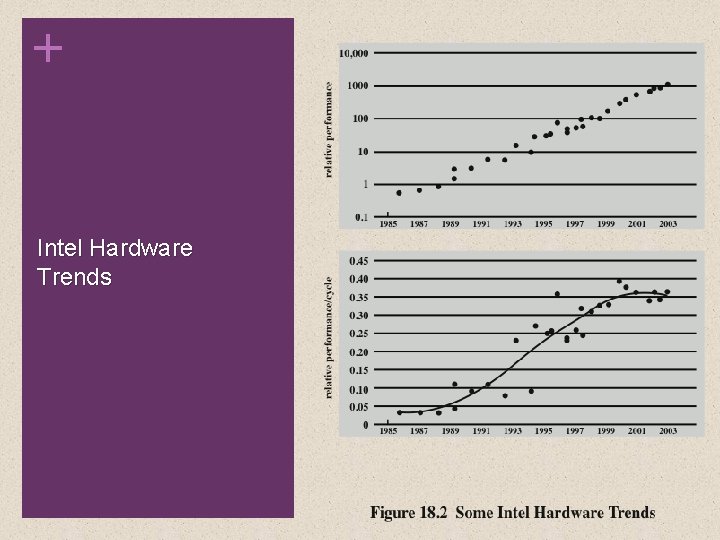
+ Intel Hardware Trends
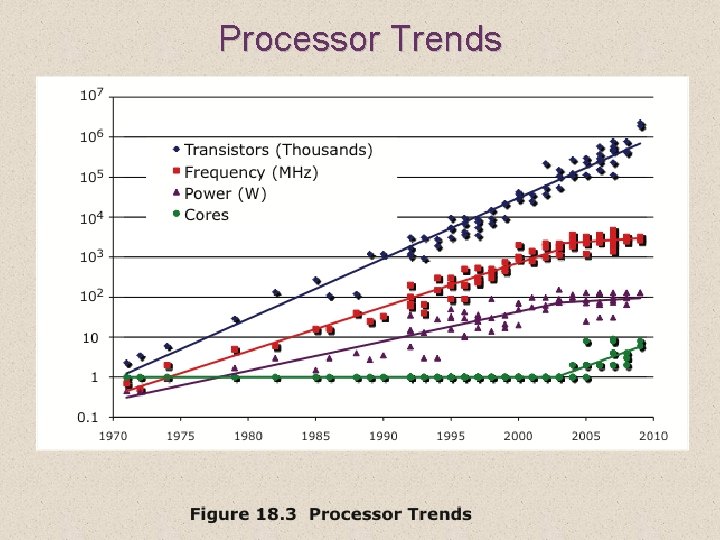
Processor Trends
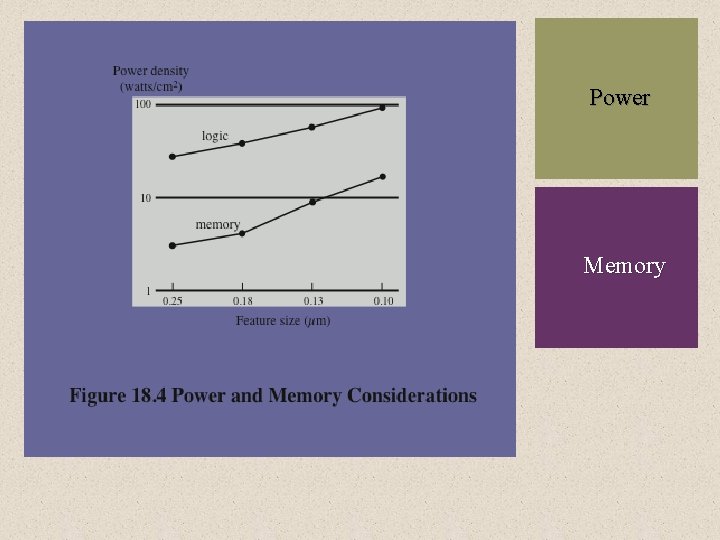
Power Memory +
+ Power Consumption n By 2015 we can expect to see microprocessor chips with about 100 billion transistors on a 300 mm 2 die n Assuming that about 50 -60% of the chip area is devoted to memory, the chip will support cache memory of about 100 MB and leave over 1 billion transistors available for logic n How to use all those logic transistors is a key design issue n Pollack’s Rule n States that performance increase is roughly proportional to square root of increase in complexity
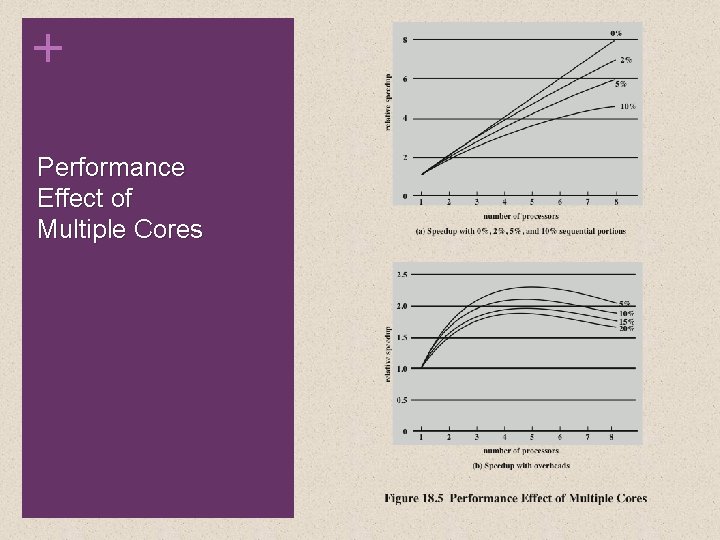
+ Performance Effect of Multiple Cores
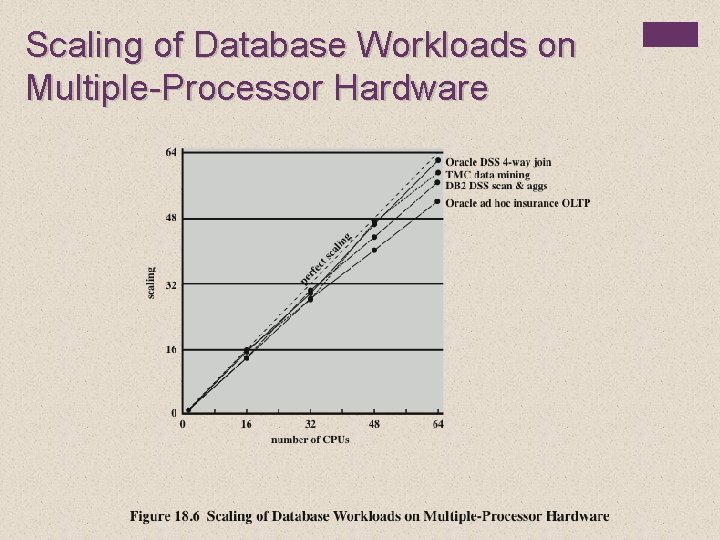
Scaling of Database Workloads on Multiple-Processor Hardware
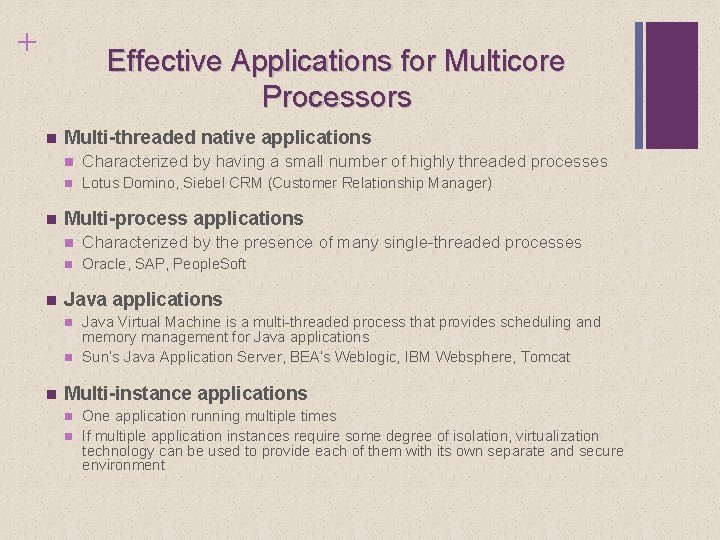
+ Effective Applications for Multicore Processors n n n Multi-threaded native applications n Characterized by having a small number of highly threaded processes n Lotus Domino, Siebel CRM (Customer Relationship Manager) Multi-process applications n Characterized by the presence of many single-threaded processes n Oracle, SAP, People. Soft Java applications n n n Java Virtual Machine is a multi-threaded process that provides scheduling and memory management for Java applications Sun’s Java Application Server, BEA’s Weblogic, IBM Websphere, Tomcat Multi-instance applications n n One application running multiple times If multiple application instances require some degree of isolation, virtualization technology can be used to provide each of them with its own separate and secure environment
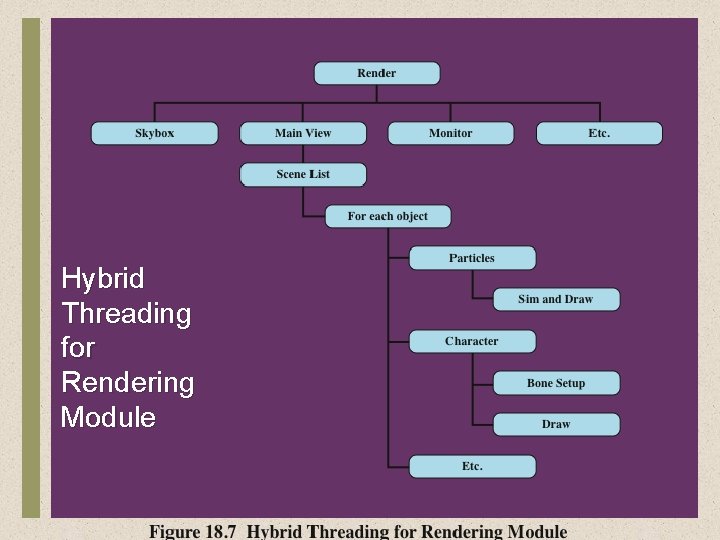
Hybrid + Threading for Rendering Module
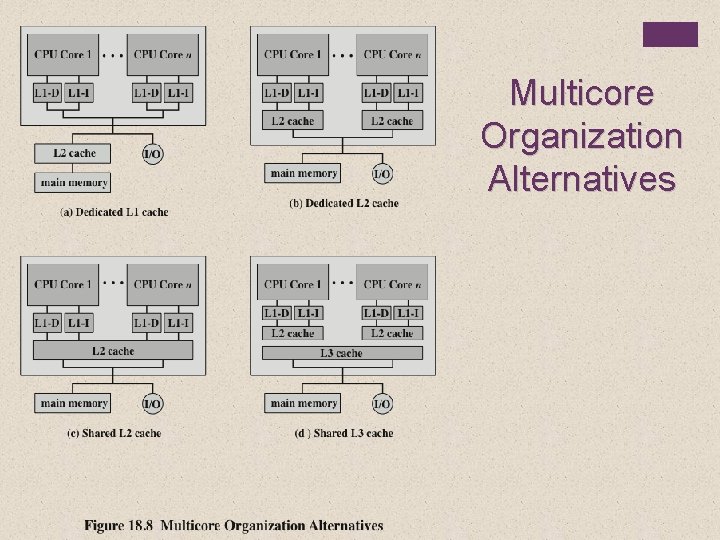
Multicore Organization Alternatives
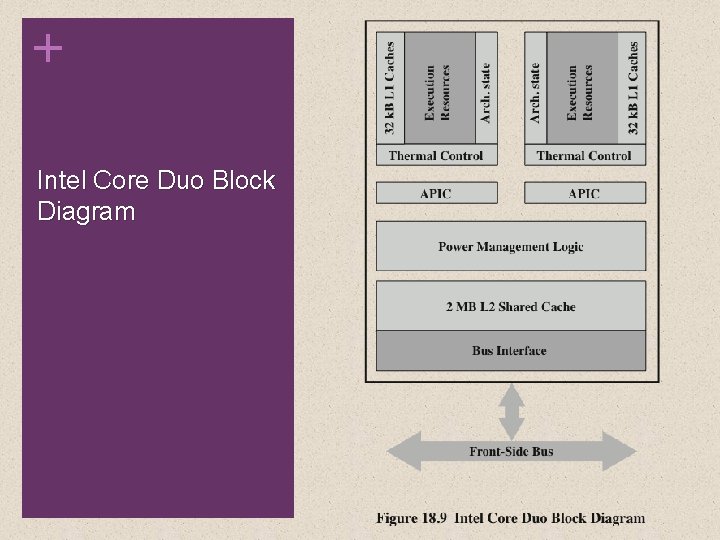
+ Intel Core Duo Block Diagram
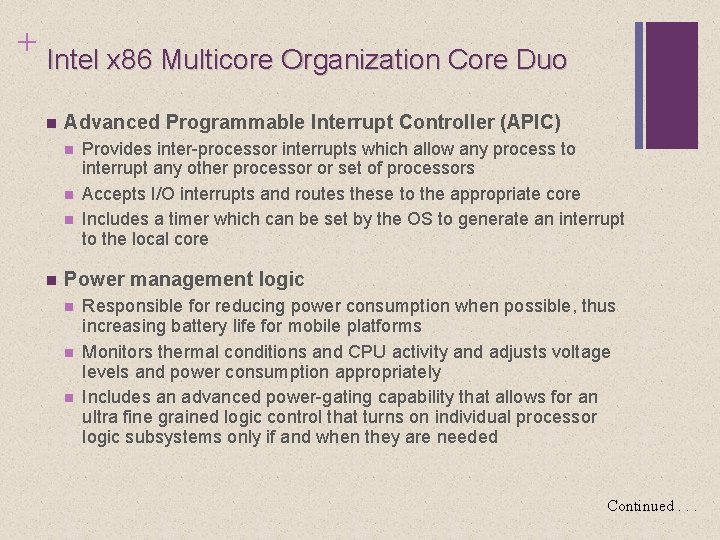
+ Intel x 86 Multicore Organization Core Duo n Advanced Programmable Interrupt Controller (APIC) n n Provides inter-processor interrupts which allow any process to interrupt any other processor or set of processors Accepts I/O interrupts and routes these to the appropriate core Includes a timer which can be set by the OS to generate an interrupt to the local core Power management logic n n n Responsible for reducing power consumption when possible, thus increasing battery life for mobile platforms Monitors thermal conditions and CPU activity and adjusts voltage levels and power consumption appropriately Includes an advanced power-gating capability that allows for an ultra fine grained logic control that turns on individual processor logic subsystems only if and when they are needed Continued. . .
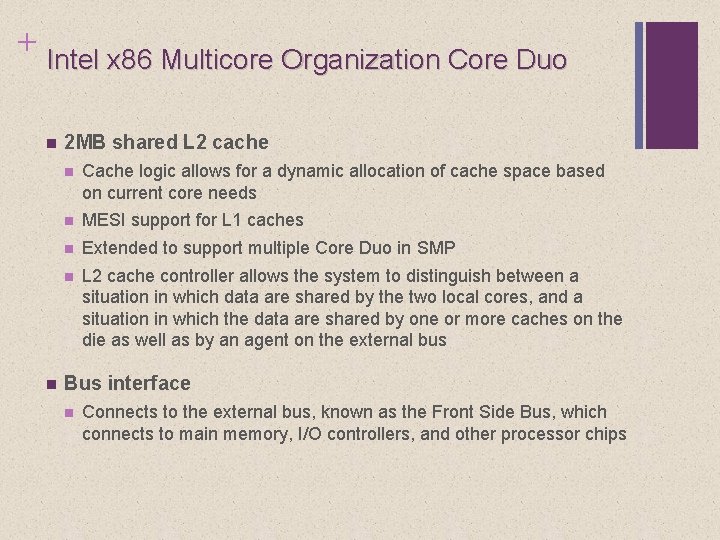
+ Intel x 86 Multicore Organization Core Duo n n 2 MB shared L 2 cache n Cache logic allows for a dynamic allocation of cache space based on current core needs n MESI support for L 1 caches n Extended to support multiple Core Duo in SMP n L 2 cache controller allows the system to distinguish between a situation in which data are shared by the two local cores, and a situation in which the data are shared by one or more caches on the die as well as by an agent on the external bus Bus interface n Connects to the external bus, known as the Front Side Bus, which connects to main memory, I/O controllers, and other processor chips
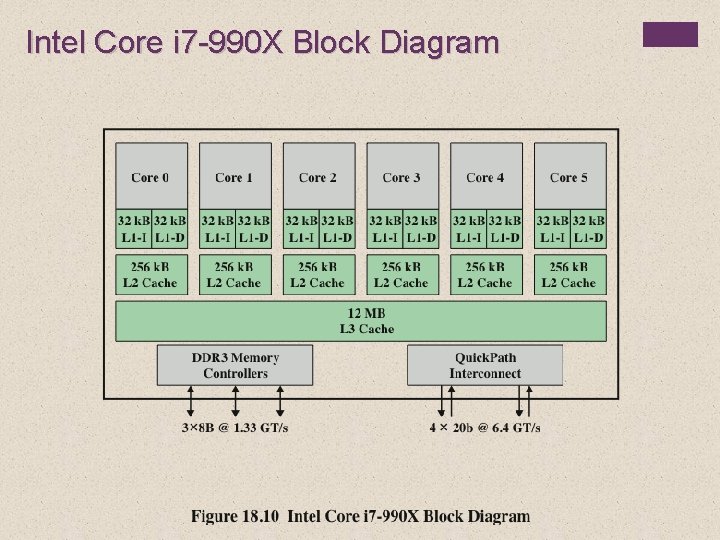
Intel Core i 7 -990 X Block Diagram
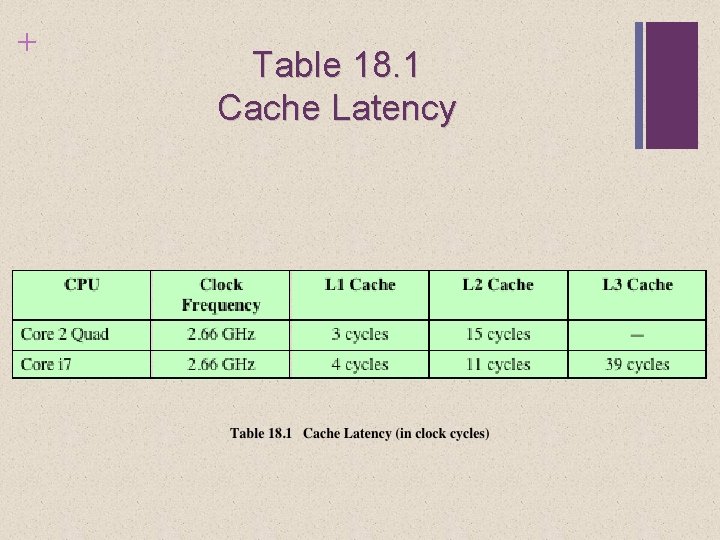
+ Table 18. 1 Cache Latency
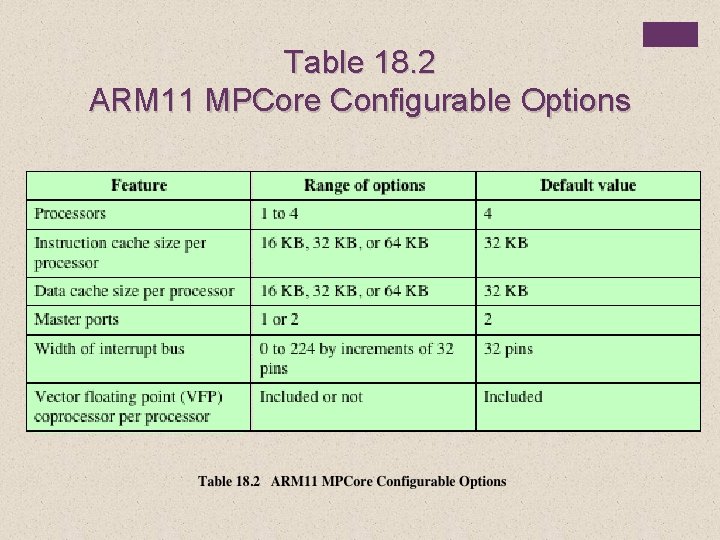
Table 18. 2 ARM 11 MPCore Configurable Options
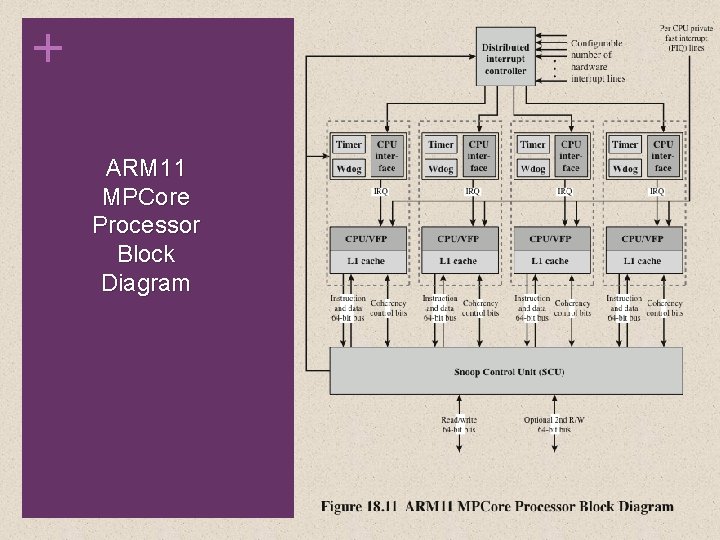
+ ARM 11 MPCore Processor Block Diagram
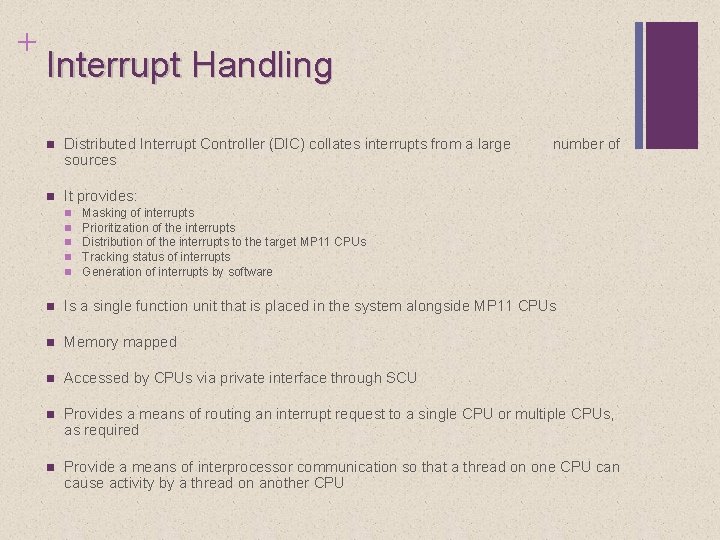
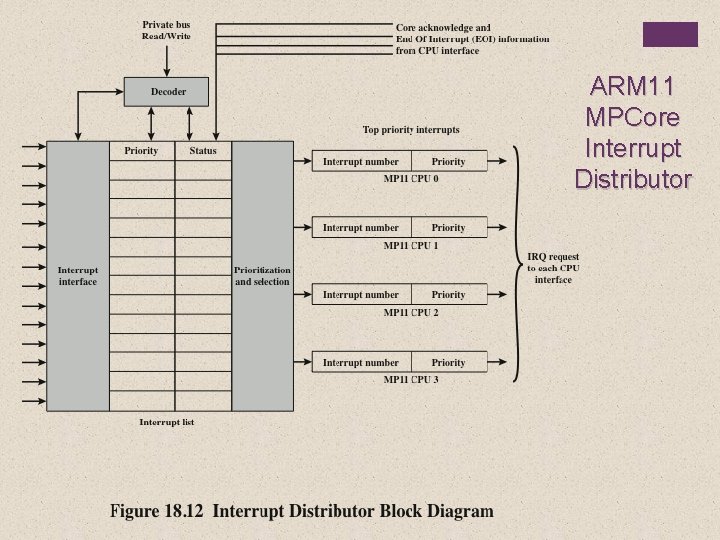
+ Interrupt Handling n Distributed Interrupt Controller (DIC) collates interrupts from a large sources n It provides: n n number of Masking of interrupts Prioritization of the interrupts Distribution of the interrupts to the target MP 11 CPUs Tracking status of interrupts Generation of interrupts by software n Is a single function unit that is placed in the system alongside MP 11 CPUs n Memory mapped n Accessed by CPUs via private interface through SCU n Provides a means of routing an interrupt request to a single CPU or multiple CPUs, as required n Provide a means of interprocessor communication so that a thread on one CPU can cause activity by a thread on another CPU
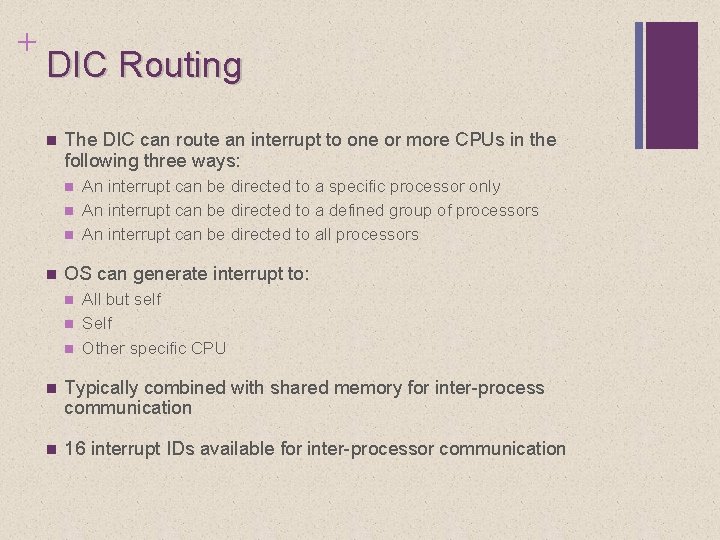
+ DIC Routing n The DIC can route an interrupt to one or more CPUs in the following three ways: n n An interrupt can be directed to a specific processor only An interrupt can be directed to a defined group of processors An interrupt can be directed to all processors OS can generate interrupt to: n n n All but self Self Other specific CPU n Typically combined with shared memory for inter-process communication n 16 interrupt IDs available for inter-processor communication
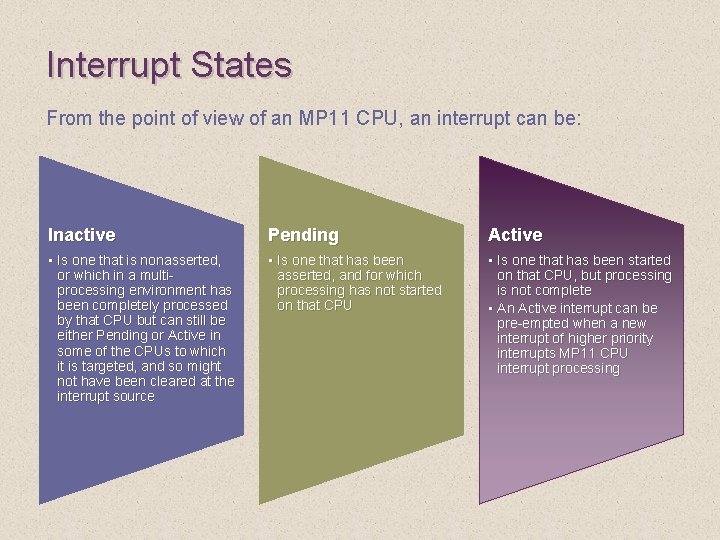
Interrupt States From the point of view of an MP 11 CPU, an interrupt can be: Inactive Pending Active • Is one that is nonasserted, or which in a multiprocessing environment has been completely processed by that CPU but can still be either Pending or Active in some of the CPUs to which it is targeted, and so might not have been cleared at the interrupt source • Is one that has been asserted, and for which processing has not started on that CPU • Is one that has been started on that CPU, but processing is not complete • An Active interrupt can be pre-empted when a new interrupt of higher priority interrupts MP 11 CPU interrupt processing
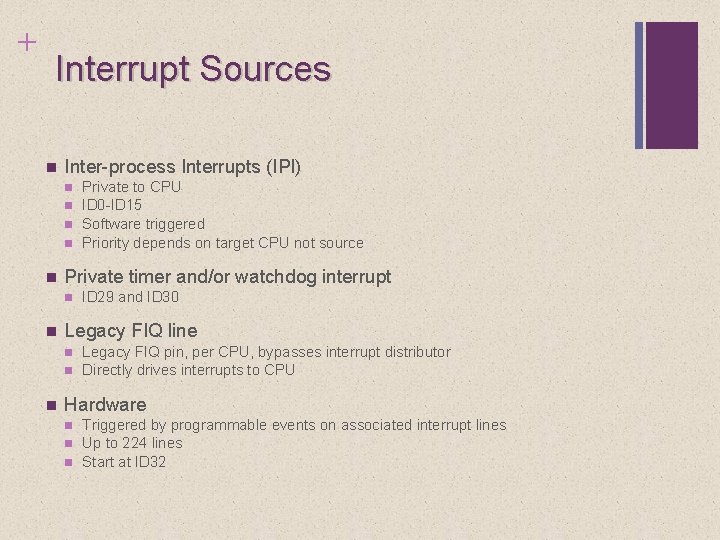
+ Interrupt Sources n Inter-process Interrupts (IPI) n n n Private timer and/or watchdog interrupt n n ID 29 and ID 30 Legacy FIQ line n n n Private to CPU ID 0 -ID 15 Software triggered Priority depends on target CPU not source Legacy FIQ pin, per CPU, bypasses interrupt distributor Directly drives interrupts to CPU Hardware n n n Triggered by programmable events on associated interrupt lines Up to 224 lines Start at ID 32
ARM 11 MPCore Interrupt Distributor
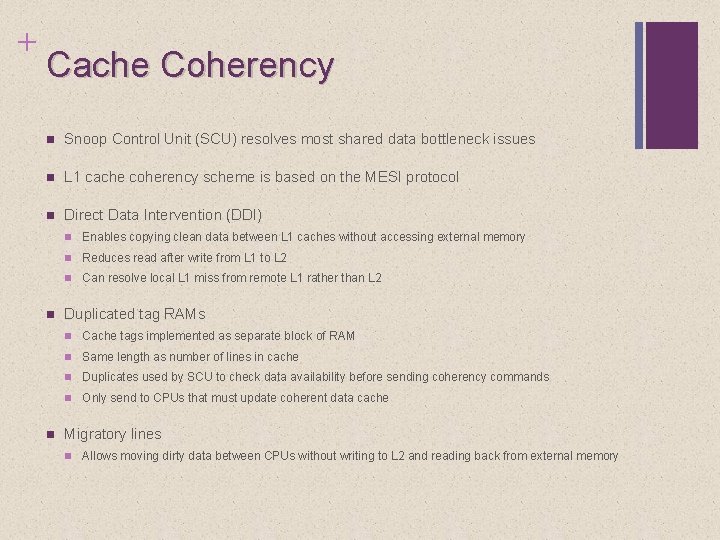
+ Cache Coherency n Snoop Control Unit (SCU) resolves most shared data bottleneck issues n L 1 cache coherency scheme is based on the MESI protocol n Direct Data Intervention (DDI) n n n Enables copying clean data between L 1 caches without accessing external memory n Reduces read after write from L 1 to L 2 n Can resolve local L 1 miss from remote L 1 rather than L 2 Duplicated tag RAMs n Cache tags implemented as separate block of RAM n Same length as number of lines in cache n Duplicates used by SCU to check data availability before sending coherency commands n Only send to CPUs that must update coherent data cache Migratory lines n Allows moving dirty data between CPUs without writing to L 2 and reading back from external memory
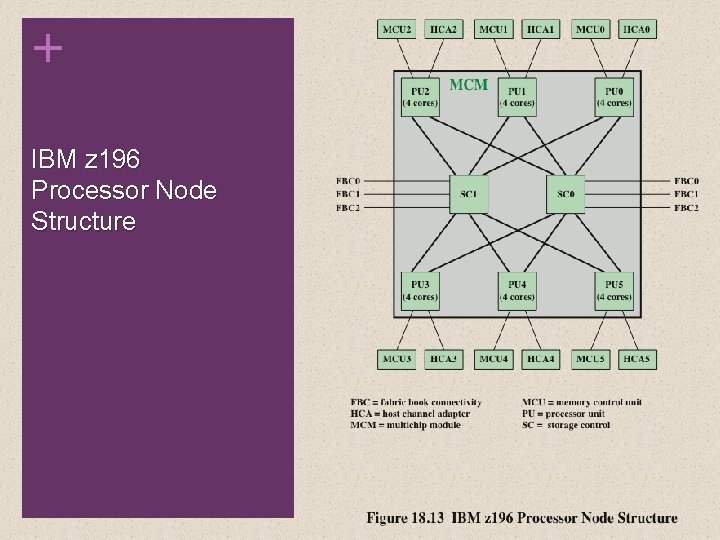
+ IBM z 196 Processor Node Structure
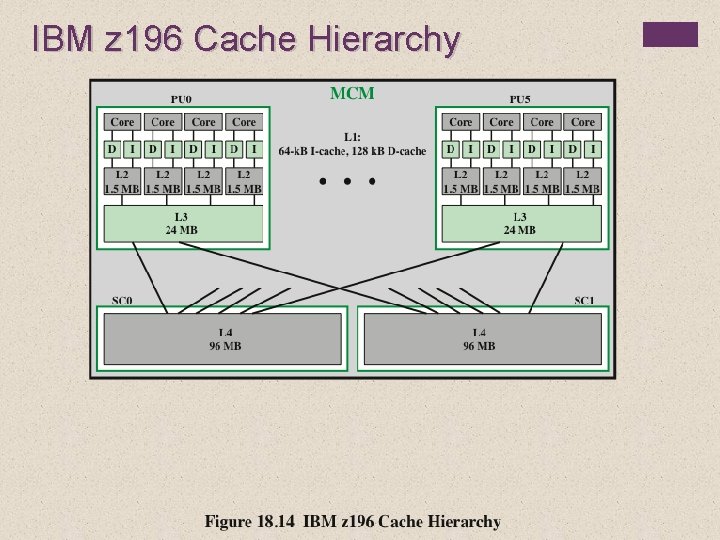
IBM z 196 Cache Hierarchy
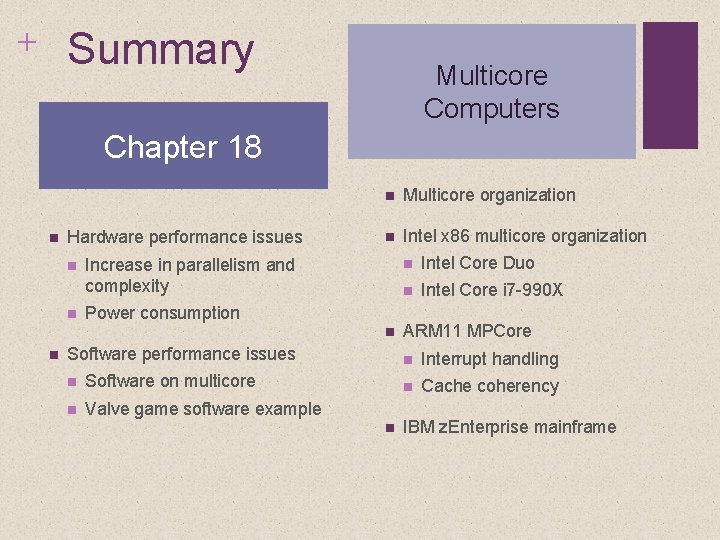
+ Summary Multicore Computers Chapter 18 n Hardware performance issues n n n Multicore organization n Intel x 86 multicore organization Increase in parallelism and complexity Power consumption n n Software performance issues n Software on multicore n Valve game software example n n Intel Core Duo n Intel Core i 7 -990 X ARM 11 MPCore n Interrupt handling n Cache coherency IBM z. Enterprise mainframe