
William Shakespeare Widely regarded as the greatest writer
- Slides: 40
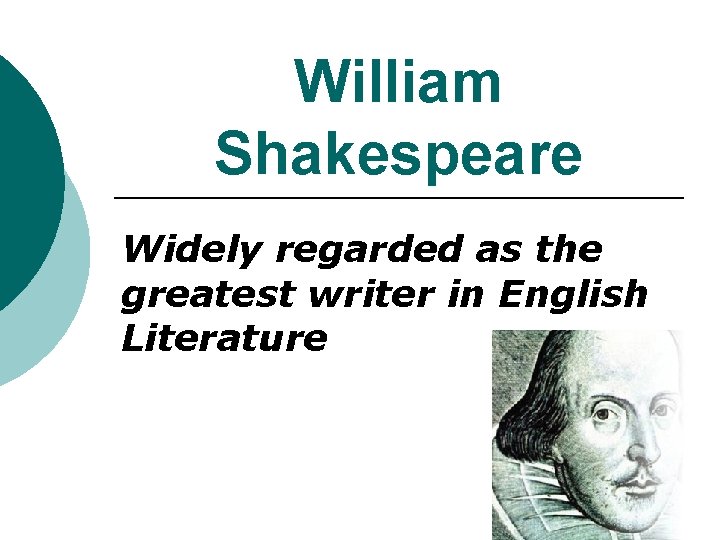
William Shakespeare Widely regarded as the greatest writer in English Literature
Shakespeare ¡ 1563 -1616 ¡ Stratford-on-Avon, England ¡ wrote 37 plays ¡ about 154 sonnets ¡ started out as an actor
Stage Celebrity ¡ Actor for Lord Chamberlain’s Men (London theater co. ) ¡ Also > principal playwright for them ¡ 1599> Lord Ch. Co. built Globe Theater where most of Sh. plays were performed
Shakespeare wrote: ¡Comedies ¡Histories ¡Tragedies
The Theater ¡ Plays produced for the general public ¡ Roofless>open air ¡ No artificial lighting ¡ Courtyard surrounded by 3 levels of galleries
Spectators ¡ Wealthy got benches ¡ “Groundlings”>poorer people stood and watched from the courtyard (“pit”) ¡ All but wealthy were uneducated/illiterate ¡ Much more interaction than today
Staging Areas ¡ Stage>platform that extended into the pit ¡ Dressing & storage rooms in galleries behind & above stage ¡ second-level gallery> upper stage> famous balcony scene in R & J ¡ Trap door>ghosts ¡ “Heavens”> angelic beings
Differences ¡ No scenery ¡ Settings > references in dialogue ¡ Elaborate costumes ¡ Plenty of props ¡ Fast-paced, colorful>2 hours!
Actors ¡ Only men and boys ¡ Young boys whose voices had not changed play women’s roles ¡ Would have been considered indecent for a woman to appear on stage
Romeo and Juliet ¡ Written about 1595 ¡ Considered a tragedy ¡ West Side Story (Movie) based on R&J
Elizabethan (QE 1) Words ¡ An, and: ¡ Anon: ¡ Aye: ¡ But: ¡ E’en: ¡ E’er: If Soon Yes Except for Even Ever
QE 1 Words (contin. ) ¡ Haply: Perhaps ¡ Happy: Fortunate ¡ Hence: Away, from here ¡ Hie: Hurry ¡ Marry: Indeed
QE 1 Words (contin. ) ¡ Whence: ¡ Wilt: ¡ Withal: ¡ Would: Where from Will, will you In addition to Wish
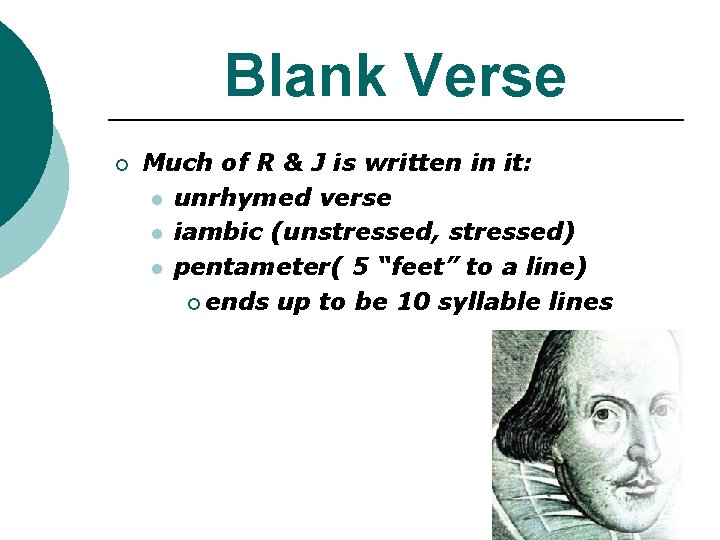
Blank Verse ¡ Much of R & J is written in it: l unrhymed verse l iambic (unstressed, stressed) l pentameter( 5 “feet” to a line) ¡ ends up to be 10 syllable lines
Prose ¡ Ordinary writing that is not poetry, drama, or song l Only characters in the lower social classes speak this way in Shakespeare’s plays l Why do you suppose that is?
Plot ¡ The sequence of events in a literary work
Exposition ¡ The plot usually begins with the exposition. It introduces ¡setting ¡characters ¡basic situation
Inciting Moment ¡ Often called “initial incident” l the first bit of action that occurs which begins the plot l Romeo and Juliet “lock eyes” at the party
Conflict ¡ The struggle that develops l man vs. man l man vs. himself l man vs. society l man vs. nature
Crisis ¡ The point where the protagonist’s situation will either get better or worse ¡ This is the beginning of the “rising action” l protagonist>good guy l antagonist>bad guy
Climax ¡ The turning point of the story>everything begins to unravel from here l This is the beginning of the “falling action”
Resolution ¡The end of the central conflict
Denouement ¡ The final explanation or outcome of the plot l If this is included in the plot, it will occur after the resolution.
Tragedy (Shakespearean) ¡ Drama where the central character/s suffer disaster/great misfortune l In many tragedies, downfall results from ¡Fate ¡Character flaw/Fatal flaw ¡Combination of the two
Theme ¡ Central idea or ¡ Insight about life which explains the downfall
Metaphorical Language ¡ Comparison of unlike things > l Paris standing over the “lifeless body” of Juliet, “Sweet flower, with flowers thy bridal bed I strew…” l “Thou detestable maw…”Gorged with the dearest morsel of the earth…” Romeo
Dramatic Foil ¡ A dramatic foil is a character that contrasts with another character to highlight various facets of the another character’s personality l usually this other character is the protagonist l A foil usually has some important characteristics in common with the other character, such as superficial traits or personal history. l Benvolio for Tybalt ¡ look for others in R & J
Round characters ¡ Characters who have many personality traits, like real people.
Flat Characters ¡ One-dimensional, embodying only a single trait l Shakespeare often uses them to provide comic relief even in a tragedy
Static Characters ¡ Characters within a story who remain the same. They do not change their minds, opinions or character.
Dynamic Character ¡ Characters that change somehow during the course of the plot. ¡ They generally change for the better.
Monologue ¡ One person speaking on stage > may be other character on stage too l ex > the Prince of Verona commanding the Capulets and Montagues to cease feuding
Soliloquy ¡ Long speech expressing the thoughts of a character alone on stage. ¡ In R & J, Romeo gives a soliloquy after the servant has fled and Paris has died.
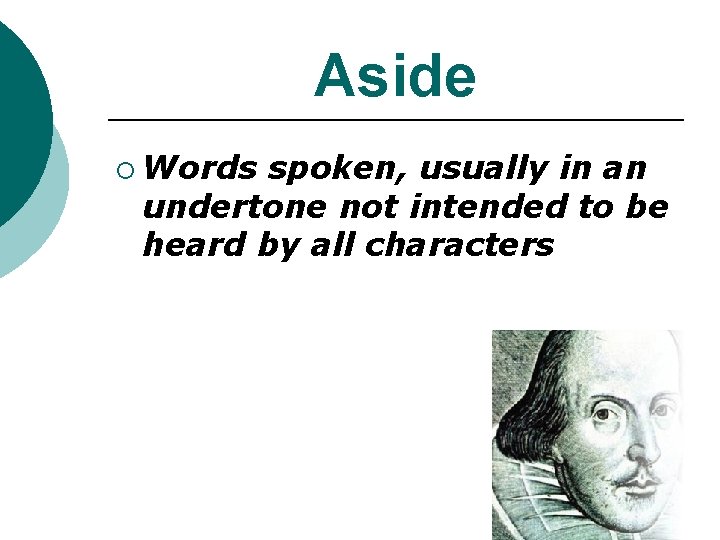
Aside ¡ Words spoken, usually in an undertone not intended to be heard by all characters
Pun ¡ Shakespeare loved to use them!!! l Humorous use of a word with two meanings l Sometimes missed by the reader because of Elizabethan language and sexual innuendo
Direct Address ¡ Words that tell the reader who is being addressed: “A right fair mark, fair coz, is soonest hit. ” l “Ah, my mistresses, which of you all/ Will now deny to dance? ” l
Dramatic Irony ¡A contradiction between what a character thinks and what the reader/audience knows to be true
Verbal Irony ¡ Words used to suggest the opposite of what is meant
Situational Irony ¡ An event occurs that directly contradicts the expectations of the characters, the reader, or the audience
Comic Relief ¡ Use of comedy within literature that is NOT comedy to provide “relief” from seriousness or sadness. ¡ In R & J, look for moments of comic relief that help “relieve” the tragedy of the situation