
William Shakespeare 1564 1616 An Introduction to Romeo
- Slides: 25
William Shakespeare (1564 -1616) An Introduction to Romeo and Juliet
Shakespeare’s Childhood Born on April 23, 1564 in the town of Stratfordon-Avon in England l His family was middle-class (father later became mayor of the town, mother’s ancestors had some social rank) l l l Ironically both his parents were illiterate (but this was also very common for the day) He enjoyed a typical, but unremarkable education at the Stratford Grammar School, which focused on a classical education in history, reading, and Latin.
More about his background… l At age eighteen, he married Anne Hathaway who was twenty-six (eight years his senior—how scandalous!) l They had three children together Ten years later, in 1592, he left his family for London and begun his writing career l By 1594, he was writing and performing with a group of actors known as “Lord Chamberlain’s Men” l l Very popular group, often performed for royalty and most London theatre-goers (remember this is before movies, so he was sort of famous guy)
“The Bard” is born! l He wrote Romeo and Juliet in 1594 l Shakespeare’s version was based on another playwright’s work, entitled The Tragicall Historye of Romeus and Juliet (1562) l Interesting historical note: Since there were no copy-right laws at the time, writers were extremely competitive at the time (and it was common practice among writers to “borrow” ideas– with or without the author’s permission)
Biographical Timeline l l l 1594 – Shakespeare becomes a shareholder in Lord Chamberlain’s Men 1599 - Lord Chamberlain’s Co. built the Globe Theater (where most of Shakespeare’s plays were performed) 1603 – James I becomes the King of England (after Queen Elizabeth dies)– Renamed acting company “King’s Men” 1610 – Shakespeare retired to Stratford-on-Avon 1616 – The famous playwright dies at age 52
Why is he still so famous? l His plays feature universally identifiable characters and situations l Such as love, marriage, death, grief, making difficult choices, separation, reunion and reconciliation l These characters are fresh and can be adapted to any time and place and help us (the audience) understand what it is to be human and cope with the problems that plague the human spirit
Enduring Language l Shakespeare’s characters used wonderfully colorful words and expressions l He used over 20, 000 words in his works l l The average writer uses only 7, 500– whoa! Interesting fact– the English Dictionary of his time only had 500 words l Shakespeare is responsible for adding 3, 000 words to the English Oxford Dictionary He had an enormous influence on the development of modern English l He’s credited with inventing some of the words we still use in our daily speech l
Such as… l l l Accommodation Amazement Assassination Bloody Countless Critic Exposure Generous Gloomy Hurry Impartial l l Lonely Majestic Misplaced Obscene Premeditated Radiance Reliance Road Submerge Suspicious l … among many others!
Shakespeare wrote: l. Comedies l. Histories l. Tragedies
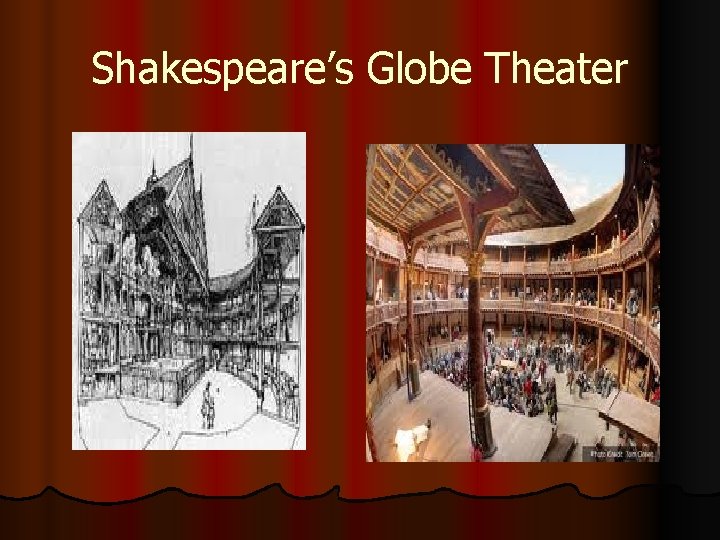
The Theater in Shakespeare’s Day l Plays produced for the general public l Took place in an roofless / open air theatre (Thank goodness because public sanitation, hygiene and common decency were not as we expect them to be today!) l Building had three levels l Stage: l. A large platform without a curtain
Shakespeare’s Globe Theater
Elements of a Drama l These are the FIVE (5) parts that correspond to the five ACTS of plays l Exposition (the introduction) l Establishes the TONE, introduces the setting, the main characters, and the conflict l It may also provide additional background info important to understanding the plot l In Romeo & Juliet, there was a Prologue to provide a comprehensive summary of the plot l Rising Action l Series of complications for the protagonist (main character) l Flows from the main character
Elements of a Drama (continued) l Climax (or crisis) Turning point in the story l The moment of choice (an important decision must be made) l Forces of conflict come together l l Falling Action Results of protagonist’s decision l Maintains suspense l l Resolution Conclusion of the play l Unraveling of the plot l Typically, in a Shakespearean play, may include the characters’ death l
Dramatic Techniques l Pun l A play on words involving A word or words with more than one meaning, or l Words with similar sounds l l Soliloquy Medium to long speech l Spoken by one actor alone on stage (or not heard by other actors) l l Monologue One person speaking for a longer period of time l Is NOT a dialogue (which is an fair exchange of words between two or more characters) l
Some additional dramatic techniques l Comic Relief l Use of comedy or humor used to provide “relief” from the seriousness or sadness, or to “relieve” the tension of the situation l Aside l Direct l Not address by actor to audience supposed to be overheard by other characters
More Dramatic Techniques: Poetic Language l Metaphoric Language l Comparison of unlike things l “Shall I compare thee to a summer’s day? . . . ” l Alliteration l. A repetition of a consonant sound at the beginning of a word l Ex. “She sells sea shells by the sea shore. ”
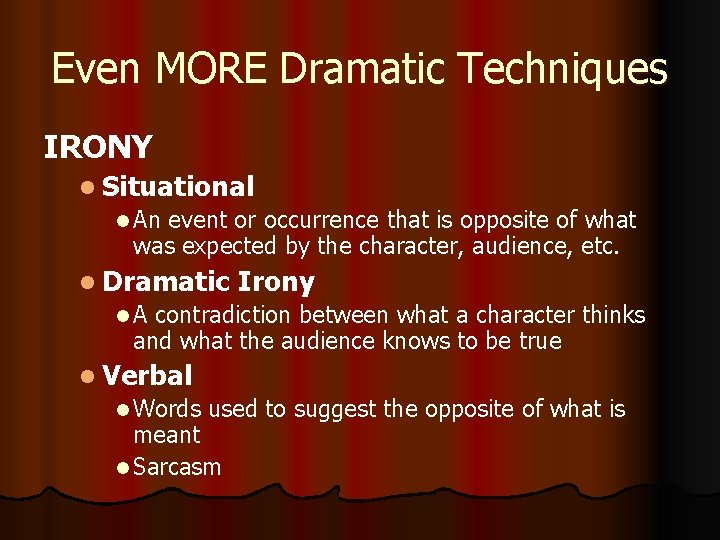
Even MORE Dramatic Techniques IRONY l Situational l An event or occurrence that is opposite of what was expected by the character, audience, etc. l Dramatic Irony l A contradiction between what a character thinks and what the audience knows to be true l Verbal l Words used to suggest the opposite of what is meant l Sarcasm
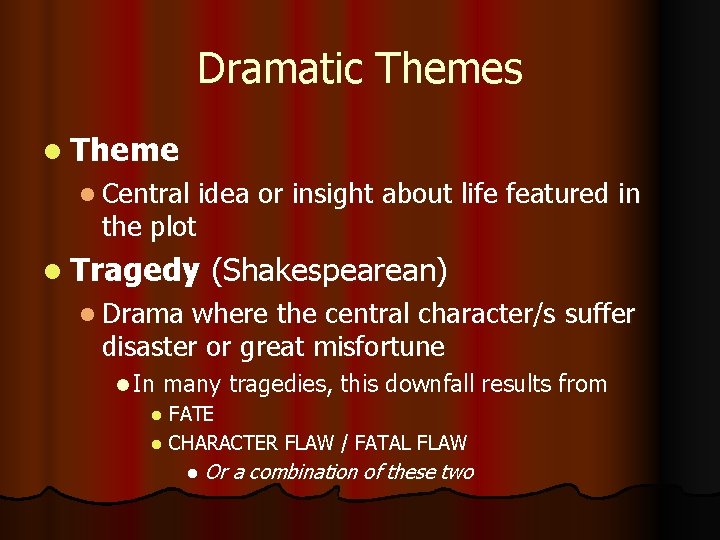
Dramatic Themes l Theme l Central the plot idea or insight about life featured in l Tragedy (Shakespearean) l Drama where the central character/s suffer disaster or great misfortune l In many tragedies, this downfall results from FATE l CHARACTER FLAW / FATAL FLAW l l Or a combination of these two
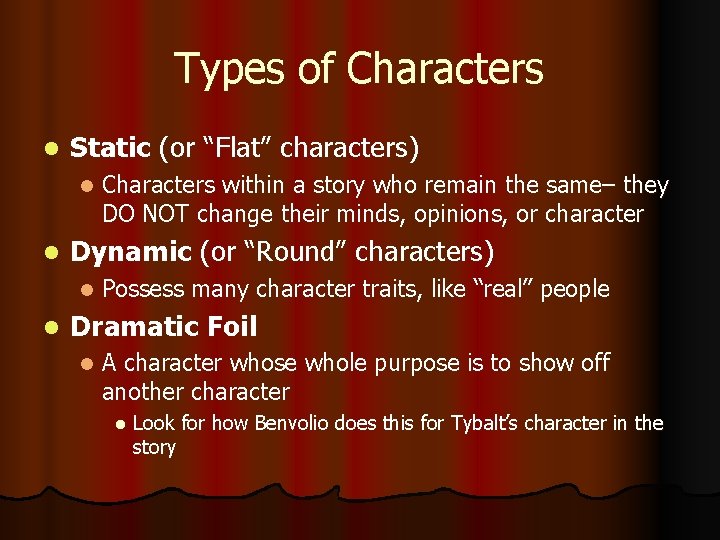
Types of Characters l Static (or “Flat” characters) l l Dynamic (or “Round” characters) l l Characters within a story who remain the same– they DO NOT change their minds, opinions, or character Possess many character traits, like “real” people Dramatic Foil l A character whose whole purpose is to show off another character l Look for how Benvolio does this for Tybalt’s character in the story
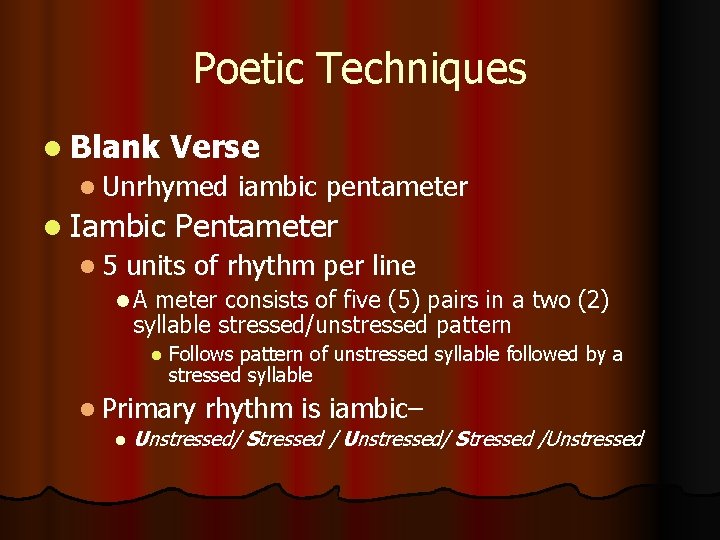
Poetic Techniques l Blank Verse l Unrhymed l Iambic l 5 iambic pentameter Pentameter units of rhythm per line l. A meter consists of five (5) pairs in a two (2) syllable stressed/unstressed pattern l Follows pattern of unstressed syllable followed by a stressed syllable l Primary l rhythm is iambic– Unstressed/ Stressed /Unstressed
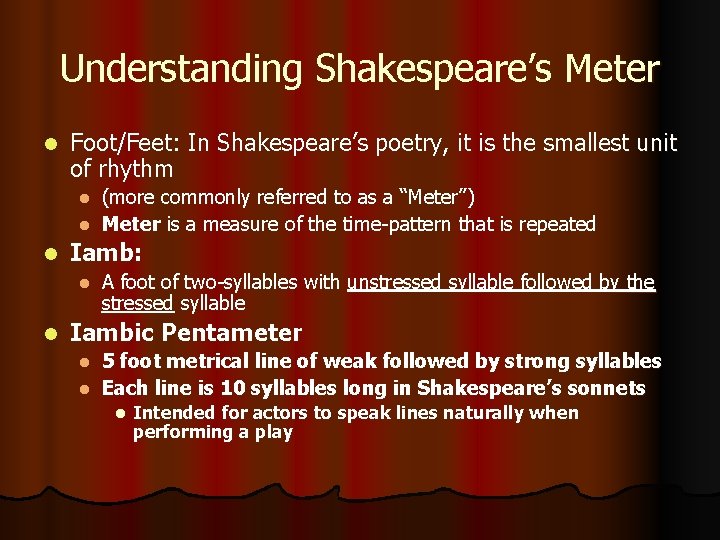
Understanding Shakespeare’s Meter l Foot/Feet: In Shakespeare’s poetry, it is the smallest unit of rhythm (more commonly referred to as a “Meter”) l Meter is a measure of the time-pattern that is repeated l l Iamb: l l A foot of two-syllables with unstressed syllable followed by the stressed syllable Iambic Pentameter 5 foot metrical line of weak followed by strong syllables l Each line is 10 syllables long in Shakespeare’s sonnets l l Intended for actors to speak lines naturally when performing a play
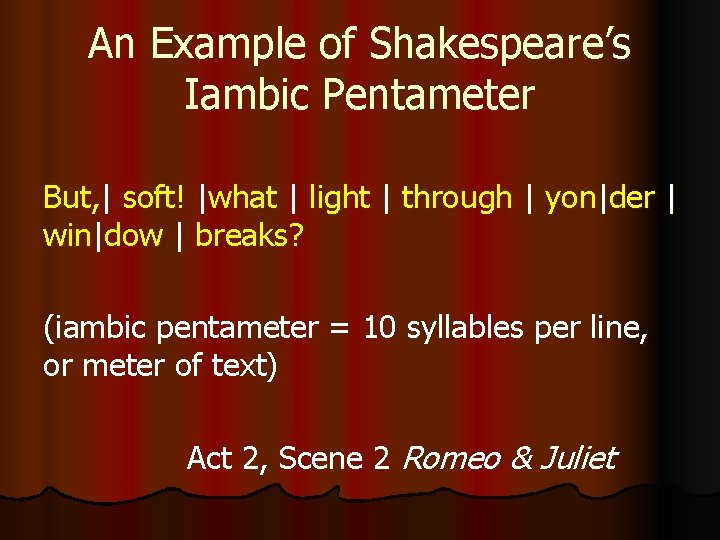
An Example of Shakespeare’s Iambic Pentameter But, | soft! |what | light | through | yon|der | win|dow | breaks? (iambic pentameter = 10 syllables per line, or meter of text) Act 2, Scene 2 Romeo & Juliet
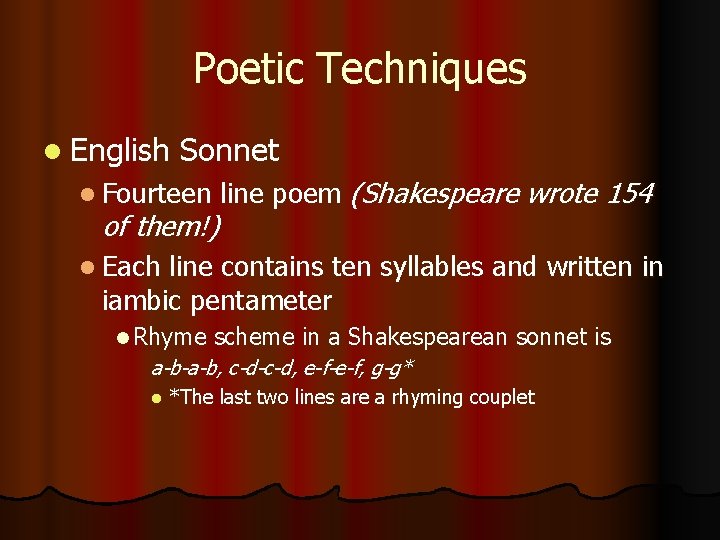
Poetic Techniques l English Sonnet l Fourteen of them!) line poem (Shakespeare wrote 154 l Each line contains ten syllables and written in iambic pentameter l Rhyme scheme in a Shakespearean sonnet is a-b-a-b, c-d-c-d, e-f-e-f, g-g* l *The last two lines are a rhyming couplet
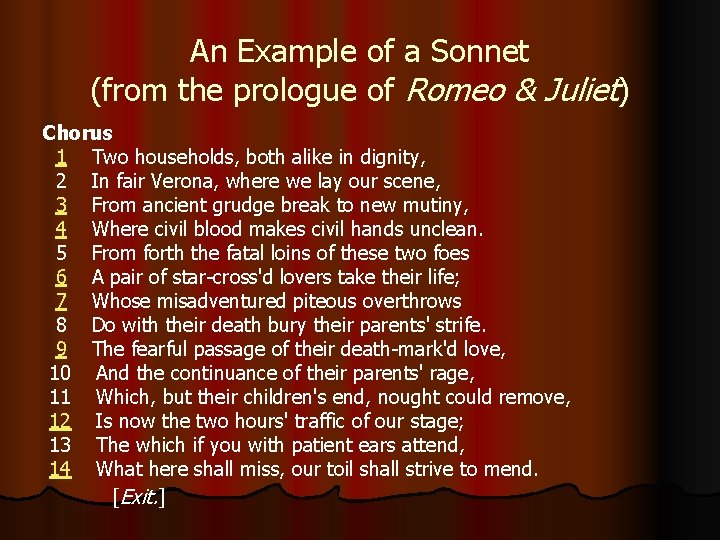
An Example of a Sonnet (from the prologue of Romeo & Juliet) Chorus 1 Two households, both alike in dignity, 2 In fair Verona, where we lay our scene, 3 From ancient grudge break to new mutiny, 4 Where civil blood makes civil hands unclean. 5 From forth the fatal loins of these two foes 6 A pair of star-cross'd lovers take their life; 7 Whose misadventured piteous overthrows 8 Do with their death bury their parents' strife. 9 The fearful passage of their death-mark'd love, 10 And the continuance of their parents' rage, 11 Which, but their children's end, nought could remove, 12 Is now the two hours' traffic of our stage; 13 The which if you with patient ears attend, 14 What here shall miss, our toil shall strive to mend. [Exit. ]
Figurative Language: Oxymorons l An oxymoron is a term that sounds logical (in the figurative sense), but contain words that with illogical literal meanings like ‘plastic silverware. ’ These terms have a contradictory meaning and serve to have a specific effect on the audience. List 3 on your own right now: l 1. ________ l 2. ________ l 3. ________ l