
William Is family tree What does this tell

- Slides: 7
William I’s family tree What does this tell yo u? William’s second son, William Rufus, became the next king (William II). If the Norman custom was for the eldest son to inherit (primogeniture) then it implies that there must have been a falling out between William I and Robert!
William I and his Sons Write down your title
Write down your sub title a) The character of William I Think about everything you have learned about the first Norman king. Which of these words would you use to describe William? Pick 3 -5 or use your own (optional extra back up with evidence or examples) Tough Clever Determined Ruthless Greedy Loyal Brutal Inspirational Religious Brave
b) William’s eldest son Robert Or how they fell out and sort-of made up again… Copy this out (the text in bold has the basic detail) Robert was Williams eldest son. Although he was a good warrior, the king chose Queen Mathilda to run Normandy instead of him. After a 1079 prank by his brothers got out of hand, Robert was reprimanded by his father. Robert stated a revolt by attacking Rouen and other castles. Queen Mathilda secretly sent money to Robert humiliated his father by defeating him at Gerberoi. They made peace in 1080 – William made Robert his heir in Normandy (!) and Robert led an army against the Scots. “Heir” means successor, i. e. Robert was to become the next Duke of Normandy when his father died, but not the next king of England
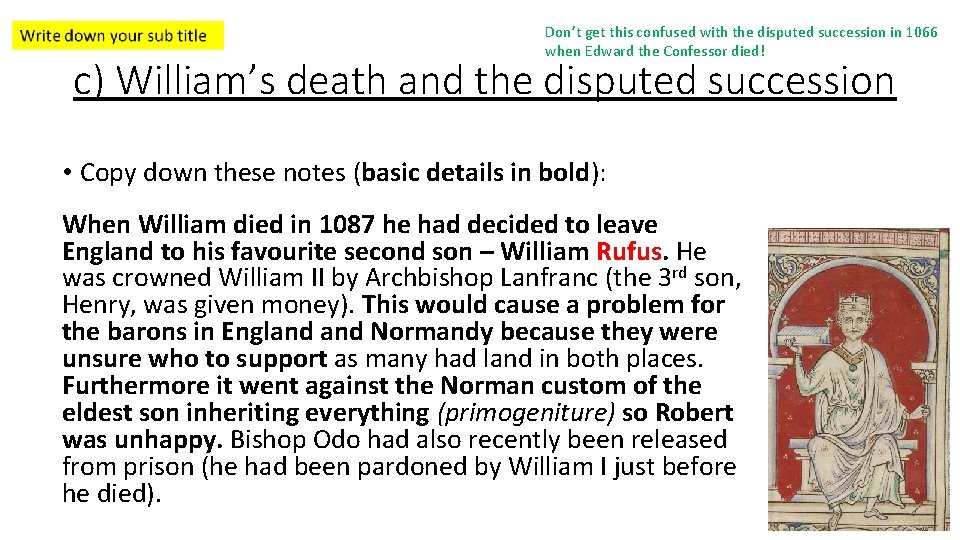
Don’t get this confused with the disputed succession in 1066 when Edward the Confessor died! c) William’s death and the disputed succession • Copy down these notes (basic details in bold): When William died in 1087 he had decided to leave England to his favourite second son – William Rufus. He was crowned William II by Archbishop Lanfranc (the 3 rd son, Henry, was given money). This would cause a problem for the barons in England Normandy because they were unsure who to support as many had land in both places. Furthermore it went against the Norman custom of the eldest son inheriting everything (primogeniture) so Robert was unhappy. Bishop Odo had also recently been released from prison (he had been pardoned by William I just before he died).
d) The defeat of Robert and Odo Copy down these notes (basics in bold) Odo had been released from prison and in 1088 he led a rebellion against William II in support of Robert. Odo controlled large areas of the south of England (he had been Earl of Kent) and there were further rebellions in other areas such as the Welsh Marches (borders) However most of the Norman Aristocracy (and the Anglo-Saxons) stayed loyal to the new king. Robert also failed to attack England from Normandy. William II eventually defeated Odo by a siege at Rochester Castle. Odo was stripped of all his lands and sent into exile.
Optional extra task Create a picture timeline / storyboard for the years 1077 -1088 using information on Odo and William’s sons (research and put them in order first). • William I dies in Normandy. Odo is released from prison. • William chooses his wife Mathilda, not his eldest son Robert, to control Normandy • Odo’s rebellion is defeated by William II at Rochester Castle • Robert defeats his father William I at Gerberoi (with help from Mathilda) • William I and his son Robert make peace. Robert is to inherit Normandy (only) • Odo travels to Italy to try and become Pope • The Domesday Book is written • Robert rebels against his father and brothers over the prank • Odo is put in prison on his return to England from Italy • Robert fails to join Odo’s rebellion from Normandy • William Rufus is crowned King of England by Lanfranc • The Norman nobles are not sure who to be loyal to – Robert or William Rufus? William Rufus (William II) has ginger hair (“Rufus”=red) whilst Robert was known as “Curthose” or “shortlegs”!