
WILLARD HIGH SCHOOL SPEECH DEBATE TOURNAMENT OCTOBER 20
WILLARD HIGH SCHOOL SPEECH & DEBATE TOURNAMENT— OCTOBER 20 -21 JUDGES’ WORKSHOP
WHAT IS SPEECH & DEBATE? • A Co-Curricular Activity which teaches students to become effective communicators • A competitive activity, much like Football or Marching Band.
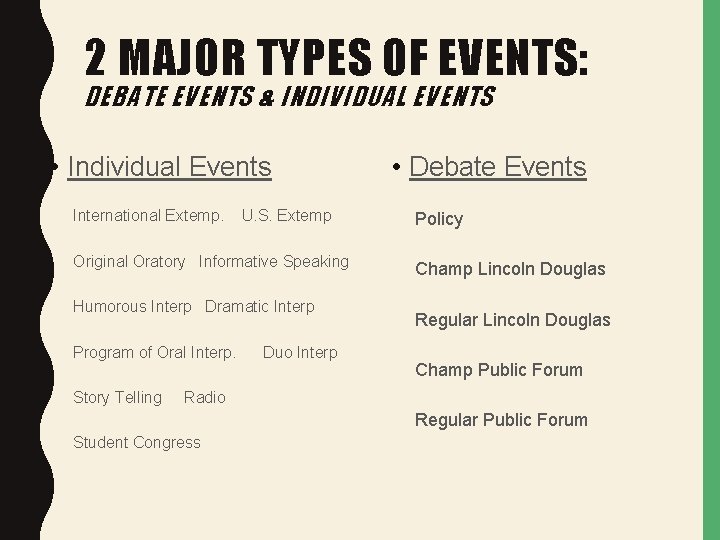
2 MAJOR TYPES OF EVENTS: DEBATE EVENTS & INDIVIDUAL EVENTS • Individual Events International Extemp. U. S. Extemp Original Oratory Informative Speaking Humorous Interp Dramatic Interp Program of Oral Interp. Story Telling Duo Interp • Debate Events Policy Champ Lincoln Douglas Regular Lincoln Douglas Champ Public Forum Radio Regular Public Forum Student Congress
ARE YOU QUALIFIED TO JUDGE? …YES! • Anyone who is out of high school can judge. • The goal of speech and debate is to teach students to communicate to all types of people. • Thank you and please DO NOT underestimate yourself
JUDGING INDIVIDUAL EVENTS • You will watch approx. 6 -8 performances per round. • Each competitor will have a code, it is very important that your rank match the proper code. • You will have 1 ballot for each performance. • You may make comments and suggestions on the ballot. • After watching all performances you will rank them in order from best to least best. • NO 2 Performances may receive the same rank. • Please wait for all performances, before leaving and/or making your decision. • Following the round return your ballots to the Ballot Judges table in the Commons by the Library.
INTERNATIONAL AND U. S. EXTEMPORANEOUS SPEAKING • Description – A 7 minute Informative Speech – Random questions dealing with current events. – 30 minutes of preparation time. – Speakers must perform in order. • What to Look For Does the Speaker… – Answer the question. – inform you of the issues. – speak to you, or over you. – have good delivery and content.
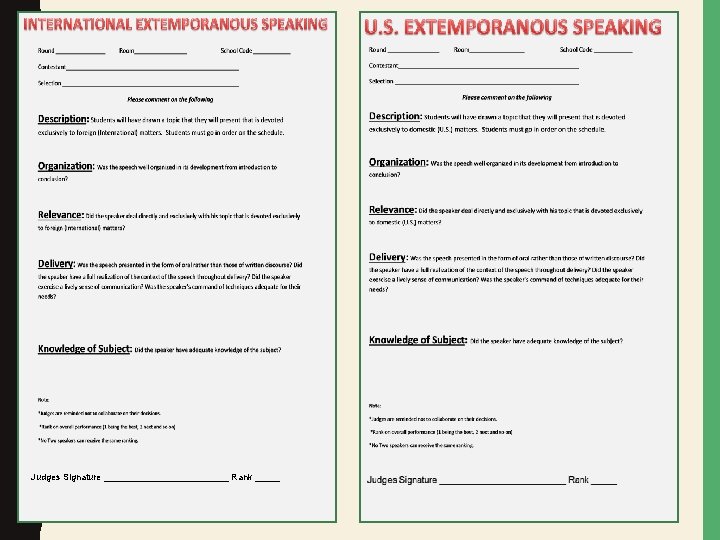
Judges Signature _____________ Rank _____
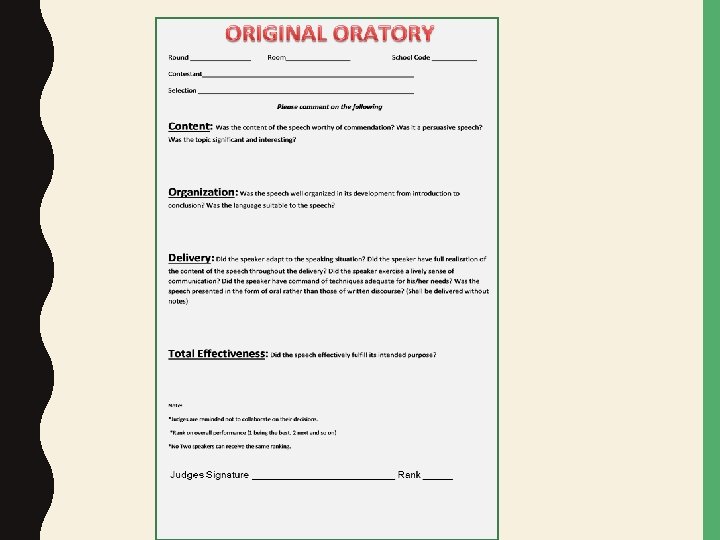
ORIGINAL ORATORY • Description – An 8 -10 minute persuasive speech. – Written by the student – Students do not have to perform in order. • What to Look For Does the Speaker… – Persuade and Motivate you. – Use stories, examples, and quotes effectively. – Clearly establish a problem and a solution. – Have good delivery and content.
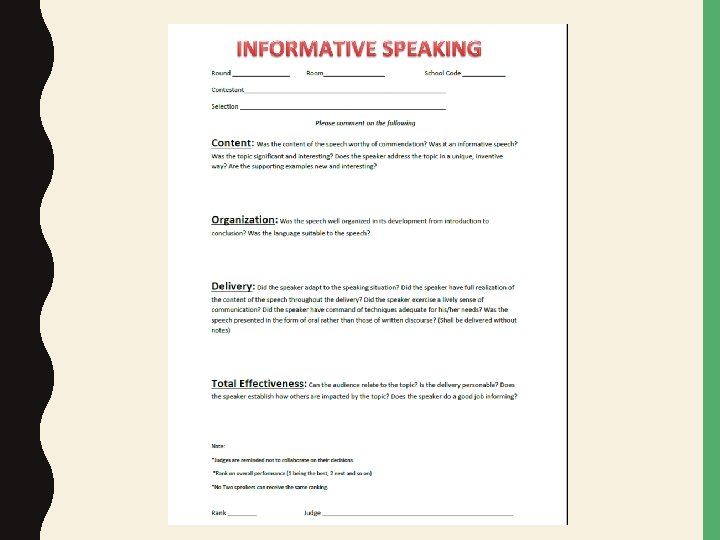
INFORMATIVE SPEAKING • Description – An 8 -10 minute informative speech. – Written by the student – Students do not have to perform in order. • What to Look For Does the Speaker… – Inform you. – Use stories, examples, and quotes effectively. – Have good delivery and content. – They may use visual aids
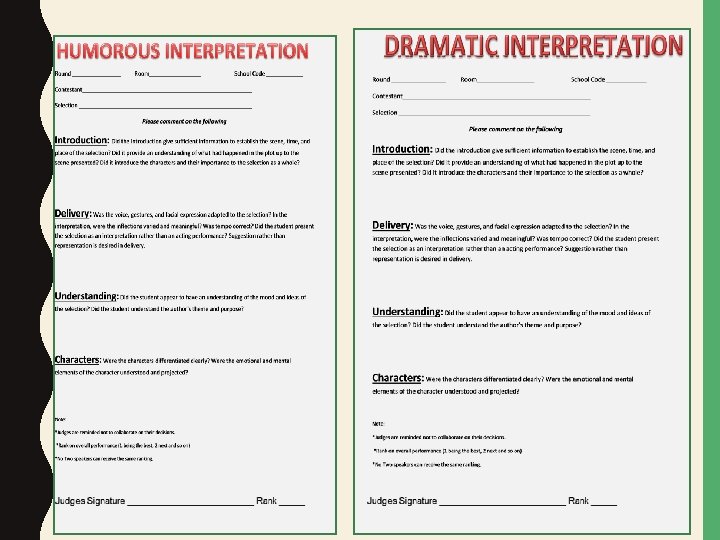
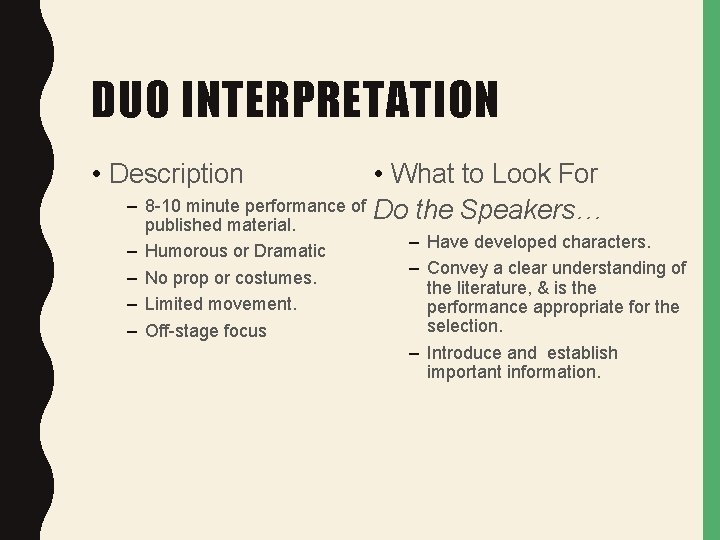
HUMOROUS & DRAMATIC INTERPRETATION • Description – 8 -10 minute performance – Cut from a published source, (play, book, etc. ) – Creative development of characters. – No costumes, props, or other visual aids. • What to Look For Does the speaker… – Have developed characters. – Convey a clear understanding of the literature, & is the performance appropriate for the selection. – Introduce and establish important information.
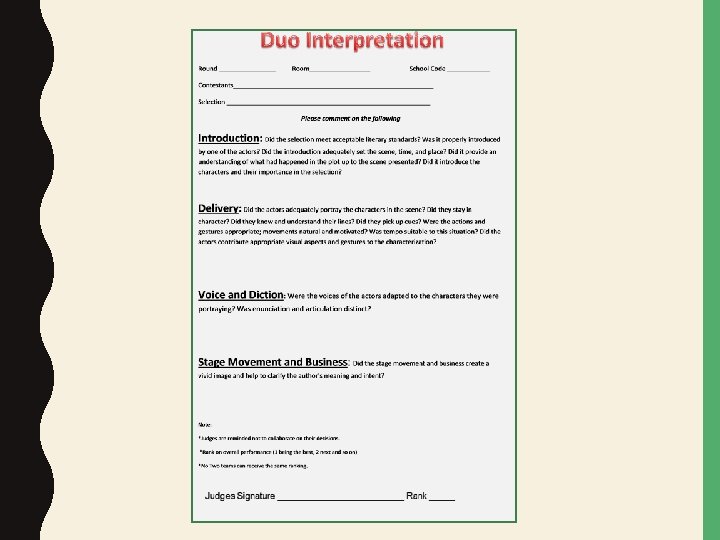
DUO INTERPRETATION • Description • What to Look For – 8 -10 minute performance of Do the Speakers… published material. – – Humorous or Dramatic No prop or costumes. Limited movement. Off-stage focus – Have developed characters. – Convey a clear understanding of the literature, & is the performance appropriate for the selection. – Introduce and establish important information.
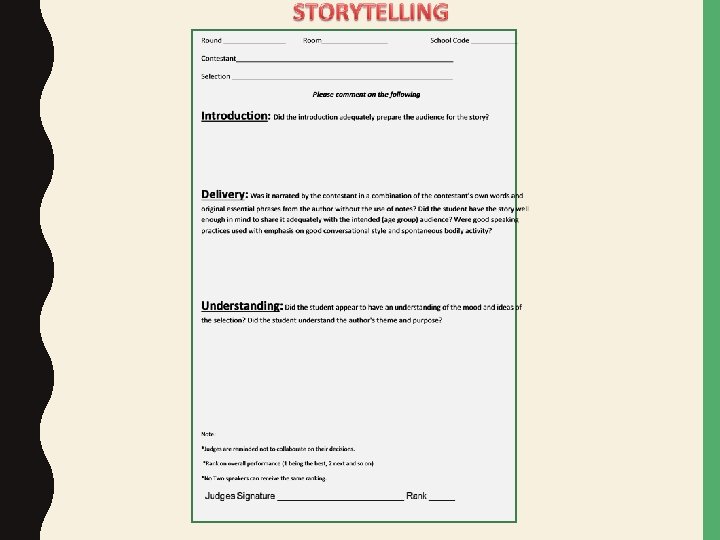
STORY TELLING • Description • What to Look For – 6 -8 minute performance of published material. – The story shall be told from a Does the speaker… seated position on a chair. – Convey a clear understanding of the literature, & is the – Narrated by the contestant in performance appropriate for the a combination of the selection. contestant’s own words and original essential phrases – Display good eye contact and from the author without the facial expression use of notes. – Introduce and establish – Limited movement. important information.
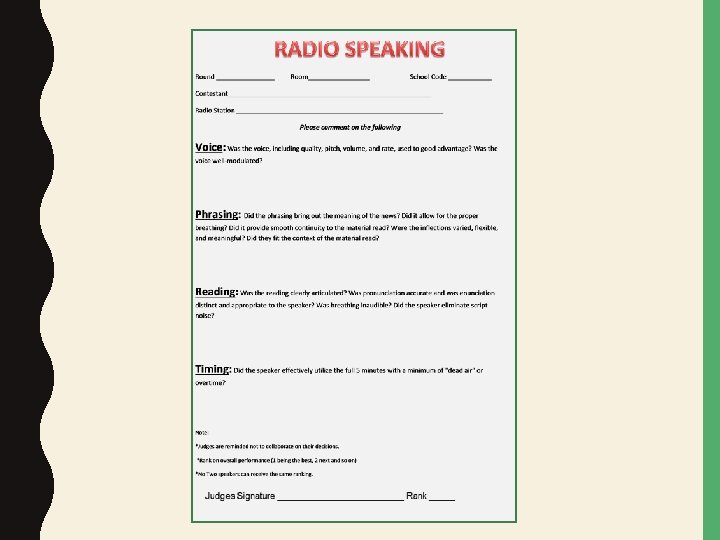
RADIO SPEAKING • Description • What to Look For Does – Not more than full 5 minutes with a minimum of "dead air". – Prepare and present a script which contains news, weather and sports. Copy used to prepare the script shall be no more than 24 hours old – No commercials may be used. – The contestant will have their back to the judge. the speaker… – The contestant's voice shall be pleasing when heard on radio. – The contestant’s articulation should be clear; enunciation distinct and pronunciation accurate. – The student's voice, including quality, pitch, volume, modulation and rate, should be used to good advantage. – The individual should have an understanding of the material read.
STUDENT CONGRESS • Description – 15 -20 students who give speeches about proposed laws. – Students are controlled by a Presiding Officer. – Students are ranked individually on a scale of 6 -1. – When the round is done you need to rank the room by ranking the top 8 speakers from 1 -8 • What to Look For Does the Speaker… – Seem informed about the issues. – Provide support for their opinions. – Work well with other students – Conduct him/her self with integrity and respect.
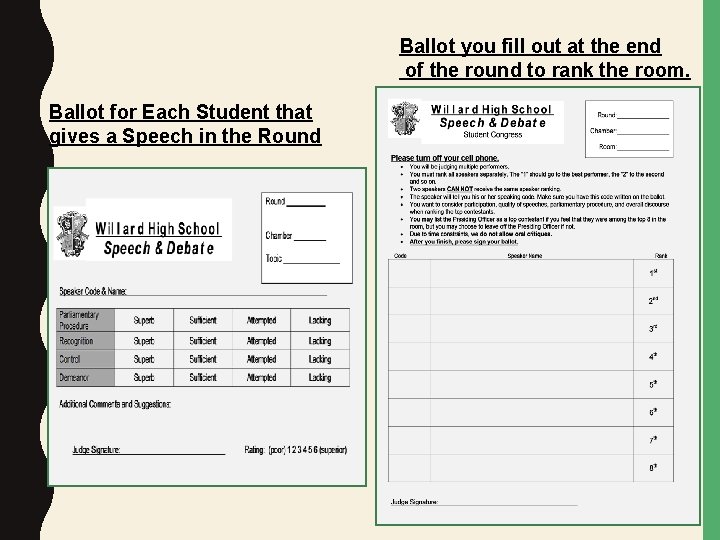
Ballot you fill out at the end of the round to rank the room. Ballot for Each Student that gives a Speech in the Round
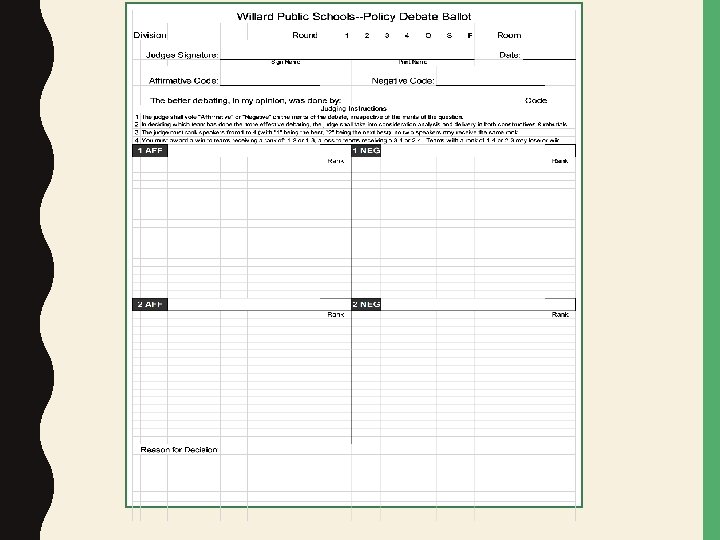
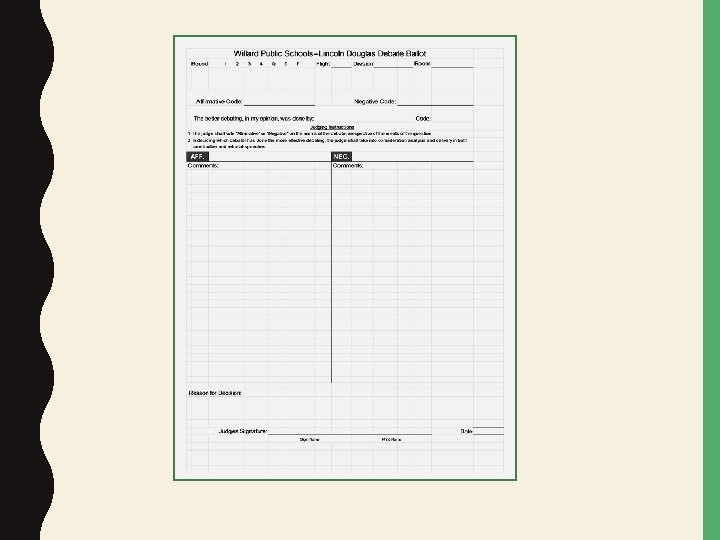
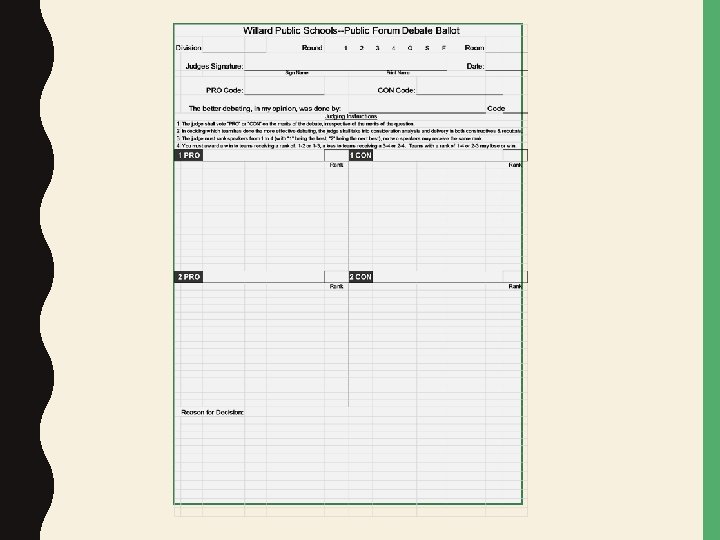
JUDGING DEBATE EVENTS • Each Debate Round you will watch 1 Policy Debate, 2 Lincoln Douglas Debates, or 2 Public Forum Debates. • There will be an Affirmative and a Negative Team for each debate. • Each debate team will have a code, it is very important that your decision match the proper code. • You will have 1 ballot for each debate you watch in the round. • You may make comments and suggestions on the ballot. • After watching a full debate you will give one team a win, no ties. • Following the round return your ballots to the Ballot Return table • Please judge the debate regardless of the merits of the resolution.
POLICY DEBATE • Resolved: The United States federal government should substantially increase its funding and/or regulation of elementary and/or secondary education in the United States. • Two Sides: Affirmative (2 students) & Negative (2 students). • Affirmative proposes a plan to change, & the negative argues against that plan. • Rank Speakers from 1 to 4 (1=best). • You should vote for the team that is most convincing, most prepared, and most professional.
LINCOLN/DOUGLAS DEBATE • Resolved: In the United States, national service ought to be compulsory. • 1 Affirmative & 1 Negative Speaker • Students debate the value of the issue, and not the policy of it. • Vote for the competitor who is persuasive, proves his/her points, and is the most professional.
PUBLIC FORUM DEBATE • Resolved: Deployment of anti-missile systems is in South Korea’s best interest. • They will flip a coin to decide who speaks first and who is Pro or Con • Pro (2 speakers) and Con (2 speakers) teams. • Students debate the intent. • Vote for the team that best persuades you, is best prepared, and is most professional. • During crossfire, all four speakers will ask and answer questions.
ANY QUESTIONS? Thank You For Your Help!. The WHS Speech & Debate Team
- Slides: 29