
Will LHCb be running during the HLLHC era
Will LHCb be running during the HL-LHC era? Burkhard Schmidt for the LHCb Collaboration Helpful discussions with L. Rossi and several other colleagues from the machine acknowledged Outline: • Introduction and Physics Motivation YES • LHCb Detector and Trigger Upgrade • Machine related issues to the LHCb upgrade • Conclusions
Will LHCb be running during the HL-LHC era? § LHCb believes there is a strong case for continuing to run beyond LS 2 in 2018. § We appreciate that at fixed luminosity the data-doubling time will become long, so we consider it essential to upgrade the experiment to increase the signal rate to storage by an order of magnitude. § The physics case for 50 fb-1 in LHCb has been presented in detail to the LHCC in a Letter of Intent and endorsed by them. § The evidence for CP violation in the charm sector is one of the most important and unexpected results to have come from the LHC so far, and illustrates the potential of probing for new physics in the flavour sector. B. Schmidt LHC performance workshop Chamonix 2012 2
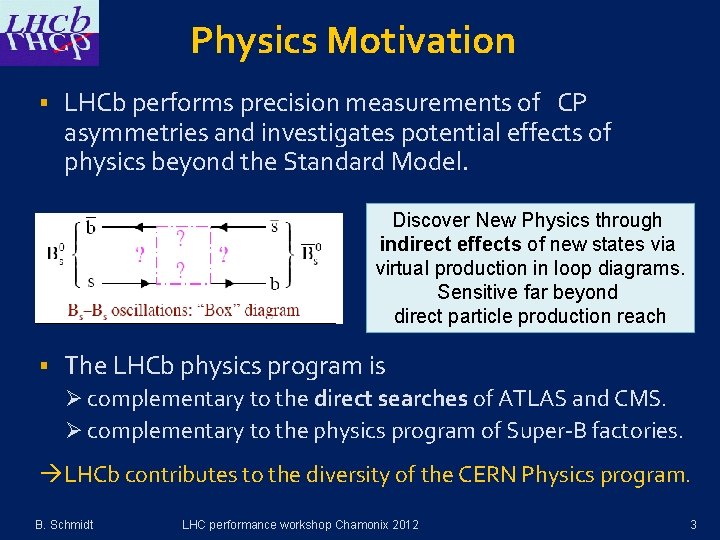
Physics Motivation § LHCb performs precision measurements of CP asymmetries and investigates potential effects of physics beyond the Standard Model. Discover New Physics through indirect effects of new states via virtual production in loop diagrams. Sensitive far beyond direct particle production reach § The LHCb physics program is Ø complementary to the direct searches of ATLAS and CMS. Ø complementary to the physics program of Super-B factories. LHCb contributes to the diversity of the CERN Physics program. B. Schmidt LHC performance workshop Chamonix 2012 3
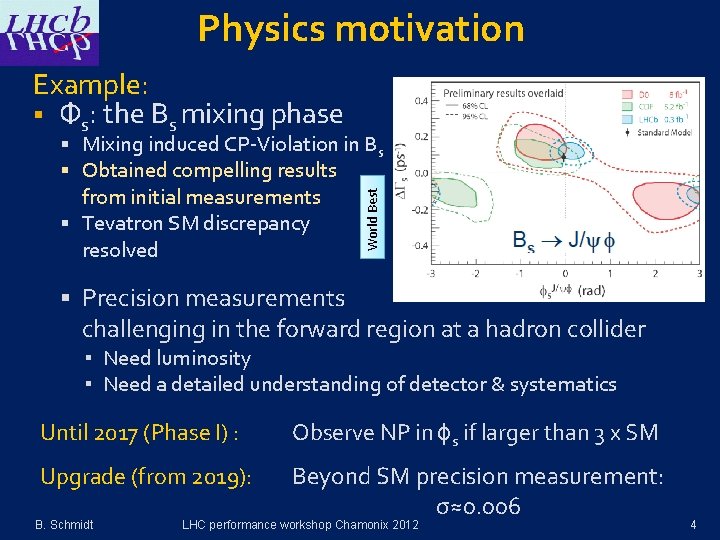
Physics motivation Example: § Φs: the Bs mixing phase from initial measurements § Tevatron SM discrepancy resolved World Best § Mixing induced CP-Violation in Bs § Obtained compelling results § Precision measurements challenging in the forward region at a hadron collider ▪ Need luminosity ▪ Need a detailed understanding of detector & systematics Until 2017 (Phase I) : Observe NP in ϕs if larger than 3 x SM Upgrade (from 2019): Beyond SM precision measurement: σ≈0. 006 B. Schmidt LHC performance workshop Chamonix 2012 4

LHCb Trigger – key to better performance Present Trigger hardware 40 MHz Level-0 μ, had, e, γ § § Must raise p. T cut to stay within 1 MHz readout limit Max 1 MHz software HLT 1 global recon. To profit of a luminosity of 2 x 1033 cm-2 s-1, information has to be introduced that is more discriminating than ET. 3 -4 k. Hz Upgrade strategy: part. recon. HLT 2 Storage: event size ~50 k. B B. Schmidt Final states with muons Linear gain Hadronic final states Yield flattens out § 40 MHz readout rate Fully software trigger 20 k. Hz output rate LHC performance workshop Chamonix 2012 5
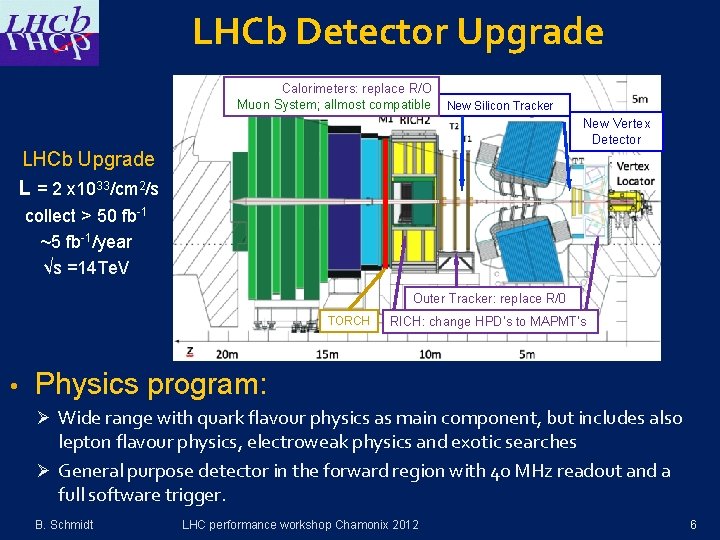
LHCb Detector Upgrade Calorimeters: replace R/O Muon System; allmost compatible New Silicon Tracker New Vertex Detector LHCb Upgrade L = 2 x 1033/cm 2/s collect > 50 fb-1 ~5 fb-1/year √s =14 Te. V Outer Tracker: replace R/0 TORCH • RICH: change HPD’s to MAPMT’s Physics program: Ø Wide range with quark flavour physics as main component, but includes also lepton flavour physics, electroweak physics and exotic searches Ø General purpose detector in the forward region with 40 MHz readout and a full software trigger. B. Schmidt LHC performance workshop Chamonix 2012 6
LHCb Upgrade The Physics program of LHCb is limited by the detector, not by the LHC. § The detector upgrade allows LHCb to better utilise the LHC capabilities. § The LOI for the upgrade has been submitted in March 2011 and endorsed by the LHCC in June 2011. § LHCb has been encouraged to proceed preparing TDRs. § § LHCb intends to upgrade the detector in LS 2, scheduled for 2018, and to take data for about 10 years afterwards. B. Schmidt LHC performance workshop Chamonix 2012 7
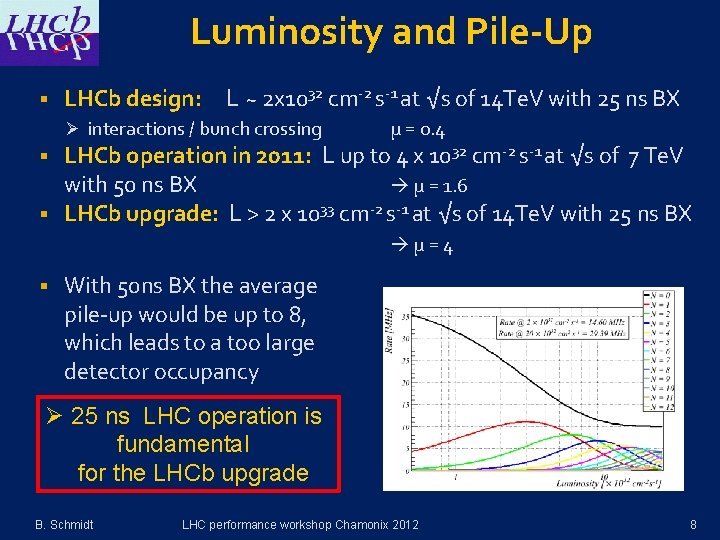
Luminosity and Pile-Up § LHCb design: L ~ 2 x 1032 cm-2 s-1 at √s of 14 Te. V with 25 ns BX Ø interactions / bunch crossing µ = 0. 4 LHCb operation in 2011: L up to 4 x 1032 cm-2 s-1 at √s of 7 Te. V with 50 ns BX µ = 1. 6 § LHCb upgrade: L > 2 x 1033 cm-2 s-1 at √s of 14 Te. V with 25 ns BX § µ=4 § With 50 ns BX the average pile-up would be up to 8, which leads to a too large detector occupancy Ø 25 ns LHC operation is fundamental for the LHCb upgrade B. Schmidt LHC performance workshop Chamonix 2012 8
Machine related Issues Target Absorber for Secondaries (TAS): § The high luminosity insertions at IP 1 and IP 5 are equipped with a TAS and a TAN to protect the triplet quadrupole magnets and other machine elements from particles leaving the IP. Would a TAS/TAN be needed in IP 8 for the envisaged luminosity increase to 2 x 1033/cm 2/s? § § Good knowledge of BLM thresholds around IP 8 is important. Detailed FLUKA simulations are needed. A first glance at the issue of the TAS: § Look at beam losses up- and down-stream of IP 8 for a fill in 2011 where the luminosity has been 4 x 1032/cm 2/s in LHCb (at √s of 7 Te. V). § Factor 5 below maximum luminosity for the upgrade, and factor 2 less in energy § Factor 4 is needed to take into account the difference between L peak and L Level § How far are we from the threshold causing a beam dump? (which is at ~30% of the quench limit) B. Schmidt LHC performance workshop Chamonix 2012 9
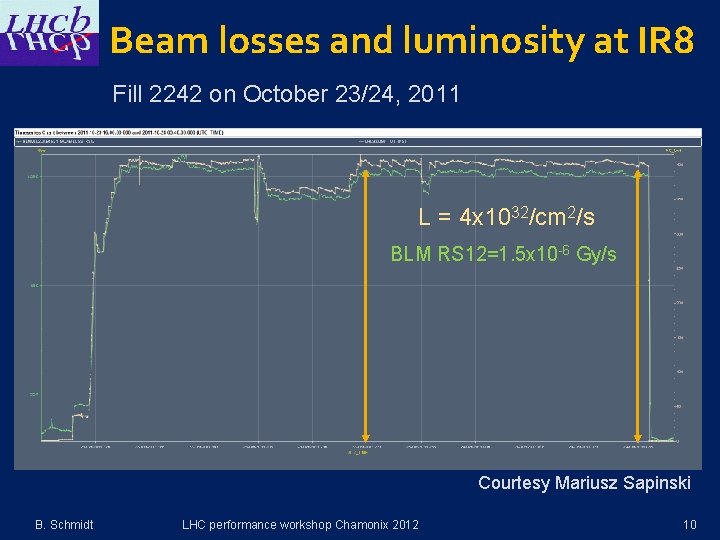
Beam losses and luminosity at IR 8 Fill 2242 on October 23/24, 2011 L = 4 x 1032/cm 2/s BLM RS 12=1. 5 x 10 -6 Gy/s Courtesy Mariusz Sapinski B. Schmidt LHC performance workshop Chamonix 2012 10
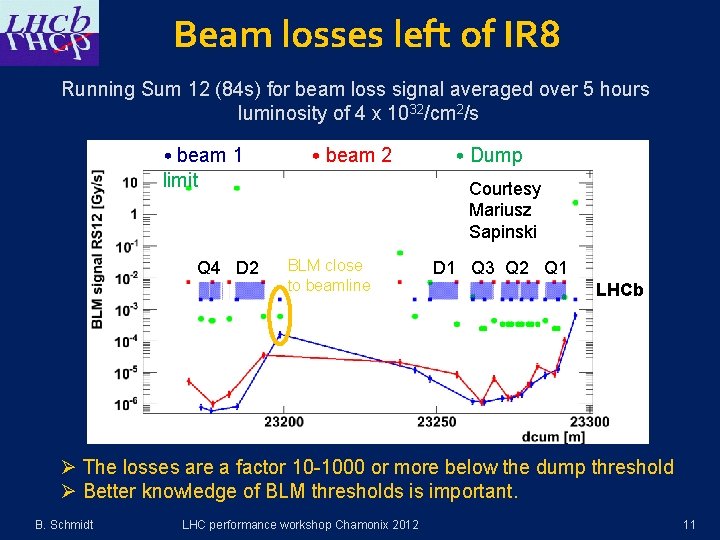
Beam losses left of IR 8 Running Sum 12 (84 s) for beam loss signal averaged over 5 hours luminosity of 4 x 1032/cm 2/s • beam 1 limit Q 4 D 2 • beam 2 • Dump Courtesy Mariusz Sapinski BLM close to beamline D 1 Q 3 Q 2 Q 1 LHCb Ø The losses are a factor 10 -1000 or more below the dump threshold Ø Better knowledge of BLM thresholds is important. B. Schmidt LHC performance workshop Chamonix 2012 11
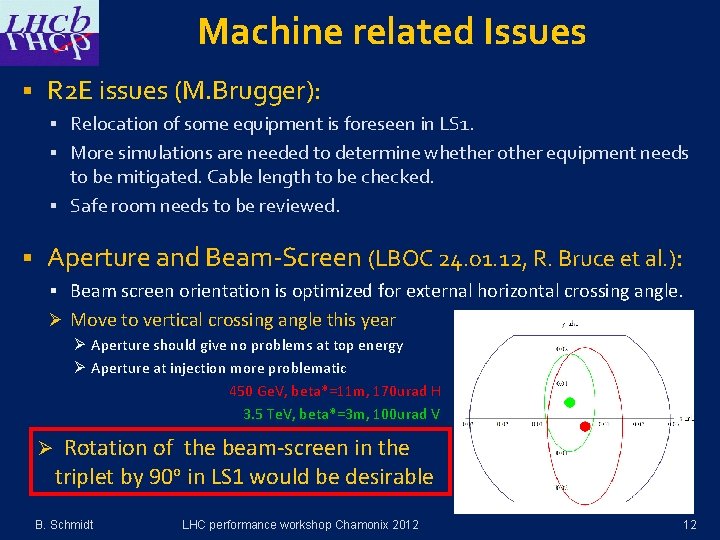
Machine related Issues § R 2 E issues (M. Brugger): § Relocation of some equipment is foreseen in LS 1. § More simulations are needed to determine whether other equipment needs to be mitigated. Cable length to be checked. § Safe room needs to be reviewed. § Aperture and Beam-Screen (LBOC 24. o 1. 12, R. Bruce et al. ): § Beam screen orientation is optimized for external horizontal crossing angle. Ø Move to vertical crossing angle this year Ø Aperture should give no problems at top energy Ø Aperture at injection more problematic 450 Ge. V, beta*=11 m, 170 urad H 3. 5 Te. V, beta*=3 m, 100 urad V Ø Rotation of the beam-screen in the triplet by 90 o in LS 1 would be desirable B. Schmidt LHC performance workshop Chamonix 2012 12
Conclusions § LHCb submitted an LOI to the LHCC in March 2011 and has a firm plan to upgrade the detector by 2018 Ø LHCC considers “the physics case compelling” and 40 MHz readout as the right upgrade strategy. Ø LHCC encouraged LHCb to prepare a TDR as soon as possible. § the Given its forward geometry, its excellent tracking and PID capabilities and the foreseen flexible software trigger, the upgraded LHCb detector Ø is an ideal detector for the next generation of flavour physics experiments Ø provides unique and complementary possibilities for New Physics studies. § LHCb intends to run for about 10 years after the upgrade and relies on Ø 25 ns LHC operation, Ø luminosity levelling, Ø equal amounts of data for the two spectrometer magnet polarities. § First discussions with the machine in relation to the upgrade took place and we intend to continue them in view of the TDRs under preparation. B. Schmidt LHC performance workshop Chamonix 2012 13

Backup Slides
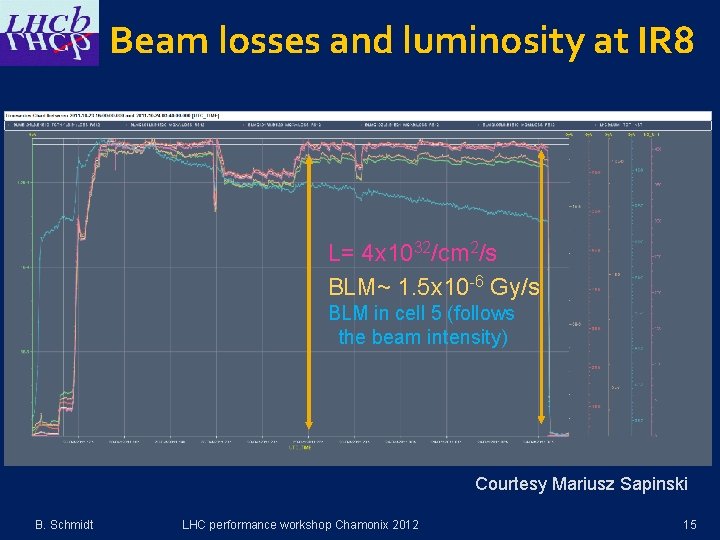
Beam losses and luminosity at IR 8 L= 4 x 1032/cm 2/s BLM~ 1. 5 x 10 -6 Gy/s BLM in cell 5 (follows the beam intensity) Courtesy Mariusz Sapinski B. Schmidt LHC performance workshop Chamonix 2012 15
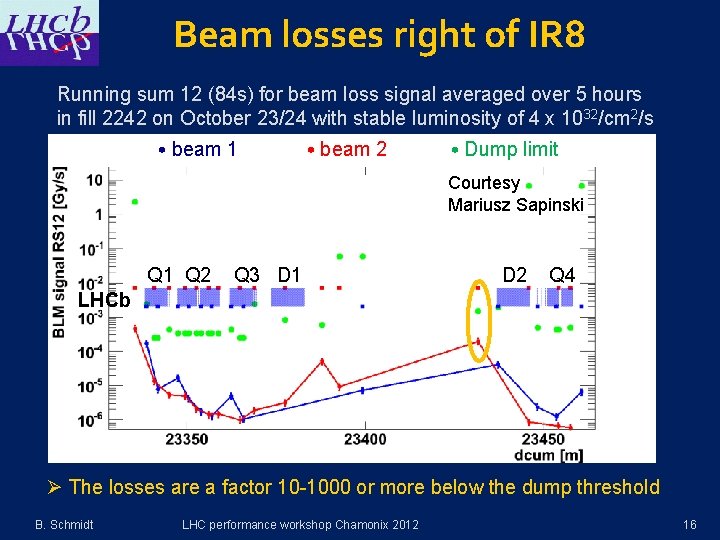
Beam losses right of IR 8 Running sum 12 (84 s) for beam loss signal averaged over 5 hours in fill 2242 on October 23/24 with stable luminosity of 4 x 1032/cm 2/s • beam 1 • beam 2 • Dump limit Courtesy Mariusz Sapinski Q 1 Q 2 Q 3 D 1 D 2 Q 4 LHCb Ø The losses are a factor 10 -1000 or more below the dump threshold B. Schmidt LHC performance workshop Chamonix 2012 16
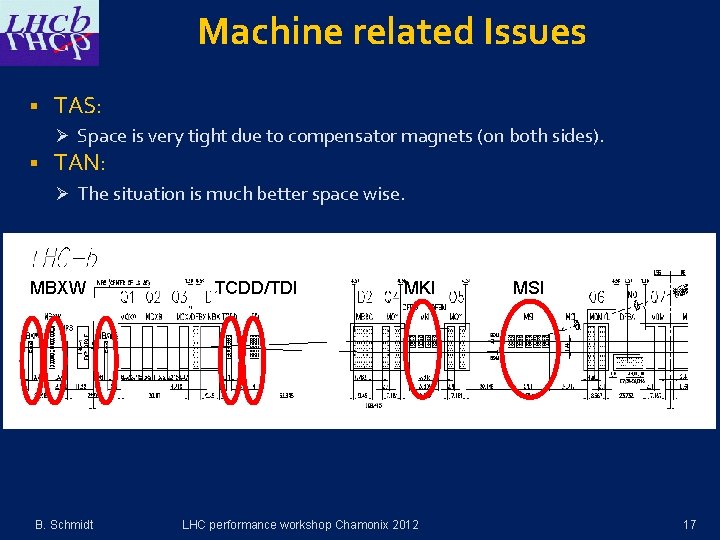
Machine related Issues § TAS: Ø Space is very tight due to compensator magnets (on both sides). § TAN: Ø The situation is much better space wise. MBXW B. Schmidt TCDD/TDI MKI LHC performance workshop Chamonix 2012 MSI 17
- Slides: 17