
Will Dieting Cure The Obesity Epidemic Traci Mann
Will Dieting Cure The Obesity Epidemic? Traci Mann, Ph. D. University of Minnesota Department of Psychology
No Traci Mann, Ph. D. University of Minnesota Department of Psychology
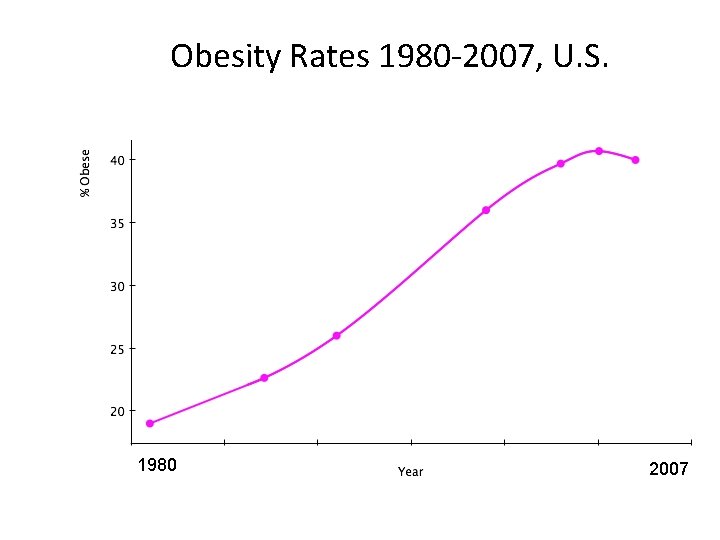
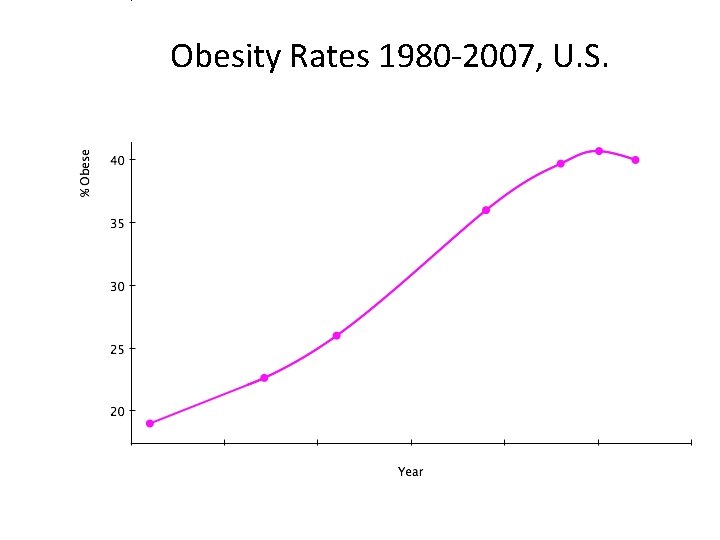
Obesity Rates 1980 -2007, U. S. 1980 2007
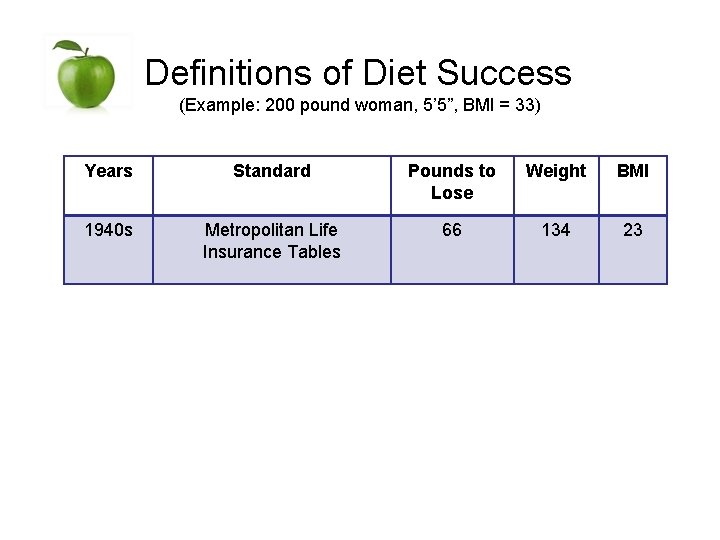
Definitions of Diet Success (Example: 200 pound woman, 5’ 5”, BMI = 33) Years Standard Pounds to Lose Weight BMI 1940 s Metropolitan Life Insurance Tables 66 134 23
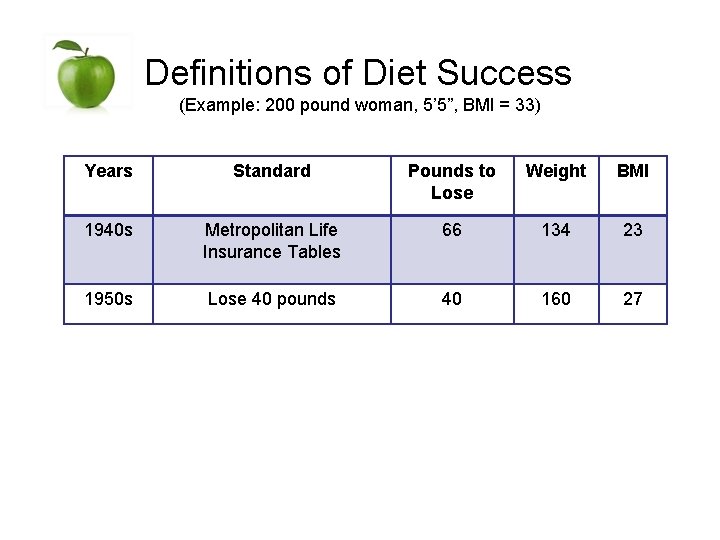
Definitions of Diet Success (Example: 200 pound woman, 5’ 5”, BMI = 33) Years Standard Pounds to Lose Weight BMI 1940 s Metropolitan Life Insurance Tables 66 134 23 1950 s Lose 40 pounds 40 160 27
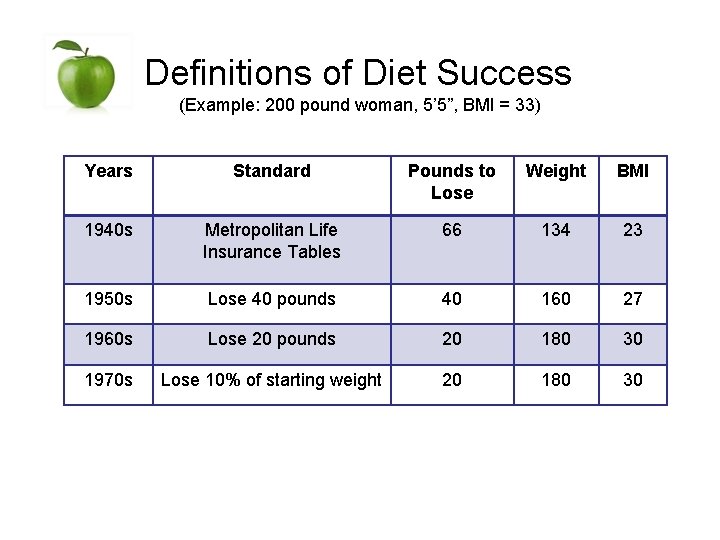
Definitions of Diet Success (Example: 200 pound woman, 5’ 5”, BMI = 33) Years Standard Pounds to Lose Weight BMI 1940 s Metropolitan Life Insurance Tables 66 134 23 1950 s Lose 40 pounds 40 160 27 1960 s Lose 20 pounds 20 180 30 1970 s Lose 10% of starting weight 20 180 30
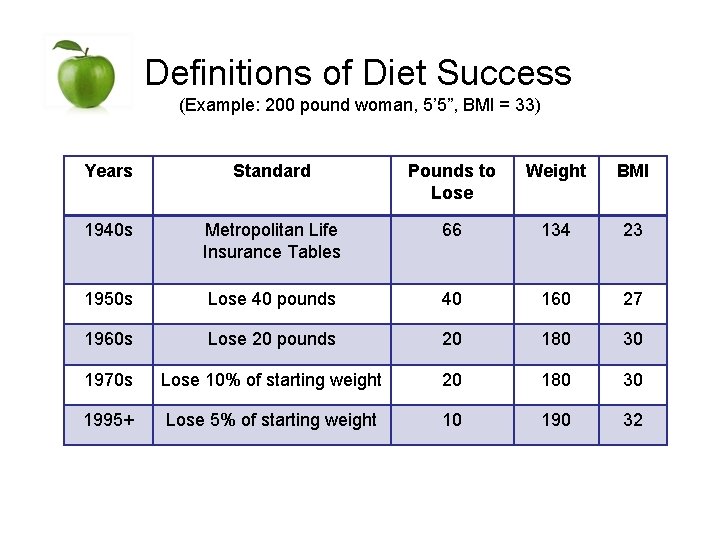
Definitions of Diet Success (Example: 200 pound woman, 5’ 5”, BMI = 33) Years Standard Pounds to Lose Weight BMI 1940 s Metropolitan Life Insurance Tables 66 134 23 1950 s Lose 40 pounds 40 160 27 1960 s Lose 20 pounds 20 180 30 1970 s Lose 10% of starting weight 20 180 30 1995+ Lose 5% of starting weight 10 190 32
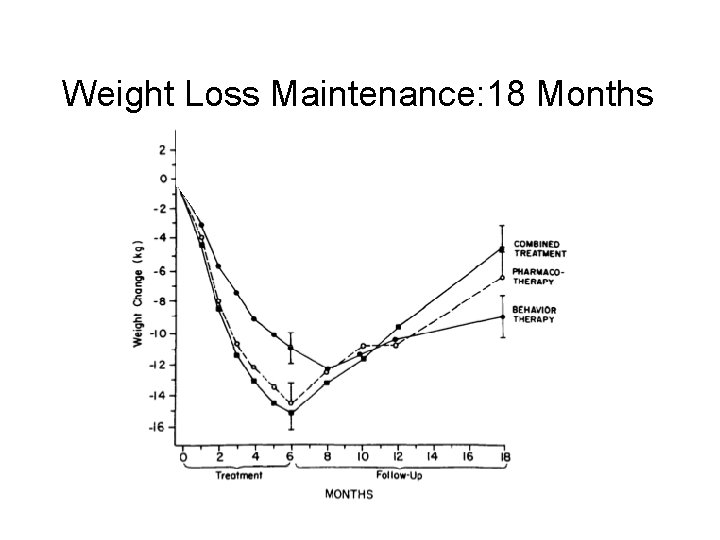
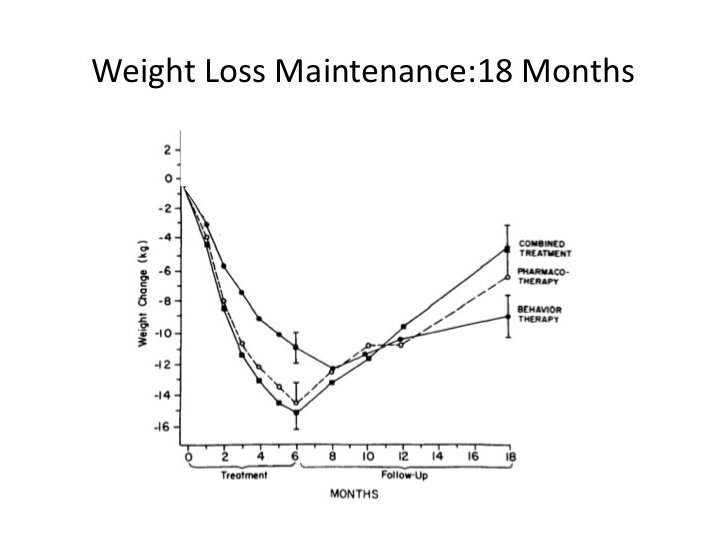
Weight Loss Maintenance: 18 Months
Long-Term Diet Studies (Mann et al. , 2008, American Psychologist) • Studies with control groups (n=8) – Avg. weight change of dieters: Lost 2. 3 lbs – Avg. weight change of controls: • Studies without control groups (n=13) – Initial weight loss: 39 pounds – Ultimate gain-back: – % regain more than they lost:
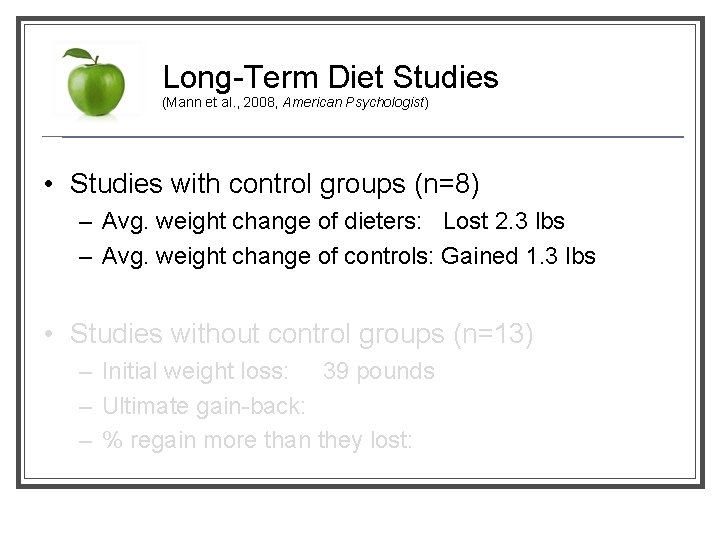
Long-Term Diet Studies (Mann et al. , 2008, American Psychologist) • Studies with control groups (n=8) – Avg. weight change of dieters: Lost 2. 3 lbs – Avg. weight change of controls: Gained 1. 3 lbs • Studies without control groups (n=13) – Initial weight loss: 39 pounds – Ultimate gain-back: – % regain more than they lost:
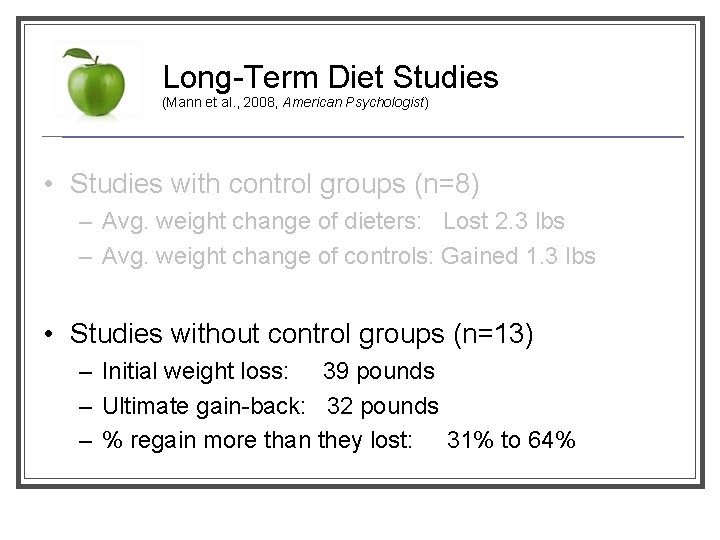
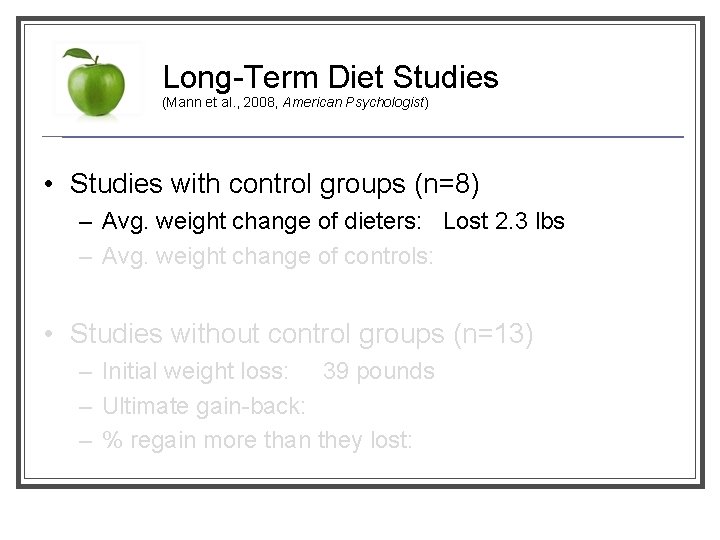
Long-Term Diet Studies (Mann et al. , 2008, American Psychologist) • Studies with control groups (n=8) – Avg. weight change of dieters: Lost 2. 3 lbs – Avg. weight change of controls: Gained 1. 3 lbs • Studies without control groups (n=13) – Initial weight loss: 39 pounds – Ultimate gain-back: 32 pounds – % regain more than they lost: 31% to 64%
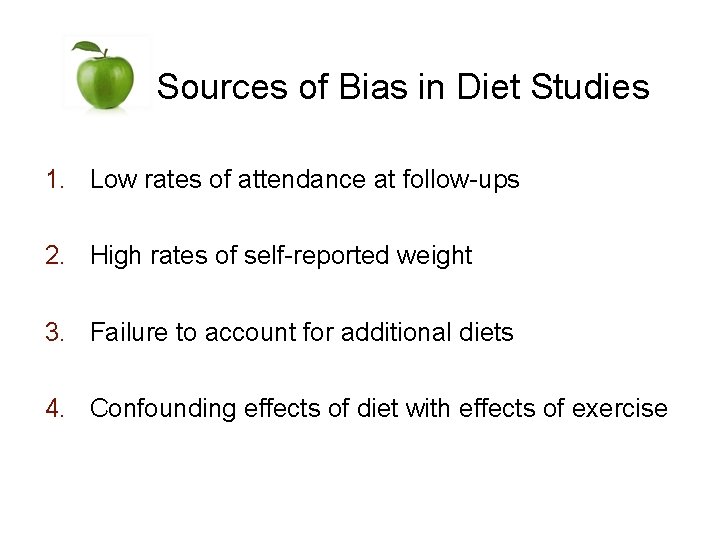
Sources of Bias in Diet Studies 1. Low rates of attendance at follow-ups 2. High rates of self-reported weight 3. Failure to account for additional diets 4. Confounding effects of diet with effects of exercise
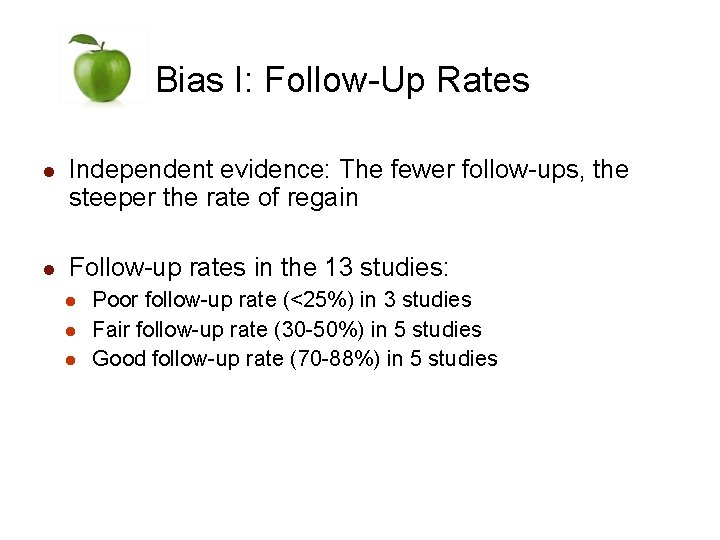
Bias I: Follow-Up Rates l Independent evidence: The fewer follow-ups, the steeper the rate of regain l Follow-up rates in the 13 studies: l l l Poor follow-up rate (<25%) in 3 studies Fair follow-up rate (30 -50%) in 5 studies Good follow-up rate (70 -88%) in 5 studies
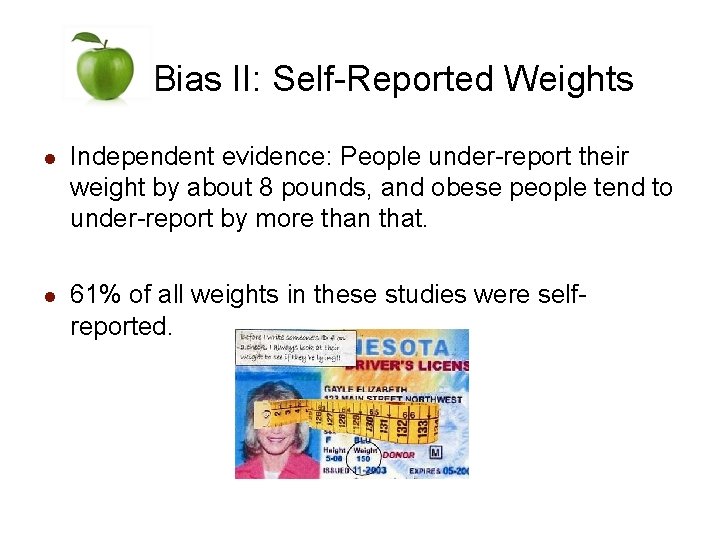
Bias II: Self-Reported Weights l Independent evidence: People under-report their weight by about 8 pounds, and obese people tend to under-report by more than that. l 61% of all weights in these studies were selfreported.
Bias III: Participation in Additional Diets l Independent Evidence: Survey of Dieters 60% weighed more than starting weight at some point since diet 40% weigh more than starting weight now l Rates of participation in other diets l l l 20% to 65% of participants (7 studies) 1 to 3 diets/year (3 studies) 3 studies did not report this
Bias IV: Confounding Diet and Exercise l Independent Evidence l l l Strongest predictor of weight-loss maintenance >90% of successful maintainers use regular exercise Rates of exercise in the 13 studies: l l 22% to 46% engaged in regular exercise 8 studies did not report on exercise
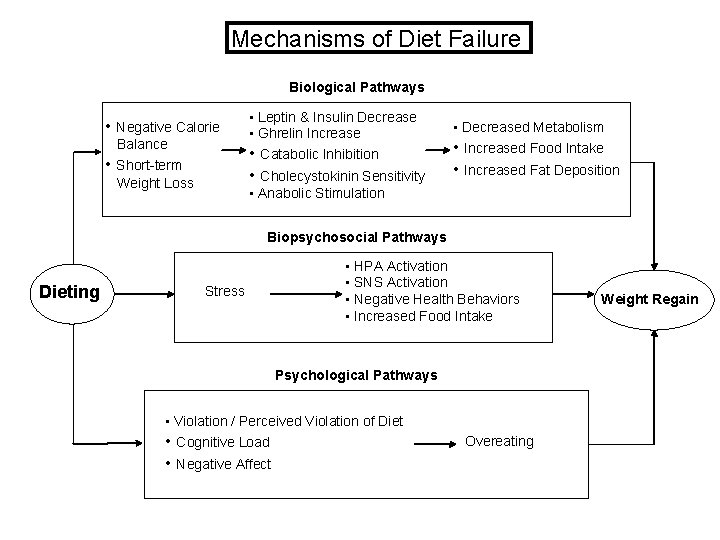
Mechanisms of Diet Failure Biological Pathways • Negative Calorie • Balance Short-term Weight Loss • Leptin & Insulin Decrease • Ghrelin Increase • Catabolic Inhibition • Cholecystokinin Sensitivity • Decreased Metabolism • Increased Food Intake • Increased Fat Deposition • Anabolic Stimulation Biopsychosocial Pathways Dieting Stress • HPA Activation • SNS Activation • Negative Health Behaviors • Increased Food Intake Psychological Pathways • Violation / Perceived Violation of Diet • Cognitive Load • Negative Affect Overeating Weight Regain
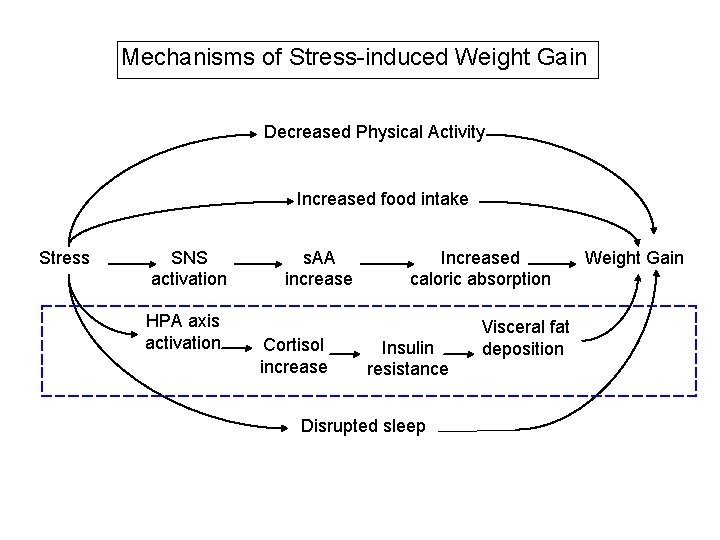
Mechanisms of Stress-induced Weight Gain Decreased Physical Activity Increased food intake Stress SNS activation HPA axis activation s. AA increase Cortisol increase Increased caloric absorption Insulin resistance Disrupted sleep Visceral fat deposition Weight Gain
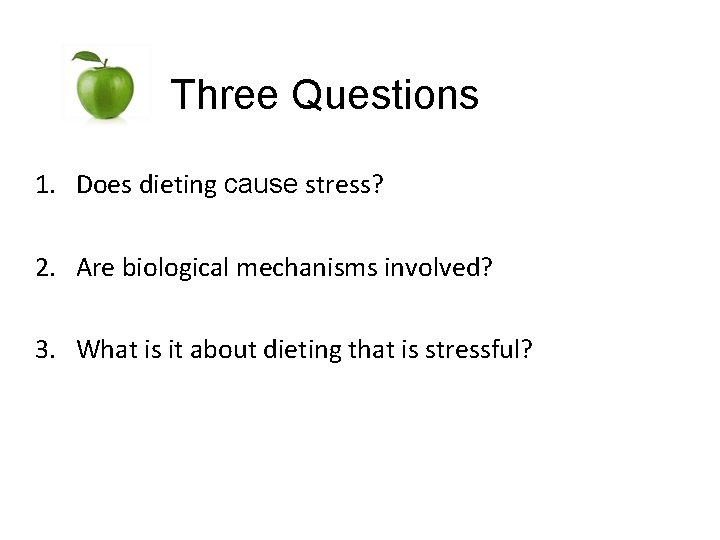
Three Questions 1. Does dieting cause stress? 2. Are biological mechanisms involved? 3. What is it about dieting that is stressful?
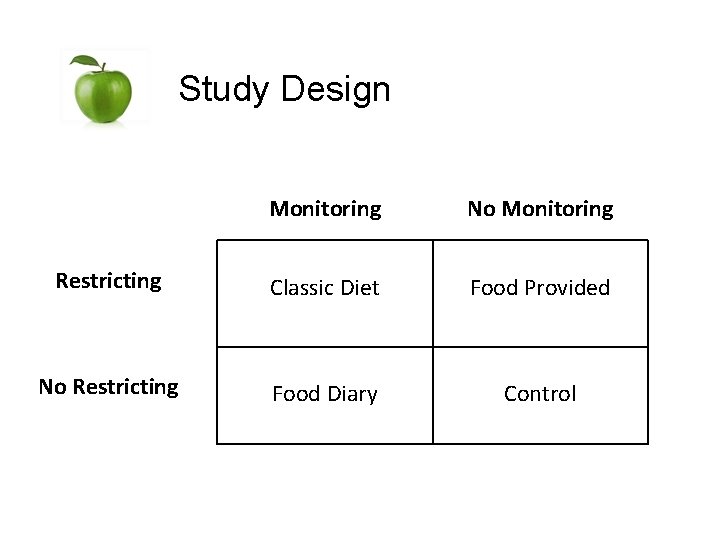
Study Design Monitoring No Monitoring Restricting Classic Diet Food Provided No Restricting Food Diary Control

Sample & Procedures Sample n = 121 females Mean age: 22 Mean BMI: 25 Procedures 1. 2. 3. Pre-diet questionnaires and 2 days of saliva sampling Three weeks of assigned diet Post-diet questionnaires and 2 days of saliva sampling
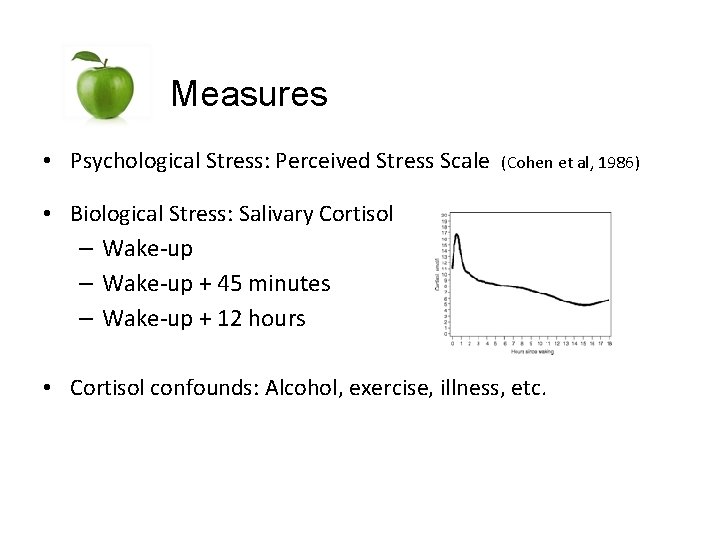
Measures • Psychological Stress: Perceived Stress Scale (Cohen et al, 1986) • Biological Stress: Salivary Cortisol – Wake-up + 45 minutes – Wake-up + 12 hours • Cortisol confounds: Alcohol, exercise, illness, etc.
Manipulation Checks • Sticking to 1200 kcal diet – Restricting conditions: 1260 kcal – Non-restricting condition: 1704 kcal • Weight change – Restricting conditions: -1. 9 lbs – Non-restricting conditions: +2. 6 lbs Only one nonrestricting condition monitored calories
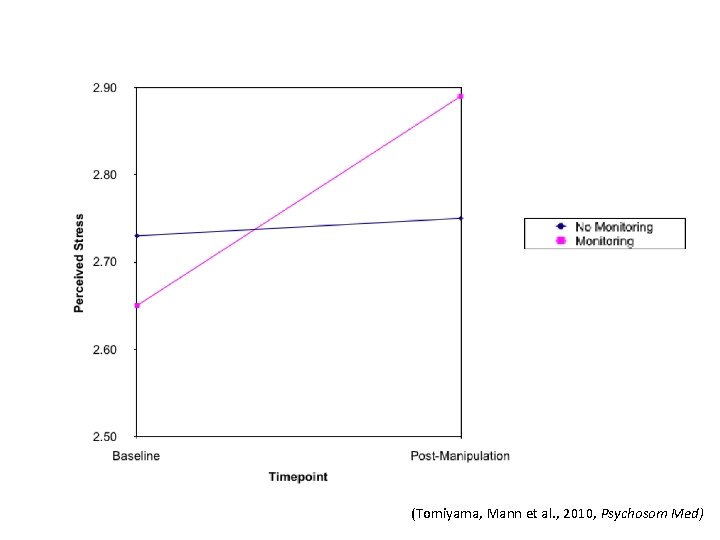
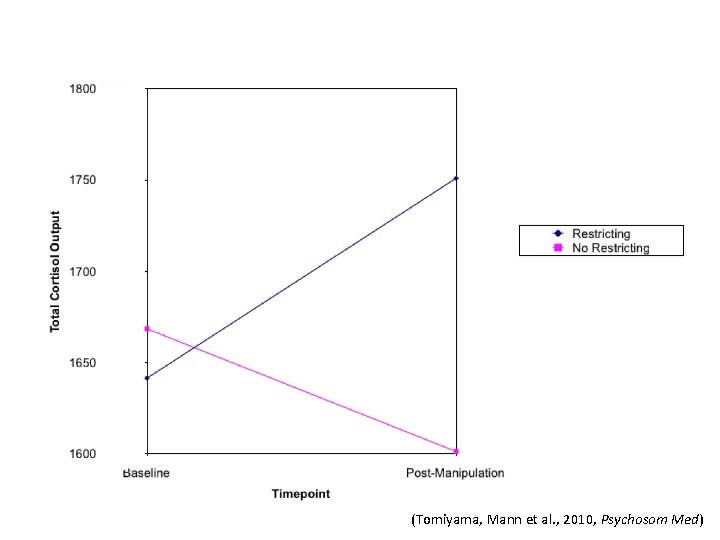
Results (Tomiyama, Mann et al. , 2010, Psychosomatic Medicine) Perceived Stress: Main effect of monitoring Monitoring diet: Not monitoring diet: Perceived stress increased Perceived stress did not change Total Cortisol Output: Main effect of restricting Restricting diet: Not restricting diet: Cortisol output increased Cortisol output did not change
(Tomiyama, Mann et al. , 2010, Psychosom Med)
(Tomiyama, Mann et al. , 2010, Psychosom Med)
Conclusions 1. Does dieting cause stress? It did in this study 2. Are biological mechanisms involved? total cortisol output was involved in this study 3. What is it about dieting that is stressful? Monitoring one’s diet increases perceived stress Restricting one’s diet increases cortisol
Why Are These Behaviors Stressful? • Monitoring: Increased perceived stress – It’s another hassle – Each food item recorded is a “failure” – We eat more than we realize • Restricting: Increased cortisol – Cortisol’s main job: Gluconeogenesis

Why Aren’t These Behaviors Stressful? • Monitoring: Did not increase cortisol – Maybe a prolonged increased in perceived stress would have? • Restricting: Did not increase perceived stress – Correlational studies find it: but they confound the two tasks – “Restricting Only” condition – provided free and delicious food – Working successfully towards a goal – positive emotion
Obesity Rates 1980 -2007, U. S.
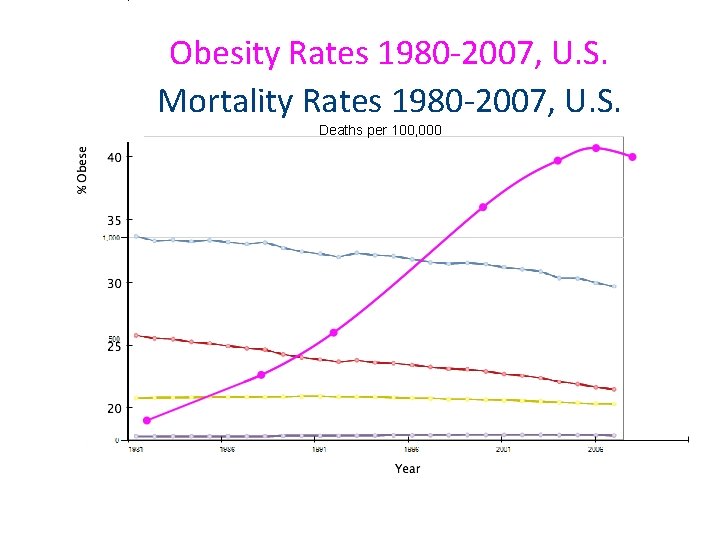
Obesity Rates 1980 -2007, U. S. Mortality Rates 1980 -2007, U. S. Deaths per 100, 000
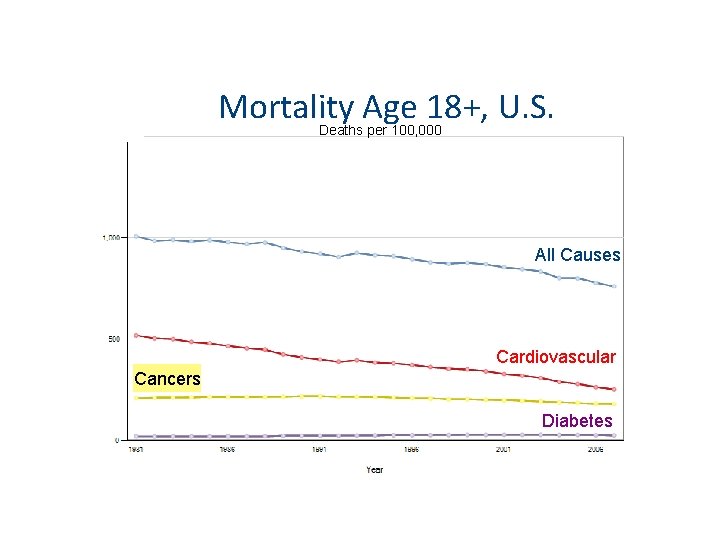
Mortality Age 18+, U. S. Deaths per 100, 000 All Causes Cardiovascular Cancers Diabetes
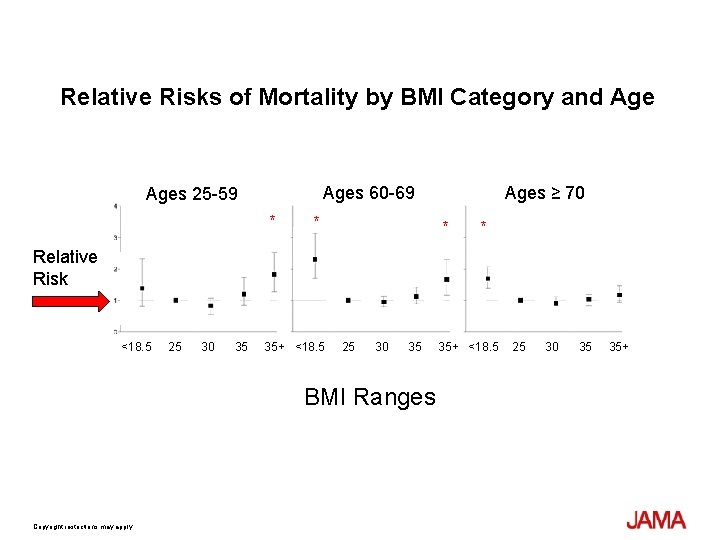
Relative Risks of Mortality by BMI Category and Ages 60 -69 Ages 25 -59 * * Ages ≥ 70 * * Relative Risk <18. 5 25 30 35 35+ <18. 5 25 30 35 BMI Ranges Copyright restrictions may apply. 35+ <18. 5 25 30 35 35+
3
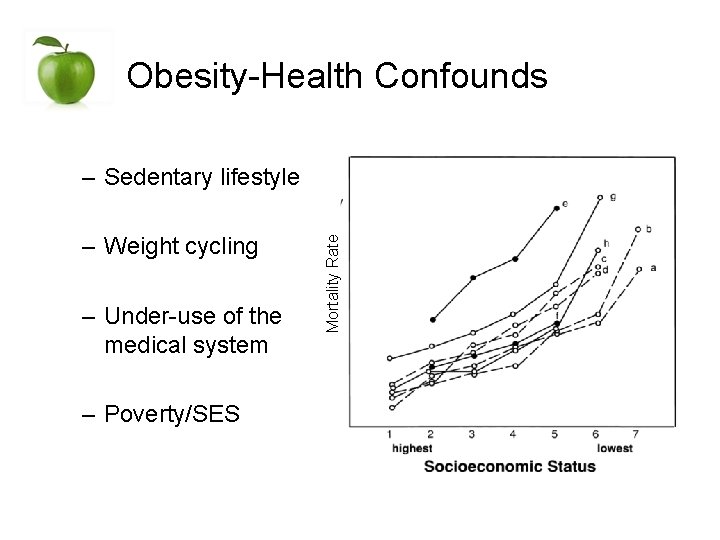
Obesity-Health Confounds – Weight cycling – Under-use of the medical system – Poverty/SES Mortality Rate – Sedentary lifestyle
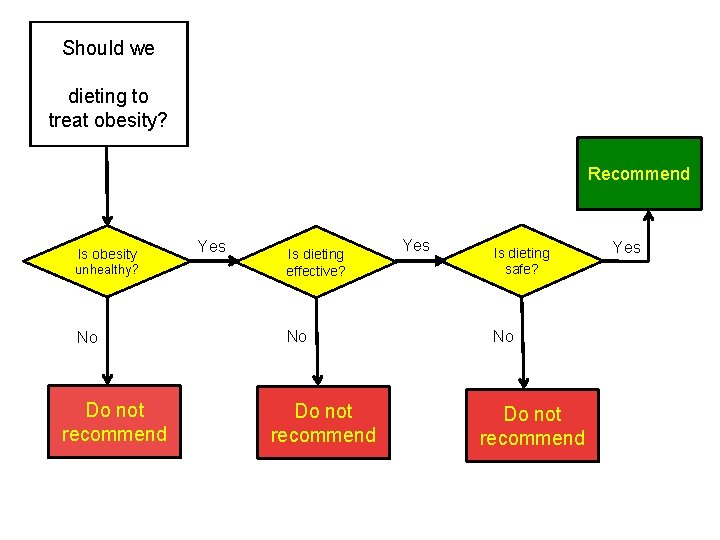
Should we recommend dieting to treat obesity? Recommend Is obesity Yes unhealthy? Is dieting effective? No No Do not recommend Yes Is dieting safe? No Do not recommend Yes
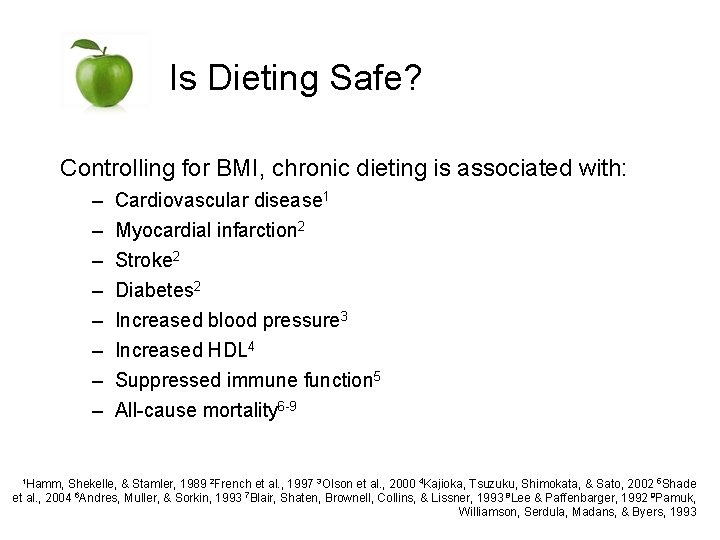
Is Dieting Safe? Controlling for BMI, chronic dieting is associated with: – – – – 1 Hamm, Cardiovascular disease 1 Myocardial infarction 2 Stroke 2 Diabetes 2 Increased blood pressure 3 Increased HDL 4 Suppressed immune function 5 All-cause mortality 6 -9 Shekelle, & Stamler, 1989 2 French et al. , 1997 3 Olson et al. , 2000 4 Kajioka, Tsuzuku, Shimokata, & Sato, 2002 5 Shade et al. , 2004 6 Andres, Muller, & Sorkin, 1993 7 Blair, Shaten, Brownell, Collins, & Lissner, 1993 8 Lee & Paffenbarger, 1992 9 Pamuk, Williamson, Serdula, Madans, & Byers, 1993
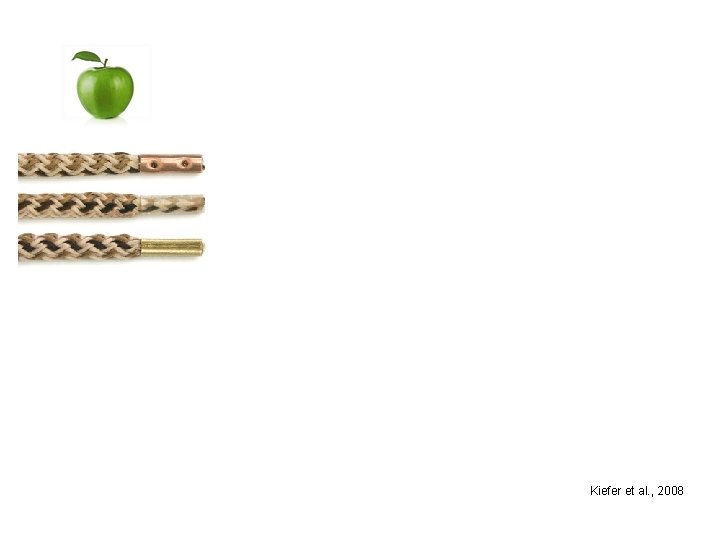
Kiefer et al. , 2008
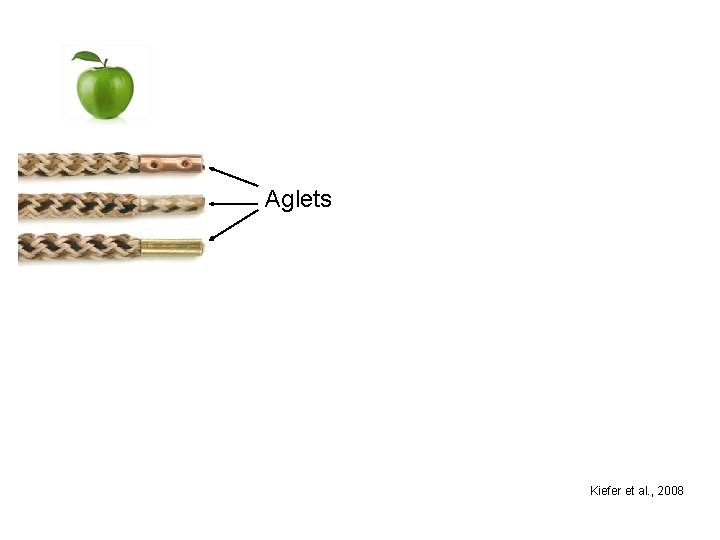
Aglets Kiefer et al. , 2008
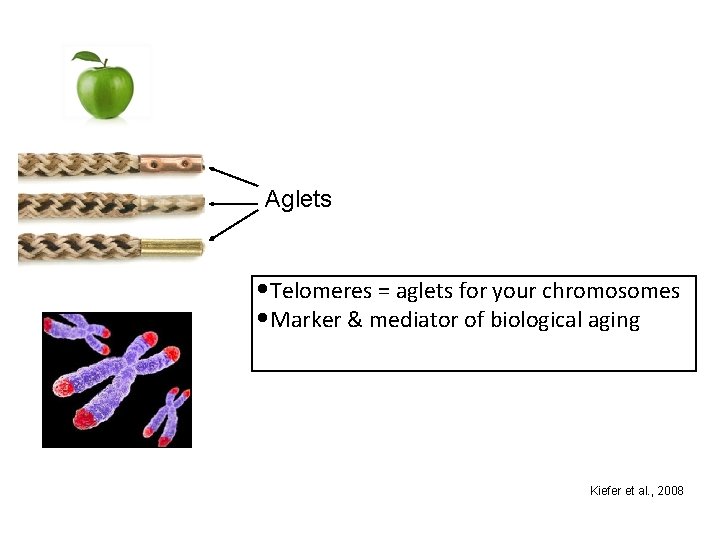
Aglets • Telomeres = aglets for your chromosomes • Marker & mediator of biological aging Kiefer et al. , 2008
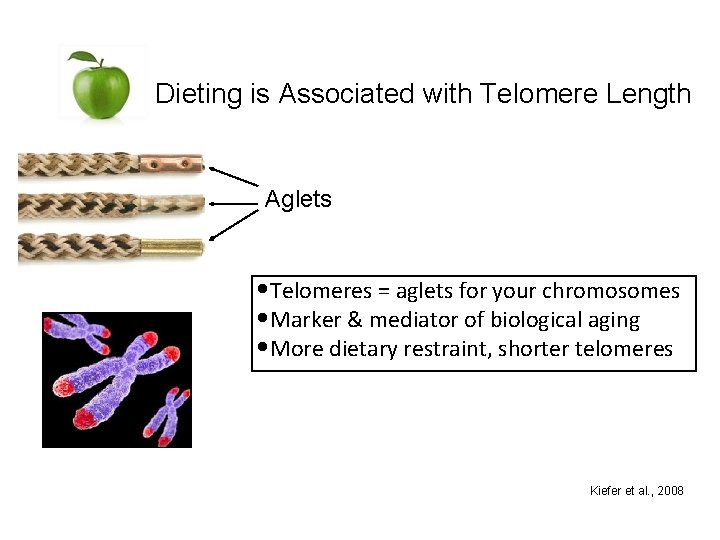
Dieting is Associated with Telomere Length Aglets • Telomeres = aglets for your chromosomes • Marker & mediator of biological aging • More dietary restraint, shorter telomeres Kiefer et al. , 2008
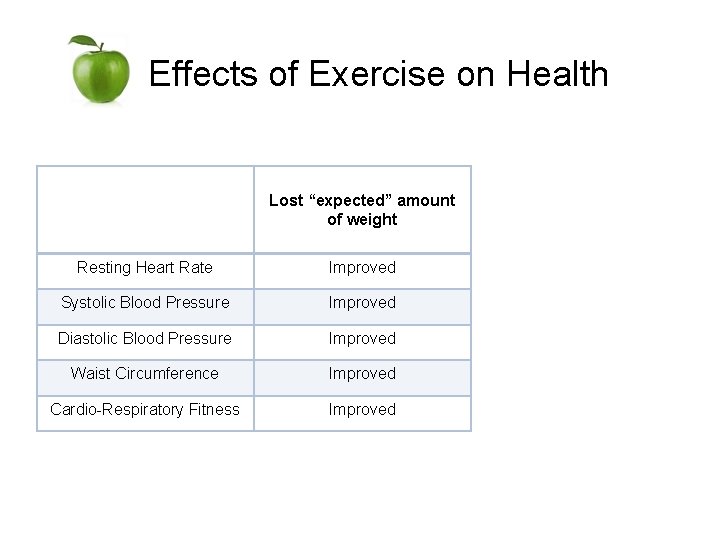
Effects of Exercise on Health Lost “expected” amount of weight Resting Heart Rate Improved Systolic Blood Pressure Improved Diastolic Blood Pressure Improved Waist Circumference Improved Cardio-Respiratory Fitness Improved

Effects of Exercise on Health Lost “expected” amount of weight Didn’t lose “expected” amount of weight Resting Heart Rate Improved Systolic Blood Pressure Improved Diastolic Blood Pressure Improved Waist Circumference Improved Cardio-Respiratory Fitness Improved

Acknowledgements Funders National Institute of Mental Health National Heart, Lung, and Blood Institute US Department of Agriculture University of Minnesota UCLA Main Collaborators Janet Tomiyama Andrew Ward Health and Eating Lab UMN Health and Eating Lab UCLA Research Assistants Danielle Vinas Jeff Hunger Kate E. Byrne Haltom Students in Psychology of Eating Defrayer of Cortisol Assay Costs Clemens Kirschbaum
- Slides: 47