
Wildlife Ranching an industry of the future DR
- Slides: 30
Wildlife Ranching - an industry of the future – DR GC DRY PAST-PRESIDENT, WILDLIFE RANCHING SOUTH AFRICA AQUASAND GAME RANCH DIRECTOR OF COMPANIES NORTH WEST UNIVERSITY 20 MAY 2015
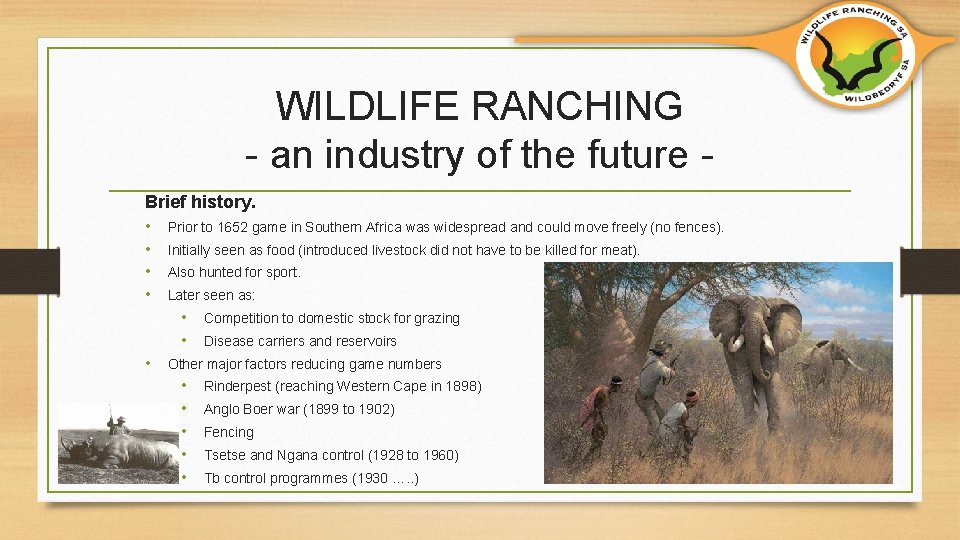
WILDLIFE RANCHING - an industry of the future Brief history. • • Prior to 1652 game in Southern Africa was widespread and could move freely (no fences). Initially seen as food (introduced livestock did not have to be killed for meat). Also hunted for sport. Later seen as: • • • Competition to domestic stock for grazing Disease carriers and reservoirs Other major factors reducing game numbers • • • Rinderpest (reaching Western Cape in 1898) Anglo Boer war (1899 to 1902) Fencing Tsetse and Ngana control (1928 to 1960) Tb control programmes (1930 …. . )
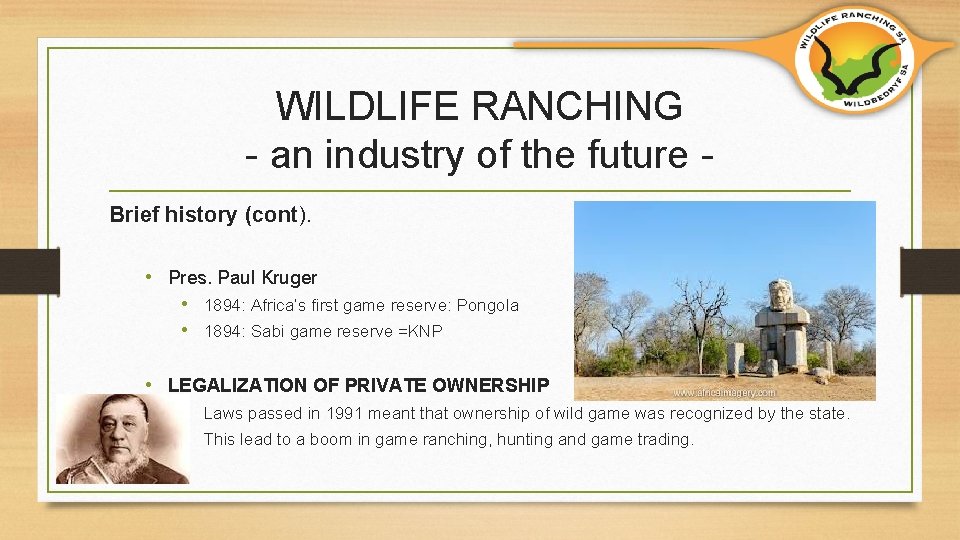
WILDLIFE RANCHING - an industry of the future Brief history (cont). • Pres. Paul Kruger • 1894: Africa’s first game reserve: Pongola • 1894: Sabi game reserve =KNP • LEGALIZATION OF PRIVATE OWNERSHIP • Laws passed in 1991 meant that ownership of wild game was recognized by the state. • This lead to a boom in game ranching, hunting and game trading.
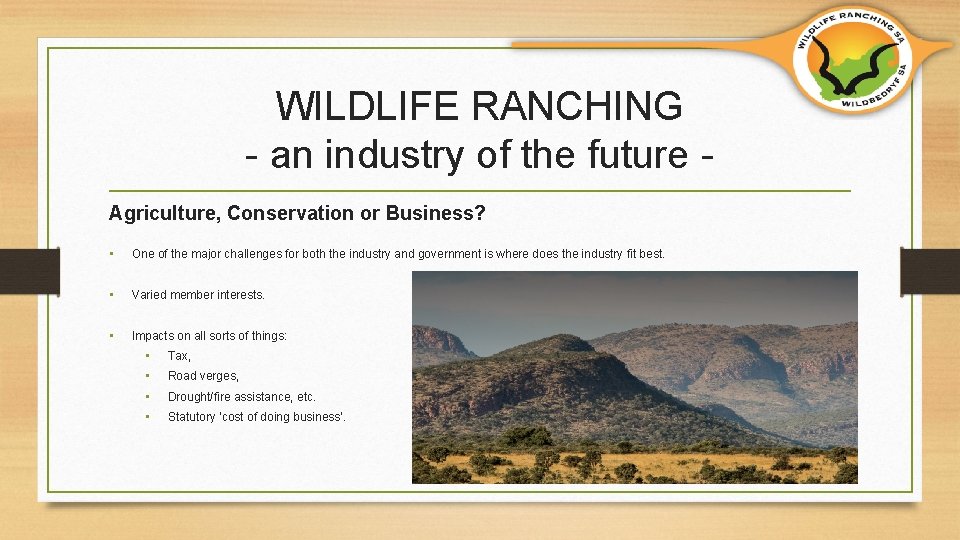
WILDLIFE RANCHING - an industry of the future Agriculture, Conservation or Business? • One of the major challenges for both the industry and government is where does the industry fit best. • Varied member interests. • Impacts on all sorts of things: • • Tax, Road verges, Drought/fire assistance, etc. Statutory ‘cost of doing business’.
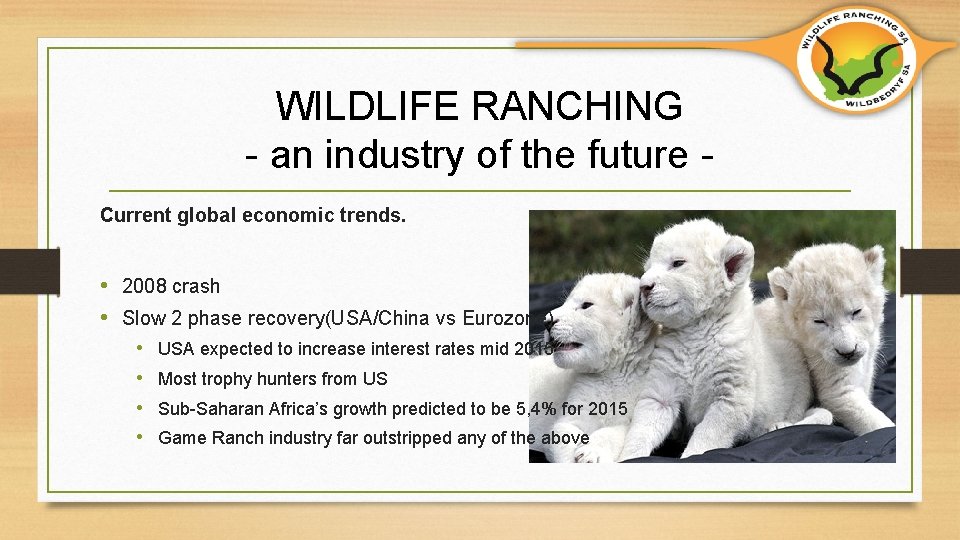
WILDLIFE RANCHING - an industry of the future Current global economic trends. • 2008 crash • Slow 2 phase recovery(USA/China vs Eurozone) • • USA expected to increase interest rates mid 2015 Most trophy hunters from US Sub-Saharan Africa’s growth predicted to be 5, 4% for 2015 Game Ranch industry far outstripped any of the above
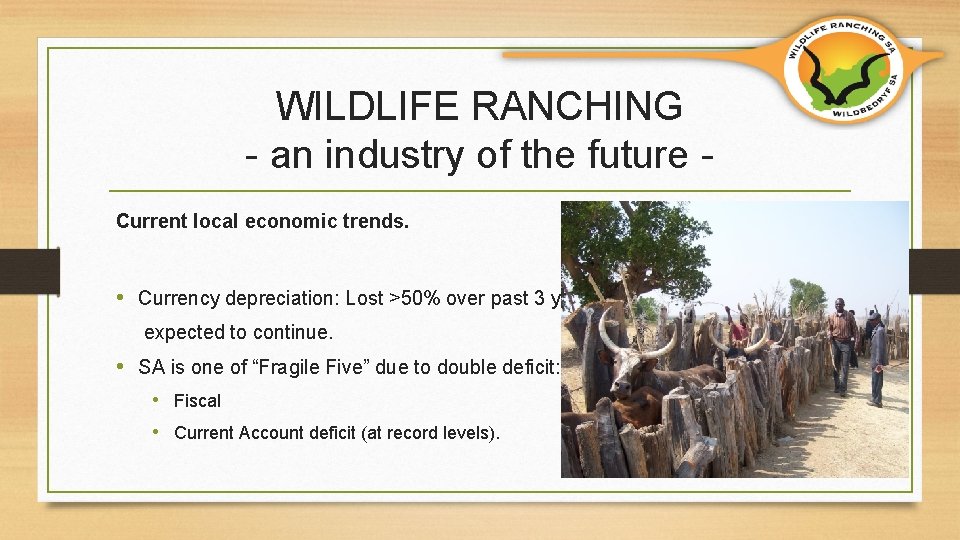
WILDLIFE RANCHING - an industry of the future Current local economic trends. • Currency depreciation: Lost >50% over past 3 years, expected to continue. • SA is one of “Fragile Five” due to double deficit: • Fiscal • Current Account deficit (at record levels).
WILDLIFE RANCHING - an industry of the future A different ideology regarding game. • American wildlife culture which is based on the belief that making money out of wildlife is immoral; South African wildlife culture is based upon sustainable use. • Due to the value placed on game, the wildlife industry has not only restored wildlife to the land, but has also enhanced and restored genetic quality of RSA’s wildlife. • The RSA wildlife industry has grown positively, as a result of the legal trade, hunting and eco-tourism.
WILDLIFE RANCHING - an industry of the future Outcome of 2 wildlife ideologies. • RSA had 3 private game ranches in 1960 with ownership of game and land vested in farmers. Currently, 28 000 ha marginal, uneconomic, semi-desert agricultural land converted into sustainable land use option. • Kenya, with similar agricultural industry, banned private ownership in 1977 – their game declined by an estimated 70%. The most widely accepted estimates for some of the key species: • 1960 = 20 000 rhinos, currently < 1 000 • 1970 = 150 000 elephants, currently 30 000 • 1970 = 20 000 lions, currently 2 000
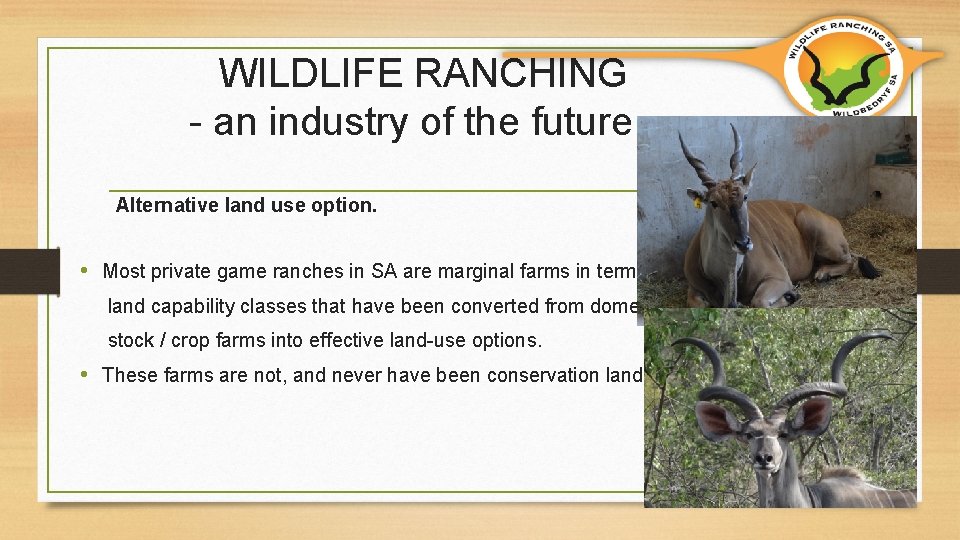
WILDLIFE RANCHING - an industry of the future Alternative land use option. • Most private game ranches in SA are marginal farms in terms of land capability classes that have been converted from domestic stock / crop farms into effective land-use options. • These farms are not, and never have been conservation land.
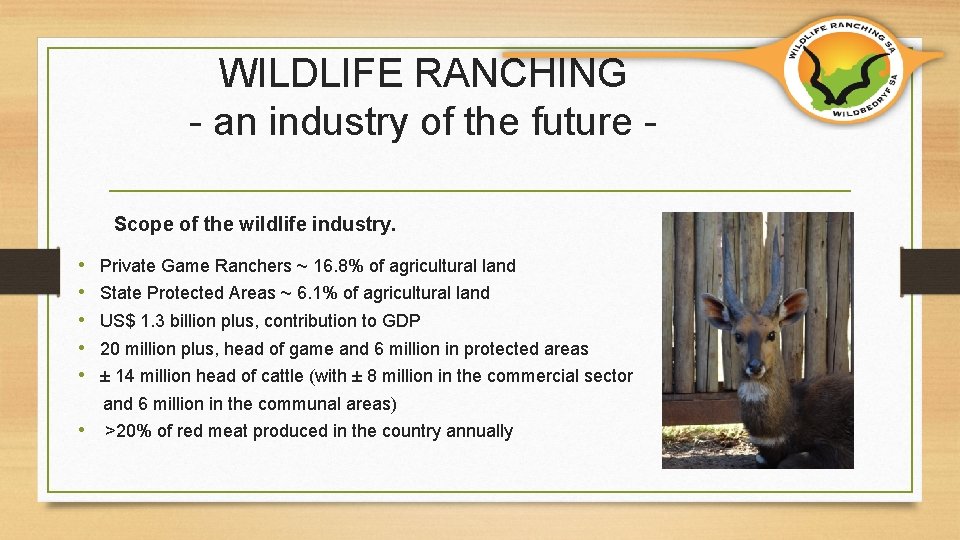
WILDLIFE RANCHING - an industry of the future Scope of the wildlife industry. • • • Private Game Ranchers ~ 16. 8% of agricultural land State Protected Areas ~ 6. 1% of agricultural land US$ 1. 3 billion plus, contribution to GDP 20 million plus, head of game and 6 million in protected areas ± 14 million head of cattle (with ± 8 million in the commercial sector and 6 million in the communal areas) • >20% of red meat produced in the country annually
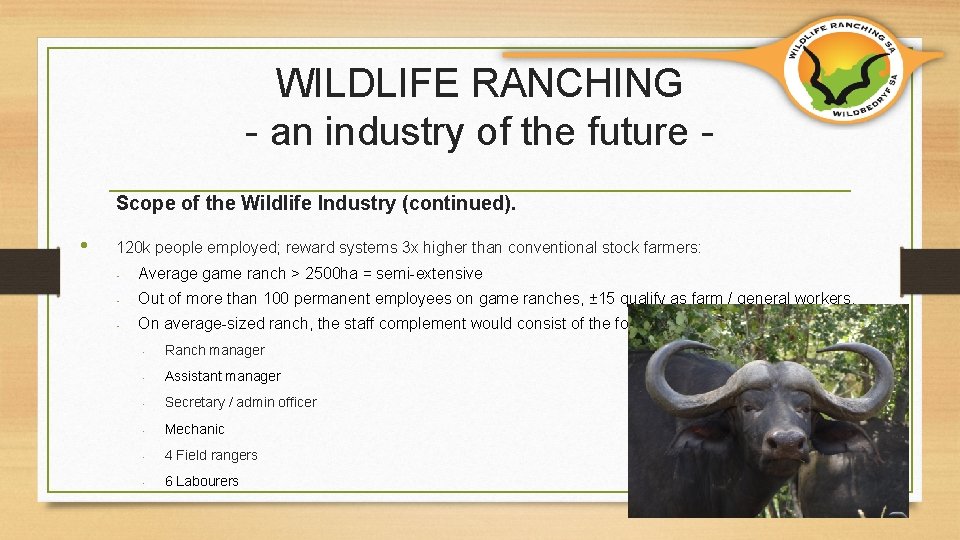
WILDLIFE RANCHING - an industry of the future Scope of the Wildlife Industry (continued). • 120 k people employed; reward systems 3 x higher than conventional stock farmers: • Average game ranch > 2500 ha = semi-extensive • Out of more than 100 permanent employees on game ranches, ± 15 qualify as farm / general workers. • On average-sized ranch, the staff complement would consist of the following: • Ranch manager • Assistant manager • Secretary / admin officer • Mechanic • 4 Field rangers • 6 Labourers
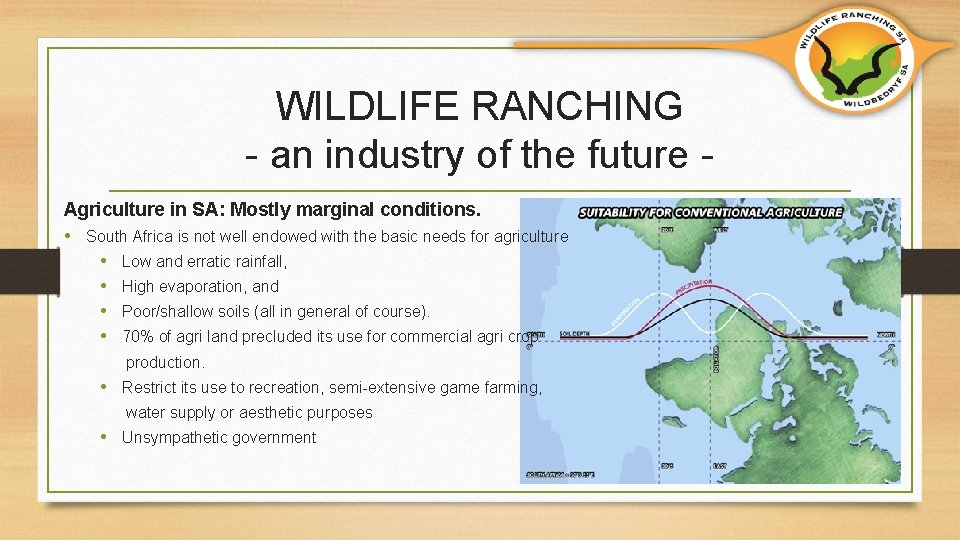
WILDLIFE RANCHING - an industry of the future Agriculture in SA: Mostly marginal conditions. • South Africa is not well endowed with the basic needs for agriculture • Low and erratic rainfall, • High evaporation, and • Poor/shallow soils (all in general of course). • 70% of agri land precluded its use for commercial agri crop production. • Restrict its use to recreation, semi-extensive game farming, water supply or aesthetic purposes • Unsympathetic government
WILDLIFE RANCHING - an industry of the future Agriculture in SA: Current economic trends. • Hard to compete internationally • Cost squeeze • Commodity prices (import parity) • Input prices (weakening Rand inflation) • Labour unrest and costs • Normal business practice is to look for the unique selling point and to exploit the competitive edge • Movement to game ranching.
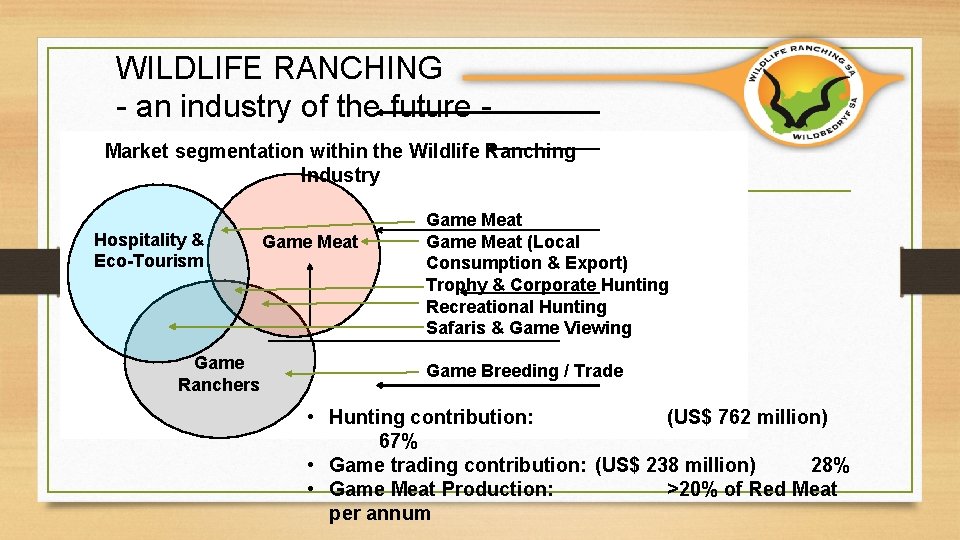
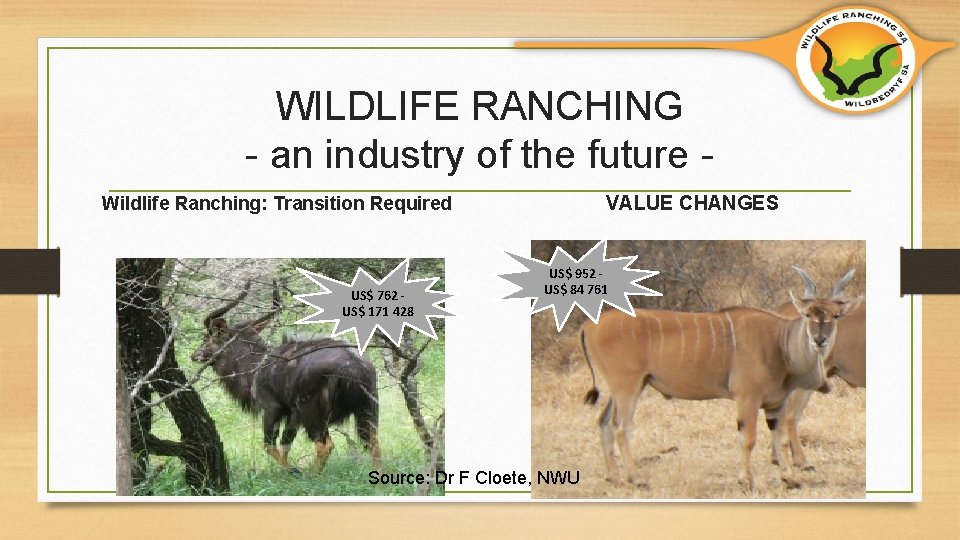
WILDLIFE RANCHING - an industry of the future Market segmentation within the Wildlife Ranching Industry Hospitality & Eco-Tourism Game Ranchers Game Meat (Local Consumption & Export) Trophy & Corporate Hunting Recreational Hunting Safaris & Game Viewing Game Breeding / Trade • Hunting contribution: (US$ 762 million) 67% • Game trading contribution: (US$ 238 million) 28% • Game Meat Production: >20% of Red Meat per annum
WILDLIFE RANCHING - an industry of the future Game Ranching in SA: Biodiversity contribution and trends: • Conservation: • More game animals in SA today than anytime since 1850 (165 years) = >10 m head owned privately. • Massive contribution to threatened species: • Rhino (40% in private hands) • Sable antelope (90%), * • buffalo (disease free) (90%) 60 000, and • roan (>90%) 2 500. • Converted >28 m ha from marginal agricultural land to a sustainable green economy. *Note: only an estimated 40 roan & 800 sable in the Kruger National Park
WILDLIFE RANCHING - an industry of the future Game Ranching in SA: Economic contribution and trends. • Ostriches and crocodiles (exports) • • Slaughter 92% of worlds ostriches SA crocs, unlike Zimbabwe and Zambia do not rely on imported young from the wild in Mozambique (sustainable utilization? ) • Plains game (incl. rare species and colour morphs). • • 1991 -2000: Phase 1 – plains game 2000 – 20 xx: Phase 2 – Valuable rare species & colour morphs = game husbandry technologies. • 2015 - …… : Phase 3 – game meat
WILDLIFE RANCHING - an industry of the future VALUE CHANGES Wildlife Ranching: Transition Required US$ 762 US$ 171 428 US$ 952 US$ 84 761 Source: Dr F Cloete, NWU
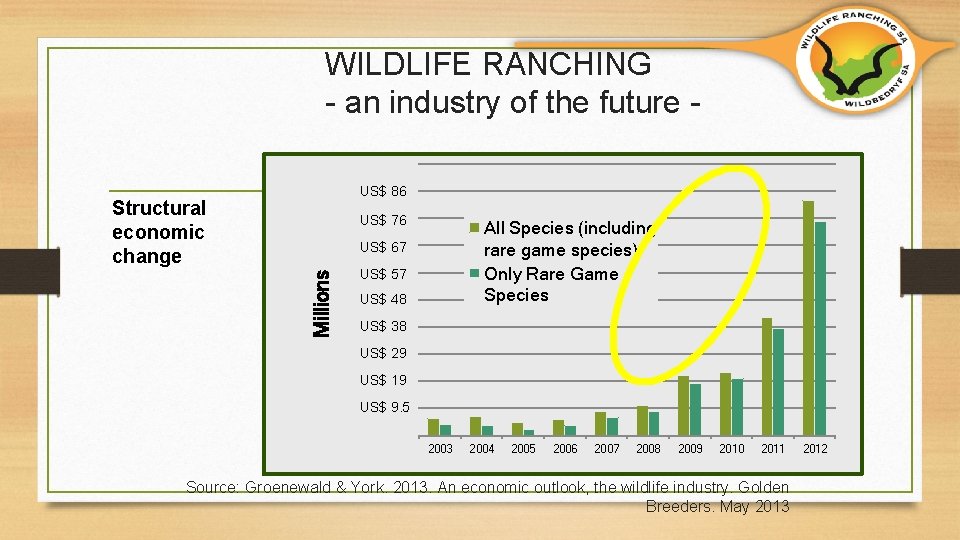
WILDLIFE RANCHING - an industry of the future US$ 86 Structural economic change US$ 76 All Species (including rare game species) Only Rare Game Species Millions US$ 67 US$ 57 US$ 48 US$ 38 US$ 29 US$ 19 US$ 9. 5 2003 2004 2005 2006 2007 2008 2009 2010 2011 Source: Groenewald & York. 2013. An economic outlook, the wildlife industry. Golden Breeders. May 2013 2012
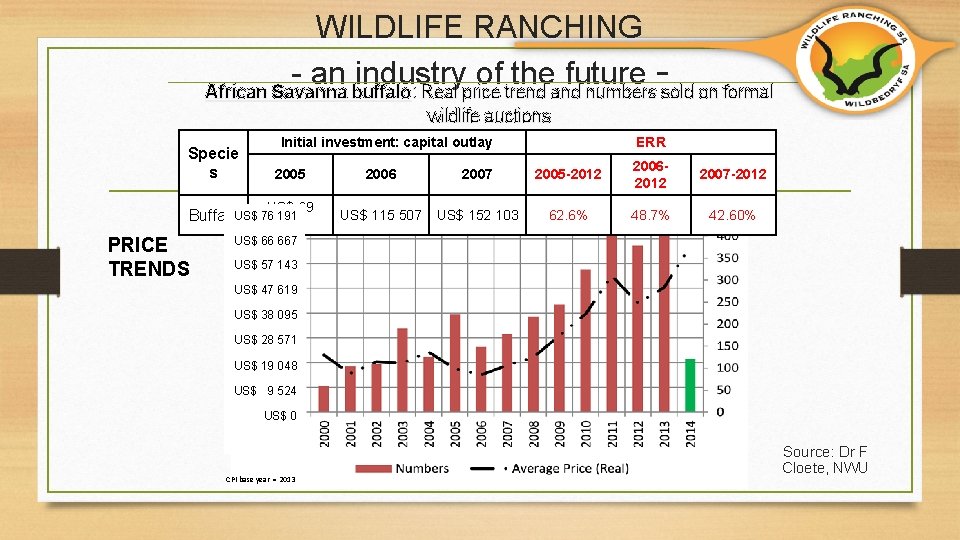
WILDLIFE RANCHING - an industry of the future African Savanna buffalo: Real price trend and numbers sold on formal wildlife auctions Specie s Initial investment: capital outlay 2005 US$ 69 Buffalo. US$ 76 191 579 PRICE TRENDS ERR 2006 2007 2005 -2012 20062012 2007 -2012 US$ 115 507 US$ 152 103 62. 6% 48. 7% 42. 60% US$ 66 667 US$ 57 143 US$ 47 619 US$ 38 095 US$ 28 571 US$ 19 048 US$ 9 524 US$ 0 CPI base year = 2013 Source: Dr F Cloete, NWU
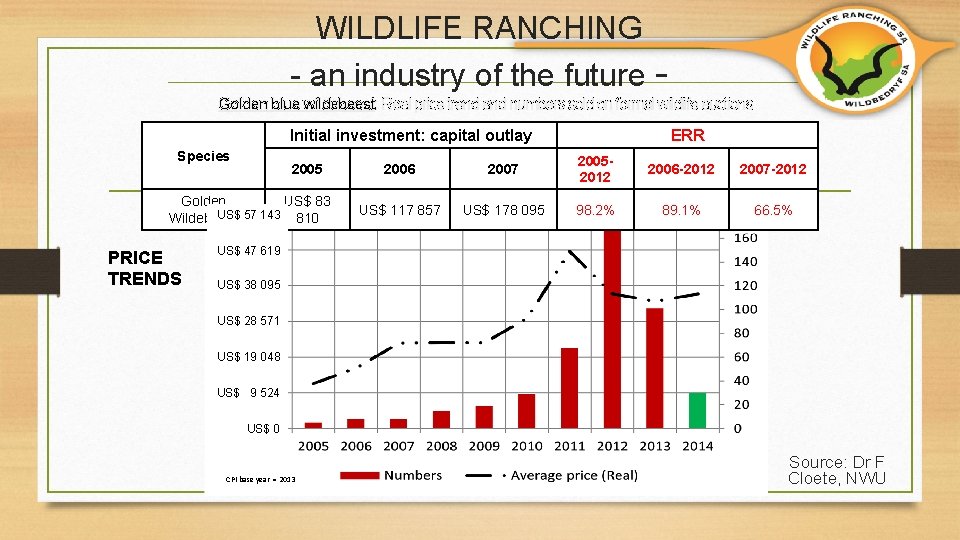
WILDLIFE RANCHING - an industry of the future Golden blue wildebeest: Real price trend and numbers sold on formal wildlife auctions Initial investment: capital outlay Species 2005 Golden US$ 83 US$ 57 143 Wildebeest 810 PRICE TRENDS ERR 2006 2007 20052012 2006 -2012 2007 -2012 US$ 117 857 US$ 178 095 98. 2% 89. 1% 66. 5% US$ 47 619 US$ 38 095 US$ 28 571 US$ 19 048 US$ 9 524 US$ 0 CPI base year = 2013 Source: Dr F Cloete, NWU
WILDLIFE RANCHING - an industry of the future Governance Ideology for Sustainable Wildlife use. • Sustainable use cannot be understood only from a biological or ecological perspective, such as the harvest of a specific species over time in isolation. The broader social, economic, cultural and political dynamics, should be factored into the equation.
WILDLIFE RANCHING - an industry of the future Governance recommended for SA. • Sustainable use dictates a specific State Governance system. Eco- and humanity systems that depend on good governance change constantly. The governance system must be capable of detecting, assessing, and apply adaptive management prudently to changes in public, private, community-based, formal and informal, environments. • Applied evidence-based research by academic research agencies • Adaptive management
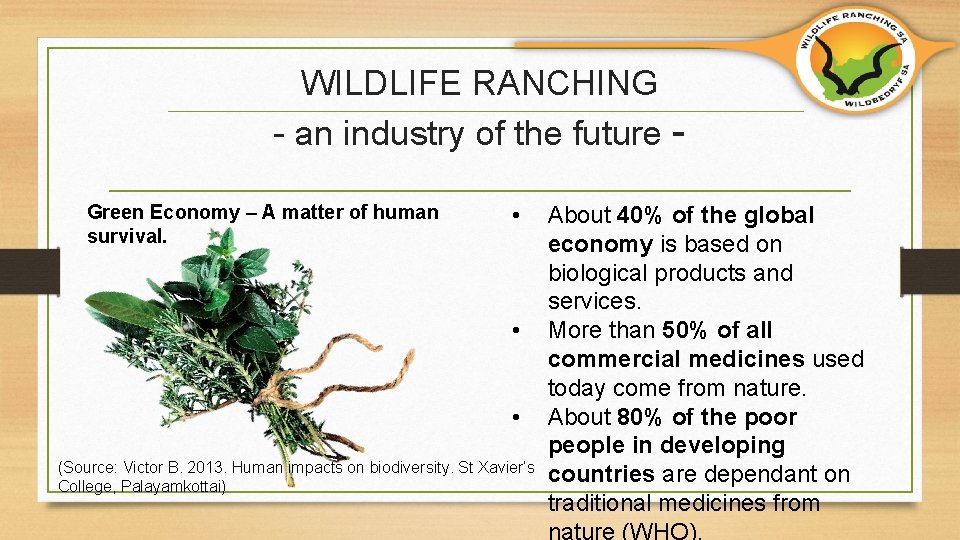
WILDLIFE RANCHING - an industry of the future Green Economy – A matter of human survival. • • • (Source: Victor B. 2013. Human impacts on biodiversity. St Xavier’s College, Palayamkottai) About 40% of the global economy is based on biological products and services. More than 50% of all commercial medicines used today come from nature. About 80% of the poor people in developing countries are dependant on traditional medicines from nature (WHO).
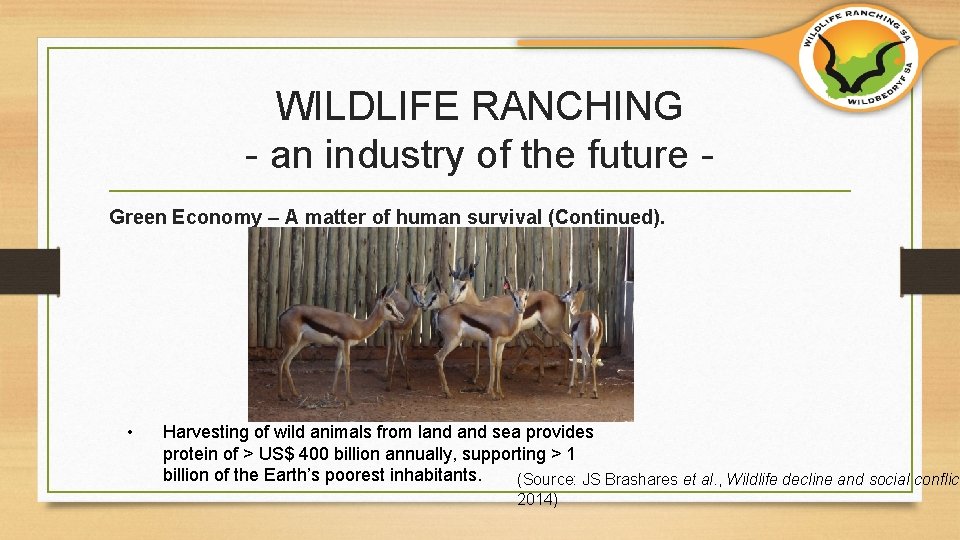
WILDLIFE RANCHING - an industry of the future Green Economy – A matter of human survival (Continued). • Harvesting of wild animals from land sea provides protein of > US$ 400 billion annually, supporting > 1 billion of the Earth’s poorest inhabitants. (Source: JS Brashares et al. , Wildlife decline and social conflict 2014)
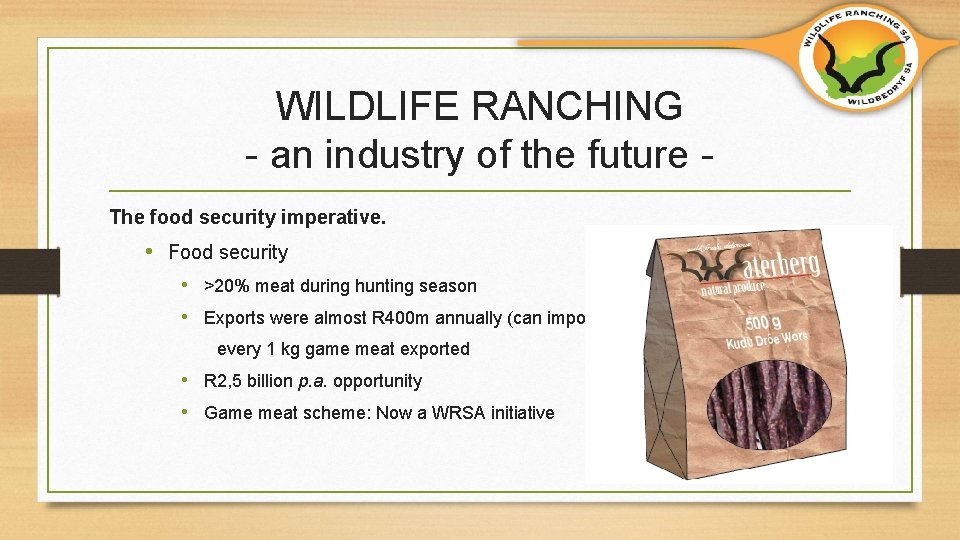
WILDLIFE RANCHING - an industry of the future The food security imperative. • Food security • >20% meat during hunting season • Exports were almost R 400 m annually (can import 3 kg beef for every 1 kg game meat exported • R 2, 5 billion p. a. opportunity • Game meat scheme: Now a WRSA initiative
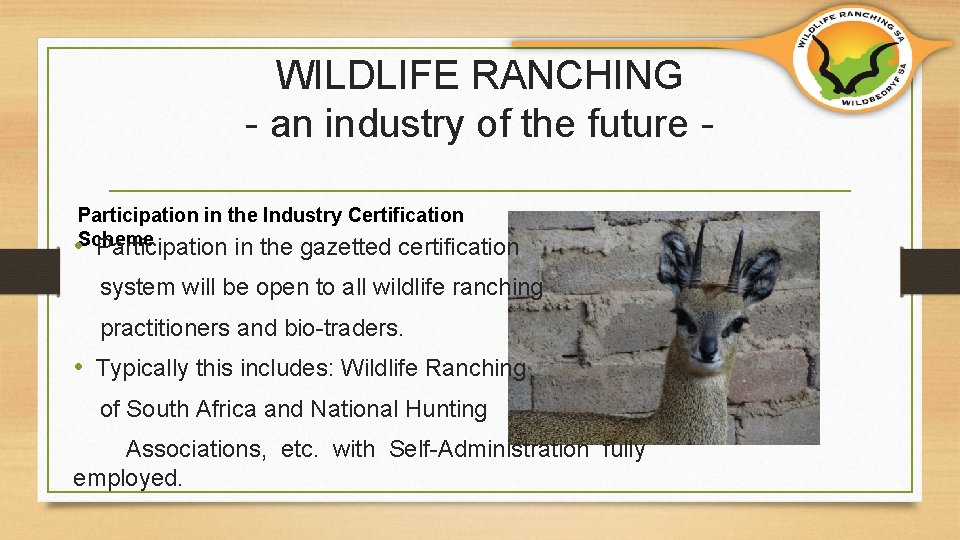
WILDLIFE RANCHING - an industry of the future Participation in the Industry Certification • Scheme Participation in the gazetted certification system will be open to all wildlife ranching practitioners and bio-traders. • Typically this includes: Wildlife Ranching of South Africa and National Hunting Associations, etc. with Self-Administration fully employed.
WILDLIFE RANCHING - an industry of the future Participation in the Industry Certification Scheme (Continued). • According to WRSA Industry Standards (currently being developed); • General Game Husbandry: how animals are bred, kept and treated (e. g. medication, feeding and general translocation practices) • Harvesting of animals based on acceptable standard operating procedures • How carcass is handled / processed; WRSA, Vet & VPN Standards • How meat is further processed / beneficiated; Department of Health and WRSA Standards • An International Compliant industry standard for game meat (ISO 9601 QA Standard, ISO 14 000 Environmental Standard and ISO 22 000 Food Standard) approved this week for WRSA
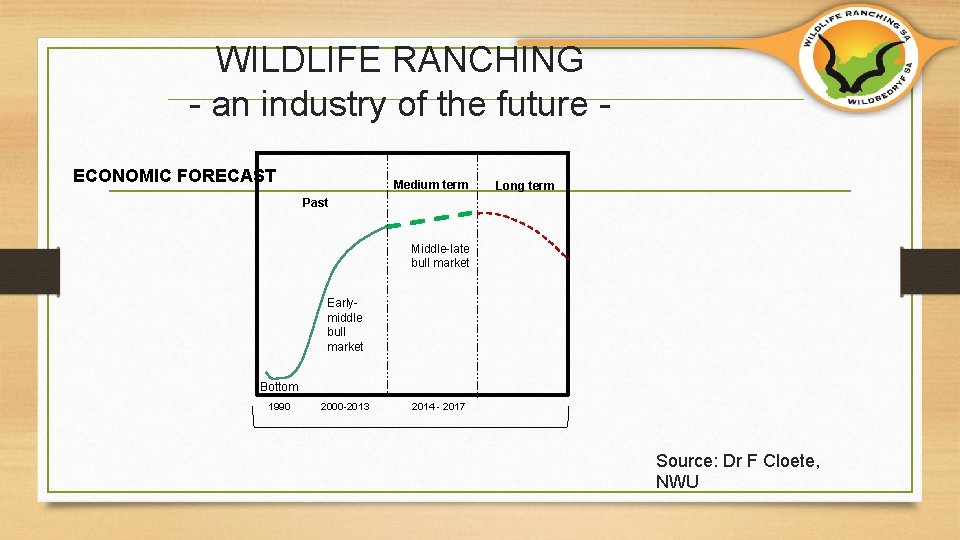
WILDLIFE RANCHING - an industry of the future ECONOMIC FORECAST Medium term Long term Past Middle-late bull market Earlymiddle bull market Bottom 1990 2000 -2013 2014 - 2017 Source: Dr F Cloete, NWU
WILDLIFE RANCHING - an industry of the future Conclusion (Continued) WRSA believes in a positive future for the industry. WHY? • • • Wildlife is a unique asset – different to most if not all other assets Wildlife enables one to breed a good investment – boils down to good asset management! Balance between short term financial gains and long term financial viability Game Meat Production new growth phase Institutional Repositioning in progress Land Reform Pilot Projects Genetics and Evidence-based Research Vaccine for Malignant Catarrhal Fever (MCF) ‘Snotsiekte’ CITES & Rhino trade normalization
THANK YOU WRSA WISHES YOU A HAPPY AND PROSPEROUS FUTURE IN THIS GREAT INDUSTRY