
Wildlife Population Analysis More on Known Fate models
- Slides: 48
Wildlife Population Analysis More on Known Fate models & the Design Matrix
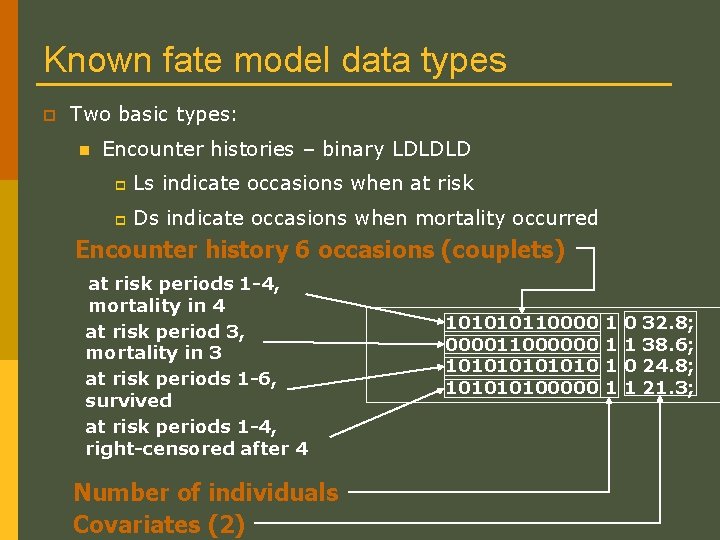
Known fate model data types p Two basic types: n Encounter histories – binary LDLDLD p Ls indicate occasions when at risk p Ds indicate occasions when mortality occurred Encounter history 6 occasions (couplets) at risk periods 1 -4, mortality in 4 at risk period 3, mortality in 3 at risk periods 1 -6, survived at risk periods 1 -4, right-censored after 4 Number of individuals Covariates (2) 10101011000011000000 1010100000 1 1 0 1 32. 8; 38. 6; 24. 8; 21. 3;
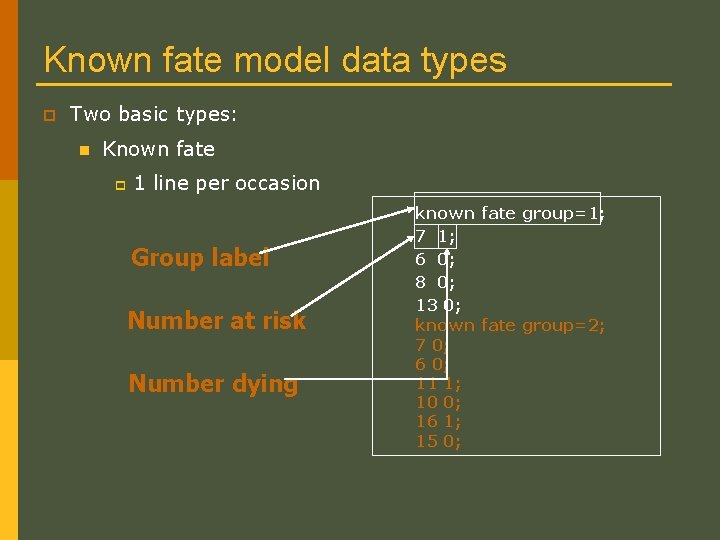
Known fate model data types p Two basic types: n Known fate p 1 line per occasion Group label Number at risk Number dying known fate group=1; 7 1; 6 0; 8 0; 13 0; known fate group=2; 7 0; 6 0; 11 1; 10 0; 16 1; 15 0;
References p Hosmer, D. W. , and S. Lemeshow. 2000. Applied logistic regression. John Wiley & Sons, Inc. New York. p Blackduck example: n C: Program FilesMARKExamplesBlck. Duck n Conroy M. J. , Costanzo, G. R. , and Stotts, D. B. 1989. Winter Survival of Female American Black Ducks on the Atlantic Coast. J. Wildlife Management 53: 99 -109.
Review of the design matrix and logit link p Link function used to “link” data to the “real” parameters of interest. p Relating our observations back to the demography of the populations we study. p Real parameters of interest n Survival, success, recruitment, movement, population growth rate, and distribution (occupancy), n Nuisance parameters (e. g. , reporting, recapture, and resighting rates) n Included in the maximum likelihood estimators we employ.
Outline p Review the link function p Relate the design matrix to link function p Examples of common linear model types
Data p Response variable (e. g. , success or failure), p Additional information n Sex, age, weight, size, locations, etc. p Used to quantify important relationships about those demographic parameters, p Explain the heterogeneity (i. e. , variation) among individuals or groups to obtain better estimates of the parameters or effects of interest.
Data - example p For example, trying to estimate the survival rate of a heavily harvest population of a game species p Sex- and age-related differences in natural mortality and harvest, p Sex and age are important data p Explore the differences in those rates by linking them to the data on sex and age in models & compare models
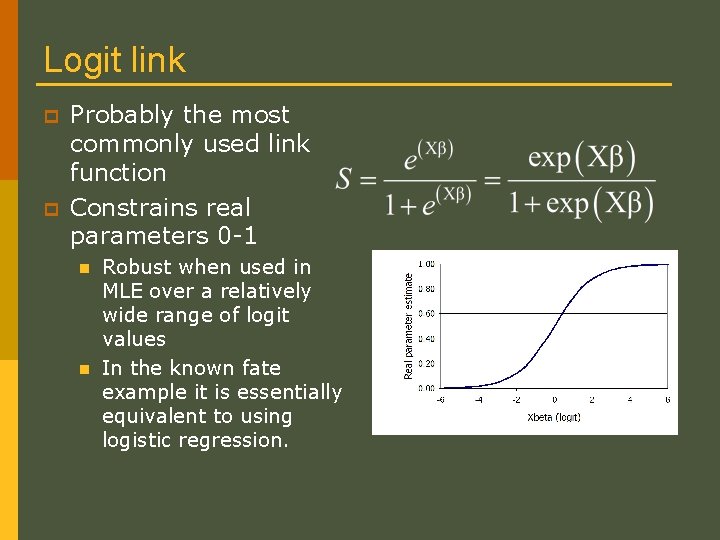
Logit link p p Probably the most commonly used link function Constrains real parameters 0 -1 n n Robust when used in MLE over a relatively wide range of logit values In the known fate example it is essentially equivalent to using logistic regression.
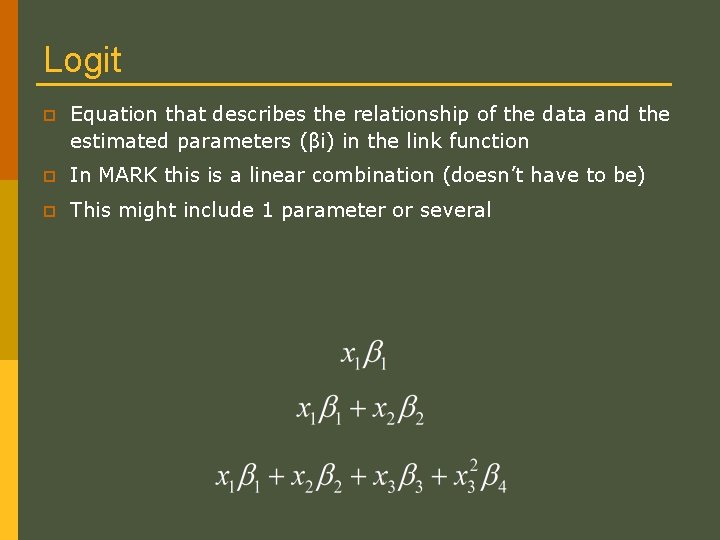
Logit p Equation that describes the relationship of the data and the estimated parameters (βi) in the link function p In MARK this is a linear combination (doesn’t have to be) p This might include 1 parameter or several
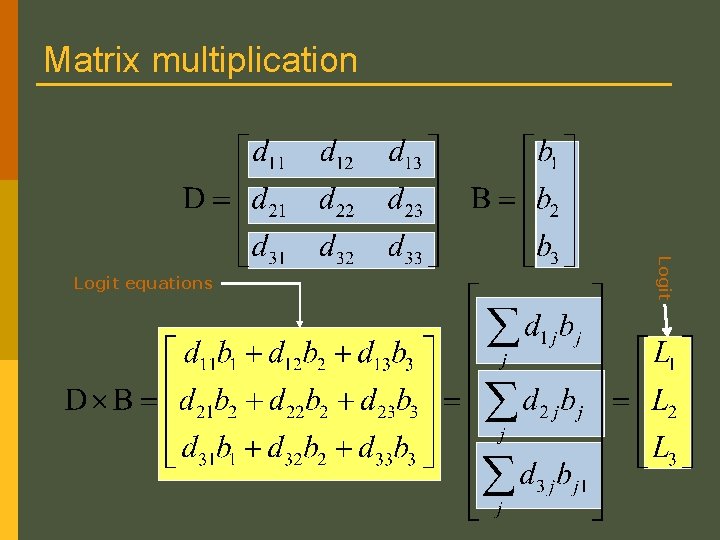
Matrix multiplication Logit equations
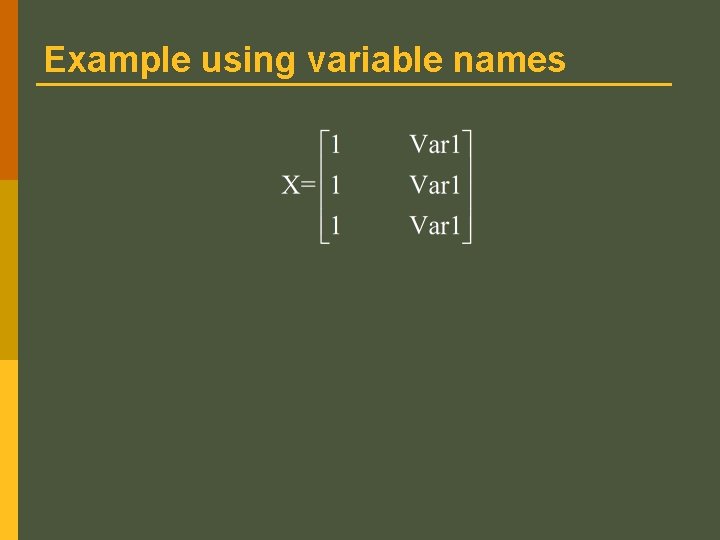
Logit p Often written in generalized matrix notation as Xβ p X is the matrix of data used to specify the model (not including the response variable) p n May represent indicator variables (0 s and 1 s) n May be values (as in the time variable or group covariate examples) n May be variable (covariate) names β are the estimated parameters (i. e. , the coefficients in the linear combination)
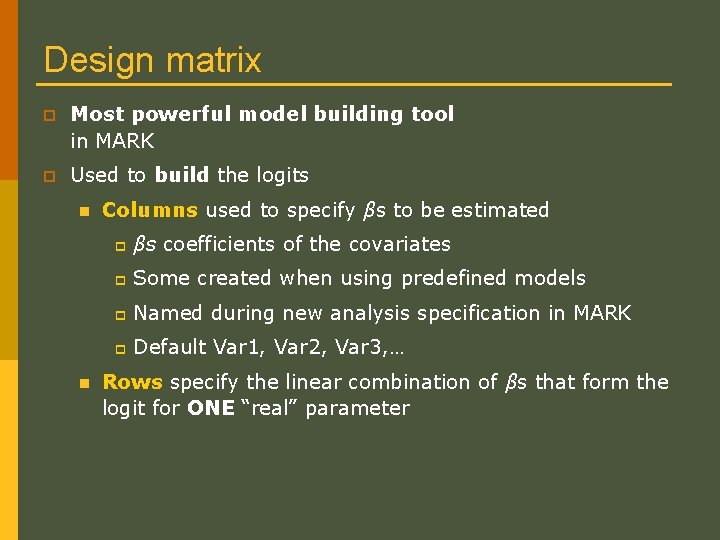
Design matrix p Most powerful model building tool in MARK p Used to build the logits n n Columns used to specify βs to be estimated p βs coefficients of the covariates p Some created when using predefined models p Named during new analysis specification in MARK p Default Var 1, Var 2, Var 3, … Rows specify the linear combination of βs that form the logit for ONE “real” parameter
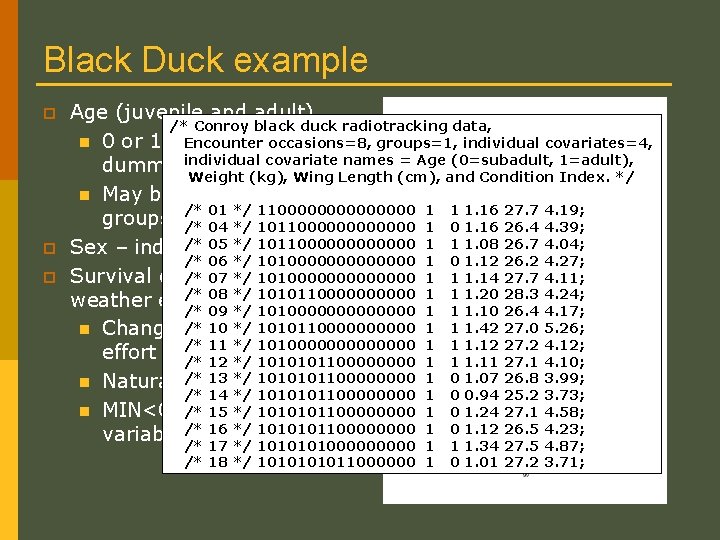
Black Duck example p p p Age (juvenile and adult) /* Conroy black duck radiotracking data, n 0 or 1 - Encounter indicatoroccasions=8, or groups=1, individual covariates=4, covariate names = Age (0=subadult, 1=adult), dummy individual variable. Weight (kg), Wing Length (cm), and Condition Index. */ n May be treated as /* 01 */ 110000000 1 1 1. 16 27. 7 4. 19; groups in MARK /* 04 */ 1011000000 1 0 1. 16 26. 4 4. 39; /* 05 variable */ 1011000000 1 1 1. 08 26. 7 4. 04; Sex – indicator /* 06 */ 1010000000 1 0 1. 12 26. 2 4. 27; Survival could be to /* 07 */related 1010000000 1 1 1. 14 27. 7 4. 11; /* 08 */ 10101100000 1 1 1. 20 28. 3 4. 24; weather events /* 09 */ 1010000000 1 1 1. 10 26. 4 4. 17; */ 10101100000 1 1 1. 42 27. 0 5. 26; n Changes/* in 10 harvest 11 */ 1010000000 1 1 1. 12 27. 2 4. 12; effort /* /* 12 */ 101010110000 1 1 1. 11 27. 1 4. 10; /* 13 */ 101010110000 1 0 1. 07 26. 8 3. 99; n Natural mortality /* 14 */ 101010110000 1 0 0. 94 25. 2 3. 73; n MIN<0 –/*continuous 15 */ 101010110000 1 0 1. 24 27. 1 4. 58; 16 */ 101010110000 1 0 1. 12 26. 5 4. 23; variable /* /* 17 */ 10100000 1 1 1. 34 27. 5 4. 87; /* 18 */ 101011000000 1 0 1. 01 27. 2 3. 71;
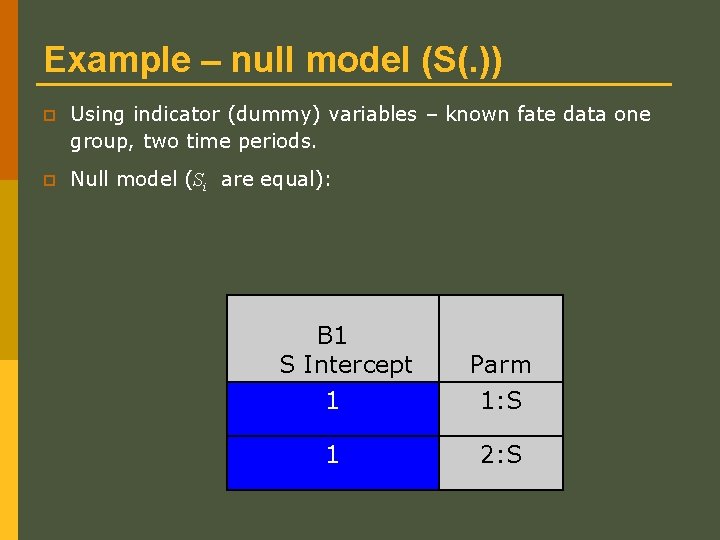
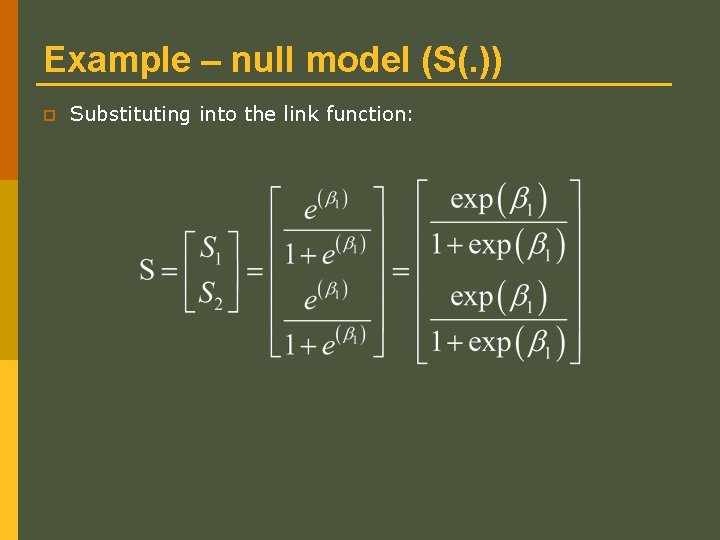
Example – null model (S(. )) p Using indicator (dummy) variables – known fate data one group, two time periods. p Null model (Si are equal): B 1 S Intercept 1 1 Parm 1: S 2: S
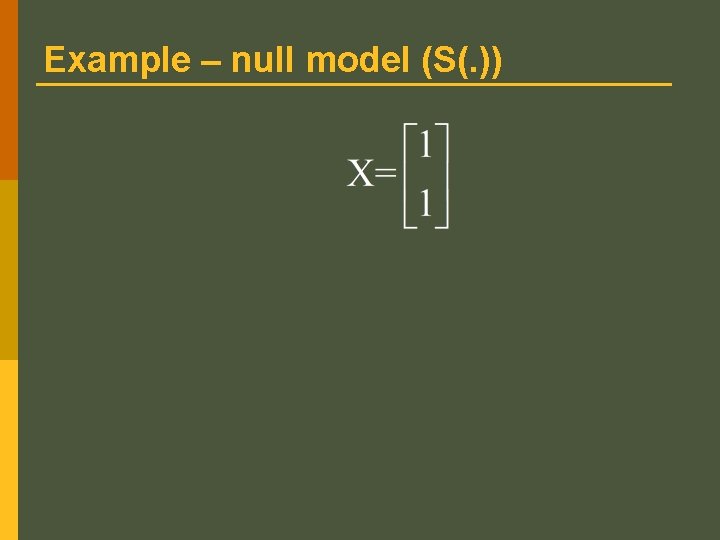
Example – null model (S(. ))
Example – null model (S(. )) p Substituting into the link function:
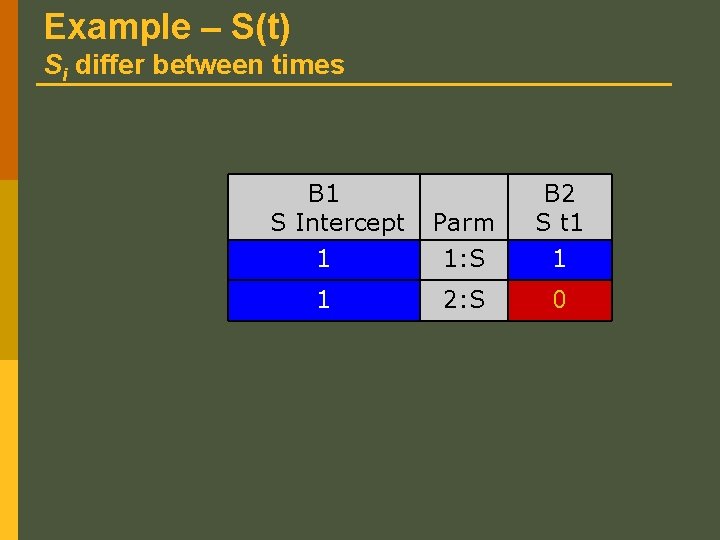
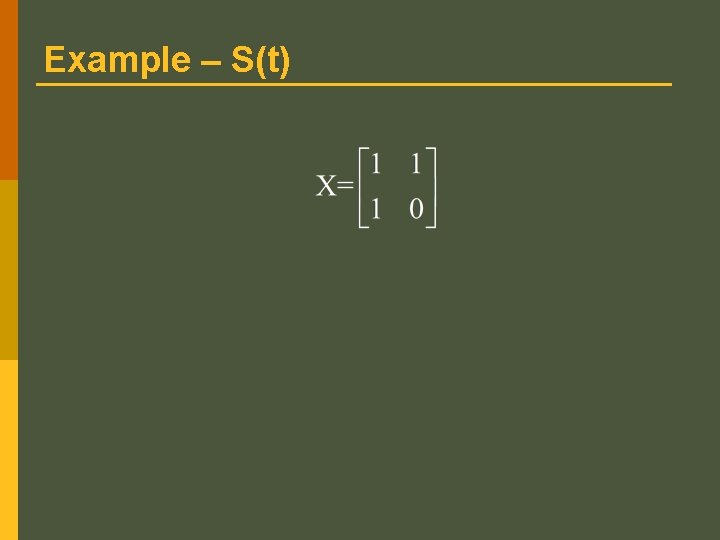
Example – S(t) Si differ between times B 1 S Intercept 1 Parm 1: S 1 2: S B 2 S t 1 1 0
Example – S(t)
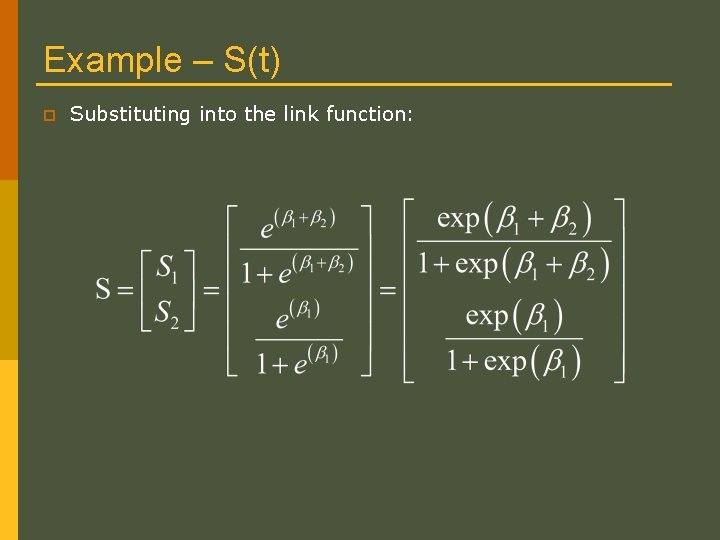
Example – S(t) p Substituting into the link function:
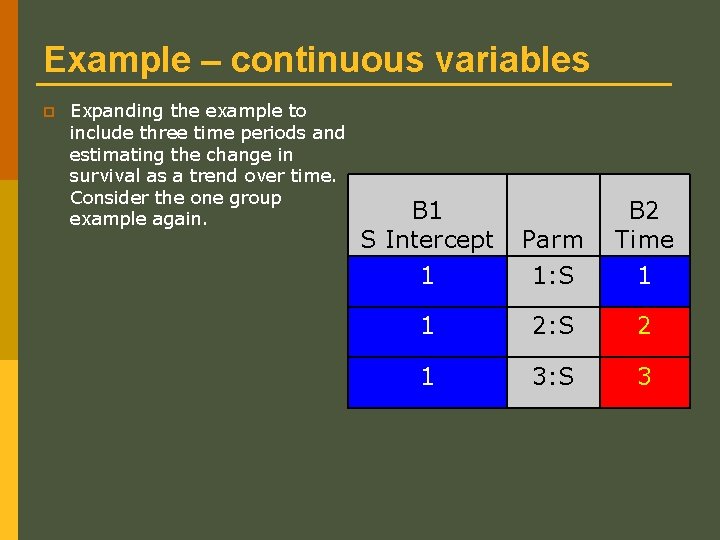
Example – continuous variables p Expanding the example to include three time periods and estimating the change in survival as a trend over time. Consider the one group example again. B 1 S Intercept 1 Parm 1: S B 2 Time 1 1 2: S 2 1 3: S 3
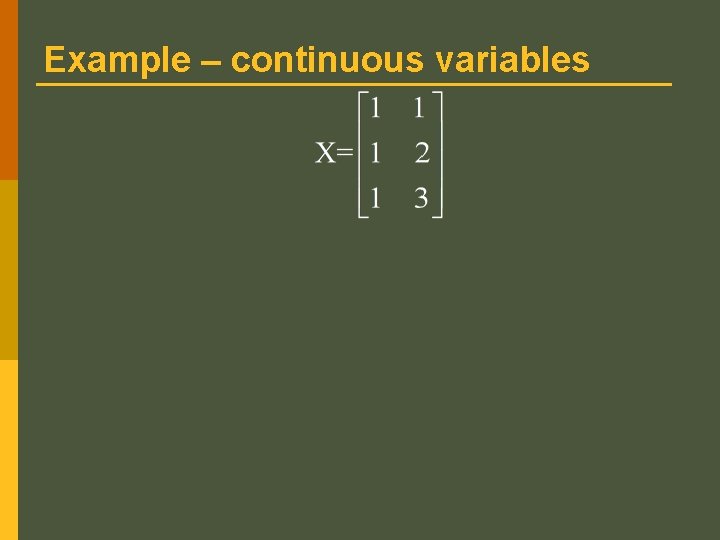
Example – continuous variables
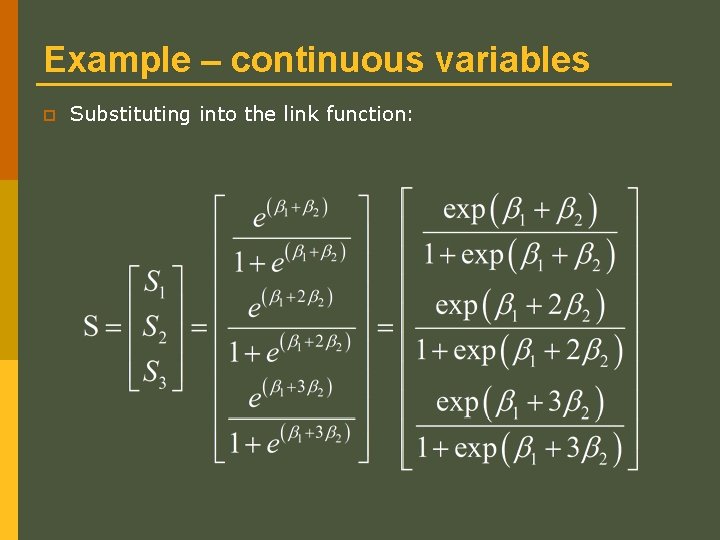
Example – continuous variables p Substituting into the link function:
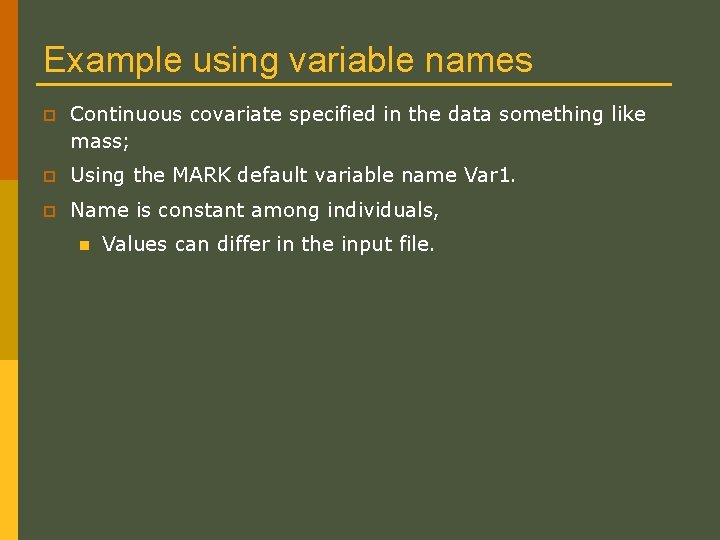
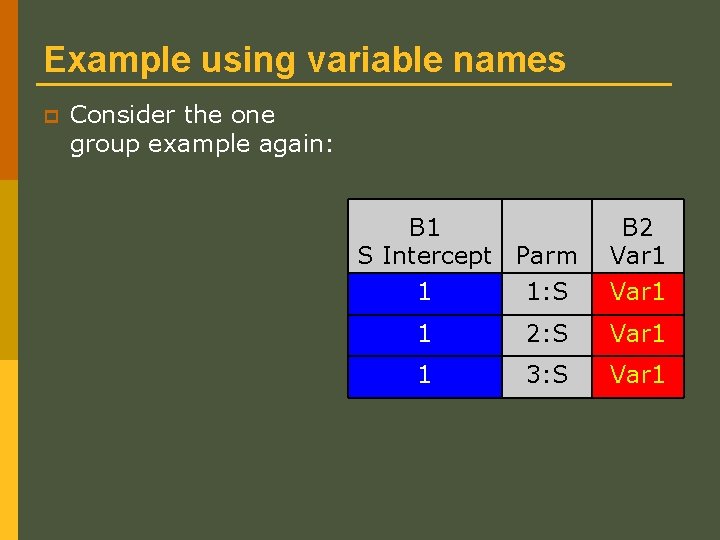
Example using variable names p Continuous covariate specified in the data something like mass; p Using the MARK default variable name Var 1. p Name is constant among individuals, n Values can differ in the input file.
Example using variable names p Consider the one group example again: B 1 S Intercept Parm 1 1: S B 2 Var 1 1 2: S Var 1 1 3: S Var 1
Example using variable names
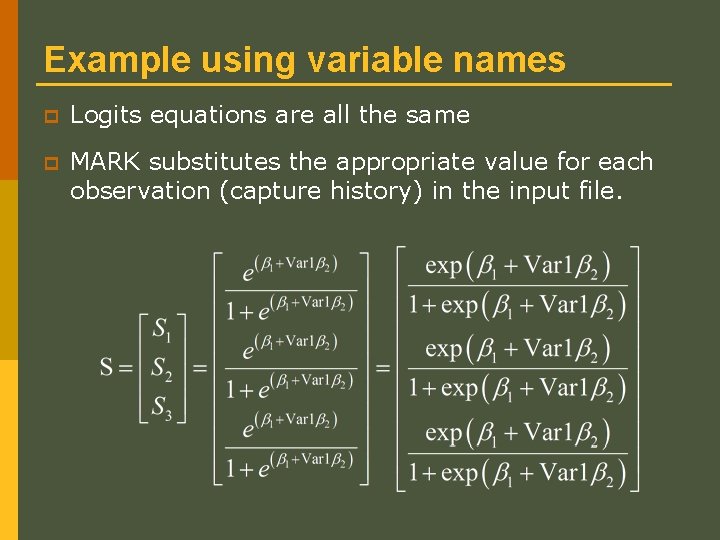
Example using variable names p Logits equations are all the same p MARK substitutes the appropriate value for each observation (capture history) in the input file.
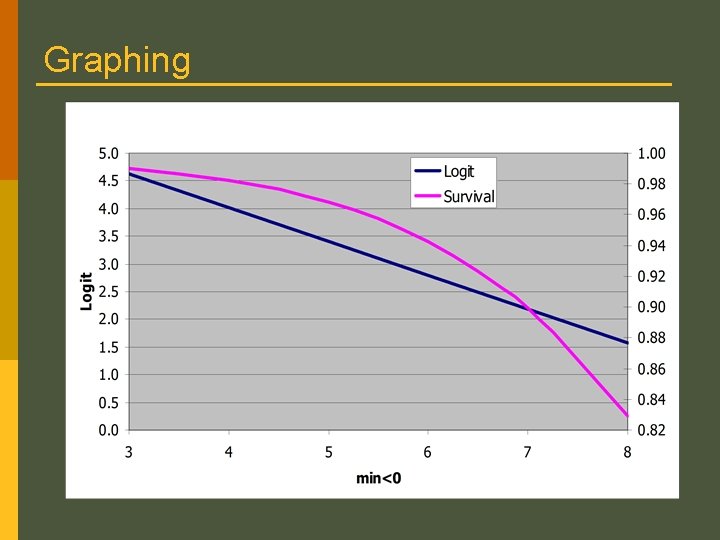
Graphing
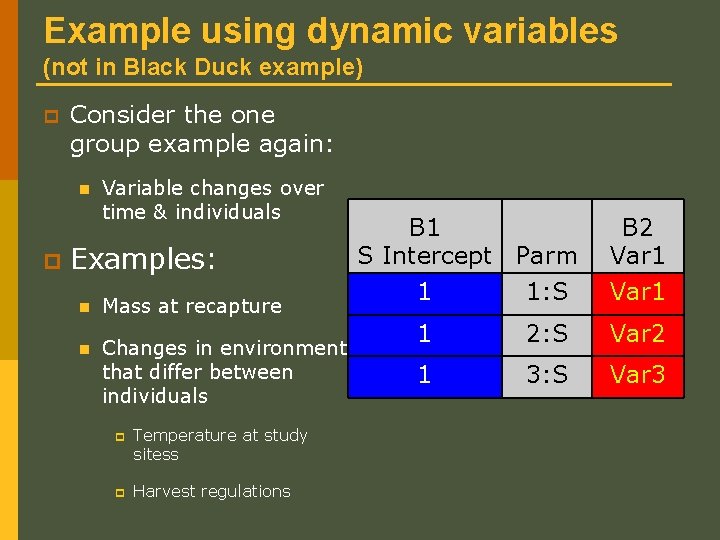
Example using dynamic variables (not in Black Duck example) p Consider the one group example again: n p Variable changes over time & individuals Examples: n Mass at recapture n Changes in environment that differ between individuals p p Temperature at study sitess Harvest regulations B 1 S Intercept Parm 1 1: S B 2 Var 1 1 2: S Var 2 1 3: S Var 3
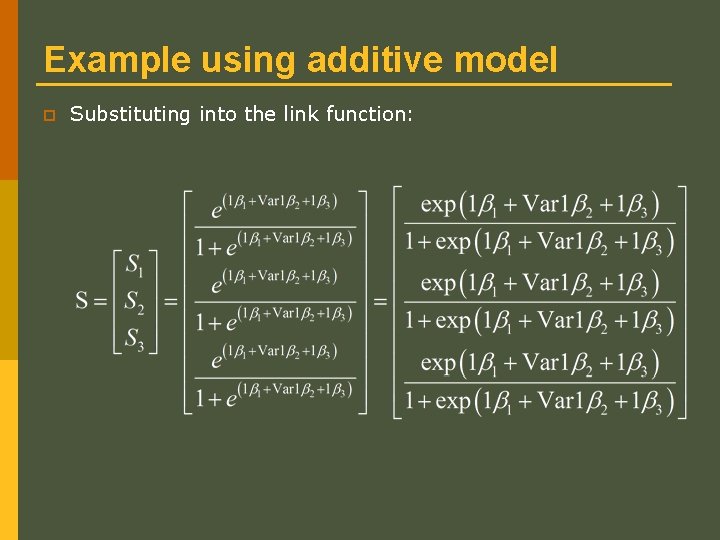
Example using additive model p Combining two models for time trend in survival and Var 1 (time and Var 1). p Effects are added together in the logit, n Their affect is constant or independent of the other dependent variables (covariates) in the model.
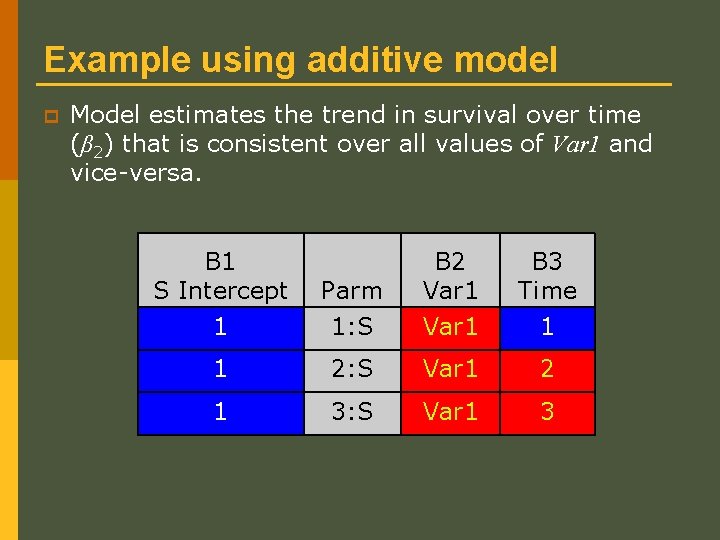
Example using additive model p Model estimates the trend in survival over time (β 2) that is consistent over all values of Var 1 and vice-versa. B 1 S Intercept 1 Parm 1: S B 2 Var 1 B 3 Time 1 1 2: S Var 1 2 1 3: S Var 1 3
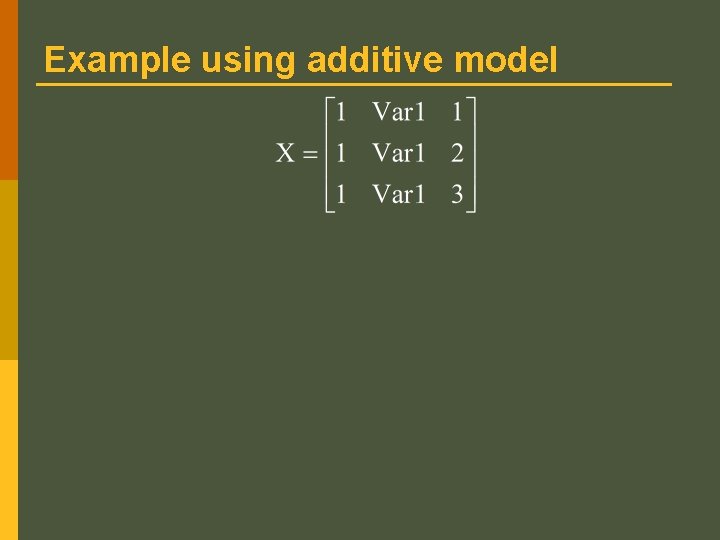
Example using additive model
Example using additive model p Substituting into the link function:
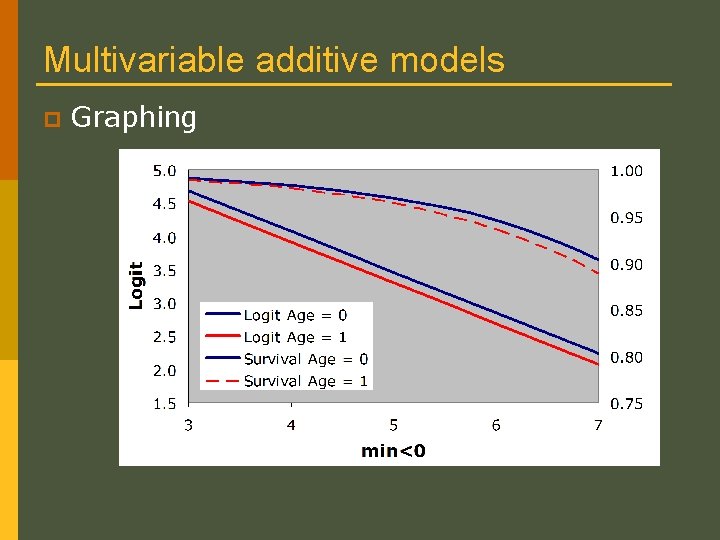
Multivariable additive models p Graphing
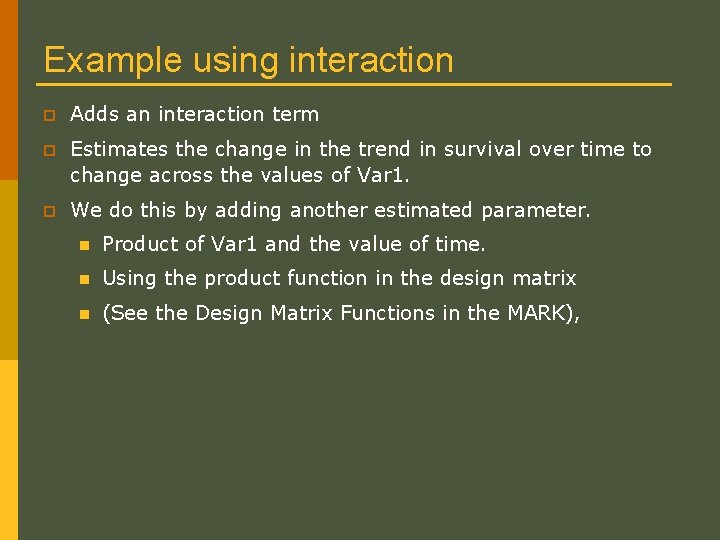
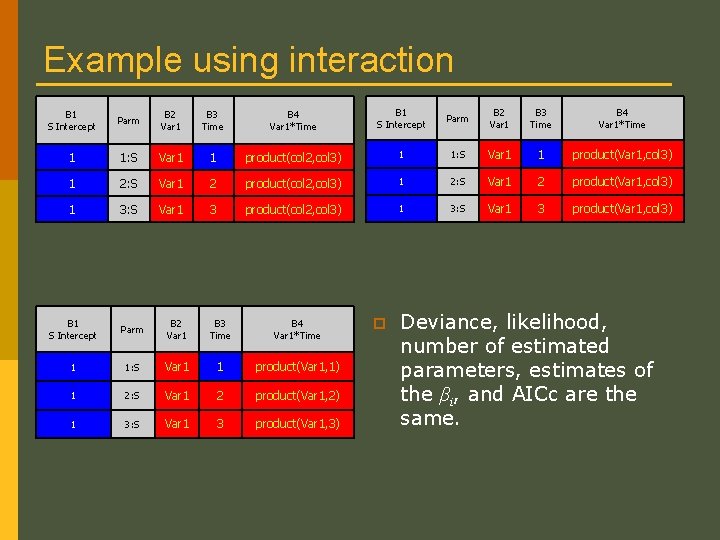
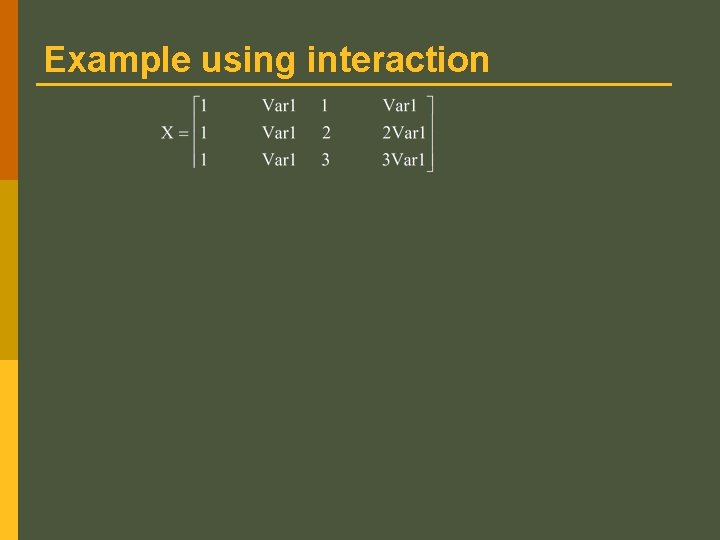
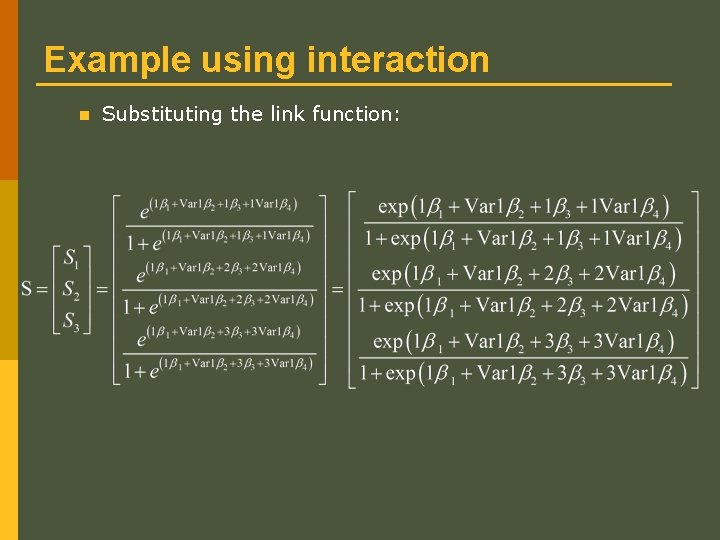
Example using interaction p Adds an interaction term p Estimates the change in the trend in survival over time to change across the values of Var 1. p We do this by adding another estimated parameter. n Product of Var 1 and the value of time. n Using the product function in the design matrix n (See the Design Matrix Functions in the MARK),
Example using interaction B 1 S Intercept Parm B 2 Var 1 B 3 Time B 4 Var 1*Time 1 1: S Var 1 1 product(col 2, col 3) 1 1: S Var 1 1 product(Var 1, col 3) 1 2: S Var 1 2 product(col 2, col 3) 1 2: S Var 1 2 product(Var 1, col 3) 1 3: S Var 1 3 product(col 2, col 3) 1 3: S Var 1 3 product(Var 1, col 3) B 1 S Intercept Parm B 2 Var 1 B 3 Time B 4 Var 1*Time 1 1: S Var 1 1 product(Var 1, 1) 1 2: S Var 1 2 product(Var 1, 2) 1 3: S Var 1 3 product(Var 1, 3) p Deviance, likelihood, number of estimated parameters, estimates of the βi, and AICc are the same.
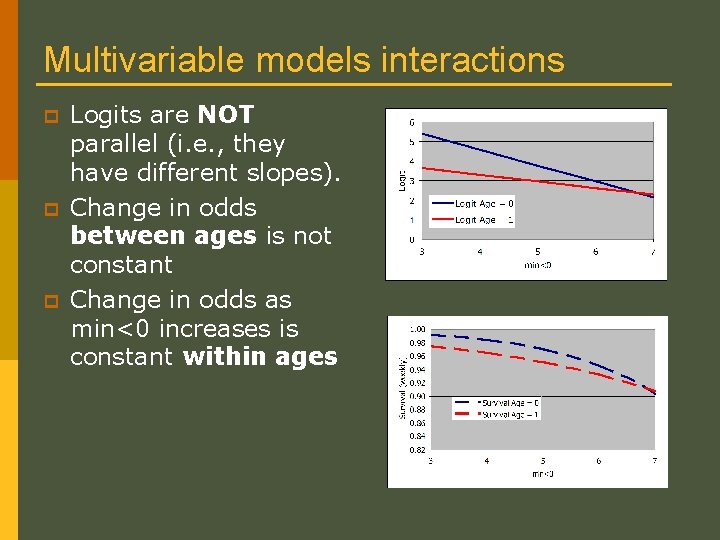
Multivariable models interactions p p p Logits are NOT parallel (i. e. , they have different slopes). Change in odds between ages is not constant Change in odds as min<0 increases is constant within ages
Example using interaction
Example using interaction n Substituting the link function:
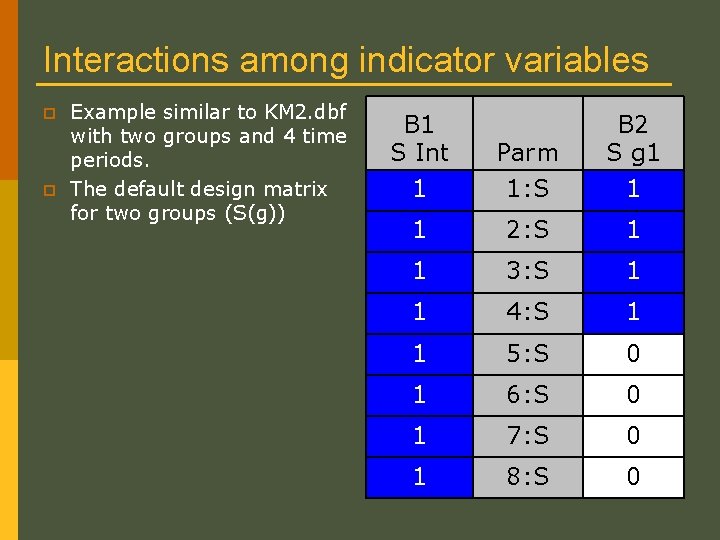
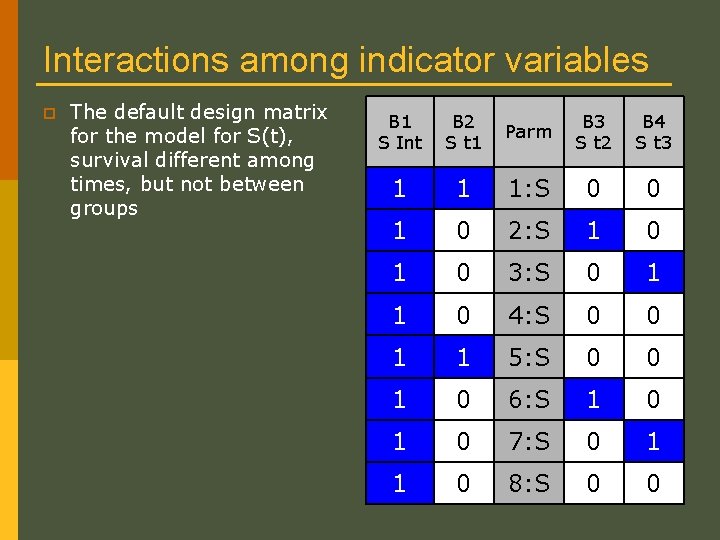
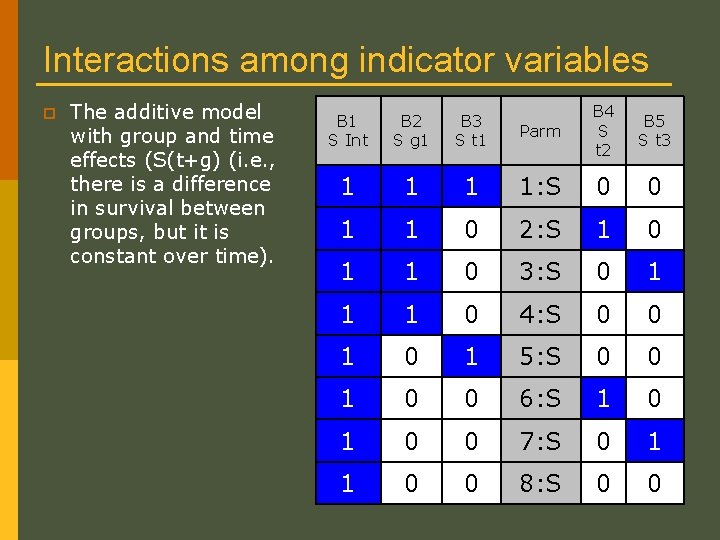
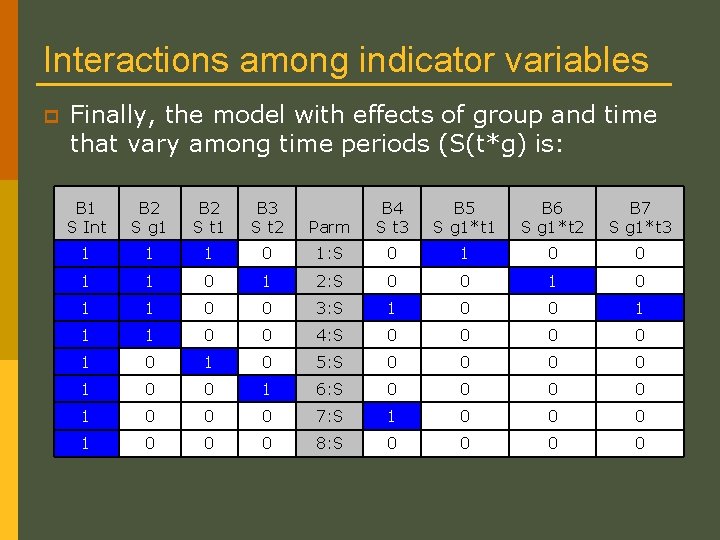
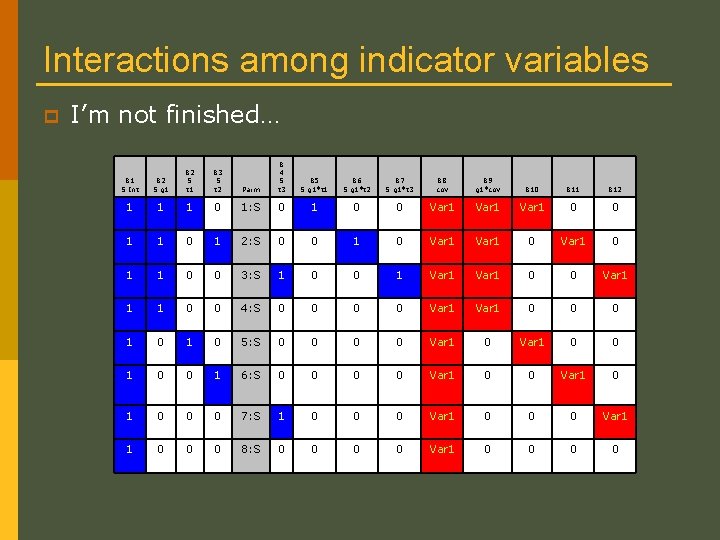
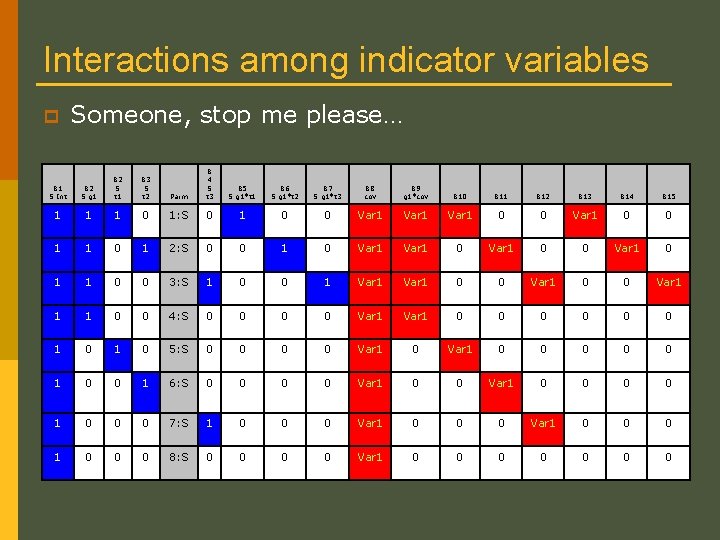
Interactions among indicator variables p Polychotomous (more than two possibilities) aka indicator or dummy variables p Each column used in specifying the polychotomous parameter multiplied by the columns specifying the other parameter(s).
Interactions among indicator variables p p Example similar to KM 2. dbf with two groups and 4 time periods. The default design matrix for two groups (S(g)) B 1 S Int 1 Parm 1: S B 2 S g 1 1 1 2: S 1 1 3: S 1 1 4: S 1 1 5: S 0 1 6: S 0 1 7: S 0 1 8: S 0
Interactions among indicator variables p The default design matrix for the model for S(t), survival different among times, but not between groups B 1 S Int B 2 S t 1 Parm B 3 S t 2 B 4 S t 3 1 1 1: S 0 0 1 0 2: S 1 0 3: S 0 1 1 0 4: S 0 0 1 1 5: S 0 0 1 0 6: S 1 0 7: S 0 1 1 0 8: S 0 0
Interactions among indicator variables p The additive model with group and time effects (S(t+g) (i. e. , there is a difference in survival between groups, but it is constant over time). Parm B 4 S t 2 B 5 S t 3 1 1: S 0 0 1 0 2: S 1 0 1 1 0 3: S 0 1 1 1 0 4: S 0 0 1 5: S 0 0 1 0 0 6: S 1 0 0 7: S 0 1 1 0 0 8: S 0 0 B 1 S Int B 2 S g 1 B 3 S t 1 1
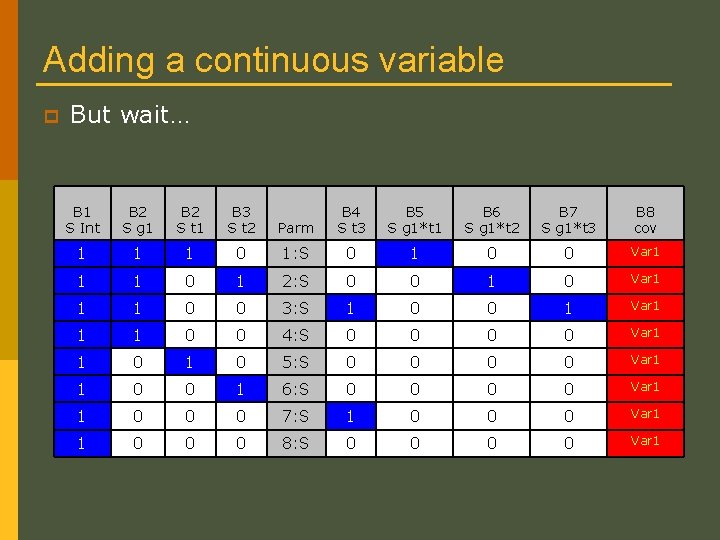
Interactions among indicator variables p Finally, the model with effects of group and time that vary among time periods (S(t*g) is: B 1 S Int B 2 S g 1 B 2 S t 1 B 3 S t 2 Parm B 4 S t 3 B 5 S g 1*t 1 B 6 S g 1*t 2 B 7 S g 1*t 3 1 1 1 0 1: S 0 1 0 0 1 1 0 1 2: S 0 0 1 1 0 0 3: S 1 0 0 1 1 1 0 0 4: S 0 0 1 0 5: S 0 0 1 6: S 0 0 1 0 0 0 7: S 1 0 0 0 8: S 0 0
Adding a continuous variable p But wait… B 1 S Int B 2 S g 1 B 2 S t 1 B 3 S t 2 Parm B 4 S t 3 B 5 S g 1*t 1 B 6 S g 1*t 2 B 7 S g 1*t 3 B 8 cov 1 1 1 0 1: S 0 1 0 0 Var 1 1 1 0 1 2: S 0 0 1 0 Var 1 1 1 0 0 3: S 1 0 0 1 Var 1 1 1 0 0 4: S 0 0 Var 1 1 0 5: S 0 0 Var 1 1 0 0 1 6: S 0 0 Var 1 1 0 0 0 7: S 1 0 0 0 Var 1 1 0 0 0 8: S 0 0 Var 1
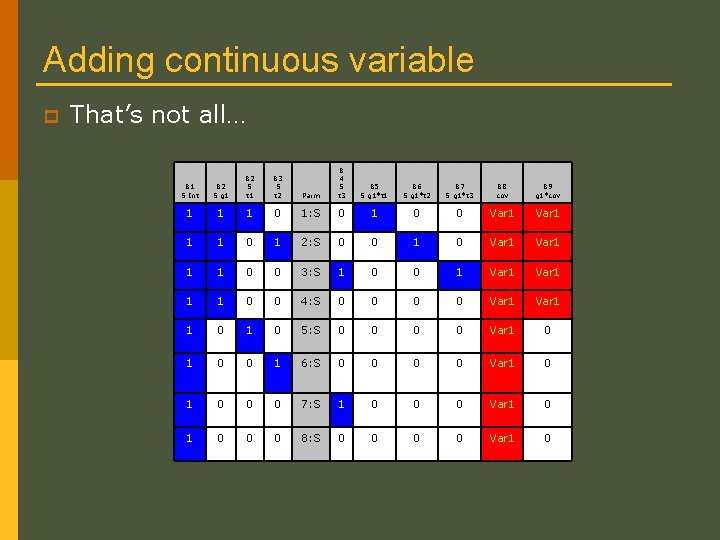
Adding continuous variable p That’s not all… B 3 S t 2 Parm B 4 S t 3 B 5 S g 1*t 1 B 6 S g 1*t 2 B 7 S g 1*t 3 B 8 cov B 9 g 1*cov B 1 S Int B 2 S g 1 B 2 S t 1 1 0 1: S 0 1 0 0 Var 1 1 1 0 1 2: S 0 0 1 0 Var 1 1 1 0 0 3: S 1 0 0 1 Var 1 1 1 0 0 4: S 0 0 Var 1 1 0 5: S 0 0 Var 1 0 0 1 6: S 0 0 Var 1 0 0 0 7: S 1 0 0 0 Var 1 0 0 0 8: S 0 0 Var 1 0
Interactions among indicator variables p I’m not finished… B 3 S t 2 Parm B 4 S t 3 B 5 S g 1*t 1 B 6 S g 1*t 2 B 7 S g 1*t 3 B 8 cov B 9 g 1*cov B 10 B 11 B 12 B 1 S Int B 2 S g 1 B 2 S t 1 1 0 1: S 0 1 0 0 Var 1 0 0 1 1 0 1 2: S 0 0 1 0 Var 1 0 1 1 0 0 3: S 1 0 0 1 Var 1 0 0 Var 1 1 1 0 0 4: S 0 0 Var 1 0 0 0 1 0 5: S 0 0 Var 1 0 0 1 6: S 0 0 Var 1 0 0 0 7: S 1 0 0 0 Var 1 1 0 0 0 8: S 0 0 Var 1 0 0
Interactions among indicator variables p Someone, stop me please… B 3 S t 2 Parm B 4 S t 3 B 5 S g 1*t 1 B 6 S g 1*t 2 B 7 S g 1*t 3 B 8 cov B 9 g 1*cov B 10 B 11 B 12 B 13 B 14 B 15 B 1 S Int B 2 S g 1 B 2 S t 1 1 0 1: S 0 1 0 0 Var 1 0 0 1 1 0 1 2: S 0 0 1 0 Var 1 0 1 1 0 0 3: S 1 0 0 1 Var 1 0 0 Var 1 1 1 0 0 4: S 0 0 Var 1 0 0 0 1 0 5: S 0 0 Var 1 0 0 0 1 6: S 0 0 Var 1 0 0 0 0 1 0 0 0 7: S 1 0 0 0 Var 1 0 0 0 8: S 0 0 Var 1 0 0 0 0