
Wikipedia of telemedicine http en wikipedia orgwikiTelemedicine From








- Slides: 36
• Wikipedia of telemedicine • http: //en. wikipedia. org/wiki/Telemedicine • From scholar google
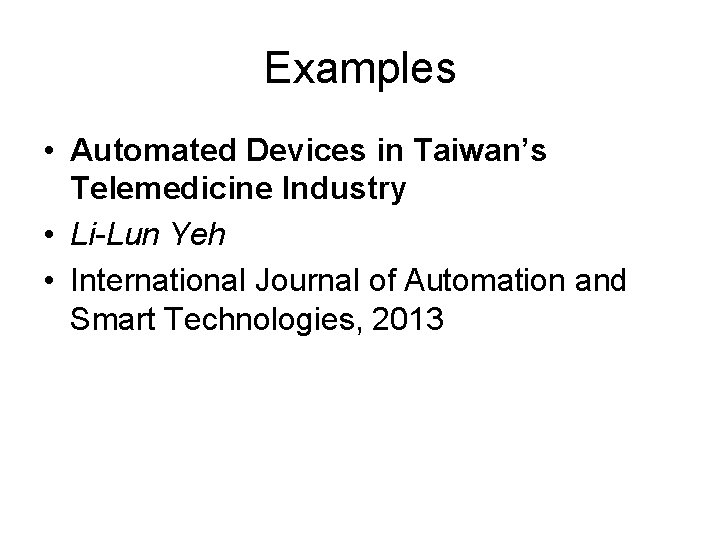
Examples • Automated Devices in Taiwan’s Telemedicine Industry • Li-Lun Yeh • International Journal of Automation and Smart Technologies, 2013
• Telemedicine industry generally refers to the application of media technology to overcome the limits of time and space and to interactive medical professional consulting and advisory services so that doctors may attend remote video conferences and provide tele-consultation for a full range of medical care in remote and island areas, • Healthcare professionals in these areas may be accessible to educational training opportunities.
• This study investigated analyzed the automation process as required by doctors in remote areas to diagnose and treat patients, in order to point out the limitation in the current telemedicine process automation and the new potential automation devices for better quality in overall telemedicine services.
• According to the survey on the need for telemedicine process automation in this AHPbased study, among all the questionnaires from respondents, 38. 96% of them suggested that the process of “transmission of medical information” is most in need of automation technology to improve the service quality and efficiency. • 37. 91% of them suggested that the process of “retrieval of medical information” is most in need of the assistance from automation technology.
• Effectiveness of telemedicine: A systematic review of reviews • Anne G. Ekelanda, Alison Bowesb, Signe Flottorpc, d • a Norwegian Centre for Integrated Care and Telemedicine, University Hospital of North Norway, P. O. Box 6060, N-9038 Tromsø, Norway • International Journal of Medical Informatics • Volume 79, Issue 11, November 2010, Pages 736– 771
Method • A review of systematic reviews of telemedicine interventions was conducted. Interventions included all e-health interventions, information and communication technologies for communication in health care, Internet based interventions for diagnosis and treatments, and social care if important part of health care and in collaboration with health care for patients with chronic conditions were considered relevant.
• Each potentially relevant systematic review was assessed in full text by one member of an external expert team, using a revised check list from EPOC (Cochrane Effective Practice and Organisation of Care Group) to assess quality. Qualitative analysis of the included reviews was informed by principles of realist review.
Results • In total 1593 titles/abstracts were identified. Following quality assessment, the review included 80 heterogeneous systematic reviews. • Twenty-one reviews concluded that telemedicine is effective, 18 found that evidence is promising but incomplete and others that evidence is limited and inconsistent. • Emerging themes are the particularly problematic nature of economic analyses of telemedicine, the benefits of telemedicine for patients, and telemedicine as complex and ongoing collaborative achievements in unpredictable processes.
Conclusion • The emergence of new topic areas in this dynamic field is notable and reviewers are starting to explore new questions beyond those of clinical and cost-effectiveness. • Reviewers point to a continuing need for larger studies of telemedicine as controlled interventions, and more focus on patients’ perspectives, economic analyses and on telemedicine innovations as complex processes and ongoing collaborative achievements. Formative assessments are emerging as an area of interest.