
Wigan Educational Psychology Service Emotionally Based School Avoidance

Wigan Educational Psychology Service Emotionally Based School Avoidance Information for schools What is Emotionally Based School Avoidance (EBSA)? Emotionally Based School Avoidance (EBSA) is when pupils avoid school, or an aspect of school, due to anxiety. A key message from the research is that early intervention is essential for positive outcomes. EBSA is thought to develop along a continuum, so it is important to monitor for the early signs that a child may be becoming anxious about school: Responding to EBSA 1. Anxious feelings around school 5. Reduction in anxiety 2. Negative thoughts 4. Respite 3. Avoidant behaviour The first two stages of EBSA may not be obvious to school staff as they may occur at home, therefore a strong home/school relationship with effective and regular communication is a significant protective factor to preventing and addressing EBSA as early as possible. It will be essential to establish shared goals and to develop a mutually agreed plan. Once children start to avoid aspects of school, it can start a cycle of reinforcement, embedding avoidance. The child’s voice A key message from the research is to start with the child’s voice. There are many ways that this can be done, such as using Talking Mats. Your school may have tried and tested ways, and there are some further ideas in the Emotionally Friendly Schools manual.
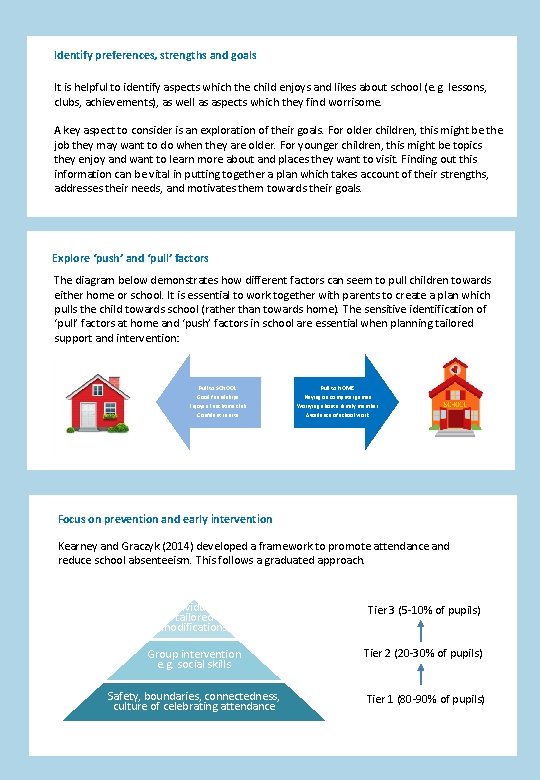
Identify preferences, strengths and goals It is helpful to identify aspects which the child enjoys and likes about school (e. g. lessons, clubs, achievements), as well as aspects which they find worrisome. A key aspect to consider is an exploration of their goals. For older children, this might be the job they may want to do when they are older. For younger children, this might be topics they enjoy and want to learn more about and places they want to visit. Finding out this information can be vital in putting together a plan which takes account of their strengths, addresses their needs, and motivates them towards their goals. Explore ‘push’ and ‘pull’ factors The diagram below demonstrates how different factors can seem to pull children towards either home or school. It is essential to work together with parents to create a plan which pulls the child towards school (rather than towards home). The sensitive identification of ‘pull’ factors at home and ‘push’ factors in school are essential when planning tailored support and intervention: Pull to SCHOOL Good friendships Enjoys a lunchtime club Confident in arts Pull to HOME Playing on computer games Worrying about a family member Avoidance of school work Focus on prevention and early intervention Kearney and Graczyk (2014) developed a framework to promote attendance and reduce school absenteeism. This follows a graduated approach. Individually tailored modifications Tier 3 (5 -10% of pupils) Group intervention e. g. social skills Tier 2 (20 -30% of pupils) Safety, boundaries, connectedness, culture of celebrating attendance Tier 1 (80 -90% of pupils)
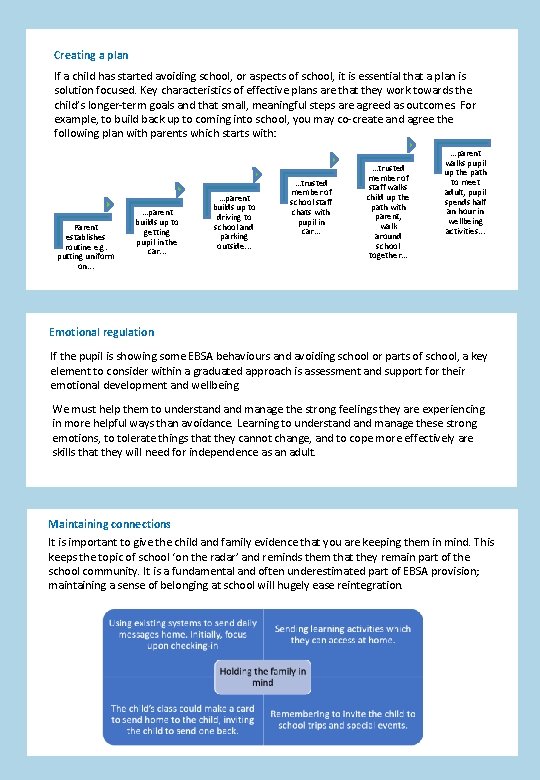
Creating a plan If a child has started avoiding school, or aspects of school, it is essential that a plan is solution focused. Key characteristics of effective plans are that they work towards the child’s longer-term goals and that small, meaningful steps are agreed as outcomes. For example, to build back up to coming into school, you may co-create and agree the following plan with parents which starts with: Parent establishes routine e. g. putting uniform on. . . parent builds up to getting pupil in the car. . . parent builds up to driving to school and parking outside. . . trusted member of school staff chats with pupil in car. . . trusted member of staff walks child up the path with parent, walk around school together. . . parent walks pupil up the path to meet adult, pupil spends half an hour in wellbeing activities. . . Emotional regulation If the pupil is showing some EBSA behaviours and avoiding school or parts of school, a key element to consider within a graduated approach is assessment and support for their emotional development and wellbeing. We must help them to understand manage the strong feelings they are experiencing in more helpful ways than avoidance. Learning to understand manage these strong emotions, to tolerate things that they cannot change, and to cope more effectively are skills that they will need for independence as an adult. Maintaining connections It is important to give the child and family evidence that you are keeping them in mind. This keeps the topic of school ‘on the radar’ and reminds them that they remain part of the school community. It is a fundamental and often underestimated part of EBSA provision; maintaining a sense of belonging at school will hugely ease reintegration.
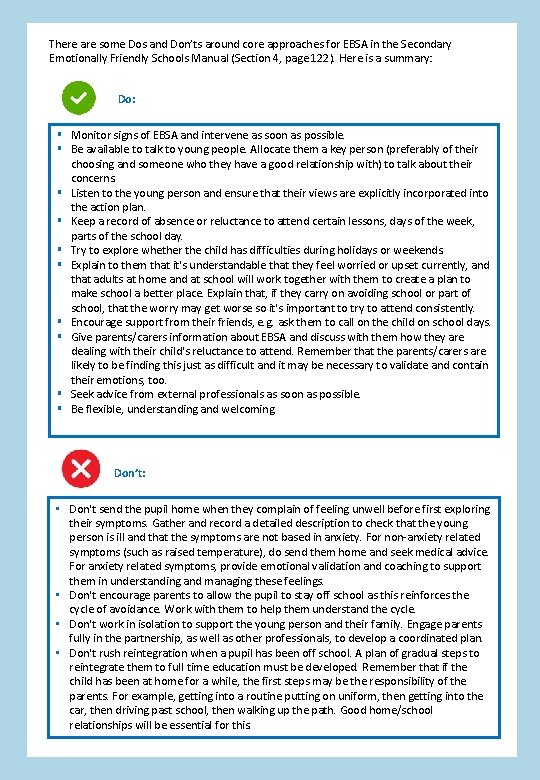
There are some Dos and Don’ts around core approaches for EBSA in the Secondary Emotionally Friendly Schools Manual (Section 4, page 122). Here is a summary: Do: § Monitor signs of EBSA and intervene as soon as possible. § Be available to talk to young people. Allocate them a key person (preferably of their choosing and someone who they have a good relationship with) to talk about their concerns. § Listen to the young person and ensure that their views are explicitly incorporated into the action plan. § Keep a record of absence or reluctance to attend certain lessons, days of the week, parts of the school day. § Try to explore whether the child has difficulties during holidays or weekends. § Explain to them that it's understandable that they feel worried or upset currently, and that adults at home and at school will work together with them to create a plan to make school a better place. Explain that, if they carry on avoiding school or part of school, that the worry may get worse so it's important to try to attend consistently. § Encourage support from their friends, e. g. ask them to call on the child on school days. § Give parents/carers information about EBSA and discuss with them how they are dealing with their child's reluctance to attend. Remember that the parents/carers are likely to be finding this just as difficult and it may be necessary to validate and contain their emotions, too. § Seek advice from external professionals as soon as possible. § Be flexible, understanding and welcoming. Don’t: • Don't send the pupil home when they complain of feeling unwell before first exploring their symptoms. Gather and record a detailed description to check that the young person is ill and that the symptoms are not based in anxiety. For non-anxiety related symptoms (such as raised temperature), do send them home and seek medical advice. For anxiety related symptoms, provide emotional validation and coaching to support them in understanding and managing these feelings. • Don't encourage parents to allow the pupil to stay off school as this reinforces the cycle of avoidance. Work with them to help them understand the cycle. • Don't work in isolation to support the young person and their family. Engage parents fully in the partnership, as well as other professionals, to develop a coordinated plan. • Don't rush reintegration when a pupil has been off school. A plan of gradual steps to reintegrate them to full time education must be developed. Remember that if the child has been at home for a while, the first steps may be the responsibility of the parents. For example, getting into a routine putting on uniform, then getting into the car, then driving past school, then walking up the path. Good home/school relationships will be essential for this.
- Slides: 4