
Wifi Range Topics Discussed When we say range

- Slides: 19
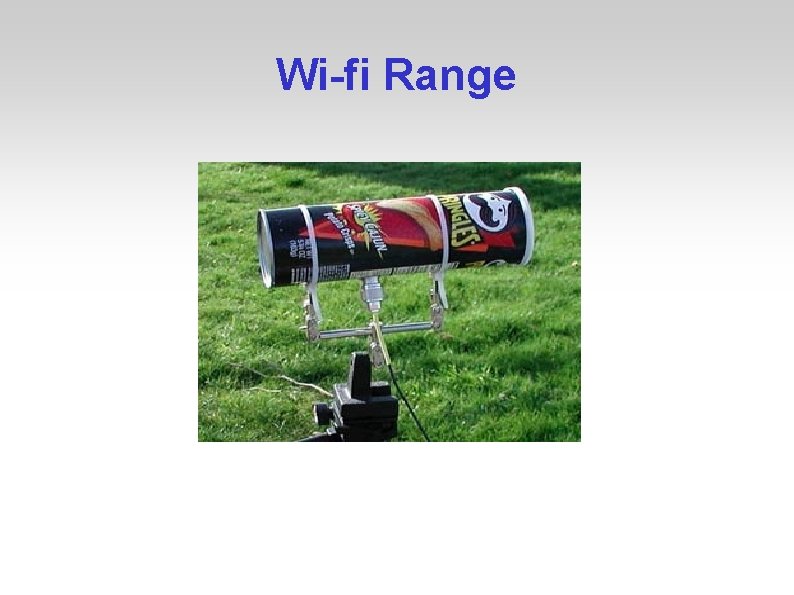
Wi-fi Range
Topics Discussed When we say range or coverage, what do we mean? What factors can affect range? Why are there so many different designs of antennas? Interference, Multipath, Attenuation The future of Wi-Fi
Defining Range and Coverage Range – The maximum distance at which the sender and reciver can mantain a connection Coverage – The total area that a wi-fi enabled device can be in and make a connction to an access point
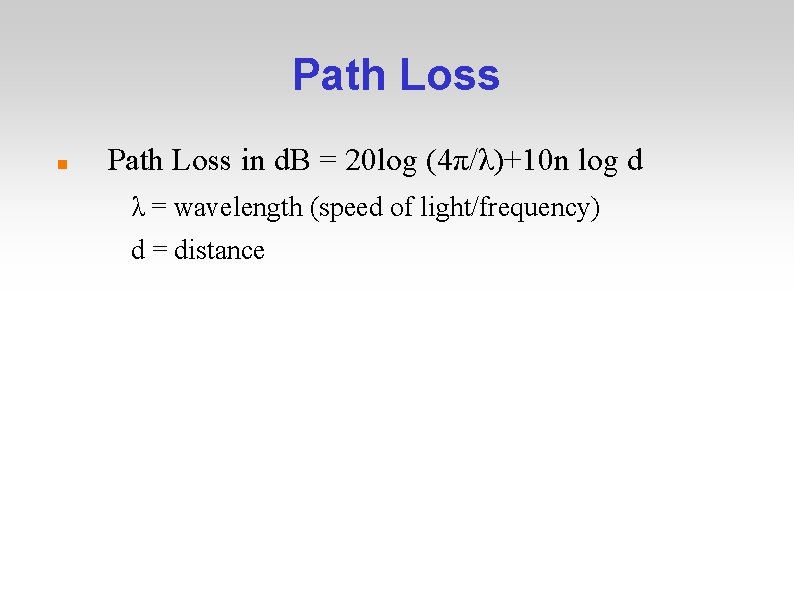
The Basics of Range is a function of data rate. Higher the data rate, the shorter the range Higher the transmission power, the higher the signal strength or amplitude As these factors can increase range, path loss will reduce it Path Loss – the reduction in signal strength that a signal experiences as it travels through air or objects
Path Loss in d. B = 20 log (4π/λ)+10 n log d λ = wavelength (speed of light/frequency) d = distance
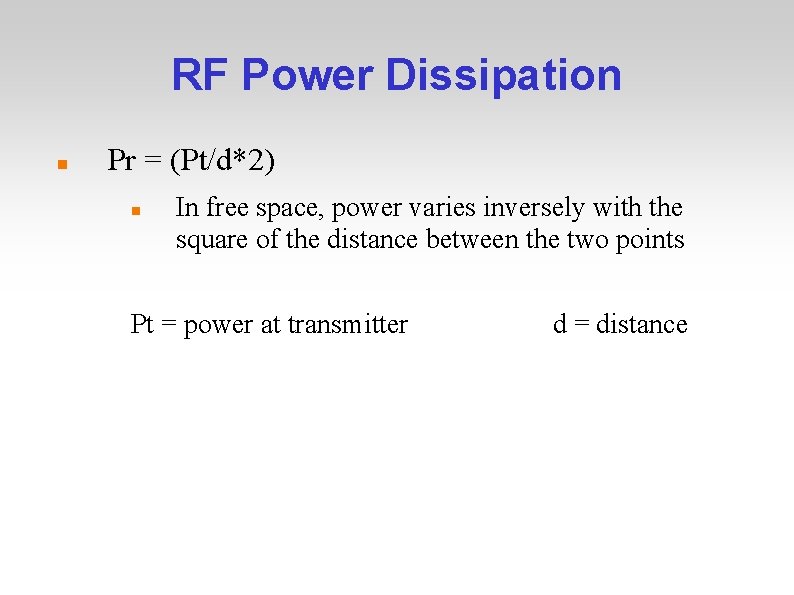
RF Power Dissipation Pr = (Pt/d*2) In free space, power varies inversely with the square of the distance between the two points Pt = power at transmitter d = distance
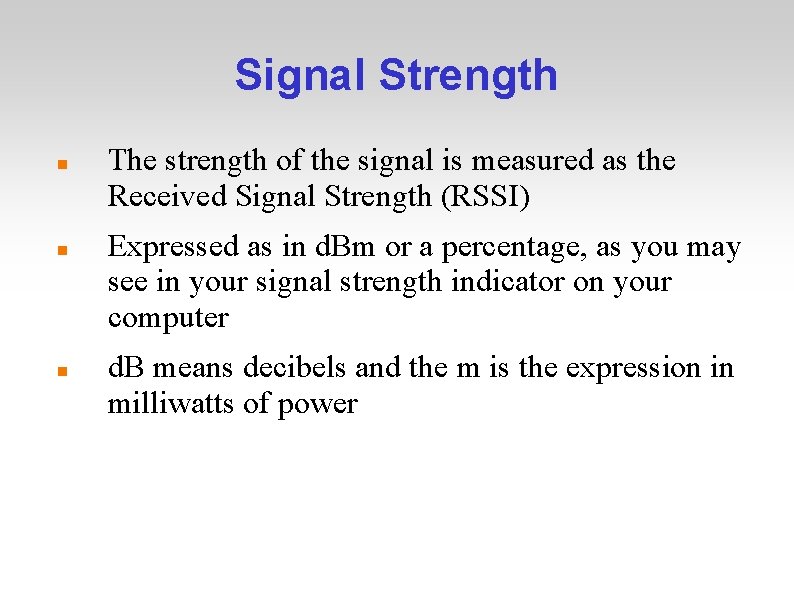
Signal Strength The strength of the signal is measured as the Received Signal Strength (RSSI) Expressed as in d. Bm or a percentage, as you may see in your signal strength indicator on your computer d. B means decibels and the m is the expression in milliwatts of power
Signal Strength (RSSI) Rr = Pt * Gr (λ/4πd)*2 Pt = power at transmitter Gt = antenna gain at reciver Gr = antenna gain at reciver d = distance λ = wavelength (speed of light/frequency)
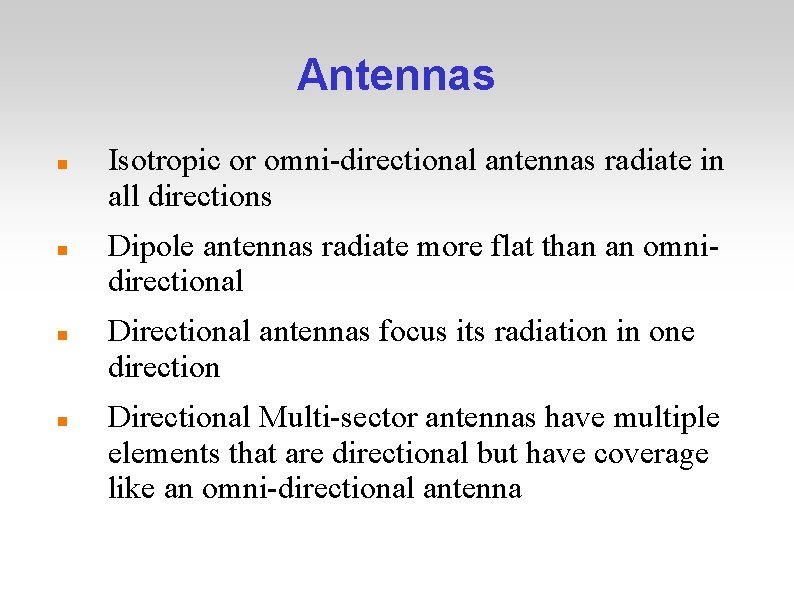
Antennas Isotropic or omni-directional antennas radiate in all directions Dipole antennas radiate more flat than an omnidirectional Directional antennas focus its radiation in one direction Directional Multi-sector antennas have multiple elements that are directional but have coverage like an omni-directional antenna
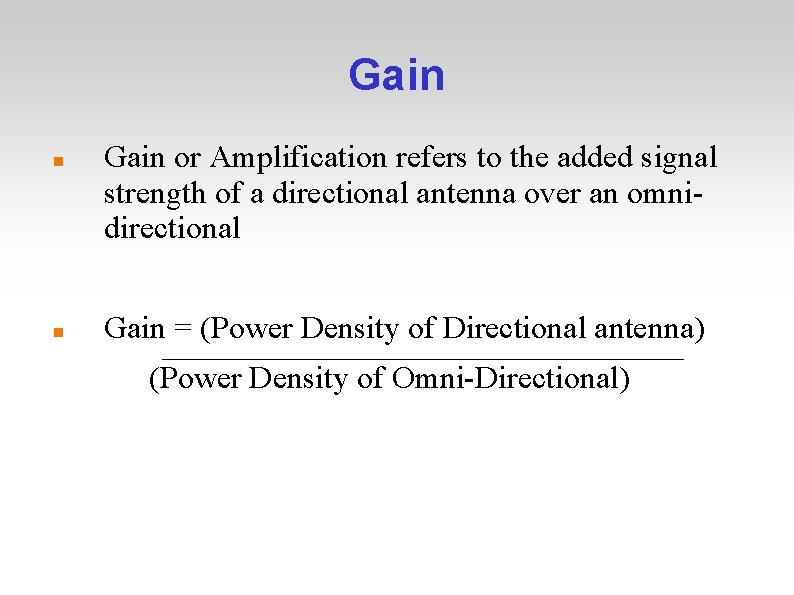
Gain or Amplification refers to the added signal strength of a directional antenna over an omnidirectional Gain = (Power Density of Directional antenna) (Power Density of Omni-Directional)
Factors That Limit Range Interference can cause the radio waves to lose its shape causing packets to be retransmitted Interference usualy comes from devices that use the same band as 802. 11 Many things we use in our daily lives can cause interference such as: Bluetooth Devices Ham Radio Cordless Phones Microwaves Wireless Video Cameras
Factors That Limit Range Multipath occurs when the same transmission uses a different route to reach its destination Creates weaker copies of the same transmission and arrive slightly later than the straightest path Gets worse as the gap between primary and secondary signals increases Causes corrupt packets that must be retransmitted Could also help reception in some cases Directional antennas can help lessen multipath problems
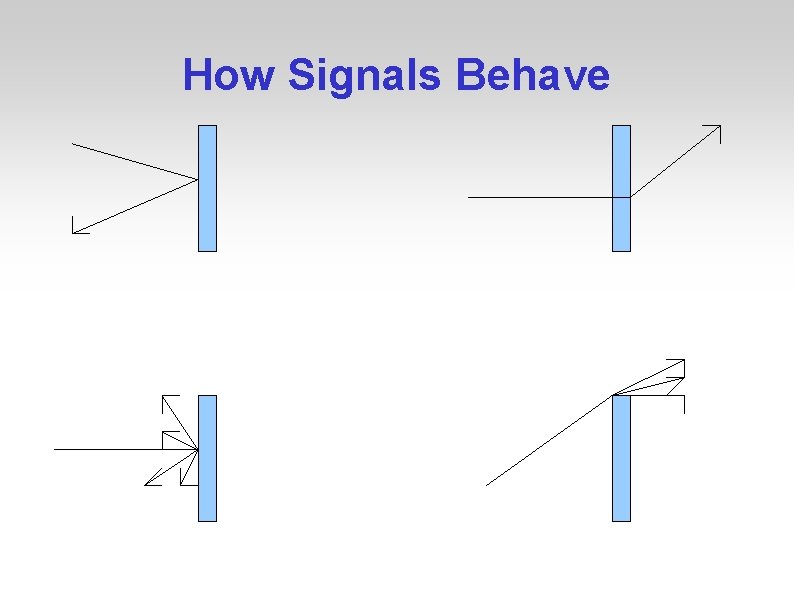
How Signals Behave
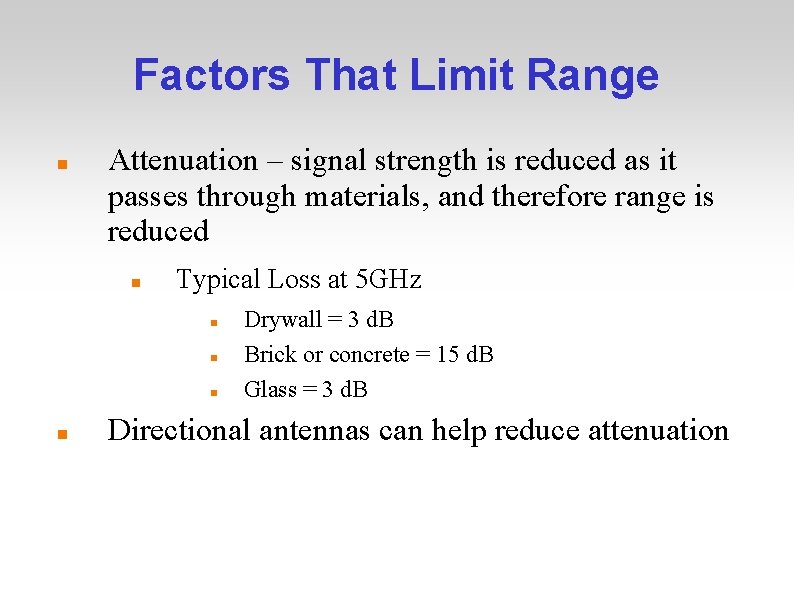
Factors That Limit Range Attenuation – signal strength is reduced as it passes through materials, and therefore range is reduced Typical Loss at 5 GHz Drywall = 3 d. B Brick or concrete = 15 d. B Glass = 3 d. B Directional antennas can help reduce attenuation
Factors That Limit Range Hidden Node – when 2 or more nodes try to sent to the same AP at the same time because they think its safe to transmit CTS-RTS can help eliminate this but slows the network Directional antennas can help with this problem as well and will not create overhead like CTSRTS
Factors That Limit Range Signal to Noise Ratio (SNR) is the needed signal strength to overcome interference As the data rate goes up, more complex encoding and modulation schemes are needed The simpler the encoding, the range appears farther The more complicated, the shorter the range due to path loss and more chance for interference
Range vs Capacity Higer range may not always be a good thing The farther the range, the more users are able to connect to that one antenna Therefore more users are taking a pre defind amount of bandwidth More range means lower data rates for users at the edge of the cell
Future Technology 802. 11 n data rate at 54 Mbit/s to a maximum of 600 Mbit/s as of April 4 th 2009, draft 9 has passed with an expected final release in Jan of 2010 Can achive these rates by MIMO and Chanle Bonding
MIMO Precoding – each antenna in a transmitter transmitts the same signal at an appropiate phase so the receiver gets the maximum signal strength Spatial multiplexing – high rate signal is split into multiple lower rate streams and each stream is transmitted from a different transmit antenna in the same frequency channel.