
WideField Science Capabilities at the AAO Stuart Ryder
Wide-Field Science Capabilities at the AAO Stuart Ryder Australian Gemini Office Australian Astronomical Observatory
Outline • Radio – Optical synergies • ATAC “open skies” access to – (UKST) – AAT – Gemini – Magellan – Time exchange • Complementing ASKAP Surveys
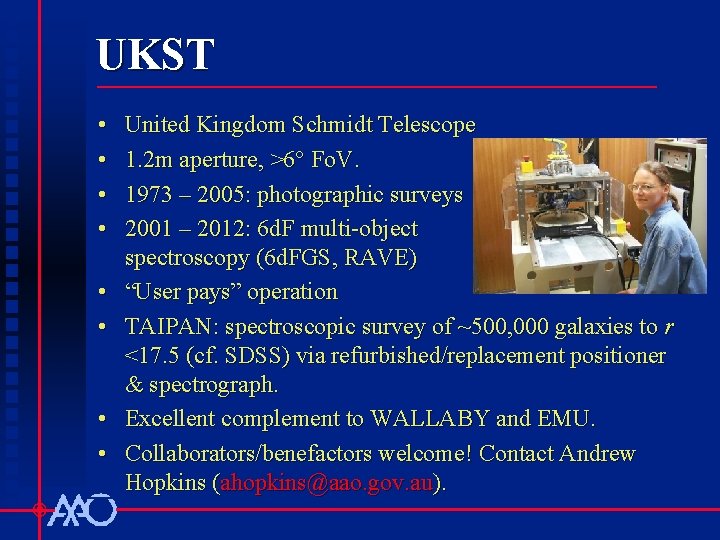
UKST • • United Kingdom Schmidt Telescope 1. 2 m aperture, >6° Fo. V. 1973 – 2005: photographic surveys 2001 – 2012: 6 d. F multi-object spectroscopy (6 d. FGS, RAVE) “User pays” operation TAIPAN: spectroscopic survey of ~500, 000 galaxies to r <17. 5 (cf. SDSS) via refurbished/replacement positioner & spectrograph. Excellent complement to WALLABY and EMU. Collaborators/benefactors welcome! Contact Andrew Hopkins (ahopkins@aao. gov. au).
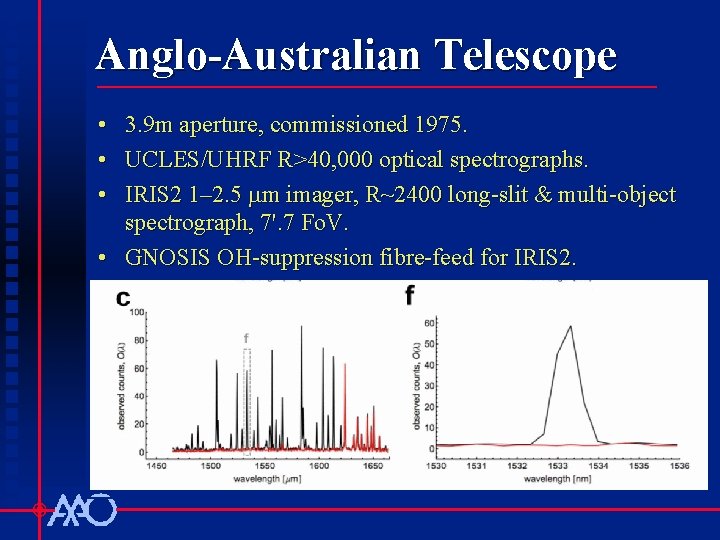
Anglo-Australian Telescope • 3. 9 m aperture, commissioned 1975. • UCLES/UHRF R>40, 000 optical spectrographs. • IRIS 2 1– 2. 5 mm imager, R~2400 long-slit & multi-object spectrograph, 7'. 7 Fo. V. • GNOSIS OH-suppression fibre-feed for IRIS 2.

AAOmega • Dual-beam spectrograph, R=1300– 8000, VPH gratings. • 2 d. F robotic fibre positioner places 392 2" fibres within a 2° Fo. V (2 d. FGRS, 2 QZ, Wiggle. Z, GAMA). • SPIRAL Integral Field Unit lenslet array covers Fo. V 22. 4" 11. 2" at 0. 7" per lenslet. • KOALA (2012/13) will double the SPIRAL Fo. V.
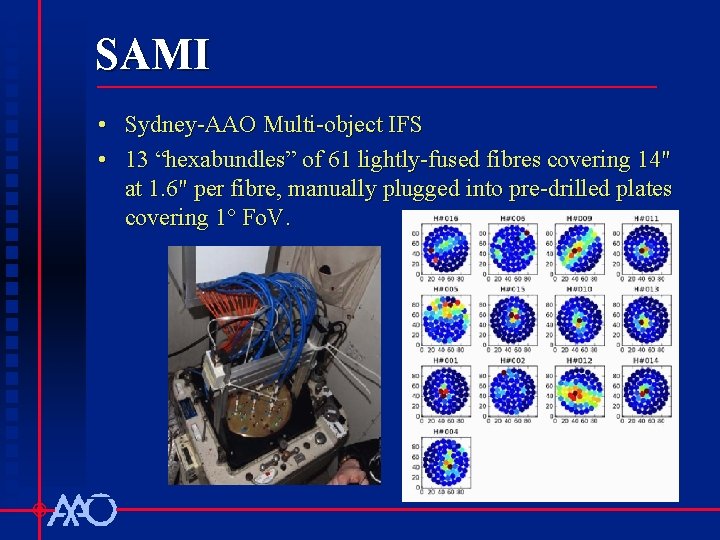
SAMI • Sydney-AAO Multi-object IFS • 13 “hexabundles” of 61 lightly-fused fibres covering 14" at 1. 6" per fibre, manually plugged into pre-drilled plates covering 1° Fo. V.
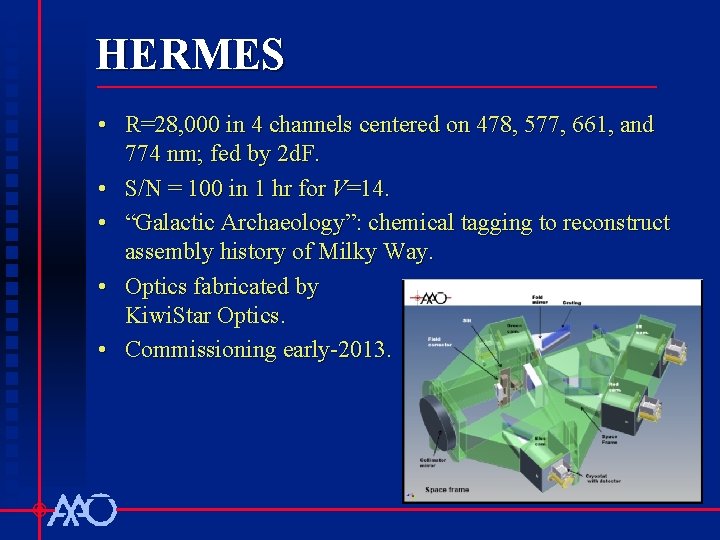
HERMES • R=28, 000 in 4 channels centered on 478, 577, 661, and 774 nm; fed by 2 d. F. • S/N = 100 in 1 hr for V=14. • “Galactic Archaeology”: chemical tagging to reconstruct assembly history of Milky Way. • Optics fabricated by Kiwi. Star Optics. • Commissioning early-2013.
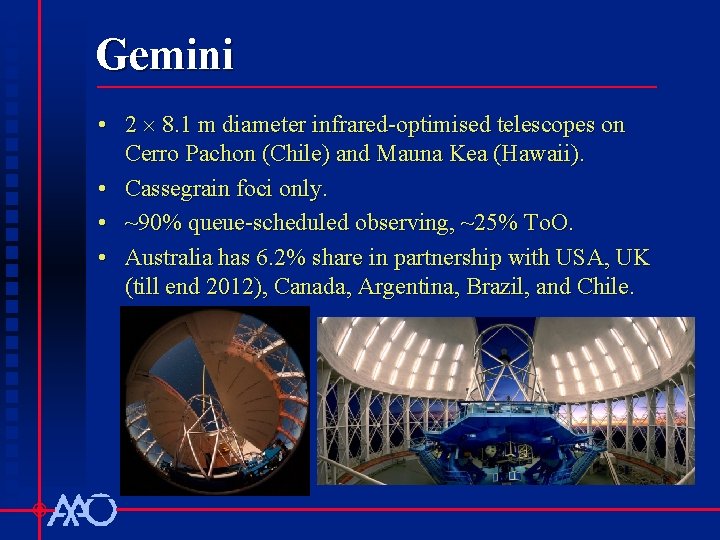
Gemini • 2 8. 1 m diameter infrared-optimised telescopes on Cerro Pachon (Chile) and Mauna Kea (Hawaii). • Cassegrain foci only. • ~90% queue-scheduled observing, ~25% To. O. • Australia has 6. 2% share in partnership with USA, UK (till end 2012), Canada, Argentina, Brazil, and Chile.
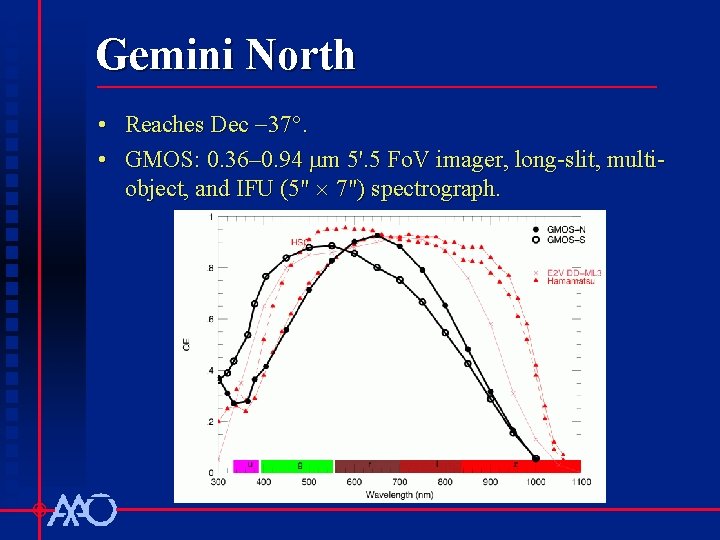
Gemini North • Reaches Dec 37°. • GMOS: 0. 36– 0. 94 mm 5'. 5 Fo. V imager, long-slit, multiobject, and IFU (5" 7") spectrograph.
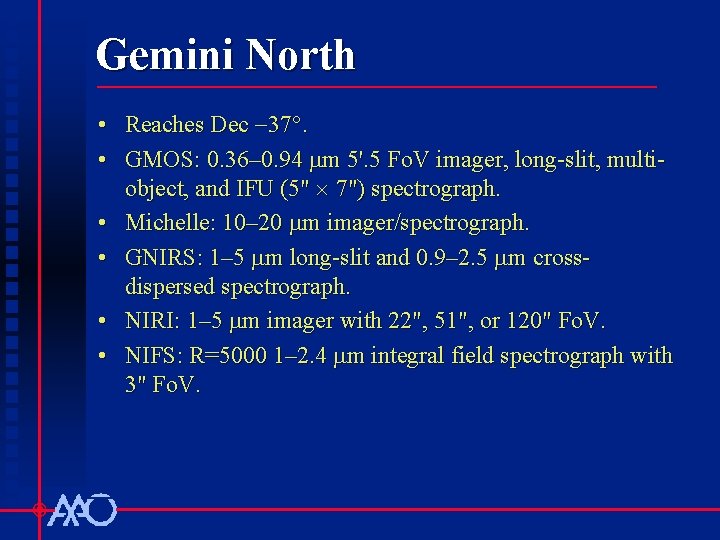
Gemini North • Reaches Dec 37°. • GMOS: 0. 36– 0. 94 mm 5'. 5 Fo. V imager, long-slit, multiobject, and IFU (5" 7") spectrograph. • Michelle: 10– 20 mm imager/spectrograph. • GNIRS: 1– 5 mm long-slit and 0. 9– 2. 5 mm crossdispersed spectrograph. • NIRI: 1– 5 mm imager with 22", 51", or 120" Fo. V. • NIFS: R=5000 1– 2. 4 mm integral field spectrograph with 3" Fo. V.
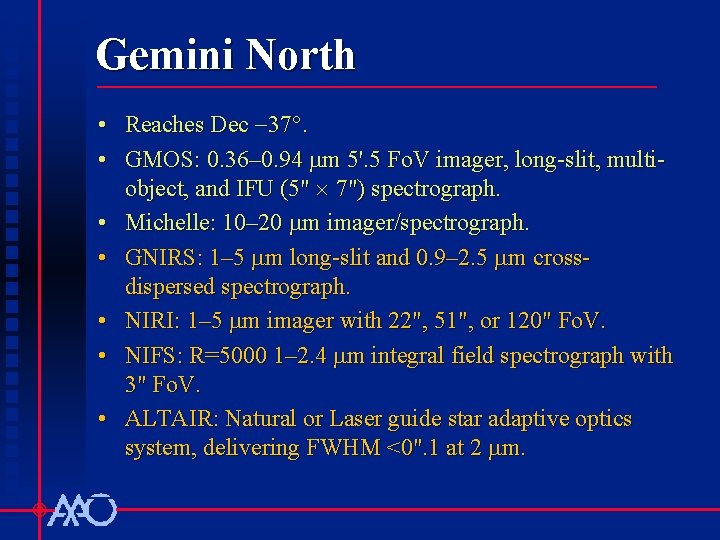
Gemini North • Reaches Dec 37°. • GMOS: 0. 36– 0. 94 mm 5'. 5 Fo. V imager, long-slit, multiobject, and IFU (5" 7") spectrograph. • Michelle: 10– 20 mm imager/spectrograph. • GNIRS: 1– 5 mm long-slit and 0. 9– 2. 5 mm crossdispersed spectrograph. • NIRI: 1– 5 mm imager with 22", 51", or 120" Fo. V. • NIFS: R=5000 1– 2. 4 mm integral field spectrograph with 3" Fo. V. • ALTAIR: Natural or Laser guide star adaptive optics system, delivering FWHM <0". 1 at 2 mm.
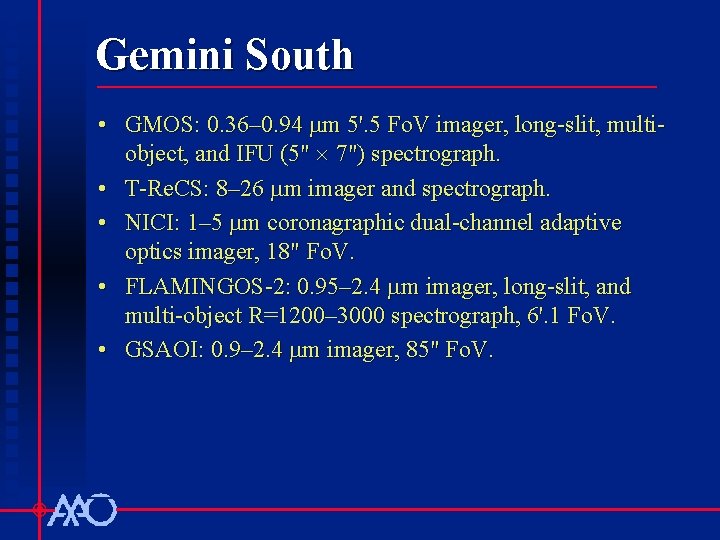
Gemini South • GMOS: 0. 36– 0. 94 mm 5'. 5 Fo. V imager, long-slit, multiobject, and IFU (5" 7") spectrograph. • T-Re. CS: 8– 26 mm imager and spectrograph. • NICI: 1– 5 mm coronagraphic dual-channel adaptive optics imager, 18" Fo. V. • FLAMINGOS-2: 0. 95– 2. 4 mm imager, long-slit, and multi-object R=1200– 3000 spectrograph, 6'. 1 Fo. V. • GSAOI: 0. 9– 2. 4 mm imager, 85" Fo. V.
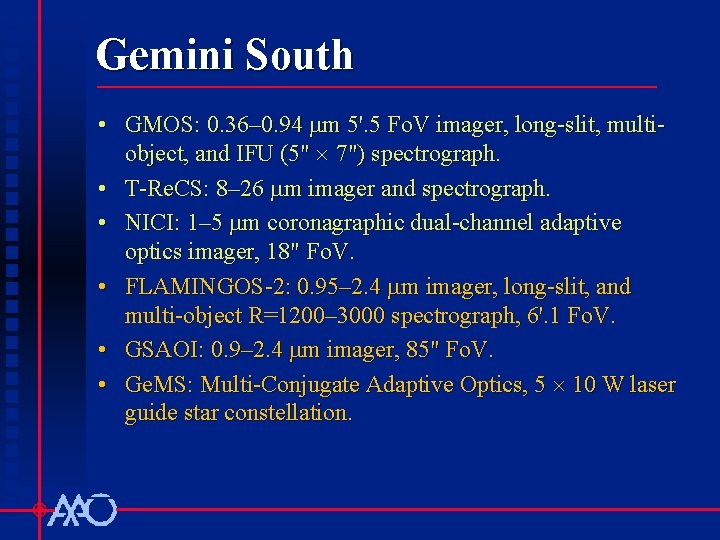
Gemini South • GMOS: 0. 36– 0. 94 mm 5'. 5 Fo. V imager, long-slit, multiobject, and IFU (5" 7") spectrograph. • T-Re. CS: 8– 26 mm imager and spectrograph. • NICI: 1– 5 mm coronagraphic dual-channel adaptive optics imager, 18" Fo. V. • FLAMINGOS-2: 0. 95– 2. 4 mm imager, long-slit, and multi-object R=1200– 3000 spectrograph, 6'. 1 Fo. V. • GSAOI: 0. 9– 2. 4 mm imager, 85" Fo. V. • Ge. MS: Multi-Conjugate Adaptive Optics, 5 10 W laser guide star constellation.
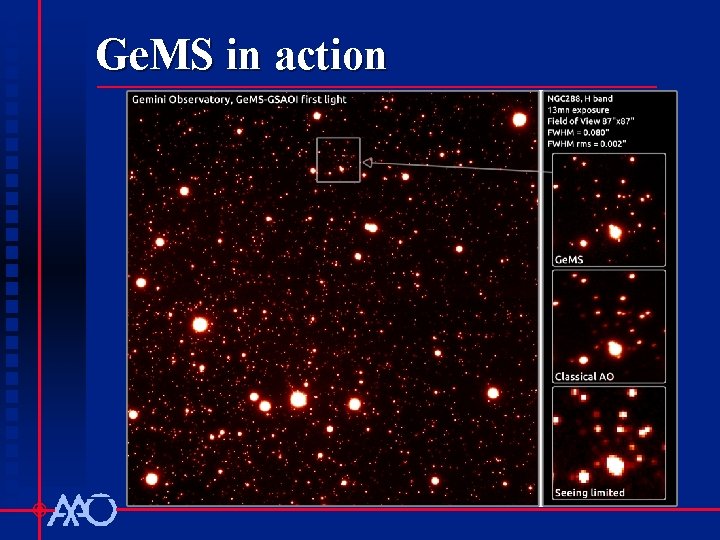
Ge. MS in action
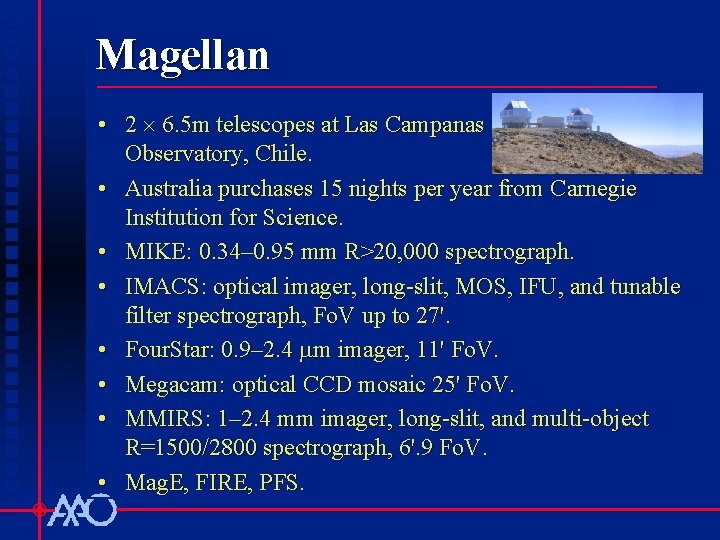
Magellan • 2 6. 5 m telescopes at Las Campanas Observatory, Chile. • Australia purchases 15 nights per year from Carnegie Institution for Science. • MIKE: 0. 34– 0. 95 mm R>20, 000 spectrograph. • IMACS: optical imager, long-slit, MOS, IFU, and tunable filter spectrograph, Fo. V up to 27'. • Four. Star: 0. 9– 2. 4 mm imager, 11' Fo. V. • Megacam: optical CCD mosaic 25' Fo. V. • MMIRS: 1– 2. 4 mm imager, long-slit, and multi-object R=1500/2800 spectrograph, 6'. 9 Fo. V. • Mag. E, FIRE, PFS.
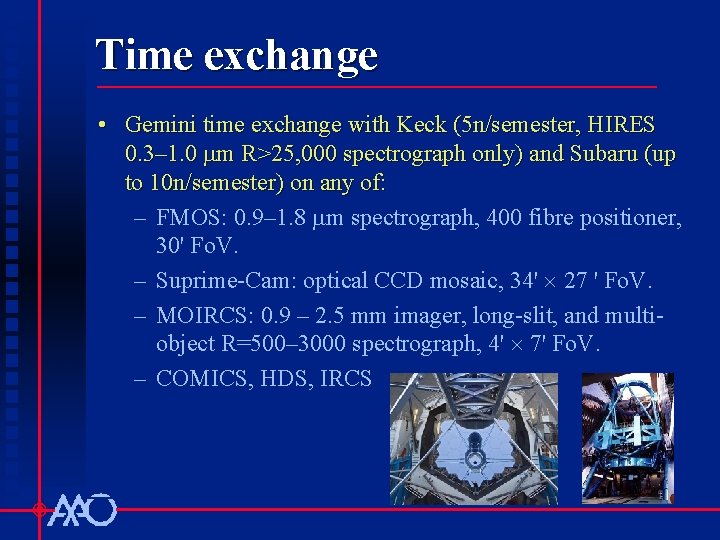
Time exchange • Gemini time exchange with Keck (5 n/semester, HIRES 0. 3– 1. 0 mm R>25, 000 spectrograph only) and Subaru (up to 10 n/semester) on any of: – FMOS: 0. 9– 1. 8 mm spectrograph, 400 fibre positioner, 30' Fo. V. – Suprime-Cam: optical CCD mosaic, 34' 27 ' Fo. V. – MOIRCS: 0. 9 – 2. 5 mm imager, long-slit, and multiobject R=500– 3000 spectrograph, 4' 7' Fo. V. – COMICS, HDS, IRCS
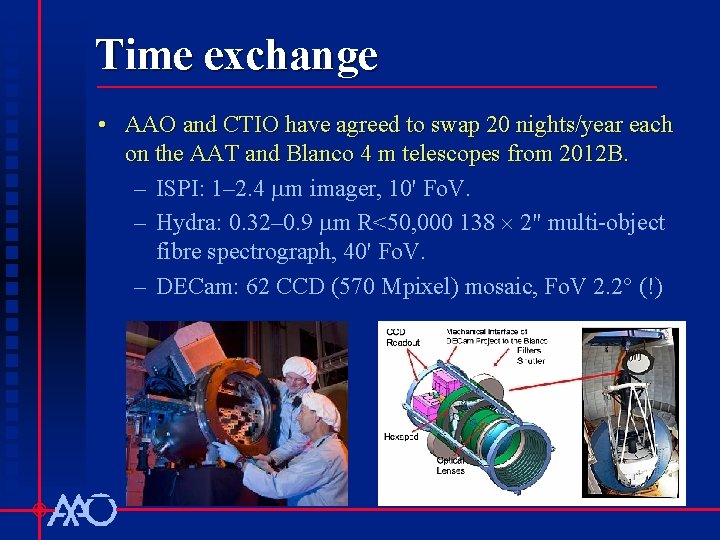
Time exchange • AAO and CTIO have agreed to swap 20 nights/year each on the AAT and Blanco 4 m telescopes from 2012 B. – ISPI: 1– 2. 4 mm imager, 10' Fo. V. – Hydra: 0. 32– 0. 9 mm R<50, 000 138 2" multi-object fibre spectrograph, 40' Fo. V. – DECam: 62 CCD (570 Mpixel) mosaic, Fo. V 2. 2° (!)
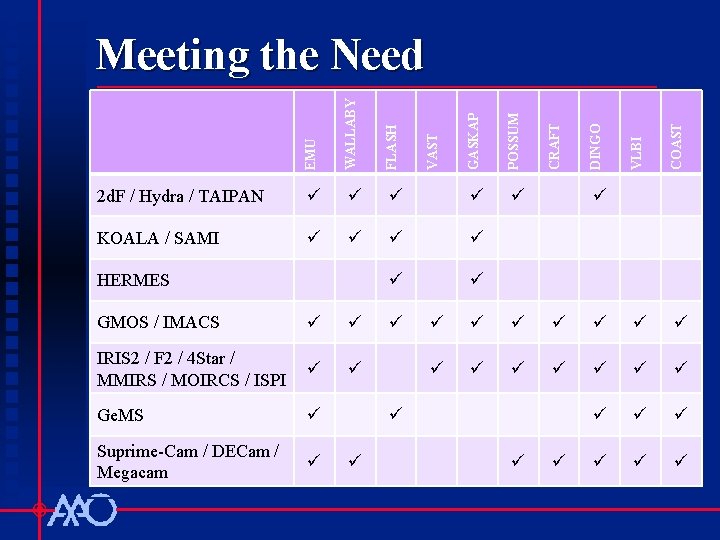
FLASH GASKAP POSSUM KOALA / SAMI HERMES GMOS / IMACS IRIS 2 / F 2 / 4 Star / MMIRS / MOIRCS / ISPI Ge. MS Suprime-Cam / DECam / Megacam DINGO CRAFT VAST COAST WALLABY 2 d. F / Hydra / TAIPAN VLBI EMU Meeting the Need
- Slides: 18