
Wide Range Achievement Test 4 WRAT 4 Rebecca
Wide Range Achievement Test 4 (WRAT 4) Rebecca Gowen
History • • • Joseph F. Jastak First published in 1946 WRAT 4 published in 2006 Developed to complement measure developed by David Wechsler Revisions • WRAT-R (1978) • WRAT-III (1993)
Purpose • It is designed to measure basic academic skills involving reading, spelling, and math computation. • Word Reading • Measures letter and word recognition • Sentence Comprehension – • New to the WRAT 4 • Measures an individual’s ability to gain meaning and comprehend information contained in a sentence • Added to address validity • Spelling • Measures one’s ability to encode sounds into the written form • Math Computation • Measures one’s ability to perform basic mathematical computations
Administration Format • Recommended administration – Word Reading, Sentence Comprehension, Spelling, then Math Computation. • Level B Qualification • Blue and Green forms Time • Depends upon age, skill, and response. • Age: 5 -7 years old • Approximately 15 -25 minutes • Age: 8 years and older • Approximately 35 -45 minutes
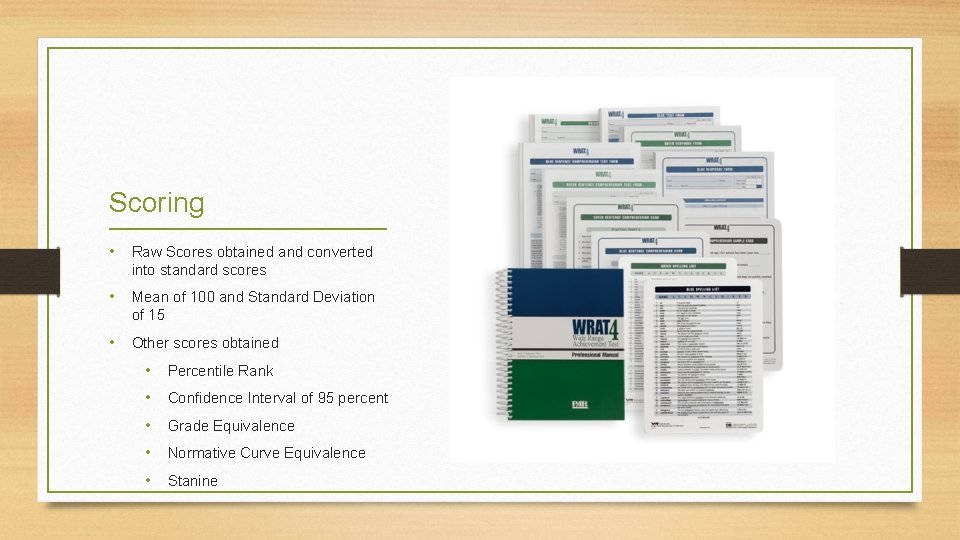
Scoring • Raw Scores obtained and converted into standard scores • Mean of 100 and Standard Deviation of 15 • Other scores obtained • Percentile Rank • Confidence Interval of 95 percent • Grade Equivalence • Normative Curve Equivalence • Stanine
Testworthiness Validity Reliability • Internal and External Validity • Internal Consistency coefficient • Correlates with: • WSIC-IV • KBIT • WAIT-II AND III • WASI-R • RAIS • Stanford Achievement Test typically. 92 -. 98 • Subtest Consistency coefficient range from. 87 -. 93 • Alternate-form coefficient range from. 82 -. 90
Sample • 3, 000 individuals • Based on age, gender, ethnicity, SES, and geographical region. • Multi-cultural considerations include: • African-American • Hispanic (Latino & Spanish) • Asian • American Indian • Hawaiian/Pacific Islander • Caucasian
Strengths • • • Initially can assess for educational and vocational factors Assess an individual’s academic progress Scoring is concise Strong reliability and validity Time efficient (Individual and Small group)
Weaknesses • Validity remains questionable • Does not identify behavioral difficulties • Does not accurately assess for learning disabilities, visual and/or auditable concerns, and special educational needs.
• Any Questions? ?
References • Dell, C. A. , Harrold, B. , & Dell, T. (2008). Test Review: Wide Range Achievement Test- Fourth Edition. Rehabilitation Counseling Bulletin. doi: 10. 1177/0034355208320079 • Gander Publishing Educational Materials (2014). Wide Range Achievement Test Fourth Edition (WRAT-4). Retrieved from http: //www. ganderpublishing. com/Wide-Range-Achievement-Test-Fourth-Edition-WRAT-4. html • Makray, C. , & Hope, G (2006). Wide Range Achievement Test 4 (WRAT 4). Journal of Occupational Psychology, Employment and Disability, 11(1). • Neukrug, E. , & Fawvett R (2006). Essentials of testing and assessment: A practical guide for counselors, social workers, and psychologists. Belmont, CA: Brooks/Cole. pgs. 166 -167 • PAR (2012). Wide Range Achievement Test 4 (WRAT 4). Retrieved from http: //www 4. parinc. com/Products/Product. aspx? Product. ID=WRAT 4
- Slides: 11