
Wide Field Optical Spectrograph WFOS TMT UCSC US
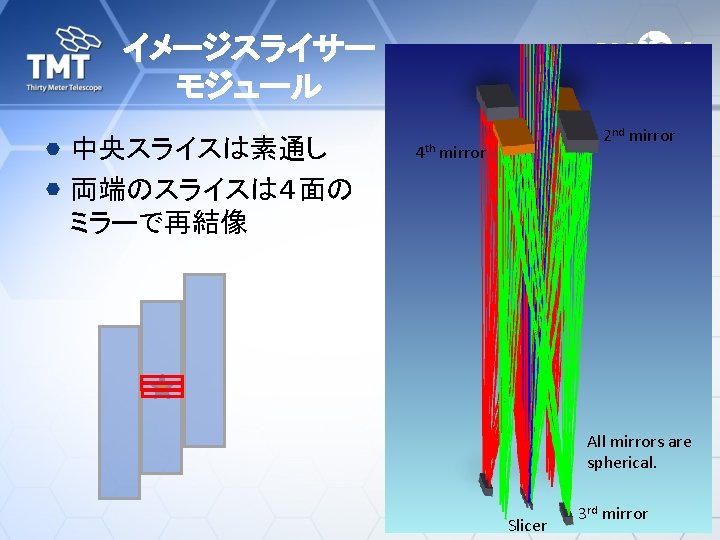
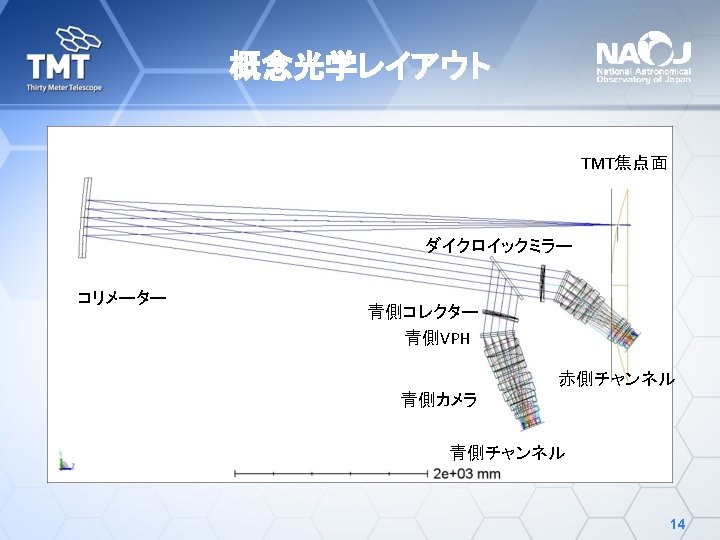
- Slides: 16
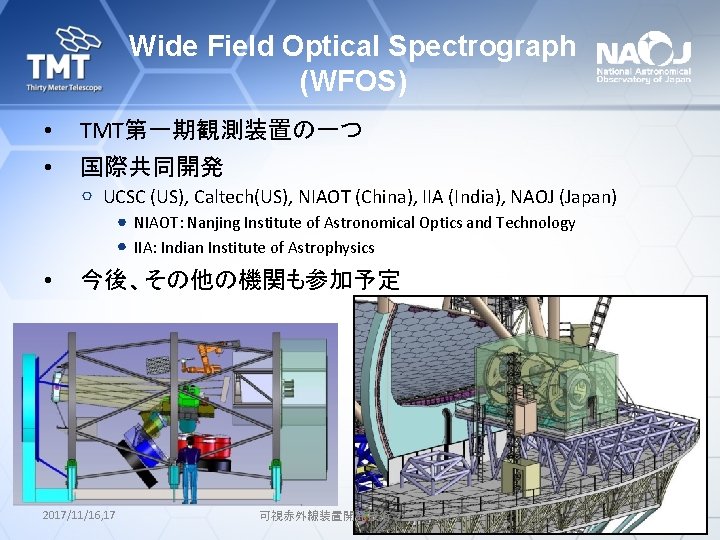
Wide Field Optical Spectrograph (WFOS) • TMT第一期観測装置の一つ • 国際共同開発 UCSC (US), Caltech(US), NIAOT (China), IIA (India), NAOJ (Japan) NIAOT: Nanjing Institute of Astronomical Optics and Technology IIA: Indian Institute of Astrophysics • 今後、その他の機関も参加予定 2017/11/16, 17 可視赤外線装置開発技術ワークショップ 4
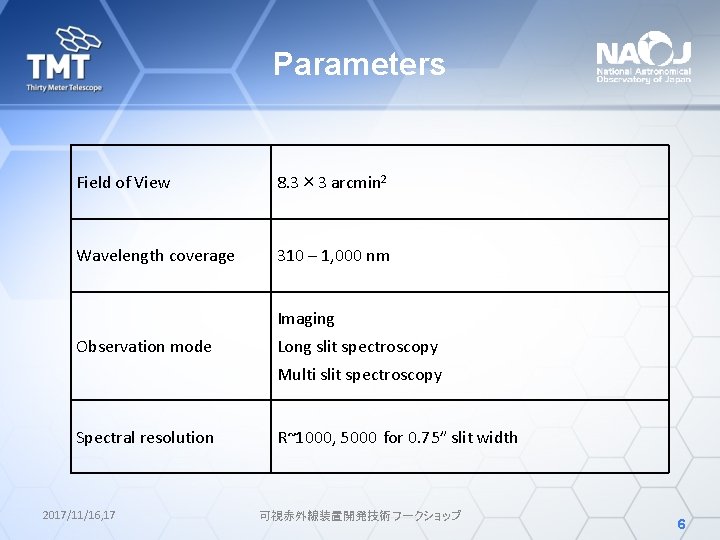
Parameters Field of View 8. 3× 3 arcmin 2 Wavelength coverage 310 – 1, 000 nm Imaging Observation mode Long slit spectroscopy Multi slit spectroscopy Spectral resolution 2017/11/16, 17 R~1000, 5000 for 0. 75” slit width 可視赤外線装置開発技術ワークショップ 6
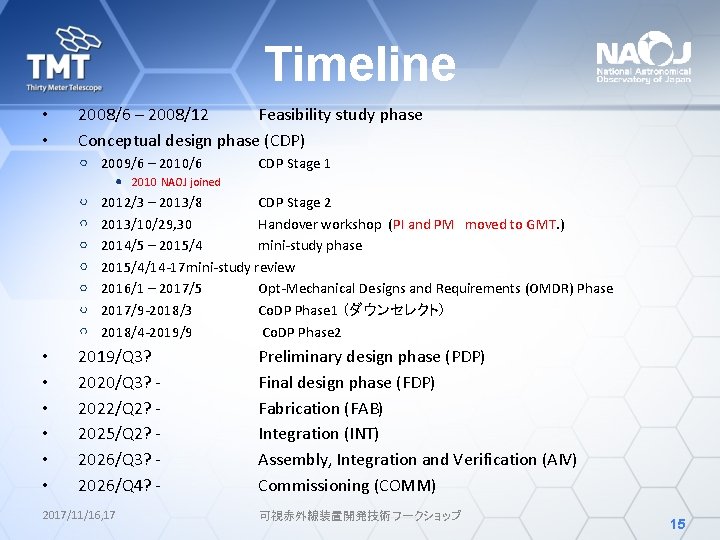
Timeline • • 2008/6 – 2008/12 Feasibility study phase Conceptual design phase (CDP) 2009/6 – 2010/6 CDP Stage 1 2010 NAOJ joined 2012/3 – 2013/8 CDP Stage 2 2013/10/29, 30 Handover workshop (PI and PM moved to GMT. ) 2014/5 – 2015/4 mini-study phase 2015/4/14 -17 mini-study review 2016/1 – 2017/5 Opt-Mechanical Designs and Requirements (OMDR) Phase 2017/9 -2018/3 Co. DP Phase 1 (ダウンセレクト) 2018/4 -2019/9 Co. DP Phase 2 • • • 2019/Q 3? 2020/Q 3? 2022/Q 2? 2025/Q 2? 2026/Q 3? 2026/Q 4? - 2017/11/16, 17 Preliminary design phase (PDP) Final design phase (FDP) Fabrication (FAB) Integration (INT) Assembly, Integration and Verification (AIV) Commissioning (COMM) 可視赤外線装置開発技術ワークショップ 15
Acknowledgments The TMT Project gratefully acknowledges the support of the TMT collaborating institutions. They are the California Institute of Technology, the University of California, the National Astronomical Observatory of Japan, the National Astronomical Observatories of China and their consortium partners, the Department of Science and Technology of India and their supported institutes, and the National Research Council of Canada. This work was supported as well by the Gordon and Betty Moore Foundation, the Canada Foundation for Innovation, the Ontario Ministry of Research and Innovation, the Natural Sciences and Engineering Research Council of Canada, the British Columbia Knowledge Development Fund, the Association of Canadian Universities for Research in Astronomy (ACURA), the Association of Universities for Research in Astronomy (AURA), the U. S. National Science Foundation, the National Institutes of Natural Sciences of Japan, and the Department of Atomic Energy of India. 16