
Wide field HAR imaging surveys in thermal infrared
- Slides: 33
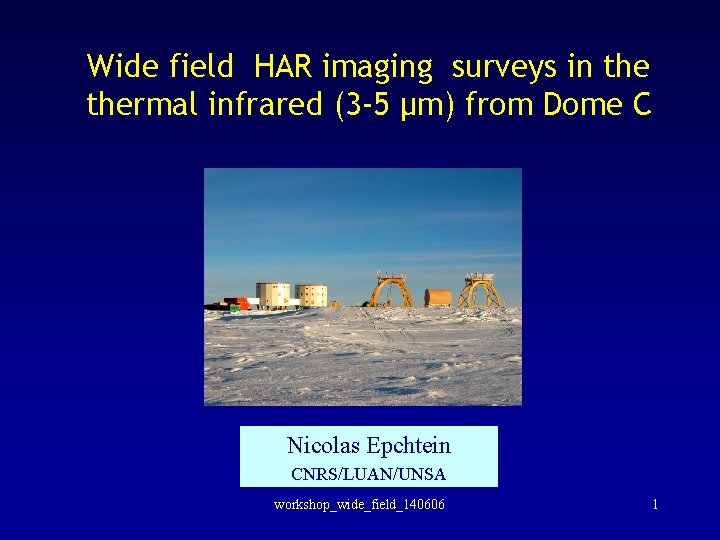
Wide field HAR imaging surveys in thermal infrared (3 -5 µm) from Dome C Nicolas Epchtein CNRS/LUAN/UNSA workshop_wide_field_140606 1
Main goals • Extend 2 MASS/DENIS and VISTA/UKDISS – Deeper – Toward longer l: K dark, L short, L’, M’(NQ) • Complete Spitzer; ASTRO-F; WISE – Better angular resolution – Remove confusion limit (Spitzer/WISE) • Imaging Surveys of selected large targets: Magellanic Clouds (global monitoring); Bulge /Disk sample (ISOGAL); Nearby Large Molecular Clouds & SFR (Cham, Carina, . . ); Deep Fields for extragalactic and cosmology/ nearby very low mass stars • Provide astrometric/photometric catalogues to JWST workshop_wide_field_140606 2
Questions • science case to extend large scale infrared sky surveys (VISTA-like) beyond 2. 3 µm (ARENA 5. 1)? • Are the future space missions ASTRO-F; WISE; JWST opportunities? • Does Dome C provide the appropriate response? • If yes, what are the top level requirements ? • What is achievable at Dome C within the next decade ? • Long range: small ELT (20 m class) dream or reality ? workshop_wide_field_140606 3
Reflections on an: «Antarctic Mid-Infrared Deep Survey Telescope» (AMIDST) workshop_wide_field_140606 4
General remark • No High Angular Resolution large scale surveys > K • K-L’ index is a simple and efficient test to select dusty objects, in general, much more efficient than IJHK colours workshop_wide_field_140606 5
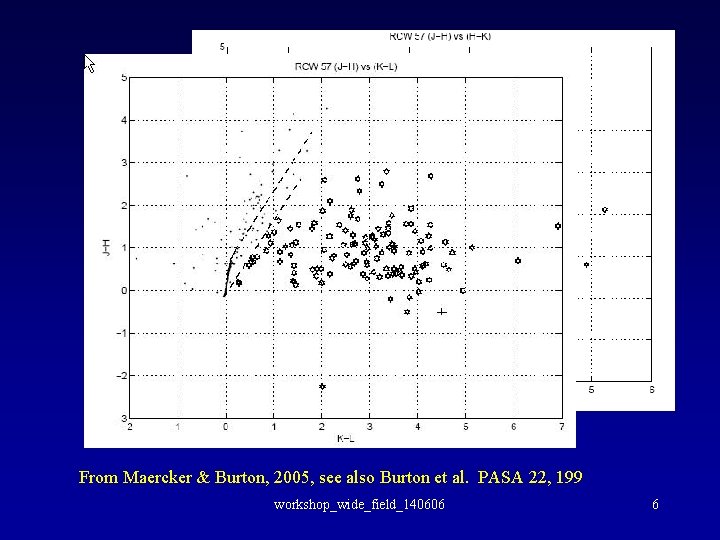
From Maercker & Burton, 2005, see also Burton et al. PASA 22, 199 workshop_wide_field_140606 6
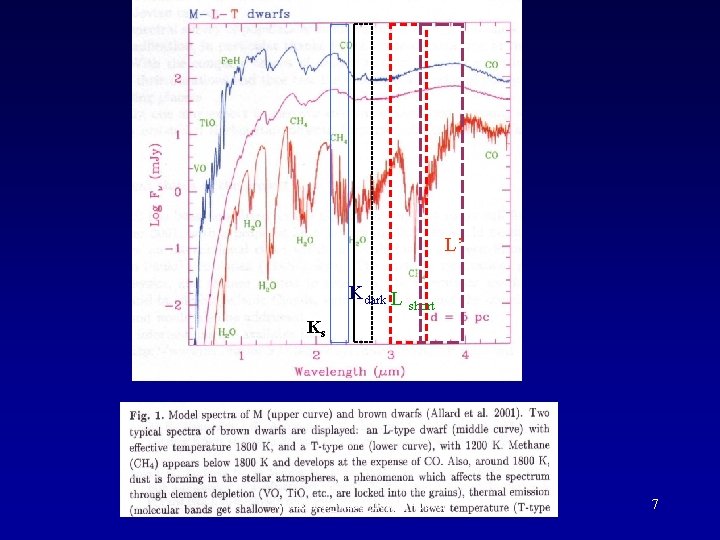
L’ Kdark L short Ks workshop_wide_field_140606 7
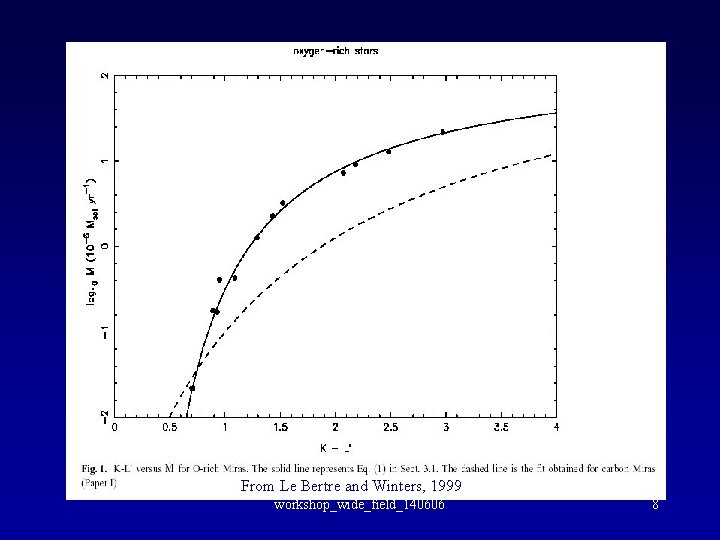
K-L index is a powerful tool to evaluate the Mass loss From Le Bertre and Winters, 1999 workshop_wide_field_140606 8
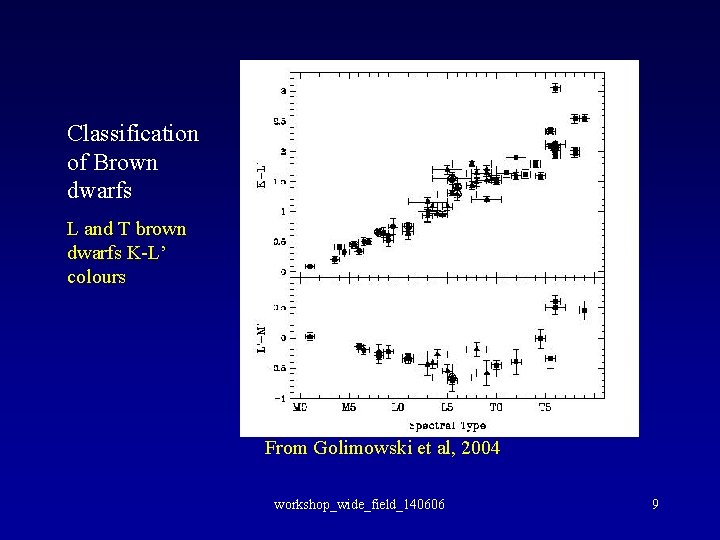
Classification of Brown dwarfs L and T brown dwarfs K-L’ colours From Golimowski et al, 2004 workshop_wide_field_140606 9
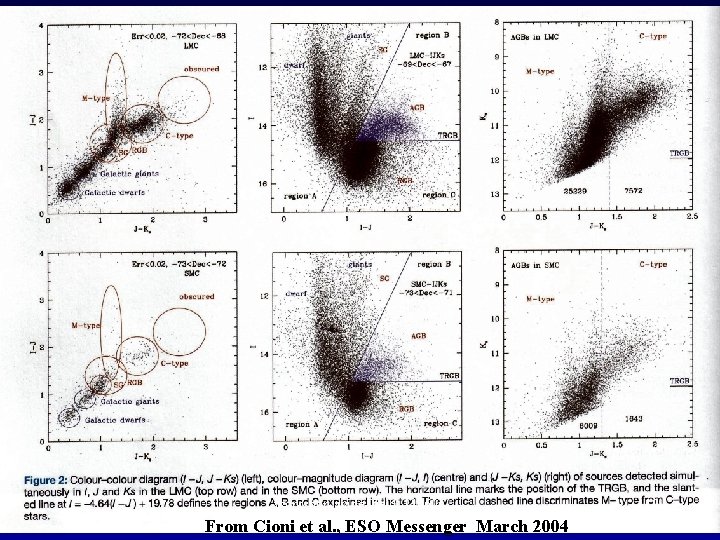
workshop_wide_field_140606 From Cioni et al. , ESO Messenger March 2004 10
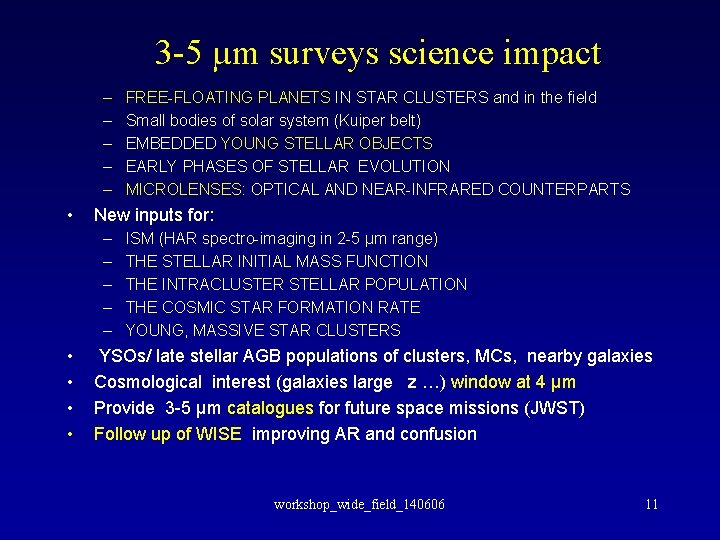
3 -5 µm surveys science impact – – – • New inputs for: – – – • • FREE-FLOATING PLANETS IN STAR CLUSTERS and in the field Small bodies of solar system (Kuiper belt) EMBEDDED YOUNG STELLAR OBJECTS EARLY PHASES OF STELLAR EVOLUTION MICROLENSES: OPTICAL AND NEAR-INFRARED COUNTERPARTS ISM (HAR spectro-imaging in 2 -5 µm range) THE STELLAR INITIAL MASS FUNCTION THE INTRACLUSTER STELLAR POPULATION THE COSMIC STAR FORMATION RATE YOUNG, MASSIVE STAR CLUSTERS YSOs/ late stellar AGB populations of clusters, MCs, nearby galaxies Cosmological interest (galaxies large z …) window at 4 µm Provide 3 -5 µm catalogues for future space missions (JWST) Follow up of WISE improving AR and confusion workshop_wide_field_140606 11
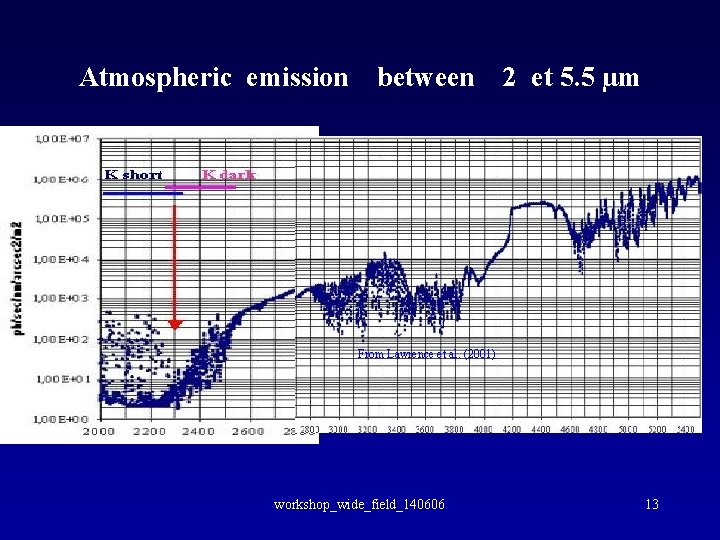
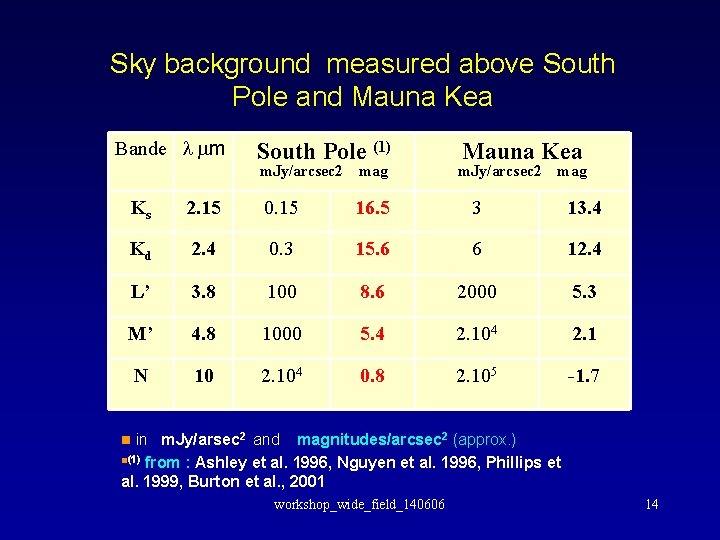
• No deep survey can be carried out from the ground beyond 2. 3 µm because of: – Sky emission brightness K=12/13 at M. Kea – Sky emission instability – Instrumental thermal emission (250 -300 K) • BUT from Polar sites workshop_wide_field_140606 12
Atmospheric emission between 2 et 5. 5 µm From Lawrence et al. (2001) workshop_wide_field_140606 13
Sky background measured above South Pole and Mauna Kea Bande l mm South Pole (1) m. Jy/arcsec 2 mag Mauna Kea m. Jy/arcsec 2 mag Ks 2. 15 0. 15 16. 5 3 13. 4 Kd 2. 4 0. 3 15. 6 6 12. 4 L’ 3. 8 100 8. 6 2000 5. 3 M’ 4. 8 1000 5. 4 2. 104 2. 1 N 10 2. 104 0. 8 2. 105 -1. 7 n in m. Jy/arsec 2 and magnitudes/arcsec 2 (approx. ) from : Ashley et al. 1996, Nguyen et al. 1996, Phillips et al. 1999, Burton et al. , 2001 n(1) workshop_wide_field_140606 14
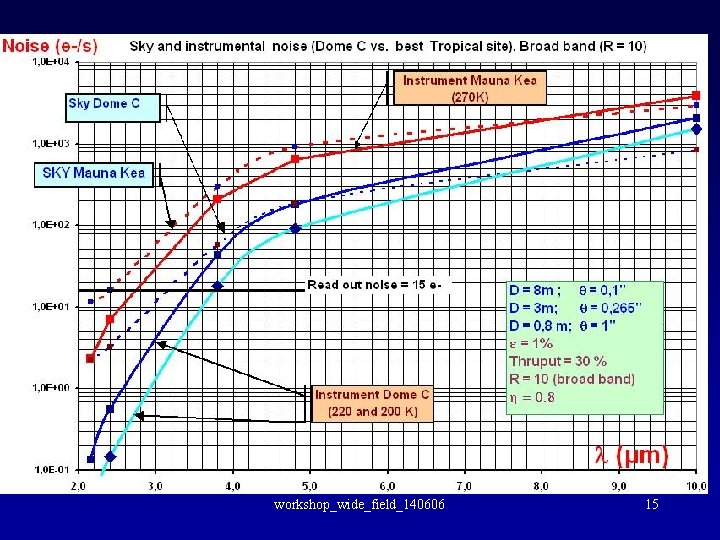
workshop_wide_field_140606 15
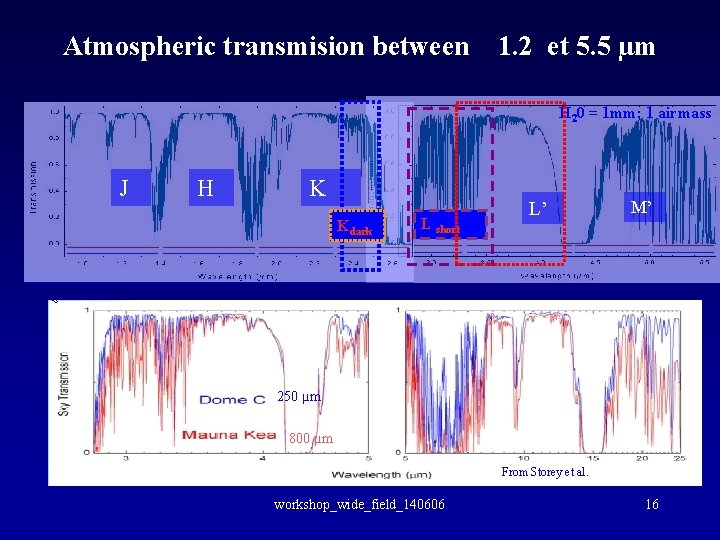
Atmospheric transmision between 1. 2 et 5. 5 µm H 20 = 1 mm; 1 airmass J H K Kdark L short L’ M’ 250 µm 800 µm From Storey et al. workshop_wide_field_140606 16
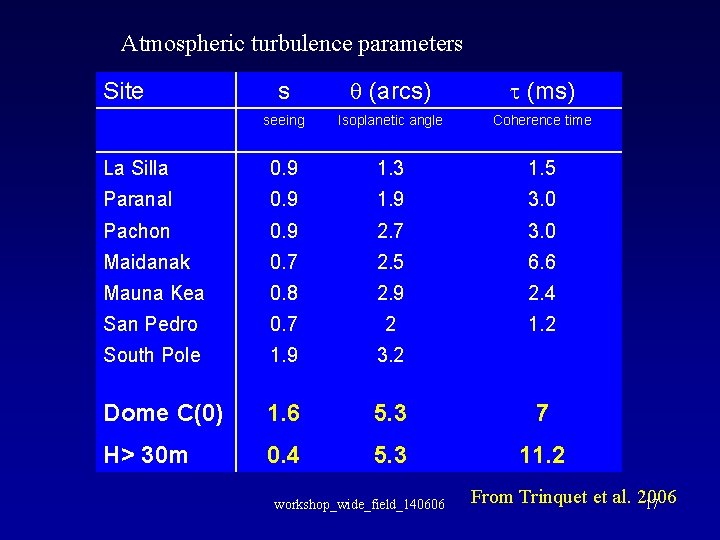
Atmospheric turbulence parameters s q (arcs) t (ms) seeing Isoplanetic angle Coherence time La Silla 0. 9 1. 3 1. 5 Paranal 0. 9 1. 9 3. 0 Pachon 0. 9 2. 7 3. 0 Maidanak 0. 7 2. 5 6. 6 Mauna Kea 0. 8 2. 9 2. 4 San Pedro 0. 7 2 1. 2 South Pole 1. 9 3. 2 Dome C(0) 1. 6 5. 3 7 H> 30 m 0. 4 5. 3 11. 2 Site workshop_wide_field_140606 From Trinquet et al. 2006 17
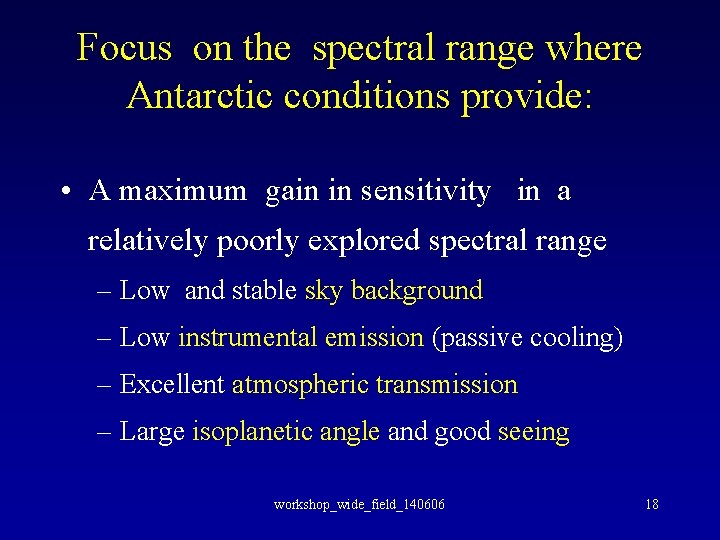
Focus on the spectral range where Antarctic conditions provide: • A maximum gain in sensitivity in a relatively poorly explored spectral range – Low and stable sky background – Low instrumental emission (passive cooling) – Excellent atmospheric transmission – Large isoplanetic angle and good seeing workshop_wide_field_140606 18
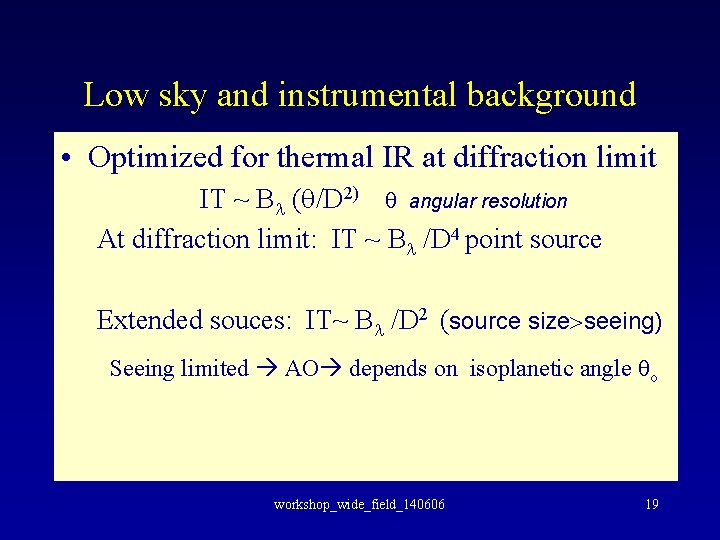
Low sky and instrumental background • Optimized for thermal IR at diffraction limit IT ~ Bl (q/D 2) q angular resolution At diffraction limit: IT ~ Bl /D 4 point source Extended souces: IT~ Bl /D 2 (source size>seeing) Seeing limited AO depends on isoplanetic angle qo workshop_wide_field_140606 19
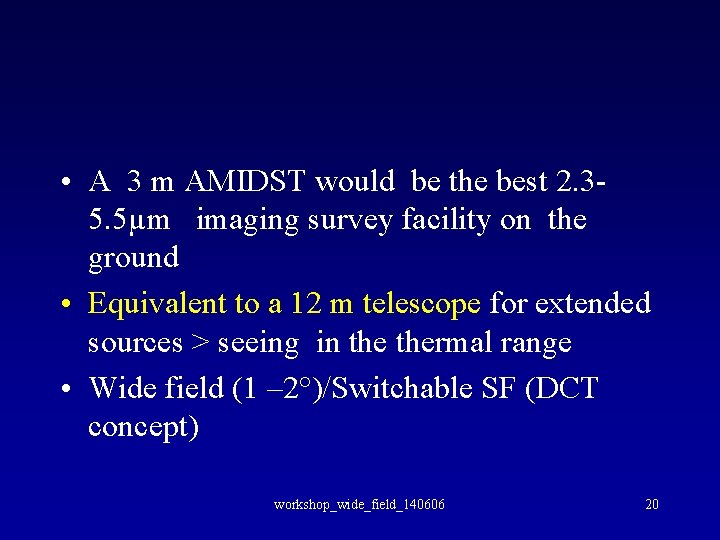
• A 3 m AMIDST would be the best 2. 35. 5µm imaging survey facility on the ground • Equivalent to a 12 m telescope for extended sources > seeing in thermal range • Wide field (1 – 2°)/Switchable SF (DCT concept) workshop_wide_field_140606 20
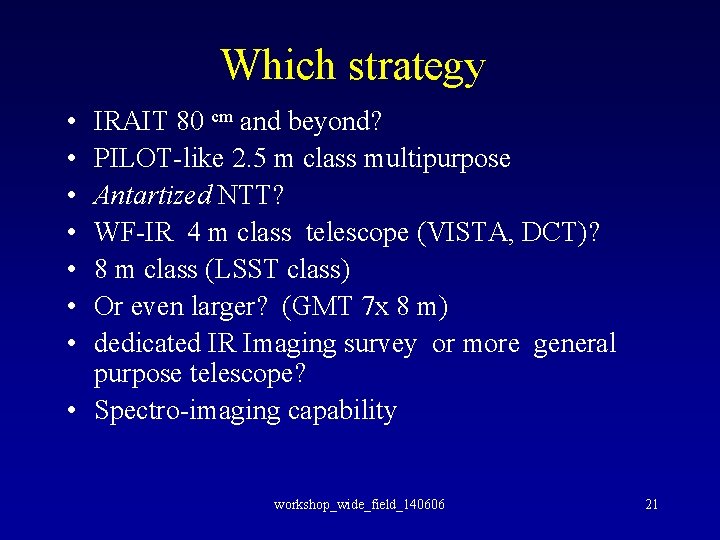
Which strategy • • IRAIT 80 cm and beyond? PILOT-like 2. 5 m class multipurpose Antartized NTT? WF-IR 4 m class telescope (VISTA, DCT)? 8 m class (LSST class) Or even larger? (GMT 7 x 8 m) dedicated IR Imaging survey or more general purpose telescope? • Spectro-imaging capability workshop_wide_field_140606 21
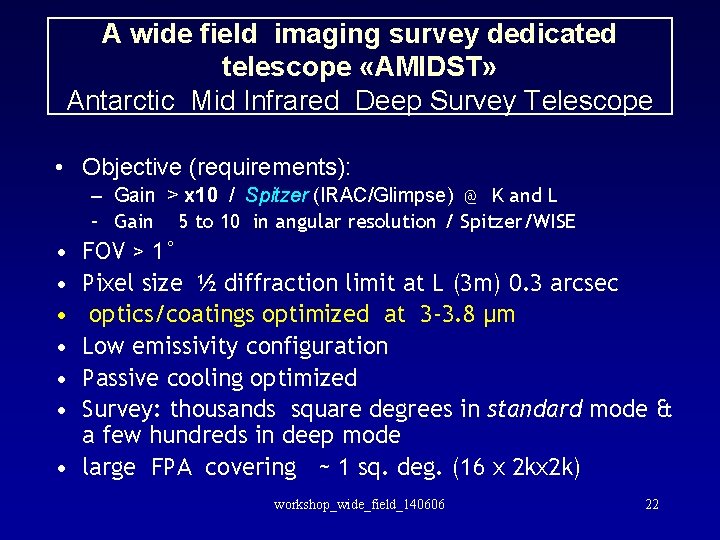
A wide field imaging survey dedicated telescope «AMIDST» Antarctic Mid Infrared Deep Survey Telescope • Objective (requirements): – Gain > x 10 / Spitzer (IRAC/Glimpse) @ K and L – Gain 5 to 10 in angular resolution / Spitzer/WISE • • • FOV > 1° Pixel size ½ diffraction limit at L (3 m) 0. 3 arcsec optics/coatings optimized at 3 -3. 8 µm Low emissivity configuration Passive cooling optimized Survey: thousands square degrees in standard mode & a few hundreds in deep mode • large FPA covering ~ 1 sq. deg. (16 x 2 k) workshop_wide_field_140606 22
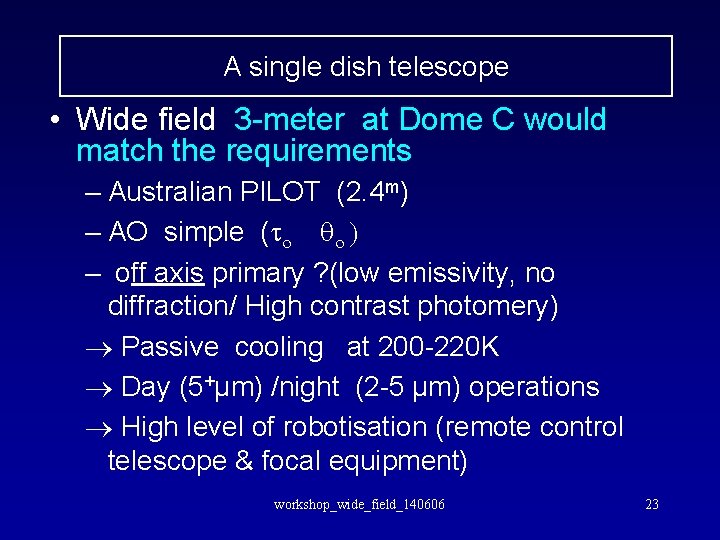
A single dish telescope • Wide field 3 -meter at Dome C would match the requirements – Australian PILOT (2. 4 m) – AO simple (to qo ) – off axis primary ? (low emissivity, no diffraction/ High contrast photomery) ® Passive cooling at 200 -220 K ® Day (5+µm) /night (2 -5 µm) operations ® High level of robotisation (remote control telescope & focal equipment) workshop_wide_field_140606 23
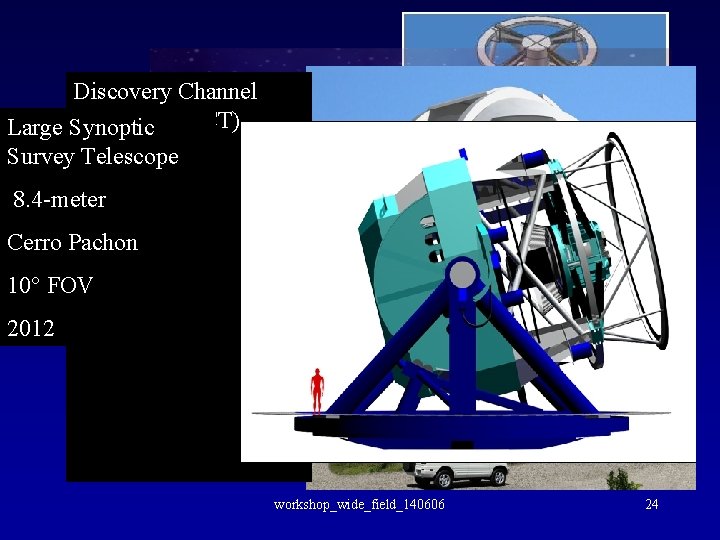
Discovery Channel Telescope (DCT) Large Synoptic Survey. Lowell Telescope 8. 4 -meter FOV 2° Cerro Pachon 4 m Flagstaff 10° FOV VISTA 2012 workshop_wide_field_140606 24
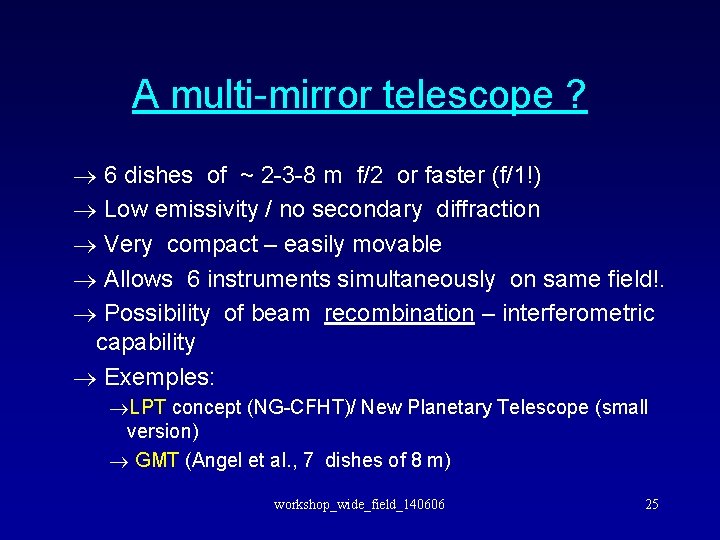
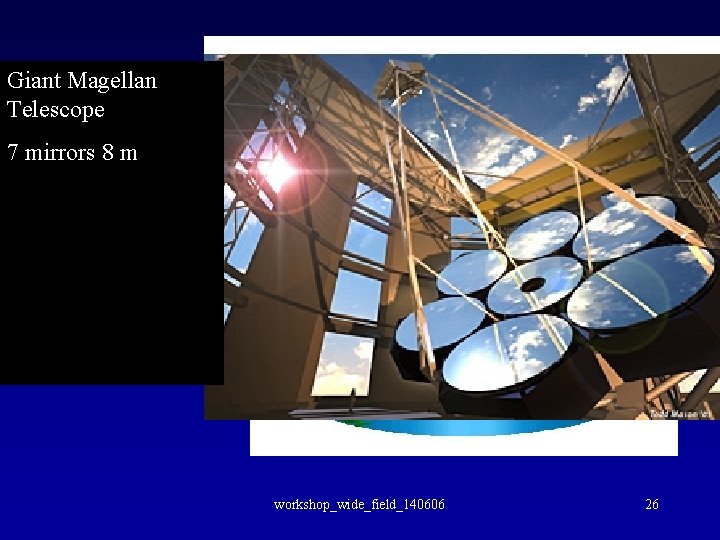
A multi-mirror telescope ? ® 6 dishes of ~ 2 -3 -8 m f/2 or faster (f/1!) ® Low emissivity / no secondary diffraction ® Very compact – easily movable ® Allows 6 instruments simultaneously on same field!. ® Possibility of beam recombination – interferometric capability ® Exemples: ®LPT concept (NG-CFHT)/ New Planetary Telescope (small version) ® GMT (Angel et al. , 7 dishes of 8 m) workshop_wide_field_140606 25
Giant Magellan High Dynamic range Telescope telescope for NGCFHT 8 m 7 mirrors • 6 x 8 meter • From Kuhn & Moretto, et al. 2001 workshop_wide_field_140606 26
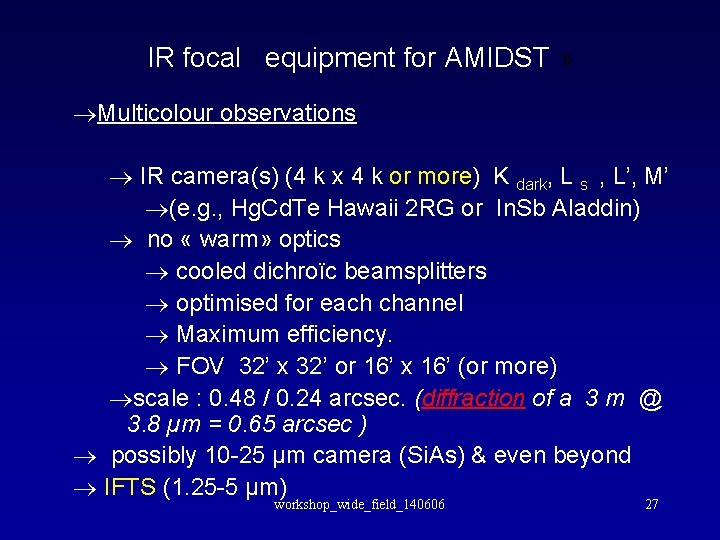
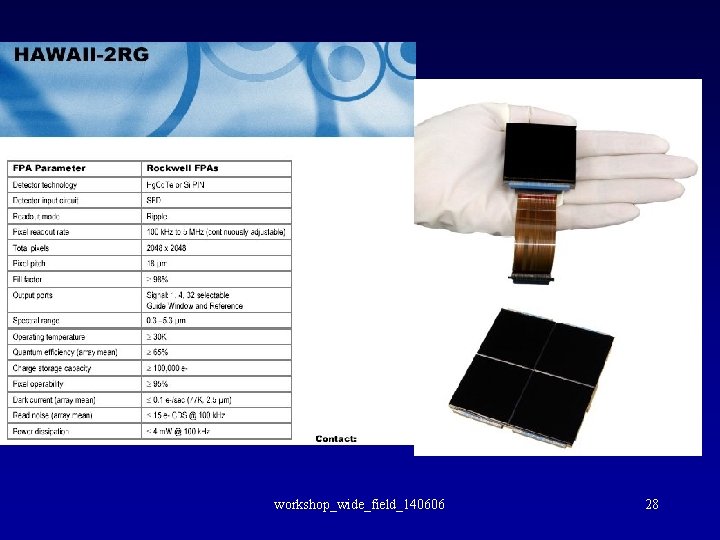
IR focal equipment for AMIDST » ®Multicolour observations ® IR camera(s) (4 k x 4 k or more) K dark, L s , L’, M’ ®(e. g. , Hg. Cd. Te Hawaii 2 RG or In. Sb Aladdin) ® no « warm» optics ® cooled dichroïc beamsplitters ® optimised for each channel ® Maximum efficiency. ® FOV 32’ x 32’ or 16’ x 16’ (or more) ®scale : 0. 48 / 0. 24 arcsec. (diffraction of a 3 m @ 3. 8 µm = 0. 65 arcsec ) ® possibly 10 -25 µm camera (Si. As) & even beyond ® IFTS (1. 25 -5 µm) workshop_wide_field_140606 27
workshop_wide_field_140606 28
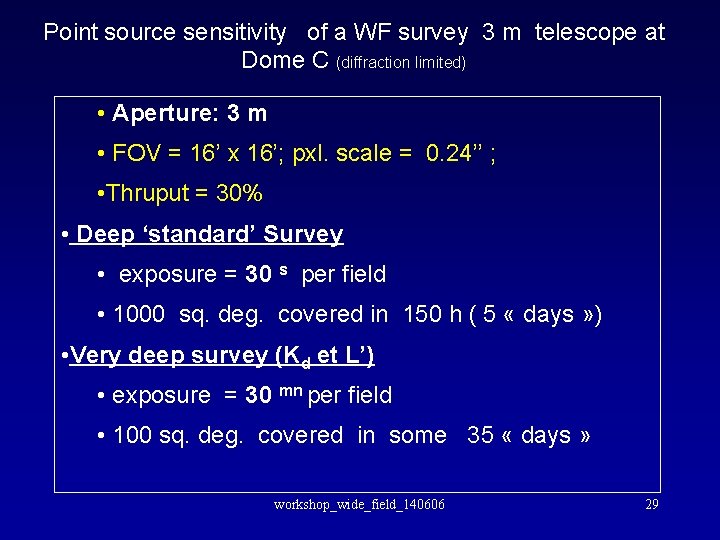
Point source sensitivity of a WF survey 3 m telescope at Dome C (diffraction limited) • Aperture: 3 m • FOV = 16’ x 16’; pxl. scale = 0. 24’’ ; • Thruput = 30% • Deep ‘standard’ Survey • exposure = 30 s per field • 1000 sq. deg. covered in 150 h ( 5 « days » ) • Very deep survey (Kd et L’) • exposure = 30 mn per field • 100 sq. deg. covered in some 35 « days » workshop_wide_field_140606 29
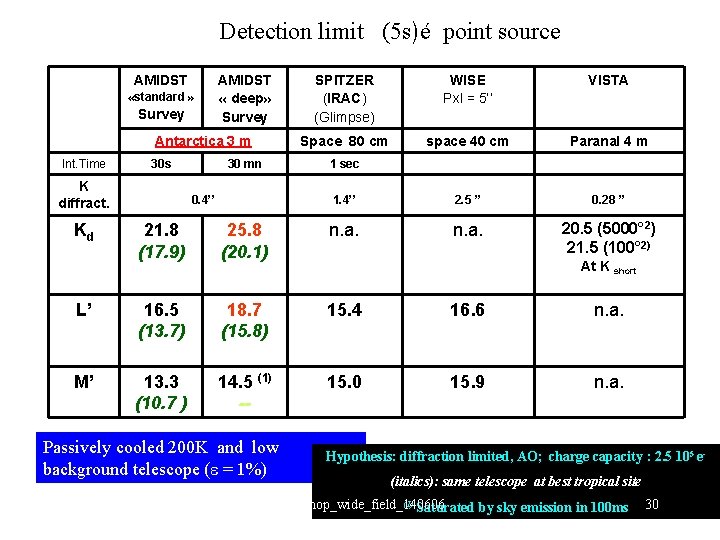
Detection limit (5 s)é point source AMIDST «standard » Survey AMIDST « deep» Survey Antarctica 3 m Int. Time 30 s K diffract. Kd 30 mn SPITZER (IRAC) (Glimpse) WISE Pxl = 5’’ VISTA Space 80 cm space 40 cm Paranal 4 m 1. 4’’ 2. 5 ’’ 0. 28 ’’ n. a. 20. 5 (5000° 2) 21. 5 (100° 2) 1 sec 0. 4’’ 21. 8 (17. 9) 25. 8 (20. 1) n. a. L’ 16. 5 (13. 7) 18. 7 (15. 8) 15. 4 16. 6 n. a. M’ 13. 3 (10. 7 ) 14. 5 (1) -- 15. 0 15. 9 n. a. At K short Passively cooled 200 K and low background telescope (e = 1%) Hypothesis: diffraction limited, AO; charge capacity : 2. 5 105 e(italics): same telescope at best tropical site (1) Saturated by sky emission in 100 ms workshop_wide_field_140606 30
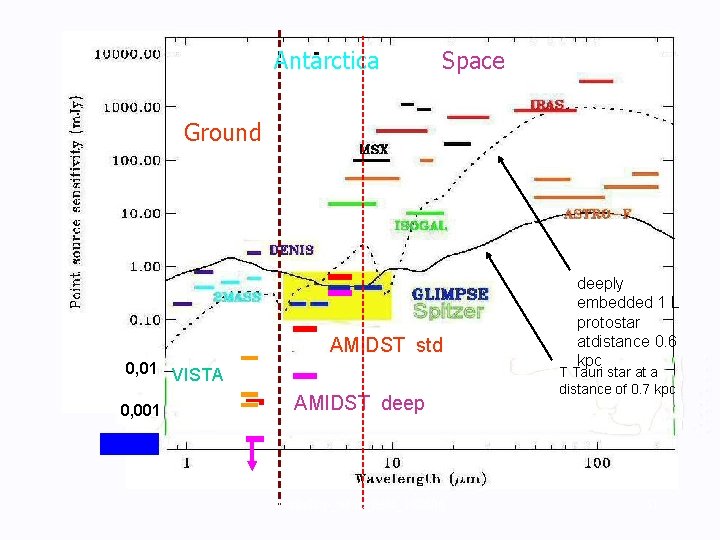
Antarctica Space Ground AMIDST std 0, 01 VISTA 0, 001 AMIDST deep workshop_wide_field_140606 deeply embedded 1 L protostar atdistance 0. 6 kpc T Tauri star at a distance of 0. 7 kpc 31
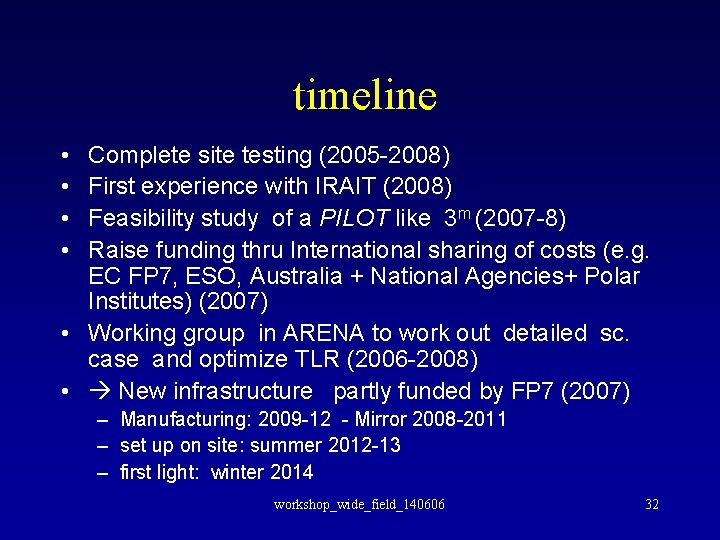
timeline • • Complete site testing (2005 -2008) First experience with IRAIT (2008) Feasibility study of a PILOT like 3 m (2007 -8) Raise funding thru International sharing of costs (e. g. EC FP 7, ESO, Australia + National Agencies+ Polar Institutes) (2007) • Working group in ARENA to work out detailed sc. case and optimize TLR (2006 -2008) • New infrastructure partly funded by FP 7 (2007) – Manufacturing: 2009 -12 - Mirror 2008 -2011 – set up on site: summer 2012 -13 – first light: winter 2014 workshop_wide_field_140606 32
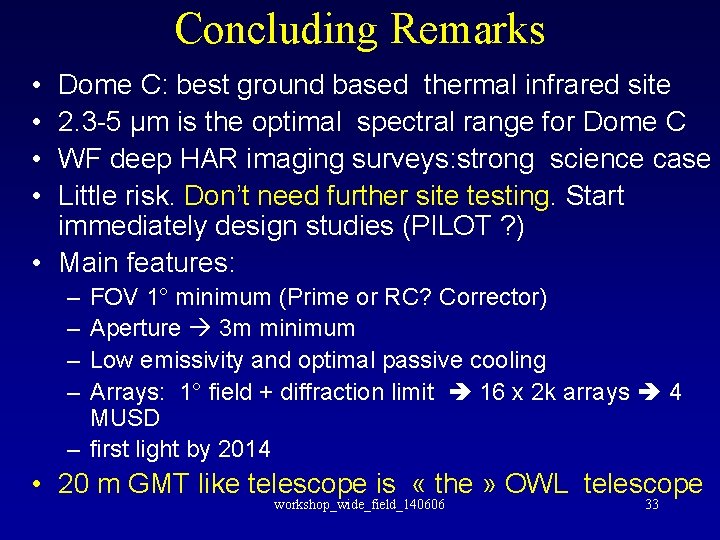
Concluding Remarks • • Dome C: best ground based thermal infrared site 2. 3 -5 µm is the optimal spectral range for Dome C WF deep HAR imaging surveys: strong science case Little risk. Don’t need further site testing. Start immediately design studies (PILOT ? ) • Main features: – – FOV 1° minimum (Prime or RC? Corrector) Aperture 3 m minimum Low emissivity and optimal passive cooling Arrays: 1° field + diffraction limit 16 x 2 k arrays 4 MUSD – first light by 2014 • 20 m GMT like telescope is « the » OWL telescope workshop_wide_field_140606 33