
WIAT II Wechsler Individual Achievement Test Second Edition
- Slides: 22
WIAT II Wechsler Individual Achievement Test Second Edition By: David Wechsler
About the WIAT II ¨ Published by The Psychological Cooperation ¨ Updated in 2001 ¨ Nationally standardized on 5, 586 individuals aged 4 through 80 years of age during the 1999 -2000 and 2000 -2001 school years (representative of 2000 census) ¨ Goal is to assess academic achievement of a student.
Overview of the WIAT-II ¨ Comprehensive ¨ Individually administered ¨ Grades Pre Kindergarten through 12 th ¨ Ages 4: 0 to adulthood ¨ 9 Subtests in 4 content areas ¨ Time: Pre-K - K Grades 1 – 6 Grades 7 – 16 45 min 90 – 120 min
At the Pre-K level: • Word Reading: id letters of the alphabet, beginning and ending sounds of words, rhyming words, read whole words. • Numerical Operations: number discrimination, writing single and double digit numbers, rote counting to 8, basic addition and subtraction • Math Reasoning: using whole numbers to describe quantities, spatial reasoning (point to tall rectangle, use grids and graphs • Written Expression: alphabet writing, word fluency. • Spelling: write their name, write individual letters, write short words. • Listening Comprehension and Oral Expression.
Reliability and Validity ¨ Reliability : Split-Half and averages at. 98. ¨ Internal Consistency is above. 85. ¨ Validity is. 80 for the total test.
WIAT-II Test Kit • Examiner’s Manual • Stimulus Booklet/Flipchart 1 (Word Reading, Numerical Operations, Reading Comprehension, Spelling, Pseudoword Decoding) • Stimulus Booklet/Flipchart 2 (math reasoning, written expression, listening comprehension, oral expression) • Word Card (for word reading subtest) • Pseudoword Card (audio cassette to assist with scoring, not to be used when administering subtest • Supplemental Manual for College Students and Adults
WIAT-II Reading Subtests q Word Reading (timing is optional) Can mark responses that exceed 3 seconds. or denote when students SC (self-correct) q Pseudoword decoding All students start at the same level. Audio tape to assist with scoring only. q Reading Comprehension Can obtain 3 different scores: reading comprehension (passages)**, target words (reading fluency and accuracy) and/or Reading Speed (automaticity)
Reading Comprehension ¨ Reverse Rule! If child scores 0 on all the grade-specific items, go back three start points and continue by following the administration rules of the new grade level. (when scoring, use the grade level you had to revert back to)
Reading Composite: Things to look for when assessing ¨ Reading speed ¨ Strategies the child used to answer comprehension questions (re-reading, pointing to answers, relying on the picture for clues, paraphrasing, emphasis on details rather than big picture) ¨ Note how word recognition influences or affects their comprehension.
WIAT-II Math Composite ¨ Numerical Operations (allow paper and pencil) ¨ Math Reasoning – Assesses: Counting, 1: 1 correspondence (8 pennies) , numerical identification and writing of numbers, calculation, fractions, decimals and algebra. Reasoning subtest assesses math reasoning via verbal and visually presented problems including interpreting graphs, identifying patterns and solving problems related to probability.
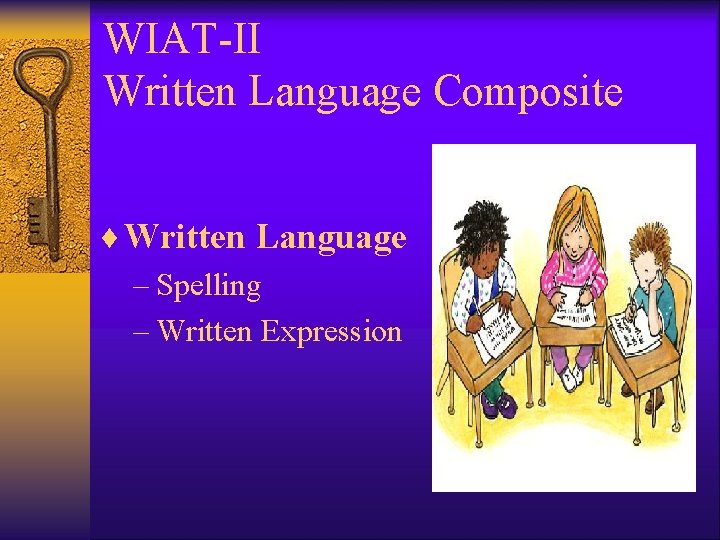
WIAT-II Written Language Composite ¨ Written Language – Spelling – Written Expression
Spelling Subtest: §Reversed letters are not considered errors unless it constitutes a unique letter (b/d) §Legibility – can ask student to spell orally once written, if the student spells the word correctly, can give credit. §Capital for lowercase if OK on this subtest §Apostrophes are important (OK if written backwards)
Spelling Subtest cont. Misspellings in which letters are omitted, invented spellings, reversals of letters or letter-order reversals and other errors can be very revealing of weaknesses in word analysis and word-reading skills. Watch and note.
Written Expression Subtest ¨ Alphabet Writing ¨ Word Fluency ¨ Sentences – generation and combination ¨ Paragraph/Persuasive Essay
Alphabet Writing ¨ May need to show the examiner what you mean by lowercase letters, by showing them the sample “a”. You may substitute another term they may be more use to. ¨ In directions, make sure to emphasize that they need to write their letters as quickly and carefully as they can. ¨ If actively engaged in writing the alphabet, can note what letter they are on at 15 seconds and let them finish. “testing the limits”
Written Expression: Word Fluency ¨ Record number of acceptable responses (review with child so you know what they wrote!) ¨ Different item, same category OK (eg. Football, basketball, baseball) ¨ Different descriptions of same object not OK (red ball, big ball, etc. ) ¨ Points assigned based on single or multiple syllables. ¨ Do not give credit for “pizza”
Written Expression: Sentences and Paragraph or Essay ¨ No spelling devices allowed. Our prompt is “spell the word the best you can” ¨ You are allowed to read unfamiliar words in the examiner’s booklet to student. ¨ Paragraph/Essay: can use prompt A or B. ¨ Encourage student to use 5 to 10 good sentence OR 3 supporting arguments for their position.
Written Expression: Interpretation u. The Paragraph (given to Grades 3 -6) can be evaluated analytically using a rubric scoring system based on organization, vocabulary, and writing mechanics (spelling and punctuation). u. The Essay (given to Grades 7 -16) can be evaluated analytically using a rubric scoring system based on organization, vocabulary, theme development and writing mechanics. u. Both the Paragraph and the Essay can be scored holistically, but analytic scoring is required for a subtest standard score. u. Word count is a Supplemental score.
Most frequently occurring Errors ¨ Reading Comprehension Subtest Strongly encourage the use of the “Total Raw Score Conversion Worksheet” on back page of protocol. ¨ Only administer one “set” on Reading comprehension. If have to reverse, use “new” set and “new” grade level for scoring purposes.
Common scoring errors: ¨ Written Expression Subtest ¨ Converting the Word Fluency, Spelling Errors and Punctuation Errors scores to Quartile Scores. Tables for conversion listed on scoring protocol. ¨ Use Appendix A in WIAT-II Examiner’s Manual for samples (pg. 64)
Completed Assessment ¨ Add up raw scores ¨ Double check chronological age ¨ Look up AGE-BASED standard scores and percentile ranks ¨ Develop Confidence Intervals ¨ Fill out rest of front of protocol ¨ Write up report re: strengths and weaknesses
In Conclusion In conclusion the WIAT II appears to be an effective tool for measuring individual achievement. We feel that the test is user friendly, provided the proper training has occurred. The test also seems to be unbiased and appropriate for the testee.